Tag:

Nepal

Flowers of Nepal — 1313 wild plant species documented from the Nepalese Himalaya, from subtropical foothills to high alpine meadows above 4,000 m. Nepal’s dramatic elevation gradient makes it one of the richest botanical regions on Earth, home to rhododendrons, primulas, gentians and the famed blue poppies (Meconopsis). Every entry gives a botanical description, native distribution, habitat and flowering season, alongside the original field photograph and the location where it was taken.

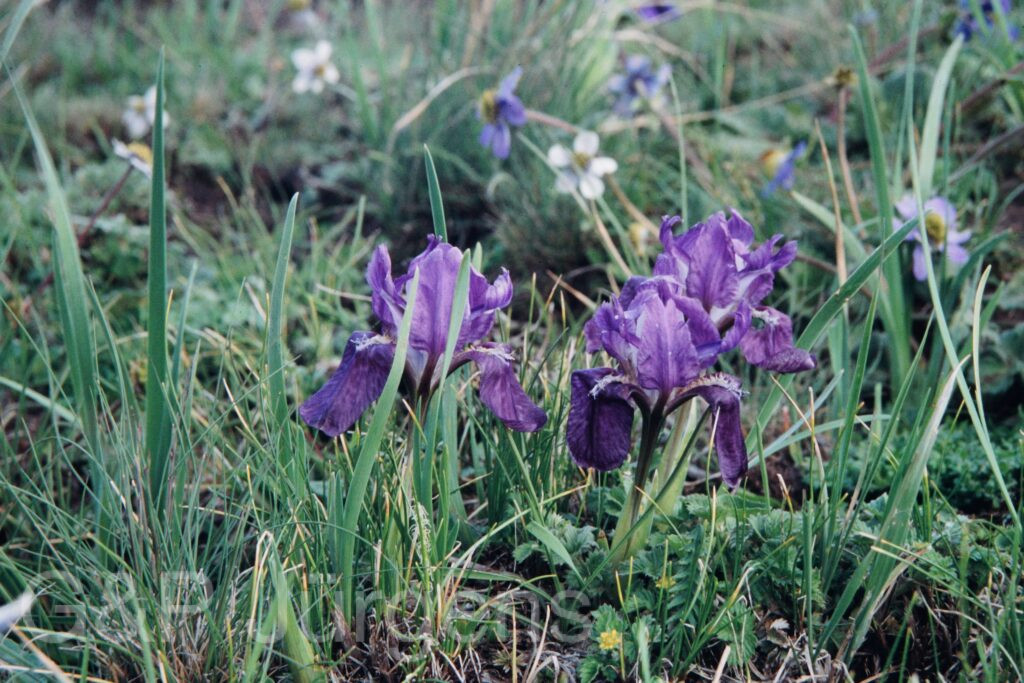
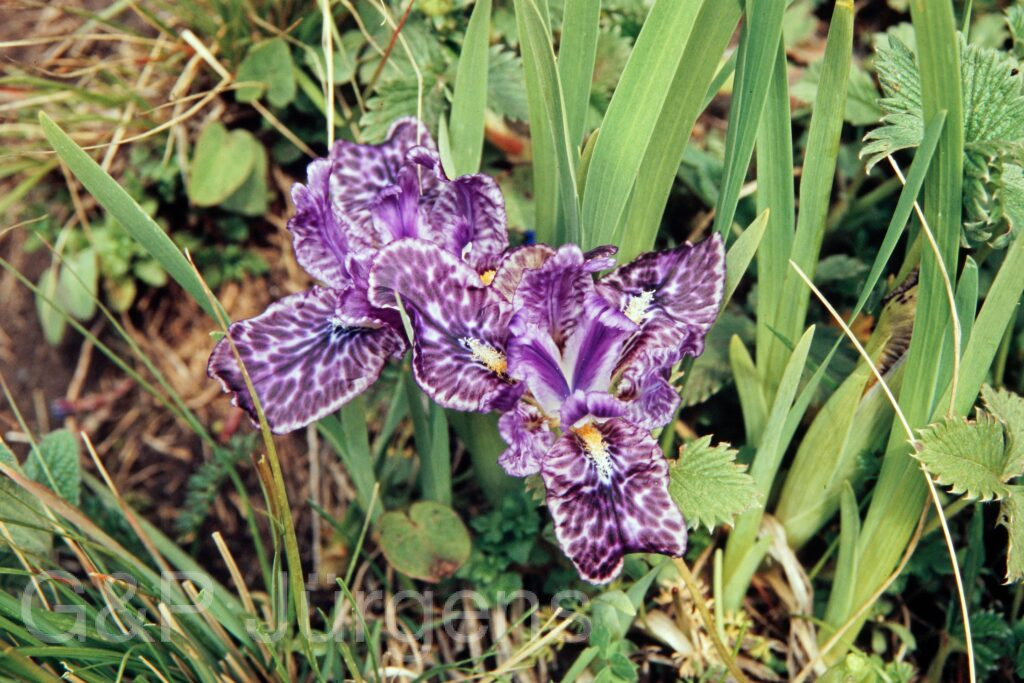
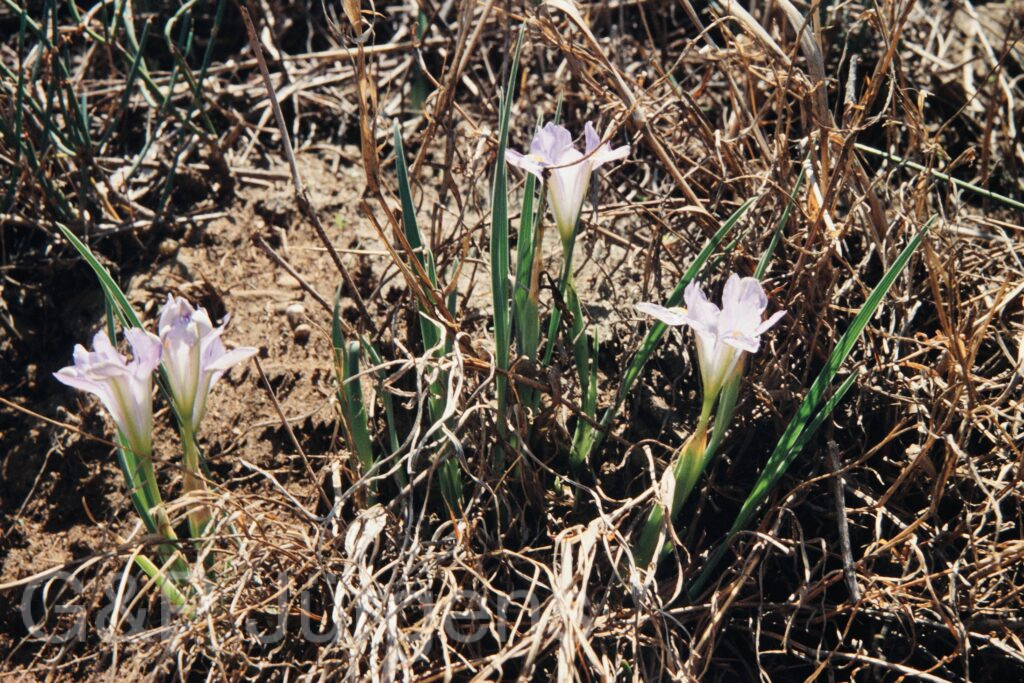
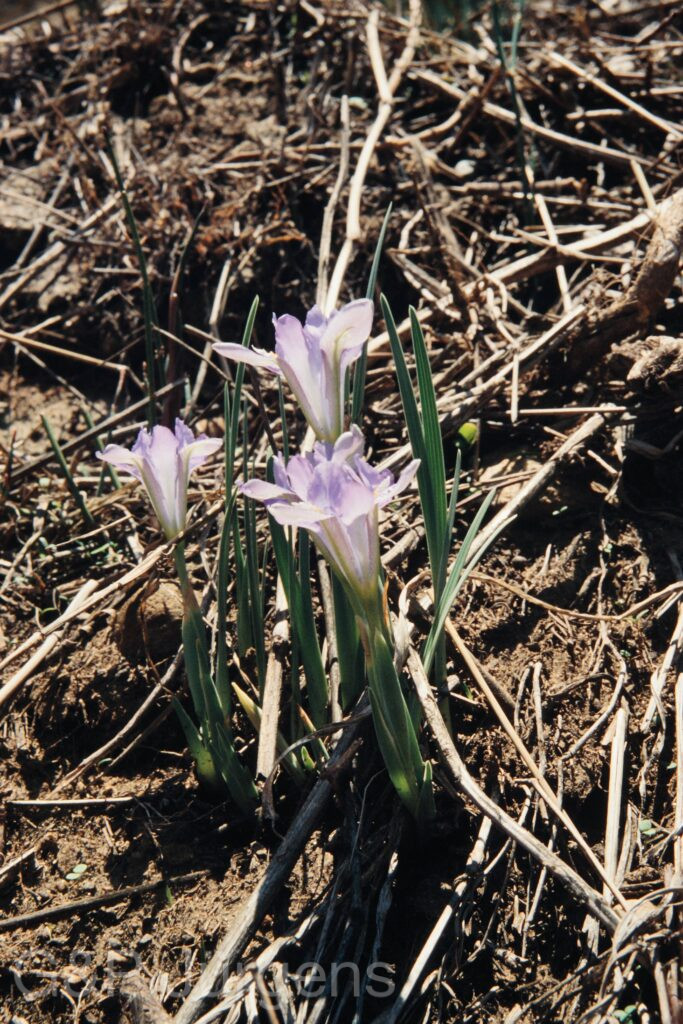
Iris decora

by G & P Jürgens

Wall.

Nepal 99 13 ergebnis
West-Nepal, Jumla 2500m june
Nepal 99 14 ergebnis
West-Nepal, Jumla 2500m june

Description

Iris decora Wall. is a tuberous-rooted iris of the Himalaya and the mountains of southwestern China. GBIF data confirm its presence in Nepal, India, Bhutan, Pakistan, China and Myanmar, a range extending the length of the Himalayan arc into Yunnan. It grows on open grassy hillsides, stony slopes and among scrub in the temperate zone, characteristically between about 1,800 and 3,300 m. The plant recorded near Jumla in west Nepal at 2,500 m, flowering in June, typifies its early-summer flowering on sunny montane meadows.

The species arises from a cluster of slender, fleshy, fascicled roots rather than a true rhizome, and produces narrow, grass-like, ribbed leaves that develop fully after flowering. The flowering stem is short, bearing one to several flowers in succession, each subtended by membranous spathe valves. The flowers are lilac to pale violet-blue, the falls bearing a conspicuous yellow or white crest along the central ridge and the standards smaller and erect. The capsule is oblong-cylindric with a beaked apex, splitting to release numerous seeds.

Iris decora belongs to the subgenus Nepalensis (section Pseudoregelia in older treatments), a small group of Sino-Himalayan irises characterised by fascicled fleshy roots and crested falls. It is grown by alpine-plant enthusiasts and is the type of its species group. Although locally common in suitable grassland, it is vulnerable to overgrazing and habitat conversion in the more accessible parts of its range.

Author: Wall. · Sources: POWO (Kew), GBIF, Flora of China Vol. 24, Flora of Bhutan Vol. 3, Mathew: The Iris (1989)
Noltie

Bh09 30 G56
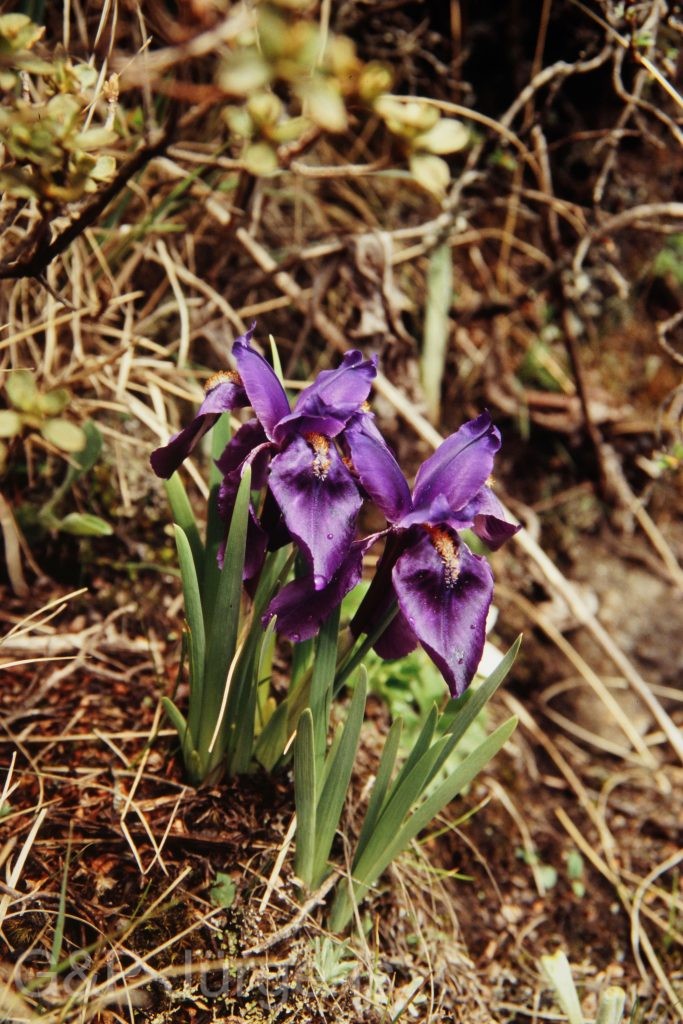
Bhutan Shele-La 4000m, June
Bh09 31 P57
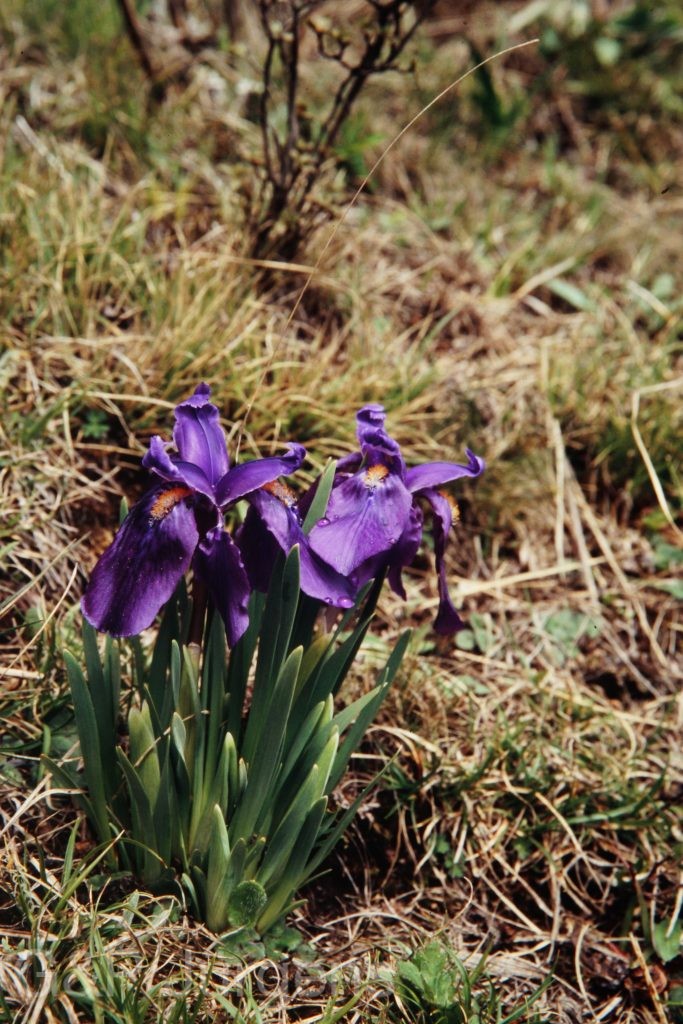
Bhutan Shele-La 4000m, June

Description

Iris dolichosiphon is a high-alpine dwarf iris restricted to the eastern Himalaya and adjacent China, a narrow-range endemic recorded by GBIF from only China, Bhutan and India, with a small total of around 77 occurrences reflecting both its limited distribution and the remoteness of its habitat. It grows in open alpine turf, meadows, grassy slopes and rocky pastures above the treeline, generally between about 3500 and 4500 m, where snow-melt and short cool summers govern its brief flowering season. The photographed plant from the Shele La in Bhutan, at roughly 4000 m and flowering in June, is exactly typical of its occurrence on exposed high passes, where it forms low cushions among short alpine vegetation soon after the snow recedes.

It is a small, tufted perennial of the dwarf-crested and beardless Himalayan iris assemblage, arising from a slender, fibrous-coated rhizome and producing narrow, linear, grass-like leaves. The flowers are nearly sessile at ground level but are raised, in effect, by an extremely long, slender perianth tube, the character that gives the species its epithet (dolichos, long; siphon, tube), so that the floral parts are presented well above the very short stem. The flowers are violet to lilac-blue, the three outer tepals (falls) spreading and signalled with a paler, veined and crested or ridged blaze, the three inner tepals (standards) smaller and erect; the three petaloid style branches arch over the stamens.

Described by H. J. Noltie, who clarified much of the Sino-Himalayan iris flora, I. dolichosiphon belongs to the alpine, beardless dwarf irises and is allied to species such as I. kemaonensis and the I. goniocarpa group, from which the conspicuously elongate perianth tube distinguishes it. Its pollination by long-tongued bumblebees is favoured by the deep tube, and seed is set in a capsule that ripens as the brief alpine season closes. As a narrowly distributed high-altitude endemic with few records, it warrants monitoring; while not formally assessed as threatened, its restricted range and sensitivity to climate-driven shifts in the alpine zone make it of biogeographic and conservation interest.

Author: Noltie · Sources: POWO (Kew), GBIF, Flora of China Vol. 24, Flora of Bhutan Vol. 3, Flora of Nepal, Flora of Pakistan, Noltie's account of the Sino-Himalayan irises

Iris kemaonensis

by GP Jürgens

Wall. ex D.Don

Nepal 99 299 ergebnis
West-Nepal Kalmura 4200m, June
Nepal 99 298 ergebnis
West-Nepal Kalmura 4200m, June
Garh 07 172 ergebnis
India Garhwal Kinkhola 3545m, June

Description

Iris kemaonensis is a dwarf alpine iris of the Himalaya and adjacent ranges, distributed across Pakistan, Nepal, NW India, Bhutan and SW China, with 346 GBIF occurrences. It grows on open alpine meadows, grassy slopes, stony pastures and recently snow-freed ground in the upper subalpine to alpine zone. The cited collections from Kalmura in West Nepal at about 4,200 m and Kinkhola in Garhwal at 3,545 m, both in June, are characteristic of its early-summer flowering as snow melts on high turf, where it forms low scattered clumps.

It is a rhizomatous perennial with a short, stout, branching rhizome bearing fibrous remains of old leaves. The leaves are linear-ensiform, appearing with or shortly after the flowers and elongating considerably as the fruit ripens. The flowers are usually solitary and almost sessile at ground level, lilac to pale purple, mottled and spotted with deeper purple; the falls are obovate with a yellow or white beard along the median crest, the standards smaller and erect. The perianth tube is long and slender, raising the flower above the spathes. The fruit is a trigonous capsule, often borne on an elongating stalk emerging after anthesis.

The species belongs to Iris subgen. Pseudoregelia, the bearded, mottled-flowered, rhizomatous group centred on the Himalaya and Central Asia. GBIF records it as accepted. It is a charismatic, ground-hugging alpine bearing close ecological resemblance to other cushion-meadow geophytes, and remains widespread and unthreatened, though locally subject to grazing pressure.

Author: Wall. ex D.Don · Sources: POWO (Kew), Flora of China Vol. 24, Flora of Bhutan Vol. 3, GBIF, Mathew: The Iris (1989)
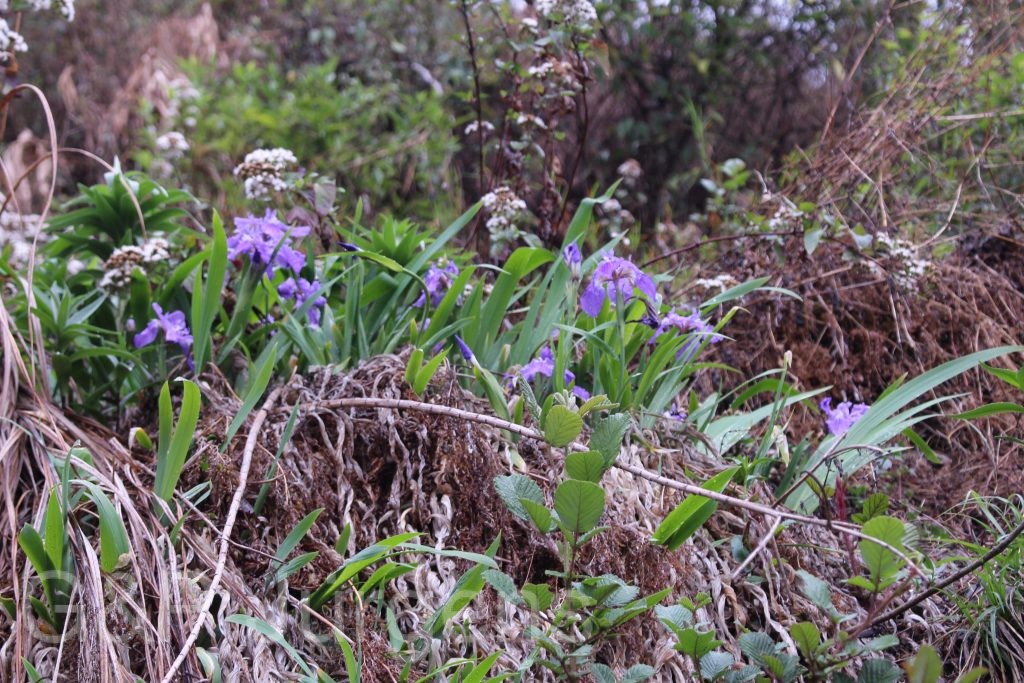
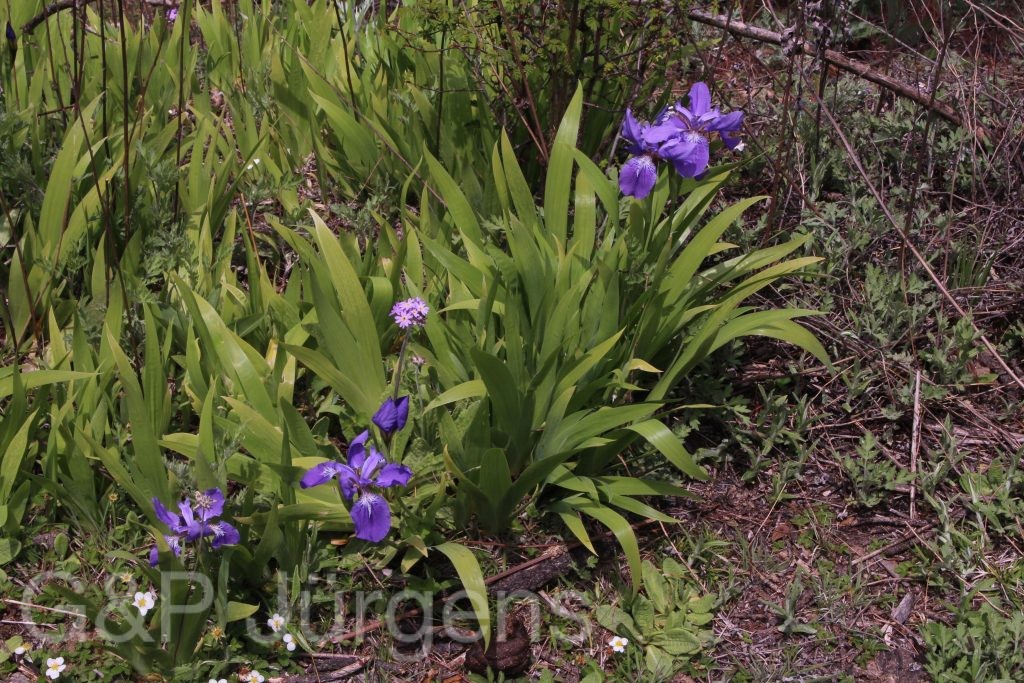
Iris tectorum

by G & P Jürgens

Maxim.

Bhutan2014 42
Bhutan Trashigang 1200m, May
Bhutan2014 974
Bhutan Chele-La 3400m, May
Bhutan2014 975
Bhutan Chele-La 3400m, May

Description

Iris tectorum, the roof iris or wall iris, is native to China and long cultivated across East Asia, with naturalised and planted populations widely recorded; GBIF documents 1128 occurrences in China, Japan, Korea, the United States, India, Bhutan, Myanmar, Taiwan, Kazakhstan and parts of Europe. It grows on dry banks, grassy slopes, rocky ground and, famously, on thatched roofs and old walls where it was traditionally established. In Bhutan the illustrated plants span a wide range, from Trashigang at about 1200 m to Chele-La at 3400 m, both flowering in May, showing its tolerance of both warm valley and high-pass conditions.

The plant is a rhizomatous perennial with a stout, shortly creeping rhizome bearing tufts of broadly ensiform, soft, ribbed leaves arranged in flat fans. The flowering stem is branched and bears several large flowers; each has the iris structure of three spreading, reflexed outer perianth segments (falls) and three smaller erect inner segments (standards). The falls are pale lilac-blue, conspicuously veined and mottled with darker blue, and bear a fringed or crested white-and-violet ridge in place of a beard, identifying it as a crested (Evansia) iris. The three petaloid style branches arch over the stamens; the inferior ovary matures into an oblong, ridged loculicidal capsule releasing rounded seeds.

Assigned to subgenus Limniris and the crested-iris alliance, I. tectorum is a long-standing ornamental and the source material for traditional medicinal use of its rhizome. POWO and GBIF accept the name. Its frequent cultivation accounts for the scattered extralimital records far beyond its East Asian native range.

Author: Maxim. · Sources: POWO (Kew), GBIF, Flora of China, Flora of Bhutan, The Iris (Iridaceae monograph), Annotated Checklist of the Flowering Plants of Nepal

(Buch.-Ham. ex D.Don) H.Hara

Bhutan2015 586
Bhutan Mo-Chu 1800m, October
Bhutan2015 587
Bhutan Mo-Chu 1800m, October

Description

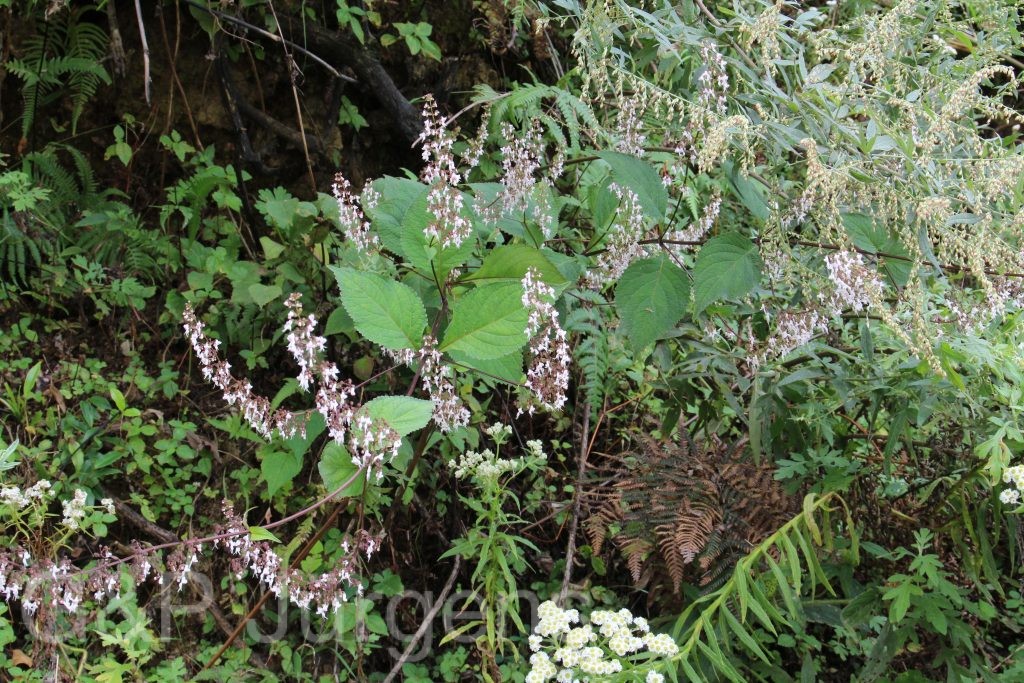
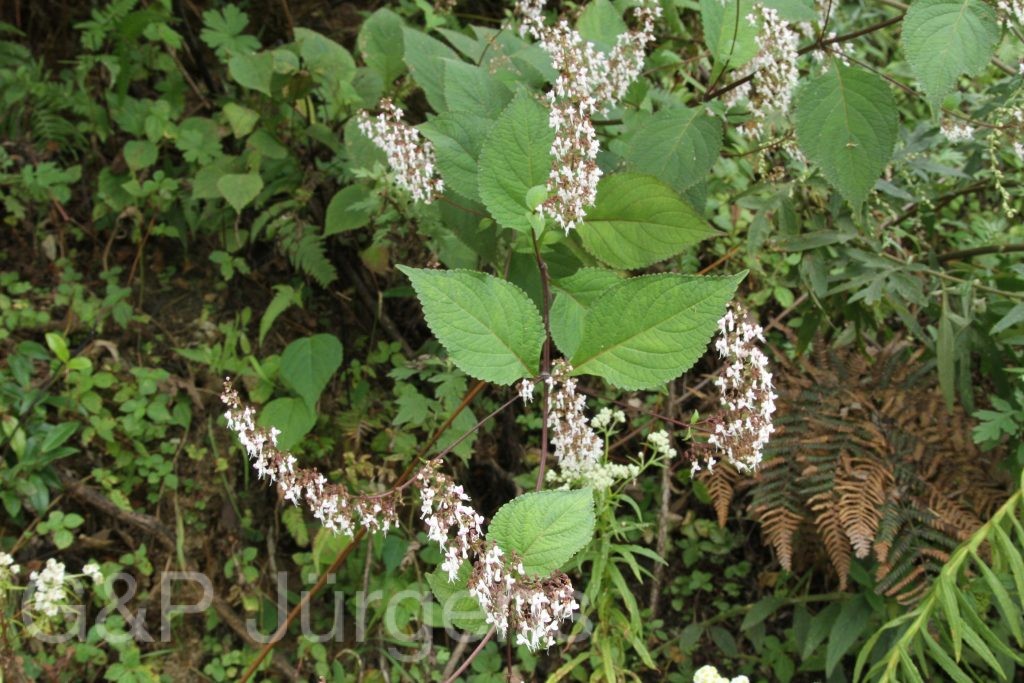
Isodon lophanthoides is a widespread herb of the Sino-Himalayan region, recorded from China, the Indian Himalaya, Nepal, Bhutan, Pakistan, Myanmar, Thailand, Laos, Vietnam, Bangladesh, Malaysia and Hong Kong, and represented by nearly two thousand georeferenced collections. It occupies a broad subtropical to warm-temperate belt, growing on moist shaded banks, forest margins, streamsides, grassy slopes and disturbed ground. In Bhutan it descends to warm river valleys, as along the Mo-Chu at about 1800 m where it was photographed flowering in October, the late-season anthesis typical of the genus.

The plant is an erect to ascending annual or short-lived perennial herb with quadrangular, often purple-tinged and pubescent or glandular stems. The leaves are opposite, ovate to broadly ovate, crenate-serrate, acuminate, and narrowed at the base into a winged petiole, often gland-dotted beneath. The inflorescence is a lax, much-branched terminal panicle of small cymes. The flowers have a bilabiate, glandular calyx that enlarges in fruit, and a small two-lipped corolla that is white to pale pink or purplish, dotted with darker spots, with a flat lower lip and four declinate didynamous stamens. The fruit consists of four smooth ovoid nutlets (mericarps).

Isodon (formerly included in a broad Rabdosia and Plectranthus) belongs to subfamily Nepetoideae of Lamiaceae; this species was described as Plectranthus lophanthoides by Buchanan-Hamilton and transferred by Hara. Several intraspecific varieties have been recognised across its range. Rich in bioactive ent-kaurane diterpenoids, it is used in Chinese herbal medicine, and its broad ecological tolerance and frequency mean it is not of conservation concern.

Author: (Buch.-Ham. ex D.Don) H.Hara · Sources: POWO (Kew), GBIF, Flora of China, Flora of Bhutan, Flora of Pakistan, taxonomic revisions of Isodon (Lamiaceae) by H. W. Li

(Wall.) Murata

Bhutan2012 352
Bhutan Wangdi 2200m, October

Description

An erect perennial mint of the Himalaya and adjacent mountains, recorded from Nepal, China, India, Bhutan and Myanmar, with about 180 GBIF occurrences. It grows on open slopes, scrub margins, forest edges, roadbanks and disturbed clearings in the warm-temperate and subtropical zones, generally between about 1500 and 2800 m, flowering into the autumn. The illustrated plant was photographed in October at Wangdi in Bhutan at around 2200 m, a sunny mid-elevation montane site typical of its late-season flowering.

The species is a tall, branching herb or subshrub with the characteristic quadrangular stems of the mint family, often finely pubescent. The leaves are opposite and decussate, ovate to ovate-lanceolate, acuminate, with serrate margins and a glandular-punctate, aromatic surface, borne on distinct petioles. The inflorescence is a lax, much-branched terminal panicle of small cymes. Each flower has a campanulate, two-lipped calyx and a small bilabiate corolla, pale lilac to whitish or bluish, with a short tube, a four-lobed upper portion and a larger boat-shaped lower lip enclosing the four declinate stamens. The fruit comprises four small, smooth, ovoid nutlets seated in the persistent calyx.

Accepted by POWO and GBIF, I. scrophularioides belongs to the genus Isodon (formerly within Rabdosia and Plectranthus), a group of mints rich in bioactive diterpenoids and of interest in traditional medicine and phytochemistry. The deflexed lower lip forms a landing platform for bee pollinators, and the dry nutlets are dispersed by gravity and disturbance. Adaptable and frequent in secondary habitats across its range, it is of no conservation concern and exemplifies the largely Asian, montane radiation of the genus.

Author: (Wall.) Murata · Sources: POWO (Kew), GBIF, Flora of China, Flora of Bhutan, Li revision of Isodon

(D.Don) Kudô

Bhutan2015 461
Bhutan Trongtsa 2100m, October

Description

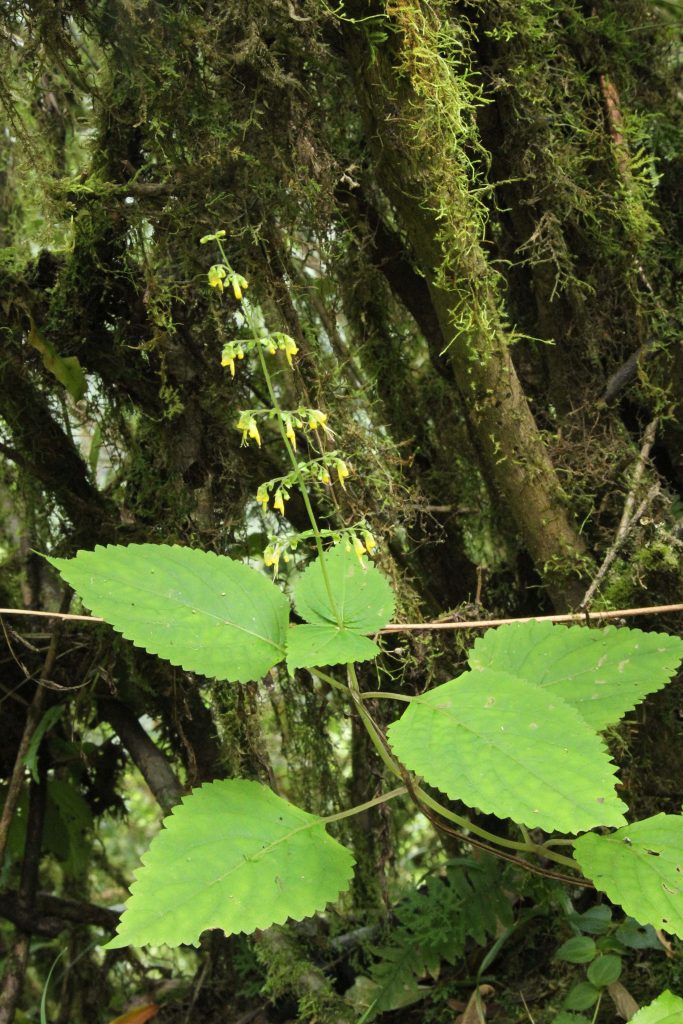
Isodon ternifolius is a shrubby mint distributed across the eastern Himalaya and Southeast Asia, recorded by GBIF (477 occurrences) from China, India, Thailand, Nepal, Myanmar, Vietnam, Bhutan, Bangladesh and Laos. It occupies forest margins, thickets, open hillsides, roadsides and disturbed slopes, mostly at lower to mid montane elevations between roughly 500 and 2500 m. The plant photographed at Trongsa in central Bhutan at 2100 m in October illustrates its autumn flowering, when the airy inflorescences come into bloom along forested valley margins toward the upper end of its altitudinal range.

The species is an erect perennial herb or soft shrub with quadrangular, often densely pubescent stems. As suggested by the epithet, the leaves are frequently borne in whorls of three (ternate), in addition to the opposite arrangement typical of the family; they are ovate to lanceolate, crenate-serrate and shortly petiolate, with a velvety to tomentose indumentum. The flowers are small and arranged in many-flowered thyrses formed of axillary cymes. The corolla is bilabiate with a short tube, the upper lip four-lobed and reflexed and the lower lip boat-shaped and declinate to enclose the four stamens and the bifid style. The fruit comprises four smooth, ovoid nutlets enclosed within the persistent campanulate calyx.

Isodon, long included within Plectranthus or Rabdosia, is now recognised as a distinct genus of Old World mints noted for its rich array of bioactive ent-kaurane diterpenoids, several species being used in traditional Chinese medicine. The nectariferous bilabiate flowers are pollinated by bees and other insects, and the nutlets are dispersed passively from the persistent calyces. The species is common, weedy in disturbed habitats and not regarded as threatened.

Author: (D.Don) Kudô · Sources: POWO (Kew), GBIF, Flora of China, Flora of Bhutan, Flora of Thailand, Revision of the Genus Isodon (Li)

(Wall. ex DC.) B.Nord.

Sikkim2003 444 G617
Sikkim Chopta Valley 3900m August
Nepal 95 130 P222 ergebnis
Nepal south of Rupien La 3600m October
Bhutan2015 379
Bhutan Tumching-La 4000m, October

Description

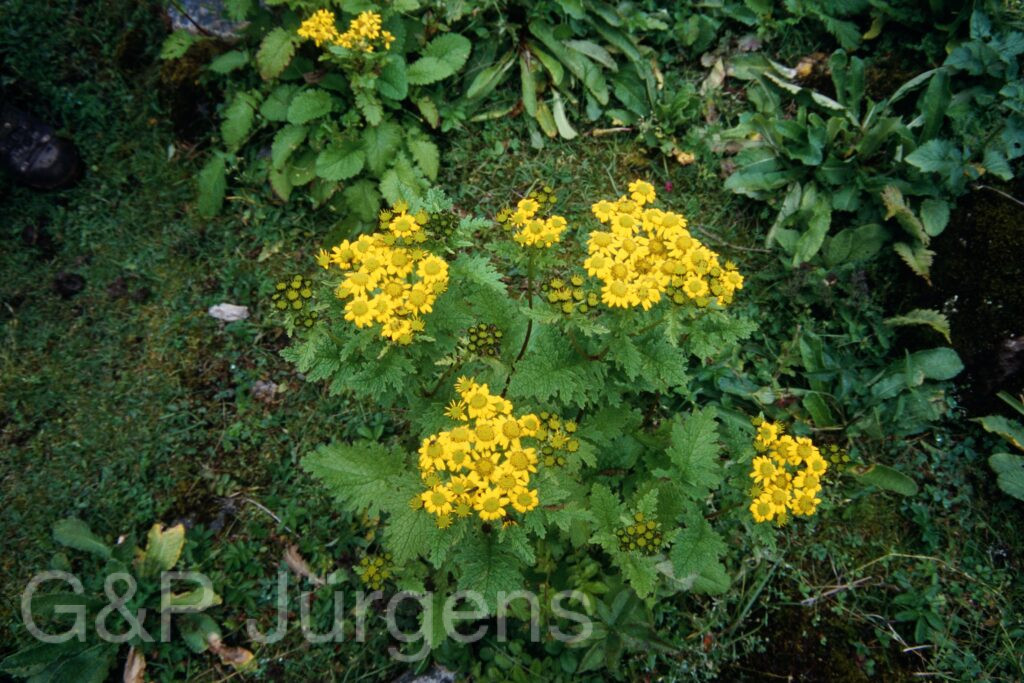
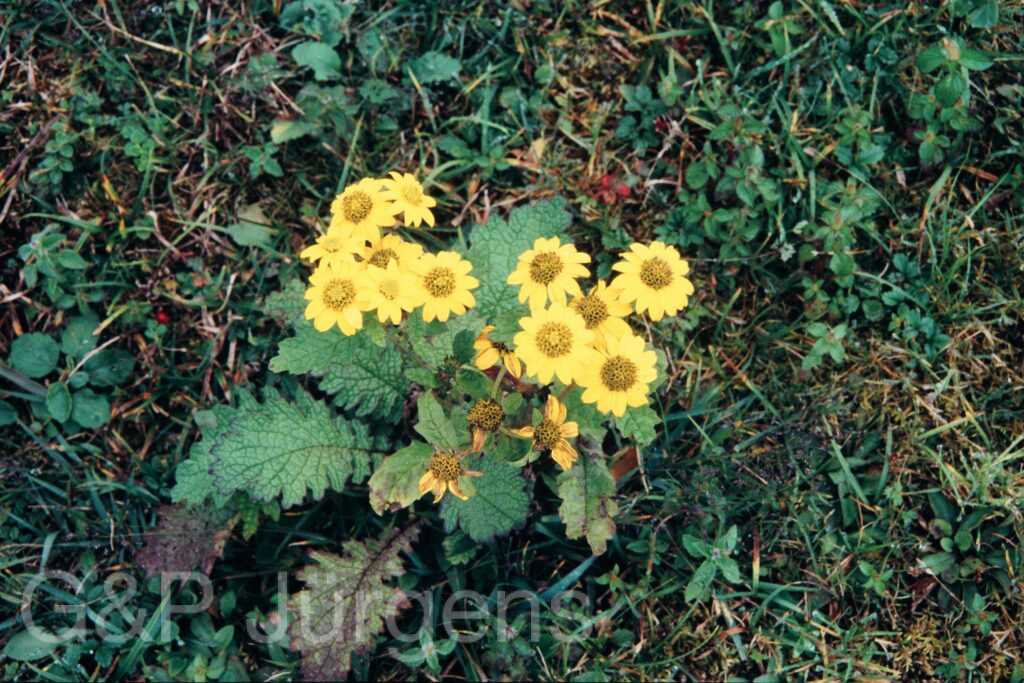
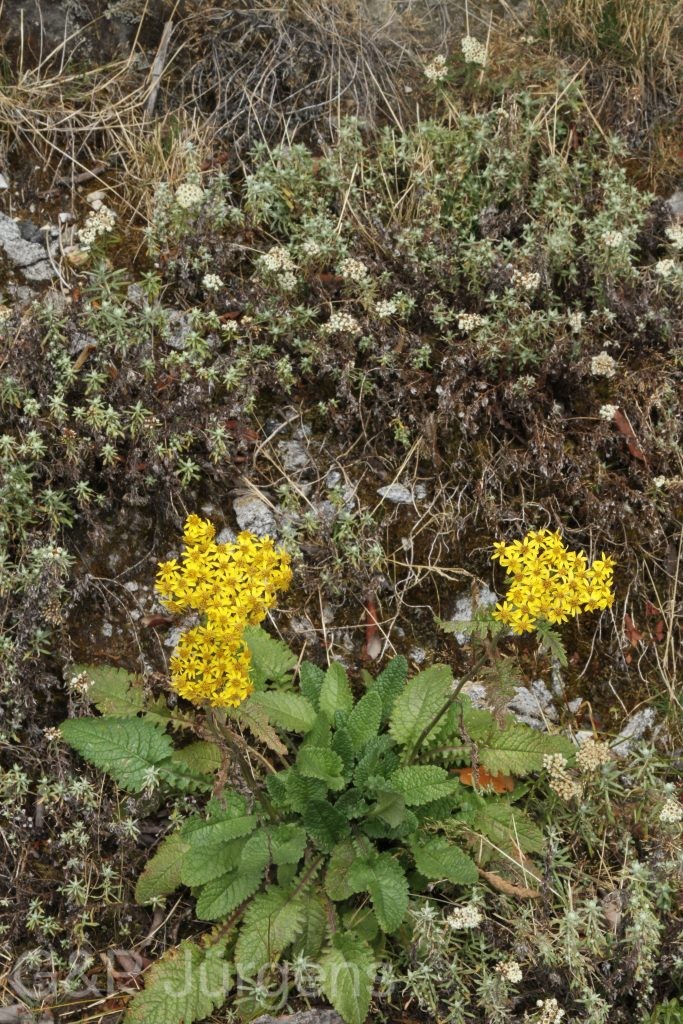
Jacobaea raphanifolia is a perennial herb of the high Himalaya and adjoining mountains of central Asia, recorded by GBIF (some 202 occurrences) from Nepal, India, China, Bhutan, Afghanistan, Pakistan and Myanmar, with scattered records reaching Kenya and South Africa that probably reflect cultivated or naturalised material. It is a plant of the upper subalpine and alpine zones, favouring moist meadows, streamsides, open scrub and damp rocky slopes. The species was photographed across a broad altitudinal band, in the Chopta Valley of Sikkim at about 3900 m in August, south of the Rupien La in Nepal at 3600 m in October, and on the Tumching La in Bhutan near 4000 m, a range centred between roughly 3500 and 4200 m.

It forms an erect, somewhat stout herb arising from a short, fibrous-rooted rhizome, with simple or branched leafy stems. The lower leaves are lyrate-pinnatifid to runcinate with a large terminal lobe, recalling a radish (raphanifolia), the margins toothed and the surfaces sparsely hairy; cauline leaves become smaller, sessile and often auriculate upwards. The capitula are radiate, several to many in a loose terminal corymb, subtended by a single row of narrow green phyllaries with a few short calyculate bracts. Ray florets are yellow, female and ligulate; the disc florets yellow, tubular and bisexual. The fruit is a ribbed, cylindrical cypsela crowned by a pappus of fine white capillary bristles.

The species belongs to a complex of montane ragworts segregated from Senecio into Jacobaea on molecular and morphological grounds. As a wide-ranging meadow herb of the alpine pastures it is locally common and of no conservation concern, though like many Senecioneae it contains pyrrolizidine alkaloids and is generally avoided by grazing stock, a trait that may favour its persistence in heavily pastured high valleys.

Author: (Wall. ex DC.) B.Nord. · Sources: POWO (Kew), GBIF, Flora of Bhutan, Flora of China, Annotated Checklist of the Flowering Plants of Nepal, Nordenstam's revision of Jacobaea and the Senecioneae

Wall.

Nepal 97 92 P153
Nepal above Meta-Khola 2250m April
Nepal 97 312 P616
Nepal above Meta-Khola 2250m April

Description

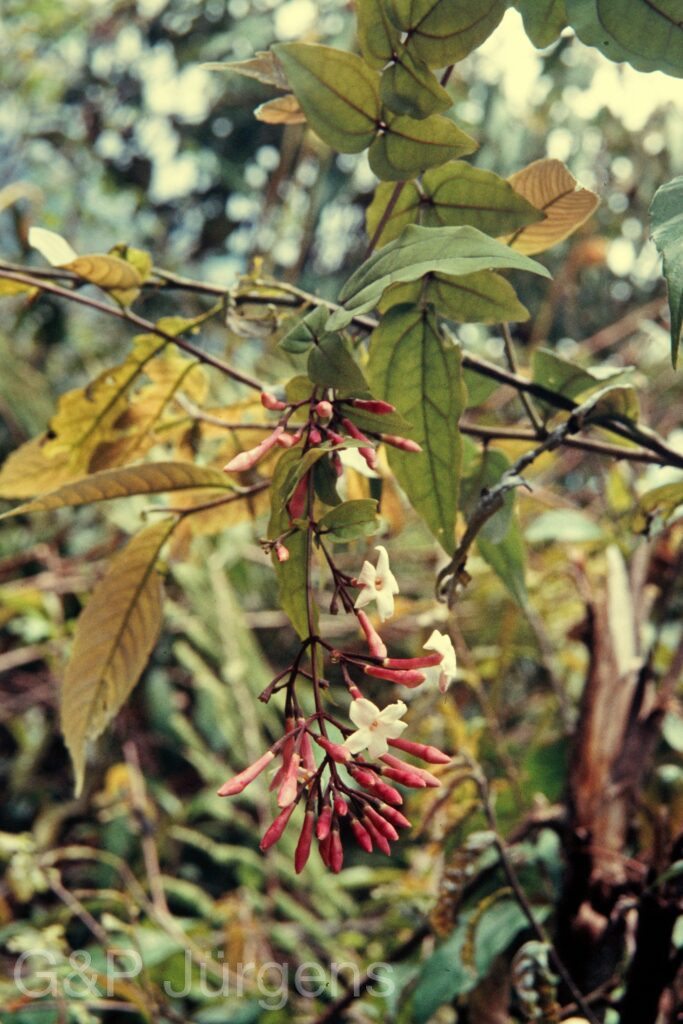
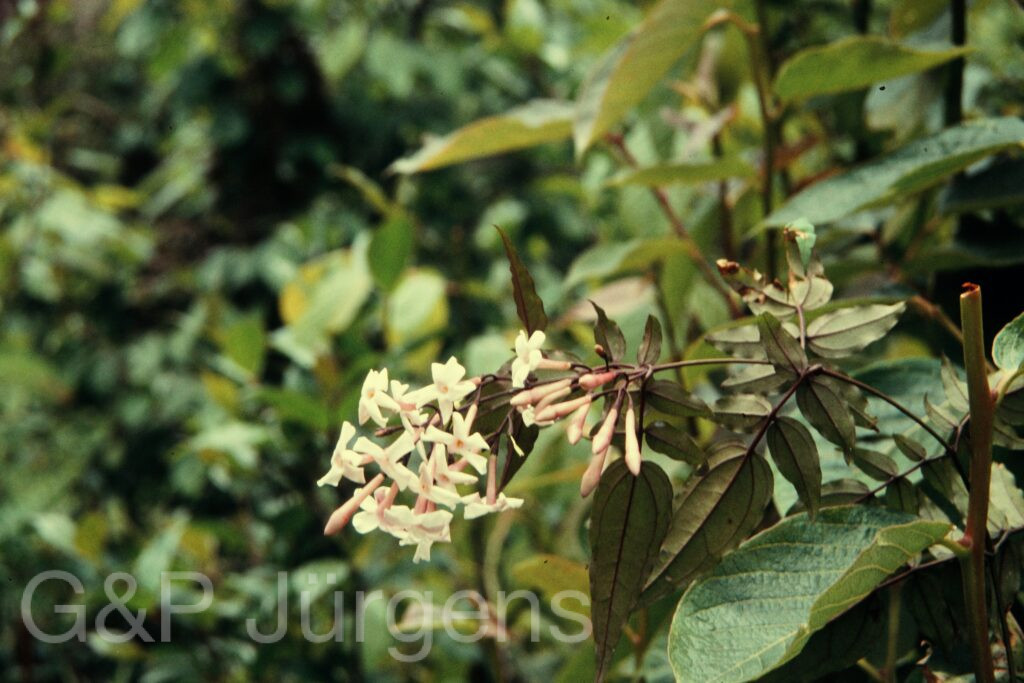
Jasminum dispermum is a scandent or climbing jasmine widely distributed across the Himalaya and montane south-east Asia, recorded from China, India, Nepal, Myanmar, Thailand and Bhutan, with outlying records (ID, KR, RU, ZZ) reflecting cultivation and herbarium material. Of more than 400 georeferenced collections, the core range lies along the subtropical-to-temperate forest belt of the Himalayan foothills. It grows in forest margins, scrub, ravines and along streams, scrambling over rocks and shrubs in the warm-temperate zone. The photographed plant from above the Meta-Khola in Nepal at 2250 m, flowering in April, is typical of its lower montane habitat and its spring flowering ahead of the monsoon.

It is a woody, twining shrub or liana with terete, often pubescent branchlets. The leaves are opposite and pinnately compound, usually with five to seven leaflets (sometimes reduced to three or trifoliolate uppermost ones), the leaflets ovate to lanceolate, acuminate and entire. The fragrant flowers are borne in terminal and axillary cymose panicles; each has a small, toothed calyx and a salverform corolla with a slender tube and spreading lobes, white within and frequently flushed pink or rose-purple on the outside in bud. Two stamens are inserted in the corolla tube. The fruit, reflected in the epithet dispermum, is a paired or two-seeded berry that ripens black.

Jasminum is a large Old World genus of the olive family centred on tropical and warm-temperate Asia and Africa, many species prized for their scent. J. dispermum is a vigorous, ornamentally attractive climber, occasionally cultivated, and remains common throughout its native range with no conservation concern. Its nocturnally fragrant, pale flowers suggest pollination by long-tongued moths and other nectar-seeking insects.

Author: Wall. · Sources: POWO (Kew), GBIF, Flora of China Vol. 15, Flora of Bhutan Vol. 2, Flora of Nepal, Green's Synopsis of the Oleaceae

Roxb. ex Hornem.

Bhutan2014 149
Bhutan Trashigang 2000m, May

Description

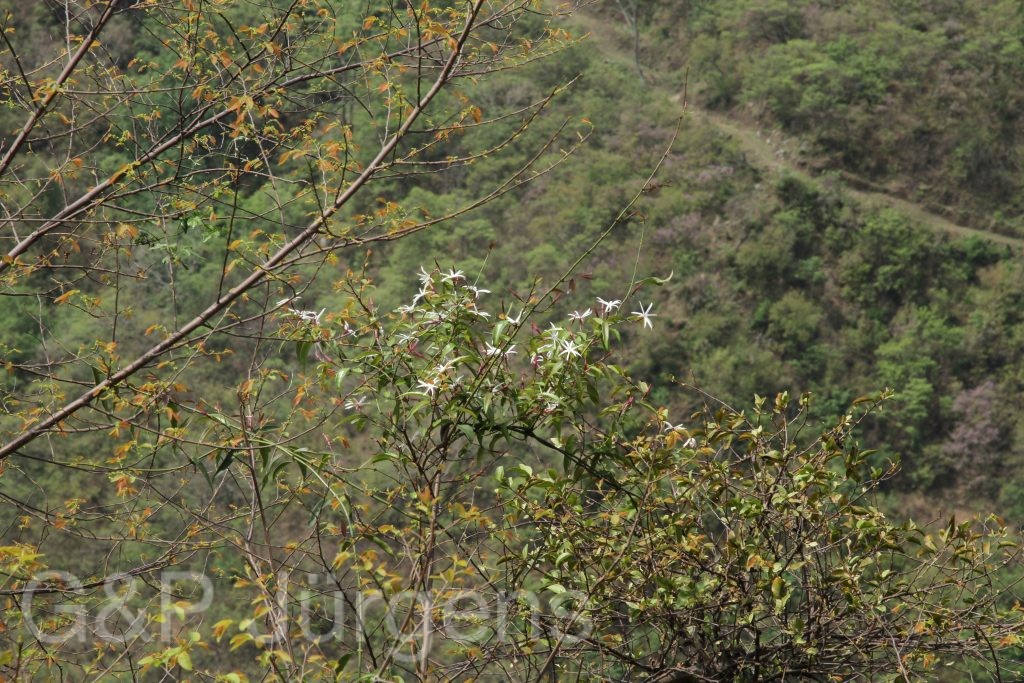
Jasminum laurifolium is a climbing jasmine native to the eastern Himalaya and South-East Asia, occurring in north-eastern India, Bhutan, Nepal, Myanmar, Thailand and southern China, and widely cultivated as an ornamental; its GBIF records (over 440) span this native range together with numerous cultivated occurrences in the Americas, the Pacific and the West Indies that account for the scattered records in Brazil, Colombia, Mexico, French Polynesia and the Caribbean. It grows in evergreen and mixed forest, on forest margins, thickets and shrubby slopes, generally up to about 2000 m. The photographed plant from Trashigang in eastern Bhutan at 2000 m in May reflects its occurrence in warm, humid mid-elevation forest.

It is an evergreen, woody twining shrub or liana with slender, glabrous, terete branchlets. The opposite, simple leaves are leathery and glossy, ovate-lanceolate to elliptic and laurel-like (whence laurifolium), with an entire margin, a long-acuminate apex and prominent pinnate venation. The fragrant flowers are borne in terminal and axillary cymes; each has a small, toothed calyx and a salverform white corolla with a slender tube and several narrow, spreading lobes. The fruit is a small, two-lobed black berry, often only one lobe maturing.

Jasminum is a large genus of the olive family Oleaceae, well represented in tropical Asia. J. laurifolium, sometimes treated with the variety brachylobum, is grown for its fragrant white flowers and is a familiar ornamental and source of perfume. Widespread in the wild and broadly cultivated, it is not of conservation concern, and its escape and naturalisation in warm regions outside its native range account for many of the extralimital records.

Author: Roxb. ex Hornem. · Sources: POWO (Kew), GBIF, Flora of China, Flora of Bhutan, Flora of Thailand, Jasminum (Oleaceae) revision (Green monograph)