Tag:

Subtropical (<1500 m)

Remusatia vivipara

by GP Jürgens

(Roxb.) Schott

Bhutan2015 106 1
Bhutan Galephug 600m, October
Nepal 1994 223 ergebnis
Ost-Nepal Mewa-Khola 1900m April 

Description

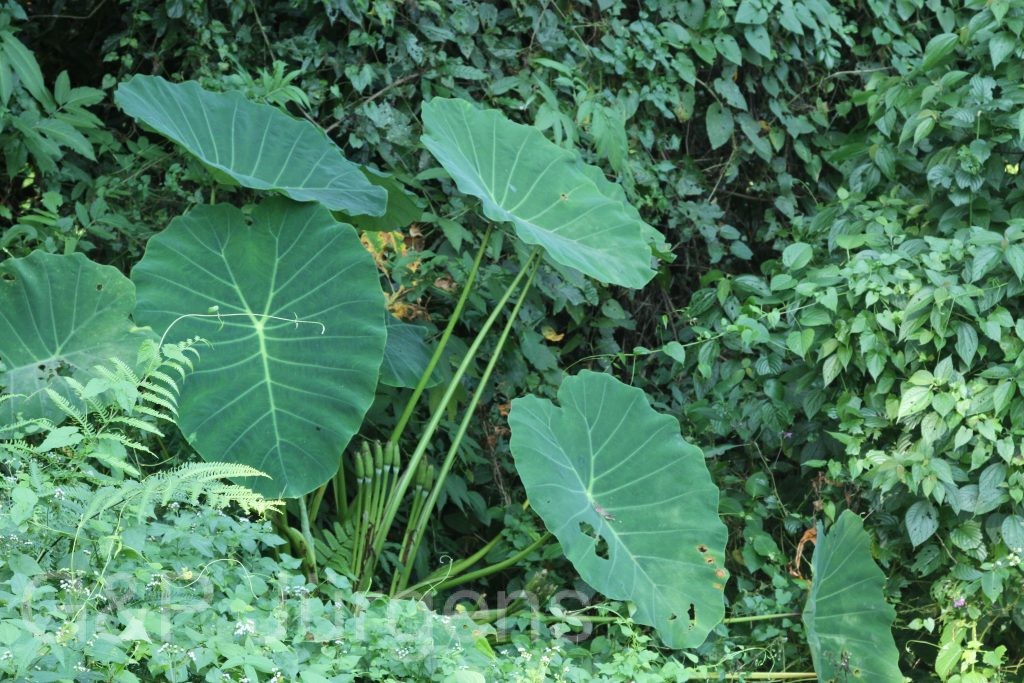
Remusatia vivipara (Roxb.) Schott is a widespread tuberous aroid of the Old World tropics, the most broadly distributed member of its genus, with nearly 790 records spanning the Himalaya and India, China and Taiwan, Southeast Asia, Indonesia and Australia, tropical Africa and Madagascar, and Arabia, plus naturalised occurrences elsewhere. It is chiefly an epiphyte and lithophyte on mossy tree trunks, cliffs and boulders in humid forest, descending into shaded ravines and persisting in disturbed semi-shade. The cited gatherings from Galephug in southern Bhutan at 600 m in October and the Mewa Khola of East Nepal at 1900 m in April span its lowland-to-submontane range.

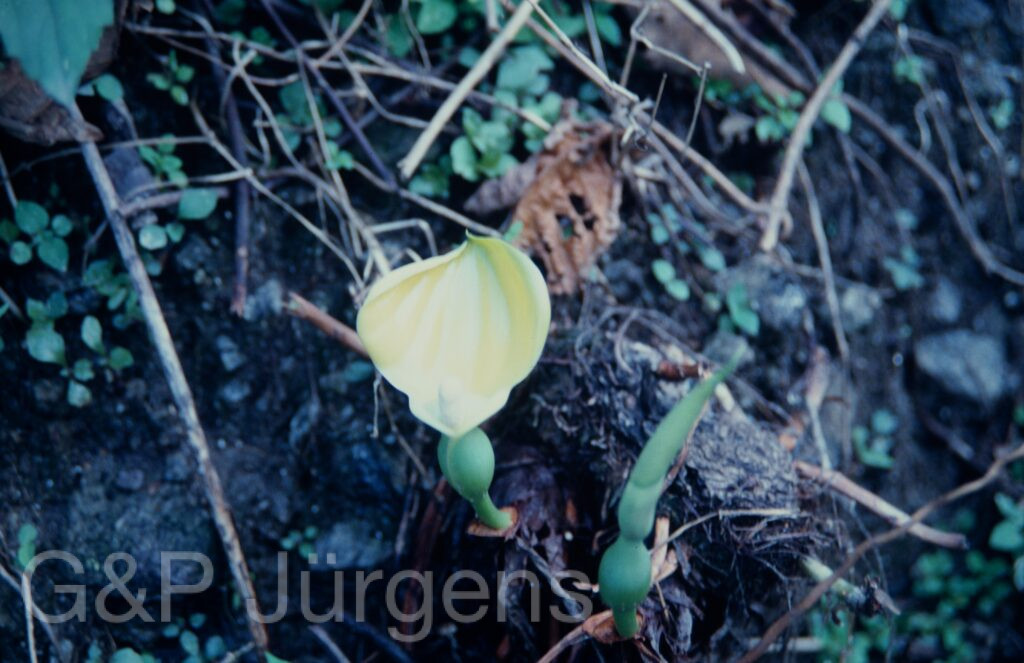
The plant grows from a small depressed-globose tuber that gives rise annually to one or few leaves and to the conspicuous bulbiliferous shoots characteristic of the genus. The leaf blade is ovate to ovate-cordate and peltate, on a long sheathing petiole. Dispersal is dominated by erect, spike-like bulbil-bearing axes densely set with small, scale-covered bulbils armed with recurved hooks that catch on the fur and feathers of passing animals. Flowering, where it occurs, produces a spathe with a basal convolute tube and expanded limb, subtending a spadix with separate female and male zones; sexual reproduction is much less frequent than vegetative propagation.

The extraordinary pantropical range of R. vivipara is largely attributable to this epizoochorous bulbil dispersal, supplemented by human movement of ornamental and tuber stock. Its placement in Colocasieae, near Colocasia and Gonatanthus, has been confirmed by molecular work. The species is common, ecologically plastic and locally weedy, and is of no conservation concern; in cultivation it is valued as a curious bulbil-producing aroid.

Author: (Roxb.) Schott · Sources: POWO (Kew), GBIF, Flora of China, Flora of Bhutan, Flora of Nepal, monograph of Remusatia and tribe Colocasieae
(Roxb.) Schott

Sikkim 2006 487 ergebnis
India West-Bengal, Ruigi-Chu 1800m, May
Bhutan2015 147
Bhutan Galephug 800m, October

Description

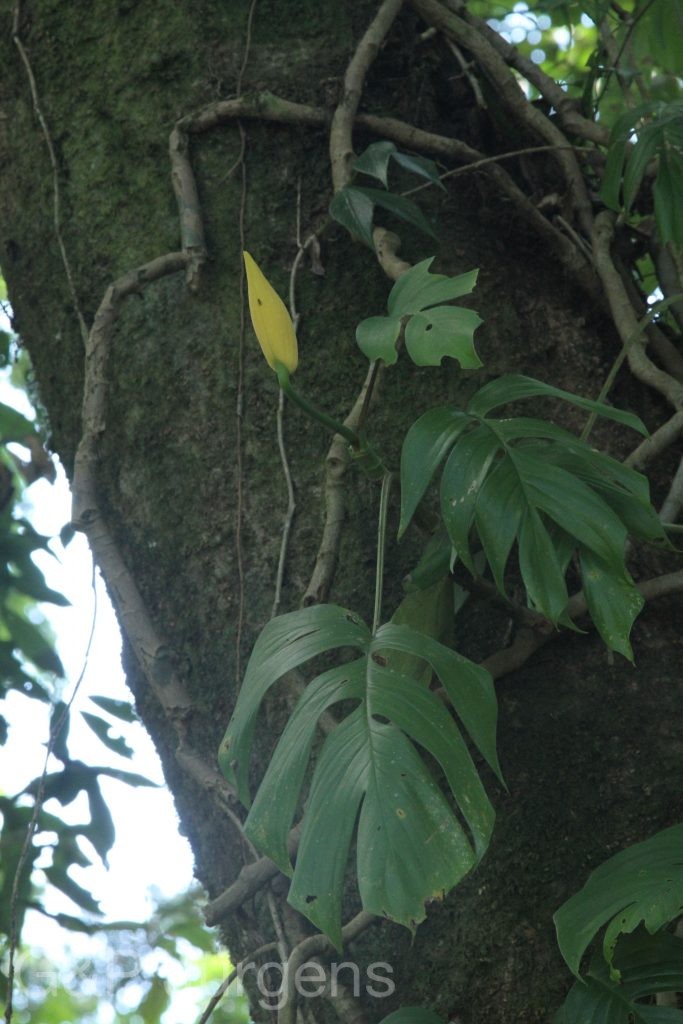
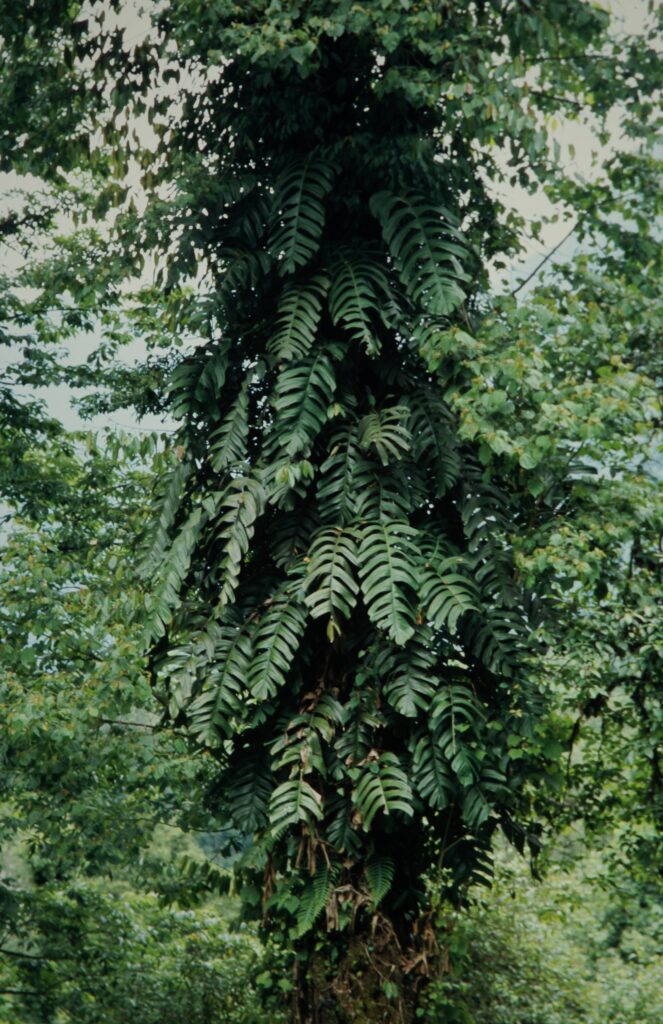
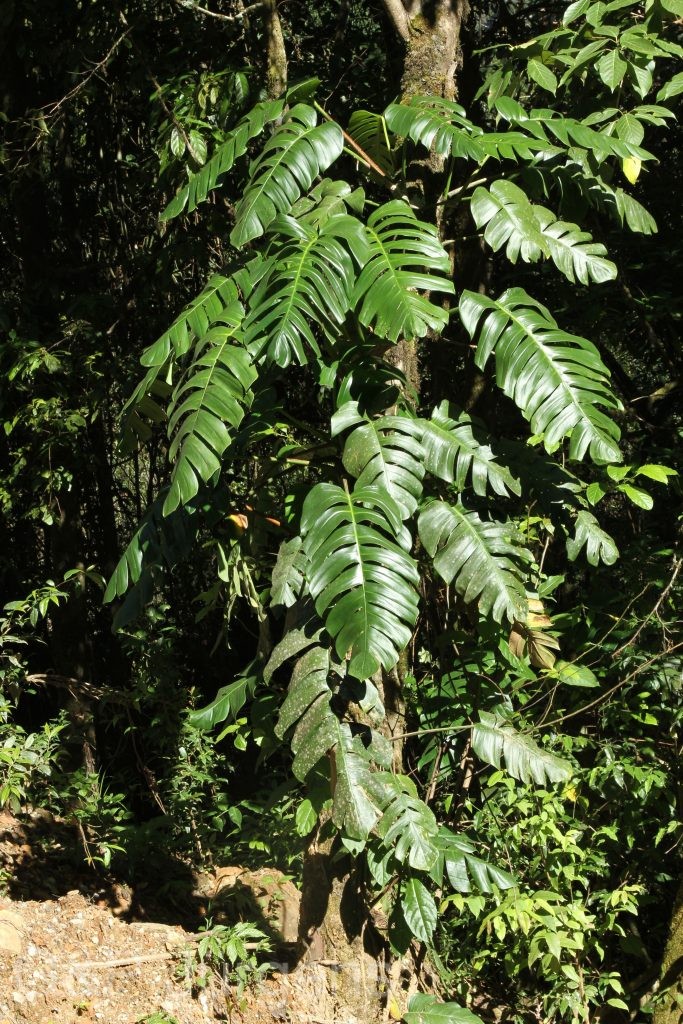
Rhaphidophora decursiva ((Roxb.) Schott) is a robust root-climbing aroid widely distributed across tropical and subtropical Asia, ranging from the eastern Himalaya and northeast India through Bangladesh, Myanmar, Thailand, Laos, Vietnam and southern China to Sri Lanka and the Malay region. The roughly 700 GBIF records confirm a strong concentration in the Indo-Burmese hill forests. It is a hemiepiphyte of humid evergreen and semi-evergreen broad-leaved forest, climbing tree trunks and clambering over rocks in shaded, moist ravines from near sea level to about 2,000 m. The cited material from Ruigi-Chu in West Bengal at 1,800 m in May and from Galephug, Bhutan, at 800 m in October illustrates its wide altitudinal amplitude across the Himalayan foothills.

The plant produces stout, scandent stems that cling by abundant clasping adventitious roots, the internodes green to brownish and somewhat flattened against the support. The leaves are large and long-petiolate, the lamina ovate-oblong in juveniles but becoming deeply pinnatifid in adults, divided almost to the midrib into numerous decurrent segments that give the species its epithet. The inflorescence is a cylindrical spadix subtended by a thick, boat-shaped, yellowish to greenish spathe; the flowers are bisexual and naked, lacking a perianth, and the infructescence ripens into a dense cluster of berries.

The genus Rhaphidophora belongs to the tribe Monstereae and is distinguished from the Neotropical Monstera by its Old World distribution and bisexual flowers. R. decursiva is among the most widespread members of the genus and shows considerable leaf heteroblasty between juvenile shingling and mature pinnatifid stages. Locally the plant is used in traditional medicine and is occasionally grown as a foliage ornamental. It is common and not regarded as threatened.

Author: (Roxb.) Schott · Sources: POWO (Kew), Flora of Bhutan Vol. 3, GBIF, Flora of China Vol. 23, Boyce & Croat: The Überlist of Araceae (Monstereae)

(Wall.) Schott

Bhutan2015 214
Bhutan Zhemgang 1000m, October

Description

Rhaphidophora glauca (Wall.) Schott is a root-climbing aroid of the eastern Himalaya and Indo-Burmese region, recorded from India, Nepal, Bhutan, China, Myanmar, Thailand, Indonesia and Bangladesh; the GBIF total of about 195 occurrences reflects its frequent presence in humid subtropical and lower montane forest. It grows as a hemiepiphytic liana ascending tree trunks and rock faces in moist broad-leaved evergreen forest, broadly between 600 and 1800 m. The photographed plant from Zhemgang in central Bhutan at about 1000 m, in October, typifies its occurrence in the shaded, humid foothill forest of southern Bhutan, clinging by adventitious roots to mossy bark.

The species is a robust, evergreen, root-climbing hemiepiphyte with stout, terete, green to glaucous stems bearing clasping adventitious roots at the nodes. The leaves are alternate, large, ovate to oblong with an obliquely cordate to unequal base, often glaucous beneath as the epithet implies, the petiole sheathing and geniculate near the apex. The inflorescence is a solitary, axillary spadix subtended by a thick, boat-shaped, caducous spathe; the flowers are small, bisexual and naked, densely covering the cylindrical spadix in the manner of the Monstereae. The fruit is a fleshy, many-seeded berry crowded along the infructescence, the seeds bearing the curved raphide-laden tissue characteristic of the genus.

Rhaphidophora (Araceae, tribe Monstereae) is a palaeotropical genus of root-climbing aroids closely allied to Epipremnum and Monstera and distinguished by its raphide-bearing seeds and shuttlecock-like spathe. R. glauca is the principal Himalayan representative, recognised by its glaucous, oblique-based leaves. As a widespread, tolerant forest liana it is of no conservation concern, though as a hemiepiphyte it depends on intact forest structure; it is occasionally grown as a foliage ornamental and used locally in folk medicine.

Author: (Wall.) Schott · Sources: POWO (Kew), GBIF, Flora of China, Flora of Bhutan, Flora of British India, Boyce & Croat — The Überlist of Araceae and Monstereae studies

Sm.

Bh2008 31 G54
Bhutan
Nepal1992 220 P322 ergebnis
Nepal Nundhaki 1400m March 
Nepal1992 228 P337 ergebnis
Nepal Nundhaki 1400m March 
Nepal1992 237 P348 ergebnis
Nepal Nundhaki 1400m March 

Description

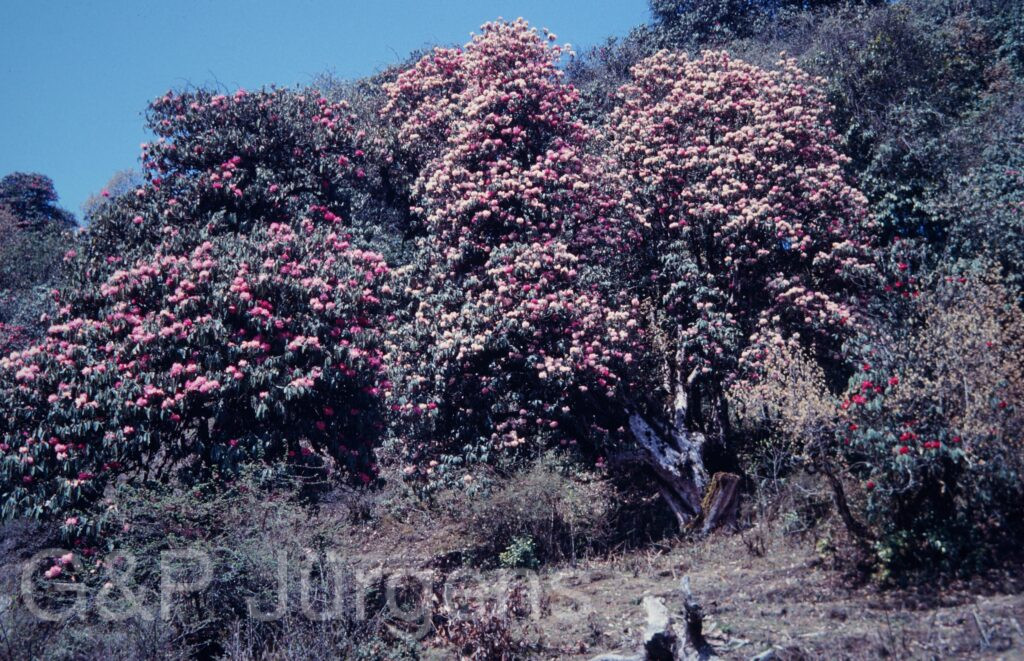
Rhododendron arboreum is the tree rhododendron of the Himalaya and the broader Indian subcontinent, ranging from Pakistan through India, Nepal, Bhutan and Myanmar into southwestern China, with a notable disjunct presence in the hills of Sri Lanka; widely cultivated, it appears in GBIF from many temperate countries and totals nearly 3000 occurrences. It is the most familiar species of the genus across its native range, growing in temperate broadleaved and oak-laurel forest, on hill slopes and in scrub, here recorded at Nundhaki in Nepal at 1400 m and in Bhutan. Spanning a broad elevational band, it flowers conspicuously in late winter and spring (March), painting Himalayan hillsides crimson.

It is an evergreen shrub or tree reaching 10-20 m, with a gnarled trunk and rough, flaking bark. The leaves are leathery, oblanceolate to elliptic, dark glossy green above and clothed beneath with a dense silvery, fawn or rusty indumentum that varies between subspecies. The flowers are massed in dense, rounded, terminal trusses of 15-20; each corolla is tubular-campanulate, 3-5 cm long, ranging from deep blood-red through pink to white, the throat marked with darker nectar spots. Stamens are typically 10, and the ovary tomentose with a long style. The fruit is a curved, woody, ribbed capsule splitting to release numerous small winged seeds.

Described by James Edward Smith, the species belongs to subgenus Hymenanthes, subsection Arborea, and is highly variable, with several recognised subspecies (e.g. subsp. cinnamomeum, subsp. nilagiricum, subsp. zeylanicum) differing in leaf indumentum and altitude. It is the national flower of Nepal (lali gurans) and the state tree of Uttarakhand, and the nectar-rich corollas are sought by sunbirds and bees, with the flowers used to make a local beverage. Although widespread and not globally threatened, lower-elevation populations face pressure from fuelwood harvesting, grazing and forest conversion.

Author: Sm. · Sources: POWO (Kew), GBIF, Flora of Bhutan, Flora of China, The Genus Rhododendron (Cullen & Chamberlain monograph)

Hook. f.

Bhutan2014 43
Bhutan Trashigang 1300m, May
Bhutan2014 391
Bhutan Tumching-La 3000m, May
Bh2008 146 P243
Bhutan Chendebji, 2450m April

Description

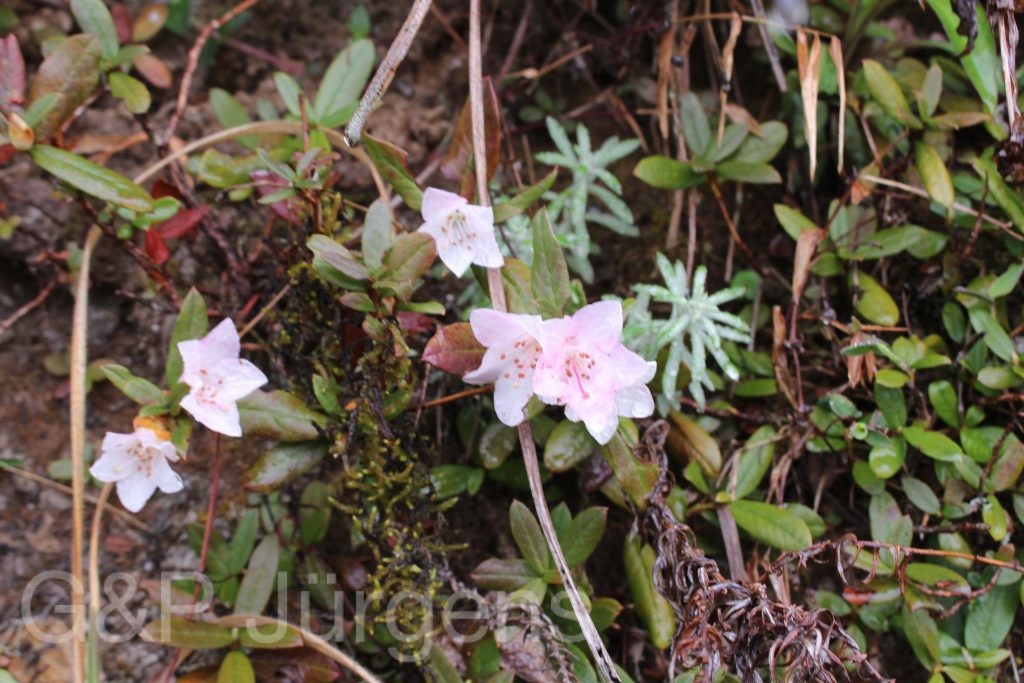
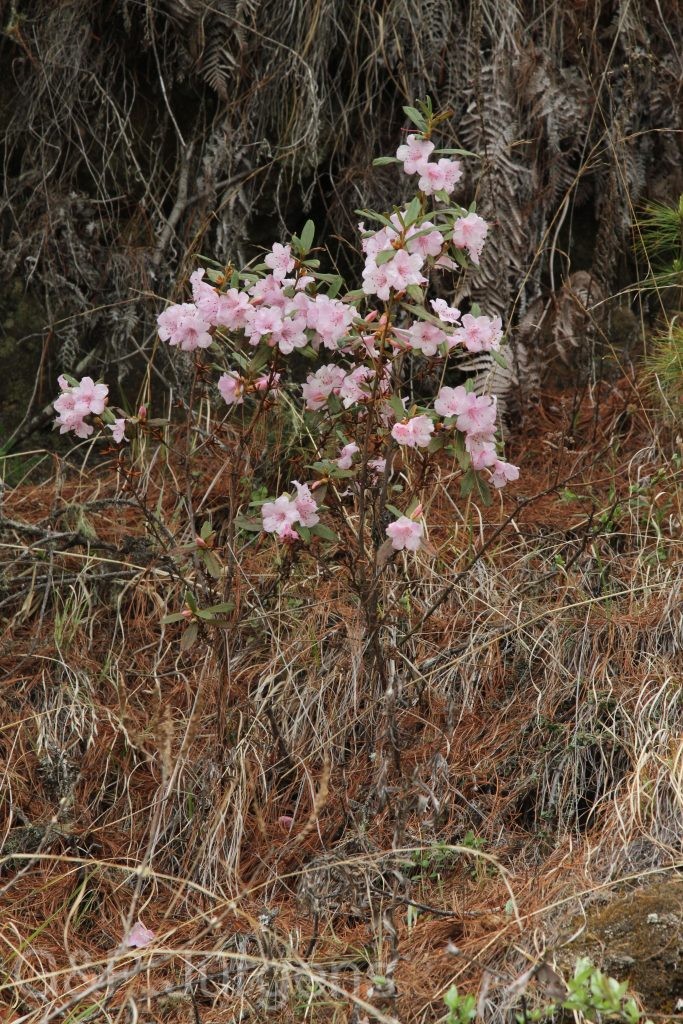
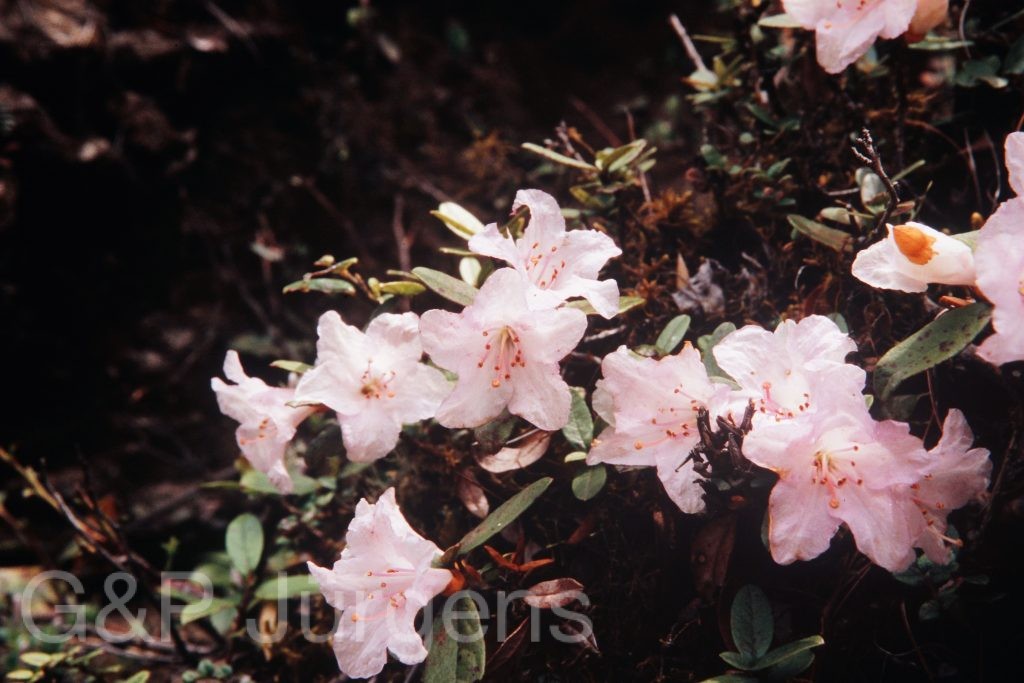
Rhododendron vaccinioides Hook. f. is a small epiphytic rhododendron of the eastern Himalaya and adjacent montane Asia, ranging from Nepal and India through Bhutan to southern China, Myanmar and Vietnam, with around 245 GBIF occurrences. It grows characteristically as an epiphyte on mossy trunks and branches, and occasionally on rocks, in humid broadleaved and mixed evergreen forest, across a wide altitudinal span. The three Bhutan gatherings cited, from Trashigang at 1300 m and Chendebji at 2450 m flowering in April and May, and Tumching-La at 3000 m, illustrate its broad range from warm subtropical to cool temperate cloud forest where atmospheric moisture is high.

The species is a dwarf, much-branched epiphytic shrub with slender twigs clothed in scales and bearing small, obovate, leathery leaves whose lower surface is densely lepidote, resembling the foliage of Vaccinium as the epithet implies. The flowers are small, solitary or few together at the branch tips, with a short tubular to campanulate, white to pale pink corolla, the lobes spreading; the ovary and style are scaly. The fruit is a small lepidote capsule splitting septicidally to release numerous minute seeds adapted to wind dispersal in the canopy.

Rhododendron vaccinioides belongs to subgenus Rhododendron, section Vireya-allied scaly rhododendrons, an epiphytic lineage radiating through the wet forests of Asia. Its diminutive epiphytic habit is unusual among Himalayan rhododendrons. Widespread and locally frequent, it is of least conservation concern, though dependent on intact humid forest canopy.

Author: Hook. f. · Sources: POWO (Kew), GBIF, Flora of Bhutan, Flora of China, The Genus Rhododendron (Royal Botanic Garden Edinburgh), Cullen monograph of lepidote Rhododendron

(Blume) Faden

Bhutan2015 254
Bhutan Zhemgang 910m, October

Description

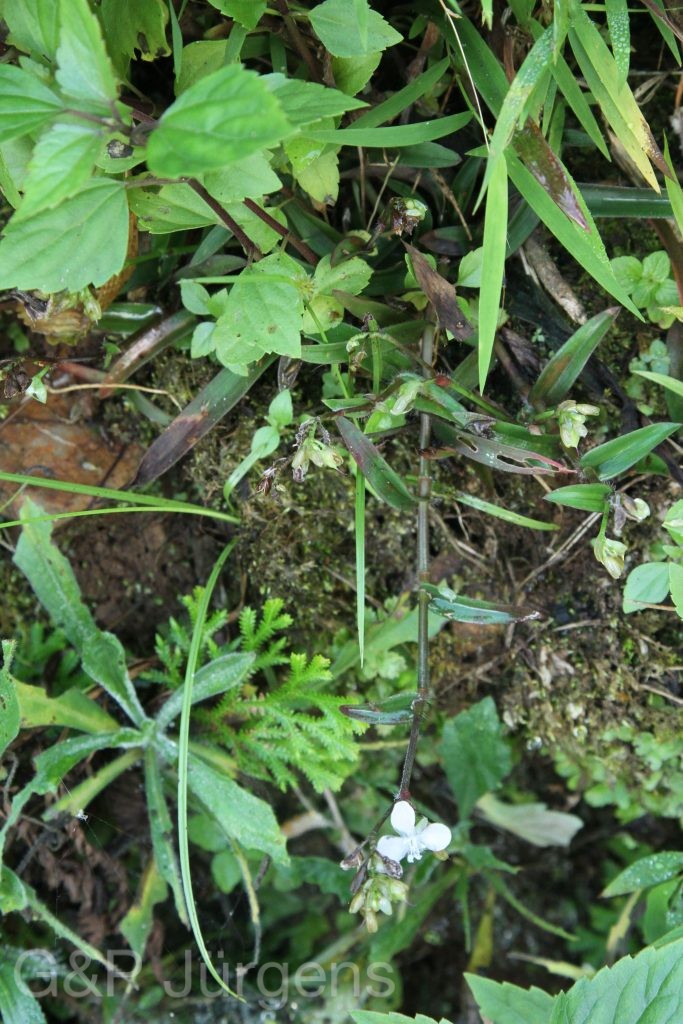
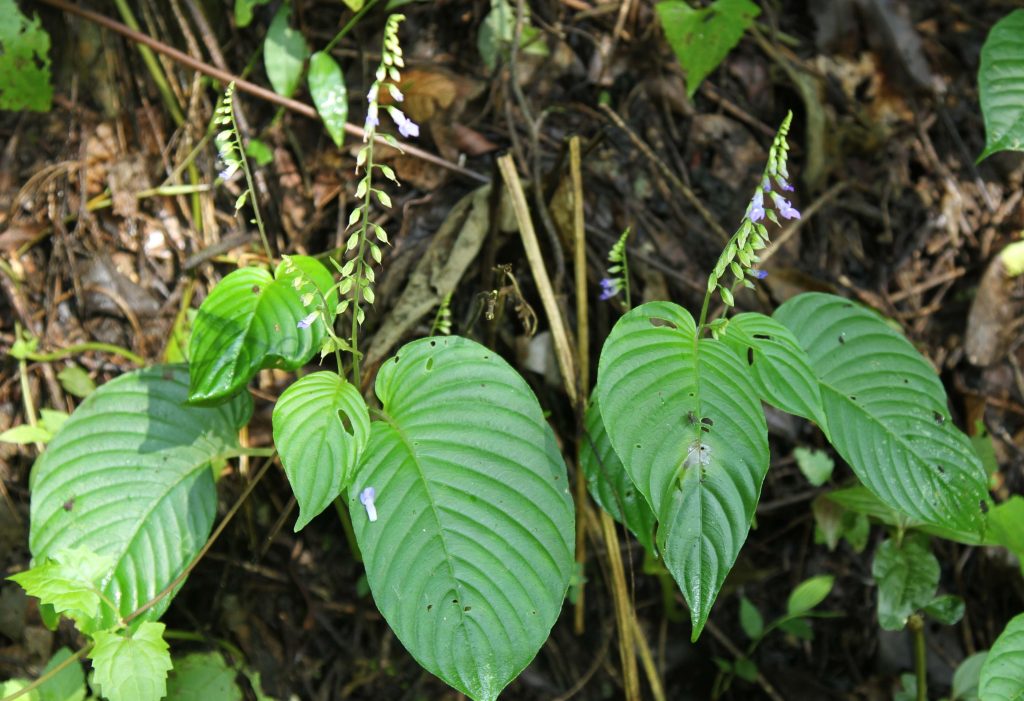
Rhopalephora scaberrima is a tropical to subtropical spiderwort widely distributed across South and Southeast Asia, recorded from India, Nepal, Bhutan, Bangladesh, Sri Lanka, Myanmar, Thailand, Malaysia, Indonesia, the Philippines, Vietnam, southern China and Taiwan. Its GBIF profile, with about 1,104 occurrences spanning these countries, confirms a broad Indomalayan range. The plant illustrated was photographed in southern Bhutan at Zhemgang at about 910 m in October. It is a species of warm, humid lowland and lower-montane settings, growing in forest understorey, along shaded streambanks, in moist grassy clearings and on disturbed roadsides, generally below about 1,500 m where high rainfall and warmth prevail.

It is a perennial, somewhat straggling herb with ascending to decumbent stems that root at the lower nodes, the surfaces and leaf-sheaths conspicuously scabrid-hispid, as the epithet indicates. The leaves are alternate, ovate-lanceolate to elliptic, with a closed sheathing base and an acuminate apex. The flowers are borne in small scorpioid cymes aggregated into a terminal panicle; each has three free sepals and three blue to violet petals, with the androecium showing the differentiation characteristic of the family, the fertile stamens separated from reduced staminodes. The fruit is a small loculicidal capsule, distinctively two-locular with the seeds arranged in two rows, a key feature separating Rhopalephora from related genera.

The genus Rhopalephora was segregated from the broadly defined Aneilema and Commelina on the basis of its bilocular capsule, biseriate seeds and stamen architecture, as clarified in Faden's revisionary work. As a common and adaptable plant of disturbed humid habitats, R. scaberrima is not threatened and serves as a useful indicator of warm, moist forest edge in the eastern Himalayan foothills.

Author: (Blume) Faden · Sources: POWO (Kew), Flora of China Vol. 24, Flora of Bhutan Vol. 3, GBIF, Faden: Commelinaceae (revisionary studies)

Mill.

Bhutan2012 535
Bhutan Wangdi 2600m, September
Bhutan2015 252
Bhutan Zhemgang 900m, October

Description

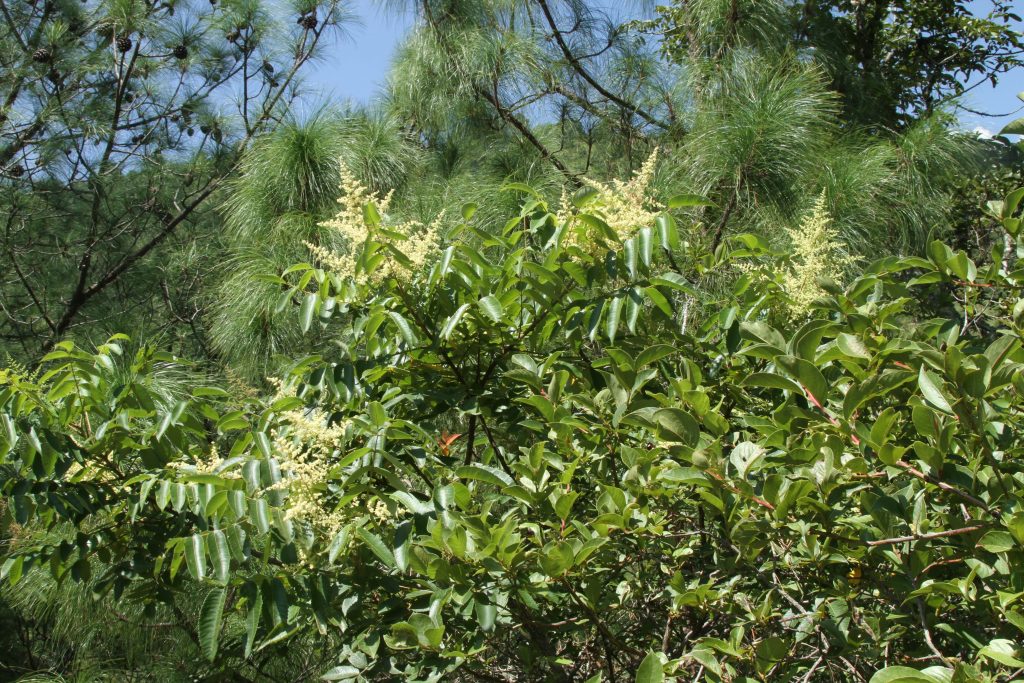
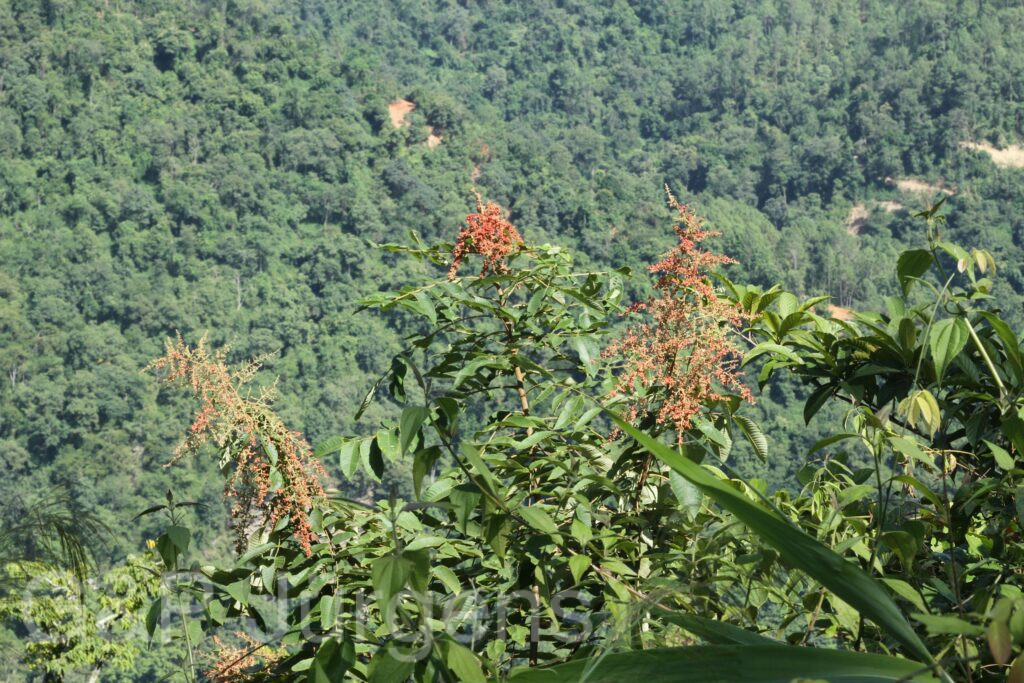
Rhus chinensis is a widespread deciduous shrub or small tree of East and South Asia, recorded across China, Taiwan, Japan, Korea, India, Vietnam, Thailand, Myanmar, Nepal, Bhutan and beyond, with more than ten thousand documented occurrences making it one of the most frequently collected sumacs in the region. It is a pioneer of open and disturbed ground, colonising forest margins, clearings, roadsides, scrub and abandoned cultivation from the lowlands into the montane zone. In Bhutan it ranges over a wide elevational band, as shown by collections near Wangdi at about 2600 m in September and at Zhemgang at 900 m in October, the autumn dates corresponding to fruiting.

The plant is a shrub to small tree with greyish bark and stout, often warted branchlets. The leaves are alternate and odd-pinnate, the rachis characteristically winged between the leaflets; the leaflets are ovate to oblong, coarsely serrate, acuminate, and tomentose beneath, turning red in autumn. The inflorescence is a large terminal pubescent panicle of numerous small whitish to greenish-yellow flowers, the plant functionally dioecious. The fruit is a small, flattened, reddish drupe covered with short hairs and a sour, salty surface bloom.

Rhus chinensis is the principal host of the Chinese sumac aphid Schlechtendalia chinensis, whose feeding induces large hollow leaf galls extraordinarily rich in tannins; these galls, known as Chinese galls or wubeizi, are harvested as a major commercial source of gallotannic acid and are valued in traditional medicine and dyeing. Wax from the fruit and the tannin-laden tissues have long been utilised economically. Hardy, fast-growing and broadly tolerant of disturbance, the species is abundant throughout its range and faces no conservation concern, functioning ecologically as an early-successional colonist.

Author: Mill. · Sources: POWO (Kew), GBIF, Flora of China Vol. 11, Flora of Bhutan Vol. 2, Flora of Nepal, Flora of Pakistan, Min & Barfod treatment of Anacardiaceae

Blume

Bhutan2012 983
Bhutan Trithangebe 1100m, October
Bhutan2012 984
Bhutan Trithangebe 1100m, October

Description

Rhynchoglossum obliquum is a widespread tropical Asian gesneriad ranging from India, Nepal, Bhutan and Bangladesh through Myanmar, Thailand, southern China, Taiwan and the Malesian region (Malaysia, Indonesia, Philippines, New Guinea, Timor) to Indochina, with more than 2200 GBIF occurrences. It is an annual herb of moist, shaded habitats on forest floors, damp rock faces, stream banks and roadside cuttings in the subtropical to tropical lowland and lower-montane zone. The plant recorded at Trithangebe in southern Bhutan at 1100 m, flowering in October at the close of the monsoon, typifies its occurrence on humid, shaded ground at low to mid elevations.

It is a soft, erect annual with succulent, often translucent stems. The leaves are markedly asymmetric (oblique) at the base, ovate to ovate-lanceolate, membranous and entire to obscurely toothed, the strong inequilaterality reflected in the epithet and frequently arranged so that the lamina appears one-sided. The flowers are borne in slender, secund, one-sided terminal racemes; each has a tubular, winged or keeled calyx and a small two-lipped blue to violet corolla with a short tube, the lower lip often marked white. There are two fertile stamens, and the superior ovary ripens into a small ellipsoid capsule enclosed by the persistent calyx, releasing numerous minute seeds.

The input places the species in the subtribe Loxonieae (here as Loxodinae) within Gesneriaceae, where Rhynchoglossum is distinguished by its oblique leaves and secund racemes. Its small bilabiate flowers are insect-pollinated and the dust-like seeds dispersed by rain-wash, aiding colonisation of disturbed shaded ground. As a widespread weedy annual it is of no conservation concern.

Author: Blume · Sources: POWO (Kew), GBIF, Flora of China Vol. 18, Flora of Bhutan Vol. 2, Flora of Nepal, The Gesneriaceae of the Old World (Rhynchoglossum)

(L.) Blume

Nepal 99 1024 ergebnis ergebnis
Nepal Kathmandu 1300m, July
Nepal 99 1025 ergebnis ergebnis
Nepal Kathmandu 1300m, July

Description

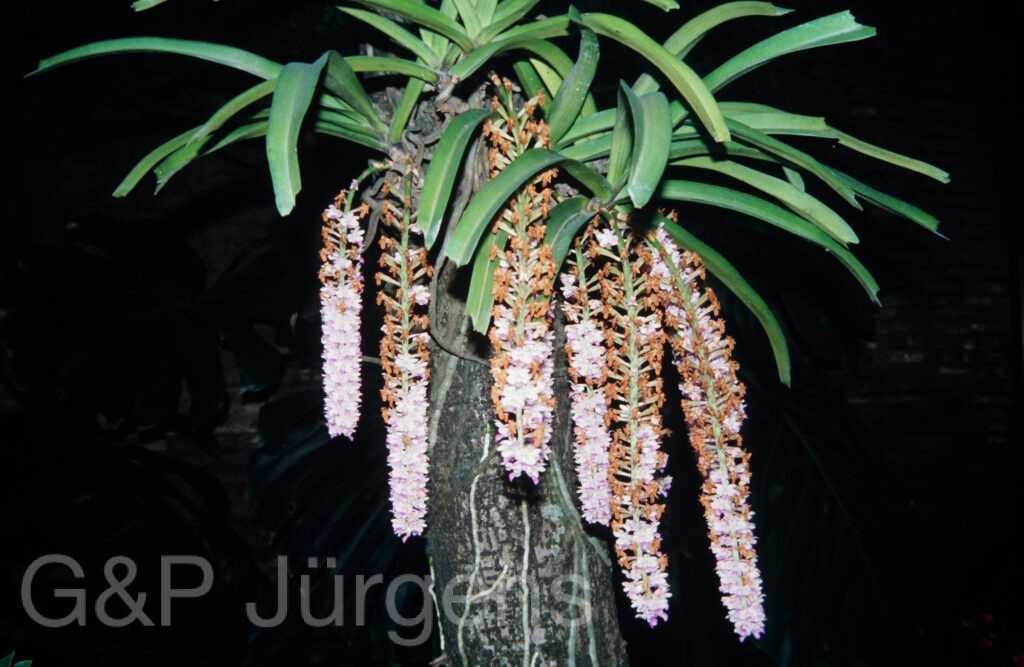
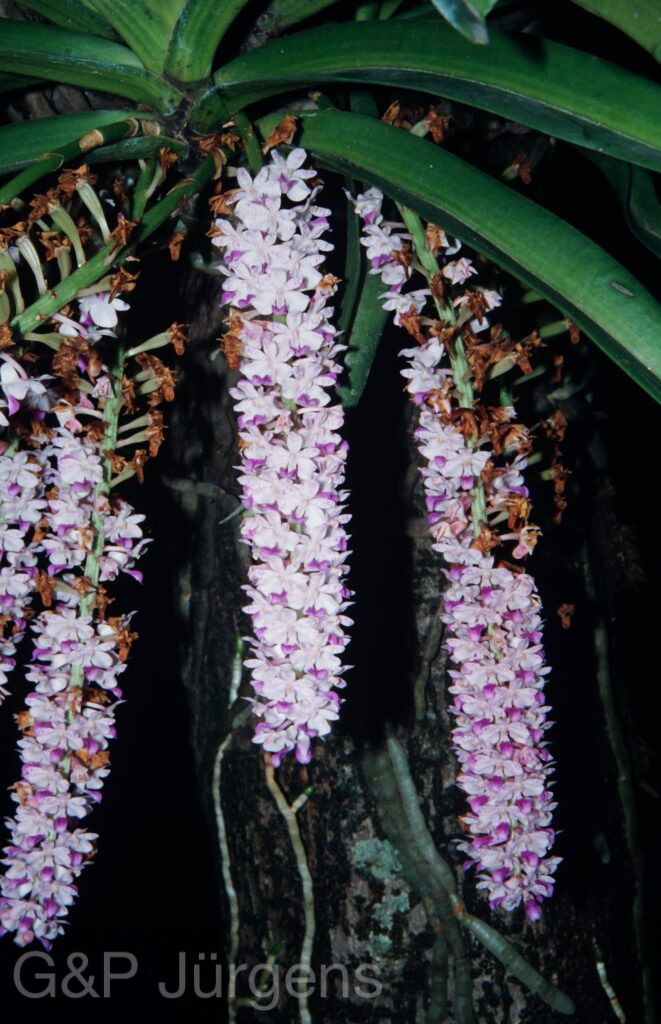
Rhynchostylis retusa (L.) Blume, the foxtail orchid, is an epiphyte widely distributed across tropical and subtropical Asia, with GBIF (617 occurrences) recording it from India, Nepal, Bhutan, China, Myanmar, Thailand, Laos, Vietnam, Cambodia, Sri Lanka, Bangladesh, Indonesia and the Philippines, plus many cultivated records. It grows on the trunks and branches of broadleaved trees in humid lowland and submontane forest, along forest edges and on roadside trees, flowering during the warm, wet summer. The photographed plant from the Kathmandu valley in Nepal at 1300 m in July reflects its typical occurrence in the warm-temperate to subtropical foothill belt of the Himalaya, where it flowers with the monsoon.

The species is a monopodial epiphyte with a short, stout stem clad in the persistent bases of distichous, fleshy, strap-shaped leaves that are channelled and conspicuously praemorse (retuse to unequally bilobed) at the apex, giving the epithet. Numerous thick, greyish aerial roots clasp the host bark. The inflorescence is a dense, pendent, cylindrical raceme of many small fragrant flowers, each white spotted and suffused with rose-purple or violet, with a spurred, entire to obscurely lobed labellum and a small column. The fruit is a pendent dehiscent capsule shedding dust-like wind-dispersed seeds.

Within the vandaceous alliance Rhynchostylis is a small genus of showy, scented epiphytes much esteemed in horticulture, and R. retusa holds particular cultural significance, being the state flower (kopou phul) of Assam. Like all orchids it is protected under CITES Appendix II. While still locally common, wild populations are reduced by habitat loss and unsustainable collection for the ornamental trade.

Author: (L.) Blume · Sources: POWO (Kew), GBIF, Flora of Nepal, The Orchids of the Himalaya (King & Pantling), Genera Orchidacearum (vandaceous orchids), CITES Appendix II

(Wall. ex Edgew.) C.-A.Jansson

Bhutan2012 1072
Bhutan Anthso 980m, October
Bhutan2012 1073
Bhutan Anthso 980m, October

Description

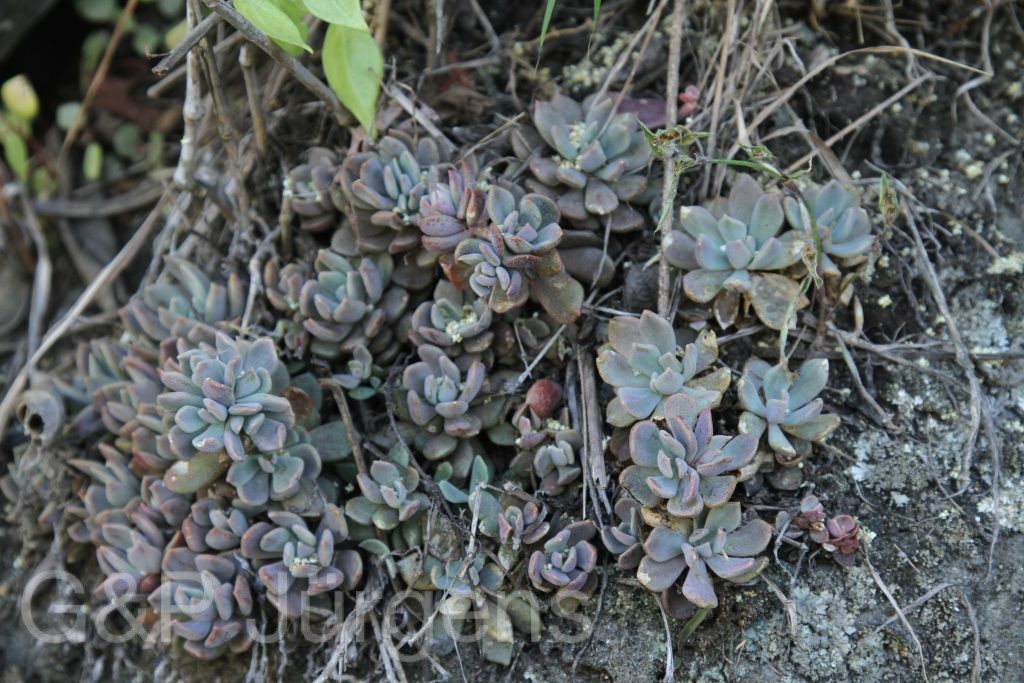
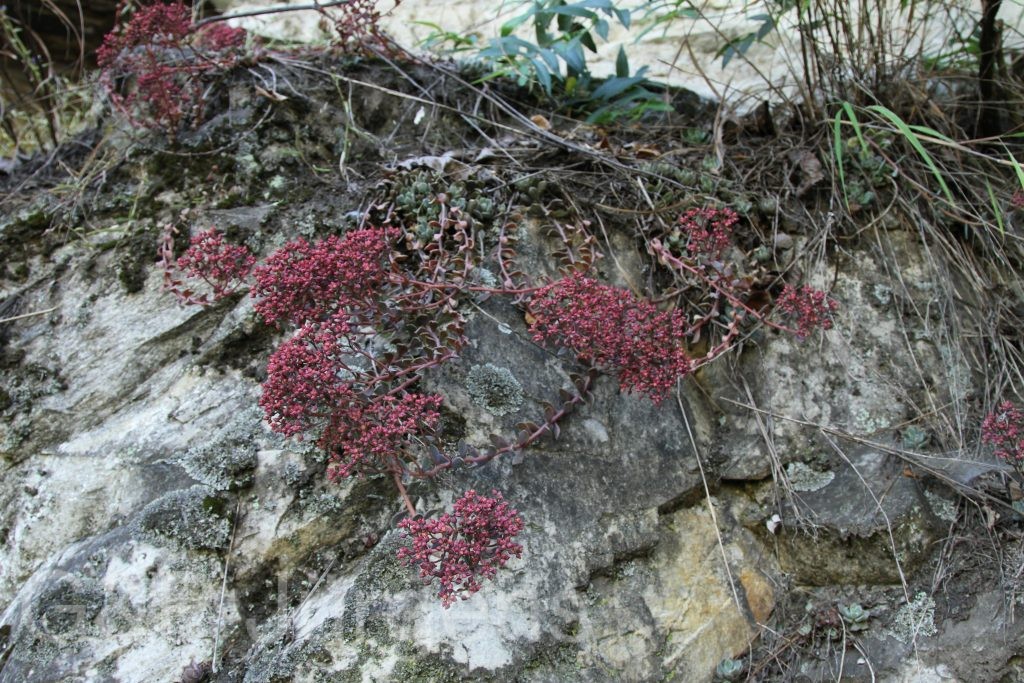
Rosularia adenotricha (Wall. ex Edgew.) C.-A.Jansson is a succulent rosette-forming herb of dry rocky slopes and cliff crevices in the western and central Himalaya and adjacent mountains. GBIF records span India, Pakistan, Afghanistan, Nepal and Bhutan, with scattered occurrences eastward to Myanmar and Thailand and west to Oman, totalling some 200 collections. It is a chasmophyte of warm, well-drained, often sun-exposed rock faces and gravelly banks, typically from low and middle elevations into the subalpine zone; the illustrated material was gathered in Bhutan at Anthso, 980 m, in October, near the lower end of its altitudinal range.

The plant develops compact basal rosettes of fleshy, obovate to spathulate leaves that are densely covered with glandular (adenose) hairs, giving a viscid, greyish-green appearance and accounting for the epithet adenotricha. From the rosette arises an erect, glandular-pubescent flowering stem bearing a cymose or thyrsoid inflorescence. The flowers are 5(–7)-merous with narrow, erect to slightly spreading petals fused only at the base, whitish to pale yellow often flushed pink, the stamens twice as many as the petals; nectar scales subtend each carpel. The fruit is a group of erect, many-seeded follicles.

Rosularia (subfamily Sempervivoideae) is a small Old World genus close to Sempervivum and Prometheum, distinguished by its campanulate, basally connate corolla. The species has been treated under several combinations, reflecting unsettled generic limits within the Sempervivum alliance. As a widespread rock-dwelling succulent it is not considered threatened, though its glandular indumentum makes it a distinctive element of arid Himalayan cliff floras.

Author: (Wall. ex Edgew.) C.-A.Jansson · Sources: POWO (Kew), GBIF, Flora of Pakistan, Flora of Bhutan Vol. 1, Flora of Nepal, Jansson: Studies in Rosularia (Sempervivoideae)