Tag:

Subtropical (<1500 m)

Wedd.

Bhutan2015 180
Bhutan Zhemgang 1000m, October

Description

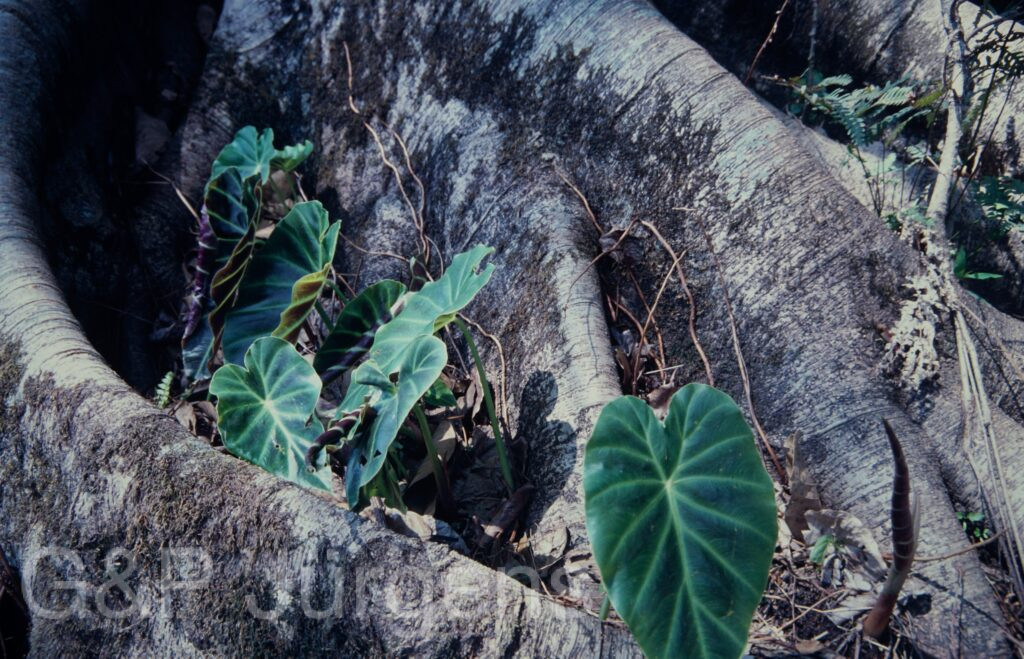
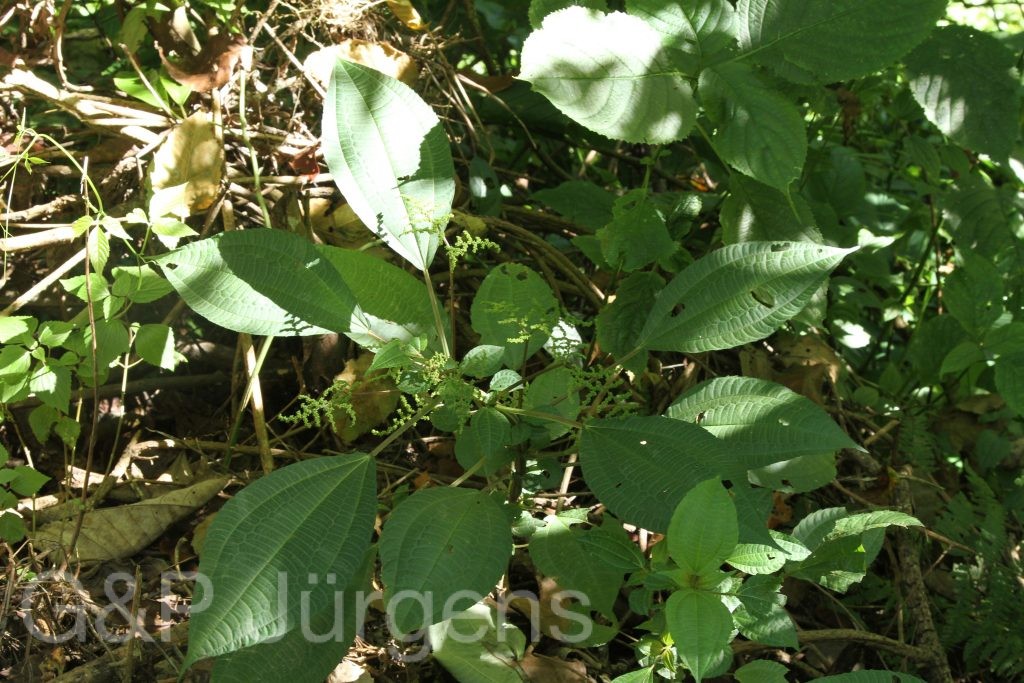
Pilea anisophylla is a perennial herb of the family Urticaceae, widely distributed through the Himalaya and Indo-Malayan region. GBIF records place it in China, Nepal, India, Bhutan, Bangladesh, Myanmar, Thailand and Indonesia, indicating a broad subtropical to warm-temperate range. It is a plant of moist, shaded habitats, growing on damp rocks, mossy boulders, stream banks, forest floors and shaded walls in evergreen and semi-evergreen broad-leaved forest, generally from low elevations up to about 2,500 m. The specimen illustrated from Zhemgang in central Bhutan at roughly 1,000 m in October typifies the humid mid-montane forest where the genus flourishes.

The plant is a soft, fleshy, often somewhat succulent herb with terete, frequently translucent stems that may root at the lower nodes. As the epithet indicates, the paired leaves of each node are strongly anisophyllous, one of the pair being markedly larger than the other; the blades are ovate to elliptic, with a toothed or crenate-serrate margin, three-veined from the base, and dotted with the linear cystoliths characteristic of the family. Stipules are present at the nodes. The flowers are minute, greenish and unisexual, borne in small axillary cymose clusters; like other Urticaceae the staminate flowers have explosively dehiscent stamens that scatter pollen, and the inconspicuous pistillate flowers develop into small, compressed achenes.

Pilea is the largest genus of the nettle family and is taxonomically difficult, with many species separated on subtle vegetative and achene characters; the conspicuous leaf inequality of P. anisophylla is a useful field character. Lacking stinging hairs, the plant is harmless to handle, and as a shade- and moisture-loving understorey herb it is a minor but consistent component of Himalayan forest ground flora. It is not regarded as threatened, its wide range and tolerance of disturbed shaded sites buffering it against habitat change.

Author: Wedd. · Sources: POWO (Kew), GBIF, Flora of China Vol. 5, Flora of Bhutan Vol. 1, Flora of Nepal, Friis: Urticaceae of the Himalaya
Buch.-Ham. ex D. Don

Bhutan2014 293
Bhutan Trithangebe near a farmhouse 800m, May

Description

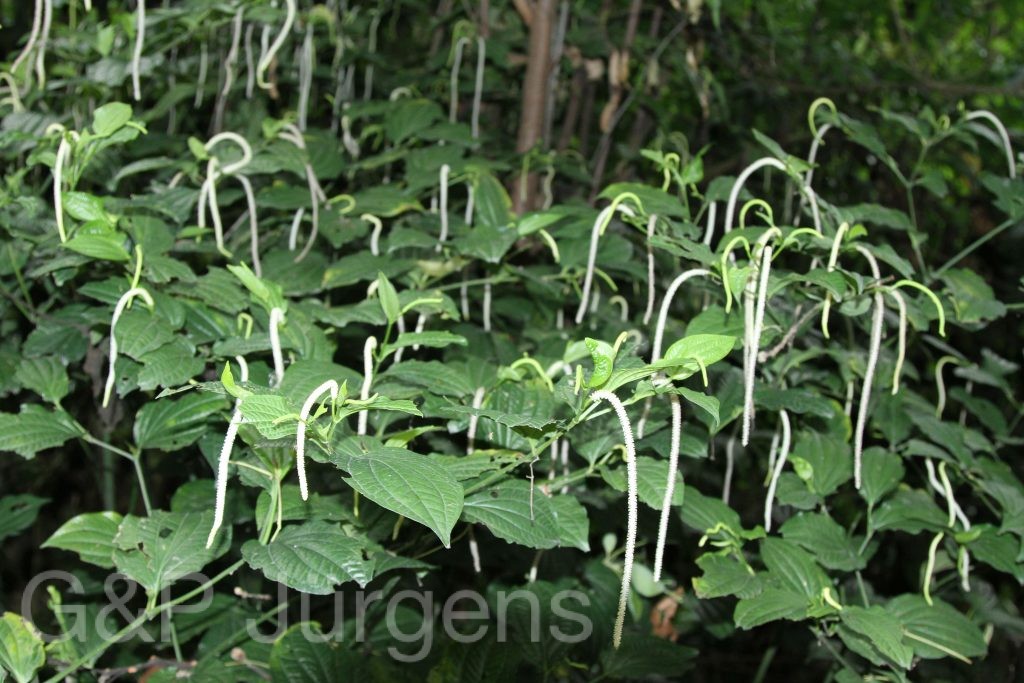
Piper suipigua (Buch.-Ham. ex D. Don) is a climbing pepper of the family Piperaceae distributed across the eastern and central Himalaya and adjacent regions, occurring in India, Nepal, Bhutan, Bangladesh, Thailand and southern China. The roughly 200 GBIF records indicate a relatively narrow but well-defined sub-Himalayan range. It is a plant of warm-temperate to subtropical forest, growing as a root-climber on tree trunks and over rocks, and is frequently encountered in the disturbed margins of cultivation and around dwellings, as reflected in the Bhutanese record from Trithangebe near a farmhouse at 800 m in May. It typically occurs from the foothills to about 1,500 m.

The plant is a woody to herbaceous climber attaching by adventitious clasping roots at the nodes, with somewhat swollen, jointed stems. The leaves are alternate, ovate to ovate-cordate, entire, acuminate at the apex and palmately several-nerved from near the base, the lower surface frequently glandular-dotted. The minute, perianth-less flowers are densely crowded on slender, pendulous or erect spikes opposed to the leaves, each subtended by a peltate bract; the species is generally dioecious. The fruit is a small, sessile, fleshy drupe aggregated into a fleshy fruiting spike.

Piper is a very large pantropical genus of considerable economic importance, including the source of black pepper (P. nigrum) and betel (P. betle). P. suipigua is one of several Himalayan wild peppers whose aromatic leaves and fruits are used locally as a condiment, masticatory and in folk medicine. The genus is characterised by its sympodial growth, swollen nodes and minute flowers densely packed on opposed spikes. Locally common in suitable habitat, the species is not regarded as being of conservation concern.

Author: Buch.-Ham. ex D. Don · Sources: POWO (Kew), Flora of Bhutan Vol. 1, GBIF, Flora of China Vol. 4, Gardner: Pipers of Nepal and the Himalaya

(D.C.) Rehder & E.H. Wilson

Bhutan2014 26
Bhutan Samdrup 850m, May

Description

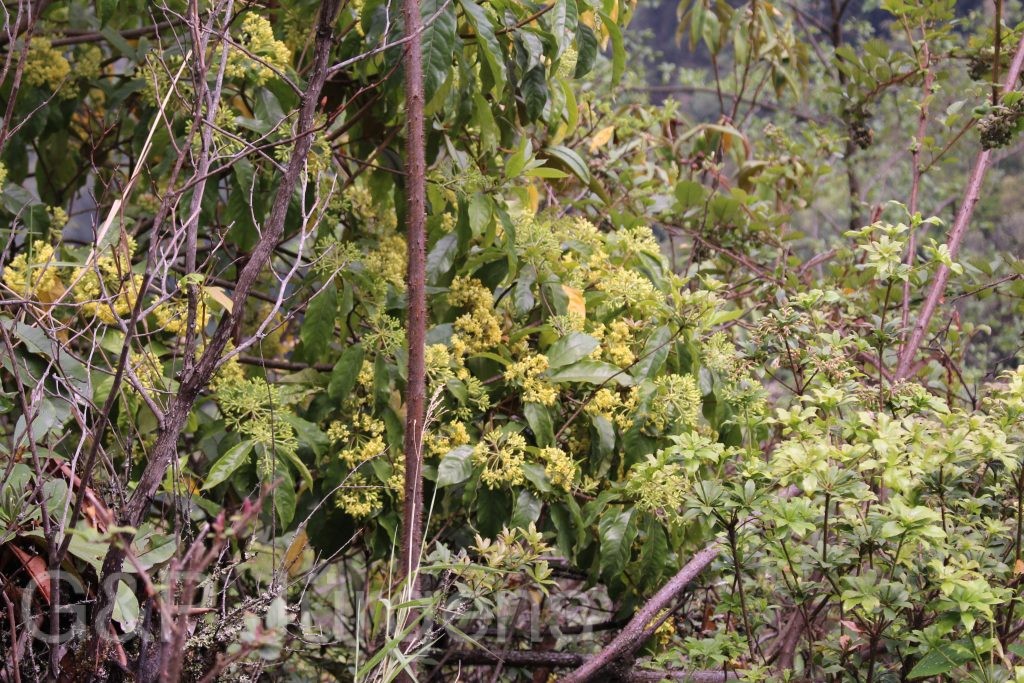
Pittosporum napaulense is an evergreen tree of the Himalaya and adjacent uplands, distributed from northern India and Nepal through Bhutan into southwestern China and Myanmar, with records also from Thailand; GBIF documents over two hundred occurrences across this range. It is a plant of subtropical to warm-temperate broadleaved forest, forest margins and ravine slopes, generally found between about 800 and 2000 m. The tree photographed at Samdrup in southern Bhutan at 850 m, in flower in May, exemplifies this preference for the warm, humid lower foothill forests of the eastern Himalaya, where it grows as an understorey to canopy tree and produces its fragrant flowers in late spring before the onset of the heaviest monsoon rains.

The plant is a small to medium-sized tree with smooth grey bark and glabrous twigs. The leaves are alternate but often crowded toward the branch tips in a pseudo-whorled arrangement, elliptic to oblong-lanceolate, leathery, entire and glossy, with the margins sometimes faintly wavy. The flowers are borne in terminal corymbose panicles and are creamy white to pale yellow and sweetly fragrant; each flower is five-merous, with free petals whose lower portions cohere into a tube and spreading upper lobes, five stamens, and a superior ovary. The fruit is a globose to ovoid woody capsule that splits into valves to expose numerous small seeds embedded in a sticky, resinous orange-red pulp, the viscid coating that gives the genus its name (Pittosporum, "pitch-seed") and aids dispersal by birds.

Pittosporum is a largely Old World genus of trees and shrubs centred on the tropics and subtropics of Asia, Australasia and the Pacific, and P. napaulense is the principal Himalayan representative. The family name is rendered "Pittosporaceaea" in the source; the accepted spelling is Pittosporaceae. The resinous, sticky-seeded capsules are a hallmark of the family, and the bark and leaves of this and related species have featured in local traditional medicine. As a widespread and ecologically adaptable forest tree spanning several countries and a broad elevational band, P. napaulense is not considered threatened, though its lower-elevation forest habitat is subject to ongoing pressure from agriculture and settlement in the densely populated eastern Himalayan foothills.

Author: (D.C.) Rehder & E.H. Wilson · Sources: POWO (Kew), GBIF, Flora of China Vol. 9, Flora of Bhutan Vol. 1 Part 2, Flora of Nepal, A Monograph of the Asian species of Pittosporum (Wenbin Zhang and Hua Peng)

Plumeria rubra

by GP Jürgens

L.

Nepal 97 575 P1112
Nepal Sabha-Khola 550m May
Nepal 1994 36 ergebnis
Ost-Nepal Simbhuwa Kola 
1000m April

Description

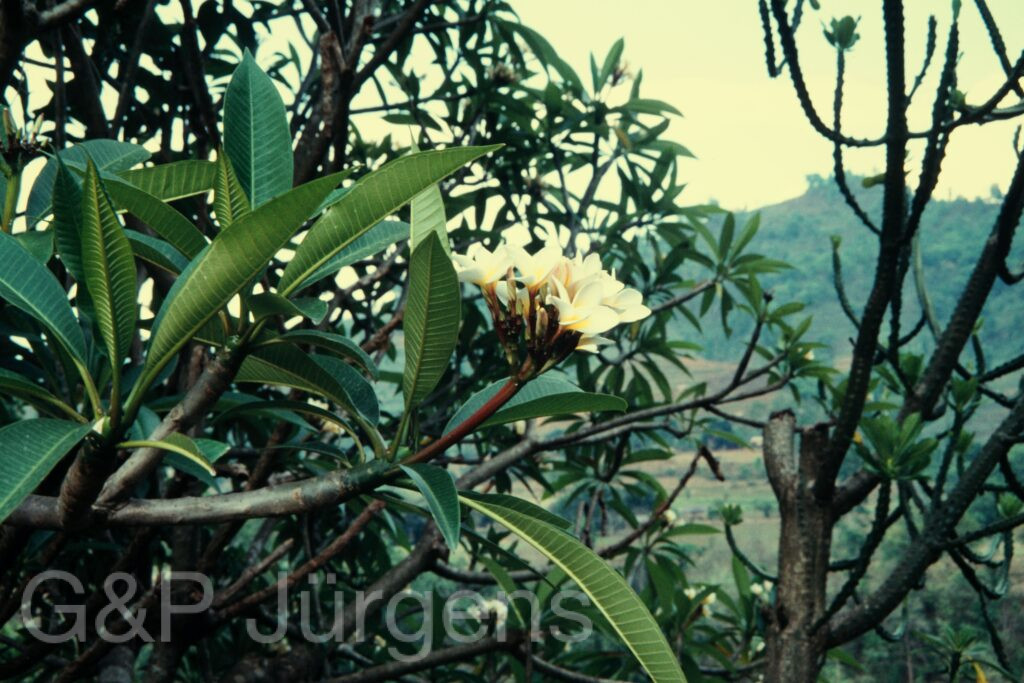
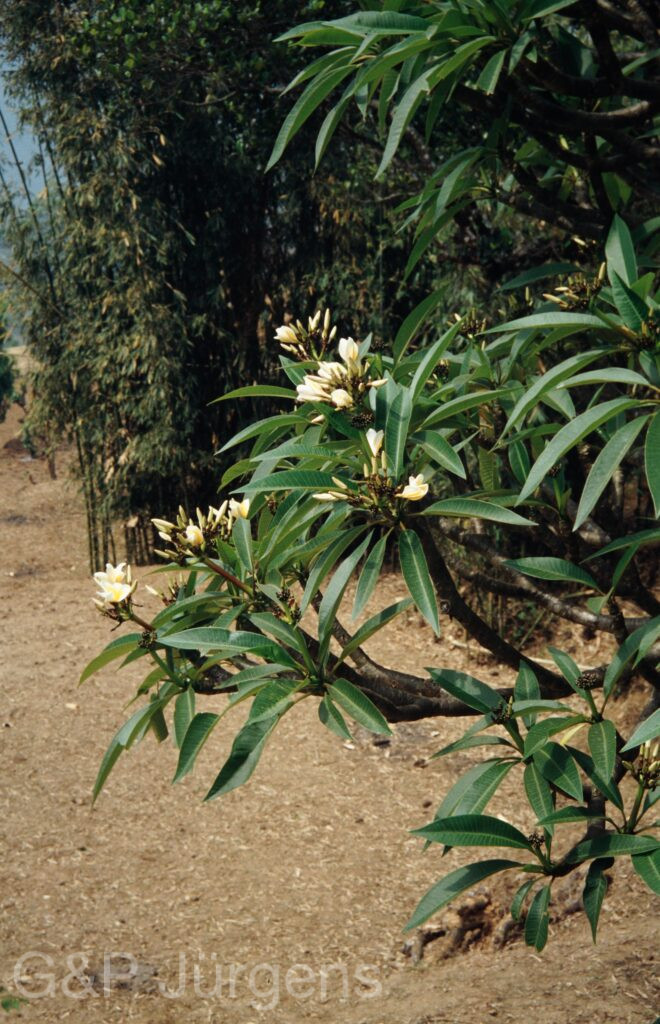
Plumeria rubra, the red frangipani, is a small tree native to Mexico and Central America but now pantropical through cultivation, a spread vividly reflected in its GBIF record of over 11,600 occurrences spanning Mexico, Guatemala, Costa Rica, Panama, Brazil, Colombia, Ecuador, Peru, the United States, India, South Africa, Indonesia, China, French Polynesia and many more. In the Himalayan foothills it is an introduced ornamental and temple tree rather than a wild element; the images from the Sabha-Khola valley (550 m, May) and the Simbhuwa Kola in eastern Nepal (1000 m, April) document it in the warm, frost-free lowland and lower hill zone where it is widely planted around dwellings, gardens and shrines. It tolerates seasonal drought, thriving in open, sunny, well-drained sites and flowering through the warm pre-monsoon and monsoon months.

It is a deciduous tree to about 5-8 m with a spreading crown of stout, blunt, sparingly branched stems exuding copious milky latex when cut. The large, alternate leaves are clustered toward the branch tips, oblong to elliptic-lanceolate, leathery, with prominent pinnate lateral veins joined by a marginal collecting vein. The strongly fragrant flowers are borne in terminal cymes; each has a salverform corolla with five overlapping, asymmetric lobes, typically white to yellow with a yellow eye in many forms but ranging to pink and deep red in the species and its cultivars. The fruit is a pair of divergent, cylindrical follicles releasing numerous winged seeds.

Plumeria belongs to the Apocynaceae subfamily Rauvolfioideae and comprises several New World species, of which P. rubra is the most variable and most widely grown, hybridising freely in cultivation. Its latex contains the iridoid glycoside plumieride and related compounds, and the plant carries deep cultural significance across South and Southeast Asia for use in offerings and garlands. Though of conservation concern nowhere because of its vast cultivated range, in the Himalaya it persists entirely as a human-introduced ornamental and has not naturalised into native forest.

Author: L. · Sources: POWO (Kew), GBIF, Flora of China Vol. 16, Flora of Nepal, Woodson's revision of Plumeria (Apocynaceae of the New World)

D.Don

Bhutan2015 187
Bhutan Zhemgang 1000m, October
Bhutan2015 188
Bhutan Zhemgang 1000m, October
Bhutan2014 194
Bhutan Trashyangtse 2100m, May
Bhutan2014 195
Bhutan Trashyangtse 2100m, May

Description

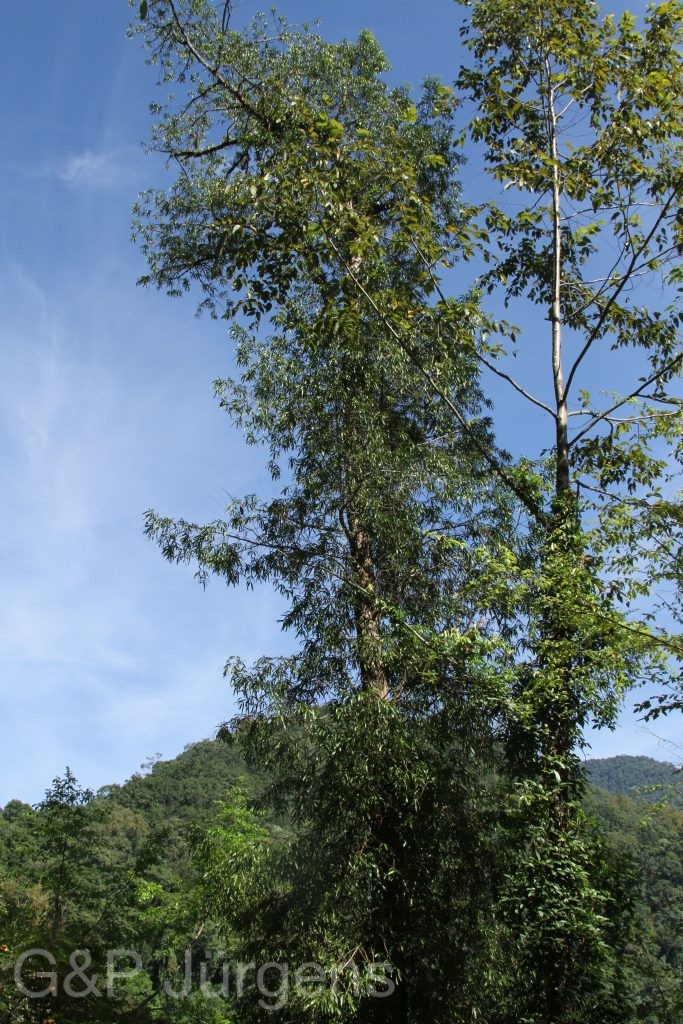
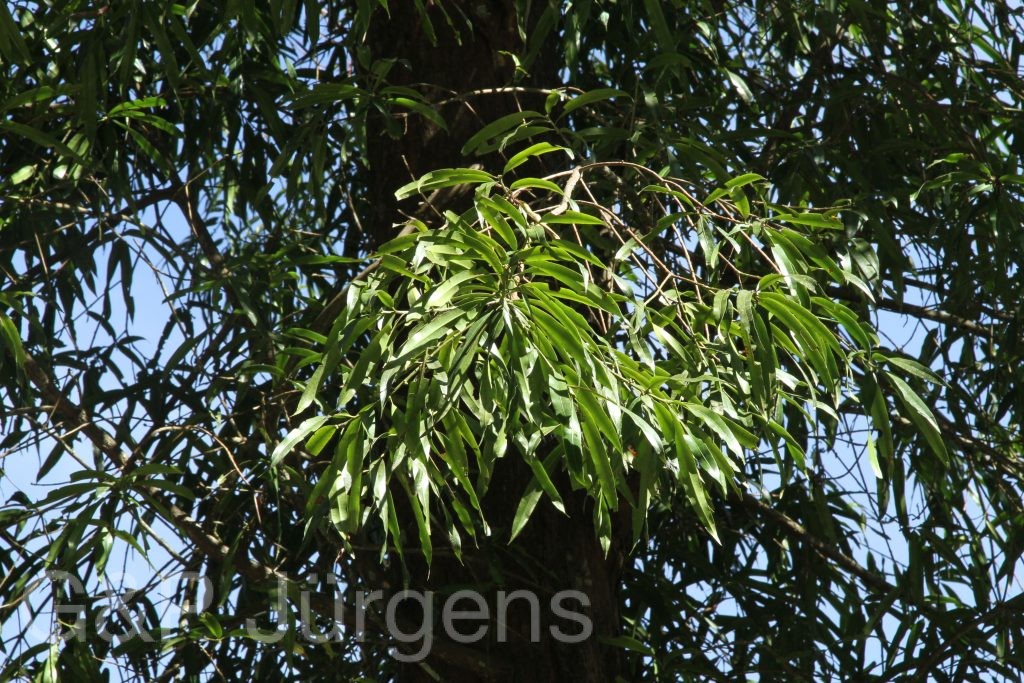
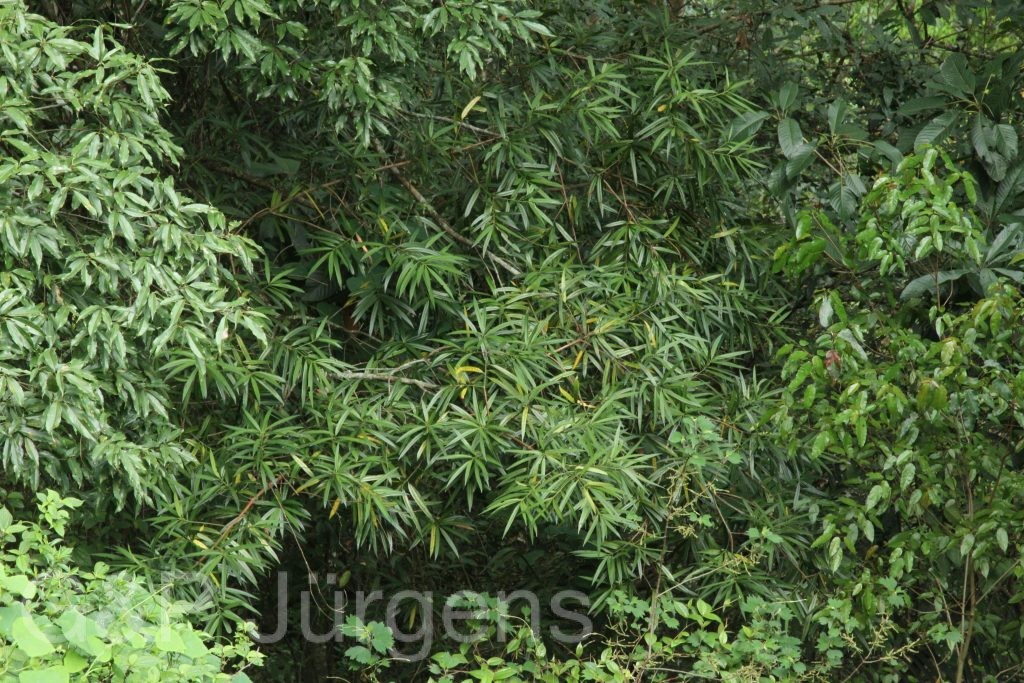
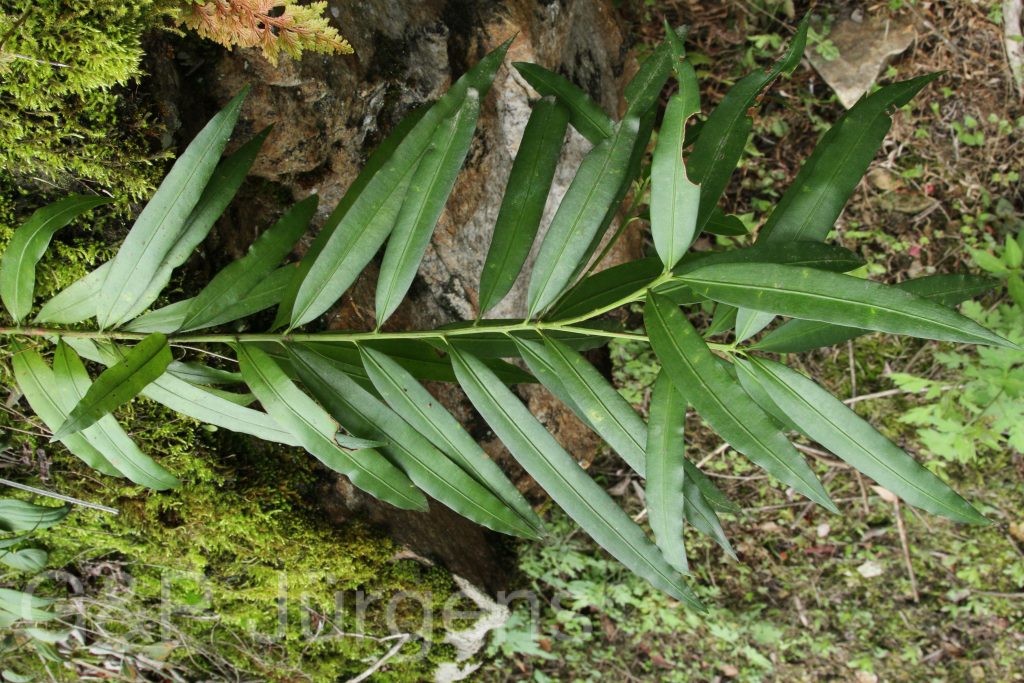
Podocarpus neriifolius, the brown pine or oleander-leaved podocarp, is a broadly distributed evergreen conifer of tropical and subtropical Asia and the western Pacific, with GBIF recording over 3,100 occurrences from Papua New Guinea, Fiji, Indonesia, Vietnam, China, Malaysia, the Solomon Islands, the Philippines, India, Thailand, Nepal, Vanuatu, Cambodia, Laos and beyond. In the eastern Himalaya it occurs in warm broad-leaved and mixed forest of the foothills and lower mountains, generally between about 500 and 2100 m. The images from Zhemgang in Bhutan at 1000 m, in October, and from Trashyangtse at 2100 m, in May, bracket its altitudinal range in that country, showing it as a scattered emergent or canopy tree in humid, evergreen subtropical forest on well-drained slopes.

It is an evergreen tree commonly 10-25 m tall, occasionally much larger, with grey to brown, fibrous, flaking bark and a dense crown. The leaves are spirally arranged but often appearing two-ranked, simple, narrowly lanceolate and leathery with a prominent midrib and a long, gradually tapering apex, recalling the foliage of oleander as the epithet indicates. The species is dioecious: pollen cones are slender, cylindrical and borne in leaf axils, while the seed cones are reduced to one or two ovules seated on a swollen, fleshy receptacle (the epimatium and aril) that ripens red to purple, the single seed crowned by a green to bluish covering and dispersed by birds.

Podocarpus is the largest genus of the Southern Hemisphere-centred family Podocarpaceae, and P. neriifolius is among its most wide-ranging species, exhibiting considerable variation in leaf size across its vast area. It is valued for its fine, even timber, which has led to local overexploitation, though its enormous geographic range means it is assessed by the IUCN as Least Concern overall. In the Himalaya it represents a tropical-Gondwanan conifer lineage reaching its northern limits in the warm forests of the eastern foothills.

Author: D.Don · Sources: POWO (Kew), GBIF, Flora of China Vol. 4, Flora of Bhutan Vol. 1, Flora of Nepal, de Laubenfels' revision of Podocarpus and the Podocarpaceae

D.Don

Sikkim 2006 261 ergebnis
India West-Bengal, Lingza 1300m, May

Description

Polygonum microcephalum is a herb of the eastern Himalaya and montane Southeast Asia, widely distributed from Nepal and north-east India through Bhutan and south-western China (Yunnan, Sichuan, Xizang) to northern Myanmar and Vietnam. The very large global occurrence figures returned under the accepted genus Persicaria reflect aggregated records of the broader complex; this taxon is properly treated as Persicaria microcephala (D. Don) H. Gross. It grows in moist, shaded situations — forest understorey, streamsides, ditches and disturbed clearings — chiefly between about 800 and 2,800 m. The plant photographed at Lingza in West Bengal, India, at 1,300 m in May represents its typical low-montane subtropical broadleaf forest habitat.

It is a perennial herb with slender, often reddish, ascending to scrambling stems rooting at the lower nodes, the swollen nodes sheathed by membranous, cylindrical ochreae. The leaves are alternate, ovate to broadly lanceolate, acuminate, frequently marked with a dark chevron and red venation, the surfaces sometimes finely pubescent. The flowers are minute and aggregated into small, dense, head-like or short-spike inflorescences, the perianth of five tepals white to pinkish; stamens commonly eight. The fruit is a trigonous, dark, shining achene enclosed within the persistent perianth.

The segregation of Persicaria from Polygonum sensu lato, supported by molecular phylogenetics, places this species in a large genus characterised by ochreate sheaths and capitate or spiciform inflorescences. The dark-marked, often red-flushed foliage has brought certain forms into cultivation. The species is widespread, ecologically adaptable and of no conservation concern, behaving locally as a colonist of disturbed ground.

Author: D.Don · Sources: POWO (Kew), Flora of China Vol. 5, Flora of Bhutan Vol. 1, GBIF, Hong et al.: Polygonaceae in Flora of China

L.

Nepal 97 548 P1074
Nepal Sabha-Khola 530m May

Description

Pontederia hastata is an aquatic to semi-aquatic herb of tropical and subtropical Asia and Australasia, with 931 GBIF occurrences extending from India, Nepal, China and Sri Lanka through Southeast Asia to the Philippines, Papua New Guinea, Fiji and northern Australia. It grows in still and slow-moving fresh water, inhabiting ponds, ditches, marshes, paddy fields and the margins of streams and pools in the lowlands and low hills. The plant recorded along the Sabha-Khola in Nepal at 530 m in May exemplifies its lowland wetland habitat, where it grows rooted in shallow water or mud and flowers in the warm pre-monsoon period.

The species is a perennial, more or less emergent herb arising from a creeping rhizome and rooting at the nodes. The leaves are long-petiolate, the petioles sometimes slightly spongy and inflated, bearing sagittate to hastate blades with diverging basal lobes that give the plant its epithet. The flowers are borne in a dense spike or raceme subtended by a leaf-like spathe; each is bluish to pale violet, with six perianth segments fused below into a tube, six stamens often differing in length, and a tricarpellate ovary. The fruit is a capsule enclosing numerous small seeds dispersed by water.

The taxon has long been known as Monochoria hastata, reflected in the source link, but Monochoria is now subsumed within an enlarged Pontederia on phylogenetic grounds, making Pontederia hastata the accepted name. Like its relatives, the plant is an effective coloniser of disturbed aquatic and agricultural wetlands; it is widely used as a leaf vegetable and remains common, of no conservation concern across its broad range.

Author: L. · Sources: POWO (Kew), GBIF, Flora of China Vol. 24, Flora of Bhutan Vol. 3, Flora of Nepal, Flora of Pakistan, Pellegrini's revision of Pontederiaceae

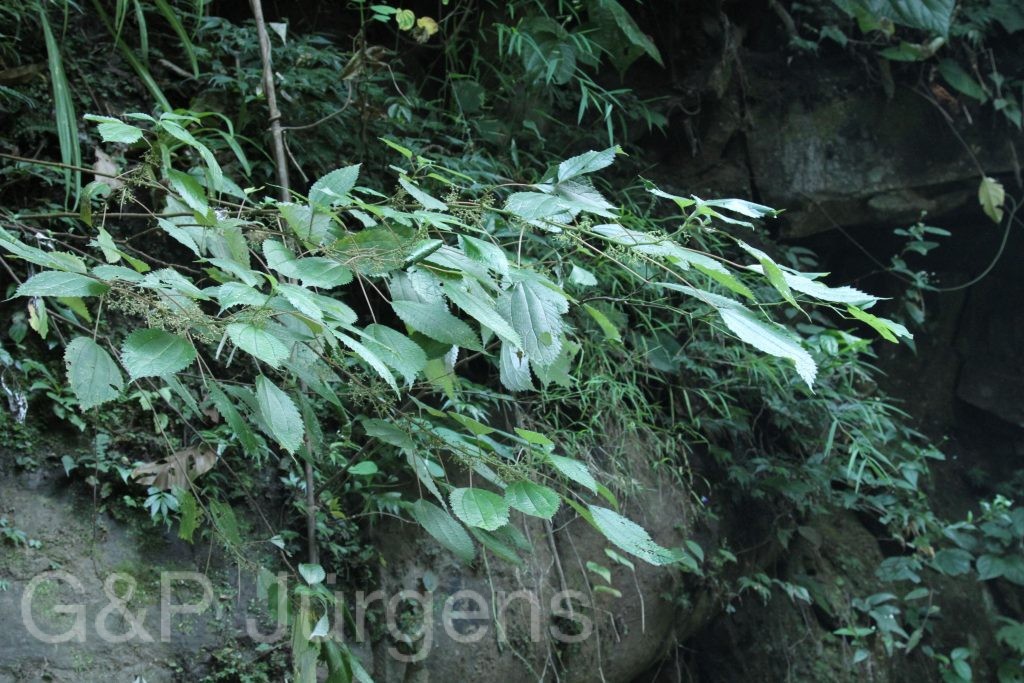
(Blume) Merr.

Bhutan2015 274
Bhutan Zhemgang 1000m, October

Description

Pouzolzia sanguinea (Blume) Merr. is a widespread shrub of the nettle family ranging through tropical and subtropical Asia, from the Himalaya and India eastward to China, Taiwan, Japan, and across Southeast Asia to Indonesia, Malaysia and the Philippines; GBIF holds over 3100 occurrences. It is a plant of forest margins, secondary scrub, ravines, roadside banks and disturbed slopes at low to mid elevations, ascending into the warm broad-leaved zone. In Bhutan it was recorded at Zhemgang at about 1000 m in October, a subtropical hill setting typical of its preference for humid, partially shaded ground in the outer ranges.

It is an erect to spreading shrub with terete, often reddish or purple-tinged young branches that are appressed-pubescent. The leaves are alternate, ovate to elliptic-lanceolate, acuminate, with three prominent basal veins, the upper surface scabrid or strigose and the lower paler and pubescent; stipules are present and the leaves lack the stinging hairs of true nettles. The plant is monoecious, the small greenish flowers borne in dense axillary glomerules, with unisexual perianths; the female flowers develop into a small, shining, longitudinally ribbed achene enclosed by the persistent accrescent perianth.

The species is taxonomically variable and several infraspecific variants have been recognised across its broad range, contributing to a tangled synonymy under Pouzolzia. Like many Urticaceae it yields a strong bast fibre and is used locally for cordage, while leaves serve as fodder and in folk medicine. Its tolerance of disturbance and wide ecological amplitude make it a common pioneer rather than a species of conservation concern, and it figures as a characteristic element of regenerating Himalayan hill forest.

Author: (Blume) Merr. · Sources: POWO (Kew), GBIF, Flora of China, Flora of Bhutan, Flora of British India, Urticaceae monograph (Friis; Wilmot-Dear & Friis revision of Pouzolzia)

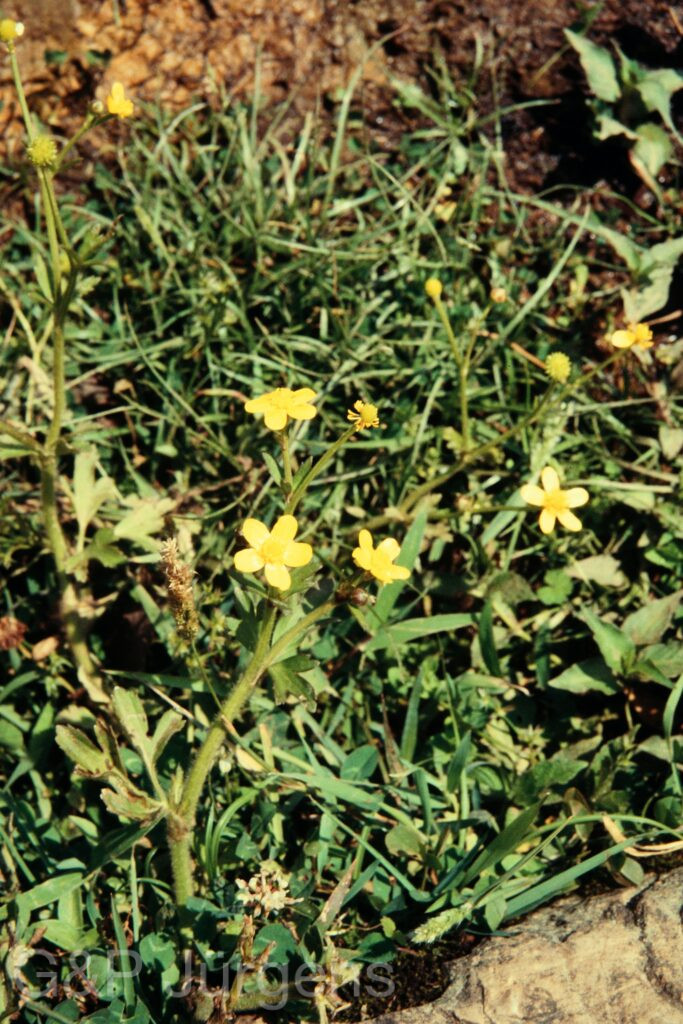
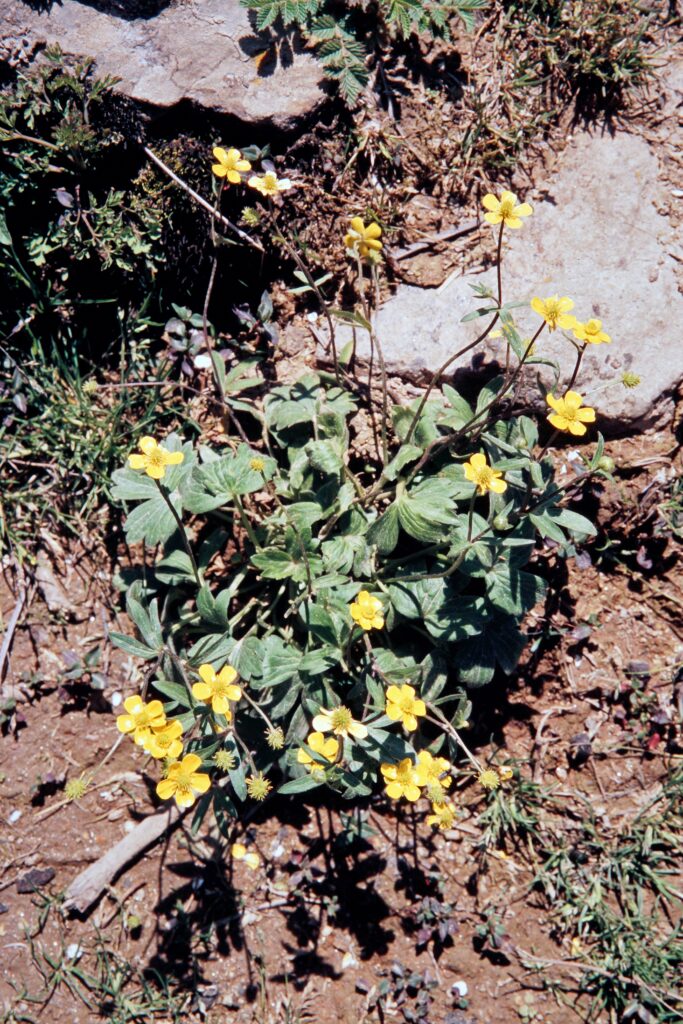
DC.

Nepal 97 611 P1182
Nepal Godawari 1350m May
Garh 07 47 ergebnis
India Garhwal Mandakini 2360m, June

Description

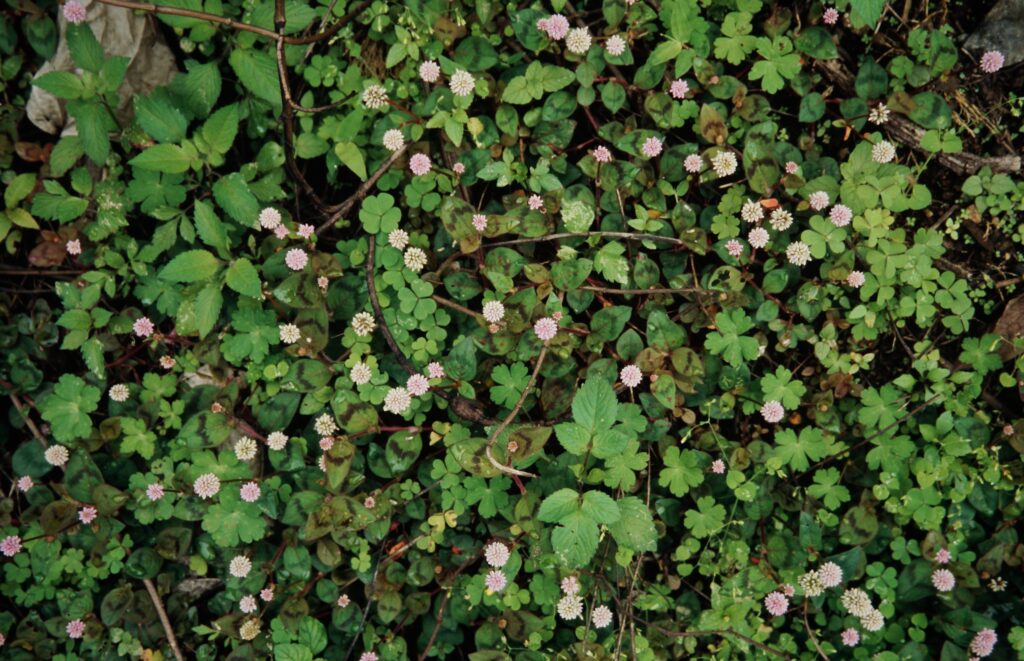
Ranunculus diffusus is a widely distributed buttercup of the Himalaya and montane Asia, recorded from India, Nepal, China, Pakistan, Bhutan, Myanmar, Vietnam, Malaysia, Indonesia, Sri Lanka and Taiwan, with some 618 occurrences in GBIF. It favours moist, shaded habitats such as forest floors, streamsides, damp banks and the margins of cultivation, ranging widely from the subtropical foothills into the temperate zone, roughly between 1000 and 3000 m. The photographs from Godawari in Nepal at about 1350 m in May and from the Mandakini valley in Garhwal at about 2360 m in June illustrate its broad ecological and altitudinal tolerance across the spring and early-monsoon flowering period.

The plant is a perennial herb with slender, diffusely spreading and often decumbent or rooting stems, the habit that gives the species its name. The basal and lower leaves are long-petioled and ternately divided into three lobed and toothed segments, more or less hairy. The flowers are small, solitary or few on slender pedicels, with usually five spreading, reflexed sepals and five glossy yellow petals each bearing a nectary scale at the base, surrounding numerous stamens and carpels. The fruiting head is a globose to ovoid cluster of small, compressed achenes tipped by a short curved or hooked beak.

Within the cosmopolitan genus Ranunculus, R. diffusus is a member of the diverse Asian assemblage of small-flowered, woodland and streamside buttercups and shows considerable variation in leaf division and pubescence across its wide range. Like most buttercups it contains the acrid glycoside ranunculin, rendering it unpalatable and somewhat toxic to livestock. Common and ecologically plastic, it is not of conservation concern and frequently behaves as a weed of moist disturbed ground.

Author: DC. · Sources: POWO (Kew), GBIF, Flora of China, Flora of Bhutan, Annotated Checklist of the Flowering Plants of Nepal, Tamura's treatment of Ranunculaceae

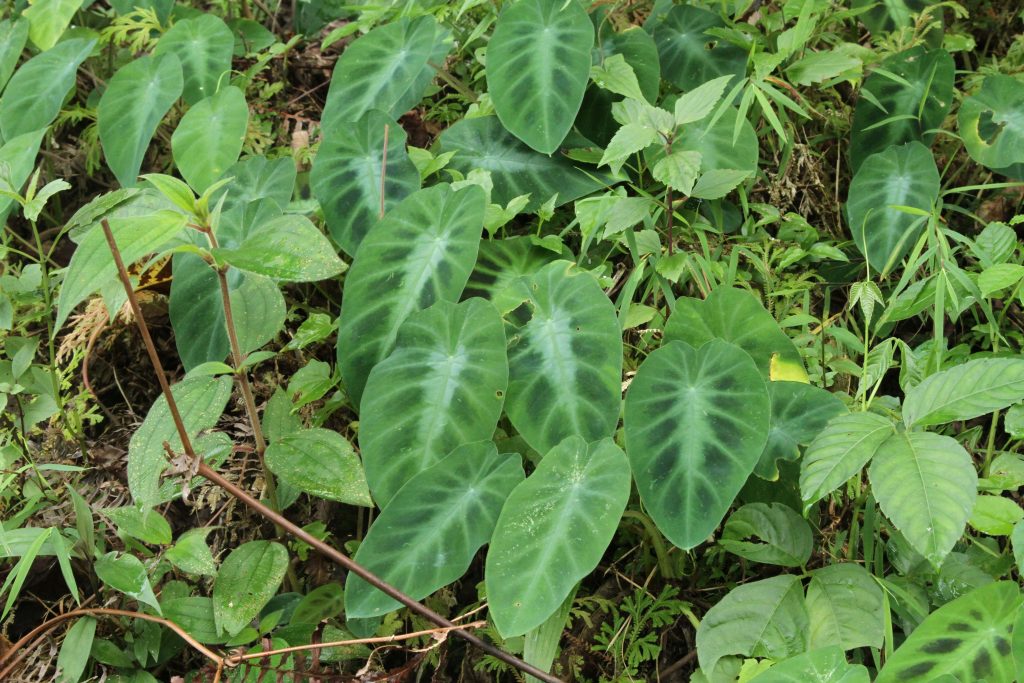
Remusatia pumila

by GP Jürgens

(D.Don) H.Li & A.Hay

Bhutan2012 715
Bhutan Galephu 850m, October
Nepal 1994 228 ergebnis
Ost-Nepal Mewa-Khola 1900m April 

Description

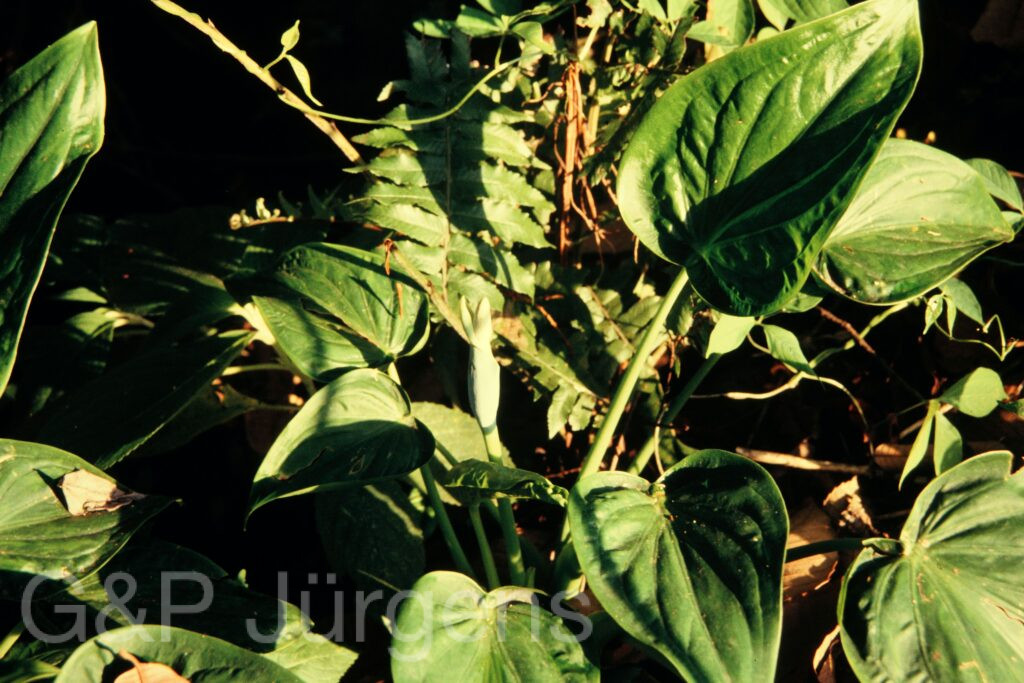
Remusatia pumila (D.Don) H.Li & A.Hay is a small tuberous aroid of the eastern Himalaya and Indo-Burmese region, documented by about 269 records spanning India, Nepal, Bhutan, China, Myanmar, Thailand, Malaysia, Indonesia and Vietnam, with naturalised reports elsewhere. It grows as a lithophyte and epiphyte on mossy rocks, boulders and tree trunks in humid broad-leaved and subtropical forest, favouring shaded, seepage-moistened microsites. The cited gatherings from Galephu in southern Bhutan at 850 m in October and the Mewa Khola of East Nepal at 1900 m in April reflect its span across the warm-temperate to subtropical foothill belt.

The plant is a diminutive geophyte arising from a small subglobose tuber that produces clusters of bulbil-bearing structures. The leaves are few, with slender petioles and ovate to ovate-cordate, peltate or sagittate blades. As in all Remusatia, vegetative reproduction is conspicuous: erect to spreading bulbiliferous shoots bear numerous hooked, scale-covered bulbils that detach and disperse epizoochorously. The inflorescence is a spathe enclosing a spadix with basal female and upper male flower zones separated by sterile flowers; flowering is comparatively infrequent relative to the prolific bulbil production.

The species was long placed in Gonatanthus, a genus now subsumed within Remusatia, the combination reflecting molecular and morphological reassessment of the tribe Colocasieae. Reliance on hooked bulbils for dispersal by passing animals is a key adaptation to its epilithic and epiphytic, often ephemerally exposed habitats. Widespread and locally frequent, it is not considered threatened, though its dependence on undisturbed humid forest links its persistence to lowland and submontane habitat integrity.

Author: (D.Don) H.Li & A.Hay · Sources: POWO (Kew), GBIF, Flora of China, Flora of Bhutan, Flora of Nepal, Araceae of the Indian subcontinent / monograph of Remusatia and Colocasieae