Tag:

Summer

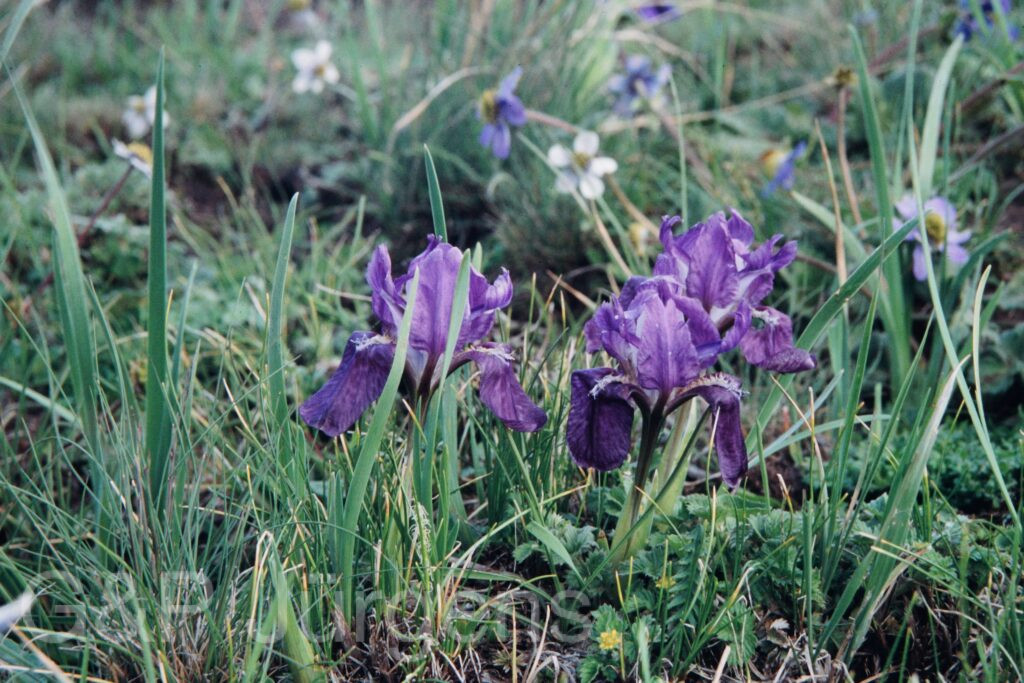
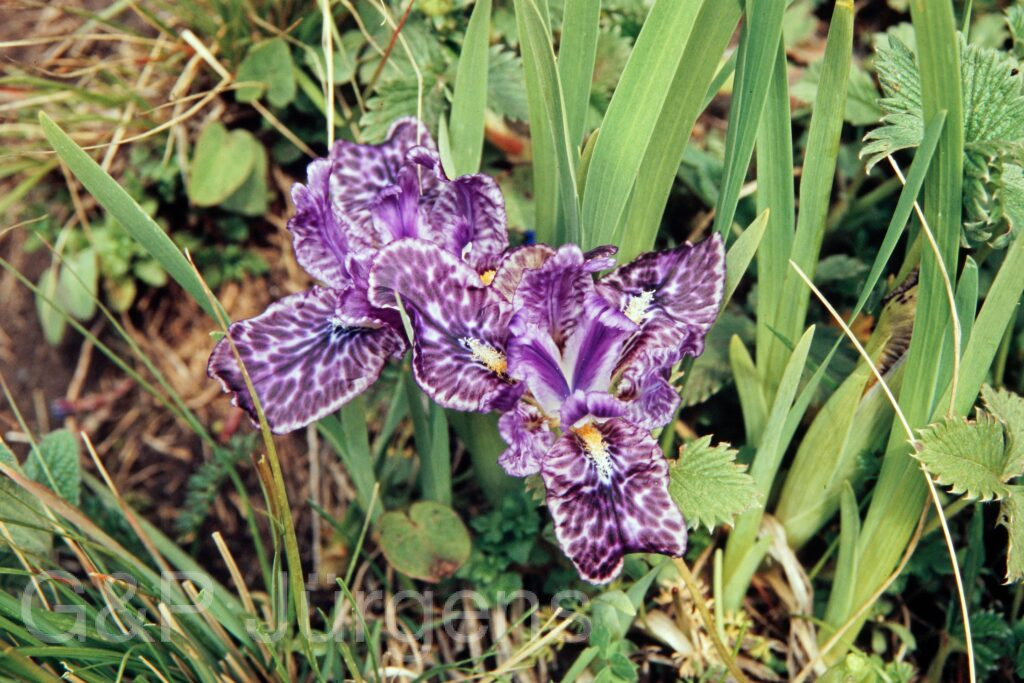
Iris kemaonensis

by GP Jürgens

Wall. ex D.Don

Nepal 99 299 ergebnis
West-Nepal Kalmura 4200m, June
Nepal 99 298 ergebnis
West-Nepal Kalmura 4200m, June
Garh 07 172 ergebnis
India Garhwal Kinkhola 3545m, June

Description

Iris kemaonensis is a dwarf alpine iris of the Himalaya and adjacent ranges, distributed across Pakistan, Nepal, NW India, Bhutan and SW China, with 346 GBIF occurrences. It grows on open alpine meadows, grassy slopes, stony pastures and recently snow-freed ground in the upper subalpine to alpine zone. The cited collections from Kalmura in West Nepal at about 4,200 m and Kinkhola in Garhwal at 3,545 m, both in June, are characteristic of its early-summer flowering as snow melts on high turf, where it forms low scattered clumps.

It is a rhizomatous perennial with a short, stout, branching rhizome bearing fibrous remains of old leaves. The leaves are linear-ensiform, appearing with or shortly after the flowers and elongating considerably as the fruit ripens. The flowers are usually solitary and almost sessile at ground level, lilac to pale purple, mottled and spotted with deeper purple; the falls are obovate with a yellow or white beard along the median crest, the standards smaller and erect. The perianth tube is long and slender, raising the flower above the spathes. The fruit is a trigonous capsule, often borne on an elongating stalk emerging after anthesis.

The species belongs to Iris subgen. Pseudoregelia, the bearded, mottled-flowered, rhizomatous group centred on the Himalaya and Central Asia. GBIF records it as accepted. It is a charismatic, ground-hugging alpine bearing close ecological resemblance to other cushion-meadow geophytes, and remains widespread and unthreatened, though locally subject to grazing pressure.

Author: Wall. ex D.Don · Sources: POWO (Kew), Flora of China Vol. 24, Flora of Bhutan Vol. 3, GBIF, Mathew: The Iris (1989)
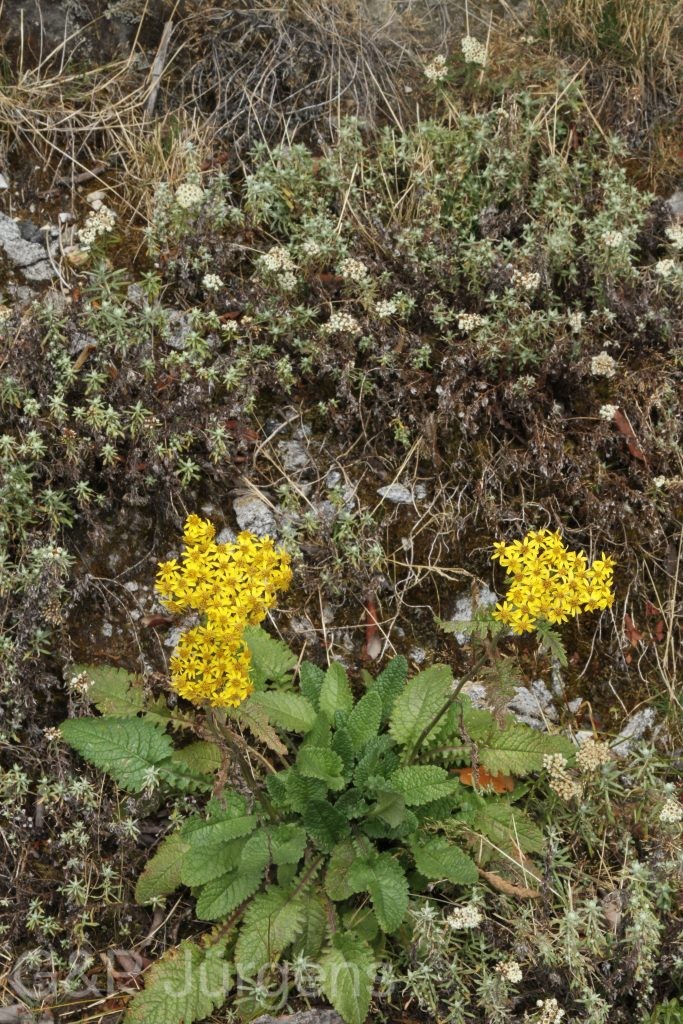
(Wall. ex DC.) B.Nord.

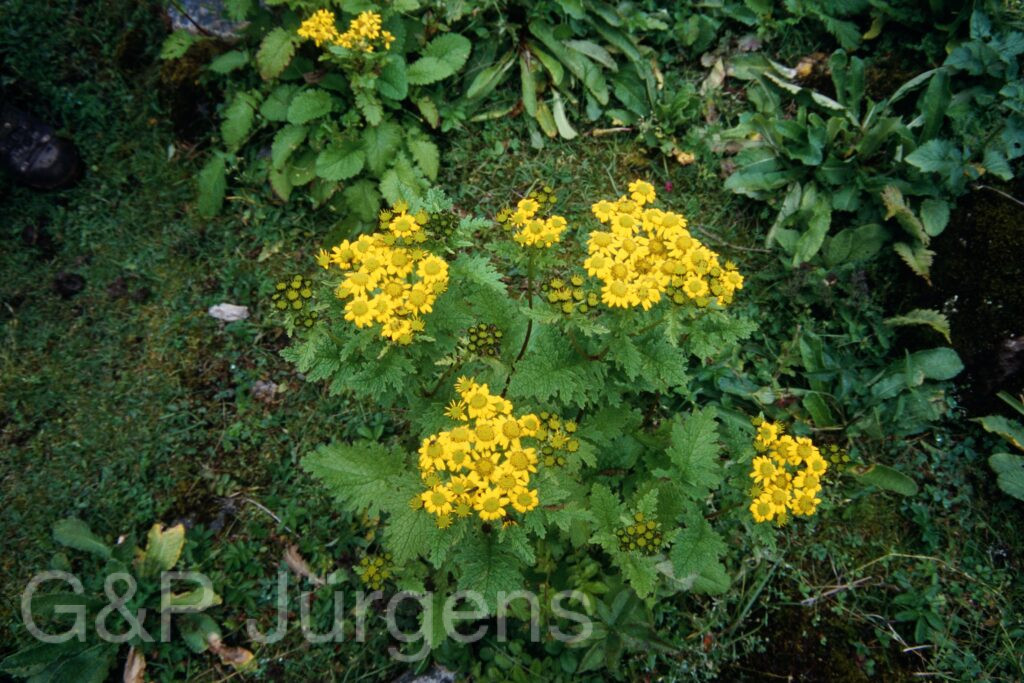
Sikkim2003 444 G617
Sikkim Chopta Valley 3900m August
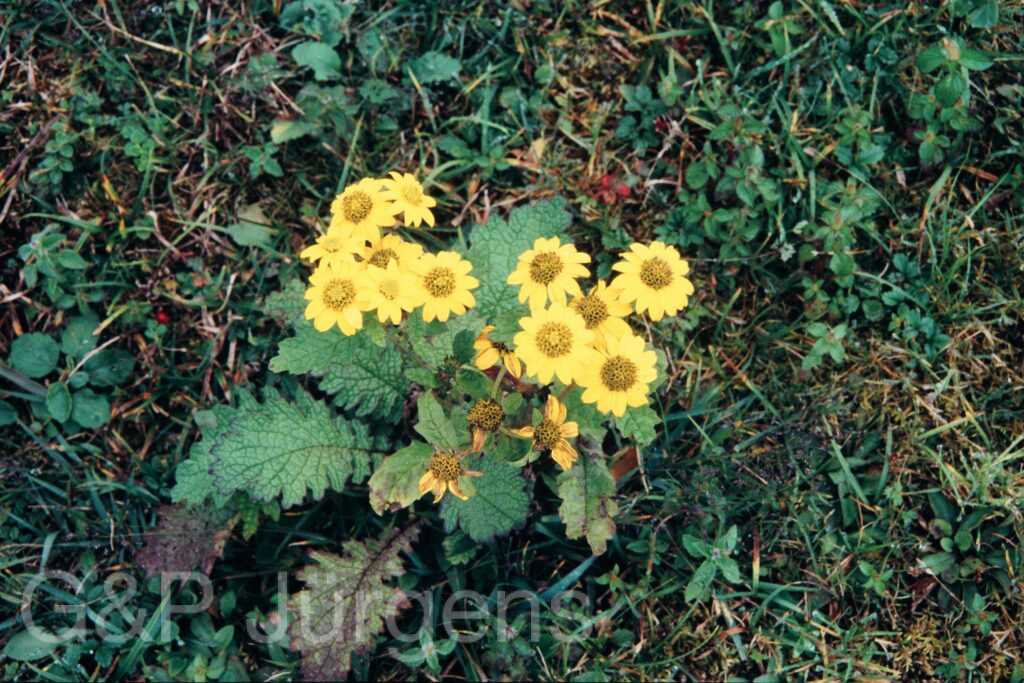
Nepal 95 130 P222 ergebnis
Nepal south of Rupien La 3600m October
Bhutan2015 379
Bhutan Tumching-La 4000m, October

Description

Jacobaea raphanifolia is a perennial herb of the high Himalaya and adjoining mountains of central Asia, recorded by GBIF (some 202 occurrences) from Nepal, India, China, Bhutan, Afghanistan, Pakistan and Myanmar, with scattered records reaching Kenya and South Africa that probably reflect cultivated or naturalised material. It is a plant of the upper subalpine and alpine zones, favouring moist meadows, streamsides, open scrub and damp rocky slopes. The species was photographed across a broad altitudinal band, in the Chopta Valley of Sikkim at about 3900 m in August, south of the Rupien La in Nepal at 3600 m in October, and on the Tumching La in Bhutan near 4000 m, a range centred between roughly 3500 and 4200 m.

It forms an erect, somewhat stout herb arising from a short, fibrous-rooted rhizome, with simple or branched leafy stems. The lower leaves are lyrate-pinnatifid to runcinate with a large terminal lobe, recalling a radish (raphanifolia), the margins toothed and the surfaces sparsely hairy; cauline leaves become smaller, sessile and often auriculate upwards. The capitula are radiate, several to many in a loose terminal corymb, subtended by a single row of narrow green phyllaries with a few short calyculate bracts. Ray florets are yellow, female and ligulate; the disc florets yellow, tubular and bisexual. The fruit is a ribbed, cylindrical cypsela crowned by a pappus of fine white capillary bristles.

The species belongs to a complex of montane ragworts segregated from Senecio into Jacobaea on molecular and morphological grounds. As a wide-ranging meadow herb of the alpine pastures it is locally common and of no conservation concern, though like many Senecioneae it contains pyrrolizidine alkaloids and is generally avoided by grazing stock, a trait that may favour its persistence in heavily pastured high valleys.

Author: (Wall. ex DC.) B.Nord. · Sources: POWO (Kew), GBIF, Flora of Bhutan, Flora of China, Annotated Checklist of the Flowering Plants of Nepal, Nordenstam's revision of Jacobaea and the Senecioneae

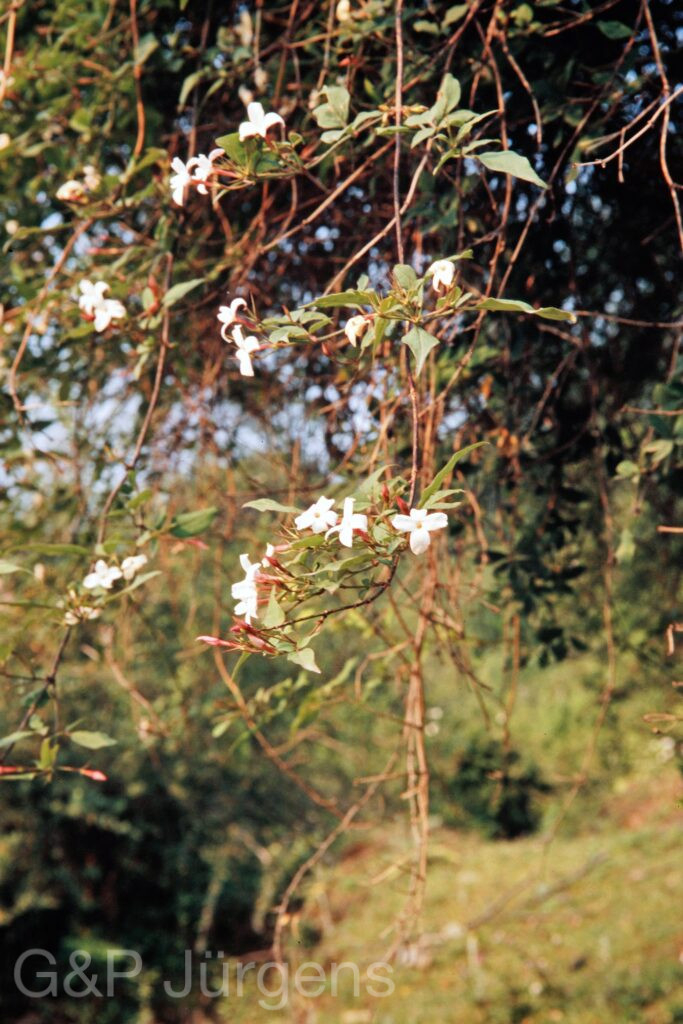
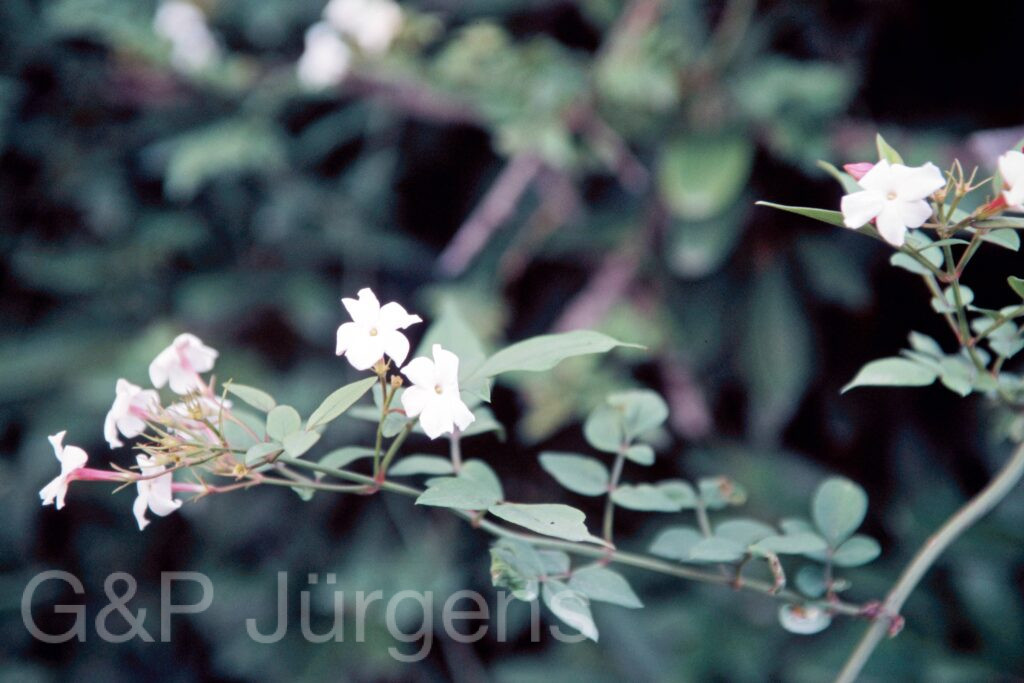
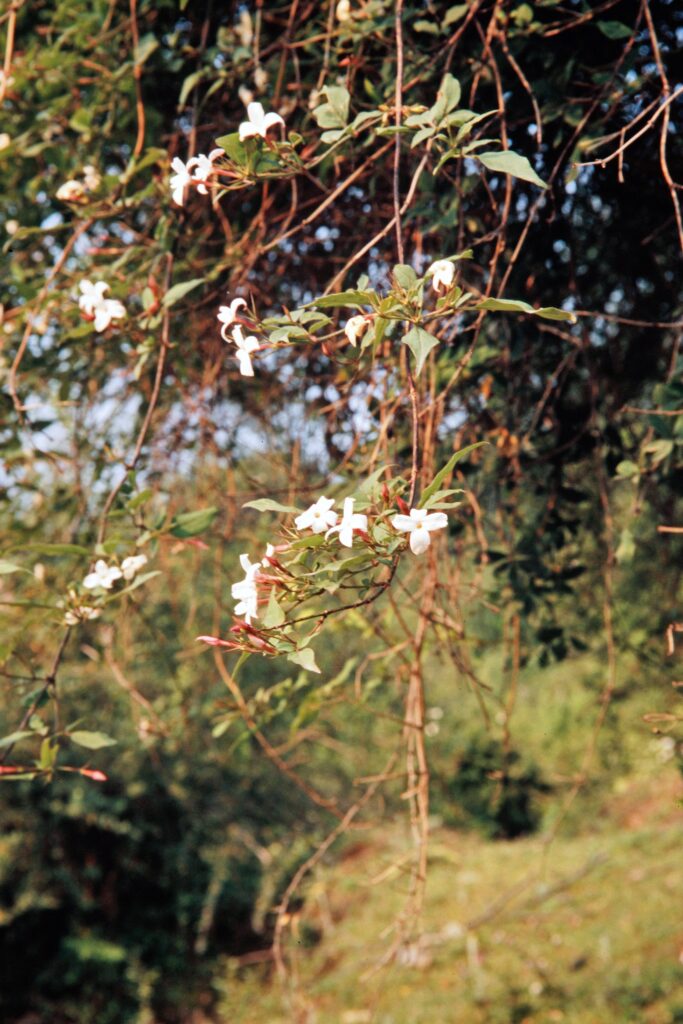
L.

Garh 07 94 ergebnis
India Garhwal Meggu Kichatti 3100m, June
Garh 07 309 ergebnis
India Garhwal Bebra 2400m, June

Description

Jasminum officinale, the common or poet's jasmine, is native to the Caucasus, Central Asia and the Himalaya through Afghanistan, Pakistan, N India, Nepal and SW China, but is so widely cultivated that GBIF's 3,200-plus records span France, Britain, Spain, Italy, the United States, Australia and beyond, reflecting naturalisation far outside its native range. In its Himalayan homeland it is a plant of open forest, scrub, thickets and rocky slopes. The photographed material from Garhwal in the Indian Himalaya, at Meggu Kichatti (3,100 m) and Bebra (2,400 m) in June, illustrates its occurrence on warm temperate to subalpine slopes between roughly 1,500 and 3,100 m.

It is a deciduous or semi-evergreen scrambling shrub with slender, angular, twining green branches. The leaves are opposite and imparipinnate, with usually five to nine ovate-lanceolate, acuminate leaflets, the terminal leaflet longer and stalked. The fragrant flowers are borne in terminal and axillary cymes; each has a slender corolla tube expanding into four to five spreading white lobes, often flushed pink in bud. The fruit is a black, two-lobed berry, though fruiting is uncommon in cultivated clones.

The intense evening fragrance, produced by volatile esters and indole, attracts moths and other long-tongued nocturnal pollinators and underlies the long economic history of the species in the perfume and tea-scenting industries. Numerous cultivars and forms exist, including the hardy var. affine. As an extensively cultivated and locally naturalising species it is of no conservation concern, and indeed can behave as a garden escape in mild-climate regions worldwide.

Author: L. · Sources: POWO (Kew), Flora of Pakistan, GBIF, Flora of China Vol. 15, Green: A Revision of the Genus Jasminum (Kew Bulletin)

L. (Aiton)

Garh 07 94 ergebnis
India Garhwal Trijugi Narayan 2250m, June

Description

Jasminum sambac, the Arabian jasmine, is believed to be native to a broad region extending from the Indian subcontinent through Southeast Asia, though its precise original range is obscured by millennia of cultivation. It is now widely grown and naturalized throughout the tropics and subtropics, with GBIF records from over 40 countries including India, China, Indonesia, the Philippines, Thailand, and numerous Pacific islands. The species typically occurs at low to moderate elevations in warm, humid climates, though it has been documented at Trijugi Narayan in the Garhwal Himalaya of Uttarakhand at 2,250 m in June, likely in a cultivated or semi-naturalized context near this important pilgrimage site, representing an unusually high-elevation occurrence.
Jasminum sambac is an evergreen or semi-deciduous scandent shrub or vine, 0.5–3 m tall, with terete, pubescent young branches. Leaves are opposite, simple (unusual in Jasminum, where most species have compound leaves), broadly ovate to elliptic, 4–12 cm long and 2–7 cm wide, with an obtuse to rounded apex, entire margins, and a glossy, dark green upper surface. The inflorescence is a terminal or axillary cyme bearing three to twelve flowers. Flowers are highly fragrant, with a tubular calyx bearing eight to ten linear lobes and a salverform corolla with a slender tube 10–15 mm long and typically eight to nine oblong, spreading, pure white lobes. In cultivated double-flowered forms, the petals are greatly multiplied. The fruit is a globose, two-lobed berry approximately 8 mm in diameter, black when ripe, though fruiting is rare in cultivated plants.
Jasminum sambac holds profound cultural, religious, and economic significance across Asia. It is the national flower of the Philippines (sampaguita) and one of three national flowers of Indonesia (melati putih), used extensively in religious ceremonies, garlands, and traditional medicine throughout South and Southeast Asia. The flowers are a major source of jasmine absolute and essential oil used in the perfume industry and are the traditional scenting agent for jasmine tea in China. Taxonomically, J. sambac is placed in Jasminum section Unifoliolata, reflecting its simple (unifoliolate) leaves. The species was first described by Linnaeus as Nyctanthes sambac and later transferred to Jasminum by Aiton in 1789.

Author: L. (Aiton) · Sources: POWO (Kew), GBIF, Flora of China Vol. 15, Green: A Revision of Jasminum in Asia and Australia (2003), Mabberley: Mabberley's Plant-Book (2017)

Sam.

Sikkim2011 378
Sikkim Lada-La 3400, June

Description

Juncus cephalostigma is a Himalayan rush distributed from Nepal through Sikkim and adjacent India to Bhutan, northern Myanmar and south-western China, with about 139 GBIF records reflecting a restricted eastern Himalayan to Sino-Himalayan range. It is a plant of wet alpine and subalpine habitats: marshy meadows, streamsides, seepage slopes, springs and the margins of pools, generally between about 3,000 and 4,200 m. The plant photographed at Lada-La in Sikkim at 3,400 m, flowering in June, is typical of the cool, perennially moist high-montane grasslands and mires where rushes of this group thrive.

The plant is a tufted perennial herb growing from a short rhizome, with slender, erect, terete to compressed stems. The leaves are basal and cauline, grass-like, with the characteristic open or closed tubular sheaths of the genus. The inflorescence is a small terminal or pseudolateral cluster of few flowers, often condensed into a head (the epithet cephalostigma alluding to the head-like stigmatic arrangement); each flower has six small, scarious-margined, brownish to greenish tepals, six (or three) stamens, and a superior ovary crowned by a style with three stigmas. The fruit is a small loculicidal capsule containing numerous minute seeds.

Juncus is the largest genus of Juncaceae, a wind-pollinated family of cosmopolitan, mostly cool-climate and wetland graminoid herbs. The Himalayan rushes form a taxonomically demanding assemblage in which species are separated by fine characters of the inflorescence, capsule and seed. As an inhabitant of high-altitude wetlands, J. cephalostigma is sensitive to hydrological change and grazing, though it is not currently regarded as threatened.

Author: Sam. · Sources: POWO (Kew), Flora of China Vol. 24, Flora of Bhutan Vol. 3, GBIF, Kirschner: Juncaceae (Species Plantarum: Flora of the World)

D.Don

Sikkim2011 200
Sikkim Yumthang 3300m, June

Description

Juncus concinnus is a tufted, grass-like perennial rush of the Juncaceae, distributed through the Himalaya and the mountains of eastern Asia. GBIF data (nearly 1,000 occurrences) document a native range across China, Nepal, India, Bhutan, Pakistan, Japan, Myanmar and Thailand. The species is characteristic of moist alpine and subalpine habitats, including wet meadows, marshy ground, streamsides, seepage flushes and damp grassy slopes, generally between about 2,500 and 4,500 m. The collection from Yumthang in northern Sikkim at 3,300 m in June reflects its occurrence in the wet, snow-fed alpine meadows of the eastern Himalaya in early summer.

The plant forms dense tufts of slender, erect, terete to slightly compressed stems arising from a short rhizome, with narrow, channelled basal and cauline leaves. The inflorescence is a more or less compact, terminal cluster of several flower heads, each head comprising a few small, dark-coloured flowers. As in all Juncus, the perianth consists of six chaffy, lanceolate tepals (the inner and outer whorls similar), subtending three or six stamens and a superior ovary. The fruit is a small, three-valved loculicidal capsule containing numerous minute seeds, the chaffy perianth persisting around it.

Juncus is a large, cosmopolitan genus of the rush family, an assemblage of wind-pollinated, reduced-flowered monocots adapted predominantly to wet and seasonally inundated ground. As a component of alpine mire and wet-meadow vegetation, J. concinnus contributes to the structure of high-altitude wetland turf and stabilises moist soils. Widely distributed and secure across its range, it nonetheless depends on intact alpine hydrology, making it sensitive to wetland drainage and to changes in snowmelt regimes.

Author: D.Don · Sources: POWO (Kew), Flora of China Vol. 24, Flora of Bhutan Vol. 3, GBIF, Kirschner et al.: Juncaceae – Species Plantarum: Flora of the World

Fisch. & C.A.Mey.

Sikkim2011 92
Sikkim Chopta-valley 4300m, June
Nepal1992 120 P170 ergebnis
Nepal Ghunsa 3400m March

Description

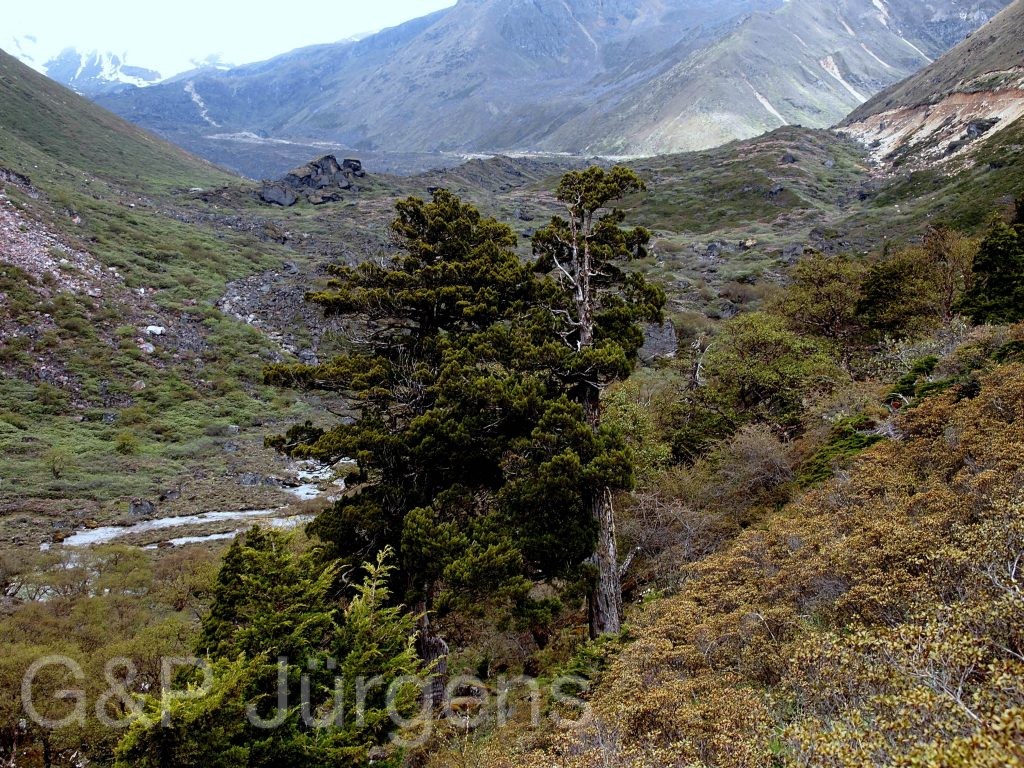
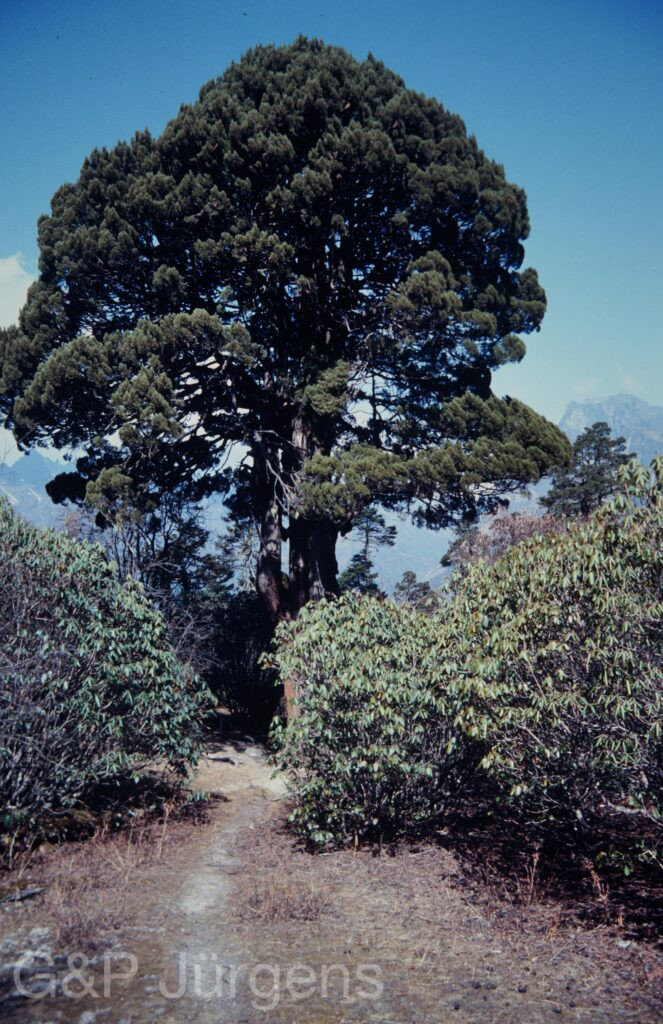
Juniperus pseudosabina is a coniferous shrub of the high mountains of Central Asia and the Himalaya, with GBIF documenting around 1678 occurrences across Russia, Kazakhstan, China, Uzbekistan, Mongolia, Kyrgyzstan, Pakistan, Tajikistan, India, Nepal, Afghanistan and Bhutan. It is a constituent of the upper subalpine and alpine zones, forming krummholz and prostrate thickets on stony slopes, rocky ridges, moraines and at the timberline. The photographed plants were recorded in Sikkim's Chopta valley at 4300 m in June and at Ghunsa in Nepal at 3400 m in March, illustrating its occupation of cold, exposed high-montane sites near and above the tree limit.

It is typically a low, spreading, mat-forming or procumbent shrub, occasionally a small tree, with reddish-brown shredding bark. The foliage is mostly squamiform (scale-like), with small, closely appressed, rhombic leaves bearing a conspicuous dorsal resin gland; needle-like juvenile leaves may persist on vigorous shoots. The species is usually dioecious; the pollen cones are small and terminal, while the seed cones are berry-like galbuli that ripen blue-black to purplish-black, are glaucous, and characteristically contain a single large seed.

GBIF accepts the name. Belonging to section Sabina, the multi-seeded and single-seeded savin junipers, J. pseudosabina is closely allied to several Himalayan and Central Asian junipers with which it has been taxonomically confused. Its galbuli are dispersed by birds, and the dwarfed, wind-pruned habit reflects adaptation to severe alpine exposure. Wide-ranging and locally abundant, it is assessed as of least concern.

Author: Fisch. & C.A.Mey. · Sources: POWO (Kew), GBIF, Flora of China, Flora of Nepal, Farjon monograph of Juniperus

(Royle ex Benth.) Rupr.

Sikkim2003 197 P275
Sikkim Dzongri 4100m 08.2003
Nepal 99 650 ergebnis
West-Nepal Kagmara-La 5000m, July
Nepal 99 648 ergebnis
West-Nepal Kagmara-La 5000m, July
Nepal 99 662 ergebnis
West-Nepal Kagmara-La 5000m, July

Description

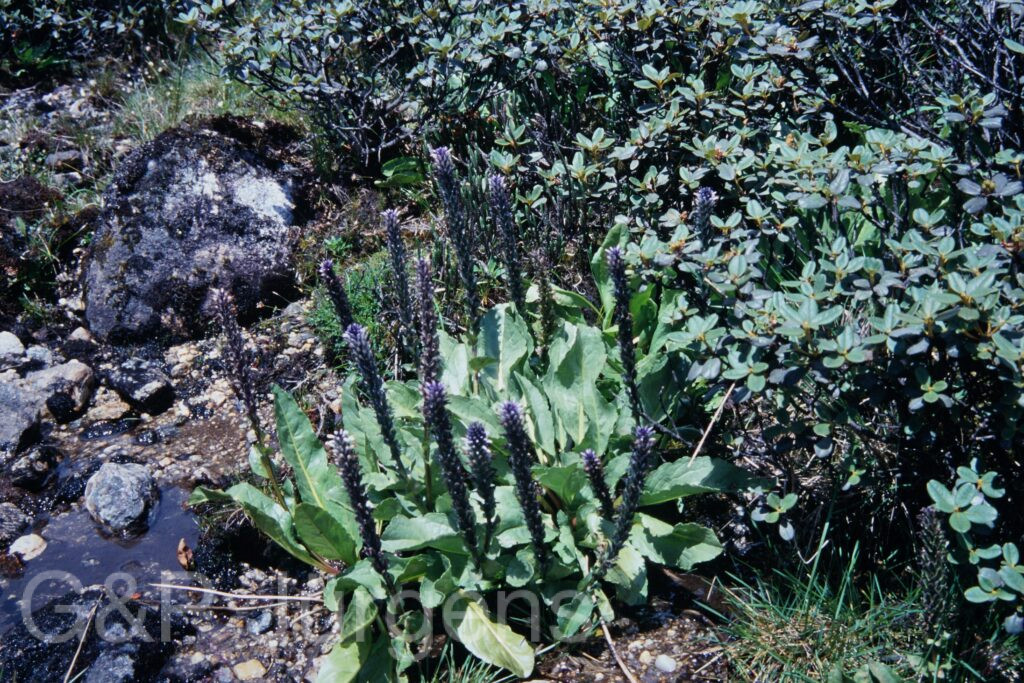
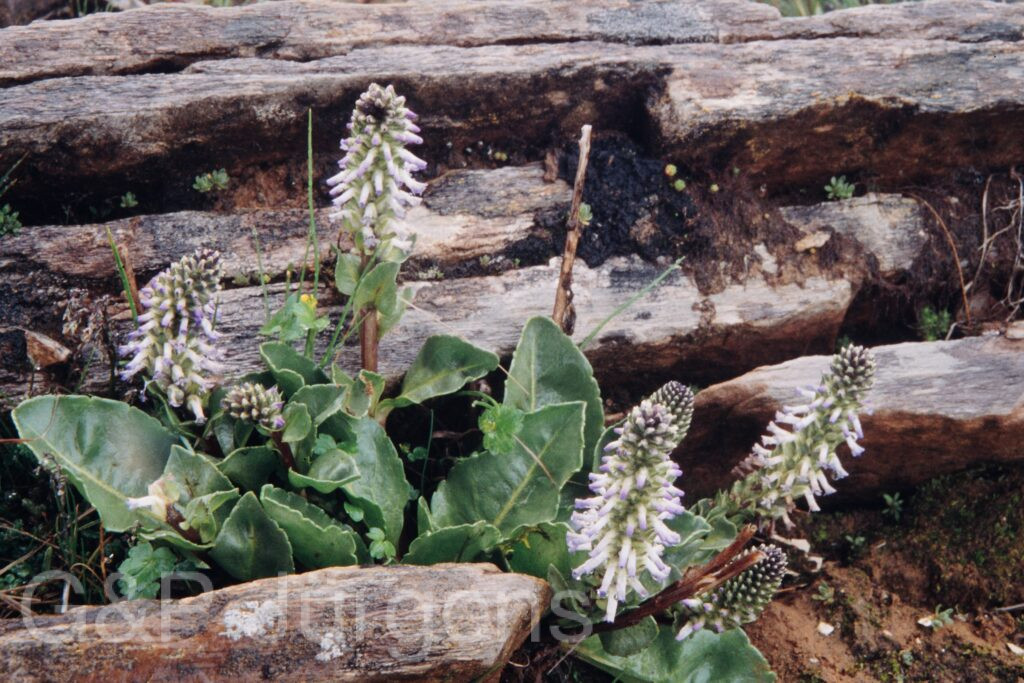
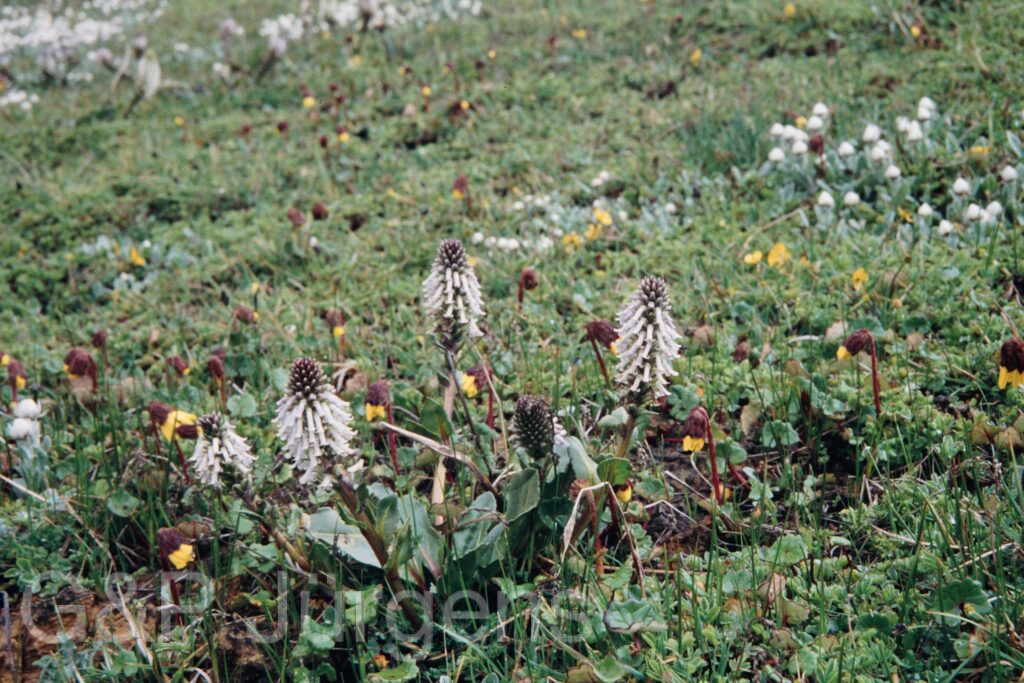
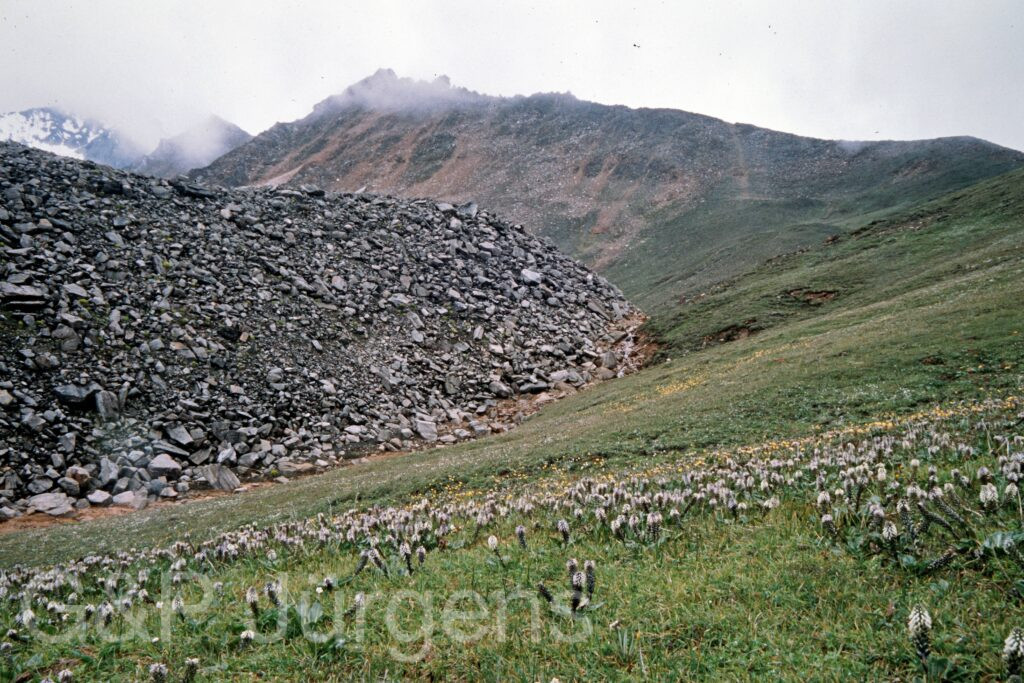
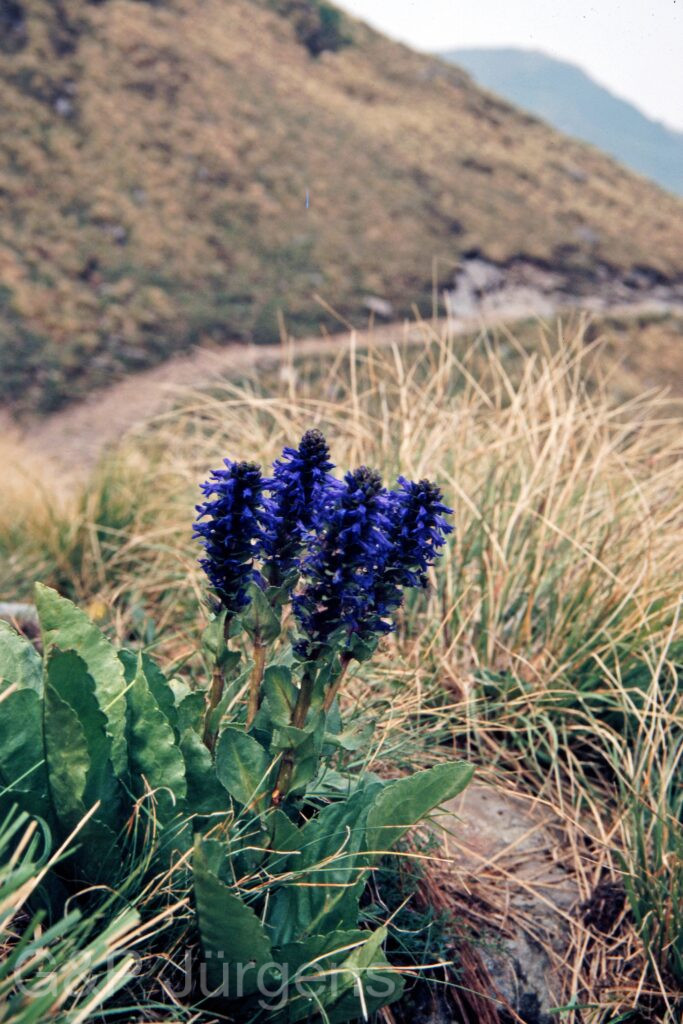
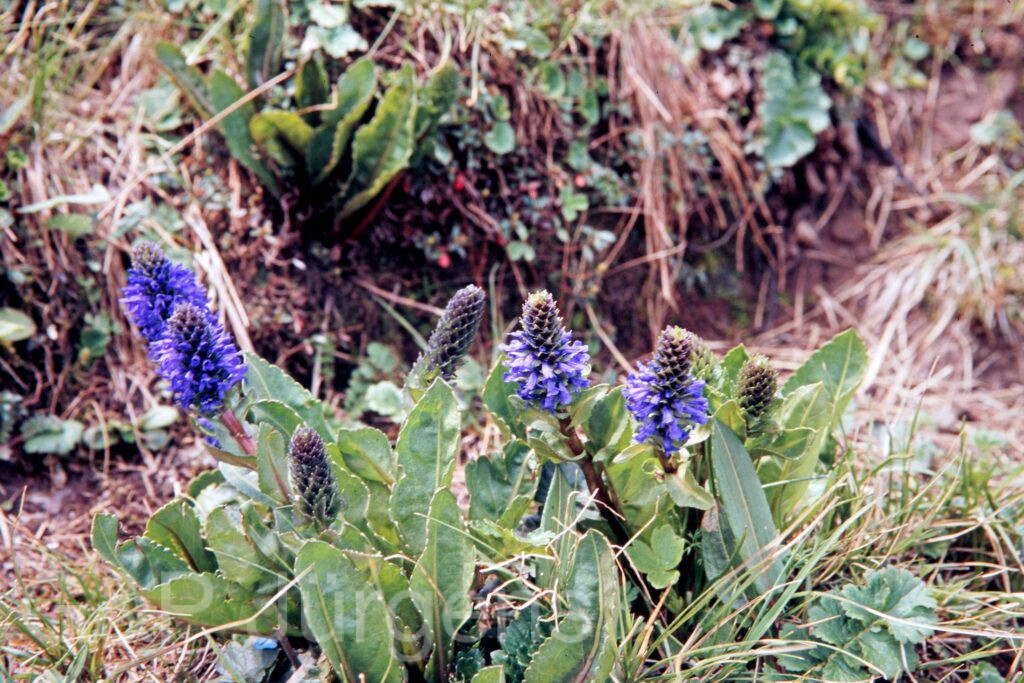
Lagotis kunawurensis is a low alpine herb of the high Himalaya, recorded by GBIF (about 116 occurrences) from Nepal, India, Pakistan and Bhutan, tracing the alpine belt from the western to the eastern part of the range. It is a plant of cold, open, high-elevation ground: short turf, stony slopes, moist alpine meadows, moraines and snow-flush margins, typically from 3500 m to well above 5000 m. The collections cited for the image span this full amplitude, from Dzongri in Sikkim at about 4100 m, to Kinkhola in Garhwal at 3550 m in June, up to the Kagmara-La in West Nepal at around 5000 m in July, the last representing one of the highest zones colonised by flowering plants in the region.

It is a small, fleshy, glabrous perennial arising from a stout rhizome or caudex with thickened roots. The leaves are mostly basal, long-petiolate, with ovate to oblong, somewhat succulent blades that are entire or shallowly crenate-toothed. The flowering stems are short and stout, the inflorescence a dense terminal spike or head of small bracteate flowers. The corolla is two-lipped (bilabiate), blue to violet or purplish, with the upper lip entire or notched and a lower lip of one to three lobes; there are typically two stamens. The fruit is a small drupe-like or two-seeded structure rather than the dry dehiscent capsule of many relatives, a feature distinctive of the genus.

Lagotis, with its concentration of species across the high mountains of Central Asia, the Himalaya and the Tibetan plateau, is now placed in Plantaginaceae following the molecular dismantling of the old Scrophulariaceae. The cushion-like, fleshy habit, short stature and early flowering are classic adaptations to the brief, cold, wind-exposed alpine growing season. Several Lagotis species are used in Tibetan and Himalayan ethnomedicine. As a widespread high-elevation specialist L. kunawurensis is not of conservation concern, though such strictly alpine taxa are intrinsically vulnerable to the upslope compression of habitat under climate warming.

Author: (Royle ex Benth.) Rupr. · Sources: POWO (Kew), GBIF, Flora of China Vol. 18, Flora of Pakistan, Flora of Nepal, Hong Monograph of the Subtribe Lagotidinae (Scrophulariaceae)

Hook. f. & Thomson

Nepal 99 681 ergebnis
West-Nepal, Pungmo-Khola 4700m, July

Description

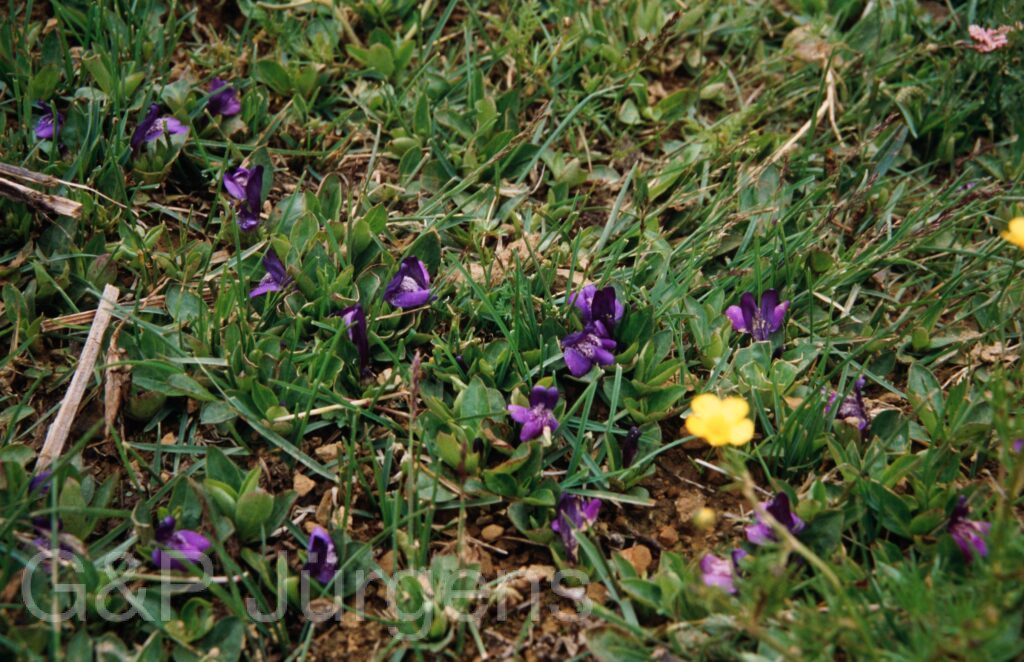
Lancea tibetica Hook.f. & Thomson is a low, perennial herb of the high Tibetan Plateau and surrounding mountains, recorded by GBIF from China, India, Nepal, Bhutan, Mongolia and Pakistan. It is a true high-alpine plant of open turf, gravelly and sandy meadows, riverine flats and grazed grassland, generally between about 3,000 and 5,000 m. The July collection from the Pungmo Khola valley in west Nepal at 4,700 m exemplifies its preference for moist alpine swards close to the upper limit of vascular plant growth, where it grows in short, frost-prone vegetation alongside other cushion and rosette herbs of the Trans-Himalayan zone.

The plant is a small, nearly stemless perennial arising from a creeping rhizome and forming low tufts seldom more than a few centimetres tall. The leaves are crowded in a basal rosette, spathulate to oblanceolate, thick, entire or slightly toothed and glabrous. The conspicuous flowers are borne almost at ground level among the leaves; the corolla is deep violet-blue to purple, tubular below and expanded into a two-lipped limb, the lower lip three-lobed and the throat often paler or marked. The fruit is a fleshy, berry-like capsule containing numerous seeds, an unusual feature among its relatives.

Formerly placed in Scrophulariaceae, Lancea is now classified in Phrymaceae following molecular phylogenetic studies, forming with the related Mazus a distinctive Asian lineage. The genus comprises only two species, making L. tibetica of considerable systematic interest as a characteristic endemic of the Qinghai-Tibetan Plateau flora. Well adapted to cold, high-altitude grassland, it serves as an indicator of intact alpine meadow ecosystems increasingly affected by grazing pressure and climate change.

Author: Hook. f. & Thomson · Sources: POWO (Kew), GBIF, Flora of China Vol. 18, Flora of Nepal, Beardsley & Olmstead: Phylogeny of Phrymaceae (American Journal of Botany)

Gand.

Sikkim2003 428 P595
Sikkim Chopta Valley 4100m August
Garw 2005 158 ergebnis
India Garhwal valley of flowers 3550m, October

Description

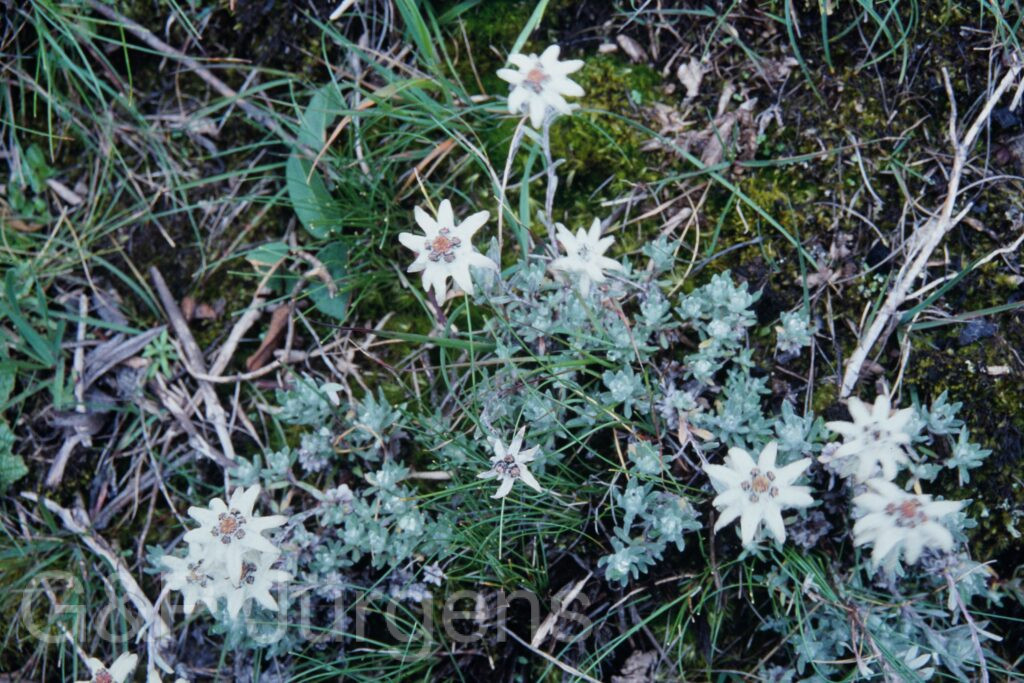
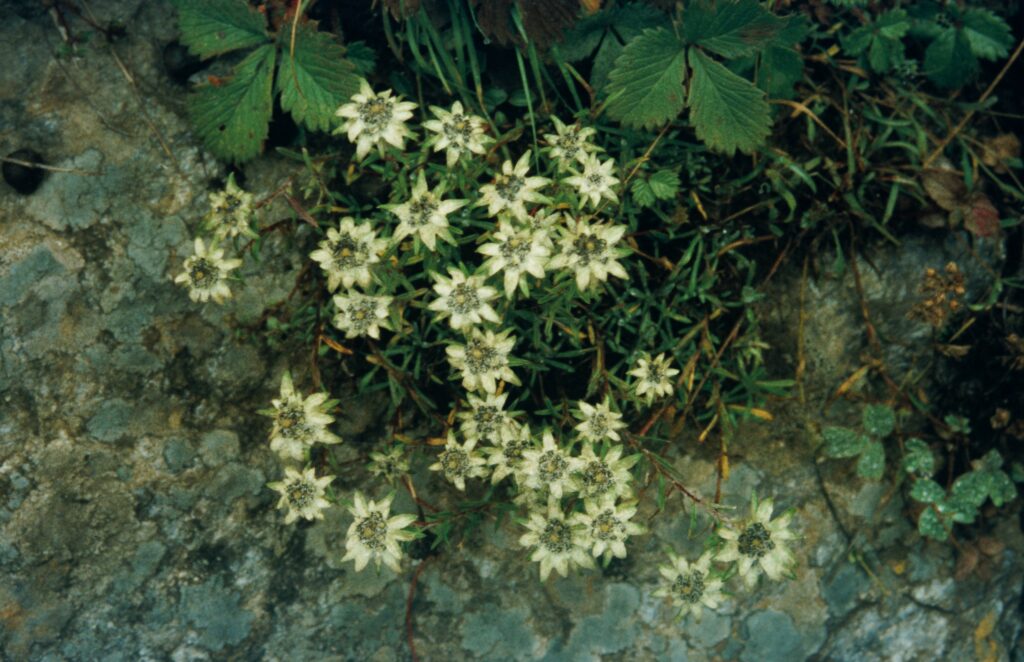
Leontopodium brachyactis is a high-alpine edelweiss of the Sino-Himalayan and Central Asian uplands, recorded from India, Pakistan, Nepal and China, with scattered occurrences extending west into Kyrgyzstan, Tajikistan, Afghanistan and Russia; the c. 92 georeferenced collections trace a distribution centred on the inner Himalaya and Tibetan margins. It inhabits open alpine turf, stony slopes, moraines and grazed meadows above the treeline, typically between 3500 and 4500 m. The species was photographed in the Sikkim Chopta Valley at 4100 m in August and in the Garhwal Valley of Flowers at 3550 m in October, sites representative of its preference for cold, well-drained, seasonally snow-covered ground.

It is a low, tufted, woolly perennial herb arising from a branched woody caudex, the stems erect to ascending and densely white-lanate. The leaves are linear to oblanceolate, entire, grey-green above and clothed beneath in a felt of appressed hairs that reflects intense montane irradiance. The capitula are small, several to many, aggregated into a dense terminal glomerule and subtended by a stellate ruff of leaf-like, densely tomentose floral bracts forming the characteristic edelweiss "star." The heads are heterogamous and disciform, with whitish corollas; the fruit is a small ribbed cypsela bearing a pappus of barbellate bristles.

The genus Leontopodium (tribe Gnaphalieae) is taxonomically intricate, its species delimited by indumentum, bract arrangement and capitulum structure, and L. brachyactis belongs to the compact-headed Himalayan element. Its dense white tomentum is a classic adaptation to alpine cold, desiccating winds and ultraviolet exposure. Though locally frequent across a wide range and not presently considered threatened, populations in accessible valleys face pressure from heavy summer grazing and increasing tourism in the Himalayan flower meadows.

Author: Gand. · Sources: POWO (Kew), GBIF, Flora of China, Flowers of the Himalaya (Polunin & Stainton), Handel-Mazzetti revision of Leontopodium