Tag:

Autumn

Benth.

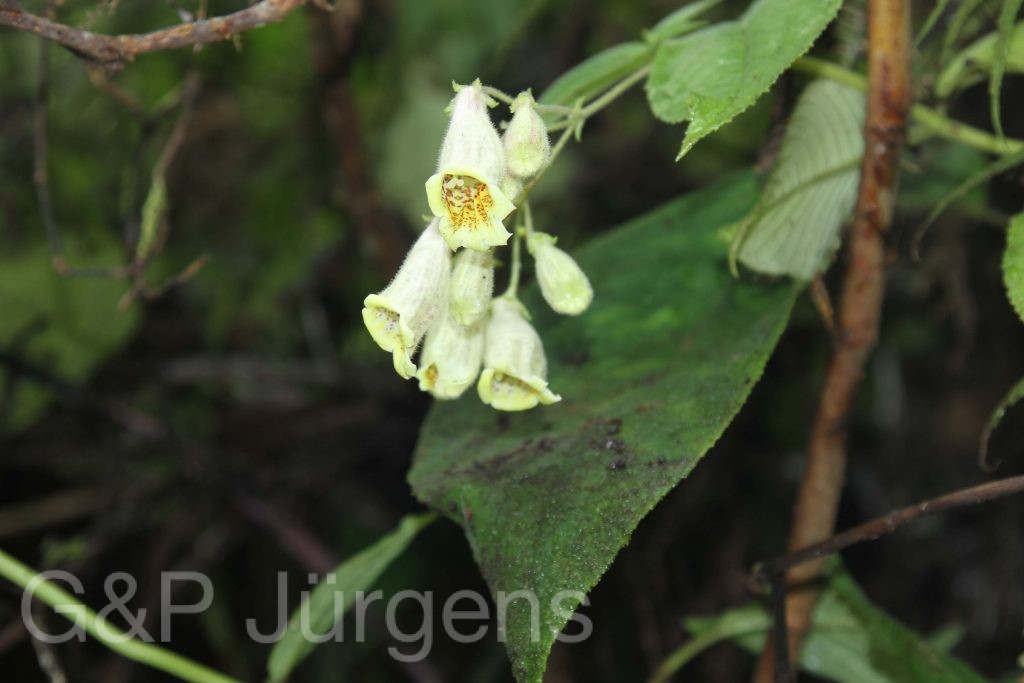
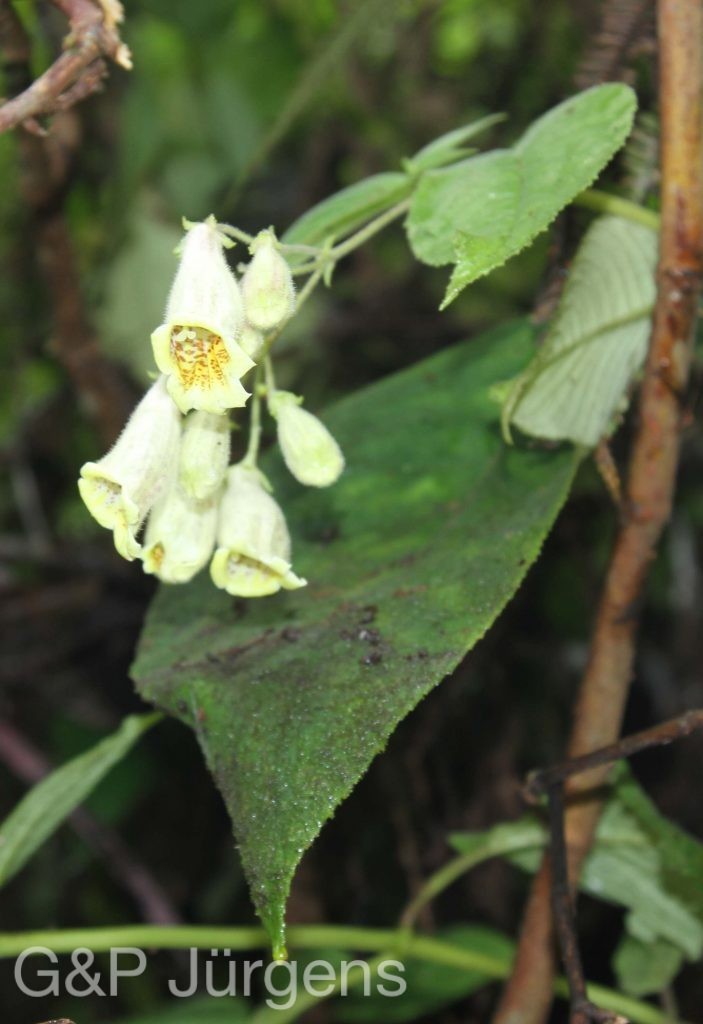
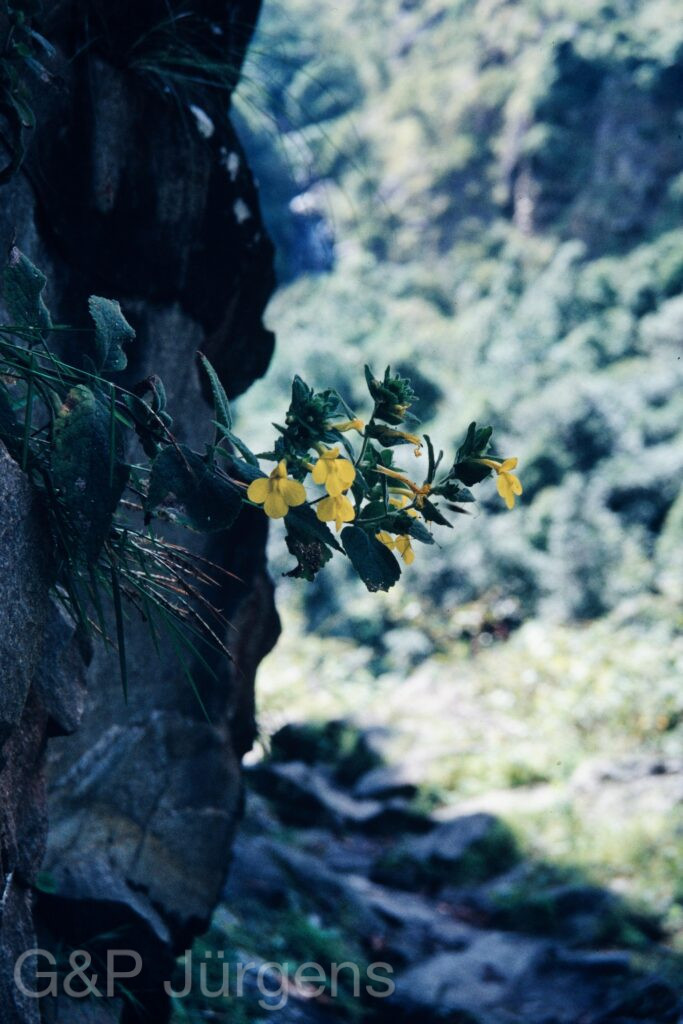
Nepal 95 249 P429 ergebnis
Nepal Valley of Buri Gandaki, Kholabensi 2100m October

Description

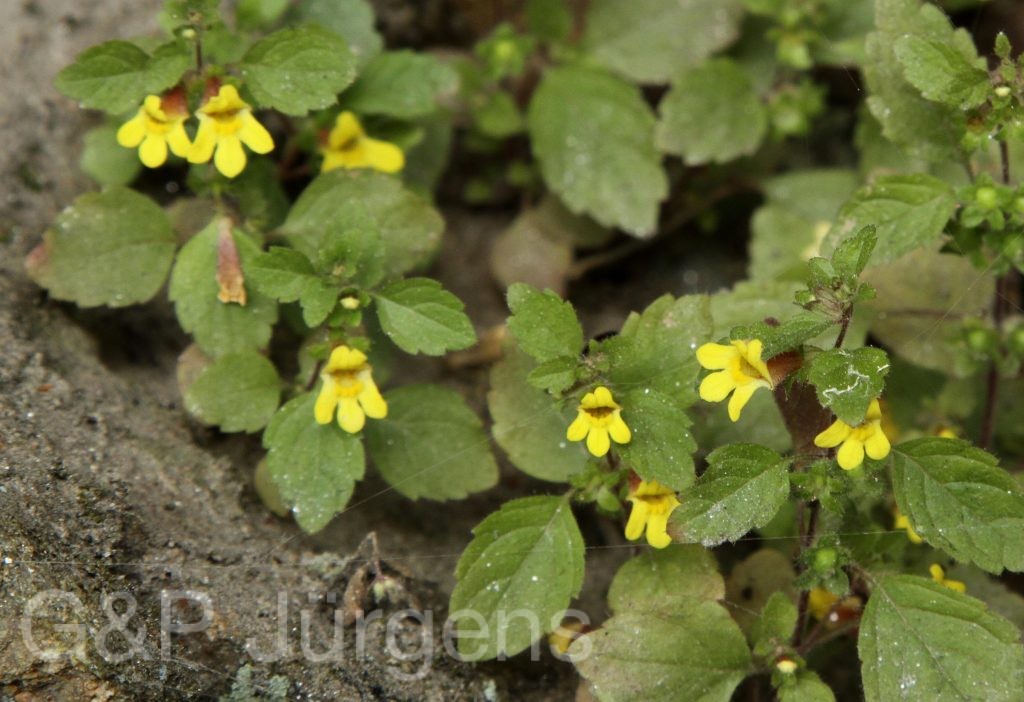
Lindenbergia grandiflora is a Himalayan herb ranging from Nepal and northern India through Bhutan into south-western China, with naturalised or introduced records noted elsewhere (including Italy and Vietnam among the catalogued occurrences). It is characteristically a plant of rocky places, old walls, dry banks, cliff ledges and other lithic, sun-exposed habitats at low to mid elevations, broadly between about 700 and 2,400 m. The plant photographed in the valley of the Buri Gandaki at Kholabensi, Nepal, at 2,100 m in October, captures its autumn flowering on the steep, well-drained slopes of an inner Himalayan river gorge.

It is an erect, branched, glandular-pubescent perennial or biennial herb with somewhat woody-based stems. The leaves are opposite below, ovate to lanceolate, with crenate-serrate margins and a softly hairy surface. The flowers are borne in the upper leaf axils, forming a leafy terminal raceme; the corolla is comparatively large for the genus, bright yellow, weakly two-lipped with a short tube and spreading lobes, the throat often bearing reddish markings. The calyx is campanulate and five-toothed; stamens four, didynamous. The fruit is a septicidal capsule with numerous small seeds.

Lindenbergia, formerly placed in Scrophulariaceae, is now referred variously to Orobanchaceae or, as here, to Plantaginaceae depending on classification; molecular studies place it among the basal, non-parasitic lineages near the Orobanchaceae, unlike its hemiparasitic relatives. The genus is a small Old World group centred on tropical Asia and Africa. The species is locally frequent on suitable rocky substrates and is not regarded as threatened.

Author: Benth. · Sources: POWO (Kew), Flora of China Vol. 18, Flora of Bhutan Vol. 2, GBIF, Fischer: Scrophulariaceae (Genera Orobanchaceae & allies)
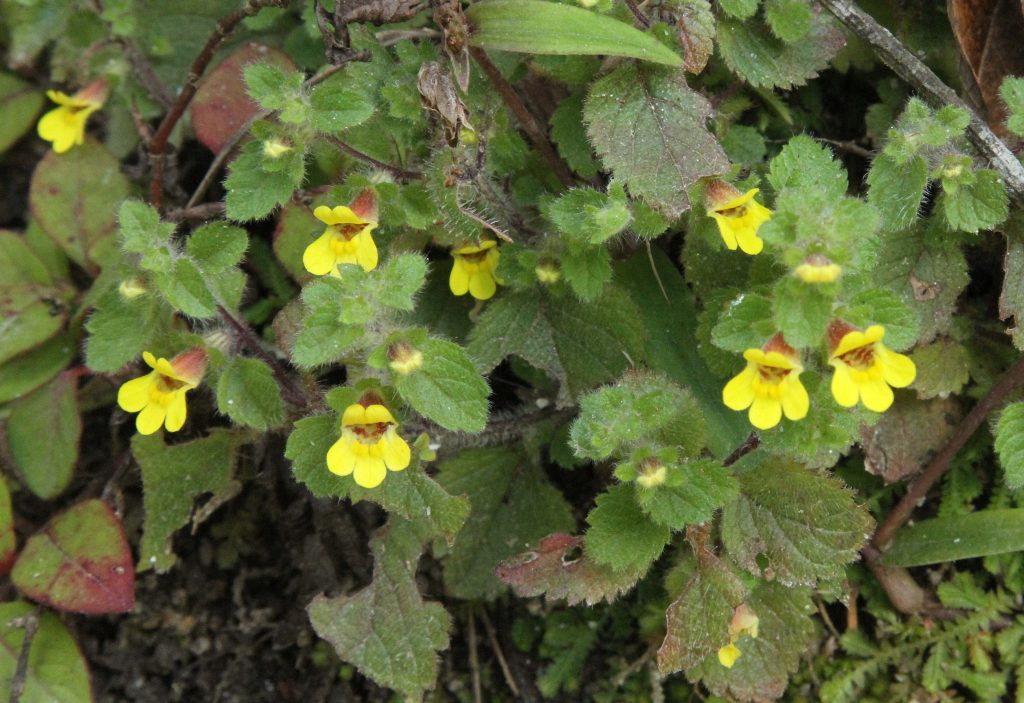
(Roxburgh ex D. Don) Brühl

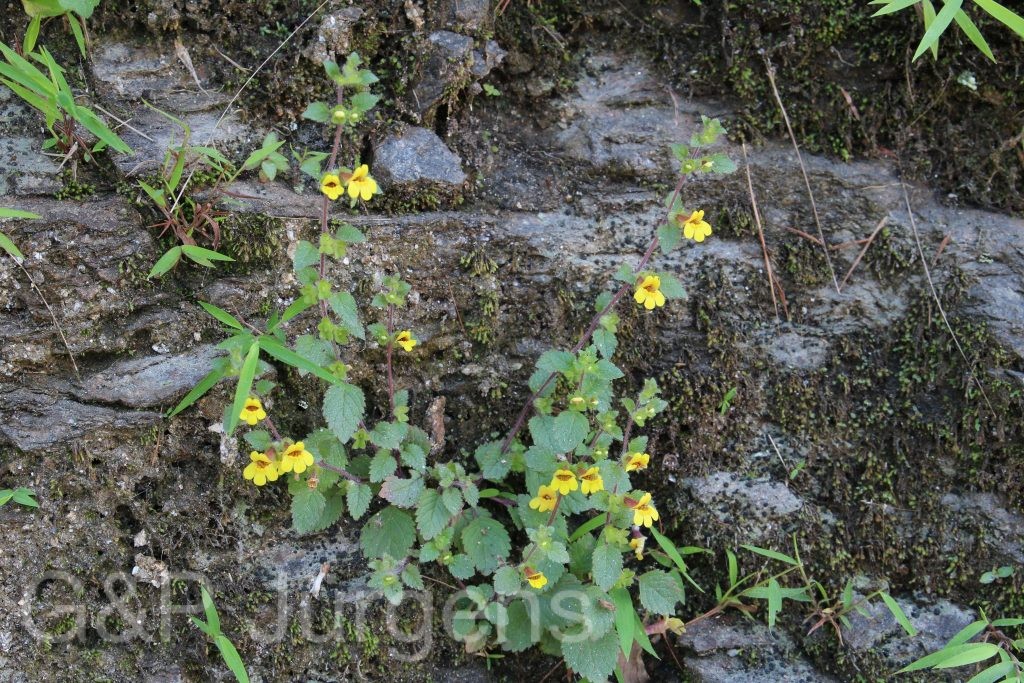
Bhutan2015 73
Bhutan Wangdi Phodrang 1500m, October
Bhutan2012 410
Bhutan Wangdi 2700m, September
Bhutan2012 654
Bhutan Tserang 1200m, September

Description

Lindenbergia muraria is a widespread herb of warm-temperate and subtropical Asia, recorded across India, China, Nepal, Bhutan, Myanmar, Thailand, Vietnam, Cambodia, Bangladesh, Pakistan and into parts of Arabia and Africa; GBIF logs 585 occurrences over this broad range. As its epithet implies, it is a colonist of old walls, rock crevices, stony banks, roadsides and waste ground, generally from the lowlands up to about 2700 m. The illustrated plants come from several Bhutanese stations, Wangdue Phodrang at 1500 m in October, Wangdue at 2700 m in September and Tsirang at 1200 m in September, spanning the autumn flowering of this ruderal species across a wide elevational band.

The plant is an erect to ascending annual or short-lived perennial herb, the stems softly pubescent and often glandular-hairy. Leaves are opposite below and sometimes alternate above, ovate to ovate-lanceolate, with a serrate margin and short petiole. The flowers are solitary or paired in the upper leaf axils, forming a leafy terminal spike-like inflorescence; each has a tubular, five-toothed calyx and a yellow, two-lipped corolla with a short tube, the lower lip three-lobed and often marked. There are four didynamous stamens, and the superior ovary ripens into a small, ovoid, septicidal capsule containing numerous minute seeds.

Lindenbergia, long placed in Scrophulariaceae, is now referred to the broadly circumscribed Plantaginaceae (consistent with the input family) following molecular reclassification, occupying a basal position near the family's scrophularioid lineages. POWO and GBIF accept the name. Its tolerance of walls and disturbed mineral substrates underlies its wide, weedy distribution across monsoon Asia.

Author: (Roxburgh ex D. Don) Brühl · Sources: POWO (Kew), GBIF, Flora of China, Flora of Bhutan, Flora of British India, Annotated Checklist of the Flowering Plants of Nepal, Revision of Lindenbergia (Plantaginaceae/Scrophulariaceae)

(Roxb.) Rehder

Bhutan2015 82
Bhutan Wangdi Galegphug 800m, October
Bhutan2015 83
Bhutan Wangdi Galegphug 800m, October

Description

Lithocarpus fenestratus is an evergreen stone-oak widely distributed across the eastern Himalaya and Indo-Burma, ranging from Nepal, Bhutan and north-eastern India through Bangladesh, Myanmar, Thailand, Laos, Vietnam and Cambodia into southern China and Taiwan. GBIF aggregates over 1080 occurrences, concentrated in the montane forests of South-East Asia and the Sino-Himalayan borderlands. It is a canopy or sub-canopy tree of subtropical and warm-temperate evergreen broad-leaved forest, often in mixed laurel-oak associations on hill slopes, generally from the lowlands up to around 2000 m. The tree photographed in Bhutan near Wangdue/Gelephu (800 m, October) reflects its presence in the warm foothill forests of the southern Bhutanese duars.

The species is a medium to large tree with greyish, fissured bark and stout twigs. The leaves are simple, alternate, coriaceous, elliptic to oblong-elliptic, entire and pinnately veined, glabrous and lustrous above and often glaucous or thinly tomentose beneath. The flowers are unisexual, borne in erect catkin-like spikes, the male inflorescences elongate and the female flowers seated singly or in clusters at the base of mixed spikes. The diagnostic fruit is the acorn: a hard nut wholly or largely enclosed by a woody cupule covered in concentric, often lamellate rings, maturing over more than one season and dispersed by gravity and rodents.

Lithocarpus is a large Asian genus distinguished from Quercus by its erect (rather than pendulous) male catkins and its frequently enclosing, ringed cupules. L. fenestratus, transferred to the genus by Rehder, has a broad range and considerable foliar variation, and several infraspecific taxa have been recognised regionally. As a widespread, often dominant forest tree it is not globally threatened, though locally exploited for timber and important as mast for forest wildlife.

Author: (Roxb.) Rehder · Sources: POWO (Kew), GBIF, Flora of China, Flora of Bhutan, Flora of Thailand, Annotated Checklist of the Flowering Plants of Nepal, monograph of Asian Lithocarpus (Camus)

Roth

Bhutan2015 35
Bhutan Dochu-La 2700m, October
Bhutan2015 36
Bhutan Dochu-La 2700m, October
Bhutan2014 286
Bhutan Trithangebe at a farm, 800m May
Bhutan2012 338
Bhutan Dochu-La 3000m, September

Description

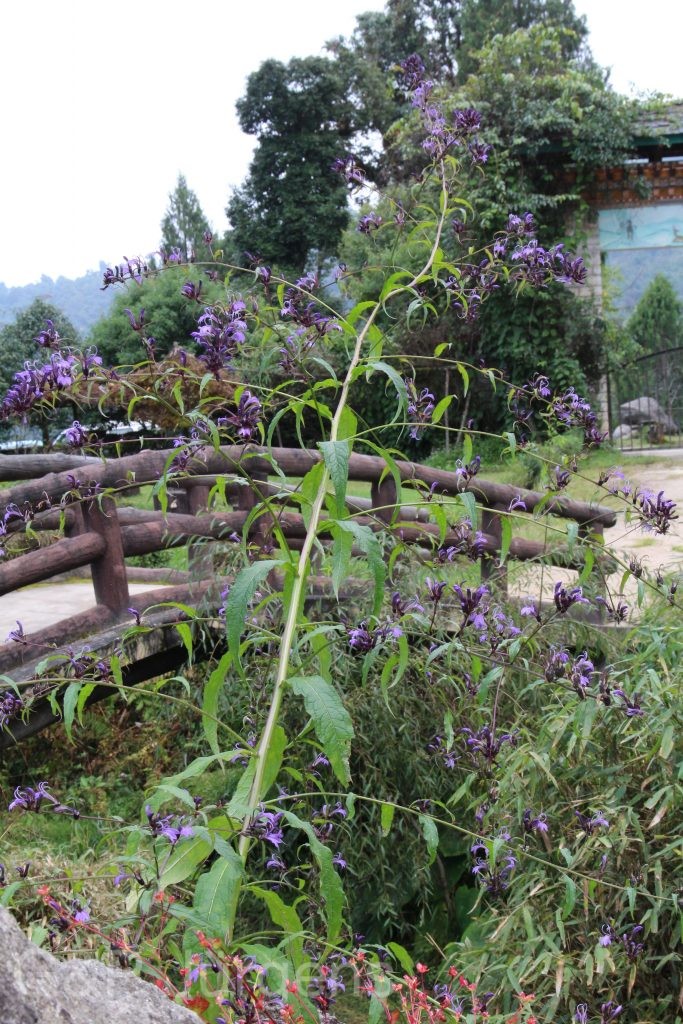
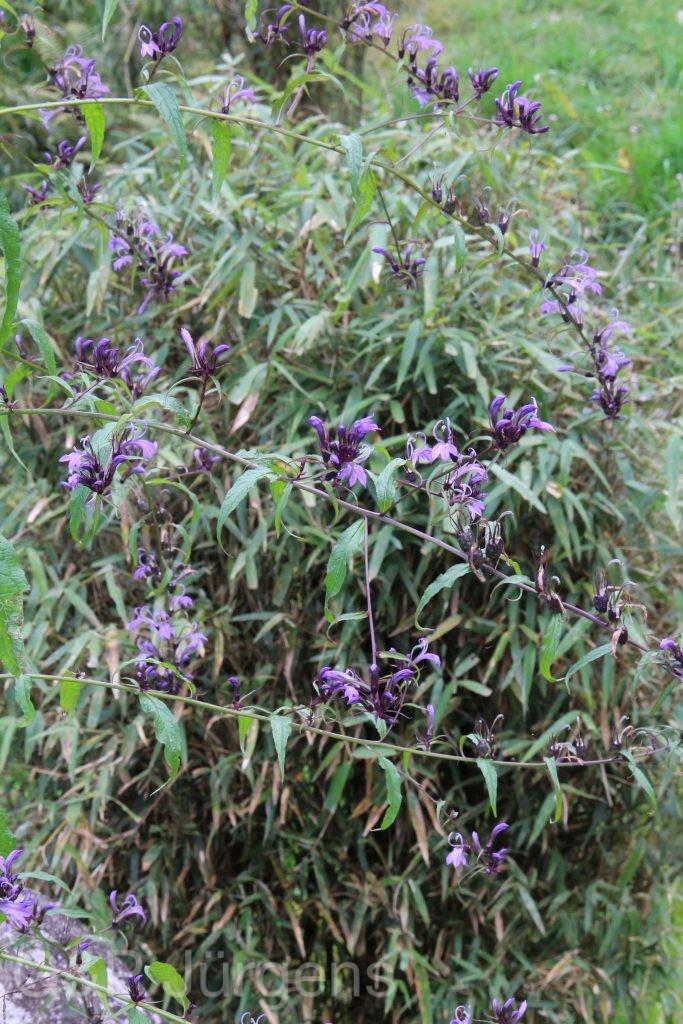
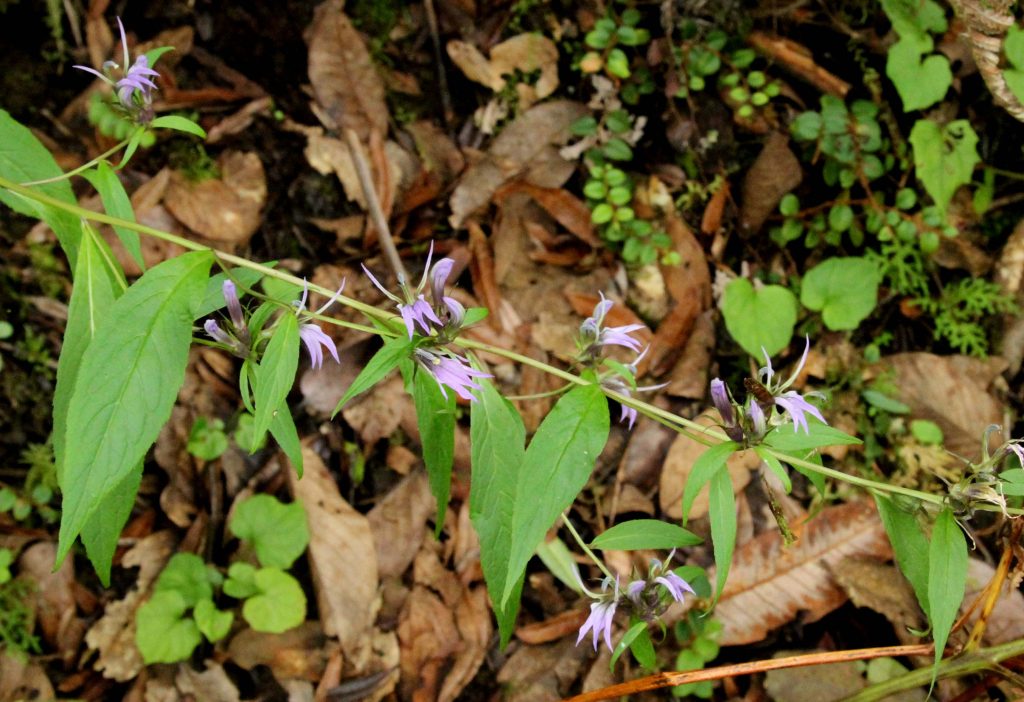
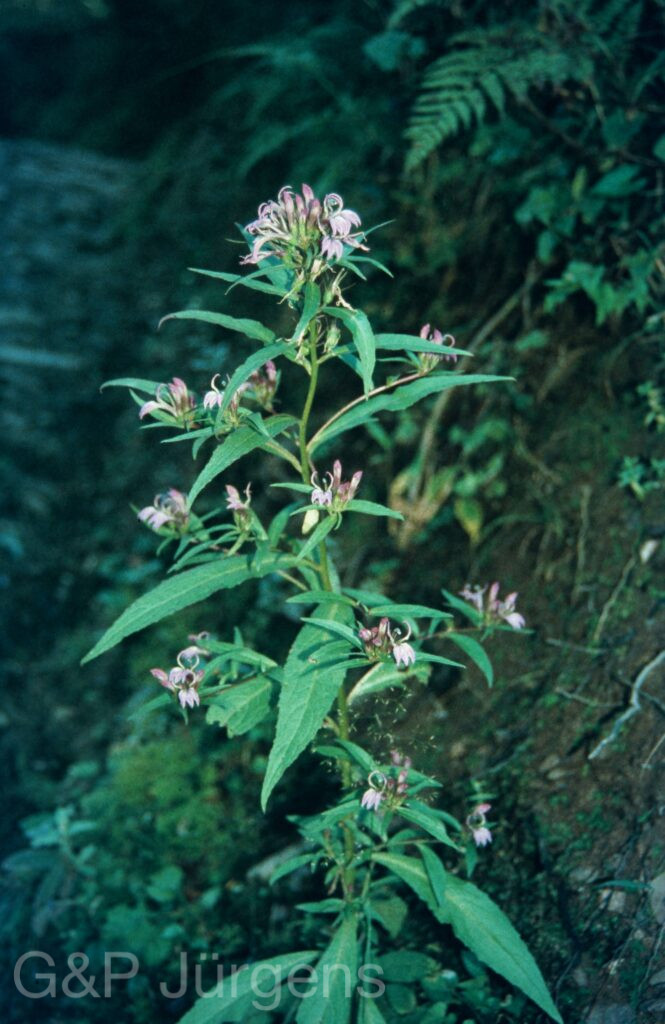
Lobelia nicotianifolia is a robust, wide-ranging lobelia of the Indian subcontinent and tropical Asia, documented from India, China, Sri Lanka, Nepal, the Philippines, Thailand, Myanmar, Indonesia, Bangladesh, Vietnam, Bhutan, Laos, Malaysia and Taiwan, with around 763 occurrences making it one of the better-collected species in this set; New World records reflect cultivation or error. It occupies a wide altitudinal span, from warm foothill farmland to cool montane forest margins, favouring open, disturbed, moist ground along roadsides, clearings and field edges. The Bhutanese collections illustrate this breadth, ranging from a farm at Trithangebe at about 800 m in May to the Dochu-La between roughly 2700 and 3000 m flowering in September and October.

It is a tall, stout biennial or short-lived perennial herb, sometimes exceeding two metres, with an erect, little-branched stem exuding acrid milky latex when cut. The leaves are large, alternate, lanceolate to elliptic, finely toothed and tobacco-like in size and texture, hence the epithet nicotianifolia, the lower ones forming a substantial basal array. The flowers are borne in a long, dense terminal raceme; each is zygomorphic with a tubular, two-lipped corolla, typically pale greenish-white to bluish, split nearly to the base, the upper lip of two narrow lobes and the lower of three, the stamens connate into a staminal tube around the style. The fruit is a many-seeded capsule dehiscing at the apex.

Within Campanulaceae, Lobelia is a large genus distinguished by strongly bilabiate flowers and syngenesious anthers, and tall species such as this are notable for their imposing single-stemmed inflorescences and their pyridine alkaloids related to lobeline, giving them a long history of medicinal and folk use. The acrid latex deters herbivores, and the protandrous flowers favour outcrossing by insect visitors. Common and adaptable across a vast range, the species is of no conservation concern and behaves as a colonist of disturbed, anthropogenic habitats.

Author: Roth · Sources: POWO (Kew), GBIF, Flora of Bhutan, Flora of China, Flora of British India, Lammers's monographic studies of Lobelia (Campanulaceae)

Wall.

Garw 2005 418 ergebnis
India Garhwal Didina 2470m, September

Description

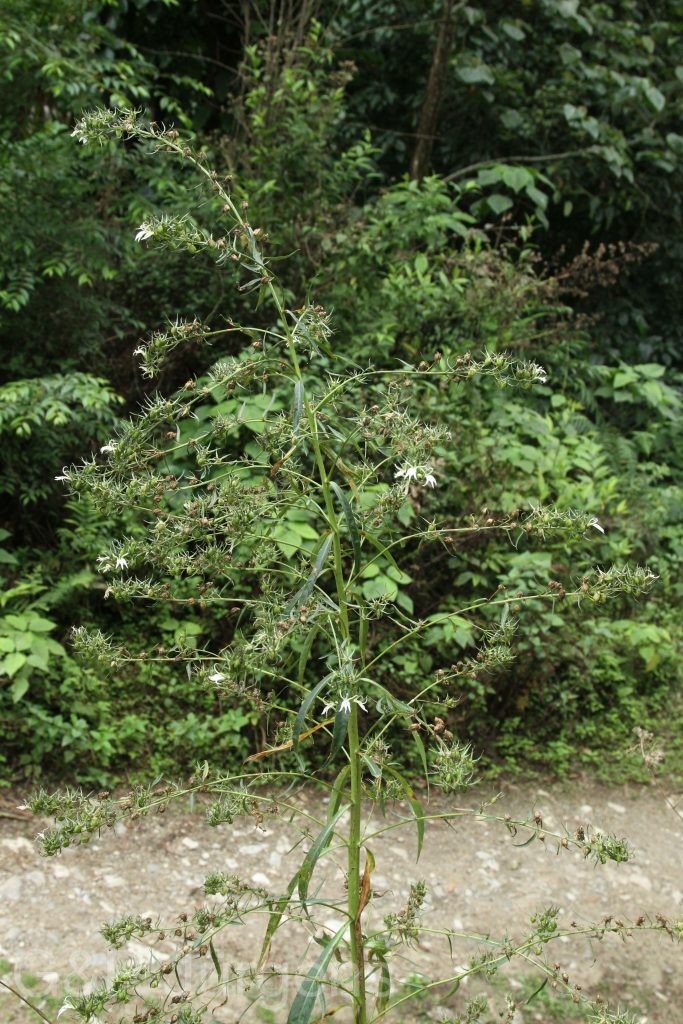
Lobelia pyramidalis is a widespread Asian lobelia ranging through the Himalaya and into mainland Southeast Asia and southern China, with GBIF records from India, Nepal, Bhutan, Bangladesh, China, Taiwan, Myanmar, Thailand and Japan (a few extralimital records from the United States represent cultivation or introductions). Its nearly 419 documented occurrences confirm a broad and well-collected distribution. The species grows on grassy banks, open hillsides, forest margins, roadside cuttings and moist disturbed ground from the lowlands up to roughly 2,800 m. The photographed plant from Didina in Garhwal, India, at 2,470 m flowering in September illustrates its preference for the temperate Himalayan zone, where it flowers late in or after the monsoon.

The plant is an erect biennial or short-lived perennial herb with a tall, simple, pyramidal flowering stem reaching up to a metre or more. The leaves are alternate, sessile and crowded below, lanceolate to oblanceolate with finely toothed margins, the lower ones forming a basal rosette. The inflorescence is a long, dense, spike-like terminal raceme of many small zygomorphic flowers, each subtended by a leafy bract; the corolla is bilabiate and pale blue to lilac or whitish, with the two upper lobes erect and the three lower lobes spreading. The fruit is a small two-valved capsule containing numerous minute seeds.

The species belongs to Lobelia subgenus Tupa-related Asian lineages and, like its congeners, contains piperidine alkaloids that render it acrid and medicinally noteworthy in folk traditions. Its tolerance of disturbed and secondary habitats makes it locally common and of no conservation concern. Its wide latitudinal and altitudinal amplitude makes it a useful indicator of the disturbed grassland flora across monsoonal Asia.

Author: Wall. · Sources: POWO (Kew), Flora of China Vol. 19, Flora of Bhutan Vol. 2, GBIF, Lammers: World Checklist and Bibliography of Campanulaceae

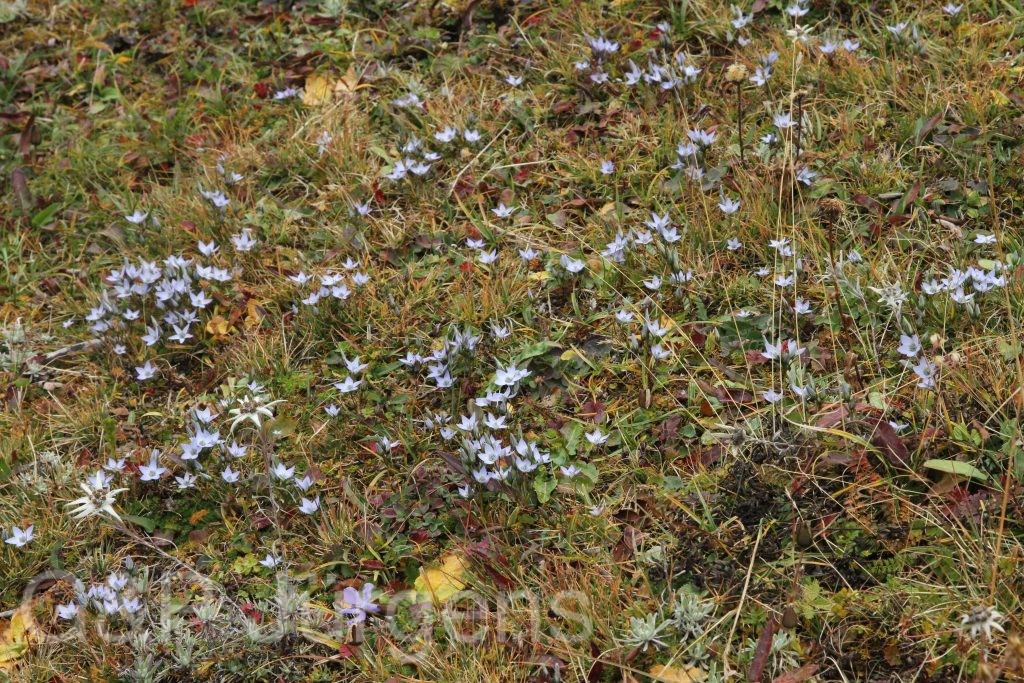
(Wulfen) A.Braun

Garw 2005 135 ergebnis ergebnis
India Garhwal Kuari-Pass 3600m, September

Description

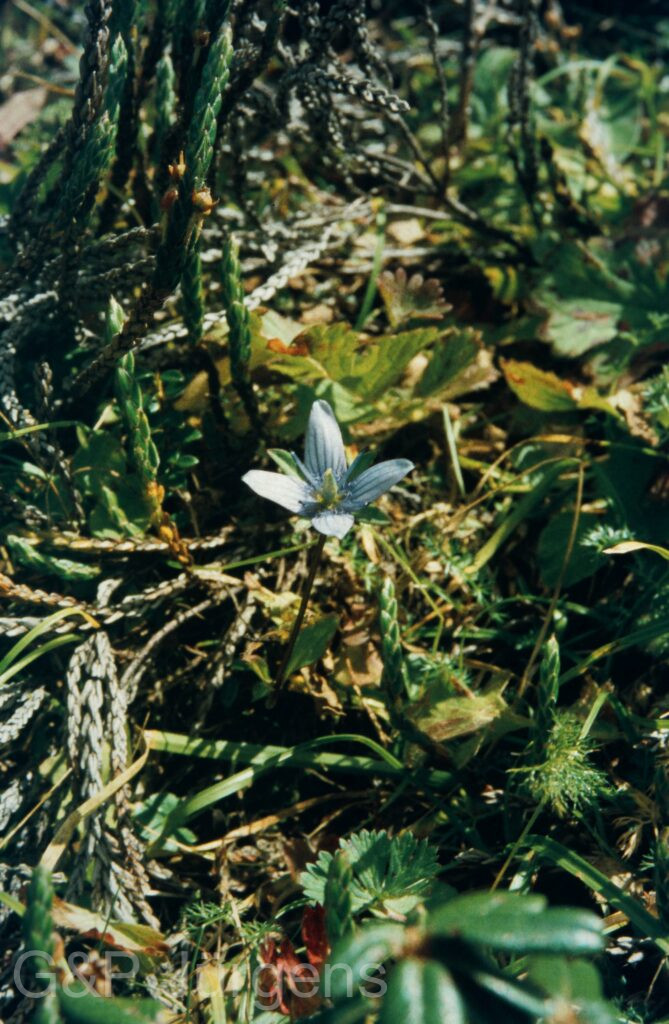
Lomatogonium carinthiacum is a small alpine gentian with an exceptionally broad Eurasian distribution, reaching from the European Alps eastward through the Caucasus, central Asia and the Himalaya to the Tibetan Plateau and Mongolia; GBIF records (over 2600) span Austria, Switzerland, China, Russia, India, Pakistan, Nepal and many other countries. It grows in alpine and subalpine meadows, damp turf, stream banks and open grassy slopes, generally between about 2500 and 4500 m. The photographed plant from the Kuari Pass in Garhwal, India (3600 m, September), is typical of the species flowering in late summer in moist alpine grassland.

The plant is a small annual or short-lived herb with an erect, often branched, somewhat quadrangular stem and opposite, sessile, ovate to lanceolate leaves. The flowers are solitary or few in lax cymes, with a rotate, deeply five-lobed corolla coloured pale blue to bluish-violet, often with darker veining; the lobes lack the plicate folds and basal fringed scales of Swertia and Gentiana. Diagnostically for the genus, the nectaries take the form of paired, scale-fringed grooves at the base of each corolla lobe. The five stamens alternate with the lobes, and the ovary is unilocular, maturing into a many-seeded capsule with the persistent styles forming decurrent ridges (the basis of the generic name).

Lomatogonium (tribe Swertieae) is closely allied to Swertia, from which it is separated chiefly by its decurrent stigmatic lines running down the ovary and by the form of its nectaries. The genus is centred on the Sino-Himalayan region, with L. carinthiacum being by far its most widespread member and a classic example of a circum-boreal/alpine disjunct distribution. It is common across much of its range and is not of conservation concern.

Author: (Wulfen) A.Braun · Sources: POWO (Kew), GBIF, Flora of China (Gentianaceae), Flora Europaea, Flora of Pakistan, A revision of Lomatogonium (Gentianaceae)

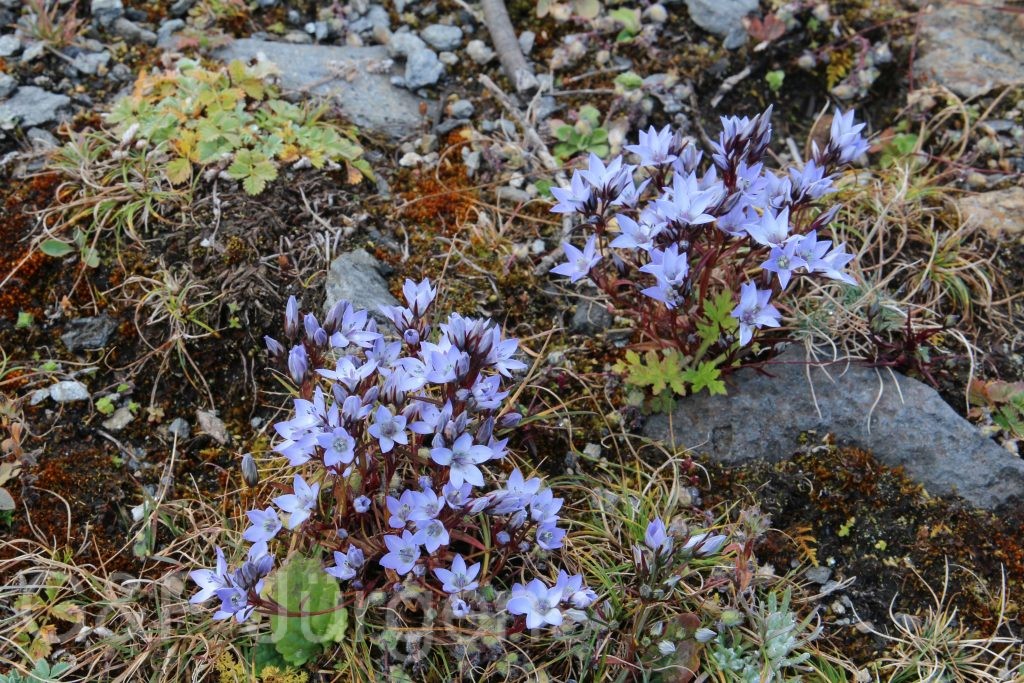
(Burkill) Harry Sm.

Bhutan2015 666
Bhutan Chele-La 4000m, October
Bhutan2015 682
Bhutan Chele-La 4000m, October
Bhutan2015 685
Bhutan Chele-La 4000m, October

Description

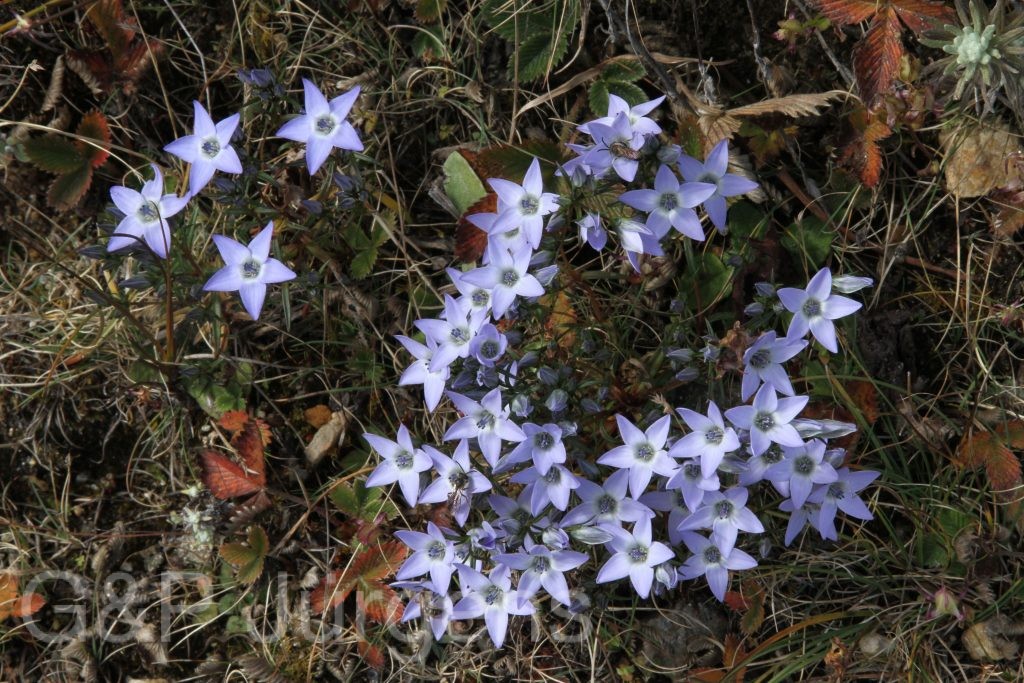
Lomatogonium sikkimense is a high-alpine gentian relative restricted to the eastern Himalaya and adjacent Tibet, recorded from Nepal, India, Bhutan and China, with about 74 occurrences in GBIF. It grows in the alpine zone on open turf, moist meadows, streamsides and gravelly slopes, characteristically between about 3500 and 4500 m, flowering late as the monsoon ends. The plants photographed at the Chele-La in Bhutan at around 4000 m in October exemplify this habitat, where the species blooms among short alpine vegetation just before the onset of winter.

It is a slender annual or short-lived herb with erect or ascending, often branched stems bearing opposite, sessile, narrowly lanceolate to linear leaves. The flowers, borne singly or in a few-flowered cyme, are rotate and deeply five-lobed, the blue to violet-blue corolla lobes acute and often delicately veined; characteristically for the genus, each lobe bears a pair of fringed nectary scales at its base, distinguishing Lomatogonium from the closely related Swertia and Gentianella. The five stamens alternate with the lobes, and the superior ovary develops into a many-seeded capsule.

Lomatogonium is a small Eurasian genus of high mountains and is centred on the Sino-Himalayan and Tibetan flora, with L. sikkimense among its narrowly distributed eastern Himalayan members, as its epithet referencing Sikkim records. The fringed paired nectaries and rotate corolla are key diagnostic features separating it from allied swertioid gentians. No formal conservation assessment exists; the species appears locally frequent within its restricted alpine range, though such narrowly zoned high-altitude annuals are potentially vulnerable to climate-driven shifts in alpine meadow vegetation.

Author: (Burkill) Harry Sm. · Sources: POWO (Kew), GBIF, Flora of Bhutan, Flora of China, Annotated Checklist of the Flowering Plants of Nepal, Ho & Liu Worldwide Monograph of Swertia and its Allies

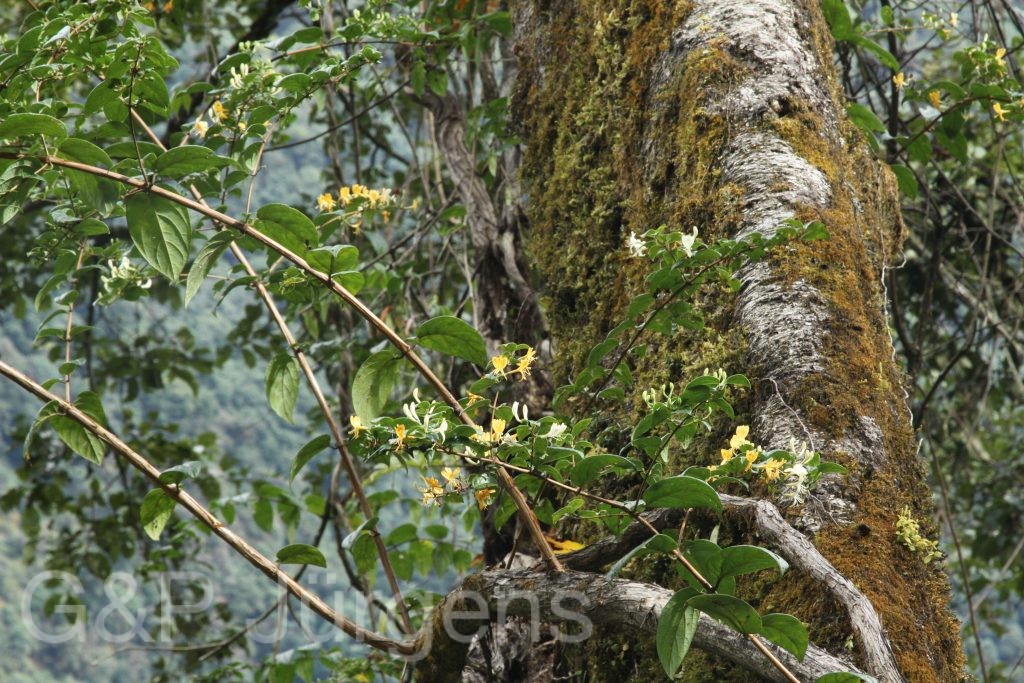
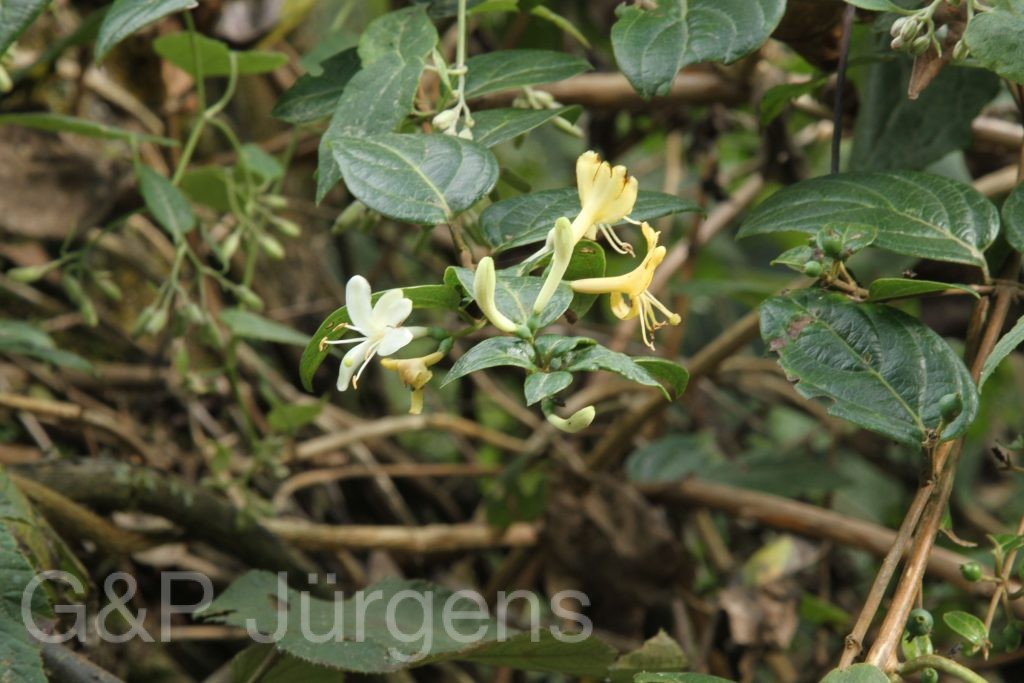
Wall.

Bhutan2015 600
Bhutan Gasa 1950m, October
Bhutan2015 601
Bhutan Gasa 1950m, October

Description

Lonicera glabrata is a Himalayan and Sino-Himalayan honeysuckle distributed from Nepal and India through Bhutan and Myanmar into south-western China; its c. 150 georeferenced records concentrate along the temperate forest belt of the eastern Himalaya. It grows in broadleaf and mixed forest, forest margins, thickets and shrubby slopes, generally between 1500 and 3000 m. The plant photographed at Gasa in northern Bhutan at 1950 m in October occupies the temperate forest zone, where its autumn fruiting follows the late-spring to early-summer flowering typical of the species.

It is a glabrous deciduous shrub, sometimes scandent, 1.5-3 m tall, distinguished as the epithet "glabrata" implies by its smooth, hairless foliage. The leaves are opposite, ovate to lanceolate, acuminate, entire and rather thin in texture. The flowers are borne in axillary pairs on a slender common peduncle, each two-lipped and creamy-white to pale yellow, fragrant, with a slender tube. Paired bracteoles subtend the ovaries. The fruit is a paired berry, the two ripening red to purplish-black, the partly fused pairs offering a conspicuous food reward. The four to five stamens and slender style are exserted from the corolla mouth.

Described by Wallich (as Wall.), L. glabrata belongs to Lonicera section Coeloxylosteum of the Caprifoliaceae, a group of paired-flowered Himalayan shrubs. The tubular, nectar-rich flowers are pollinated by bees and long-tongued insects, while the colourful berries are dispersed by birds. The species is widespread within its range and locally common in forest understorey, with no significant conservation concern, though it is sensitive to deforestation of mid-elevation broadleaf woodland.

Author: Wall. · Sources: POWO (Kew), GBIF, Flora of Bhutan, Flora of China, Flora of Nepal, Rehder's monograph of Lonicera (Caprifoliaceae)

(C.B.Clarke) B.L.Burtt.

Bhutan2012 997
Bhutan Trithangebe 900m, October
Bhutan2012 998
Bhutan Trithangebe 900m, October

Description

Loxostigma kurzii is an epiphytic or lithophytic gesneriad of the eastern Himalaya and the Sino-Himalayan borderlands, recorded by GBIF (about 165 occurrences) from China, India, Nepal, Bhutan and Myanmar. It inhabits the humid subtropical and warm-temperate forest belt, growing on mossy tree trunks, shaded cliffs and dripping rock faces in deep shade and high humidity. The illustrated plant was found in Bhutan at Trithangebe at about 900 m in October, a low, frost-free montane forest locality typical of the species, which descends well below the conifer zone into the broadleaved evergreen forests of the foothills.

The plant is a soft, somewhat fleshy herb with pendulous or ascending, often rooting stems clothed in soft hairs. The leaves are opposite, those of a pair frequently unequal, ovate to elliptic, with a crenate-serrate margin and a pubescent surface. The flowers are solitary or few in the leaf axils, each on a slender pedicel; the calyx is five-parted, and the corolla is large, tubular-funnelform and yellow, often marked within with purplish lines and slightly two-lipped at the mouth. There are four didynamous stamens with coherent anthers, and a superior ovary bearing the obliquely placed stigma from which the genus takes its name (Loxostigma). The fruit is a long, slender, twisted capsule splitting to release many minute seeds.

The taxon is sometimes treated as Briggsia kurzii, reflecting past uncertainty over generic limits within the didymocarpoid Gesneriaceae; molecular work has placed Loxostigma as a distinct lineage near Briggsia. As a forest epiphyte dependent on undisturbed, humid woodland it is sensitive to deforestation, though it remains locally frequent and is not formally assessed as threatened.

Author: (C.B.Clarke) B.L.Burtt. · Sources: POWO (Kew), GBIF, Flora of China, Flora of Bhutan, Annotated Checklist of the Flowering Plants of Nepal, Weber and Burtt's classification of the Gesneriaceae

Ghose

Nepal 95 346 P619 ergebnis
Nepal Tiblung 2810m, October

Description

Luculia grandifolia is a rare and poorly known shrub or small tree endemic to the eastern Himalayas, recorded from Bhutan, northeast India (Sikkim, Arunachal Pradesh), and central-eastern Nepal. Only 30 occurrences are documented on GBIF, making it one of the least collected species in the genus. It grows in moist, evergreen montane forests and along shaded ravines at elevations of 2,000–3,200 m, where it is associated with Rhododendron, Magnolia, and Lithocarpus in the upper warm-temperate to lower cloud-forest zone. The species favours humid, sheltered microsites on steep slopes with deep humus.
Luculia grandifolia is a semi-evergreen to evergreen shrub or small tree, 2–5 m tall, with stout, terete branches. The leaves are the largest in the genus, opposite, broadly elliptic to obovate, 15–30 cm long and 8–15 cm wide, coriaceous, with entire margins and prominent venation beneath; petioles are stout, 2–4 cm long. Stipules are interpetiolar, triangular, and caducous. The inflorescence is a terminal, dense, corymbose cyme bearing numerous fragrant flowers. Each flower has a salverform corolla, 2.5–3.5 cm long, with five spreading, rounded lobes; the colour ranges from white to pale pink. The calyx is five-lobed, with lobes often tinged reddish. The fruit is a septicidal capsule containing numerous small, winged seeds.
Luculia is a small genus of approximately five species restricted to the Sino-Himalayan region, all prized for their showy, sweetly fragrant flowers. Luculia grandifolia is distinguished from the more widely cultivated L. gratissima by its significantly larger leaves and more robust overall habit. The photographed specimen from Tiblung in Nepal at 2,810 m in October represents a late-season flowering event, consistent with the autumnal blooming period reported for the genus. Given its limited distribution, small population sizes, and dependence on undisturbed montane forest, L. grandifolia is of considerable conservation interest and would likely qualify as Vulnerable under IUCN criteria if formally assessed.

Author: Ghose · Sources: POWO (Kew), GBIF, Flora of Bhutan Vol. 2, Press et al.: Annotated Checklist of the Flowering Plants of Nepal (2000), Springate et al. (2015)