Tag:

Bhutan

Flowers of Bhutan — 1326 plant species documented across the Bhutanese Himalaya, from dense broadleaf and conifer forests to alpine scrub and meadows. Bhutan’s largely intact wilderness shelters an exceptional diversity of orchids, rhododendrons, primulas and Himalayan poppies, many of them regional endemics. Each species page includes a botanical description, distribution, habitat and flowering time, with the original photograph and its recorded altitude and locality.

(Griff.) D.G. Long & A.G. Mill.
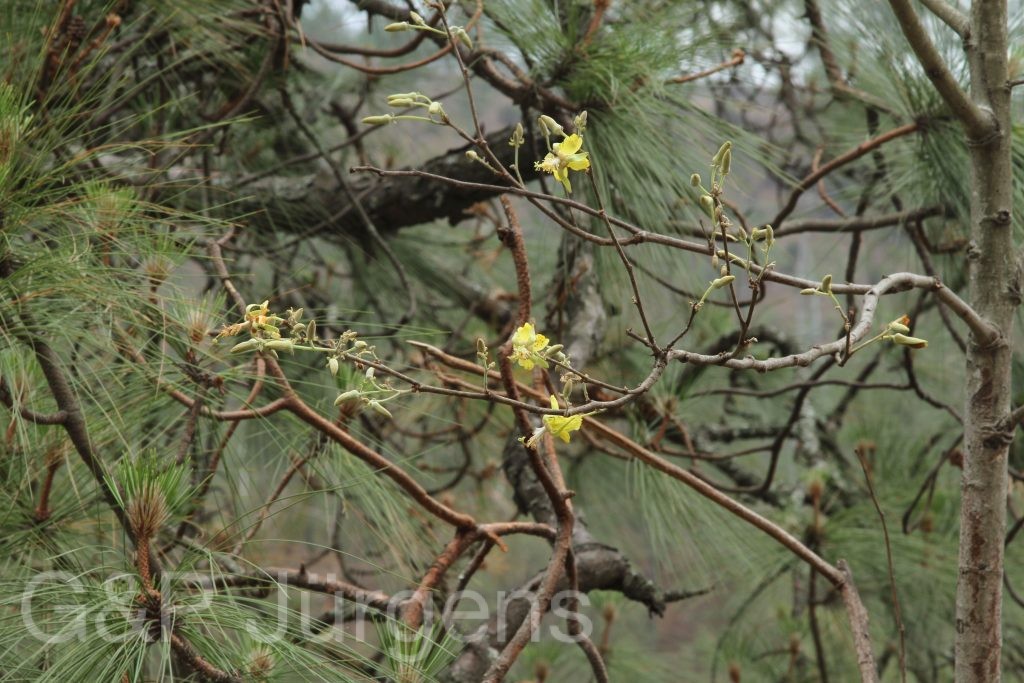
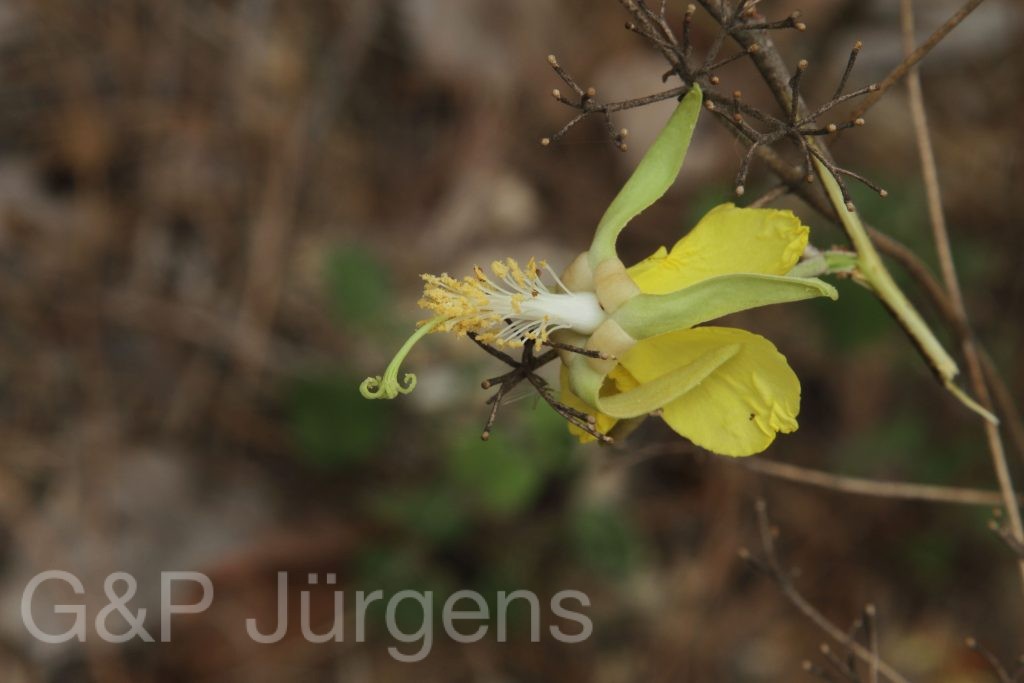
Bhutan2014 257
Bhutan Karu-Chu 1800m, May
Bhutan2014 258
Bhutan Karu-Chu 1800m, May

Description

Nayariophyton zizyphifolium is a little-collected shrub of the Eastern Himalayan foothills and adjacent Indo-Burmese region, known from a modest 45 georeferenced records concentrated in India (IN), Nepal (NP) and Bhutan (BT), with a peripheral occurrence in Thailand (TH). It is a plant of warm subtropical to lower temperate valleys and hill slopes, occurring in open forest, scrub and on rocky banks at low to middle elevations. The plant photographed at Karu-Chu in Bhutan at about 1800 m in May reflects this warm, sheltered river-valley habitat, well below the alpine flora and typical of the species' restricted foothill range. Under the name used here GBIF treats the record as a synonym, with Nayariophyton zizyphifolium itself standing as the currently accepted name.

It is an erect, somewhat woody shrub with stellate-pubescent young branches. The leaves are alternate, ovate to broadly elliptic with a serrate margin and a three-veined base, recalling the foliage of Ziziphus, from which the specific epithet zizyphifolium derives; they are clothed, especially beneath, with stellate hairs typical of the Malvaceae. The flowers are axillary, subtended by an epicalyx, with five sepals and five petals in the usual mallow arrangement and a column of fused stamens surrounding the style. The fruit is a schizocarpic, several-segmented mericarp characteristic of the genus, the dry segments separating at maturity.

Nayariophyton (Malvaceae) is a small, taxonomically isolated genus of the Eastern Himalaya, and the combination here reflects the revisionary work of D.G. Long and A.G. Miller for the Flora of Bhutan. Its scant collection record and narrow foothill distribution make it of biogeographic interest as an element of the Indo-Himalayan endemic flora. Given its limited known range and the conversion of low-elevation valley habitat, the species warrants attention from a conservation standpoint, though it has not been formally assessed.

Author: (Griff.) D.G. Long & A.G. Mill. · Sources: POWO (Kew), GBIF, Flora of Bhutan, Flora of British India, Long and Miller revision of Eastern Himalayan Malvaceae
(L.f.) W.H.Lewis

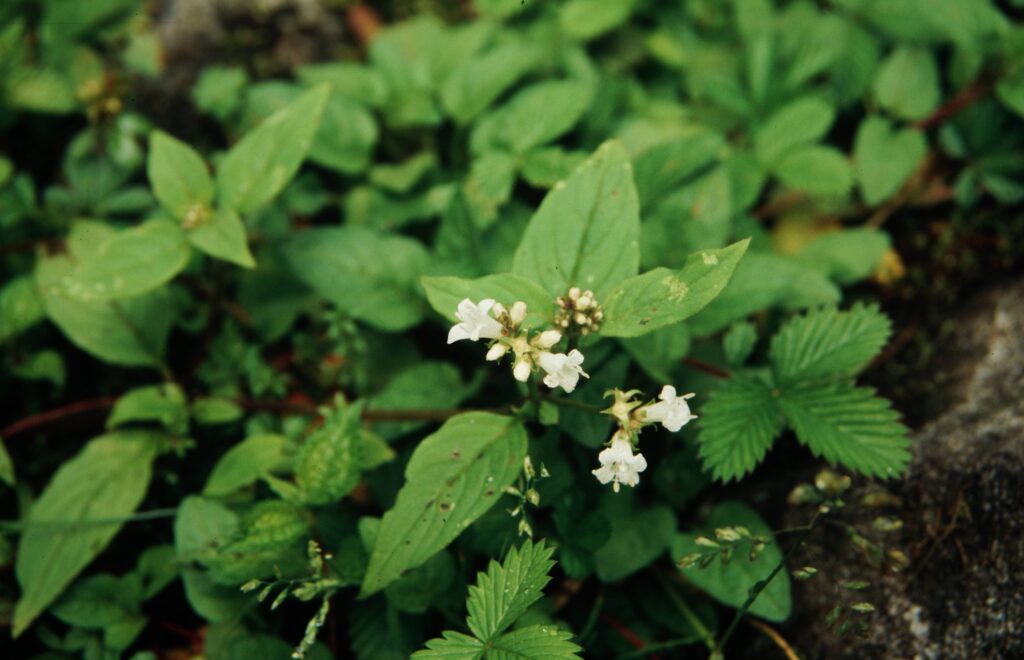
Sikkim 2006 467 ergebnis
India West-Bengal, Ruigi-Chu 2000m, May

Description

Neanotis hirsuta (L.f.) W.H.Lewis is a slender herbaceous member of the Rubiaceae with a remarkably broad Asian-Pacific distribution, recorded from India, Nepal, Bhutan, Pakistan and Sri Lanka eastwards through China, Taiwan, Japan and Korea, across Southeast Asia (Myanmar, Thailand, Vietnam, Malaysia, Indonesia, Philippines) to New Guinea and the Solomon Islands; with over 2,700 georeferenced occurrences it is among the more frequently collected species in this group. It grows in moist, shaded situations on forest floors, along streambanks, on damp rocks and trail margins and in disturbed grassy ground. The photographed plant from Ruigi-Chu in West Bengal at about 2,000 m in May reflects its presence in the humid mid-montane forests of the eastern Himalaya.

The species is a weak, creeping to ascending annual or short-lived perennial with slender, often hairy, four-angled stems that root at the lower nodes. The leaves are opposite, ovate to lanceolate, with interpetiolar stipules bearing fine bristles. Small flowers are borne in axillary and terminal clusters; each has a four-lobed calyx, a white to pale lilac funnelform corolla with four spreading lobes, four stamens and an inferior bilocular ovary. The fruit is a small didymous capsule that splits to release numerous minute angular seeds.

The genus Neanotis was segregated from Anotis and the broad Hedyotis–Oldenlandia complex by W. H. Lewis, and species delimitation within it remains intricate owing to subtle differences in habit and indumentum. Tolerant of disturbance, N. hirsuta often behaves as a pioneer of moist open ground and can be locally weedy. It is widespread and of no conservation concern.

Author: (L.f.) W.H.Lewis · Sources: POWO (Kew), Flora of China Vol. 19, Flora of Bhutan Vol. 2, GBIF, Lewis: Revision of the genus Neanotis (1966)

(DC.) Brouillet

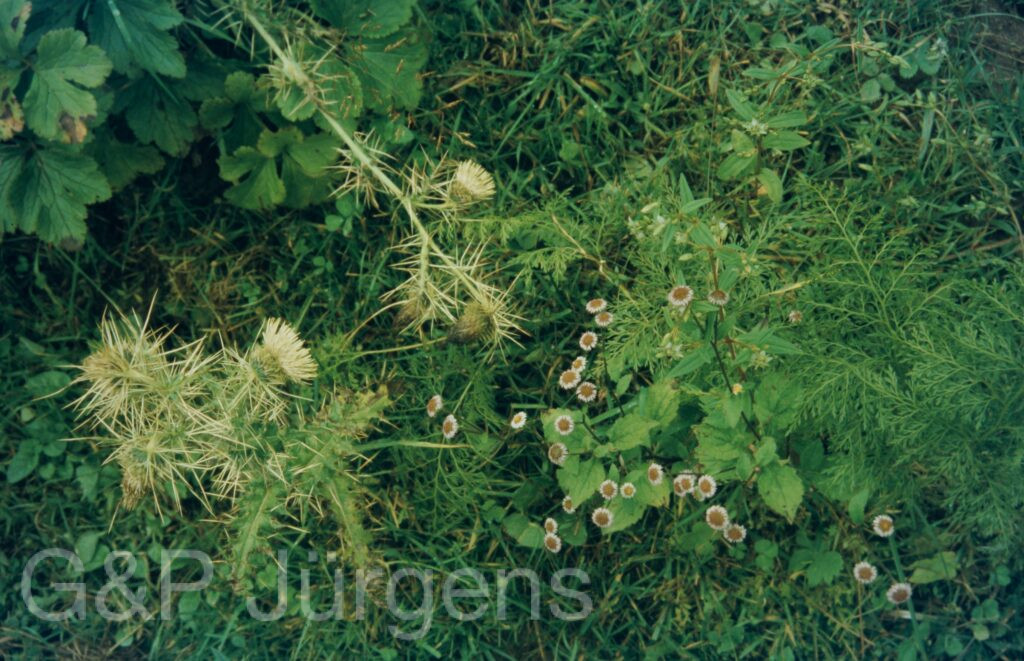
Garw 2005 77 ergebnis ergebnis
India Garhwal Gaushon 3000m, September

Description

Neobrachyactis anomala is a Himalayan composite distributed from Pakistan and Iran eastward through India, Nepal, Bhutan and southern Tibet (China), with around 153 records in GBIF. It is a plant of disturbed and open montane to subalpine ground: rocky slopes, screes, riverbanks, fallow fields, roadsides and forest clearings, generally between about 2500 and 4000 m. The population photographed at Gaushon in Garhwal, India, at around 3000 m in September occupies this kind of late-season, semi-ruderal high-mountain habitat where the species sets seed before winter.

It is an annual or short-lived herb with erect, often branched stems bearing alternate, lanceolate to oblong leaves that are toothed or pinnately lobed and somewhat glandular or hairy. The small heads (capitula) are numerous, arranged in a leafy panicle, each with an involucre of narrow bracts. As the generic relationship to Brachyactis implies, the heads are disciform: the marginal florets are female, filiform and very shortly rayed or rayless, surrounding numerous yellowish bisexual disc florets. The fruit is a small flattened cypsela crowned by a pappus of fine bristles facilitating wind dispersal.

The species was long placed in Brachyactis and allied to Erigeron and Aster, but molecular phylogenetic work in the Astereae led Brouillet to transfer it to the segregate genus Neobrachyactis, reflected in its current author citation. Its annual, ruderal strategy and abundant wind-dispersed achenes suit it to colonising unstable and disturbed alpine terrain. It is widespread and locally common, and as a weedy pioneer it is under no conservation concern; if anything such opportunistic species may expand with increasing human disturbance of mountain landscapes.

Author: (DC.) Brouillet · Sources: POWO (Kew), GBIF, Flora of China, Flora of Pakistan, Annotated Checklist of the Flowering Plants of Nepal, Brouillet Systematics of North American Astereae

(Wall.) Bennet

Bhutan2015 41
Bhutan Wangdi Phoang 2000m, October
Bhutan2012 941
Bhutan Tumching-La 2300m, October
Sikkim2003 40 K52.2
Sikkim above Yoksam 1860m 08.2003

Description

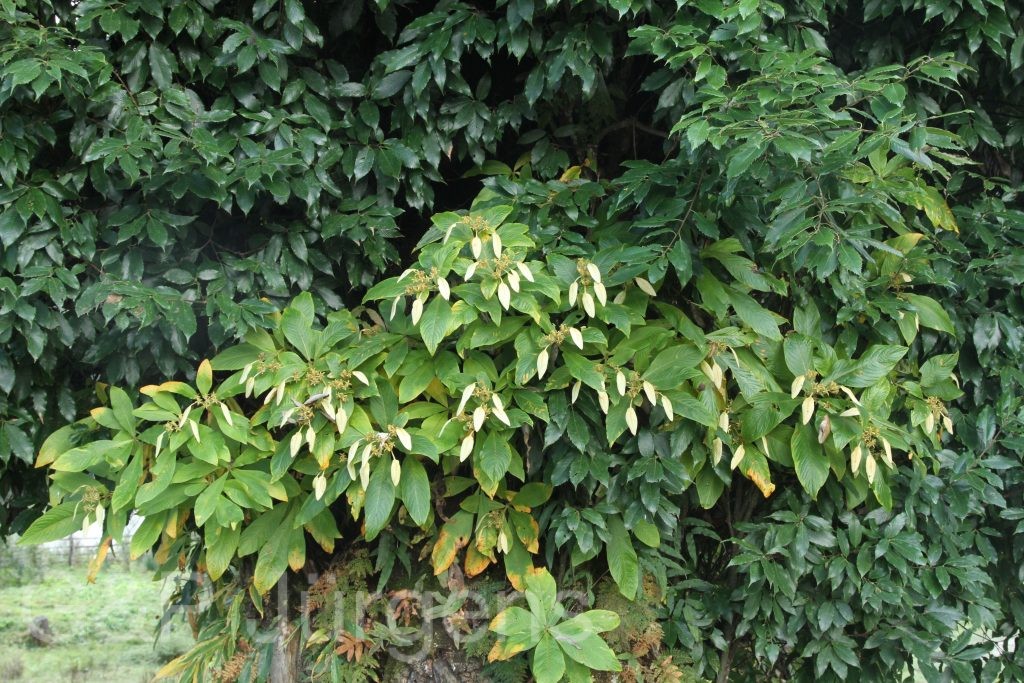
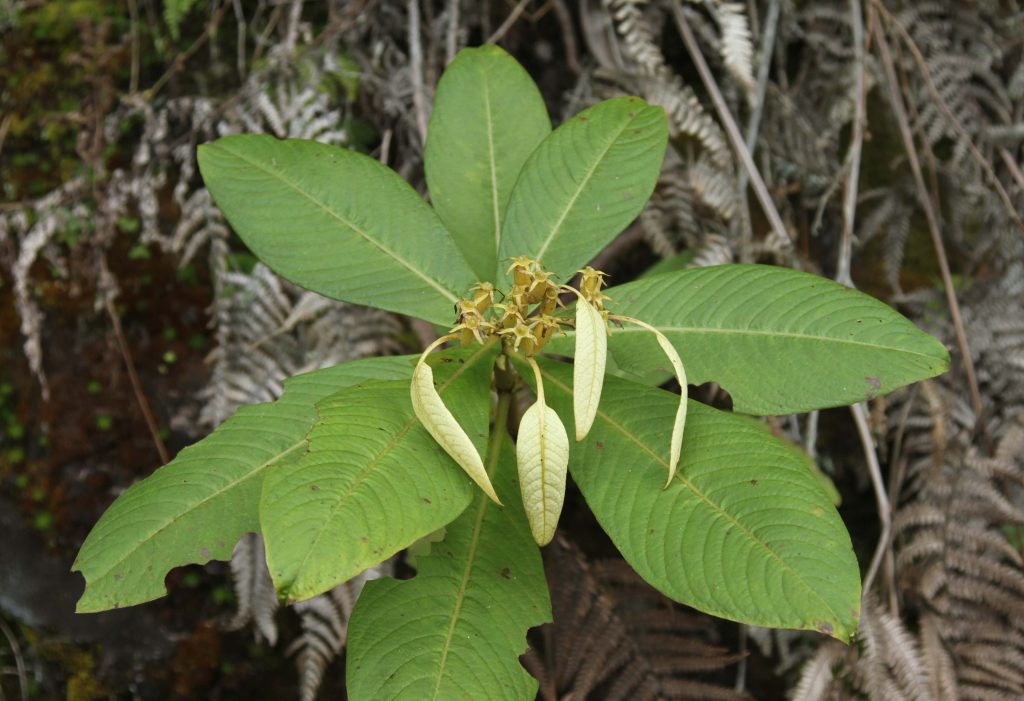
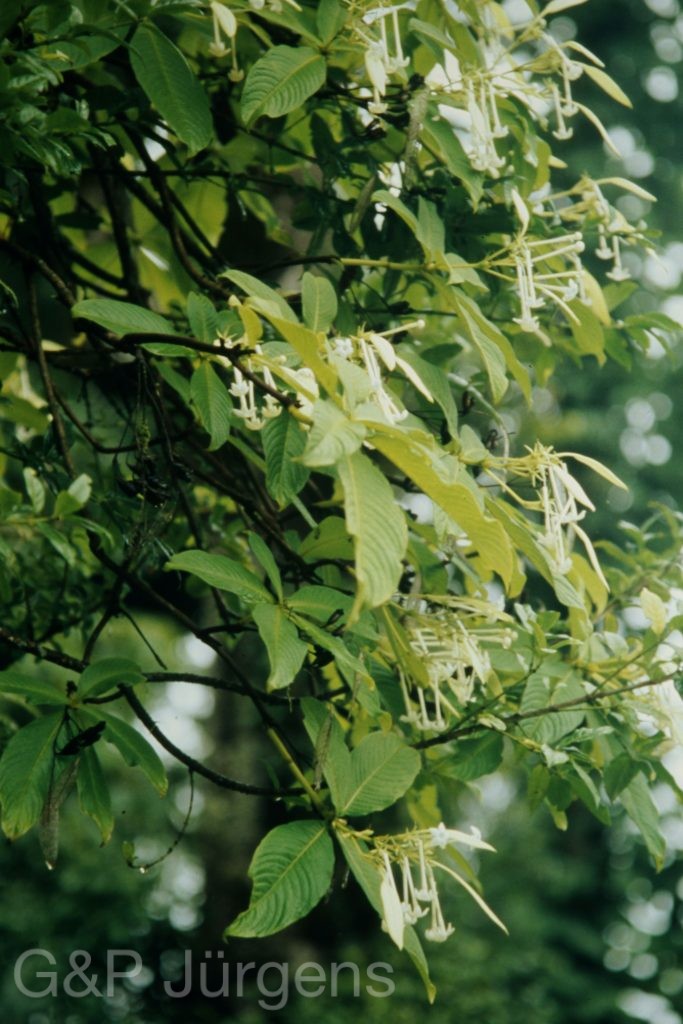
Neohymenopogon parasiticus is an epiphytic shrub of the eastern Himalaya and adjacent Sino-Himalayan and Indochinese mountains, distributed through China, Nepal, India, Thailand, Myanmar, Bhutan and Vietnam (gbif_countries: CN, NP, IN, TH, MM, BT, VN, ZZ, GB, PG), with some 438 GBIF occurrences. Despite the epithet it is not truly parasitic but grows perched on the trunks and mossy branches of trees in humid, mid-elevation broadleaved and mixed forest, occasionally also on rocks. The illustrated collections range from above Yoksam in Sikkim at about 1860 m up to Wangdi Phoang and Tumching-La in Bhutan at around 2000–2300 m, recorded in the late-monsoon to autumn months, reflecting its preference for moist, cloud-bathed submontane forest.

The plant is a glabrous to finely hairy epiphytic shrub with opposite, elliptic to obovate leaves clustered toward the branch tips, the stipules interpetiolar as in Rubiaceae. The flowers are borne in terminal cymose clusters and are showy by virtue of enlarged, white, petaloid calyx-lobes (calycophylls) that subtend the inflorescence and aid pollinator attraction, surrounding tubular corollas. The fruit is a ribbed, dehiscent capsule releasing many small, winged seeds suited to wind dispersal among the canopy.

Neohymenopogon was segregated from Hymenopogon to accommodate this distinctive Himalayan epiphytic lineage, and the species is placed in the madder family among the calycophyll-bearing Rubiaceae that mimic the petaloid bracts of Mussaenda and its allies. As an epiphyte dependent on intact, humid forest canopy, it is sensitive to deforestation, though it remains locally frequent across its range and is not currently of conservation concern.

Author: (Wall.) Bennet · Sources: POWO (Kew), GBIF, Flora of Bhutan, Flora of China, Flora of Nepal, Robbrecht's studies of Rubiaceae systematics

R.R.Mill

BhutanPG2011 420 scaled
Bhutan Ludlow-Sherriff-Trail Warrtlang-La, 4400m June

Description

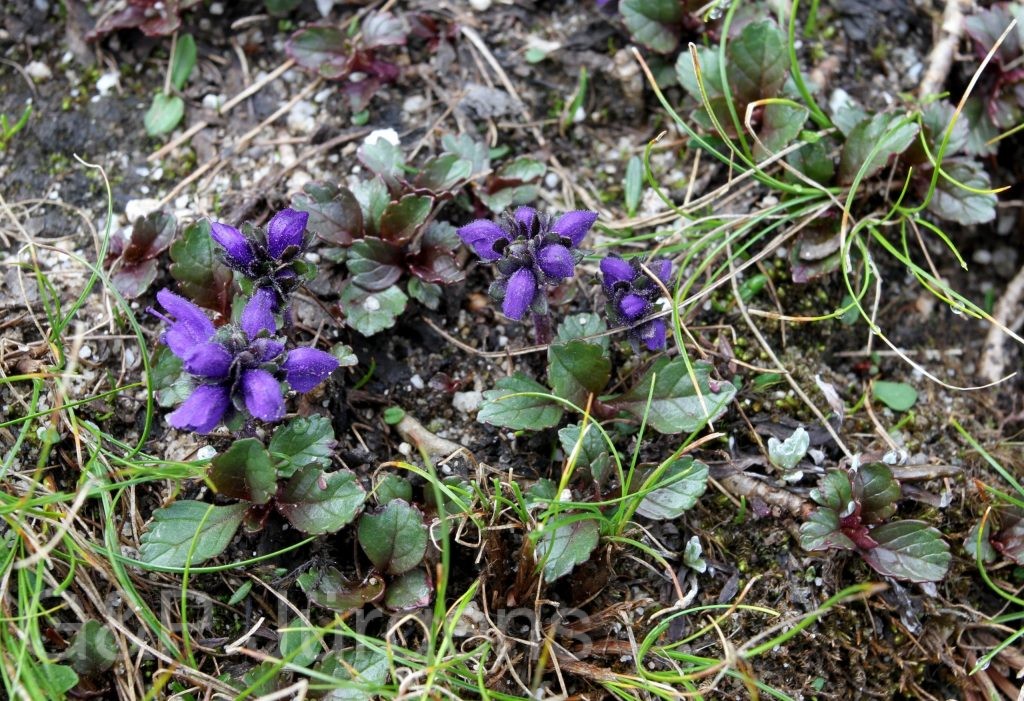
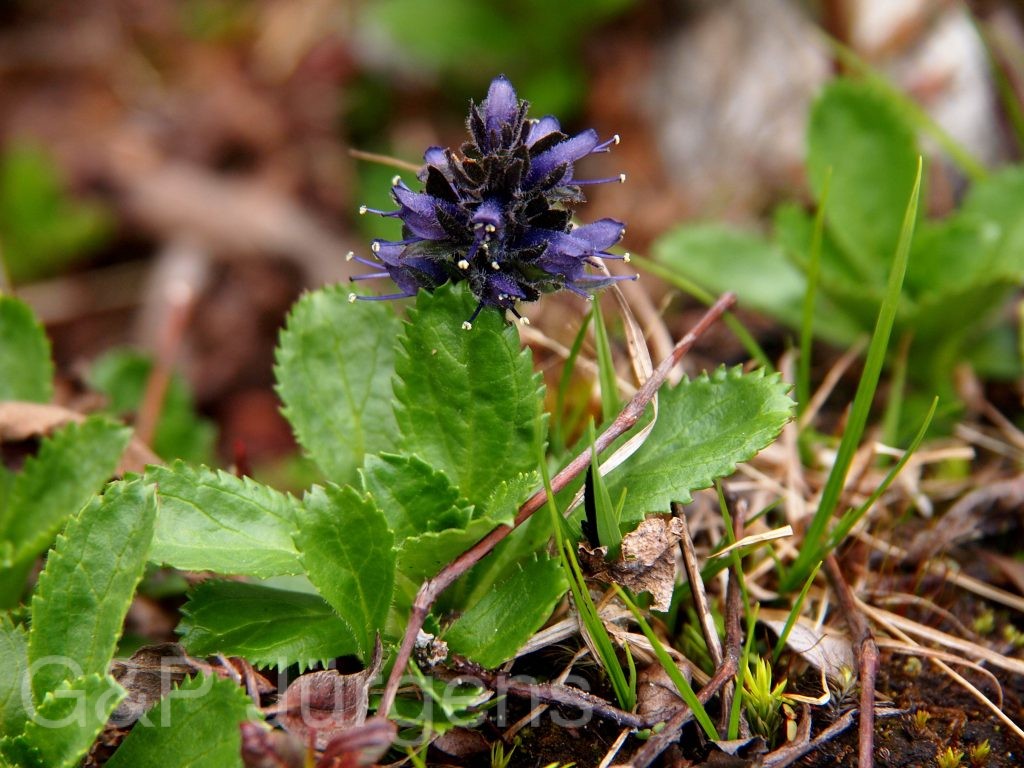
Neopicrorhiza minima is an extremely localised high-alpine herb known only from Bhutan, where GBIF holds a mere five records, underscoring its rarity and narrowly endemic distribution in the Eastern Himalaya. It is a plant of the upper alpine zone, growing on open rocky slopes, moist screes, moraines and short turf near the limit of vascular plant life, at around 4400 m. The plant photographed along the Ludlow-Sherriff Trail at Warrtlang-La in Bhutan at 4400 m in June captures it flowering in this severe, wind-exposed, snowmelt-fed environment during the brief alpine summer.

It is a small, dwarf perennial herb, as the epithet minima indicates, arising from a creeping, bitter rhizome and forming compact tufts or low mats. The leaves are basal, spathulate to oblong and crenate-toothed, narrowing into a petiole. The flowers are borne in a short, dense, terminal raceme or spike on a low scape; each flower has a small calyx and a tubular, somewhat two-lipped corolla, typically bluish-purple to mauve, with four exserted stamens. The fruit is a small capsule containing numerous minute seeds.

Neopicrorhiza was segregated from Picrorhiza, the bitter-rhizomed Himalayan herbs once placed in Scrophulariaceae and now referred to Plantaginaceae following molecular work on the lamiid families; N. scrophulariiflora is the better-known relative, valued medicinally. N. minima, described by R.R. Mill, is distinguished by its diminutive stature and high-alpine habitat. Its single-country endemism and very small number of records mark it as a species of genuine conservation concern, dependent on its restricted Bhutanese high-mountain habitat.

Author: R.R.Mill · Sources: POWO (Kew), GBIF, Flora of Bhutan, Annotated Checklist of the Flowering Plants of Nepal, Hong Scrophulariaceae monograph

(Pennell) D.Y.Hong

Sikkim2011 278
Sikkim Lada-La 3600m, June

Description

Neopicrorhiza scrophulariiflora is an alpine herb of the central and eastern Himalaya, ranging through Nepal, Bhutan, northern India and south-western China (Tibet), the roughly 106 GBIF records concentrating along this high-mountain belt with cultivated and herbarium material accounting for the United States occurrences. In GBIF the name is treated as a synonym, with Neopicrorhiza scrophulariiflora cited as the accepted name. It grows on open alpine slopes, moist rocky meadows, screes and humus-rich crevices, typically between 3500 and 4800 m. The photographed plant from Lada-La in Sikkim at 3600 m in June reflects its early-summer flowering on damp, high-alpine ground.

It is a low, creeping perennial herb spreading by a stout, bitter, woody rhizome that roots at the nodes and bears persistent leaf remains. The leaves are mostly basal, spathulate to oblong-obovate, with a crenate-serrate margin, narrowed to a winged base. From the rosette arises a short, erect scape terminating in a dense, cylindrical, spike-like raceme of small flowers; the corolla is dark bluish-purple to violet, with conspicuously exserted stamens. The fruit is a small ovoid capsule containing numerous minute seeds.

The monotypic genus Neopicrorhiza was segregated from Picrorhiza and, following molecular work, is now placed in the Plantaginaceae (formerly within Scrophulariaceae). The rhizome, known in trade as kutki, is intensely bitter and is among the most heavily harvested Himalayan medicinal plants, used for hepatic and febrile complaints. Sustained wild collection has caused marked population decline, and the species is regarded as threatened and is subject to harvesting controls and cultivation initiatives across its range.

Author: (Pennell) D.Y.Hong · Sources: POWO (Kew), GBIF, Flora of China, Flora of Bhutan, Annotated Checklist of the Flowering Plants of Nepal, Picrorhiza and Neopicrorhiza systematic study

(King & Pantl.) Szlach.

BhutanPG2011 113
Bhutan Tsochenchen, 3500m June

Description

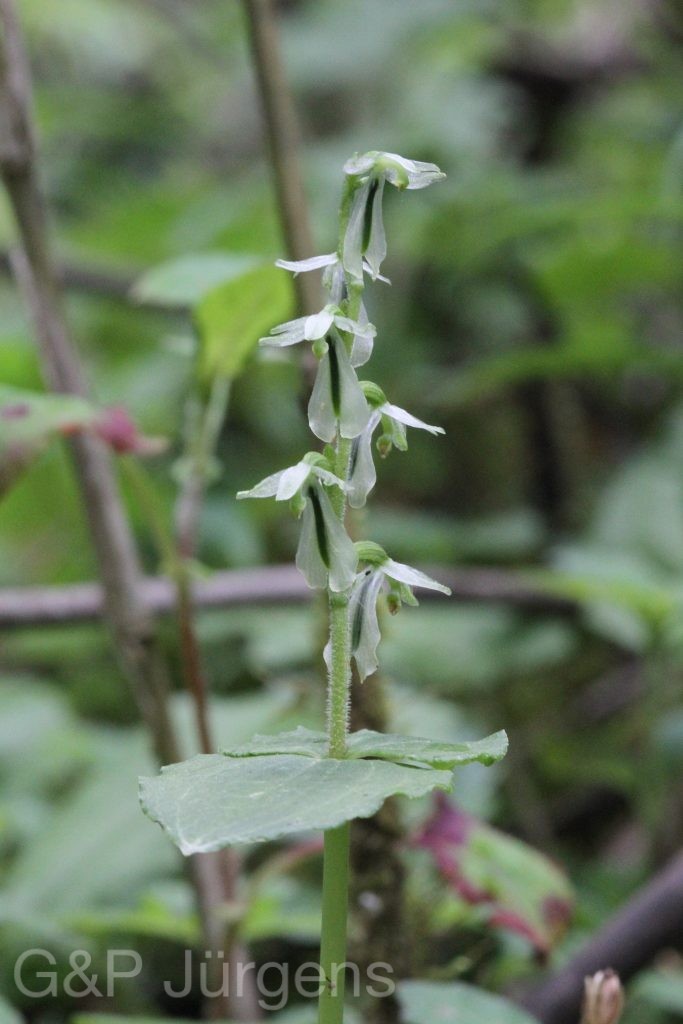
Neottia longicaulis is a terrestrial orchid of the cool, shaded forests of the eastern Himalaya, recorded from India, China, Bhutan and Nepal, with 23 GBIF occurrences reflecting a fairly narrow Sino-Himalayan distribution. It grows in damp, humus-rich leaf litter and mossy ground beneath conifer and mixed broadleaved forest, and in the moist scrub near the treeline, generally in the upper temperate to subalpine zone. The illustrated plant was found at Tsochenchen in Bhutan at about 3500 m in June, in the shaded, humus-floored fir and rhododendron forest where these inconspicuous orchids favour deep, undisturbed organic soils.

The plant is a slender, erect herb with a relatively long stem, as the epithet longicaulis indicates, bearing on its lower part a pair of opposite, broadly ovate to cordate leaves in the manner characteristic of the former genus Listera. The inflorescence is a lax raceme of small, green to yellowish-green flowers above the leaves. Each flower has spreading sepals and petals and a deeply two-lobed (bifid) pendent lip, the cleft forming two divergent arms; the column is short. The fruit is a small ellipsoid capsule containing dust-like seeds.

The basionym authority (King & Pantl.) Szlach. records the transfer of this species into Neottia, into which the genus Listera is now subsumed following phylogenetic evidence that the two are not separable. Neottia belongs to tribe Neottieae, a group spanning fully autotrophic 'twayblade' species and wholly mycoheterotrophic members. Dependent on intact, humus-rich shaded forest, N. longicaulis is sensitive to disturbance, and its small documented range warrants attention even though it has not been formally assessed.

Author: (King & Pantl.) Szlach. · Sources: POWO (Kew), GBIF, Flora of China, Flora of Bhutan, The Orchids of Bhutan (Pearce & Cribb)

(D.Don) Hand.-Mazz.

Garw 2005 28 ergebnis ergebnis
India Garhwal Valley of flowers 2950m, September

Description

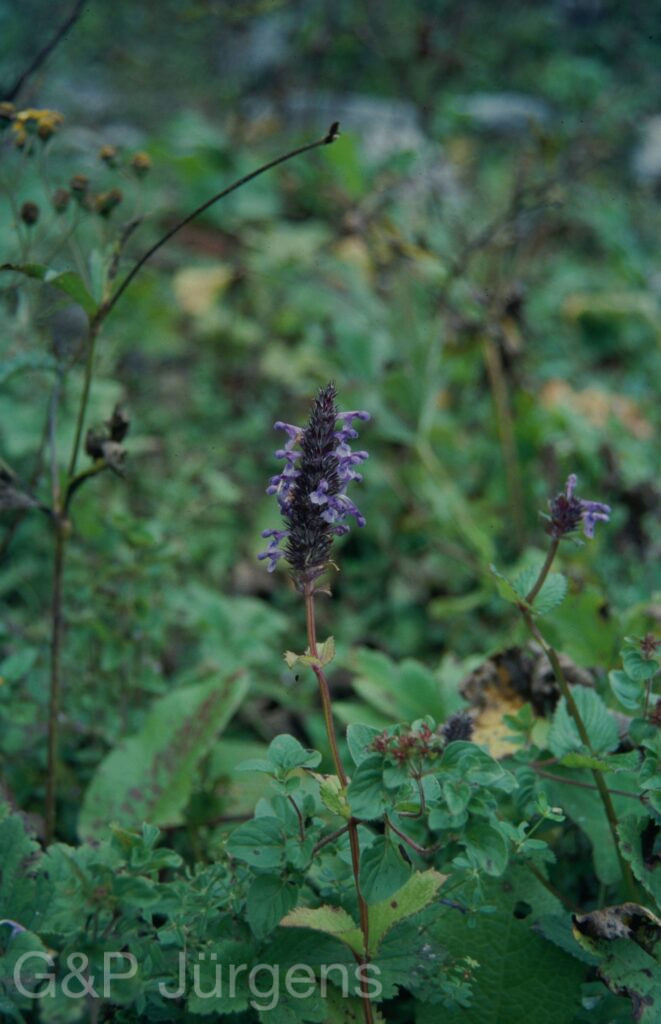
Nepeta laevigata is a perennial herb widely distributed across the temperate and subalpine Himalaya, ranging from Afghanistan and Pakistan eastwards through northern India and Nepal into south-western China, with a documented occurrence base of some 846 records (additional points from Germany, Norway and the United States reflecting cultivated or vouchered specimens). It favours open grassy slopes, forest margins, alpine meadows and disturbed ground between roughly 2400 and 3600 m. The plant illustrated here was photographed in India's Garhwal, in the celebrated Valley of Flowers at about 2950 m in September, where it flowers in the post-monsoon season among the rich herbaceous turf.

The species forms erect, quadrangular stems arising from a woody rootstock, typically 30-90 cm tall and often branched above. The leaves are opposite, ovate to ovate-lanceolate, crenate-serrate at the margin, cordate or truncate at the base and borne on distinct petioles, the surfaces glabrous to thinly pubescent and gland-dotted. The inflorescence is a slender terminal raceme or spike of well-spaced verticillasters subtended by small bracts; the flowers are bilabiate, the calyx tubular and bluntly toothed, the corolla white to pale violet with a hooded upper lip and a broad, often spotted lower lip. The fruit comprises four smooth nutlets enclosed in the persistent calyx.

Membership in Lamiaceae, subfamily Nepetoideae, is confirmed by the aromatic foliage, square stems and characteristic verticillate cymes. Like many catmints, N. laevigata is strongly insect-pollinated, its nectar-rich corollas visited by bees and bumblebees. The species is common across much of its montane range and is not regarded as threatened; it functions as a typical component of Himalayan meadow and forest-edge communities, where its volatile terpenoid oils may deter generalist herbivores.

Author: (D.Don) Hand.-Mazz. · Sources: POWO (Kew), GBIF, Flora of China, Flora of Pakistan, Flora of Bhutan, Annotated Checklist of the Flowering Plants of Nepal, Budantsev revision of Nepeta

(Hook.f. & Thomson) Al-Shehbaz

BhutanPG2011 638
Bhutan Paden-Tso, 4300m July

Description

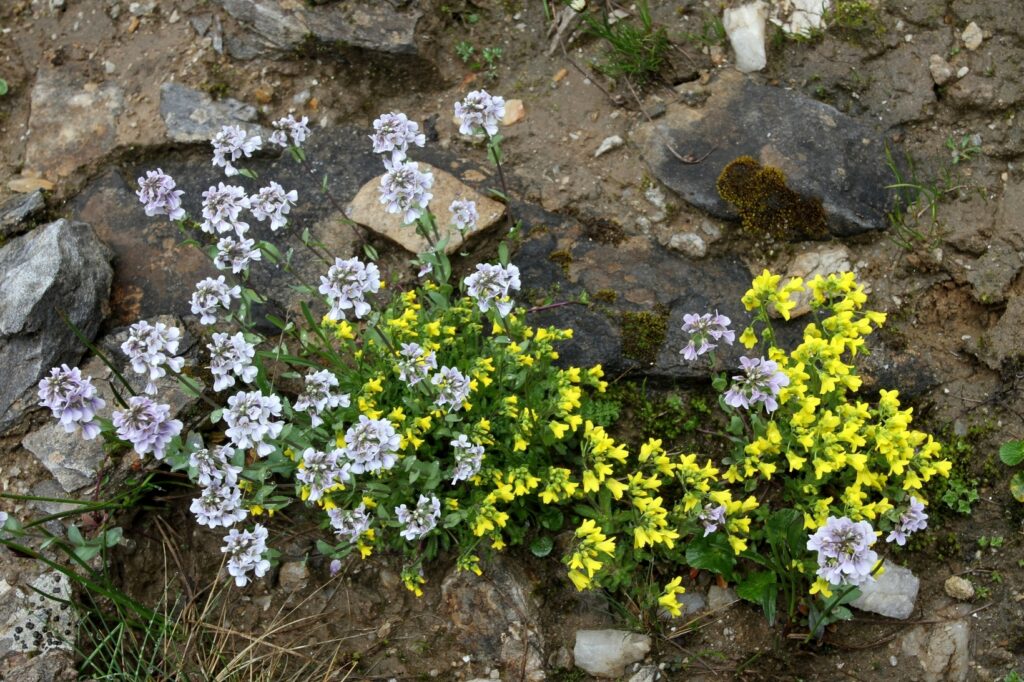
Noccaea andersonii is an alpine crucifer of the Himalaya, documented by GBIF (140 occurrences) from Nepal, India, Bhutan and southern Tibetan China. It is a plant of the upper alpine zone, growing in open stony pastures, scree, moist seepages and the margins of glacial lakes, generally between about 3800 and 4600 m. The cited collection from Paden-Tso in Bhutan at 4300 m in July typifies its preferred habitat: cold, well-drained mineral soils near tarns where it flowers during the brief post-monsoon summer, often associated with cushion plants and short alpine sedge turf.

The species is a low, glabrous, somewhat glaucous perennial herb arising from a slender caudex. Basal leaves are petiolate and form a loose rosette, while the cauline leaves are sessile and clasp the stem with sagittate-amplexicaul bases, a diagnostic feature of the genus. The inflorescence is a corymbose raceme of small flowers with four white to pale lilac petals borne above spreading sepals. The fruit is a flattened, obcordate to broadly elliptic silicle, narrowly winged toward the apex and notched at the tip, containing several smooth seeds in each loculus.

The binomial reflects the modern segregation of Noccaea from the broadly circumscribed Thlaspi, supported by the combination by Al-Shehbaz on molecular and fruit-anatomical grounds, with the perennial habit and amplexicaul leaves distinguishing it from annual Thlaspi proper. Ecologically it is a cold-adapted specialist of frost-churned alpine substrates. It is widespread across suitable habitat and not presently of conservation concern, though restricted to a narrow altitudinal band sensitive to climatic shifts.

Author: (Hook.f. & Thomson) Al-Shehbaz · Sources: POWO (Kew), GBIF, Flora of China Vol. 8, Flora of Bhutan Vol. 1, Flora of Nepal, Al-Shehbaz Brassicaceae systematic studies

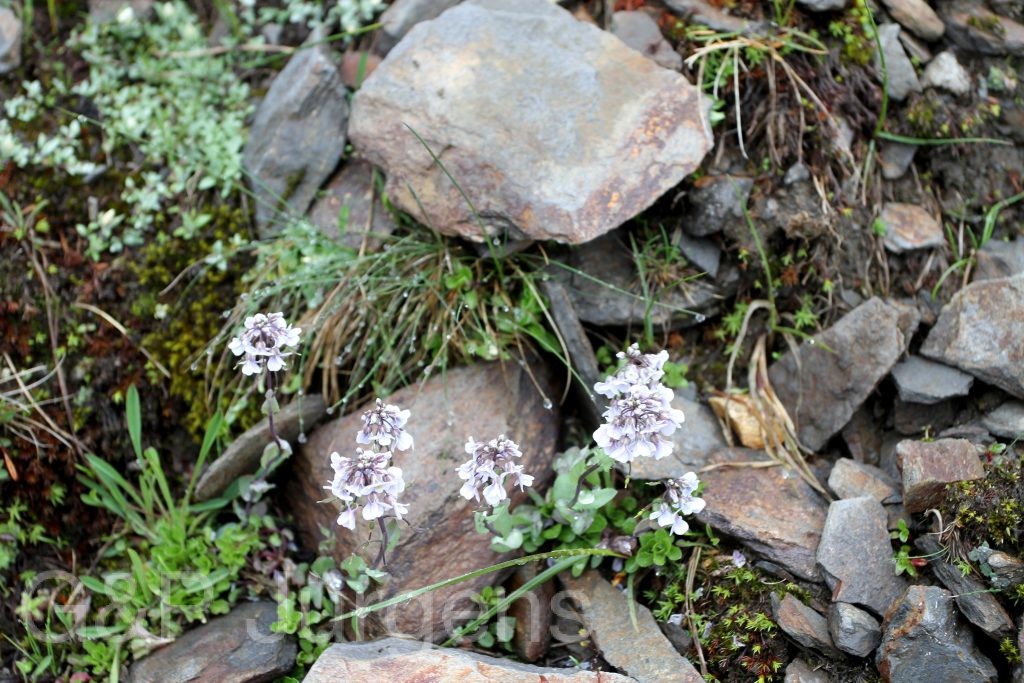
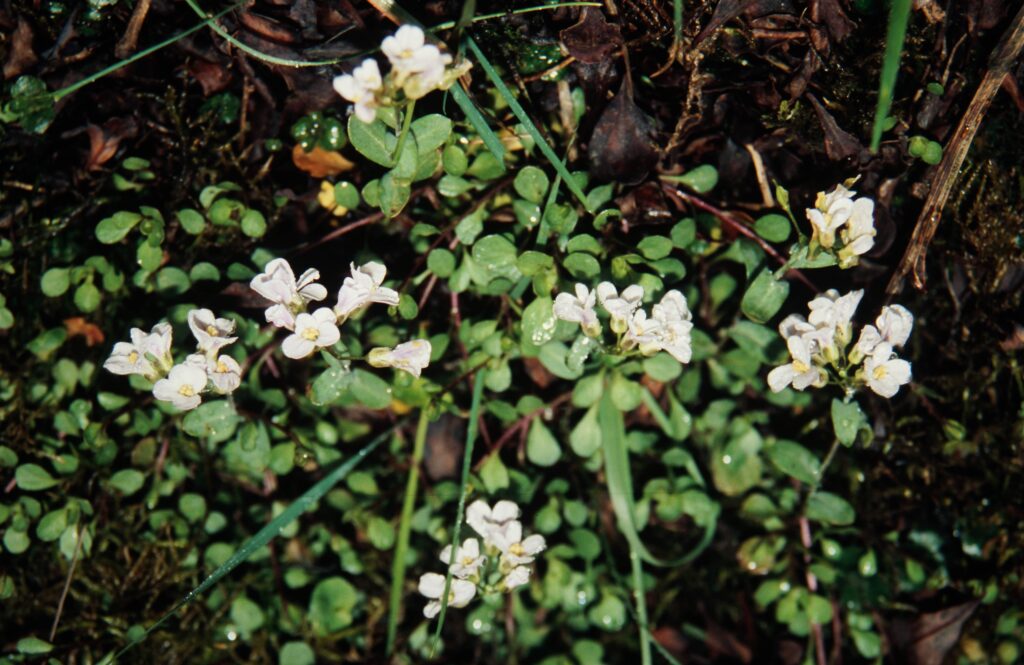
(Hook. f. & Thomson) Al-Shehbaz

BhutanPG2011 286
Bhutan Jule-Tso, 4200m June
Sikkim 2006 129 ergebnis
India West-Bengal, Molley 3630m, May

Description

Noccaea cochlearioides (Hook. f. & Thomson) Al-Shehbaz is a high-alpine crucifer of the Himalaya and adjacent Central Asia, recorded from India, Nepal, Pakistan, Bhutan, Afghanistan, southern China and the Russian mountains, with about 93 GBIF occurrences reflecting its restricted, high-elevation niche. It grows on stony alpine slopes, screes, moraines and rock crevices, characteristically between about 3500 and 4800 m. The cited gatherings from Jule-Tso in Bhutan at around 4200 m in June and from Molley in West Bengal at 3630 m in May exemplify its presence in cold, open subnival habitats where the snow-free season is brief.

The species is a small, glabrous, somewhat fleshy perennial herb with a branched caudex bearing rosettes of entire to obscurely toothed, often spathulate basal leaves; the cauline leaves are sessile and amplexicaul with auriculate-sagittate bases. The flowers are arranged in a short corymbose raceme and have four white to pale lilac petals in the typical cruciform arrangement. The fruit is a flattened, obcordate to obovate silicula, narrowly winged and notched at the apex, containing few smooth seeds in each locule.

The taxon was transferred from Thlaspi to the segregate genus Noccaea by Al-Shehbaz in his molecular-based recircumscription of the Thlaspi alliance (Brassicaceae, tribe Coluteocarpeae). Its auriculate cauline leaves and winged, notched silicles are diagnostic. A narrow alpine endemic of restricted range, it is uncommon but not assessed as threatened.

Author: (Hook. f. & Thomson) Al-Shehbaz · Sources: POWO (Kew), GBIF, Flora of Bhutan, Flora of China, Flora of Pakistan, Al-Shehbaz revisions of Thlaspi and allied Brassicaceae