Tag:

Bhutan

Flowers of Bhutan — 1326 plant species documented across the Bhutanese Himalaya, from dense broadleaf and conifer forests to alpine scrub and meadows. Bhutan’s largely intact wilderness shelters an exceptional diversity of orchids, rhododendrons, primulas and Himalayan poppies, many of them regional endemics. Each species page includes a botanical description, distribution, habitat and flowering time, with the original photograph and its recorded altitude and locality.

(DC.) H.Ohashi & K.Ohashi
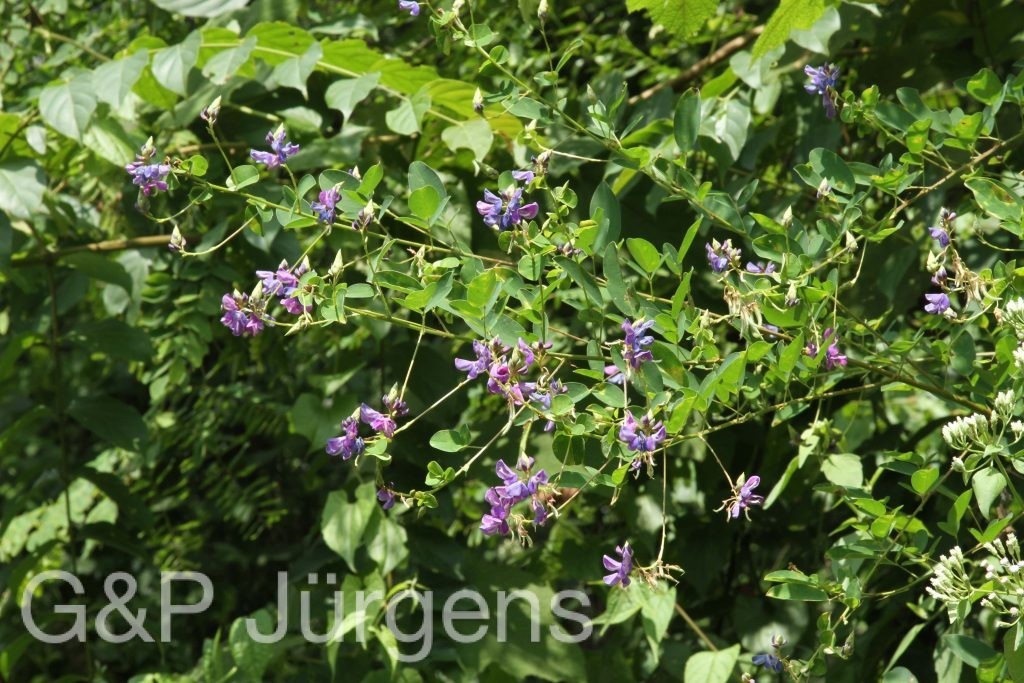
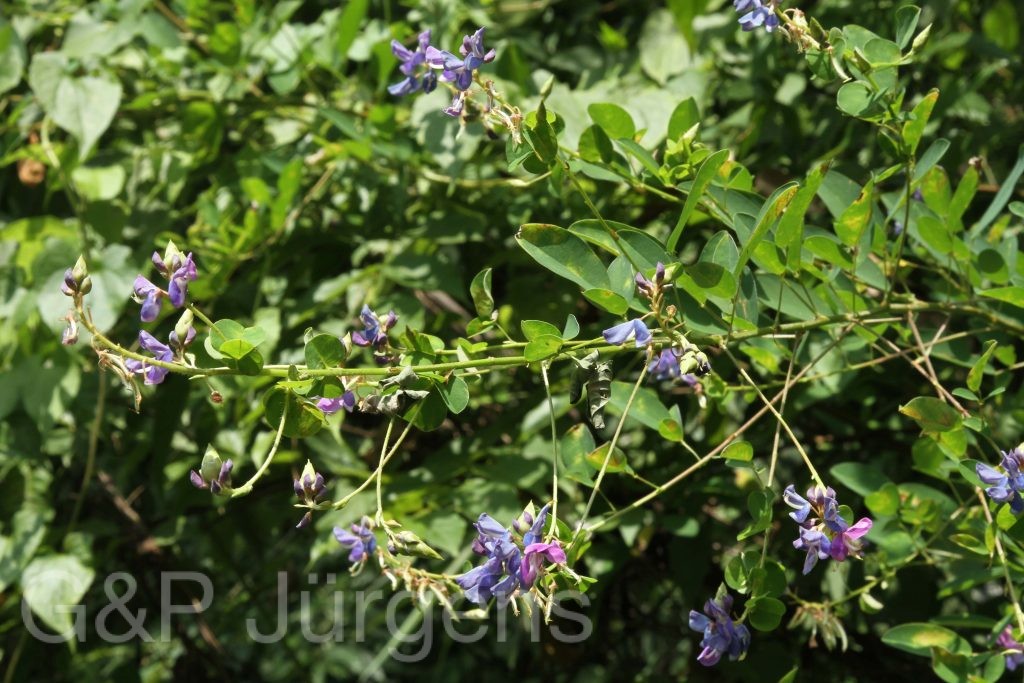
Bhutan2012 985
Bhutan Trithangebe 1050m, October
Bhutan2012 986
Bhutan Trithangebe 1050m, October

Description

Ototropis multiflora (DC.) H.Ohashi & K.Ohashi, long familiar as Desmodium multiflorum, is a shrubby legume widely distributed through tropical and subtropical Asia. GBIF records (over 1400 occurrences) extend from Pakistan, Nepal, northern India and Bhutan eastward through southern China, Taiwan, Myanmar, Thailand, Laos, Vietnam and Malaysia. It grows in open forest, scrub, forest margins, roadsides and grassy hill slopes at lower and middle elevations, broadly from near sea level to about 2400 m. The specimen photographed at Trithangebe in Bhutan at 1050 m in October, flowering late in the warm season, typifies its preference for warm, well-lit subtropical foothill habitats.

It is an erect, much-branched shrub up to about 1-2 m tall, with young stems and foliage softly pubescent. The leaves are pinnately trifoliolate; leaflets are ovate to elliptic, the terminal one largest, densely soft-hairy beneath, and subtended by persistent stipules. Flowers are borne in many-flowered terminal and axillary racemes or panicles, each papilionaceous corolla pink to purple, the keel enclosing the diadelphous stamens. The fruit is a flattened, several-jointed loment, the segments shallowly constricted and clothed in hooked uncinate hairs that adhere to fur and clothing, promoting epizoochorous dispersal.

The segregation of Ototropis from the broadly defined Desmodium follows molecular work by H. Ohashi and K. Ohashi that resolved tribe Desmodieae into several well-supported genera; Ototropis multiflora is therefore the currently accepted name. As a nitrogen-fixing legume it contributes to soil fertility on disturbed slopes and is used locally as fodder and in traditional medicine. Widespread, weedy and adaptable, it is of least conservation concern and readily colonises secondary habitats.

Author: (DC.) H.Ohashi & K.Ohashi · Sources: POWO (Kew), GBIF, Flora of China, Flora of Bhutan, Ohashi & Ohashi revision of tribe Desmodieae, Annotated Checklist of the Flowering Plants of Nepal
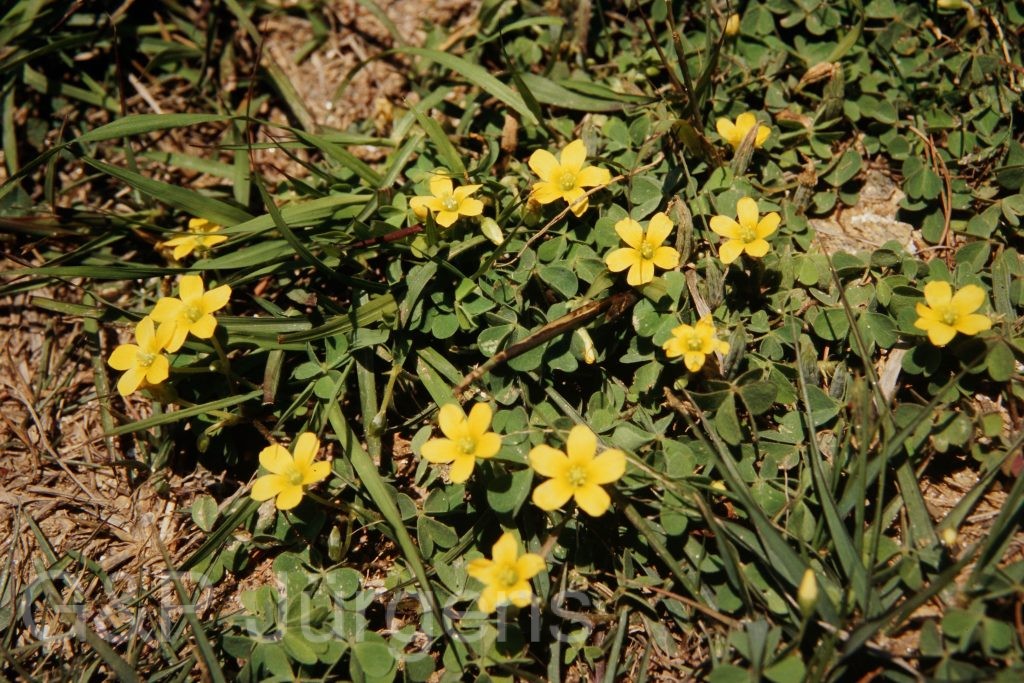
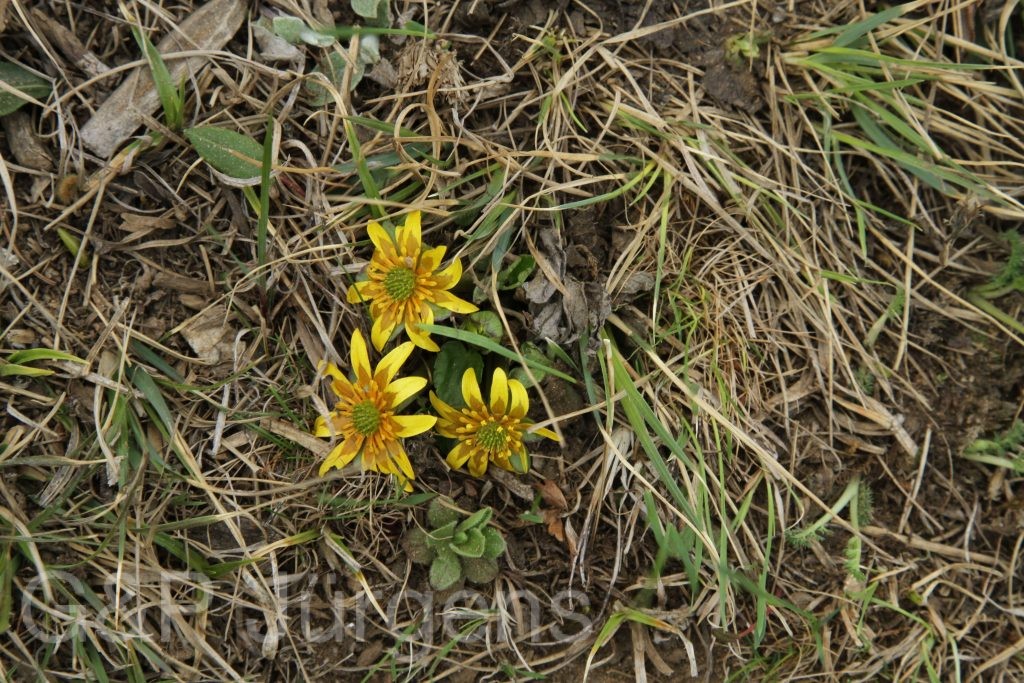
Edgew. & Hook. f.

Bh2008 308 G476
Bhutan Tongsa, 3300m April

Description

Oxalis griffithii is a woodland herb widely distributed across temperate eastern and southern Asia, ranging from the Himalaya (India, Nepal, Bhutan) through China, Taiwan, Japan, Korea, Myanmar and into Russia, with numerous cultivated and naturalised European records; GBIF logs 6798 occurrences across this broad area. It is a plant of shaded, humus-rich habitats, growing on the floor of temperate broad-leaved and conifer forests, on mossy banks and beside streams, chiefly between about 1500 and 3500 m. The photographed plant from Tongsa (Trongsa) in central Bhutan at 3300 m in April shows it flowering in early spring beneath the still-leafless forest canopy, when light reaches the understorey.

It is a small, delicate perennial herb arising from a slender, scaly, creeping rhizome or bulbil-bearing rootstock. The long-petiolate leaves are basal and trifoliolate, the leaflets obtriangular (broadly obcordate) and notched at the apex, folding downward at night and in dull weather (nyctinasty). The flowers are solitary on slender axillary scapes, with five sepals and five white petals usually marked with fine yellow or pinkish-purple veins at the base. The fruit is an elongate, cylindrical, five-angled loculicidal capsule that dehisces explosively, ejecting the small seeds whose fleshy aril everts to fling them from the parent plant.

The species belongs to Oxalis (Oxalidaceae), the largest genus of its family and the only one of the wood-sorrels well represented in temperate Asia. Its tissues are rich in oxalic acid and soluble oxalates, giving the characteristic sour taste. The explosive ballistic seed dispersal, nyctinastic leaf movements and capacity for vegetative spread by rhizomes and bulbils underlie its wide distribution and ready naturalisation. Common and ecologically adaptable, it is of least conservation concern.

Author: Edgew. & Hook. f. · Sources: POWO (Kew), GBIF, Flora of China Vol. 11, Flora of Bhutan Vol. 1, Flora of Nepal, Monograph of the Oxalidaceae (Knuth, Das Pflanzenreich)

Hook.f. & Thomson

Bhutan2014 918
Bhutan Chele-La 4000m, May
Bh2008 568 P855
Bhutan Chele-La 3900m April
Nepal 2001 332 ergebnis ergebnis
Nepal (Gorkha) Rupina-La 3300m, May

Description

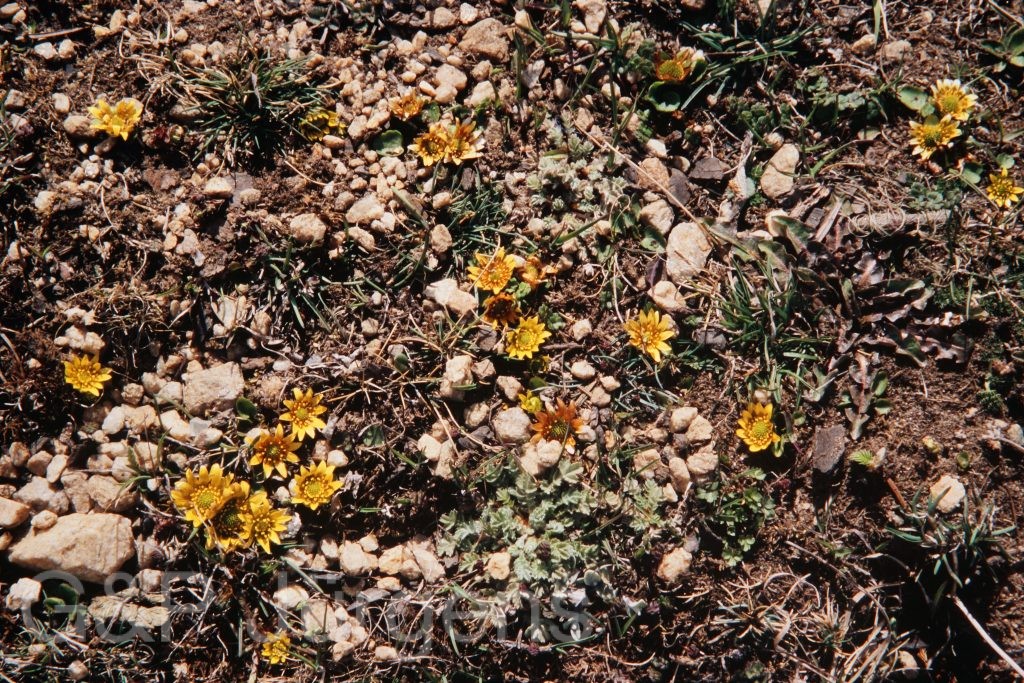
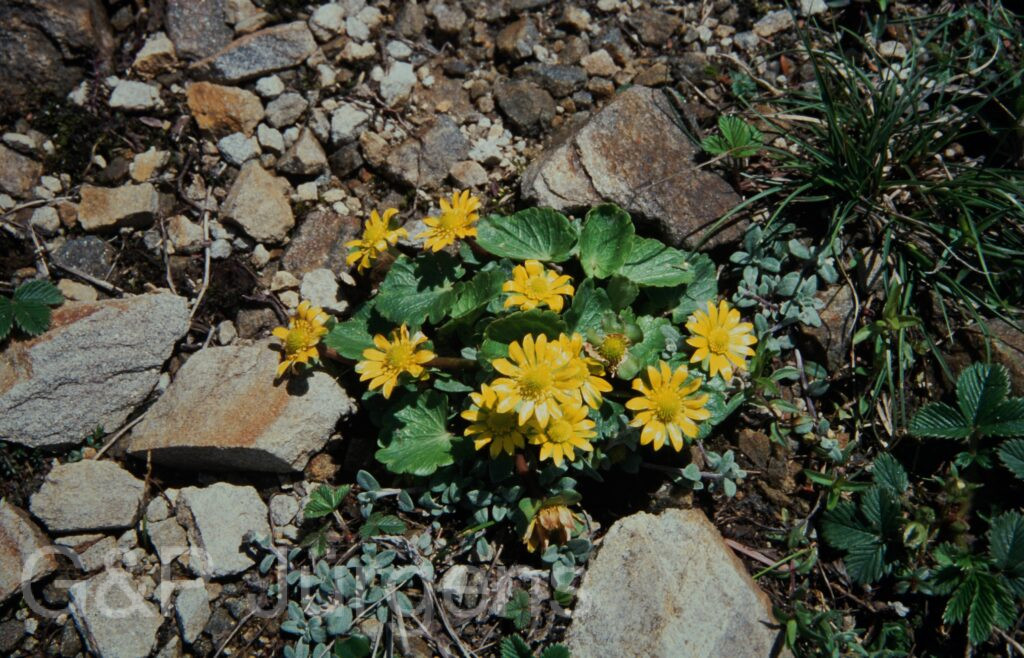
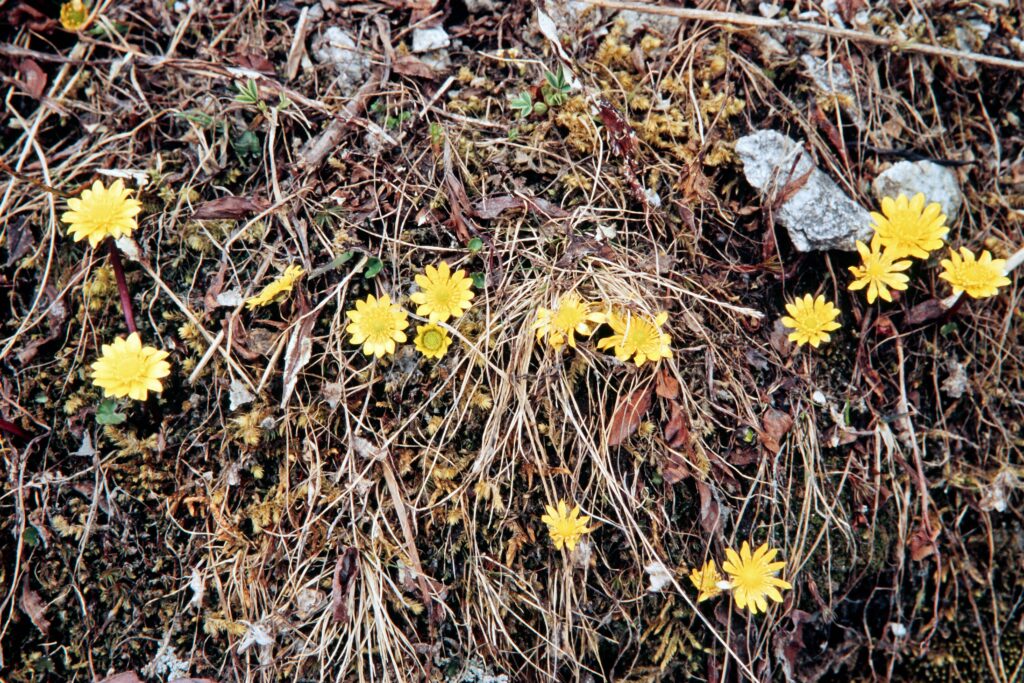
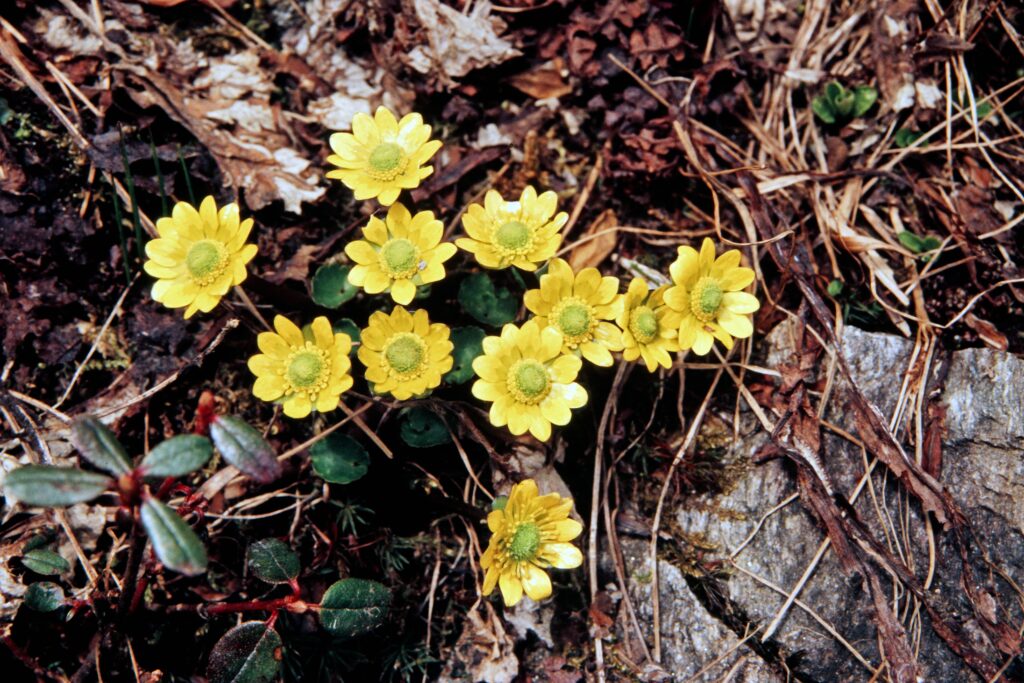
Oxygraphis polypetala is a high-alpine buttercup relative distributed across the Himalaya and Tibetan plateau, with records from India, Nepal, China, Russia, Bhutan and Pakistan and around 115 georeferenced occurrences. It is an early-flowering plant of damp alpine turf, snowmelt flushes, gravelly meadows and the margins of melting snow patches, generally between about 3300 and 4500 m. The illustrated collections—Chele-La in Bhutan at 3900–4000 m in April and May, Rupina-La in Gorkha, Nepal at 3300 m in May, and Khiar Kutti in Garhwal, India at 4100 m in June—capture its phenology of blooming almost immediately as the snow retreats.

It is a small, stemless perennial herb forming rosettes from a short rootstock. The leaves are all basal, long-petiolate, with an entire to obscurely crenate, ovate to elliptic, often somewhat fleshy blade. The flowers are solitary on leafless scapes; the perianth is conspicuous, with numerous (commonly ten or more, whence polypetala) narrow, glossy golden-yellow petaloid segments spreading star-like above a green calyx, surrounding many stamens and a domed head of carpels. The fruit is an aggregate of numerous small, beaked achenes borne on an elongating receptacle.

Oxygraphis is a small Asiatic genus segregated from Ranunculus on the basis of its persistent, leathery petals and achene structure; the name combination here, attributed to Hooker and Thomson, is treated as accepted despite synonym status in the source data. Its precocious flowering exemplifies the snowbed strategy of many high-Himalayan herbs that exploit the brief window of meltwater and warmth. Widely distributed and locally abundant, it is not regarded as threatened.

Author: Hook.f. & Thomson · Sources: POWO (Kew), GBIF, Flora of China (Ranunculaceae), Annotated Checklist of the Flowering Plants of Nepal, Grierson & Long Flora of Bhutan, Tamura's treatment of the Ranunculaceae

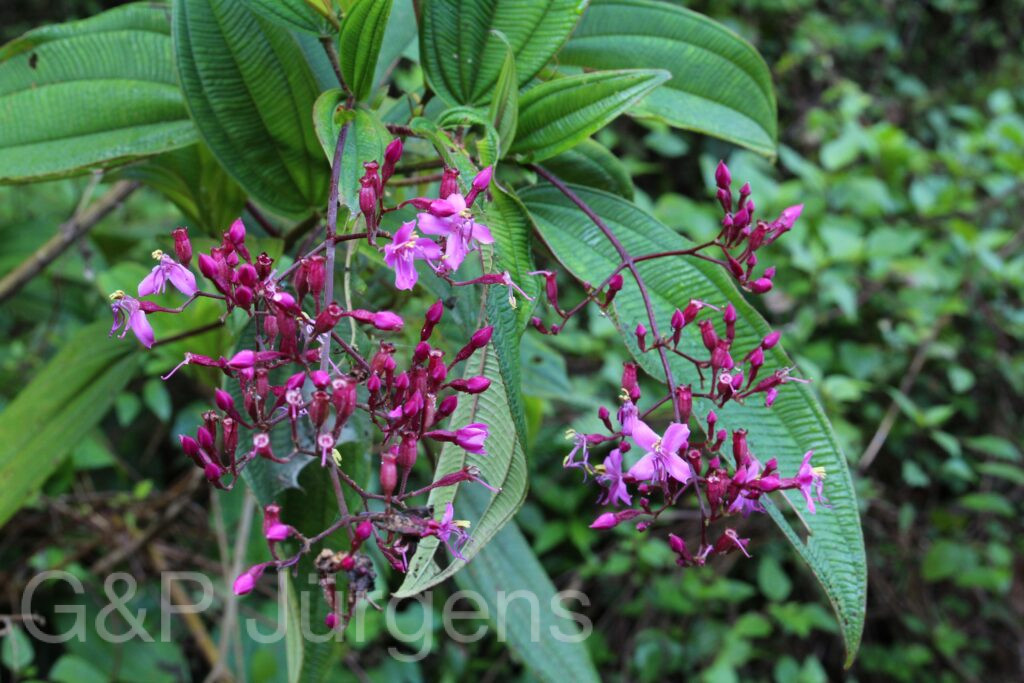
DC.

Bhutan2015 552
Bhutan Mo-Chu 1400m, October

Description

Oxyspora paniculata is a widespread species of the family Melastomataceae, distributed from the eastern Himalayas through mainland Southeast Asia to southern China and Vietnam. GBIF records over 1,090 occurrences across Nepal, India, Bhutan, Myanmar, China, Laos, Vietnam, and Japan. The species inhabits warm-temperate to subtropical broadleaved forests, forest margins, and streamsides at elevations of 500–2,200 m, favouring humid, semi-shaded habitats with well-drained acidic soils. Along the Mo-Chu valley in Bhutan at 1,400 m, it grows in the understorey of warm broadleaved forests dominated by Castanopsis and Schima.
Oxyspora paniculata is a shrub or subshrub, typically 1–3 m tall, with quadrangular, often narrowly winged stems. Leaves are opposite, ovate to ovate-lanceolate, 8–18 cm long, acuminate at the apex, with 3–5 prominent acrodromous veins and finely serrulate margins. The inflorescence is a terminal, lax panicle of cymes, 10–25 cm long, bearing numerous small flowers. Flowers are tetramerous, with pink to mauve petals 6–10 mm long and eight stamens of two lengths; the longer stamens bear sigmoid filaments and poricidal anthers with a short dorsal spur. The fruit is a urceolate capsule dehiscing by four apical valves, releasing numerous minute, cuneate seeds.
The genus Oxyspora comprises approximately 20 species centred in the Sino-Himalayan region and mainland Southeast Asia. Oxyspora paniculata is the most widespread member of the genus and has at times been confused with O. vagans, from which it differs in its distinctly winged stems and larger panicles. The species plays an important ecological role as a nectar source for pollinators in subtropical forest margins and is occasionally used in traditional medicine in parts of northeast India.

Author: DC. · Sources: POWO (Kew), GBIF, Flora of China Vol. 13, Flora of Bhutan Vol. 2, Renner et al.: Melastomataceae of the Old World (2021)

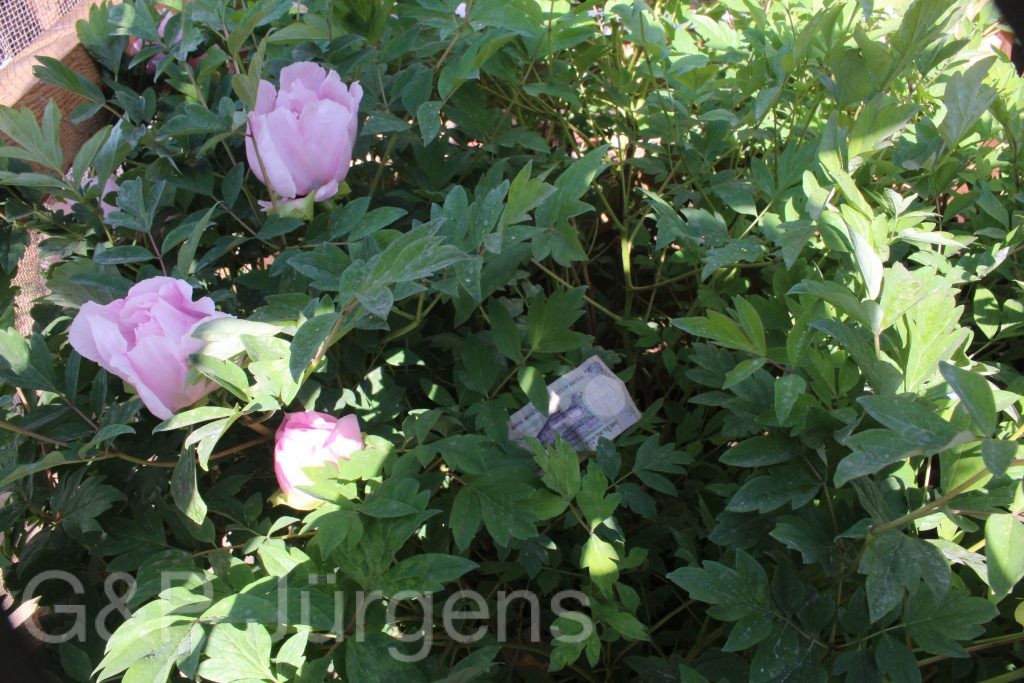
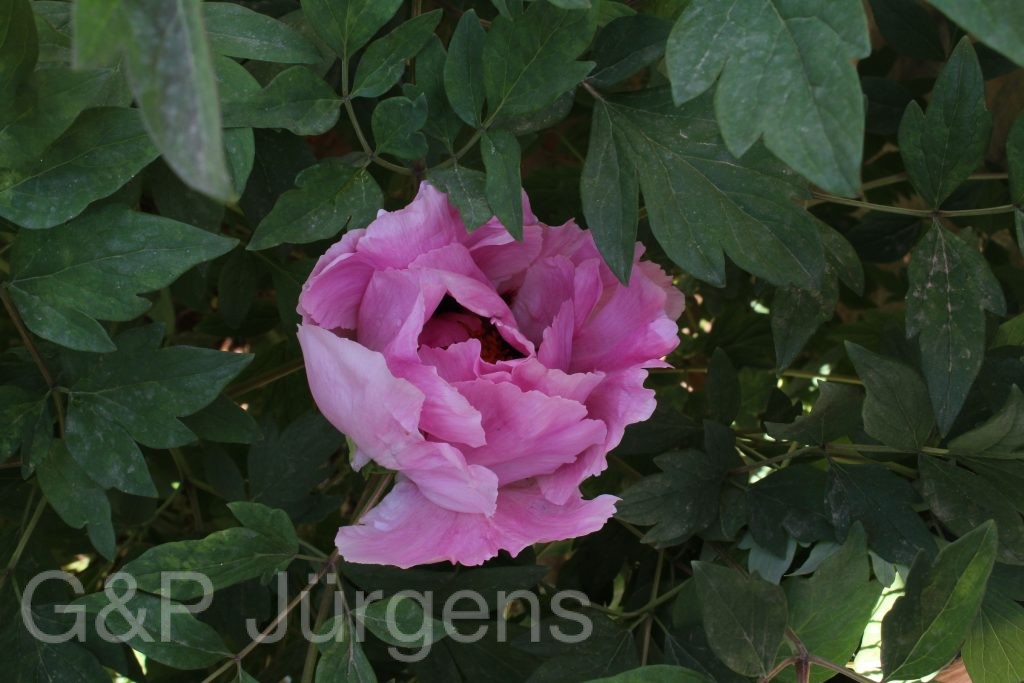
Andrews

Bhutan2014 950
Bhutan Haa-valley 640m, May
Bhutan2014 953
Bhutan Haa-valley 640m, May

Description

Paeonia suffruticosa, the tree peony, is a woody peony of Chinese origin that has been cultivated for well over a millennium and is now distributed worldwide through horticulture. Its GBIF dataset, with over 1,200 occurrences, reflects this mixed status, recording it from China, Korea, Japan and Taiwan as well as from a long list of countries where it occurs only in cultivation or as a garden escape, including the United States, Canada, Russia, Ukraine, and many European nations such as Germany, France, Spain, Italy, Sweden, Norway, Estonia, the Czech Republic, Belgium and Great Britain, alongside a record from Bhutan. The photographed plant from the Haa valley in Bhutan, at about 640 m and flowering in May, almost certainly represents cultivated or naturalised material grown around dwellings and monasteries, consistent with the species' long history as an ornamental rather than a wild Himalayan native.

It is a deciduous shrub up to about 2 m tall, with erect, branching woody stems, in contrast to the herbaceous, dying-back peonies. The leaves are alternate, large and biternately to bipinnately compound, the leaflets ovate, often lobed and glaucous beneath. The flowers are solitary and terminal and exceptionally large and showy, single to fully double in cultivated forms, with broad petals in white, pink, red, purple or yellow tones surrounding numerous stamens; a conspicuous fleshy, leathery disk forms a sheath partly enclosing the carpels. The fruit is a cluster of several densely tomentose follicles that split to release the large, rounded, dark seeds.

Paeonia, the only genus of Paeoniaceae, is divided into herbaceous and woody (section Moutan) groups, and P. suffruticosa in the strict sense is now understood to be a complex hybrid cultigen derived from several wild Chinese tree-peony species rather than a single wild taxon. As the celebrated "king of flowers" (mudan) of Chinese horticulture, it is enormously important culturally, medicinally (the root bark, mudanpi, is a traditional drug) and ornamentally, and exists in innumerable cultivars. As a cultigen it has no wild conservation status of its own, although the wild ancestral species of the Moutan group, several narrowly endemic in China, are of considerable conservation concern.

Author: Andrews · Sources: POWO (Kew), GBIF, Flora of China Vol. 6, Flora of Bhutan Vol. 1, Flora of Nepal, Flora of Pakistan, Hong's monograph Peonies of the World

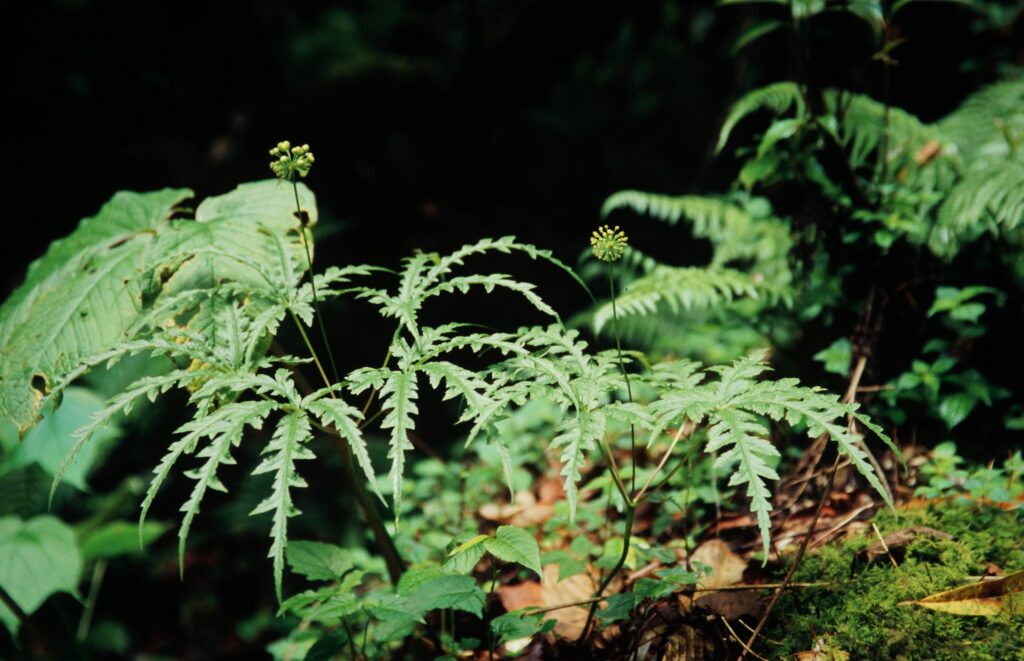
Seem.

Sikkim 2006 316 ergebnis
India West-Bengal, Chaana 1800m, May

Description

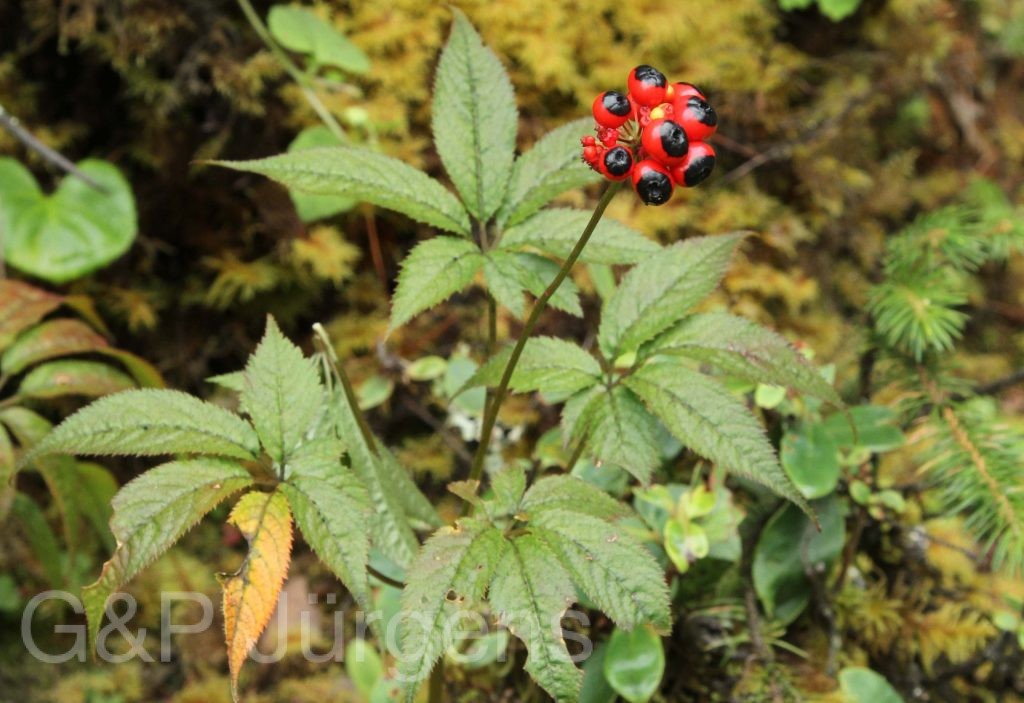
Panax bipinnatifidus is a Sino-Himalayan ginseng distributed through the eastern Himalaya and adjacent uplands of mainland Asia, with GBIF documenting some 900 occurrences across India, Nepal, Bhutan, China, Myanmar, Vietnam and Thailand. It is a herb of shaded, humus-rich temperate broad-leaved and conifer forests, growing among leaf litter on cool, moist slopes and in mossy understorey, generally between about 1800 and 3500 m. The photographed plant from Chaana in West Bengal, India, at roughly 1800 m and flowering in May, sits at the lower edge of this altitudinal band, typical of its occurrence beneath dense Himalayan forest canopy where it relies on consistent shade and well-drained organic soils.

It is a glabrous perennial herb arising from a stout, often moniliform (beaded) or fusiform fleshy rhizome that creeps horizontally. The single erect aerial stem bears a terminal whorl of (usually three to five) long-petiolate, palmately compound leaves, the leaflets characteristically deeply bipinnatifid or pinnately divided with the laminae much dissected, a feature that distinguishes the species and gives it its epithet. From the centre of the leaf whorl rises a slender peduncle terminating in a solitary, simple umbel of small greenish-white, pentamerous, mostly bisexual flowers with an inferior two-celled ovary and two styles. The fruit is a small, laterally compressed, red drupe that turns red at maturity, often with a black apical spot.

The genus Panax, the true ginsengs, is taxonomically complex in the Himalaya, where P. bipinnatifidus has historically been confused with P. pseudoginseng and treated under several varieties (var. bipinnatifidus, var. angustifolius) and synonyms; molecular and morphological work has helped clarify the dissected-leaved entity. Like its congeners it accumulates triterpenoid ginsenosides in the rhizome and is harvested as a substitute for ginseng across the Himalaya, which together with habitat loss exposes wild populations to over-collection. The species is consequently of growing conservation concern and is regarded as threatened or vulnerable in parts of its range, prompting interest in cultivation and sustainable management.

Author: Seem. · Sources: POWO (Kew), GBIF, Flora of China Vol. 13, Flora of Bhutan Vol. 2, Flora of Nepal, Flora of Pakistan, Wen's monograph of Panax (Araliaceae)

Wall.

Bhutan2012 27
Bhutan Shele-La, 3500m September

Description

Panax pseudoginseng is a rhizomatous perennial herb of the eastern Himalaya and Sino-Himalayan region, distributed across Nepal, India, Bhutan, China and Myanmar; its c. 255 georeferenced records define a temperate to subalpine forest range (records from Japan, North America, Russia and Europe largely reflect cultivation and study collections). It grows in shaded, humus-rich understorey of broadleaf and mixed forest, on mossy banks and in damp ravines, typically between 2500 and 4000 m. The plant photographed at Shele-La in Bhutan at 3500 m in September grows in the cool, moist upper-temperate to subalpine forest where the genus reaches its Himalayan optimum.

It is a slender erect herb 30-70 cm tall arising from a knotted, often elongate fleshy rhizome bearing prominent stem scars. A single whorl of palmately compound leaves crowns the stem, each leaf with three to five serrate, obovate to oblong leaflets, the terminal ones largest. From the centre rises a long peduncle bearing a solitary terminal umbel of small greenish flowers, each with five petals, five stamens and an inferior two-carpellate ovary with two recurved styles. The fruit is a small, fleshy red drupe, sometimes black-tipped, containing two flattened seeds.

Described by Wallich (as Wall.), P. pseudoginseng is the Himalayan representative of Panax, the ginseng genus of the Araliaceae, and a close relative of the medicinally renowned P. ginseng and P. notoginseng. Its rhizome contains ginsenosides and is harvested in traditional Himalayan and Chinese medicine, exposing wild populations to over-collection. The brightly coloured drupes are bird-dispersed. Because of its slow growth, narrow forest habitat and medicinal value, the species is regarded as conservation-sensitive and locally depleted by harvesting.

Author: Wall. · Sources: POWO (Kew), GBIF, Flora of Bhutan, Flora of China, Flora of Nepal, Wen's revision of Panax (Araliaceae)

Roxb.

Bhutan2012 749
Bhutan Zhemgang 850m, September
Bhutan2015 127
Bhutan Zhemgang 850m, September

Description

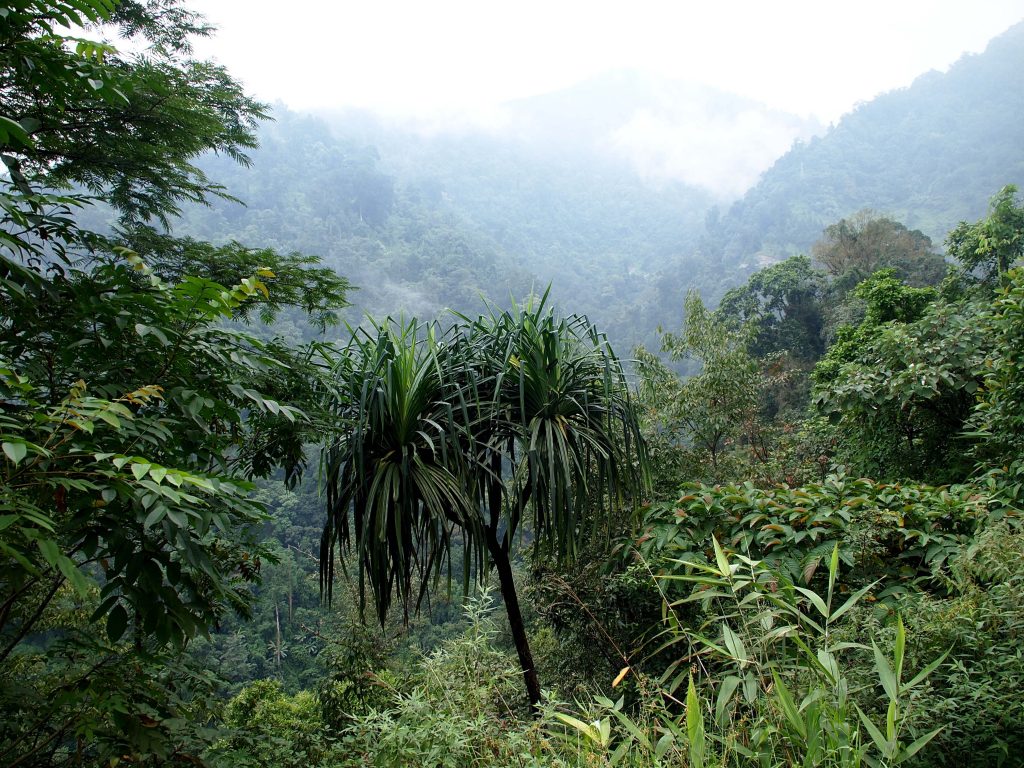
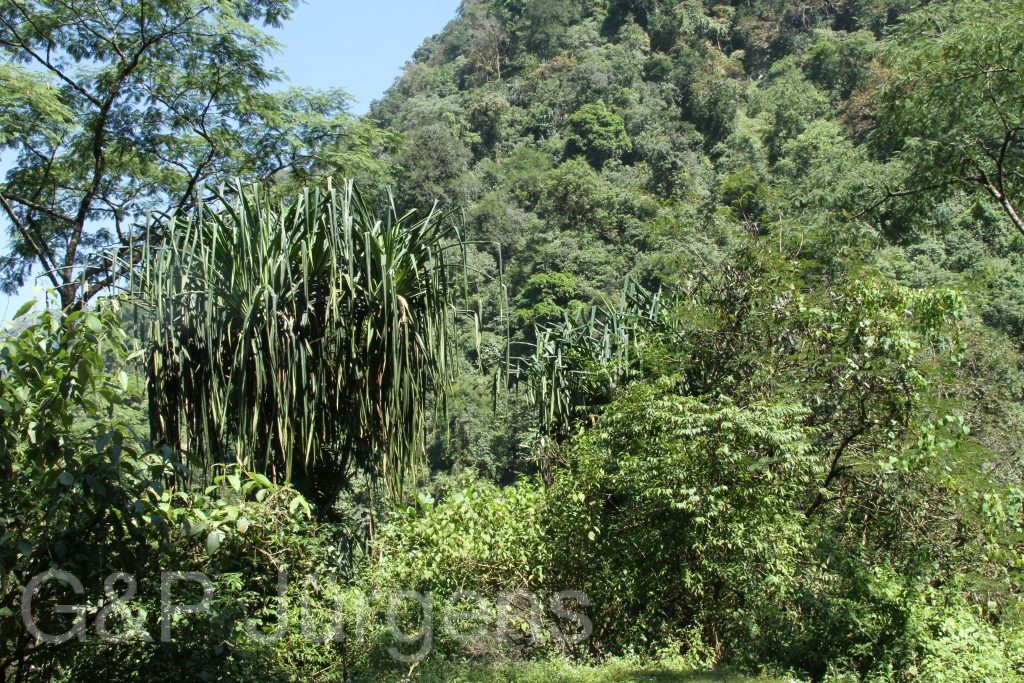
Pandanus furcatus, the Himalayan screw-pine, is a tree-like monocot of the eastern Himalaya and Southeast Asia, recorded by GBIF from Indonesia, Sri Lanka, India, Nepal, China, Malaysia, Thailand, Bhutan, Bangladesh and Myanmar (with cultivated records in Europe) across roughly 352 georeferenced occurrences. It is a plant of warm, humid, subtropical forest, favouring stream banks, moist ravines, gullies and shaded valley bottoms where the air remains saturated, generally at low elevations in the foothill zone. The photographed plant from Zhemgang in central Bhutan at about 850 m in September is characteristic of its occurrence along the moist inner-valley watercourses of the southern Himalaya, where it forms a conspicuous element of riparian vegetation.

The plant grows as a small tree with a slender trunk supported above the ground by a cone of stout, downwardly directed stilt (prop) roots, the stem typically branching and bearing terminal tufts of leaves. The leaves are very long, strap-shaped (ensiform) and spirally arranged in three ranks that twist around the stem, with sharp spiny teeth along the margins and the midrib beneath. Like all Pandanus it is dioecious. The male inflorescence is a much-branched, pendulous, fragrant spike subtended by white bracts, while the female inflorescence develops into a large, pendent, globose to ovoid syncarp (compound fruit) composed of numerous angular, wedge-shaped drupes that ripen yellow to orange-red.

Pandanus furcatus belongs to the Pandanaceae, an ancient pantropical family of arborescent monocots distinguished by their stilt roots, spiral tristichous leaves and dioecious habit. Among Himalayan species it is notable for ascending to relatively high elevations for the genus and for its role in stabilising stream banks and providing fruit and shelter for wildlife; the leaves are used locally for weaving and thatching. Although harvested locally, the species has a broad distribution and is locally common, and it is not regarded as globally threatened.

Author: Roxb. · Sources: POWO (Kew), GBIF, Flora of China Vol. 23, Flora of Bhutan Vol. 3, Flora of Nepal, Flora of Pakistan, Stone: revisional studies of Pandanus and the Pandanaceae

(Rchb.f.) Garay

Bh2008 319 G494
Bhutan Jakar, 2950m April

Description

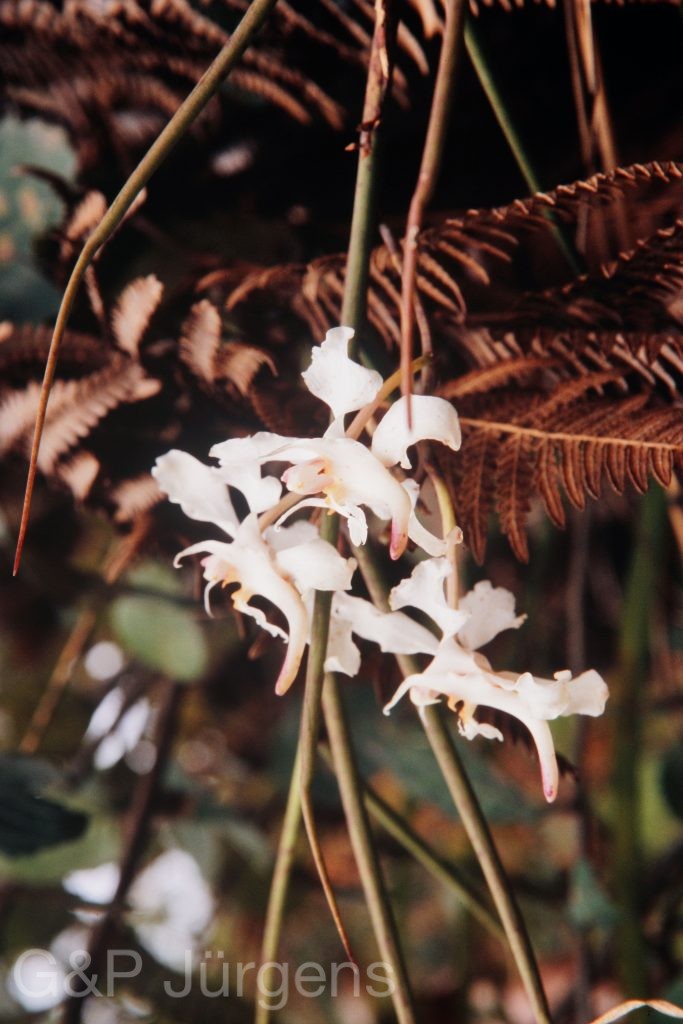
Papilionanthe vandarum is an epiphytic orchid distributed across the eastern Himalaya and adjoining Indo-Burmese ranges, with records from India, Nepal, Bhutan and Myanmar; GBIF documents some 49 occurrences, the additional points from Belgium, the United States and Great Britain reflecting cultivated material in botanical collections. It grows on tree trunks and mossy branches in humid broad-leaved and coniferous forest, frequently in the montane belt between roughly 1500 and 3000 m, where seasonal monsoon moisture alternates with a drier cool season. The photographed plant from Jakar in central Bhutan at about 2950 m, flowering in April, is typical of its upper elevational range, where it flowers before the summer rains.

The species is readily recognised by its monopodial, scrambling habit and slender, terete (pencil-like) leaves that replace the flattened laminae of most orchids, an adaptation reducing water loss in exposed epiphytic sites. Stems are elongate, branching and rooting freely along their length by means of thick, greyish aerial roots. The inflorescences are short, few-flowered racemes bearing large, showy flowers; sepals and petals are white to pale, broad and somewhat undulate, while the trilobed labellum is prominent, with a spurred base and a coloured throat. The fruit is a dry, elongate dehiscent capsule releasing innumerable dust-like seeds.

Formerly placed in Aerides and Vanda, the species was transferred to Papilionanthe (a small Asian genus of terete-leaved monopodial orchids) by Garay; its terete foliage and pendent habit distinguish it from true Vanda. Like all wild orchids it is listed on CITES Appendix II, and populations are locally threatened by forest clearance and over-collection, though it remains fairly widespread across its Himalayan range.

Author: (Rchb.f.) Garay · Sources: POWO (Kew), GBIF, Flora of Bhutan, Orchids of Bhutan, Genera Orchidacearum (Pridgeon et al.)

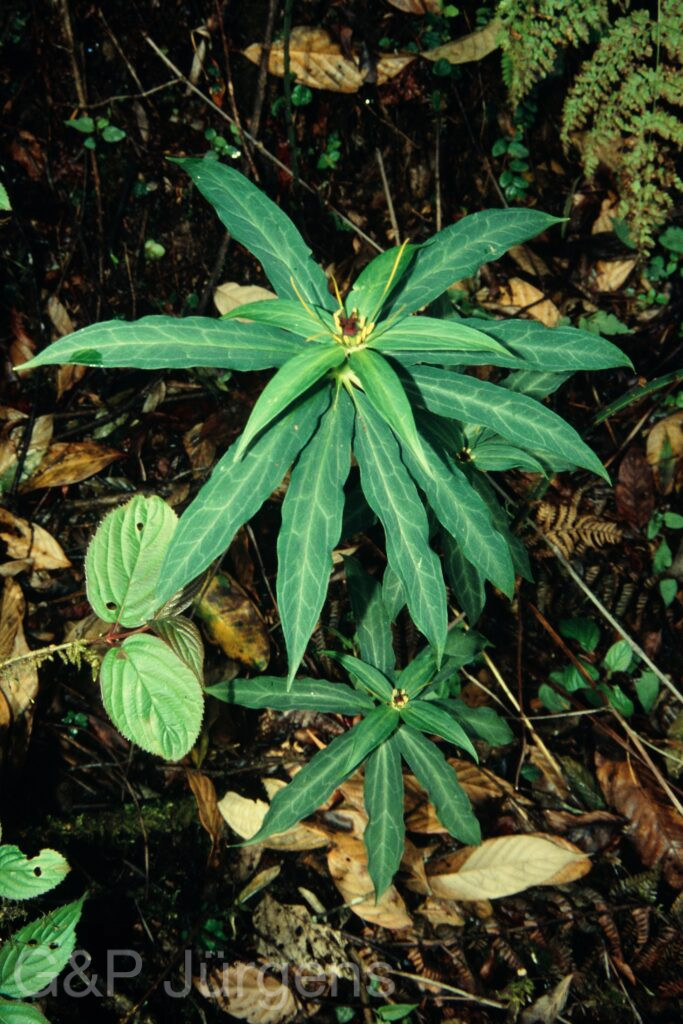
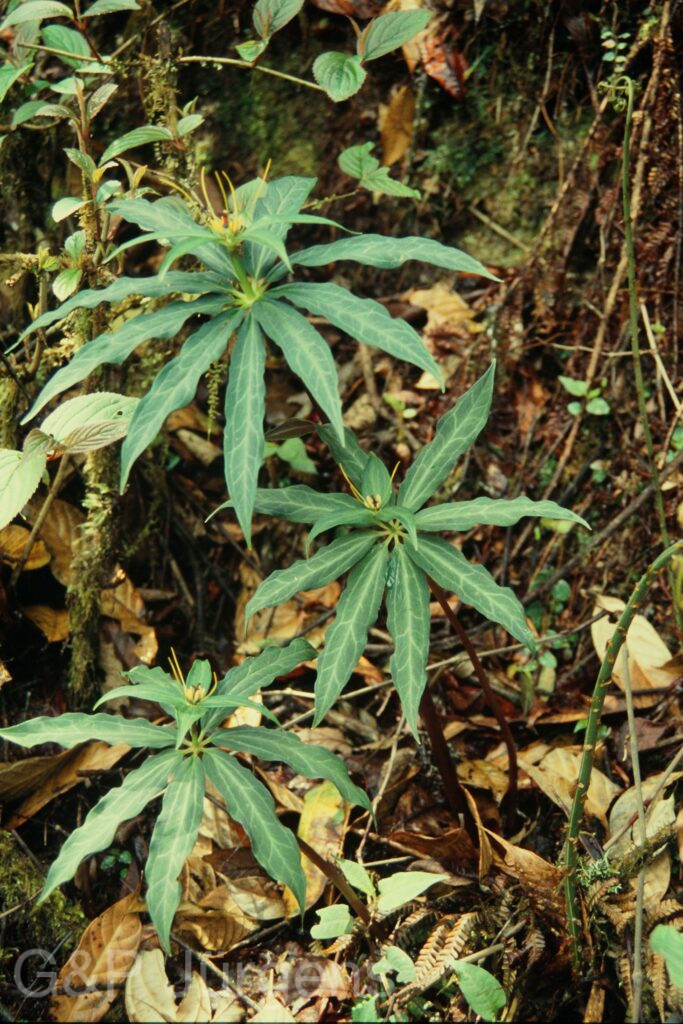
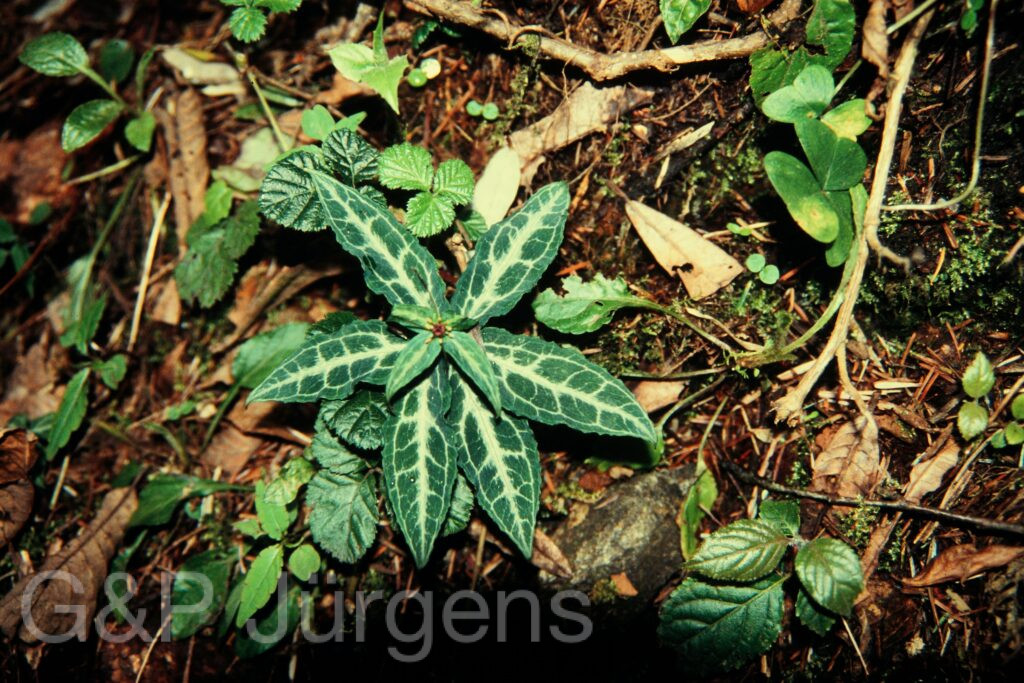
Paris mairei

by GP Jürgens

H.Lév.

Sikkim2004 7 G12
Sikkim West-Bengal, Sambon 1800m April
Sikkim2004 115 P196
Sikkim West-Bengal, Sambon 1800m April
Nepal 97 265 G547
Nepal Bagong-Khola 2700m May

Description

Paris mairei is a rhizomatous woodland herb of the Sino-Himalayan region, distributed across SW China, Nepal, NE India and Bhutan, with GBIF documenting around 269 records. It is a plant of shaded, humus-rich forest, growing in moist broadleaved and coniferous woodland, thickets and shady ravines of the temperate zone. The photographed populations at Sambon in the Sikkim–West Bengal hills (1,800 m, April) and at Bagong Khola in Nepal (2,700 m, May) reflect its altitudinal span from the warm temperate to the upper temperate forest belt, where it flowers in spring as the canopy leafs out.

It is an erect perennial arising from a creeping, knotty rhizome, bearing a single terminal whorl of stalkless or shortly petiolate, ovate to lanceolate, net-veined leaves. From the centre of the whorl rises a solitary, long-pedicellate flower with the parts in the characteristic Paris arrangement: a whorl of green, leaf-like outer perianth segments (sepals), filiform or narrowly linear inner segments (petals), prominent stamens with the connective often produced beyond the anther, and a central ovary crowned by spreading stigmas. The fruit is a capsule that splits to expose seeds with a coloured fleshy aril.

The genus Paris (now placed in Melanthiaceae rather than the former Trilliaceae) is renowned for its steroidal saponins, several Asian species being important in traditional Chinese medicine, which has driven heavy wild collection and conservation concern in parts of the range. The single leaf whorl and solitary, spider-like flower make the genus instantly recognisable, while the contrast between broad sepaloid and thread-like petaloid segments is diagnostic at species level. P. mairei is distinguished within the genus by its leaf and floral proportions and stamen connective form.

Author: H.Lév. · Sources: POWO (Kew), Flora of Nepal, GBIF, Flora of China Vol. 24, Li: The Genus Paris (Paridaceae)