L.
Description
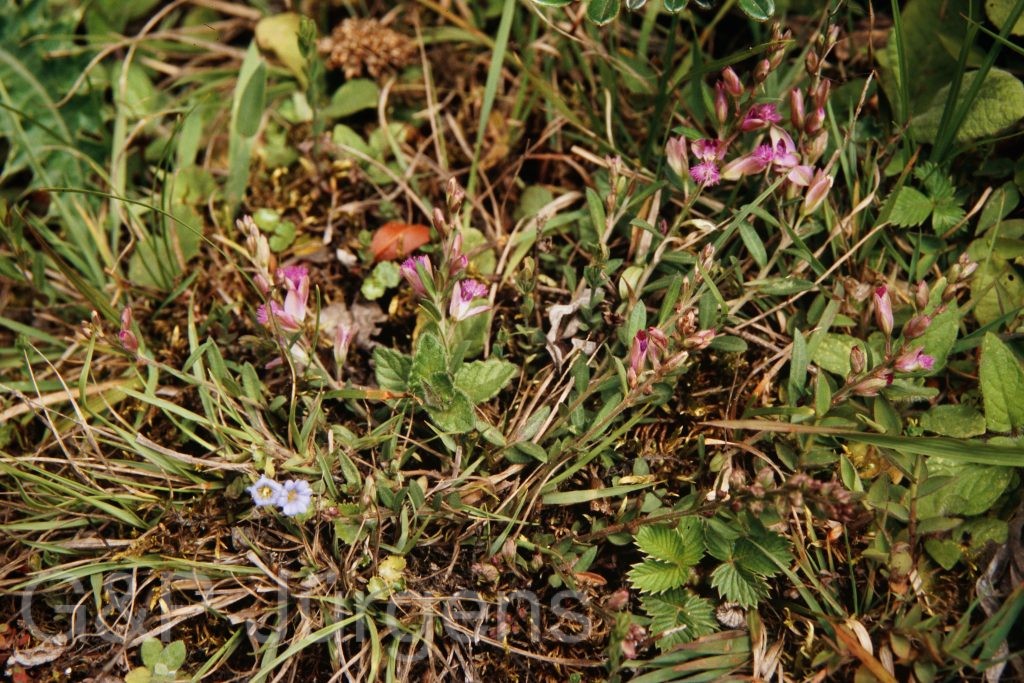
Polygala sibirica L. is a small perennial milkwort with one of the widest distributions in its genus, ranging across temperate Eurasia from eastern Europe through Central and northern Asia to the Himalaya, China, Japan and southward into Southeast Asia and Australasia. GBIF records confirm its presence in Russia, China, Mongolia, India, Nepal, Bhutan, Pakistan, Korea, Japan and many other countries, with several thousand occurrences. It grows on dry grassy slopes, open stony banks and forest margins from the lowlands to about 3,000 m. The plant photographed at Punakha in Bhutan at 2,400 m, flowering in May, exemplifies its occurrence on sunny montane slopes.
The species is a tufted perennial herb arising from a woody rootstock, with several ascending to spreading, often hairy stems 10–30 cm long. The leaves are alternate, sessile or nearly so, lanceolate to elliptic, the lower ones smaller. The flowers are borne in lax terminal racemes; the two large petaloid lateral sepals (wings) are greenish-veined, and the small blue to purplish corolla bears a conspicuous fringed keel-petal crest. The fruit is a flattened, narrowly winged, obcordate capsule containing two hairy seeds with a small aril.
Polygala sibirica is closely allied to the medicinally important P. tenuifolia, and its roots are similarly used in traditional Chinese medicine (yuan zhi) as a source of saponins. Its enormous range and ecological tolerance make it one of the most successful milkworts, and it is of least conservation concern.
Author: L. · Sources: POWO (Kew), GBIF, Flora of China Vol. 11, Flora of Bhutan Vol. 1, Bennett: Polygalaceae in Hooker's Flora of British India