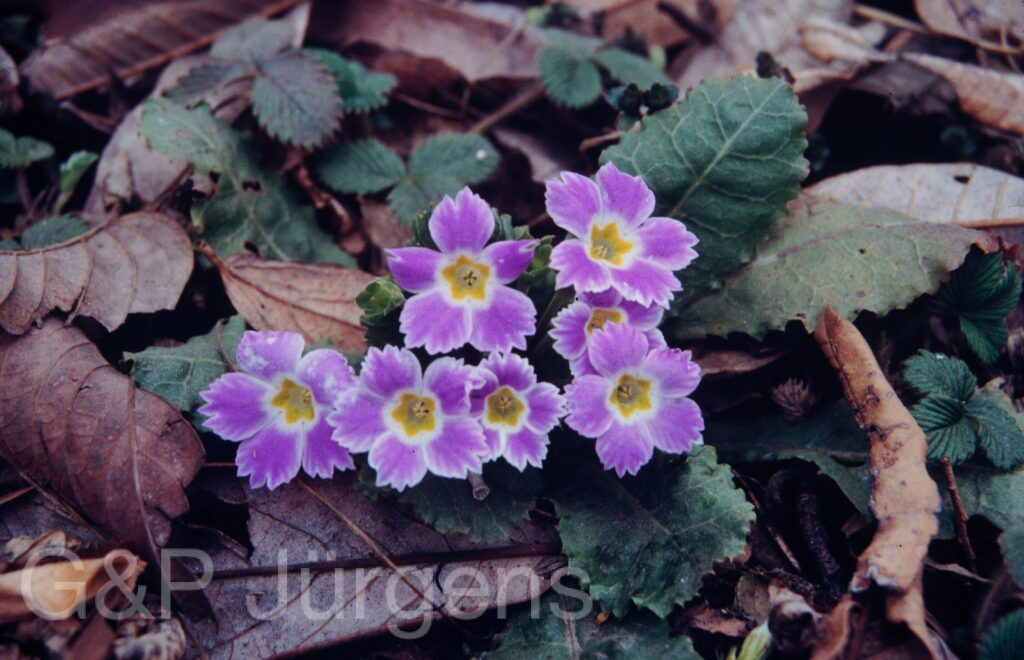
Tag:

Montane (1500-2500 m)

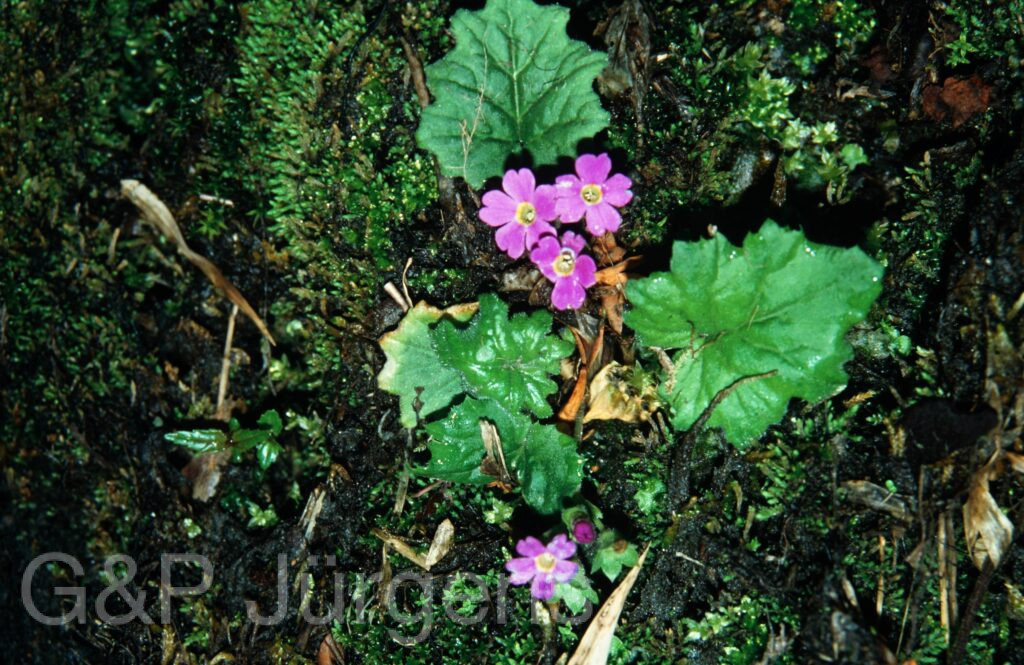
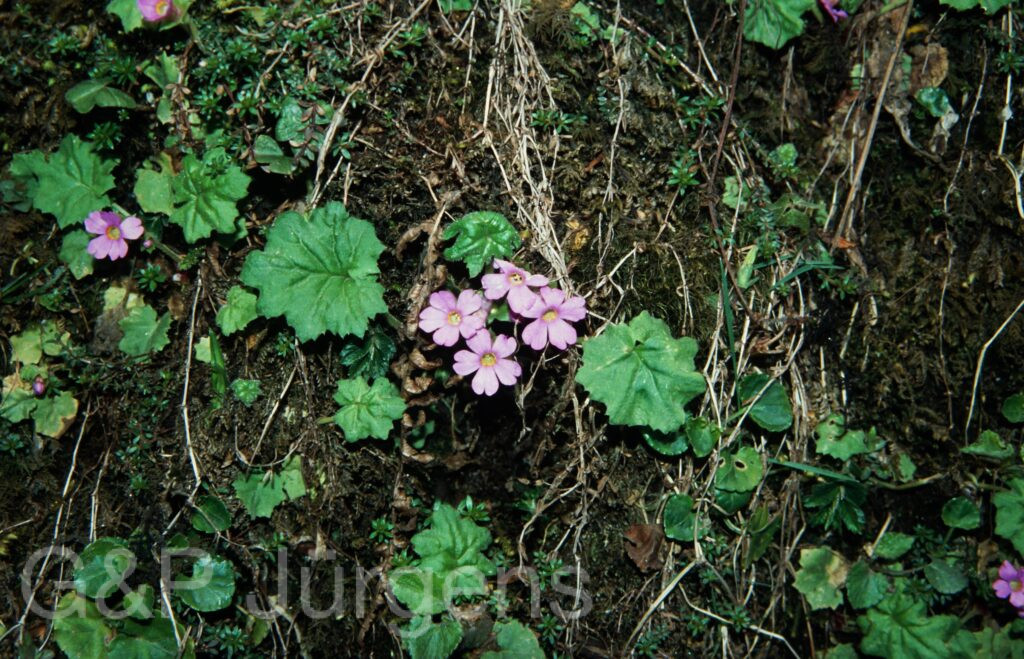
Craib

Bh2008 33 P56
Bhutan Doch-La, 3000m April
Nepal1992 198 P288 ergebnis
Nepal Suketar 2400m March 

Description

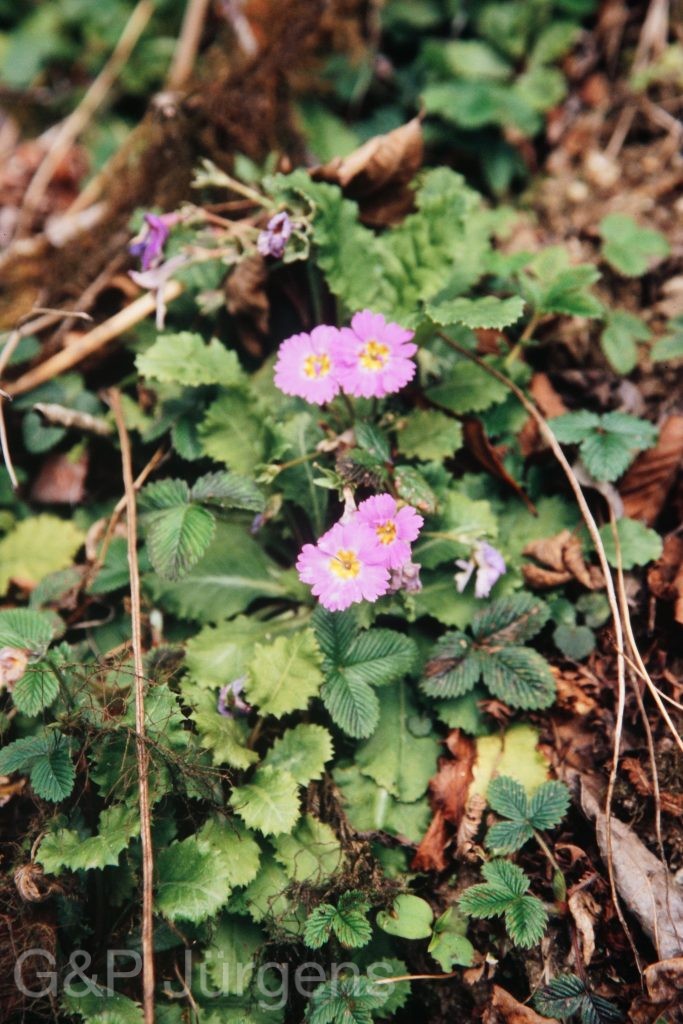
Primula irregularis Craib is a Himalayan primrose of restricted range, recorded in GBIF (about 45 occurrences) from Nepal, northern India and Bhutan. It is a plant of cool, humid temperate to subalpine habitats, growing on mossy banks, shaded forest floors, damp rock crevices and the margins of rhododendron and oak forest, broadly between about 2400 and 3500 m. The collections noted from Doch-La in Bhutan at 3000 m in April and from Suketar in eastern Nepal at 2400 m in March show it flowering very early, as winter snow recedes, in the moist, cloud-influenced mid-montane forest belt that characterises its niche.

It is a small farinose perennial forming a basal rosette that resumes growth early from a resting bud. The leaves are obovate to oblong, with a crenate-dentate, somewhat irregularly toothed margin tapering into a winged petiole, the undersurface frequently dusted with whitish or yellowish farina. The flowers open close to the rosette on a very short scape, solitary or in a few-flowered umbel. The corolla is salverform, with a slender tube and a spreading limb of obcordate, deeply emarginate lobes, pale lilac to violet with a contrasting paler or yellow eye. As in other primroses the species is heterostylous, and the small capsule contains numerous minute seeds.

Primula irregularis belongs to section Petiolares, the large Sino-Himalayan assemblage of early-flowering, farinose primulas whose species are notoriously difficult to delimit and which has been the subject of repeated revision. Heterostyly enforces outcrossing between long- and short-styled morphs. With its narrow range and dependence on perennially cool, moist microhabitats, the species is regionally restricted and likely sensitive to warming and habitat disturbance, characteristics shared by many of the high-altitude Petiolares primulas of the eastern Himalaya.

Author: Craib · Sources: POWO (Kew), GBIF, Annotated Checklist of the Flowering Plants of Nepal, Flora of Bhutan, Richards' monograph Primula, Flowers of the Himalaya
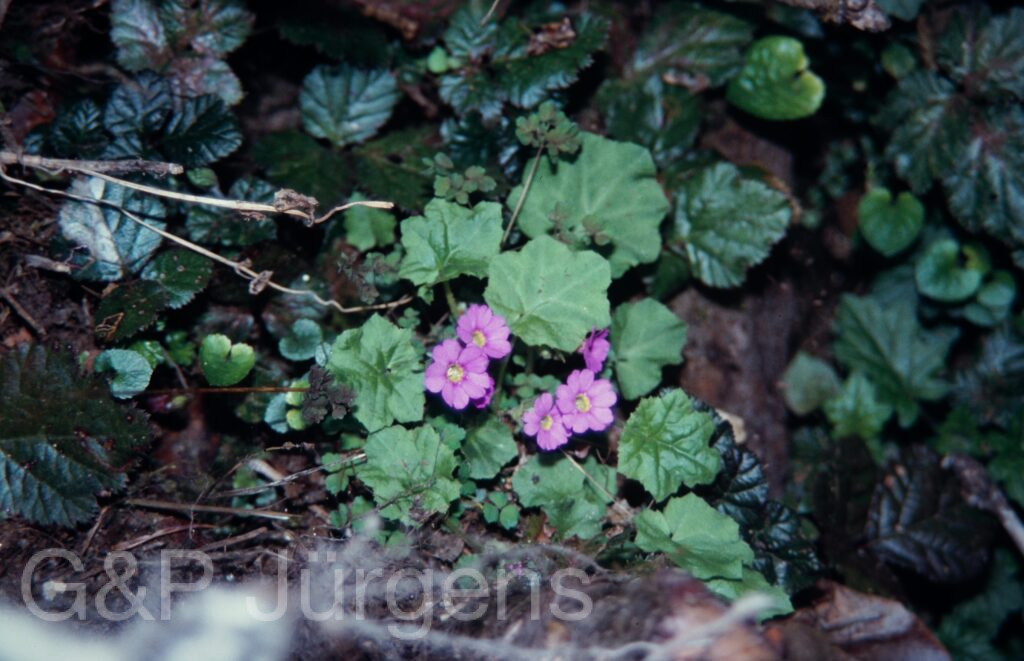
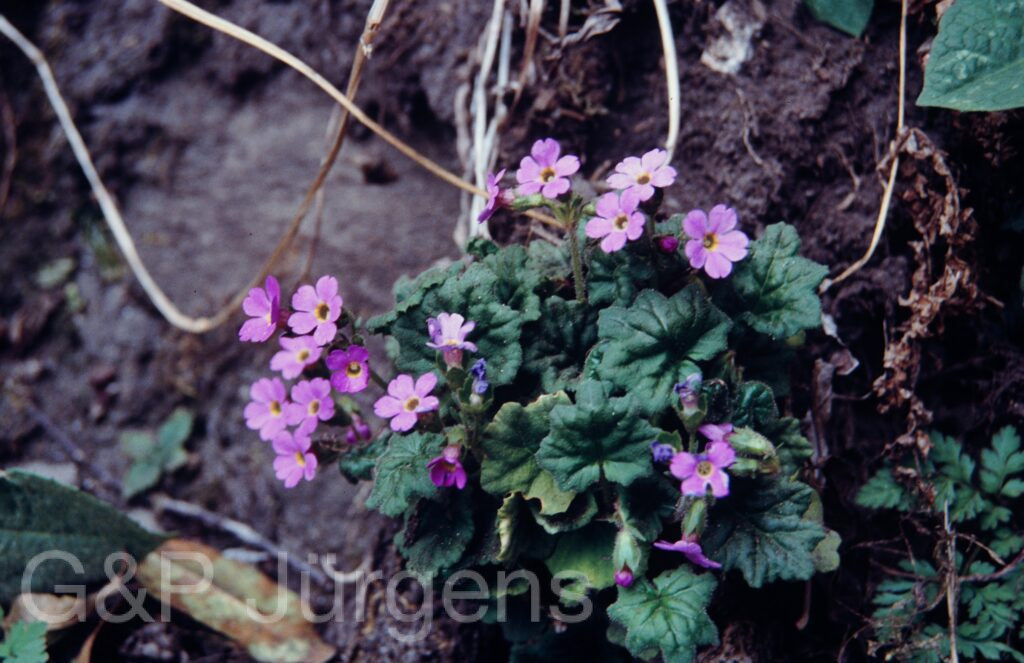
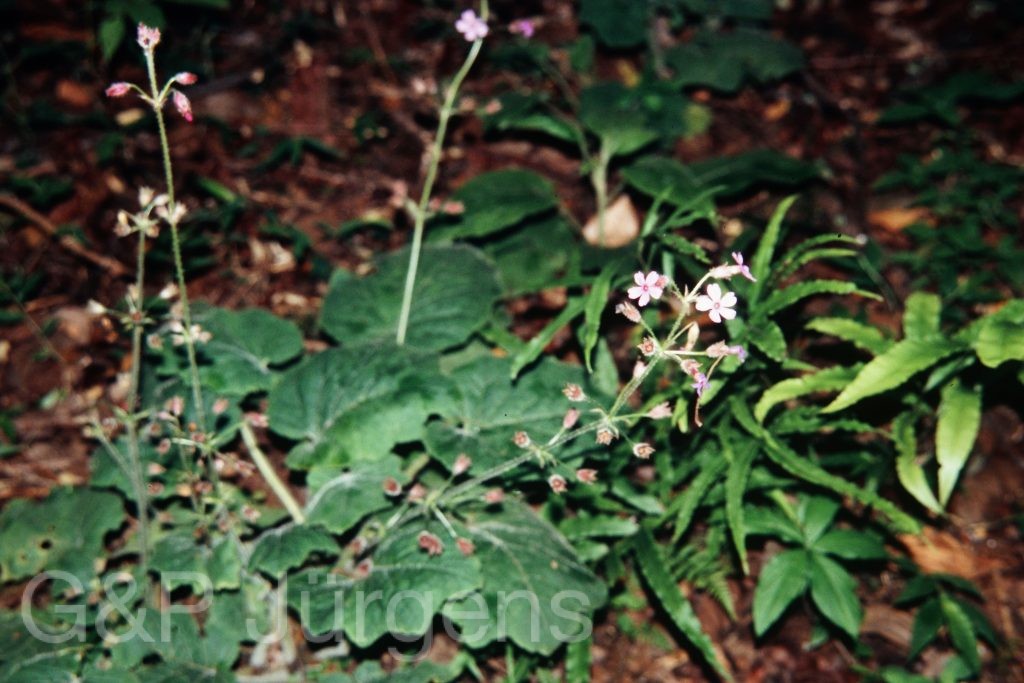
Primula listeri

by GP Jürgens

King ex Hook.f.

Nepal 1994 205 ergebnis
Ost-Nepal Mewa-Khola 2300m April 
Nepal1992 207 P303 ergebnis
Nepal Suketar 2400m March 
Nepal 2001 88 ergebnis ergebnis
East-Nepal Gupka Pokhari 3000m, April
Nepal 2001 123 ergebnis ergebnis
East-Nepal Gupka Pokhari 3000m, April

Description

Primula listeri is an eastern Himalayan species distributed through Nepal, northern India, Bhutan, southern China (Xizang, Yunnan) and northern Myanmar, with GBIF documenting around 102 georeferenced records concentrated along the wetter eastern arc of the range. It occupies shaded, humid montane environments between roughly 2000 and 3000 m, growing on mossy banks, in the leaf litter of broad-leaved and mixed forest, and along seeping rock faces. The populations imaged in East Nepal at Mewa Khola (2300 m, April), Suketar (2400 m, March) and Gupka Pokhari (3000 m, April) typify its phenology, with flowering coinciding with the early pre-monsoon period when soils remain moist and cool.

The plant is a small, delicate perennial herb forming a slender rootstock from which arises a rosette of thin-textured leaves. The leaves are petiolate, ovate to oblong with a crenate to dentate margin, and frequently sparsely farinose or efarinose beneath. Flowers are borne on a slender scape in a loose few-flowered umbel, each subtended by narrow bracts; the calyx is tubular and lobed, and the corolla is rotate with a narrow tube and notched, lilac to pale violet limb-lobes, the throat marked by an annulus. As in many sect. Petiolares allies the species is heterostylous, producing pin and thrum flowers. The fruit is a small capsule dehiscing to release numerous minute seeds.

Taxonomically P. listeri belongs to the species-rich Primula sect. Petiolares, a complex assemblage of vernal-flowering, rosette-forming primroses centred on the eastern Himalaya. Its restricted elevational band and dependence on permanently humid forest microhabitats make it sensitive to forest clearance and desiccation, though it is not formally assessed as threatened. Biogeographically it forms part of the rich Sino-Himalayan endemic flora whose diversification is linked to the monsoon-driven moisture gradient of the eastern ranges.

Author: King ex Hook.f. · Sources: POWO (Kew), GBIF, Flora of Bhutan, Flora of China, Annotated Checklist of the Flowering Plants of Nepal, Richards' Primula (monograph)

Nutt. ex Hook.

Bh09 360 G577
Bhutan Wangdi, 2300m June

Description

Primula mollis is a softly hairy perennial of the Eastern Himalaya and adjacent Indo-Burmese ranges, with verified occurrences in China, Myanmar, Bhutan and India (additional GBIF records from Belgium, Britain and the Czech Republic reflect its cultivation by alpine enthusiasts). It grows in damp, shaded situations along forest margins, stream banks and moist rocky banks at moderate elevations, typically between about 2000 and 3000 m. The illustrated plant from near Wangdi in central Bhutan at around 2300 m in June shows the species flowering in the early monsoon, when the humid conditions it favours prevail.

The whole plant is conspicuously clothed in soft spreading hairs, the feature memorialised in the epithet mollis. The leaves form a basal rosette and are ovate to oblong, shallowly lobed and toothed, cordate at the base and borne on hairy petioles. From the rosette rises a stout, hairy scape carrying several superposed whorls (a candelabra arrangement) of flowers. Each flower has a tubular calyx and a salver-shaped corolla that is rose-pink to crimson with a darker or yellowish eye, the limb shallowly notched. The fruit is a small capsule enclosed within the persistent calyx and dehiscing to release numerous angular seeds.

Primula mollis is placed in section Cortusoides (Petiolares group of broader treatments), characterised by soft-textured, lobed, hairy leaves and whorled inflorescences. It is a long-cultivated woodland primula, and ecologically contributes to the herb layer of humid montane forest, where it is pollinated by insects attracted to its bright corollas. Across its range it remains locally frequent and is not considered threatened, though it depends on the persistence of moist, lightly shaded montane habitats.

Author: Nutt. ex Hook. · Sources: POWO (Kew), GBIF, Flora of Bhutan, Flora of China, Richards' monograph Primula

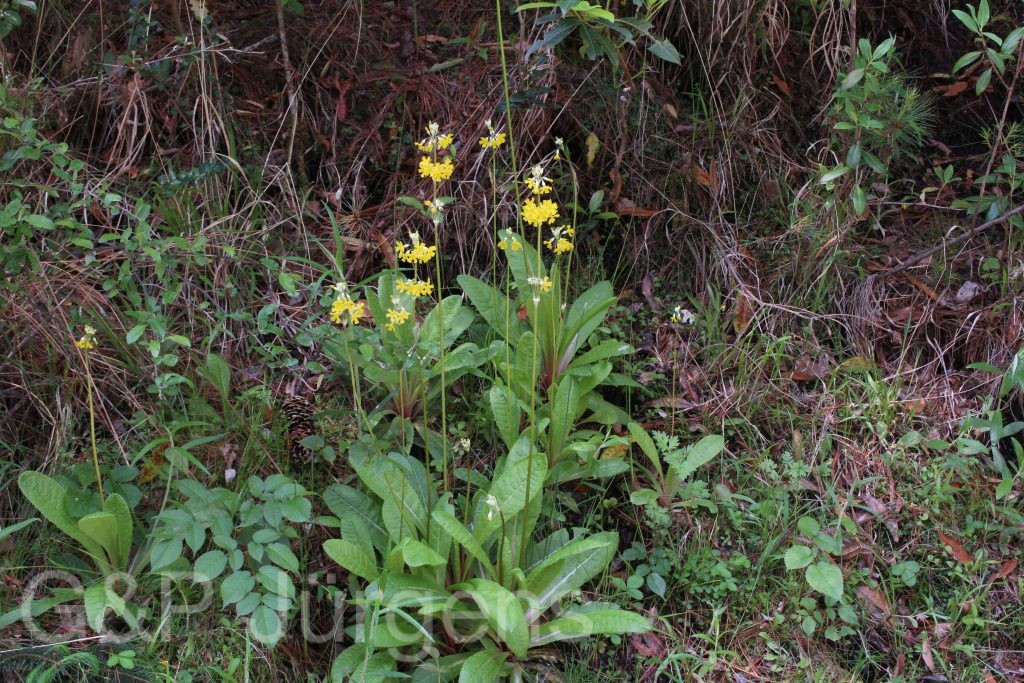
Craib

Bhutan2014 849
Bhutan Thimphu 2230m, May
Bh2008 434 G680
Bhutan Phobjika, 3100m April
Bh09 304 G501
Bhutan Yetong-La, 3000m June

Description

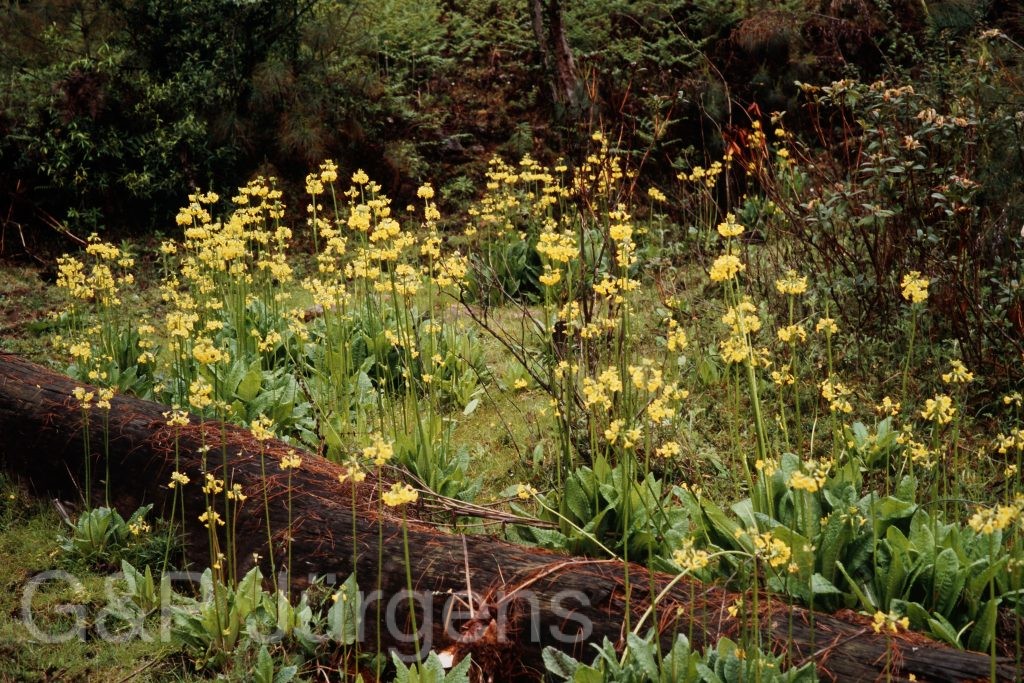
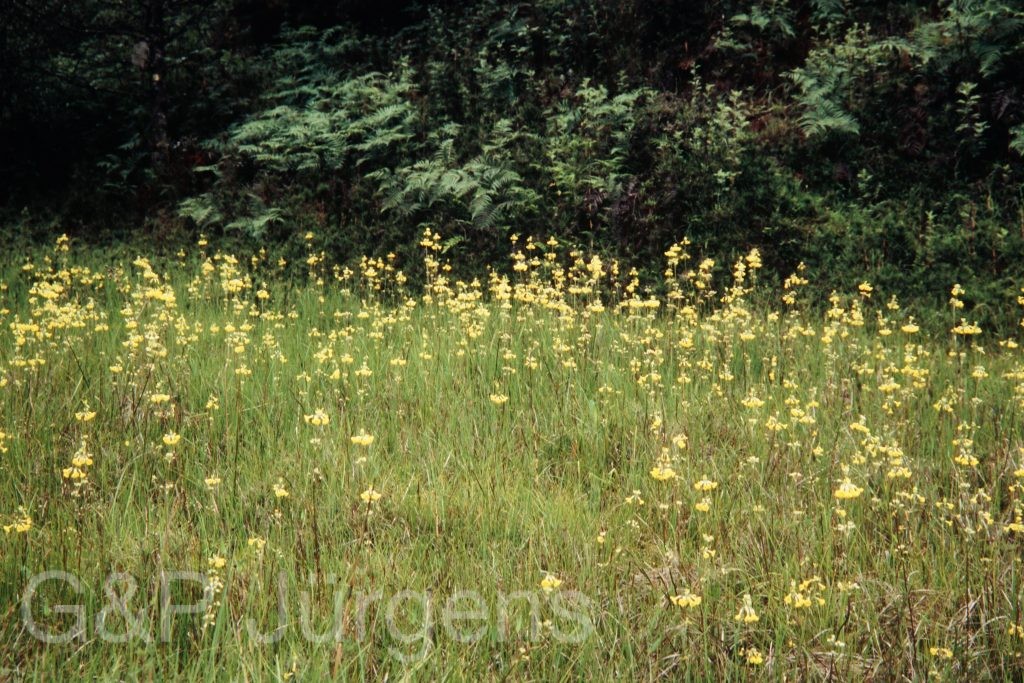
Primula smithiana Craib is an eastern Himalayan endemic distributed across Bhutan, north-eastern India (Arunachal Pradesh) and the adjacent provinces of south-central China, with some 79 georeferenced collections recorded in GBIF. It is a plant of moist temperate to subalpine zones, favouring wet meadows, streamsides, marshy hollows and the margins of conifer and rhododendron forest. The populations near Thimphu at 2230 m in May, in the Phobjika valley at 3100 m in April, and at Yetong-La at 3000 m in June illustrate its altitudinal span of roughly 2200–3500 m, where snowmelt and monsoon humidity sustain the boggy ground it requires.

The species belongs to section Sikkimensis and is a robust deciduous perennial herb arising from a short rhizome with a tuft of fleshy roots. The leaves form a basal rosette, oblong-oblanceolate to spatulate, gradually narrowed into a winged petiole, with a crenate-dentate margin and an efarinose to lightly farinose lower surface. The stout scape greatly exceeds the foliage and bears a single nodding umbel of numerous pendent, bell-shaped flowers; the corolla is pale to deep yellow with a farinose throat, the calyx campanulate and the heterostylous flowers pin or thrum. The fruit is a cylindric capsule slightly exceeding the persistent calyx and shedding small angular seeds.

Within the Sikkimensis alliance P. smithiana is distinguished from the widespread P. sikkimensis chiefly by its yellow, farinose-throated flowers and preference for lower temperate elevations. As a moisture-demanding bog primula it indicates intact subalpine wetland. It has no formal threat assessment, but its restricted range and dependence on undrained marshy ground make it locally vulnerable to grazing, drainage and trampling.

Author: Craib · Sources: POWO (Kew), GBIF, Flora of Bhutan, Flora of China, Smith & Fletcher monograph of Primula

Prunus campanulata

by GP Jürgens

Maxim.

Nepal 95 437 P759 ergebnis
Nepal Trisuli 2400m October

Description

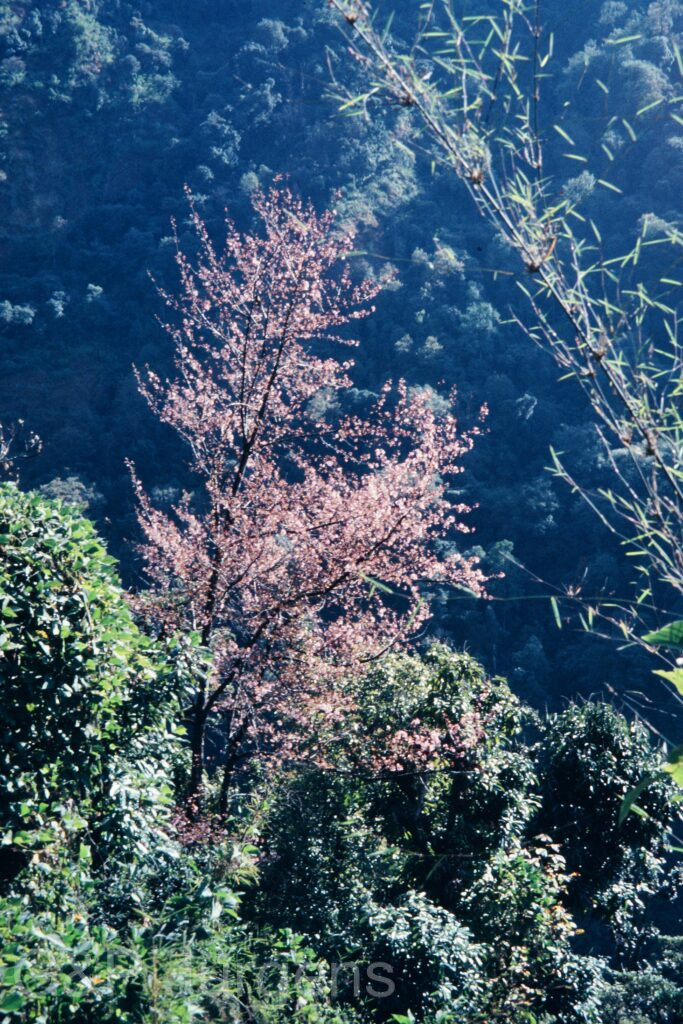
Prunus campanulata is an East Asian cherry distributed across southern China, Taiwan, Japan and Hong Kong, with outlying records reaching the central Himalaya in Nepal, India and Vietnam; it is also widely cultivated and naturalised in Australia, New Zealand, South Africa and the Americas, accounting for the broad GBIF footprint of nearly 1,900 occurrences. In its native range it occupies montane broad-leaved and mixed forest, forest margins and ravines, typically between 500 and 2,500 m. The plant photographed near Trisuli in central Nepal at about 2,400 m in October represents the species at the higher end of its Himalayan range, in cool, humid temperate forest on well-drained slopes.

It is a deciduous tree or large shrub reaching 3-8 m, with glabrous, reddish-brown twigs and conspicuous lenticels. The leaves are alternate, ovate to elliptic-oblong, 4-10 cm long, acuminate, with a sharply biserrate margin and glandular petioles. The flowers, borne in fascicles of 2-4 before or with the young leaves, are pendent and bell-shaped (campanulate), 1-2 cm across, with a deep rose-pink to carmine urceolate hypanthium and rounded, notched petals enclosed by a persistent reddish calyx. The fruit is a small ovoid drupe, ripening dark red to purplish-black and enclosing a single stone.

The distinctive nodding, deeply coloured campanulate flowers and early flowering season distinguish P. campanulata within subgenus Cerasus, where it is placed in section Pseudocerasus. Its early bloom makes it an important nectar source for overwintering birds and early insects, and the drupes are bird-dispersed. The species is horticulturally prized as the Taiwan or bellflower cherry and is a parent in numerous ornamental hybrids; its wide naturalisation reflects this cultivation, and it is locally regarded as a minor invasive in parts of the southern hemisphere. It is not considered threatened.

Author: Maxim. · Sources: POWO (Kew), GBIF, Flora of China, Flora of Nepal, Flora of Bhutan, Kew Bulletin monograph of Prunus subgen. Cerasus

(CB.Clarke) Nayar

Bhutan2012 632
Bhutan Tserang 1600m
Bhutan2012 1239
Bhutan Tserang 1600m

Description

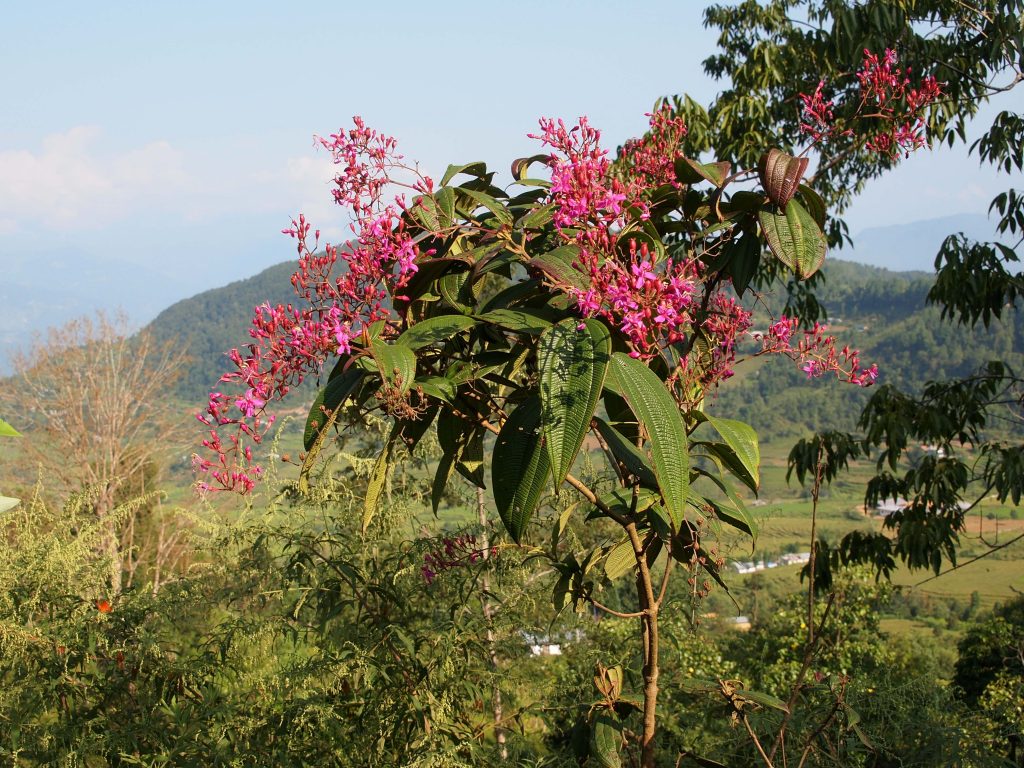
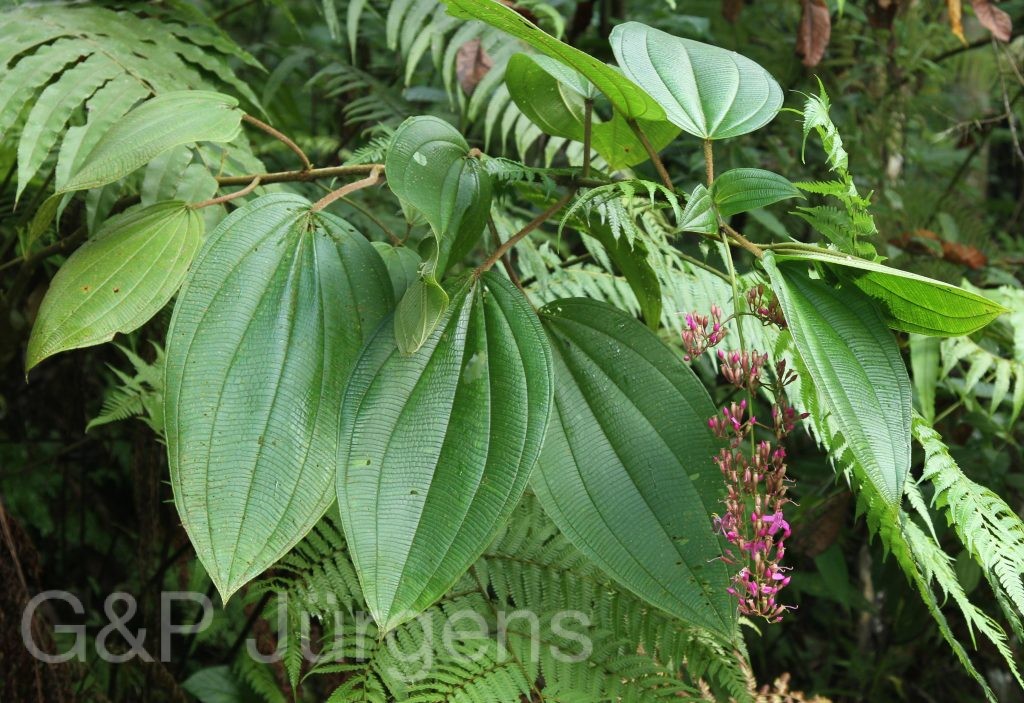
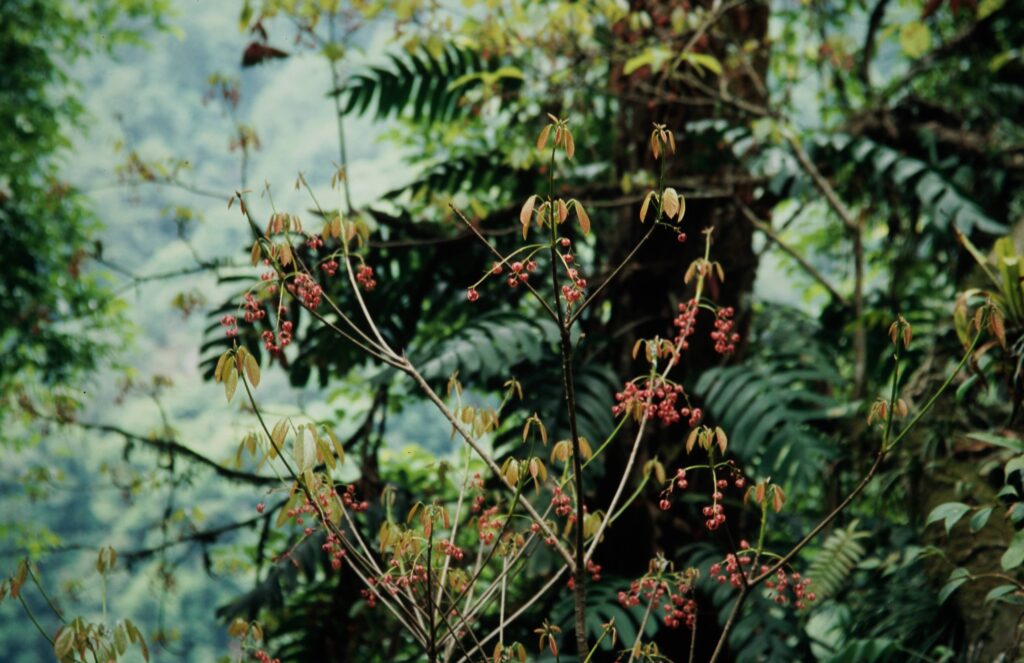
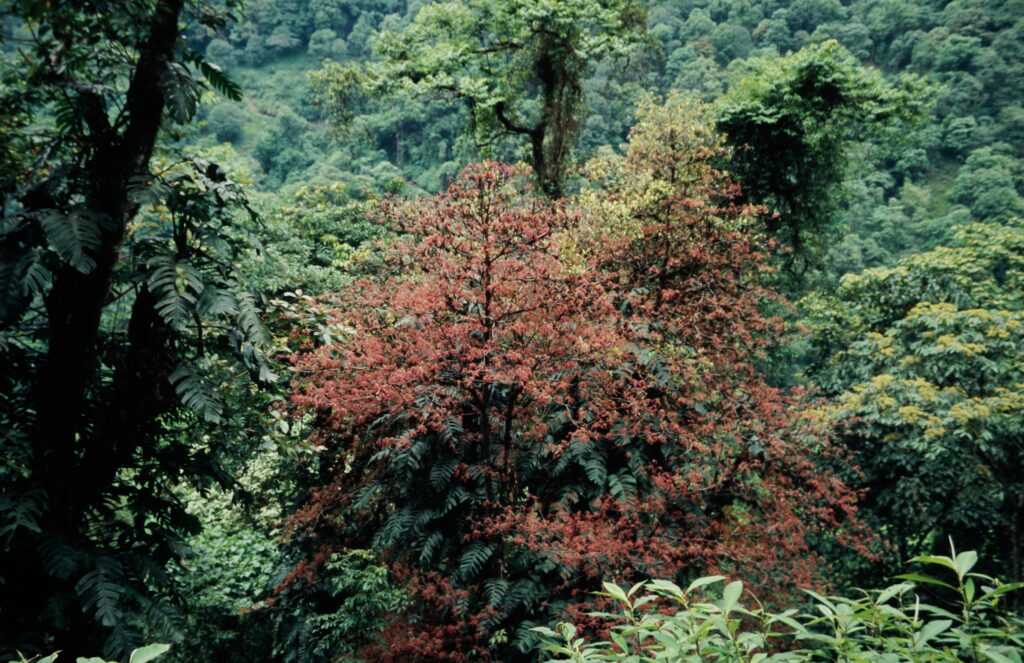
Pseudodissochaeta assamica is a forest shrub of the Sino-Himalayan and Indo-Burmese region, recorded from China, Vietnam, India, Laos, Bhutan, Myanmar and Bangladesh, with a moderate body of data (c. 126 records in GBIF). It is a plant of warm, humid broad-leaved evergreen and semi-evergreen forest, growing in shaded understorey, along streamsides, ravines and forest margins, typically in the subtropical to lower montane belt around 1000–2000 m. The photographed individual from Tserang in Bhutan, at 1600 m, is representative of this moist, shaded mid-elevation forest habitat where members of the family flourish.

The plant is an erect to scrambling shrub with quadrangular young stems and the opposite, decussate leaves typical of Melastomataceae. The leaves are large, ovate to elliptic-lanceolate, with the characteristic curvinerved (acrodromous) venation of several main veins arising near the base and converging at the apex, the lamina often scabrous or sparsely setose. The flowers are borne in terminal or axillary panicles; each has a campanulate hypanthium, four small petals, and conspicuous stamens that are markedly dimorphic or unequal, with appendaged, often geniculate connectives and poricidal anthers adapted to buzz-pollination. The fruit is an urceolate, several-seeded capsule or berry-like structure crowned by the persistent calyx.

The genus Pseudodissochaeta (tribe Dissochaeteae) was segregated by Nayar from Dissochaeta on differences in stamen and connective structure. This taxon was based on a Clarke name and has a complex synonymy; the source page links to Oxyspora paniculata, an allied melastome with which it has at times been confused, underscoring the taxonomic intricacy of the group. As a fairly widespread forest shrub it is not regarded as threatened, though it depends on intact mid-elevation forest.

Author: (CB.Clarke) Nayar · Sources: POWO (Kew), GBIF, Flora of China (Melastomataceae), Flora of Bhutan, A Revision of the Asiatic Melastomataceae

(D.Don) Anderb.

Nepal 2001 436 ergebnis ergebnis
Nepal (Gorkha) Gunda 1850m, May

Description

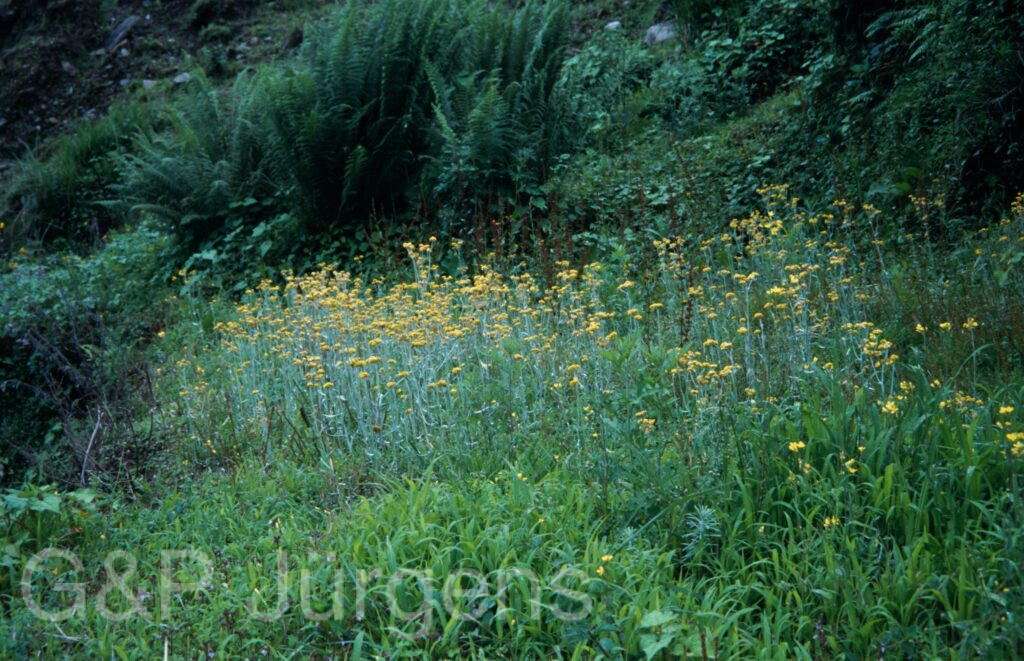
Pseudognaphalium affine is a widespread woolly cudweed of East Asia and the Indo-Himalaya, ranging across China, Japan, Korea, Taiwan, the Himalaya (Nepal, India, Bhutan, Pakistan, Afghanistan), Myanmar, Thailand, Sri Lanka and South-East Asia, and now naturalised more widely (with records as far afield as Argentina and Georgia); its very large dataset of over 7400 georeferenced occurrences confirms its abundance and weedy success. It grows on open grassy slopes, field margins, fallow ground, roadsides and other disturbed sites from the lowlands to the mid-montane belt, broadly from near sea level to about 2500 m. The plant recorded near Gunda in Gorkha, Nepal, at 1850 m in May is typical of such open, sunny, anthropogenic habitats.

It is an annual or biennial herb with erect, simple or branched stems clothed, like the foliage, in dense white-woolly (arachnoid) tomentum. The leaves are alternate, oblanceolate to spathulate, sessile and somewhat decurrent, grey-green and persistently woolly on both surfaces. The numerous small, discoid capitula are aggregated into dense terminal corymbs; each head is enclosed by several rows of pale yellow to straw-coloured, scarious involucral bracts, the florets all tubular, the outer female and filiform, the inner bisexual. The fruit is a tiny oblong cypsela bearing a pappus of slender, basally connate bristles aiding wind dispersal.

Formerly placed in Gnaphalium, this species was transferred to Pseudognaphalium on the basis of capitulum and pappus characters within tribe Gnaphalieae. It is used in East Asian cuisine and folk medicine and is a familiar ruderal weed; its broad ecological tolerance and prolific seed make it abundant and entirely unthreatened.

Author: (D.Don) Anderb. · Sources: POWO (Kew), GBIF, Flora of China, Flora of Nepal, Flora of Bhutan, Anderberg's monograph of the Gnaphalieae

Krasch.

Sikkim 2006 178 ergebnis
India West-Bengal, Samadan 2400m, May

Description

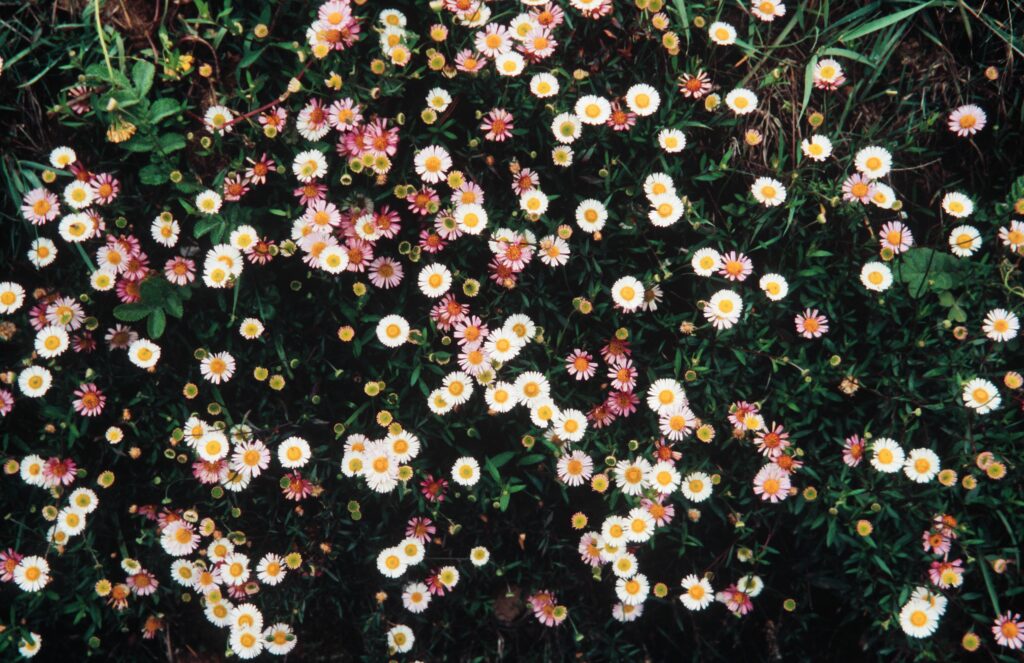
Psychrogeton alexeenkoi is a high-mountain composite of the arid ranges of Central and South-West Asia, its georeferenced records concentrated in Afghanistan, Kazakhstan, Tajikistan, Iran, Pakistan and Turkey, GBIF accumulating some 58 occurrences that reflect a narrow, sparsely collected range. It grows on stony slopes, rock crevices, gravelly screes and dry alpine to subalpine meadows, typically on calcareous or schistose substrates. The population recorded in May at Samadan in West Bengal, India, near 2400 m marks an eastern, lower-elevation extension where it occupies open, well-drained sunny situations subject to strong diurnal temperature fluctuation.

The species is a perennial herb forming a woody caudex from which arise several ascending leafy stems clothed in spreading eglandular and gland-tipped hairs. The basal and lower cauline leaves are oblanceolate to spathulate, entire or obscurely toothed and narrowed to a winged petiole, the upper ones smaller and sessile. The solitary or few terminal capitula are radiate: numerous slender lilac to pale violet ray florets surround a disc of yellow tubular perfect florets, the involucral bracts linear-lanceolate, herbaceous and pubescent in subequal series. Achenes are flattened, oblong and pubescent, crowned by a pappus of fine barbellate bristles aiding anemochory.

Psychrogeton is a small Asiatic genus segregated from Erigeron, distinguished by habit and pappus and frequently treated as transitional to Aster within tribe Astereae. P. alexeenkoi, described by Krascheninnikov, is endemic to the mountains of Middle Asia and the Hindu Kush-Karakoram and is adapted to cold continental conditions, as its name ("cold-dweller") implies. No formal conservation assessment exists, but its restricted range and reliance on undisturbed montane habitat warrant monitoring of overgrazing and degradation.

Author: Krasch. · Sources: POWO (Kew), GBIF, Flora of Pakistan, Flora Iranica, Conspectus Florae Asiae Mediae, Nesom monograph of Astereae

(Roxb.) R.Br.

Sikkim 2006 285 ergebnis
India West-Bengal, Chaana 1650m, May

Description

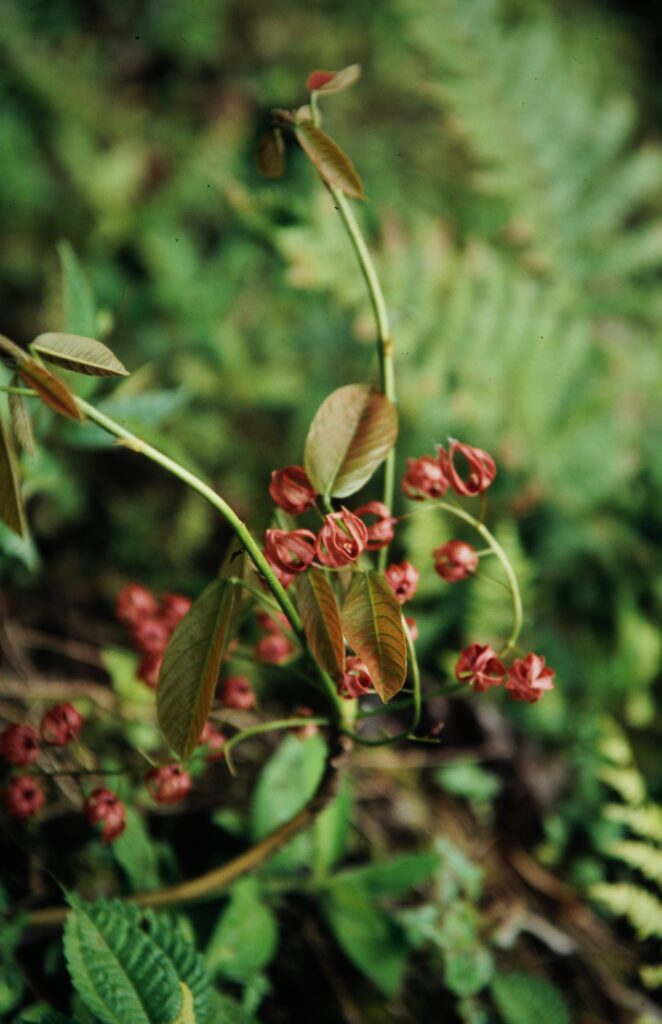
Pterygota alata is a large deciduous tree of tropical and subtropical Asia, distributed from India, Bangladesh, Sri Lanka and Nepal eastward through Myanmar, Thailand, the Malay Peninsula, Indonesia, the Philippines and southern China, with cultivated records elsewhere; GBIF lists some 350 occurrences, a number inflated by its frequent planting as an avenue and shade tree. It grows in lowland and lower-montane evergreen and semi-evergreen forest, often along valley bottoms on deep moist soils. The photographed individual was recorded in the West Bengal hills at Chaana around 1650 m in May, near the upper margin at which this tropical tree persists in the eastern Himalayan foothills.

It is a tall tree with a straight bole and spreading crown, the bark grey and rather smooth, often buttressed at the base. The leaves are alternate, large, broadly ovate to orbicular with a cordate base and abruptly acuminate apex, palmately veined and clustered toward the branch tips. The flowers are borne in axillary panicles, lacking a corolla, with a coloured, campanulate, lobed calyx. The most distinctive feature is the fruit, a cluster of large, woody, globose follicles that split to release numerous broadly winged seeds adapted for wind dispersal, the wing giving the genus its name.

Formerly placed in Sterculiaceae, Pterygota is now treated within an expanded Malvaceae (subfamily Sterculioideae), as reflected in the family given here. The winged seed and apetalous flowers ally it with Sterculia and Firmiana. Valued for its light timber and as an ornamental, P. alata is not considered globally threatened, although natural lowland-forest populations are locally reduced by logging.

Author: (Roxb.) R.Br. · Sources: POWO (Kew), GBIF, Flora of China Vol. 12, Flora of Bhutan Vol. 1, Flora of Nepal, Flora of Pakistan, Kostermans revision of Asian Sterculiaceae

Punica granatum

by GP Jürgens

L.

Bhutan2014 69
Bhutan Kadi 1600m, May

Description

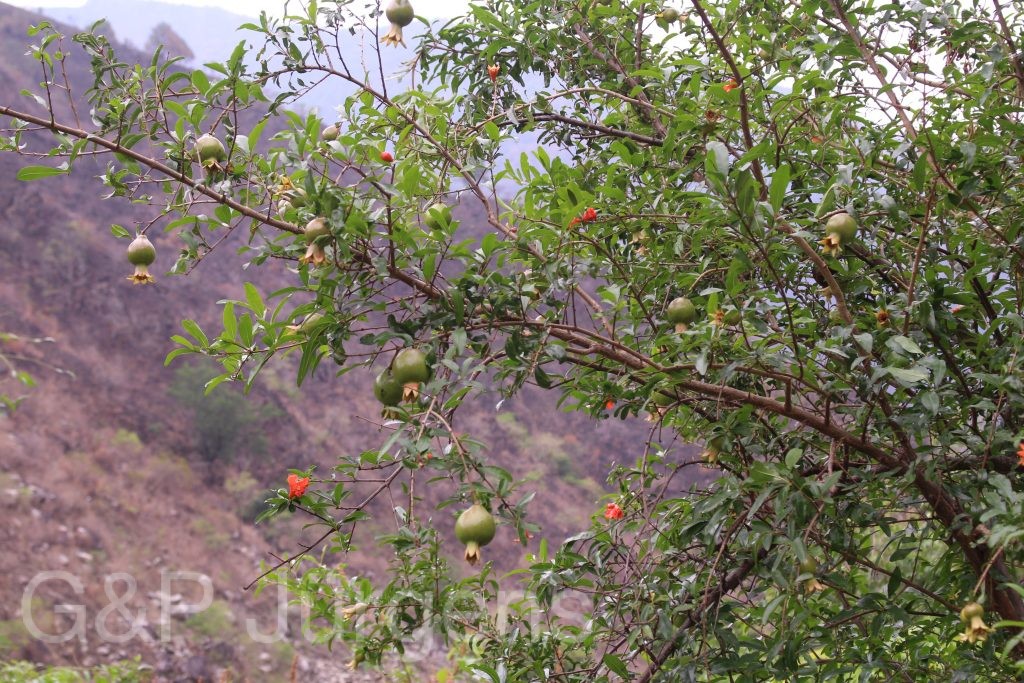
Punica granatum, the pomegranate, is a deciduous shrub or small tree native to the region from Iran and the Transcaucasus through Central Asia, now cultivated and naturalised worldwide; its 51453 GBIF occurrences span Mediterranean Europe, the Middle East, India, China, the Americas, Africa and Australia. It thrives in warm, semi-arid to subtropical climates on a wide range of soils, favouring sunny, well-drained sites, and tolerates drought and seasonal heat. The plant recorded at Kadi in Bhutan at 1600 m in May represents a cultivated or naturalised occurrence in the warm Himalayan valleys, flowering in late spring as temperatures rise.

The species is a much-branched shrub or small tree, often spinescent, with smooth grey bark and frequently angular young shoots. The leaves are opposite or subopposite, simple, entire, oblong to obovate, glossy and glabrous, often coppery when young. The showy flowers are solitary or clustered, with a thick, leathery, persistent campanulate hypanthium bearing 5-8 fleshy lobes and crumpled, bright scarlet to orange-red petals enclosing numerous stamens and an inferior ovary. The fruit is the distinctive balausta, a large, leathery-rinded berry crowned by the persistent calyx and partitioned internally into chambers packed with seeds enveloped in juicy, translucent, edible arils.

Long placed in its own family Punicaceae, Punica is now embedded within Lythraceae on molecular evidence, with the genus comprising only P. granatum and the Socotran P. protopunica. The pomegranate is among the most anciently cultivated fruit crops, valued for its edible arils, ornamental flowers and medicinal uses, and is widely grown across the warmer Himalayan foothills and adjacent plains.

Author: L. · Sources: POWO (Kew), GBIF, Flora of China Vol. 13, Flora of Bhutan Vol. 2, Flora of Nepal, Flora of Pakistan, Graham's revision of Lythraceae