Tag:

Sikkim

Flowers of Sikkim — 350 species from the Sikkim Himalaya in northeast India, a compact yet botanically extraordinary region that climbs from subtropical valleys to the alpine zone beneath Kangchenjunga. Sikkim is a classic centre of Himalayan plant diversity, celebrated for its rhododendrons, primulas, orchids and gentians. Each entry provides a botanical description, distribution, habitat and flowering season with the original field photograph.

(Prain) T.Yamaz.

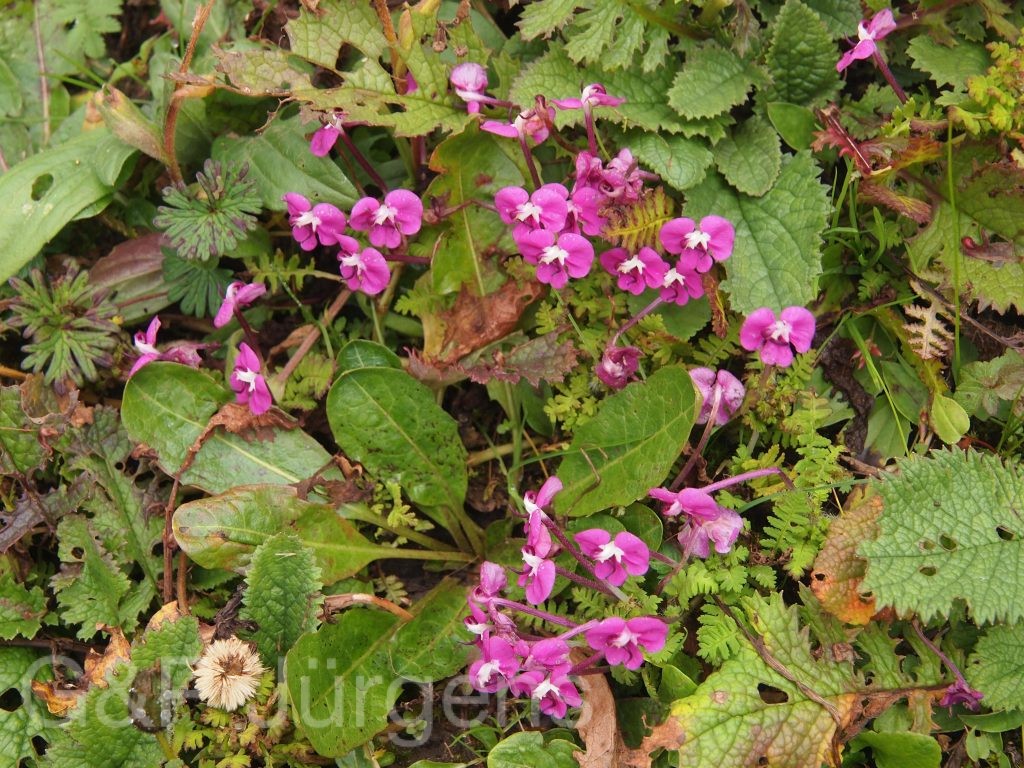
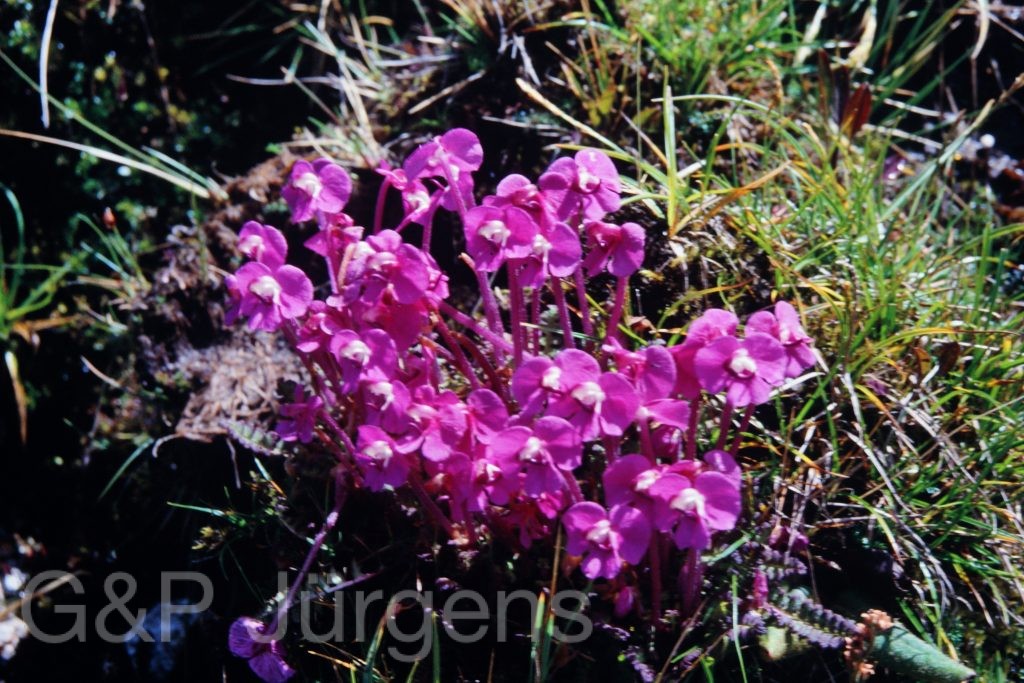
Sikkim2004 427 G737
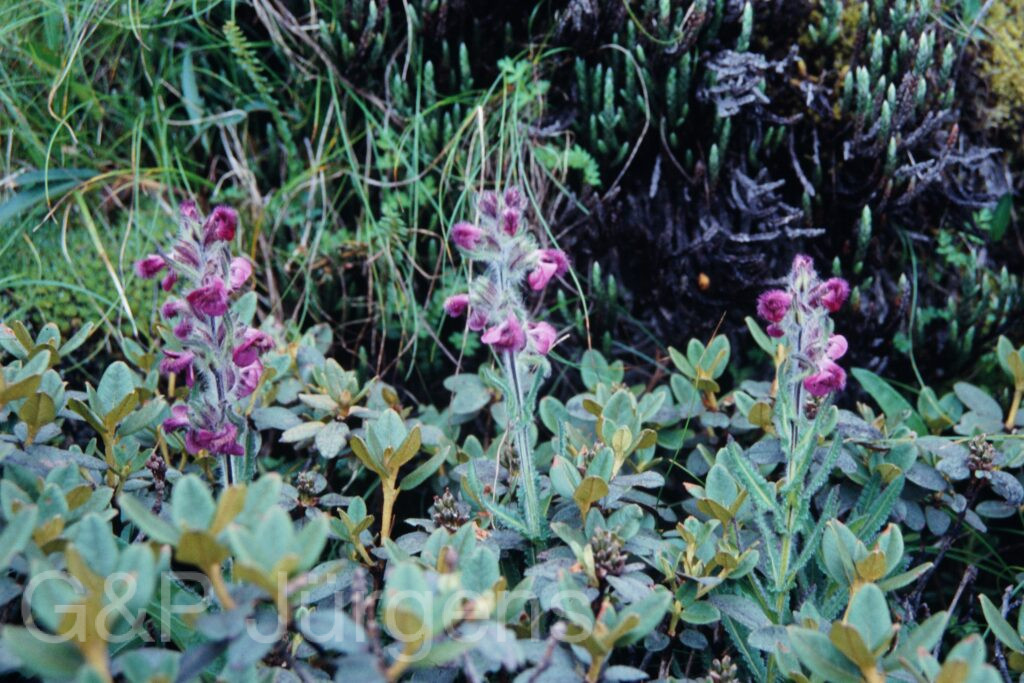
Sikkim/India Yumtahng 3500m May

Description

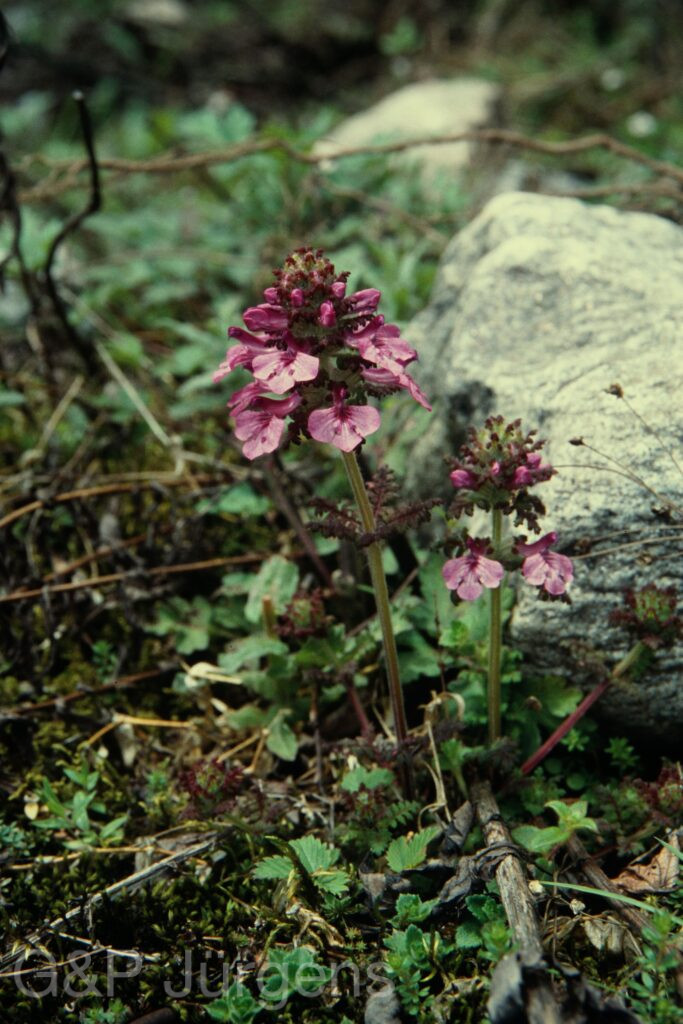
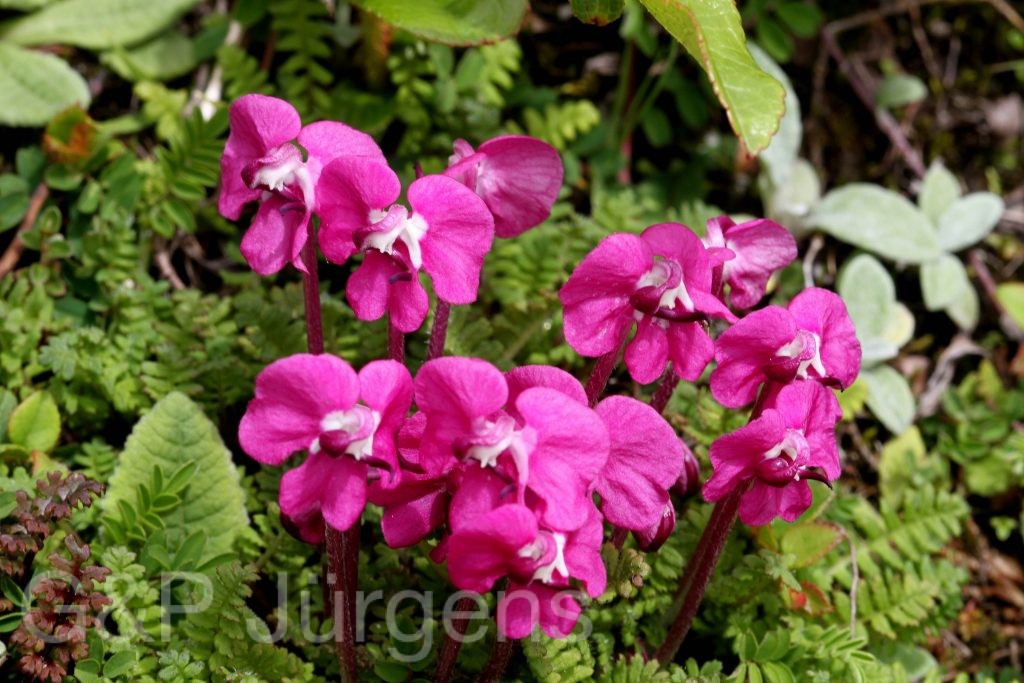
Pedicularis roylei var. speciosa is a hemiparasitic perennial of the eastern Himalaya, distributed across the high-montane and subalpine belt of southern China (Xizang and adjacent Yunnan) and Nepal, with populations extending into Sikkim and the Chumbi region. The variety is documented from a modest number of records (GBIF lists around 12 occurrences from CN and NP), reflecting both its restricted range and the limited collecting in its remote habitats. It occupies open alpine meadows, moist grassy slopes, the margins of Rhododendron and Abies forest, and streamside flushes between roughly 3000 and 4300 m. The photographed plant from the Yumthang valley in northern Sikkim at about 3500 m, flowering in May, is typical of these subalpine pastures where snowmelt sustains a brief but vigorous flush of growth. As a root-hemiparasite, it draws water and minerals from neighbouring grasses and forbs via haustoria while retaining functional green foliage.

The plant forms a low, clumped herb arising from a stout caudex, with erect or ascending stems often clothed in soft hairs. The leaves are mostly basal and pinnatisect, with oblong-lanceolate segments that are themselves toothed or crenate, giving the foliage a fern-like texture. The inflorescence is a dense spike or capitate cluster of conspicuous flowers; var. speciosa is distinguished by its notably large, showy corollas. The bilabiate corolla is rose-pink to purplish, the galea (upper lip) prolonged into a slender, often beak-like apex that twists or curves, while the broad three-lobed lower lip forms a landing platform. The calyx is tubular and toothed, and the four didynamous stamens lie concealed within the galea. The fruit is an obliquely ovoid capsule containing several seeds.

Within the large and taxonomically complex genus Pedicularis, which reaches its global diversity peak in the Sino-Himalayan region, this taxon belongs to a group whose beaked galeas reflect specialised pollination by long-tongued bumblebees. The variety, based on the basionym described by Prain and later treated by T. Yamazaki, is sometimes folded into a broadly circumscribed P. roylei; GBIF accepts it at varietal rank. Its elaborate floral architecture exemplifies the radiation of corolla forms that has accompanied the genus's hemiparasitic lifestyle. Though not currently regarded as threatened, alpine Pedicularis are sensitive to grazing pressure and climate-driven shifts in the snowmelt regime, making long-term monitoring of Himalayan populations desirable.

Author: (Prain) T.Yamaz. · Sources: POWO (Kew), GBIF, Flora of China Vol. 18, Flora of Bhutan Vol. 2 Part 3, Flora of Nepal, A Revision of the Genus Pedicularis (Pennell; Yamazaki, Pedicularis of Eastern Asia)
D.Don

Sikkim2011 202
Sikkim Lachung 3000m, June
BhutanPG2011 735 01 01
Bhutan Haa-Valley, 2750m June
Bhutan2012 77
Bhutan Shele-La, 4000m September
Sikkim2003 115 P155
Sikkim below Dzongri 4000m August

Description

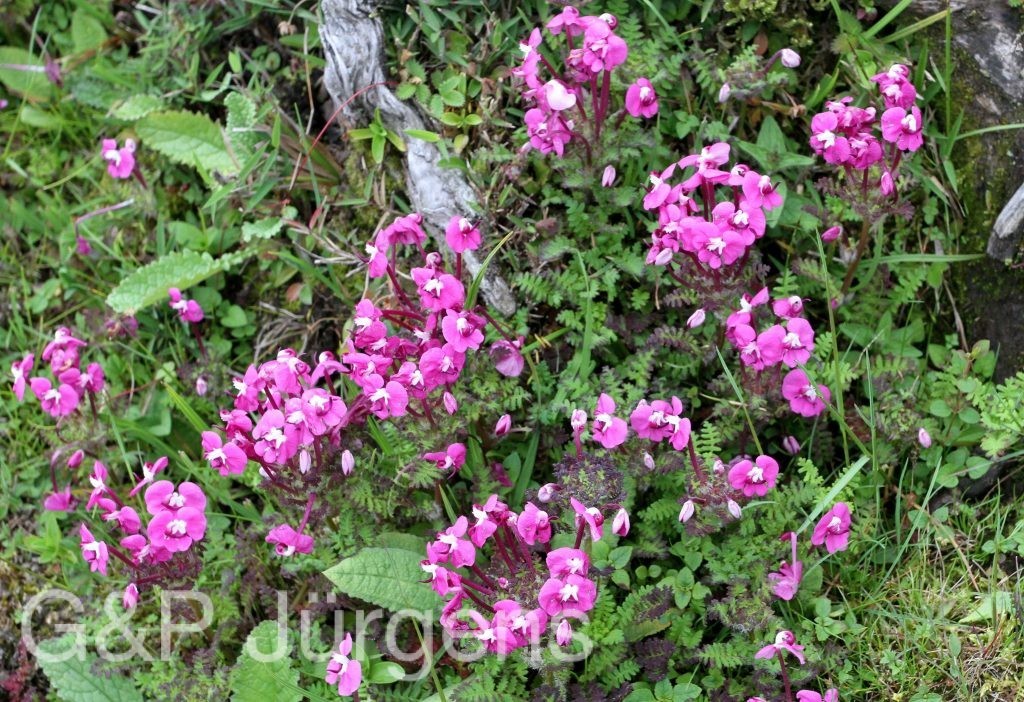
Pedicularis siphonantha is a Himalayan lousewort distributed through southern China, Nepal, northern India, Sikkim, Bhutan, Myanmar and Pakistan, well represented in GBIF with 810 occurrences. It is a plant of moist alpine and subalpine meadows, open hillsides, Rhododendron scrub and streamside turf, mostly between 2700 and 4500 m. The accompanying records span its range and season: Lachung in Sikkim at 3000 m and the Haa Valley in Bhutan at 2750 m in June, and the higher Shele-La (4000 m) and slopes below Dzongri (4000 m) flowering on into August and September, reflecting a long summer-to-autumn anthesis across an altitudinal gradient.

It is a perennial herb with erect or ascending stems arising from a stout rootstock, bearing leaves that are pinnatisect into oblong, doubly toothed segments. The rose-pink to purplish-red flowers are crowded in terminal racemes; the corolla is strongly two-lipped, its most distinctive feature a long, slender, often curved or twisted tubular galea drawn out into a beak (the siphon-like form giving the epithet), with a spreading three-lobed lower lip. The four stamens lie under the galea, and the fruit is an obliquely ovoid capsule containing several seeds.

Like all Pedicularis, it is a hemiparasite, drawing water and nutrients from the roots of neighbouring meadow plants through haustoria while retaining green photosynthetic foliage. The elongate corolla tube indicates pollination by long-tongued bumblebees. Pedicularis is exceptionally species-rich and difficult in the Sino-Himalaya, with corolla architecture central to species delimitation. Widespread and locally abundant, P. siphonantha is not regarded as threatened, though louseworts as a group are sensitive to changes in their host-rich alpine grassland communities.

Author: D.Don · Sources: POWO (Kew), GBIF, Flora of China, Flora of Bhutan, Yamazaki: Pedicularis monograph

T.Yamaz.

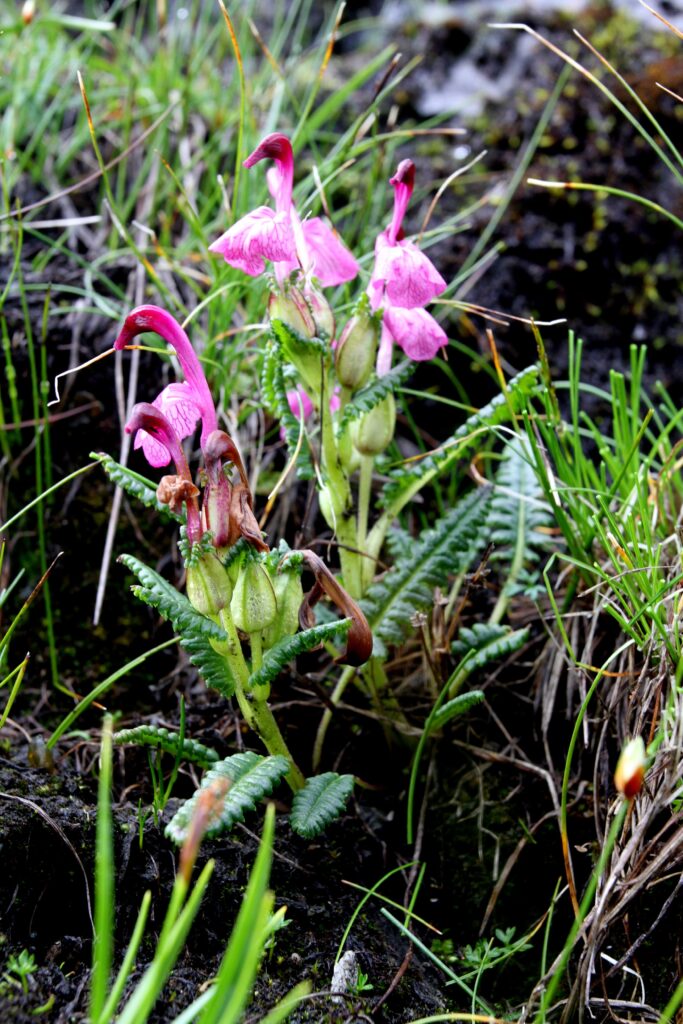
BhutanPG2011 657 ergebnis
Bhutan Thitha-Tso, 4360m, July
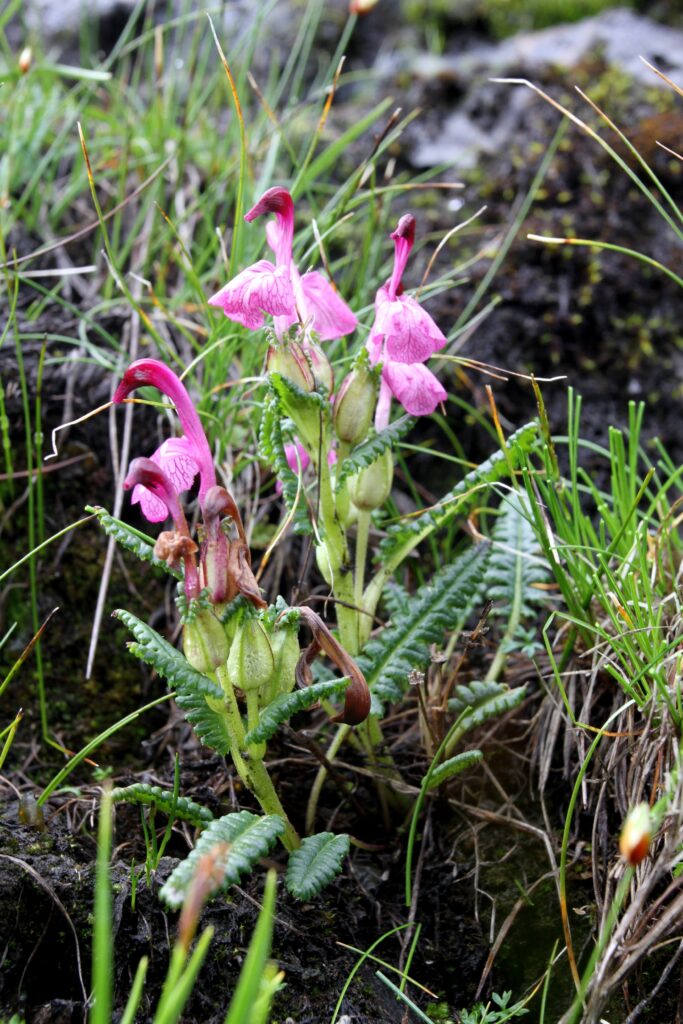
BhutanPG2011 658 ergebnis
Bhutan Thitha-Tso, 4360m, July

Description

Pedicularis trichodonta is a perennial hemiparasitic herb native to the eastern Himalayas, recorded from Nepal, northeast India (Sikkim), and Bhutan. The species inhabits alpine meadows, moist turf, and Rhododendron scrub margins at elevations of 3,800–4,800 m, attaching to the roots of neighbouring grasses and other herbaceous hosts for supplementary water and nutrient uptake. It has been documented from the Thitha-Tso area in Bhutan at 4,360 m, flowering in July during the monsoon, when alpine meadows in the eastern Himalayas reach their peak floral diversity.
The plant produces erect to ascending stems 10–25 cm tall from a fascicle of fleshy, fusiform roots. The leaves are mostly basal and sub-opposite on the stem, oblong-lanceolate in outline, 3–7 cm long, deeply pinnatisect with numerous linear to oblong segments that are themselves dentate, the teeth bearing fine, hair-like extensions — the character from which the specific epithet trichodonta ("hair-toothed") is derived. The inflorescence is a dense, terminal, capitate to shortly spicate raceme. The calyx is tubular, membranous, with five unequal, denticulate lobes. The corolla is bilabiate, typically pink to purplish-red, 15–20 mm long; the upper lip (galea) is falcate-incurved, beakless or very shortly beaked, while the lower lip is three-lobed and spreading. The capsule is obliquely ovoid, compressed, slightly exserted from the calyx.
Pedicularis trichodonta was described by Tetsuo Yamazaki and belongs to one of the most species-rich genera of flowering plants, with over 600 species worldwide, the majority concentrated in the Sino-Himalayan region. With only about 33 occurrence records in GBIF, the species is among the less frequently collected members of the genus in the eastern Himalayas. Its hemiparasitic ecology makes it dependent on intact alpine plant communities, and disruption of host populations through overgrazing or climate-driven vegetation change could indirectly threaten its persistence. Further collections are needed to clarify its full range and population status.

Author: T.Yamaz. · Sources: POWO (Kew), GBIF, Flora of Bhutan Vol. 2, Flora of China Vol. 18, Yamazaki: Pedicularis of Nepal (1988)

Hook. f.

Sikkim2003 317 P451
Sikkim Saniti-Lake 4300m August

Description

Pedicularis trichoglossa is a striking alpine lousewort of the Himalaya and Sino-Himalayan mountains, with 547 georeferenced records from China (CN), Nepal (NP), Bhutan (BT), India (IN) and Myanmar (MM). It is a plant of high alpine meadows, moist grassy slopes, streamsides and the margins of glacial lakes, typically between about 3500 and 4800 m. The population recorded at Saniti Lake in Sikkim at 4300 m in August is characteristic of its occurrence in damp, late-season alpine turf, where it flowers in the post-monsoon weeks alongside other high-elevation herbs. Its broad east-Himalayan distribution makes it a conspicuous element of the upper alpine flora.

It is an erect perennial herb with one to several simple or sparingly branched stems arising from a short rootstock. The leaves are alternate to subopposite, pinnatisect into many small, toothed segments, in the typical fern-like fashion of the genus. The flowers are crowded into a dense, elongate terminal spike, deep reddish-purple to wine-red, conspicuous against the foliage. Each strongly two-lipped corolla has a hooded, beaked galea formed by the upper lip, the beak conspicuously fringed with long purple hairs, a feature reflected in the epithet trichoglossa (hairy-tongued). The fruit is an oblique, beaked capsule containing several seeds.

Pedicularis (Orobanchaceae) is one of the largest and most diverse genera of the Himalayan alpine zone, where it has undergone remarkable radiation in floral form linked to bumblebee pollination; the hairy, beaked galea of P. trichoglossa is one such specialised adaptation. Like all members of the genus it is a hemiparasite, drawing water and nutrients from the roots of neighbouring plants via haustoria while retaining green, photosynthetic foliage. The species is widespread and frequent, of no conservation concern, but it is a valuable indicator of intact high-alpine meadow communities.

Author: Hook. f. · Sources: POWO (Kew), GBIF, Flora of China, Flora of Bhutan, Annotated Checklist of the Flowering Plants of Nepal, Prain and Tsoong monographic studies of Asian Pedicularis

Lindl.

Sikkim2003 20 P24
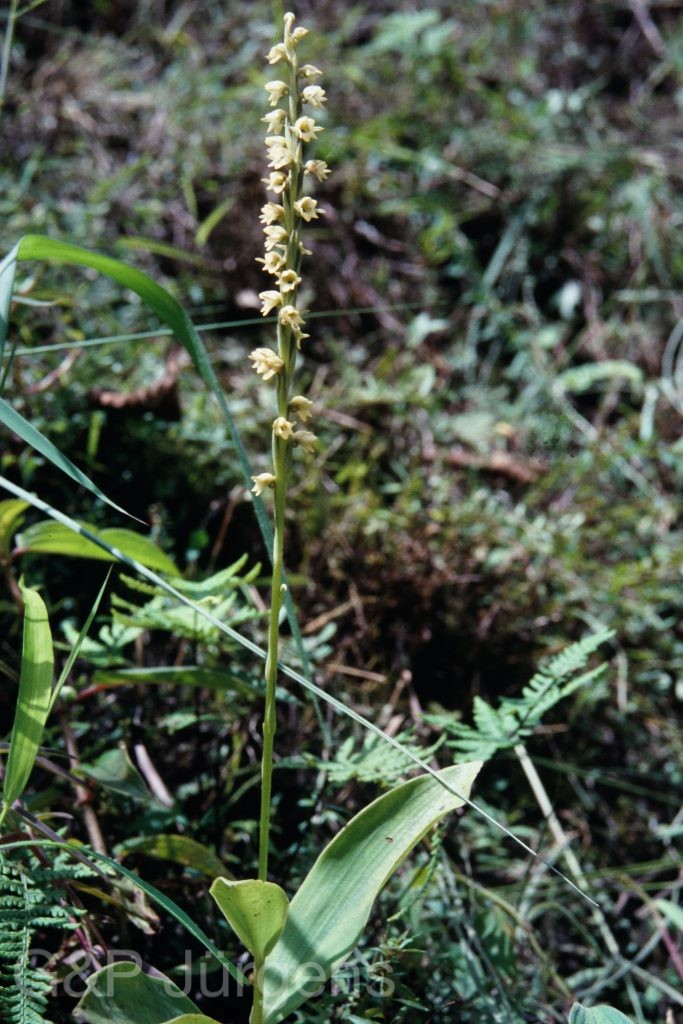
Sikkim Rathong-Chu 1200m 08.2003
Sikkim2003 21 P25
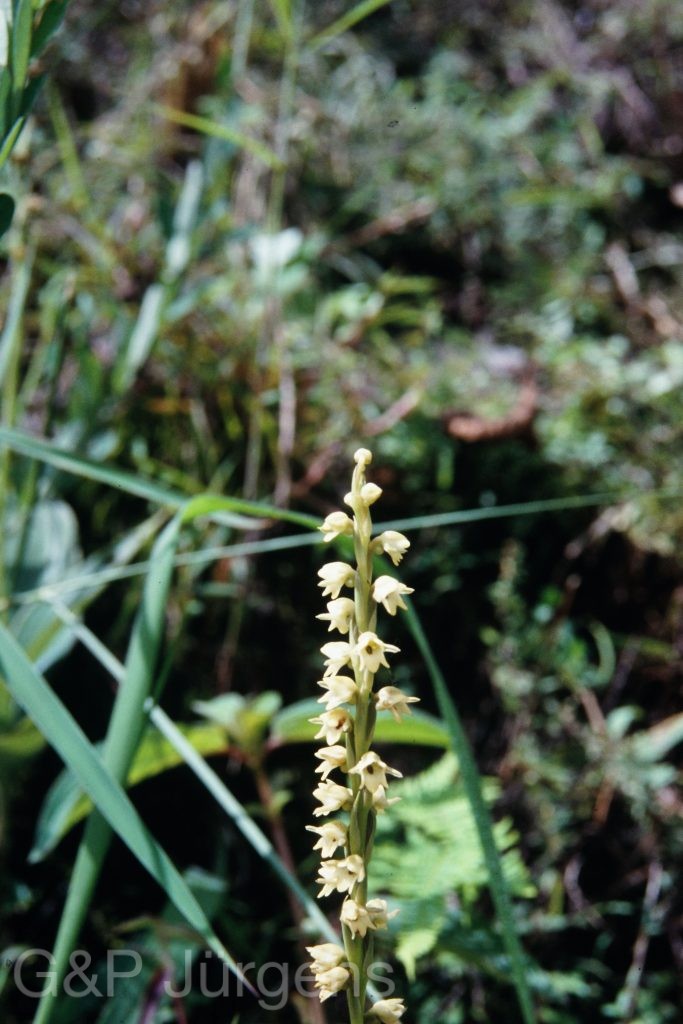
Sikkim Rathong-Chu 1200m 08.2003

Description

Peristylus goodyeroides is a terrestrial orchid with a broad tropical and subtropical Asian range, the 545 GBIF records spanning China, the Indian subcontinent, Nepal, Bhutan, much of Southeast Asia, Taiwan, Hong Kong, Japan, Timor-Leste and Papua New Guinea. It occupies grassy slopes, open forest, forest margins and scrub from the lowlands to around 2000 m. The photographed plant was found in the Rathong-Chu valley of Sikkim at 1200 m in August, during the monsoon flowering period typical of the species at lower Himalayan elevations.

It is a tuberous geophyte producing an erect leafy stem 20-60 cm tall from ellipsoid underground tubers. The few to several leaves are clustered toward the lower-middle stem, ovate to elliptic-lanceolate, acuminate and sheathing at the base. The inflorescence is a many-flowered cylindrical raceme of small, greenish-white to pale green flowers subtended by lanceolate bracts. Each flower has connivent sepals and petals forming a hood, a small three-lobed lip with a short saccate or conical spur, and the column structure characteristic of the genus, lacking the distinct rostellar arms of related Habenaria.

The genus Peristylus, long confused with Habenaria, is distinguished by its short blunt spur and small viscidia, and P. goodyeroides is the widespread type-like species of the group. Its inconspicuous greenish flowers are pollinated by small insects, and the tuberous habit allows it to survive the seasonal dry period. Given its wide distribution and tolerance of disturbed grassland, it is among the more common members of the genus and is not regarded as threatened, though, like all orchids, it is listed under CITES Appendix II.

Author: Lindl. · Sources: POWO (Kew), GBIF, Flora of China, Flora of Bhutan, Pridgeon et al.: Genera Orchidacearum

Greuter & Burdet

Bhutan2015 483
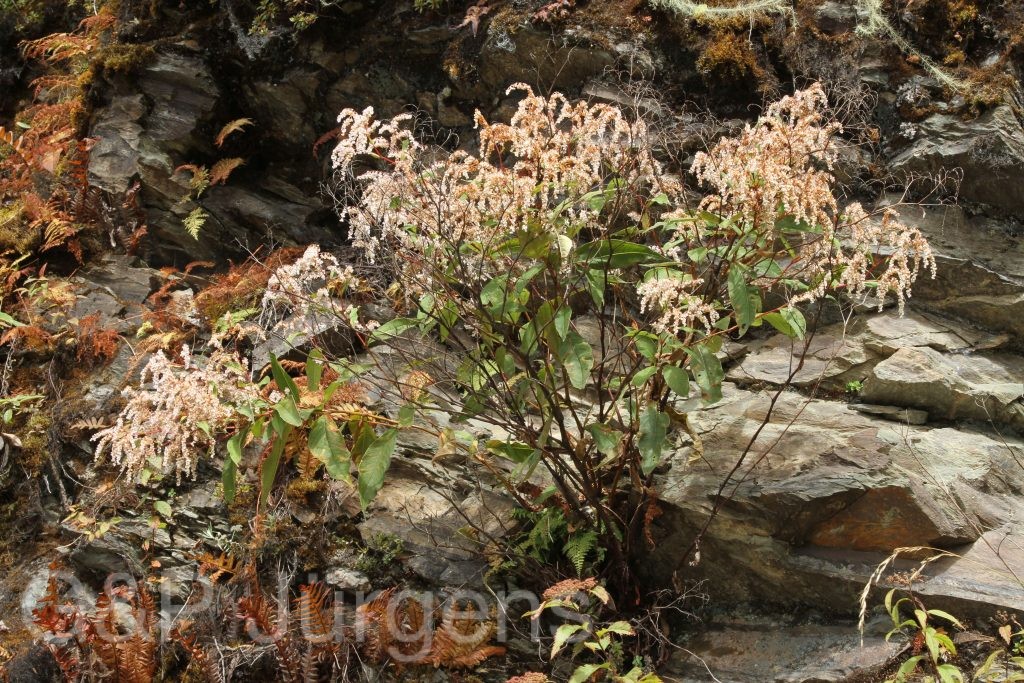
Bhutan Pele-La 3100m, October
Sikkim2003 410 G570
Sikkim Zemu Valley 3400m August

Description

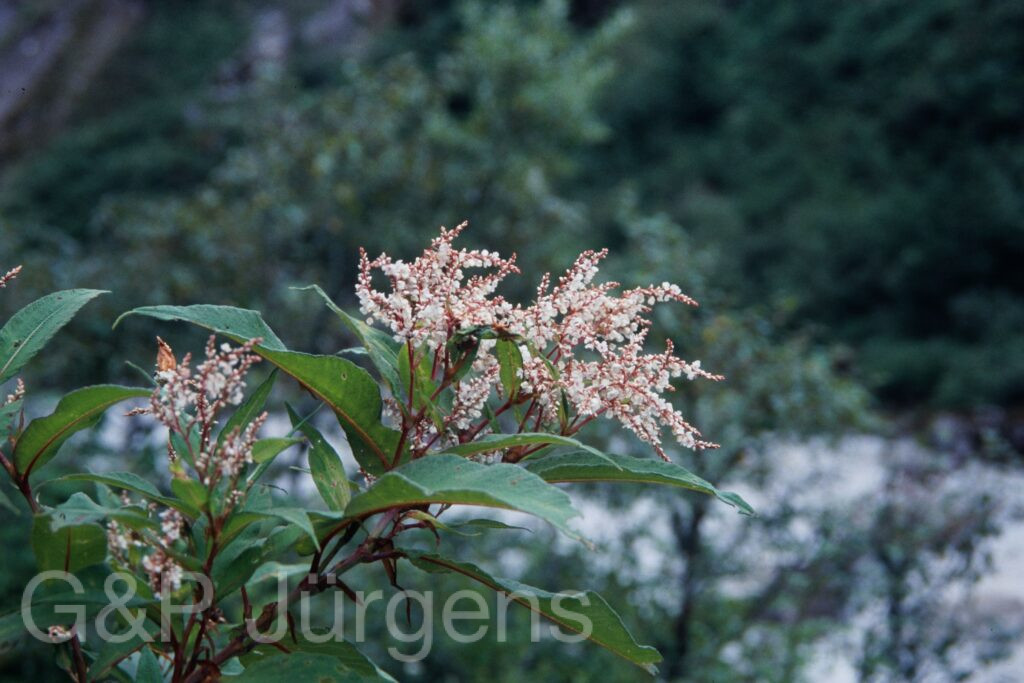
Persicaria wallichii (the accepted name under which this taxon is listed, the binomial here being treated as a synonym in GBIF) is a robust perennial knotweed native to the Himalaya and adjacent mountains of China and Myanmar, where it occupies open hillsides, forest margins, riverbanks and disturbed ground in the temperate and subalpine zones. From its Himalayan homeland it has spread widely as an introduced and frequently invasive plant, the GBIF dataset recording it across much of Europe as well as North and South America and New Zealand, totalling well over a thousand occurrences. The illustrated plants from Pele-La in Bhutan at 3100 m, flowering in October, and from the Zemu Valley in Sikkim at 3400 m in August, exemplify its native montane setting.

The plant forms tall, spreading clumps from a vigorous, far-creeping rhizome, with erect to ascending stems that are reddish-tinged and somewhat woody at the base. The leaves are large, ovate-lanceolate to triangular, acuminate, cordate to truncate at the base, often white-tomentose beneath, and subtended by membranous, brownish ochreae sheathing the swollen nodes. The numerous small flowers are borne in much-branched, lax panicles of slender spike-like racemes; each flower has a white to pinkish perianth of five tepals enclosing eight stamens and a trifid style. The fruit is a small, glossy, three-angled (trigonous) achene enclosed by the persistent perianth.

Formerly placed in Polygonum and Aconogonon (reflected in the synonymy and field labels), the species sits within a much-revised section of Persicaria. Its dense rhizomatous growth allows it to form persistent thickets, and outside its native range it behaves as an aggressive colonist of riverbanks and waste ground, prompting management concern in several countries; within the Himalaya it remains a common and ecologically benign component of moist montane vegetation.

Author: Greuter & Burdet · Sources: POWO (Kew), GBIF, Flora of Bhutan, Flora of China (Polygonaceae), Annotated Checklist of the Flowering Plants of Nepal

Wall. ex G. Don

Sikkim2011 33
Sikkim Lachung 2600m, June
Sikkim2011 177
Sikkim Lachung 2600m, June
Sikkim2011 390
Sikkim Lachung 2600m, June

Description

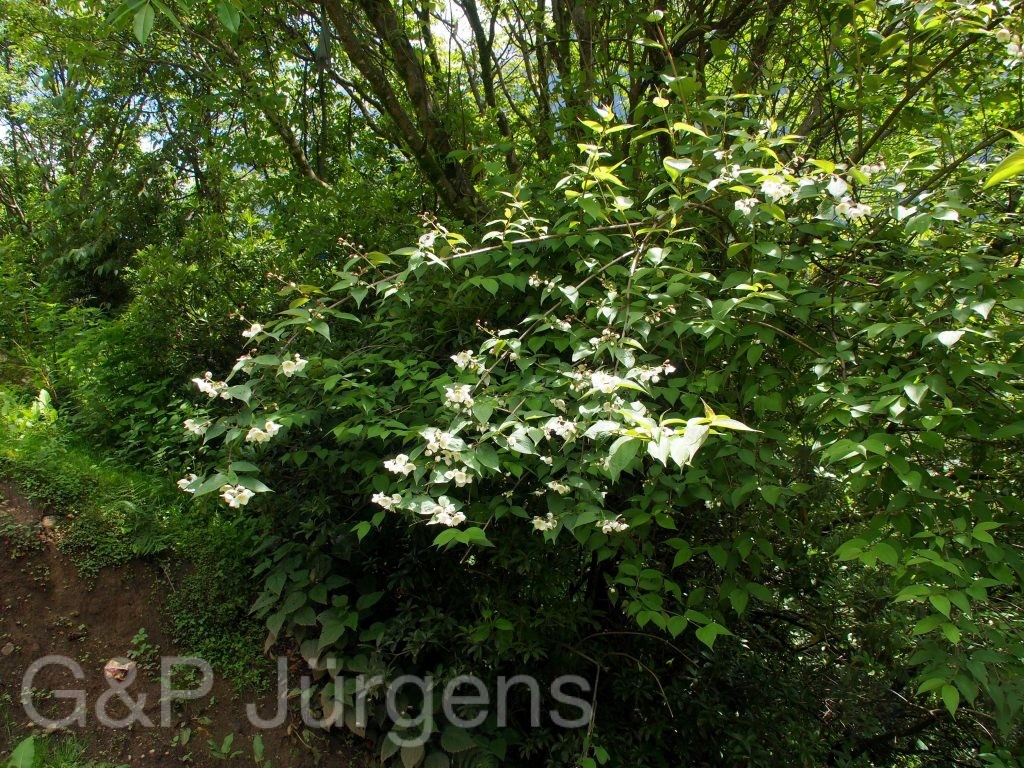
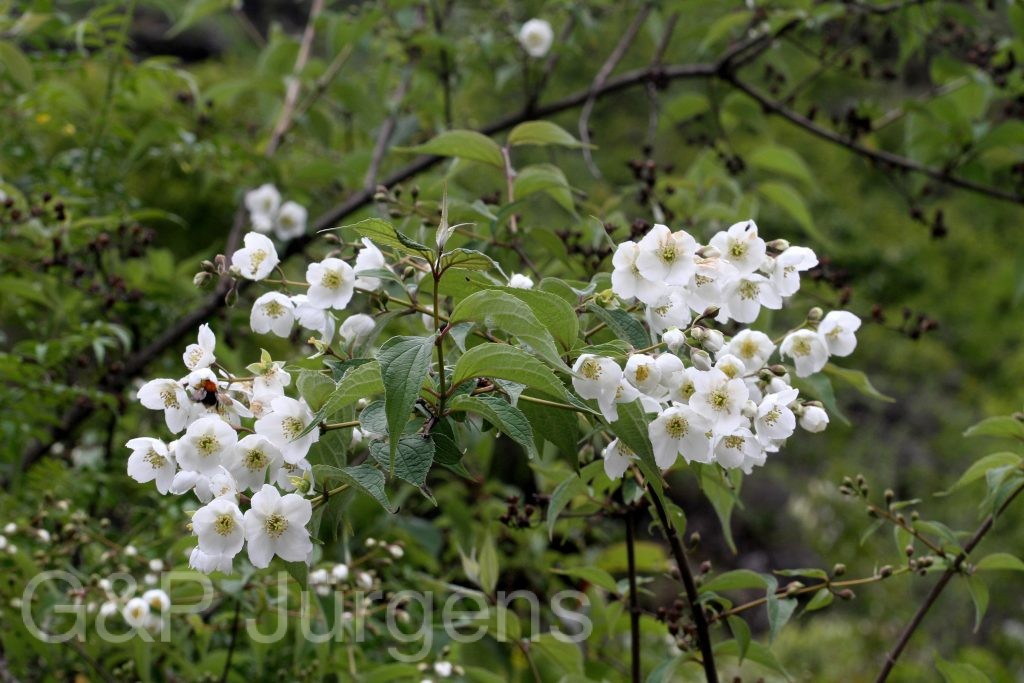
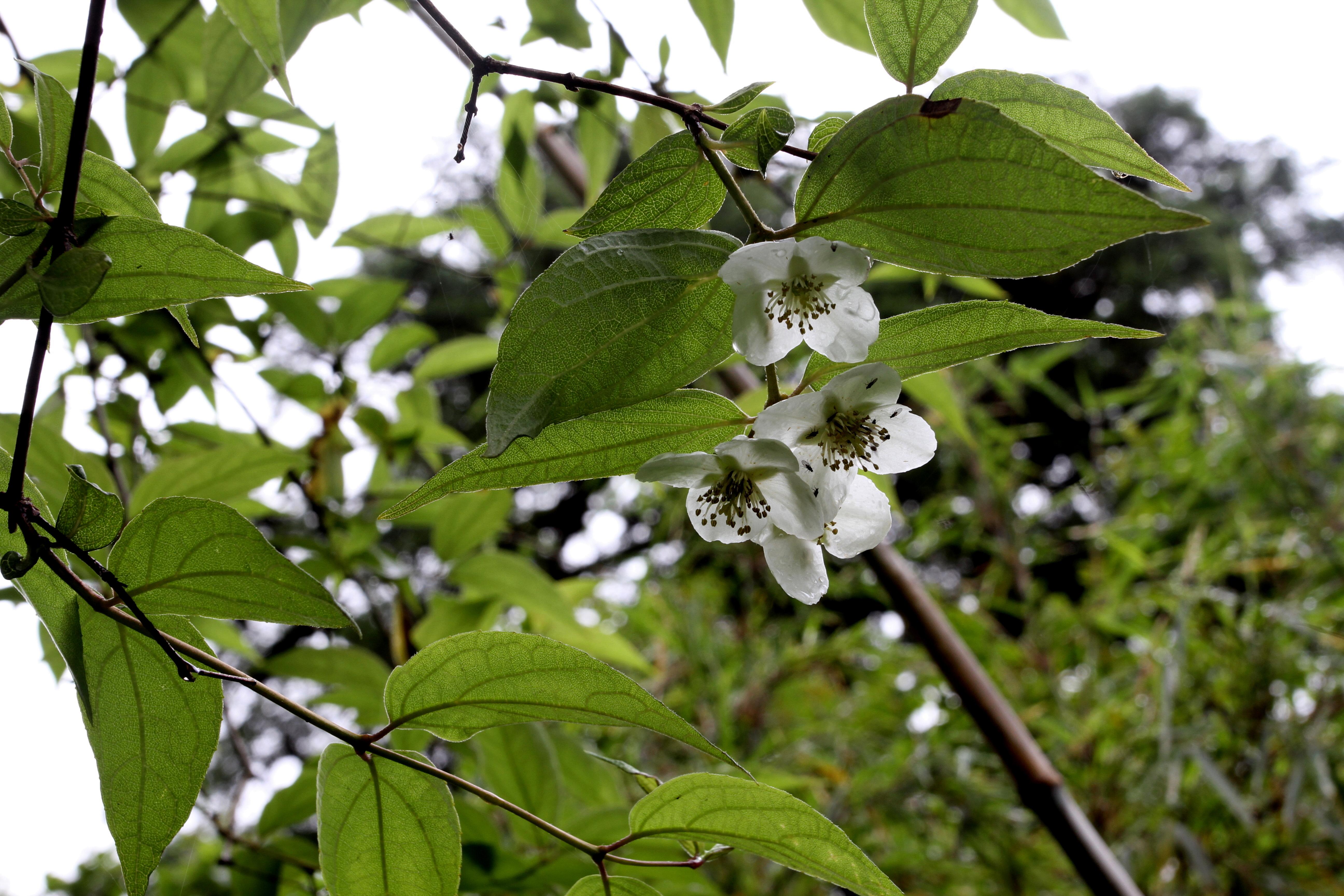
Philadelphus tomentosus, the Himalayan mock-orange, is native to the temperate Himalaya, ranging from Nepal through Sikkim and Bhutan into northern India and SW China, with the many additional GBIF country codes (US, DE, BE, GB, PL and others) reflecting its wide cultivation as an ornamental shrub rather than a natural range. Some 388 occurrence records underpin this. The photographed plant was found at Lachung in northern Sikkim at about 2,600 m in June, at the onset of flowering. In the wild it is a shrub of temperate forest margins, ravines, open slopes and streamsides, typically between 1,800 and 3,000 m, often among mixed broadleaf and conifer woodland.

It is a deciduous shrub with arching branches and exfoliating bark on older stems. The leaves are opposite, ovate to ovate-lanceolate, acuminate, with a denticulate margin and three to five main veins from the base; the lower surface is densely tomentose with greyish hairs, a character giving the species its epithet. The flowers are borne in terminal racemes or panicles and are fragrant, with four white obovate petals, a cup-shaped hypanthium, four sepals and numerous stamens surrounding a four-locular inferior ovary tipped by partly divided styles. The fruit is a small woody capsule dehiscing loculicidally to release numerous minute seeds.

The genus Philadelphus is centred on the Northern Hemisphere and is taxonomically complex owing to hybridisation and horticultural selection; the leaf indumentum and floral dimensions distinguish P. tomentosus from related Asian species. Long valued in gardens for its scented blossom, it has naturalised in parts of Europe and North America. It remains common in its native montane forests and is of no conservation concern.

Author: Wall. ex G. Don · Sources: POWO (Kew), Flora of China Vol. 8, Flora of Bhutan Vol. 1, GBIF, Hu: A Monograph of the Genus Philadelphus

(DC.) M.L.Zhang & Podlech

Nepal 2009 27 ergebnis
Nepal Helambu Koktrok 3000m, May

Description

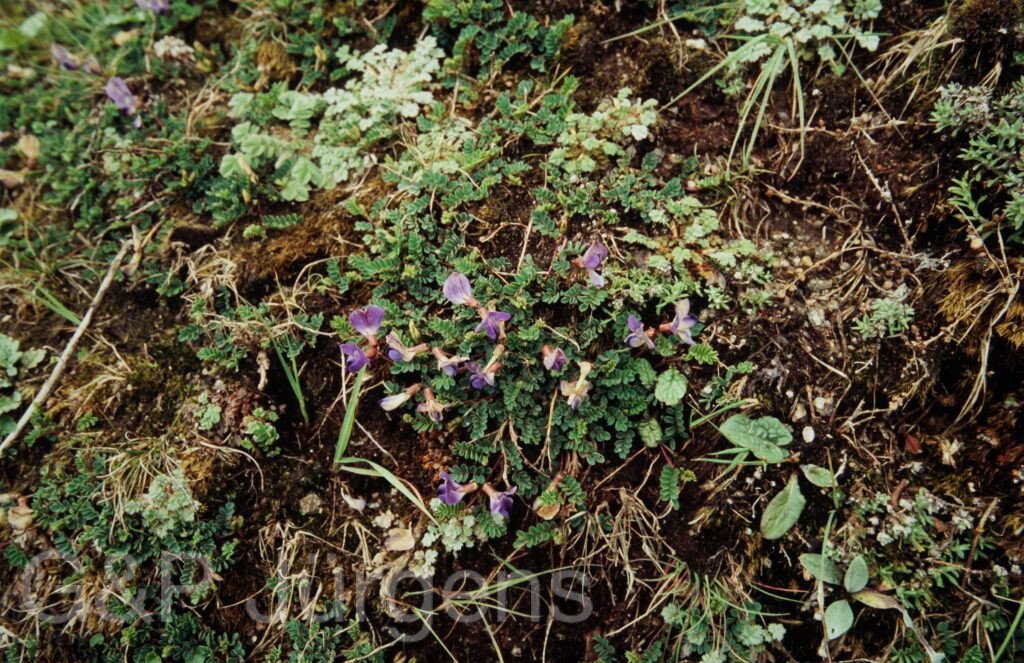
Phyllolobium donianus (correctly P. donianum, the accepted spelling), formerly placed in Astragalus, is a Sino-Himalayan legume distributed from Nepal through northern India, Sikkim and Bhutan into south-western China, with 256 GBIF records concentrated in the central and eastern Himalaya. It grows on open grassy slopes, forest clearings, banks and stony alpine pastures in the temperate to subalpine zone. The cited collection from Koktrok in the Helambu region of Nepal at 3000 m in May places its flowering in the late-spring period on warm-temperate mountain grassland before the onset of the summer monsoon.

It is a perennial herb with slender, ascending to trailing stems arising from a woody rootstock, the herbage thinly clothed in appressed medifixed (dolabriform) hairs typical of the genus. The leaves are imparipinnate with several pairs of small elliptic to obovate leaflets. The flowers are pea-shaped (papilionaceous), borne in axillary racemes on long peduncles, the corolla purplish to violet-blue with a notched standard, oblong wings and a blunt keel, subtended by a campanulate, hairy calyx with short teeth. The fruit is a small, membranous to leathery legume, somewhat inflated and stipitate, dehiscing to release several reniform seeds.

Phyllolobium was segregated from the vast genus Astragalus by Zhang and Podlech on the basis of molecular and morphological evidence, comprising a distinctive Asian clade of milkvetches. P. donianum, transferred from Astragalus donianus DC., exemplifies this realignment. Like other milkvetches it is nitrogen-fixing through rhizobial symbiosis and bee-pollinated; it is widespread and not of conservation concern.

Author: (DC.) M.L.Zhang & Podlech · Sources: POWO (Kew), GBIF, Flora of China, Annotated Checklist of the Flowering Plants of Nepal, Flora of Bhutan, Zhang & Podlech monograph of Phyllolobium

(DC.) C. Norman

Sikkim2003 247 P340
Sikkim Dzongri 4100m 08.2003

Description

Physospermopsis obtusiuscula is an alpine umbellifer of the eastern and central Himalaya, distributed across China (Tibet and adjacent provinces), Nepal, northern India and Bhutan, the roughly 136 GBIF records tracing this high-mountain arc. It inhabits open alpine meadows, moist grassy slopes, scree margins and the edges of dwarf-rhododendron and juniper scrub, characteristically between about 3500 and 4800 m. The photographed plant from Dzongri in Sikkim at 4100 m in August illustrates its late-summer flowering on a damp, high-alpine pasture, where it grows among cushion plants and short turf.

It is a small to medium perennial herb arising from a slender taproot or short rhizome, with one to few erect, ribbed, sometimes purplish stems. The leaves are mostly basal, with sheathing petioles, the blade ternately to pinnately dissected into narrow, obtuse ultimate segments. The inflorescence is a compound umbel subtended by conspicuous, often leafy bracts and bracteoles; the small flowers bear white to pinkish petals. The fruit is a mericarp pair, ovoid and somewhat laterally compressed, with prominent ribs, the genus name alluding to the inflated or bladder-like fruit character within the Apioideae.

The genus Physospermopsis comprises a small group of high-Asian umbellifers centred on the Himalaya and the Hengduan Mountains, allied to Pleurospermum and segregated chiefly on fruit and vittae characters. P. obtusiuscula, distinguished by its blunt leaf segments, is a typical element of the wet alpine flora at the upper limit of vascular plant growth. It is not formally assessed for conservation but, like other narrowly distributed alpine umbellifers, is potentially sensitive to grazing pressure and climate-driven upslope shifts.

Author: (DC.) C. Norman · Sources: POWO (Kew), GBIF, Flora of China, Flora of Bhutan, Annotated Checklist of the Flowering Plants of Nepal, Umbelliferae of the Himalaya (revision)

Picea spinulosa

by G & P Jürgens

(Griff.) A.Henry

Bhutan2015 407
Bhutan Jakar 2550, October
Sikkim2004 440 P767
Sikkim/India Lachung 3400m May

Description

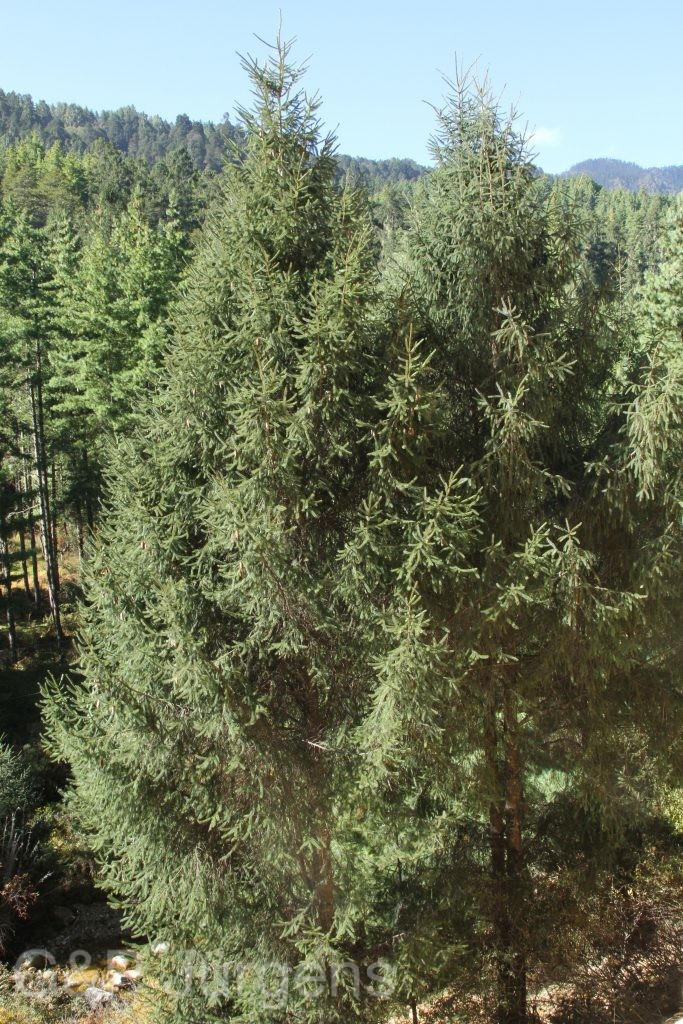
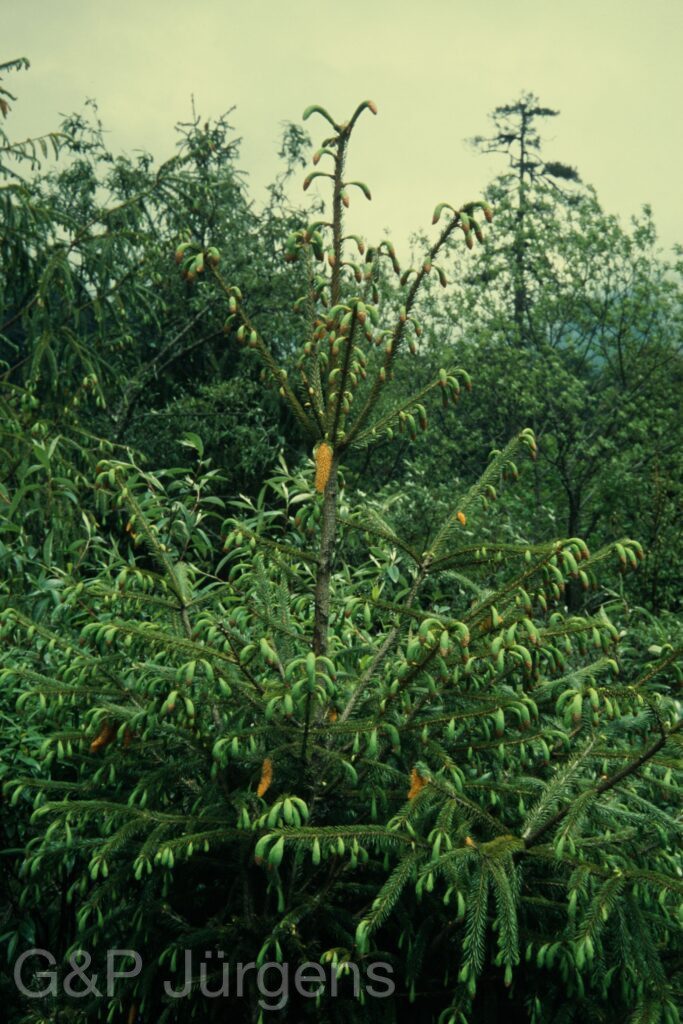
Picea spinulosa, the Sikkim or Himalayan weeping spruce, is a coniferous tree endemic to the eastern Himalaya, native to Bhutan, India (Sikkim), Nepal and adjacent China (Xizang); GBIF lists 291 occurrences, many from cultivated arboretum specimens in Europe and North America. In the wild it forms montane coniferous and mixed forests, often on north-facing slopes and in sheltered valleys, generally between about 2300 and 3700 m. The trees illustrated were photographed at Jakar in Bhutan at 2550 m in October and at Lachung in Sikkim at 3400 m in May, spanning the typical altitudinal range.

It is a tall evergreen tree with a conical to columnar crown and pendulous, weeping branchlets that give the species its distinctive habit. The bark is grey and scaly; the needle leaves are flattened, sharply pointed (spinulose, as the epithet notes), borne singly on small peg-like pulvini and showing two whitish stomatal bands beneath. The seed cones are pendulous, cylindrical, green ripening to pale brown, with thin, rounded, entire scales. Pollen and seed cones mature in a single season, and the winged seeds are dispersed by wind from the opening cones.

Picea spinulosa belongs to Pinaceae and is a regional dominant of the eastern Himalayan temperate conifer forests, frequently associating with Tsuga, Abies and broadleaved genera. Its graceful weeping form has led to its planting in temperate arboreta worldwide, accounting for the wide scatter of cultivated records. The species yields useful softwood timber. Although restricted in natural range, it remains locally common; nonetheless its forests are vulnerable to logging, fire and the cumulative effects of land-use change across the eastern Himalaya.

Author: (Griff.) A.Henry · Sources: POWO (Kew), GBIF, Flora of China, Flora of Bhutan, Conifers of the World, Farjon A Handbook of the World's Conifers