Tag:

Sikkim

Flowers of Sikkim — 350 species from the Sikkim Himalaya in northeast India, a compact yet botanically extraordinary region that climbs from subtropical valleys to the alpine zone beneath Kangchenjunga. Sikkim is a classic centre of Himalayan plant diversity, celebrated for its rhododendrons, primulas, orchids and gentians. Each entry provides a botanical description, distribution, habitat and flowering season with the original field photograph.

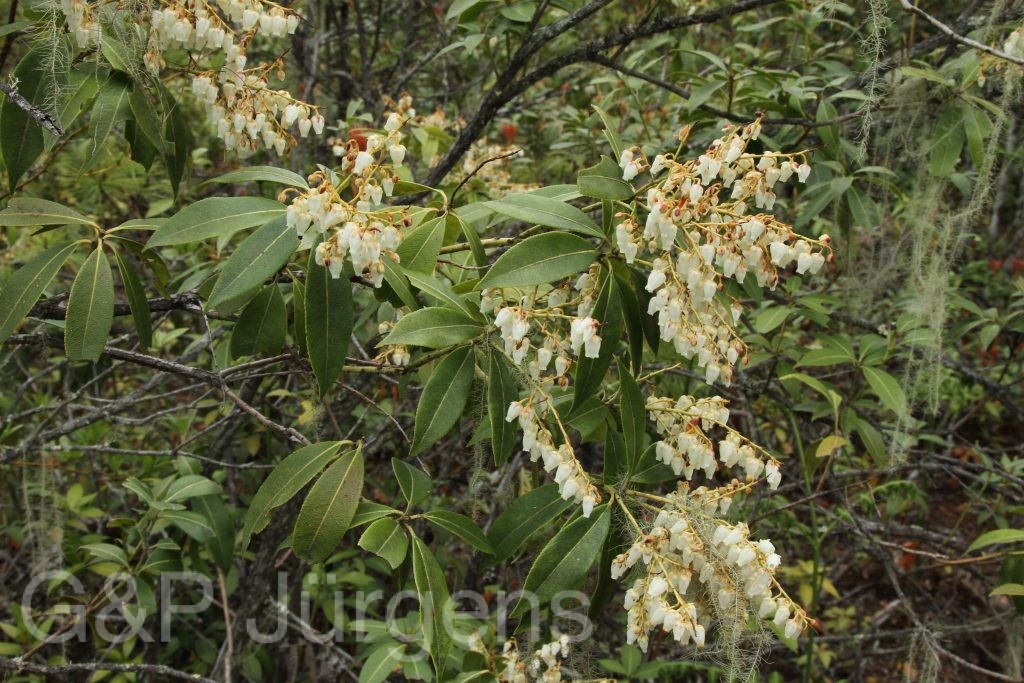
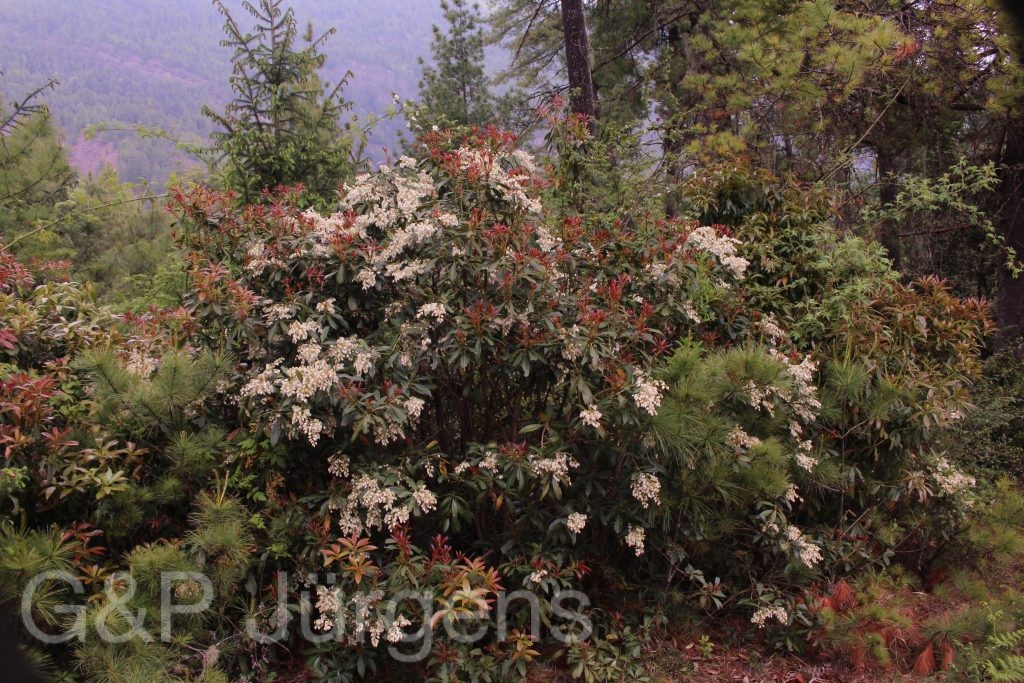
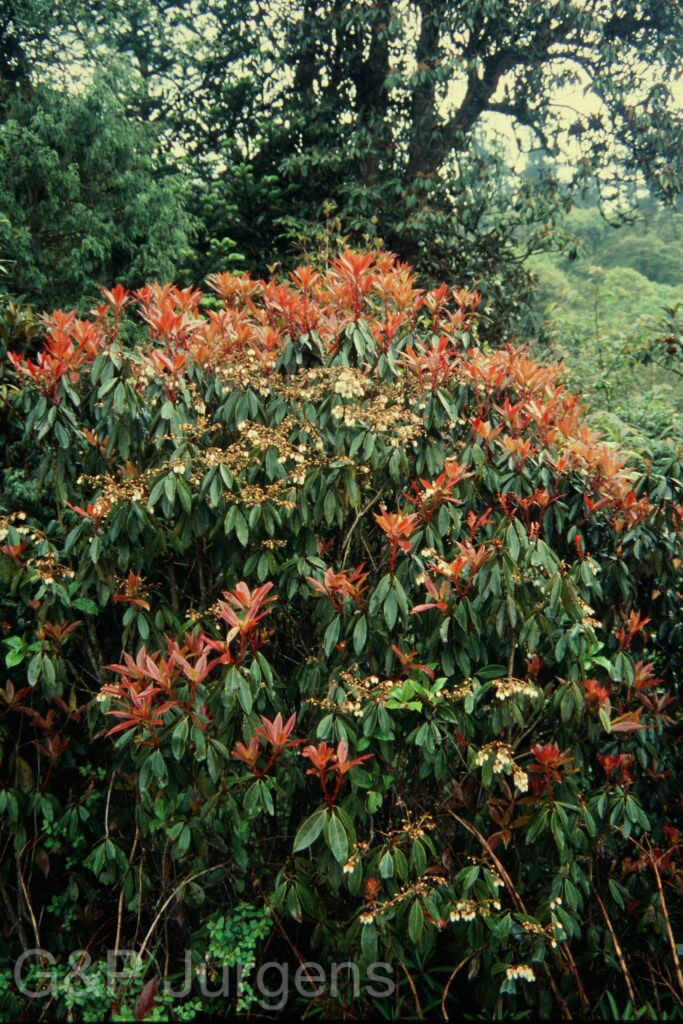
Pieris formosa

by G & P Jürgens

(Wall.) D. Don

Bhutan2014 861
Bhutan Chele-La 3000m, May
Bhutan2014 859
Bhutan Chele-La 3000m, May
Sikkim2004 381 658
Sikkim/India Lachung 3000m May

Description

Pieris formosa is an evergreen ericaceous shrub native to the Himalaya and southwestern China, recorded from China, Nepal, India, Bhutan and Myanmar, with cultivated and naturalised records elsewhere accounting for the European, North American, Japanese and other points among its substantial 2971 GBIF occurrences. It occurs in temperate forest, forest margins, thickets and open rocky slopes, generally between 900 and 3300 m. The localities in the caption, Chele-La in Bhutan and Lachung in Sikkim, both around 3000 m in May, represent the cool, humid upper montane forest where the species flowers profusely in spring.

The plant is a much-branched evergreen shrub or small tree reaching several metres, with leathery, oblong-lanceolate to elliptic leaves that are finely serrate, glossy dark green above and frequently flushed bronze or coppery-red when young. The flowers are borne in large, terminal, much-branched panicles; each corolla is small, white, urceolate (urn-shaped) and five-toothed at the mouth, with the stamens enclosed and the ovary superior. Fruit is a small erect, woody, five-valved dehiscent capsule containing numerous minute seeds, the persistent panicles remaining conspicuous after flowering.

Pieris (tribe Lyonieae, subfamily Vaccinioideae) is a small genus of Asian and North American shrubs, and P. formosa is its most robust Himalayan representative, widely grown as an ornamental, notably the form 'Forrestii' selected for its vivid red young growth. Like many Ericaceae it favours acidic, humus-rich soils and harbours grayanotoxins, rendering its foliage poisonous to livestock. Its urn-shaped flowers are pollinated chiefly by bees, and the dust-like seeds are wind-dispersed. The species is common and not threatened across its native range.

Author: (Wall.) D. Don · Sources: POWO (Kew), GBIF, Flora of China, Flora of Bhutan, Bean Trees and Shrubs Hardy in the British Isles
Wedd.

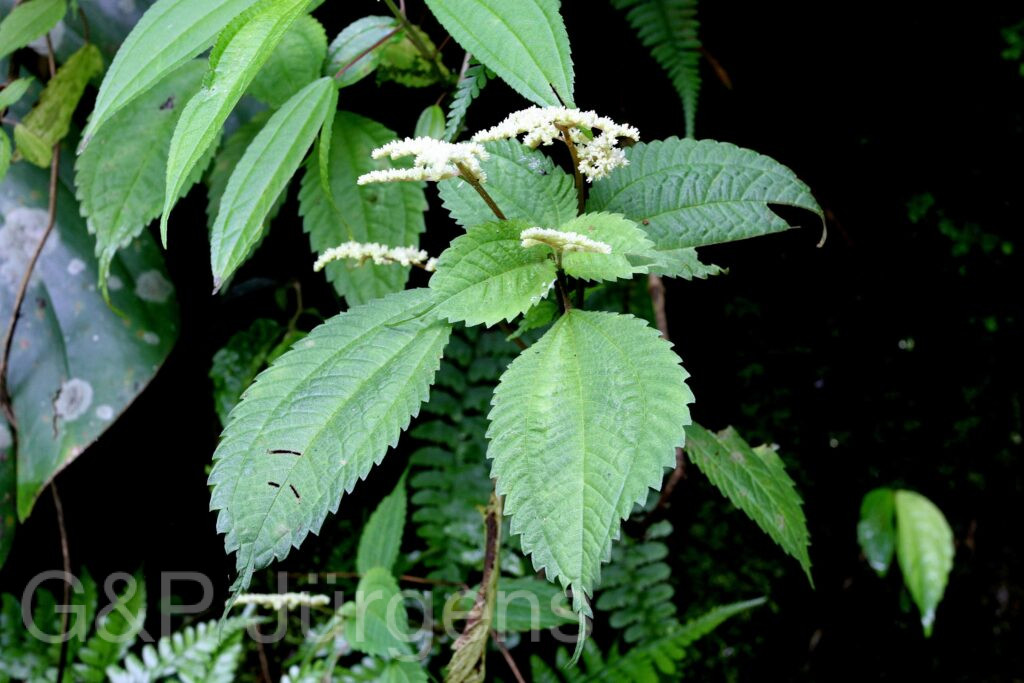
Sikkim2011 6
Bhutan Tista-valley 1900m, October

Description

Pilea insolens is a Sino-Himalayan herbaceous species distributed from central Nepal through Sikkim, Bhutan, and northeast India (Darjeeling, Arunachal Pradesh) to Bangladesh, Myanmar, southern China, Japan, and Indonesia. GBIF records 94 occurrences across this range. The species inhabits damp, shaded habitats in subtropical and warm-temperate forests at elevations of 800–2,400 m, where it colonises moist rocks, stream banks, tree bases, and old walls in areas of high humidity. It is most abundant in the eastern Himalayan valleys that receive heavy monsoon precipitation.
Pilea insolens is a succulent, erect to ascending, monoecious perennial herb, 15–40 cm tall. Stems are fleshy, translucent, glabrous, and often reddish-brown at the base. Leaves are opposite, markedly anisophyllous — a characteristic feature, with the larger leaf of each pair broadly ovate to suborbicular, 3–8 cm long, and the smaller leaf often reduced to a stipule-like scale or small blade less than 1 cm. The larger leaf surface is dark green, often with a cystolith-dotted texture visible as pale streaks, with crenate to serrate margins and three prominent basal veins. Stipules are small, membranous, and soon deciduous. Male and female flowers are borne in separate axillary cymes on the same plant; the male flowers are minute with four perianth segments, while the female flowers are even smaller, with an achene enclosed by persistent perianth lobes.
The photographed specimen from the Tista valley in Bhutan at 1,900 m in October represents a typical occurrence in the humid, deeply incised river valleys of the eastern Himalayas. Pilea insolens is distinguished from other Himalayan congeners by its pronounced leaf anisophylly combined with the broadly ovate, crenate larger leaf. The genus Pilea is enormous, with over 700 species globally, and the eastern Himalayan region is a centre of diversity with numerous narrowly distributed endemics. The species' extension from the Himalayas into Japan and Indonesia reflects a shared subtropical element across the monsoon-influenced forests of East and Southeast Asia. Its reliance on humid, undisturbed forest microsites makes it sensitive to deforestation and stream-channel modification.

Author: Wedd. · Sources: POWO (Kew), GBIF, Flora of China Vol. 5, Flora of Bhutan Vol. 1, Grierson & Long (1983), Chen (1982) — Revision of Chinese Pilea

L.

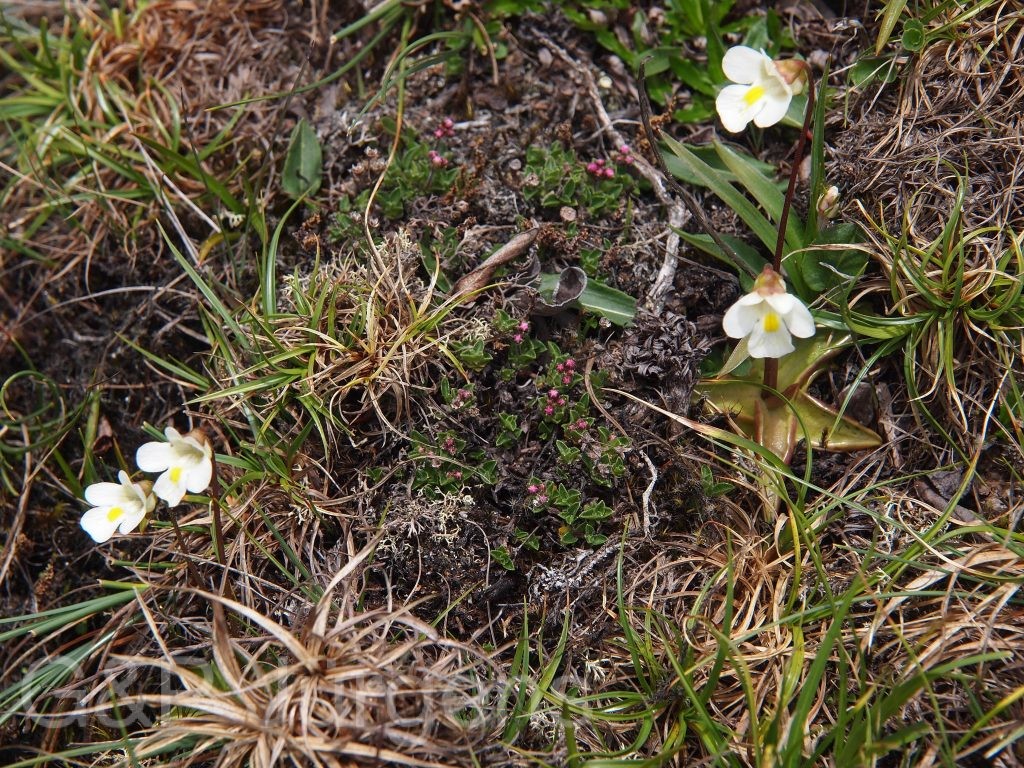
Sikkim2011 109
Sikkim, Chopta-valley 4300m, June

Description

Pinguicula alpina is a circumboreal-alpine carnivorous herb with a vast range across the mountains and high latitudes of Eurasia, from the Alps, Pyrenees and Scandinavia through Russia to China, with disjunct outliers in the Himalaya including Nepal and Sikkim. Its tens of thousands of catalogued occurrences reflect this broad distribution. It grows in wet, base-rich, often calcareous habitats — flushes, dripping rocks, fens, streamsides and damp turf — from the montane belt to high alpine elevations, reaching about 4,300 m in the Himalaya, as in the plant photographed in the Chopta valley of Sikkim at 4,300 m in June, where it flowers at the height of the alpine spring.

It is a small, perennial, insectivorous herb forming a flat basal rosette of yellow-green, oblong to elliptic leaves whose upper surfaces are sticky with glandular hairs that trap and digest minute insects, the margins slightly involute. From the rosette arise one to few erect, leafless scapes bearing a single nodding flower; the corolla is white with one or two yellow spots on the palate, two-lipped and spurred at the base, the spur short and conical. The fruit is a small ovoid capsule releasing numerous minute seeds. The plant overwinters as a resting bud (hibernaculum).

Within Lentibulariaceae, Pinguicula employs flypaper-type passive carnivory, supplementing nutrient uptake in the poor, wet soils it favours. P. alpina is distinguished from the violet-flowered P. vulgaris by its white, yellow-spotted corolla and shorter spur, and the two occasionally co-occur. Though globally secure, its Himalayan populations are localised and dependent on undisturbed calcareous wetlands sensitive to drainage and warming.

Author: L. · Sources: POWO (Kew), Flora of China Vol. 19, Flora of Nepal, GBIF, Casper: Monographie der Gattung Pinguicula (1966)

(Hook.f.) Soó

Sikkim2003 96 P133
Sikkim above Chora 3600m 08.2003
Sikkim2003 97 P134
Sikkim above Chora 3600m 08.2003

Description

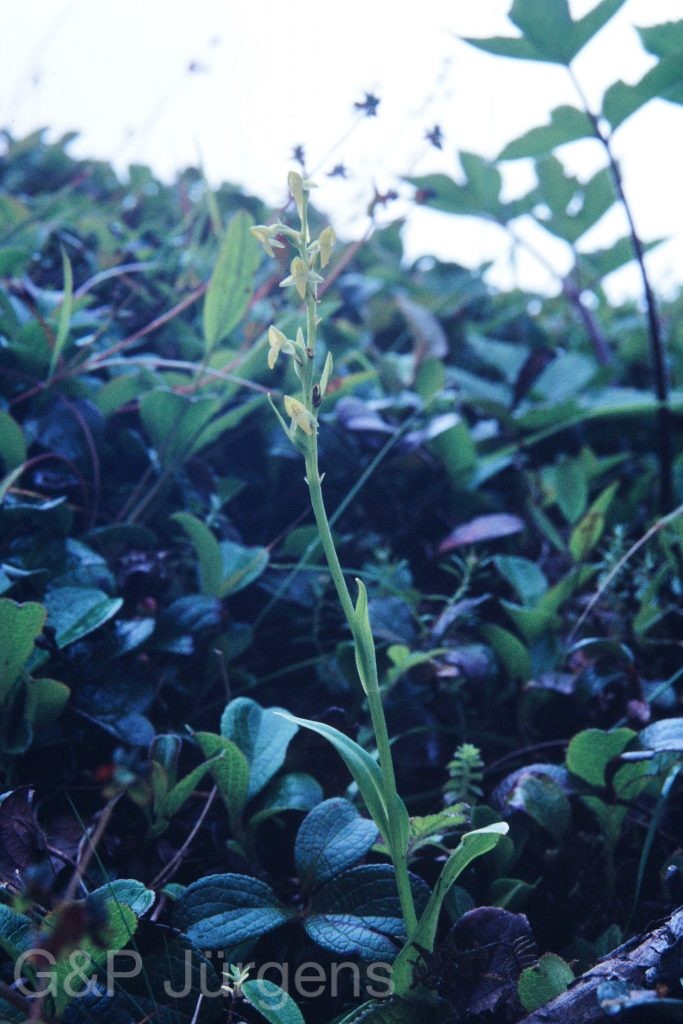
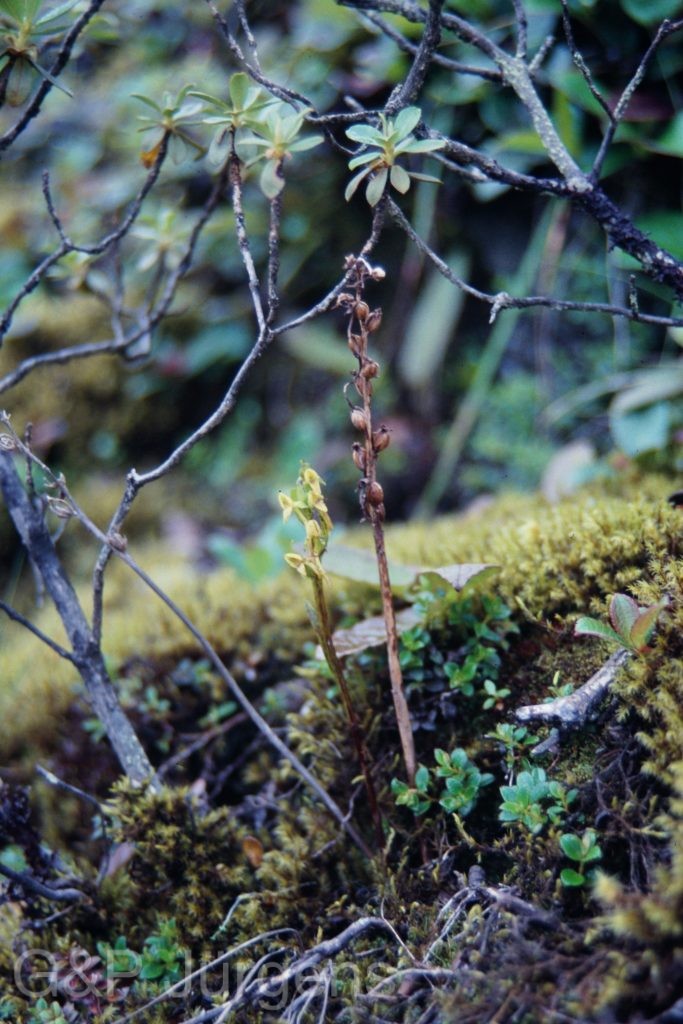
Platanthera leptocaulon is a terrestrial orchid of the eastern Himalaya and adjacent mountains of south-western China, recorded from Sikkim and the rest of northern India, Nepal, Bhutan, Myanmar and Yunnan and Sichuan in China. The roughly 67 georeferenced collections concentrate in the high subalpine to alpine belt, where the species occupies moist open turf, the margins of dwarf-shrub thickets and grassy hollows kept damp by snowmelt. The plant photographed above Chora in Sikkim at 3600 m in August typifies its habitat, flowering during the late-summer monsoon at elevations of roughly 3000-4200 m on humus-rich, well-drained slopes.

It is a slender, glabrous herb arising from ovoid to fusiform root-tubers, the erect stem comparatively thin and wiry (the epithet leptocaulon meaning "slender-stemmed"). The few cauline leaves are oblong-lanceolate to linear, sheathing at the base and grading upwards into bracts. The lax terminal raceme bears small greenish to greenish-white flowers; the dorsal sepal and petals are connivent to form a hood over the column, the lateral sepals spreading, and the entire, narrowly oblong labellum extends backwards into a slender cylindrical spur. The viscidia are naked and the pollinia are attached by slender caudicles, with fruit a small erect dehiscent capsule releasing dust-like seed.

The genus Platanthera is a large Holarctic and Asian assemblage centred on temperate and montane regions, and P. leptocaulon belongs to the species-rich Sino-Himalayan radiation, the basionym having been transferred by Soo from Habenaria. Like most members of the genus it depends on mycorrhizal fungi for germination and probably on long-tongued nocturnal pollinators attracted to the spurred flowers. Though not formally assessed, its broad transboundary range and tolerance of grazed alpine pasture suggest reasonable security, but populations remain vulnerable to overgrazing and the warming-driven upslope contraction of alpine grassland.

Author: (Hook.f.) Soó · Sources: POWO (Kew), GBIF, Flora of China, Flora of Bhutan, The Genus Platanthera (Orchidaceae) monograph

(Lindl.) Rollisson

Sikkim2011 381
Sikkim Lachen 2600m, June
Nepal 2001 262 ergebnis ergebnis
Nepal (Gorkha) Jaurey Kharka 2700m, May
Nepal 2001 263 ergebnis ergebnis
Nepal (Gorkha) Jaurey Kharka 2700m, May

Description

Pleione hookeriana is a small epiphytic and lithophytic orchid of the eastern Himalaya and Indochina, distributed across Nepal, India, Bhutan, China and Laos, with about 204 GBIF occurrences. It inhabits cool, humid montane forest, growing on mossy tree trunks, branches and shaded rocks in the temperate zone, favouring situations with abundant atmospheric moisture. The images document it in Sikkim near Lachen at about 2600 m in June and in the Gorkha district of Nepal at Jaurey Kharka around 2700 m in May, where it flowers on moss-clad substrates as the monsoon approaches.

It is a dwarf, deciduous orchid growing from a small annual pseudobulb that bears a single plicate leaf. The flower is solitary and produced with or just before the leaf on a short scape arising from the base of the pseudobulb. The sepals and petals are narrow, spreading and pale pink to rose-lilac; the labellum is comparatively large, obovate, fringed at the margin, and marked within by a yellow to brown-spotted, lamellate throat that contrasts with the paler perianth. The column is slender and winged. The fruit is a dry dehiscent capsule releasing dust-like seeds.

Pleione hookeriana is the smallest-flowered species of its genus and is distinguished by its diminutive habit and patterned lip. Like all Pleione it has an annual pseudobulb cycle and depends on mycorrhizal fungi for seed germination. The showy lip and contrasting throat markings attract bee pollinators in spring. As an attractive orchid it is subject to horticultural collection, and the entire genus is listed on CITES Appendix II, regulating international trade.

Author: (Lindl.) Rollisson · Sources: POWO (Kew), GBIF, Flora of China, Flora of Bhutan, The Genus Pleione (Cribb & Butterfield), CITES Appendices

Royle

Sikkim2011 57
Sikkim Tanghu 3900m, June
Sikkim2011 70
Sikkim Tanghu 3900m, June
Sikkim2011 72
Sikkim Tanghu 3900m, June

Description

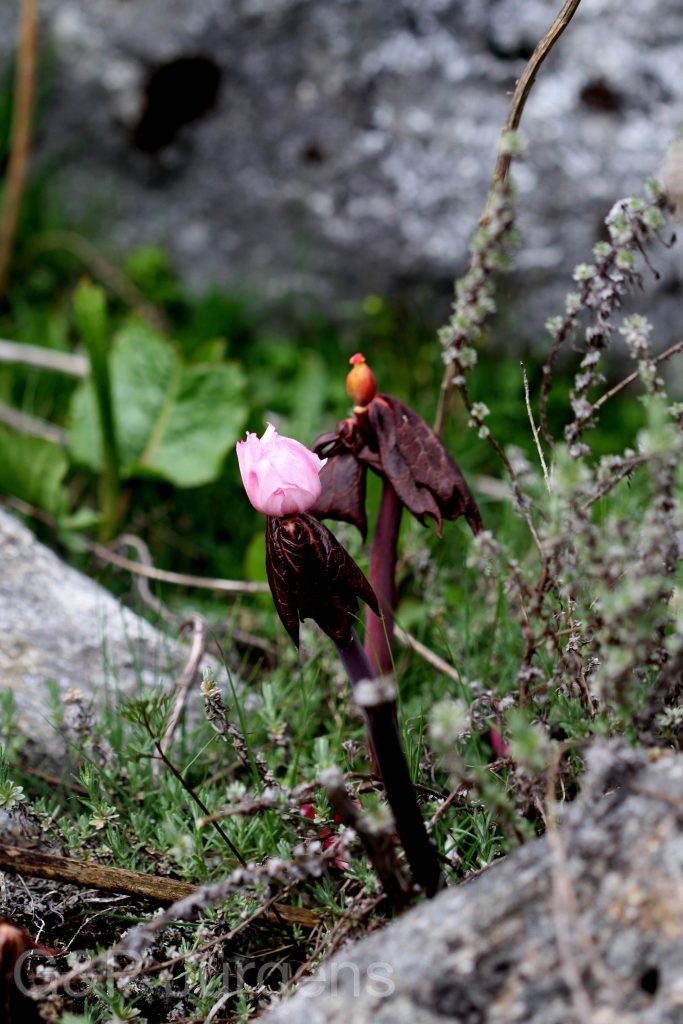
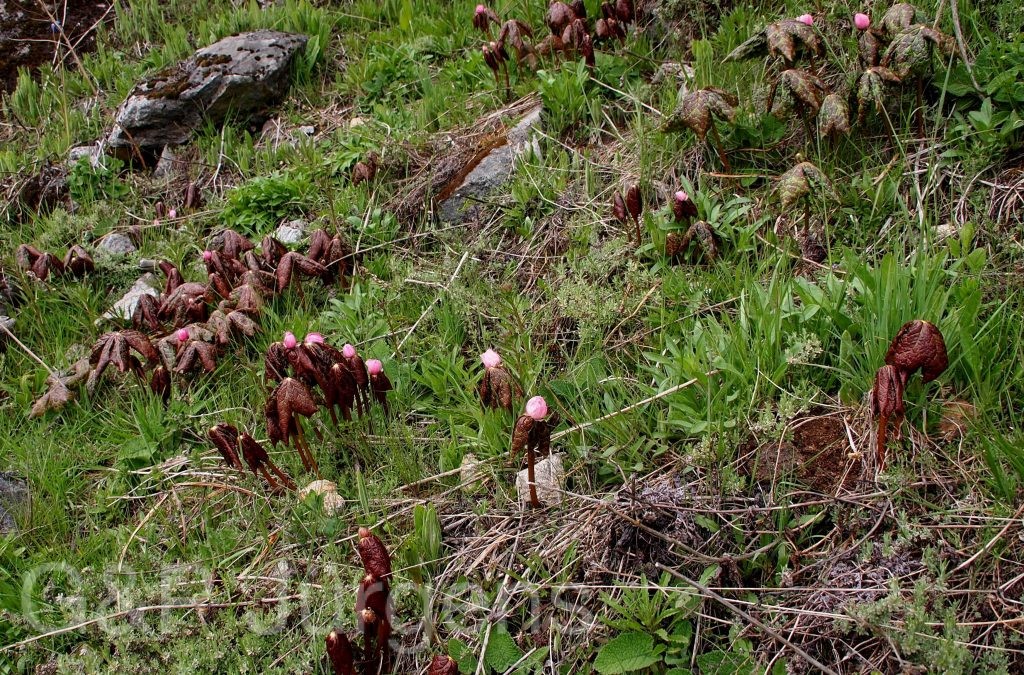
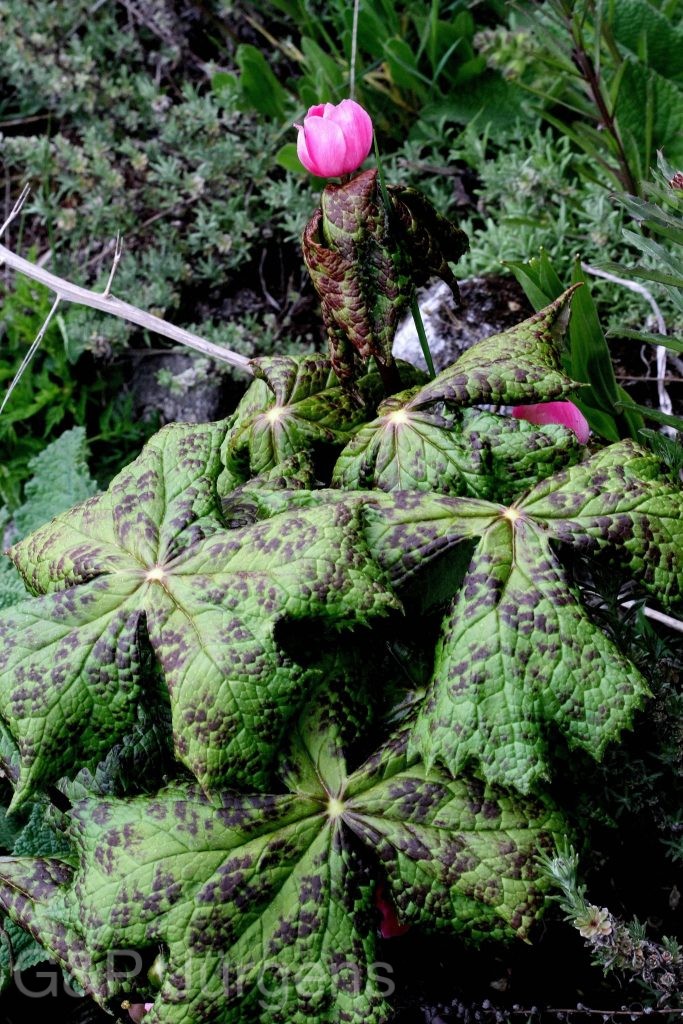
Podophyllum hexandrum, the Himalayan mayapple, is a perennial herb of the high temperate and subalpine Himalaya, occurring through China, India, Pakistan, Nepal, Bhutan and Afghanistan, with around 860 occurrences in GBIF. It grows in moist alpine meadows, open fir and birch forest, shaded scrub and along the margins of melting snowfields, typically between about 2500 and 4500 m. The plant photographed at Tanghu in northern Sikkim at 3900 m in June, emerging and flowering as the snow recedes, is characteristic of its high-elevation niche, where the rich, moist humus of the upper forest and meadow ecotone supports dense local stands.

The species arises from a stout, creeping, knotty rhizome and produces a single erect aerial stem 15–50 cm tall bearing usually two large, long-petiolate leaves that are deeply palmately three- to five-lobed, the lobes themselves further cut and toothed, often bronze-mottled when young. A solitary, nodding to erect flower is borne at the fork of the leaves; it is cup-shaped with white to pale pink petals and (as the epithet indicates) commonly six stamens. The fruit is a large, fleshy, ovoid berry ripening to bright red and containing numerous seeds embedded in pulp.

GBIF flags the name as a synonym, the species being widely treated under the accepted name Podophyllum hexandrum, with the genus Sinopodophyllum (S. hexandrum) recognised by some authors to accommodate the Asian taxon apart from the North American Podophyllum peltatum; the source page links to that segregate name. The plant is the principal natural source of podophyllotoxin, a lignan of major pharmaceutical importance as a precursor of anticancer agents. Heavy harvesting of the rhizomes for this trade, together with habitat disturbance, has caused marked local declines, and the species is regarded as threatened and is subject to conservation and CITES-related concern across much of its range.

Author: Royle · Sources: POWO (Kew), GBIF, Flora of China Vol. 19, Flora of Bhutan Vol. 1, Flora of Pakistan, Medicinal Plants of the Himalaya: A Monograph of Podophyllum

Baker

Sikkim 2006 315 ergebnis
India West-Bengal, Chaana 1800m, May

Description

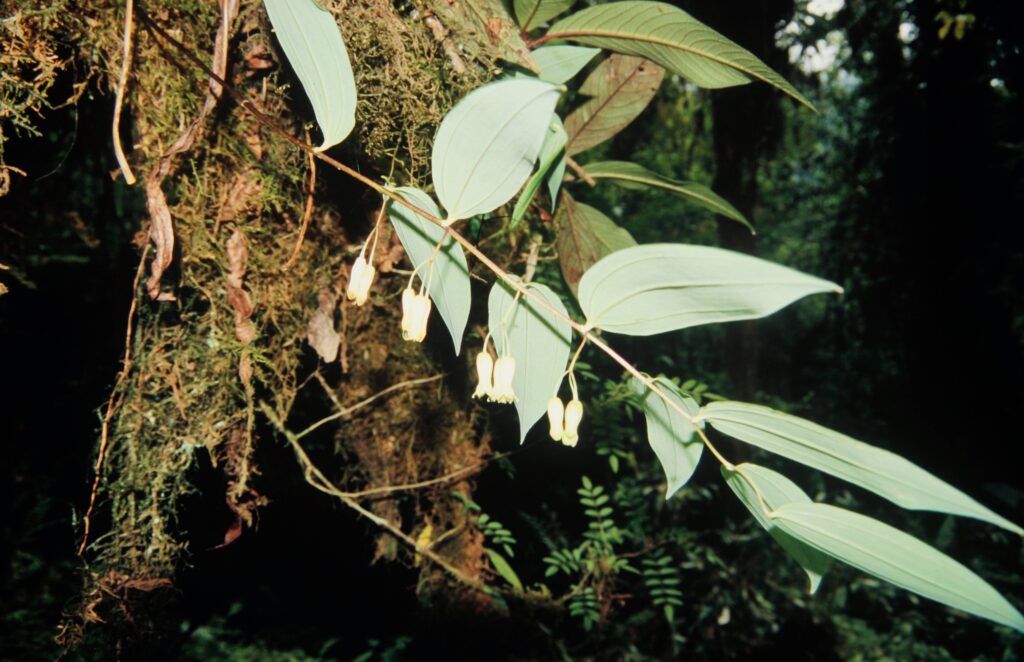
Polygonatum brevistylum is a rhizomatous perennial of the eastern Himalaya and adjacent ranges. GBIF documents it (some 27 occurrences) from Nepal, India, Bhutan and Myanmar, in moist temperate forest, forest margins, shrubberies and shaded banks. It grows in cool, humus-rich soils within the broadleaved and mixed conifer zone, generally between about 1,500 and 3,000 m. The photographed plant is from Chaana in West Bengal (Darjeeling–Sikkim Himalaya) at around 1,800 m, flowering in May, a representative low-montane station for the species as it sends up shoots in spring.

The plant has a stout, knotty, horizontally creeping rhizome from which arises an erect or arching stem. The leaves are alternate, ovate to elliptic and acuminate, glabrous, sessile or shortly petiolate. The flowers are pendent and borne in few-flowered axillary clusters; the perianth is tubular-campanulate, white to greenish-white, with six short lobes, and, as the epithet brevistylum signals, a notably short style. The fruit is a globose berry, ripening blue-black to purplish and containing several seeds.

Polygonatum (Solomon's-seal), now placed in Asparagaceae (formerly Convallariaceae or Liliaceae sensu lato), is taxonomically intricate in the Himalaya, where several closely allied rhizomatous species occur. The short style and the clustered axillary flowers are useful diagnostic characters separating P. brevistylum from sympatric congeners. Himalayan Polygonatum rhizomes are widely gathered for food and traditional medicine, so localised harvesting pressure may affect accessible populations.

Author: Baker · Sources: POWO (Kew), Flora of China Vol. 24, Flora of Bhutan Vol. 3, GBIF, Jeffrey: The Genus Polygonatum (Liliaceae) in Eastern Asia

Baker

Sikkim2011 51
Sikkim Vista-valley 3800m, June
Bhutan2014 991
Bhutan Chele-La 4000m, May

Description

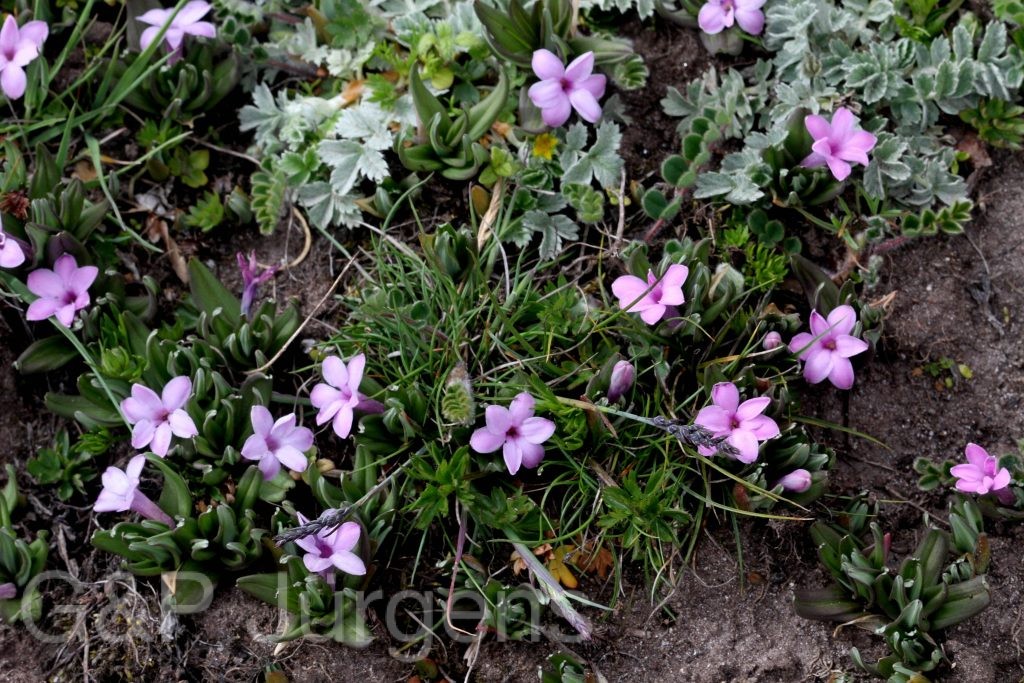
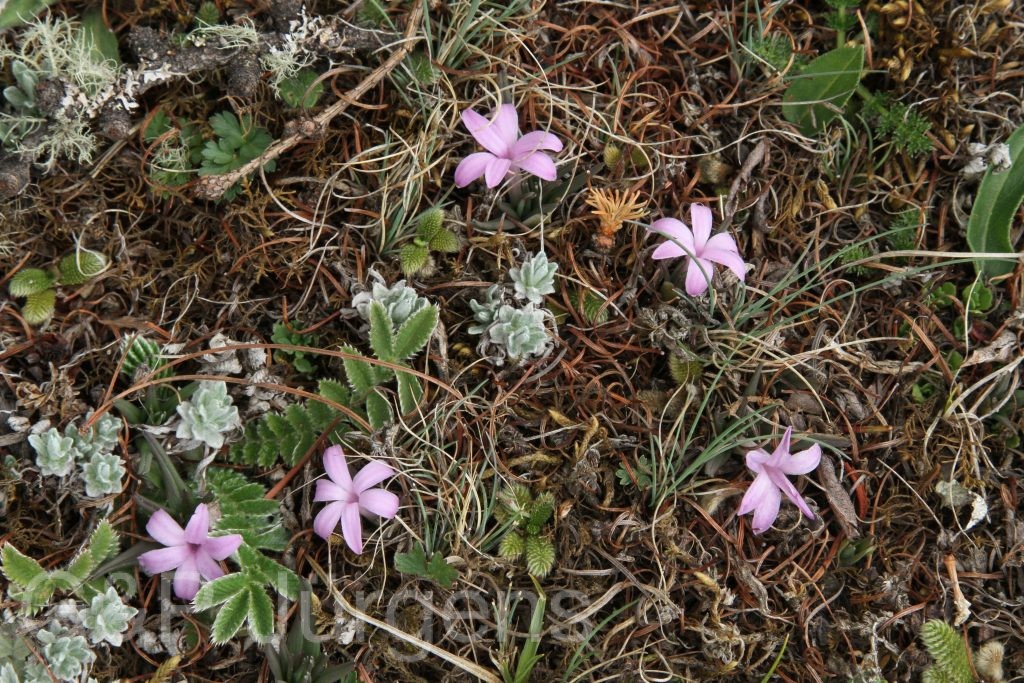
Polygonatum hookeri is a dwarf alpine Solomon's-seal of the Sino-Himalayan high mountains, recorded from China, Nepal, India, Bhutan and Pakistan across some 400 GBIF occurrences. The illustrated plants were photographed in the Vista-valley of Sikkim at 3800 m in June and on the Chele-La in Bhutan at 4000 m in May. It grows in open alpine turf, on grassy slopes, stony meadows and the margins of rhododendron scrub, typically between 3000 and 4500 m, forming low patches in short high-elevation vegetation where it flowers soon after snowmelt.

The plant is a diminutive rhizomatous perennial, spreading by a slender creeping rhizome and producing very short, sometimes almost stemless aerial shoots. The leaves are small, narrowly elliptic to oblong and crowded toward the top of the shoot. The flowers are solitary or paired and conspicuously large relative to the plant, bell- to funnel-shaped, lilac, rose-pink or purplish, borne low among the leaves; the perianth is tubular with six short lobes. The fruit is a small globose berry, ripening red, containing few seeds.

Long placed in the Liliaceae or Convallariaceae, Polygonatum is now treated in the Asparagaceae (subfamily Nolinoideae). P. hookeri is among the smallest and most alpine members of the genus, its dwarf cushion-like habit an adaptation to the harsh high-mountain environment, and it is much esteemed by rock-garden growers. The bird-dispersed berries aid colonisation of new ground. The species is widespread across the high Himalaya and of least conservation concern.

Author: Baker · Sources: POWO (Kew), GBIF, Flora of China, Flora of Bhutan, Flora of Nepal, Jeffrey – The Genus Polygonatum (Liliaceae/Asparagaceae) revision

D.Don

Sikkim 2006 463 ergebnis
India West-Bengal, Ruigi-Chu 2100m, May

Description

Polygonum molle D.Don is a robust perennial knotweed of the Himalaya and adjacent uplands. Under current circumscription the name is treated as a synonym, the accepted genus being Koenigia, into which many former Asian Polygonum and Aconogonon species have been transferred following molecular phylogenetic studies. The taxon occurs from Pakistan and Nepal eastward through Sikkim and Bhutan into southwest China, with the broad GBIF country list reflecting the wide aggregate concept of the genus and numerous cultivated or naturalised records across Europe and North America. It was recorded in West Bengal at Ruigi-Chu at 2,100 m in May, growing in moist temperate forest clearings, stream banks, and shrubby slopes between about 1,500 and 3,000 m.

The plant forms stout, erect, much-branched stems up to 1–2 m tall arising from a woody rootstock, the nodes sheathed by membranous, often brownish ochreae. The leaves are large, ovate to ovate-lanceolate, acuminate, with a softly pubescent (hence "molle") and somewhat velvety lower surface. Numerous small whitish to greenish flowers are borne in much-branched, paniculate inflorescences of slender racemes; each flower has a five-parted perianth that persists around the trigonous, glossy achene at maturity.

The transfer to Koenigia reflects a substantial reorganisation of tribe Persicarieae, in which the traditional broad Polygonum proved polyphyletic. Plants of this group are pioneer colonisers of disturbed temperate habitats and contribute to slope stabilisation. Robust and widespread, the species is of no conservation concern, though its taxonomy at species rank remains in flux pending fuller sampling.

Author: D.Don · Sources: POWO (Kew), Flora of China Vol. 5, Flora of Bhutan Vol. 1, GBIF, Schuster et al.: Phylogeny of Polygoneae (Taxon, 2011)

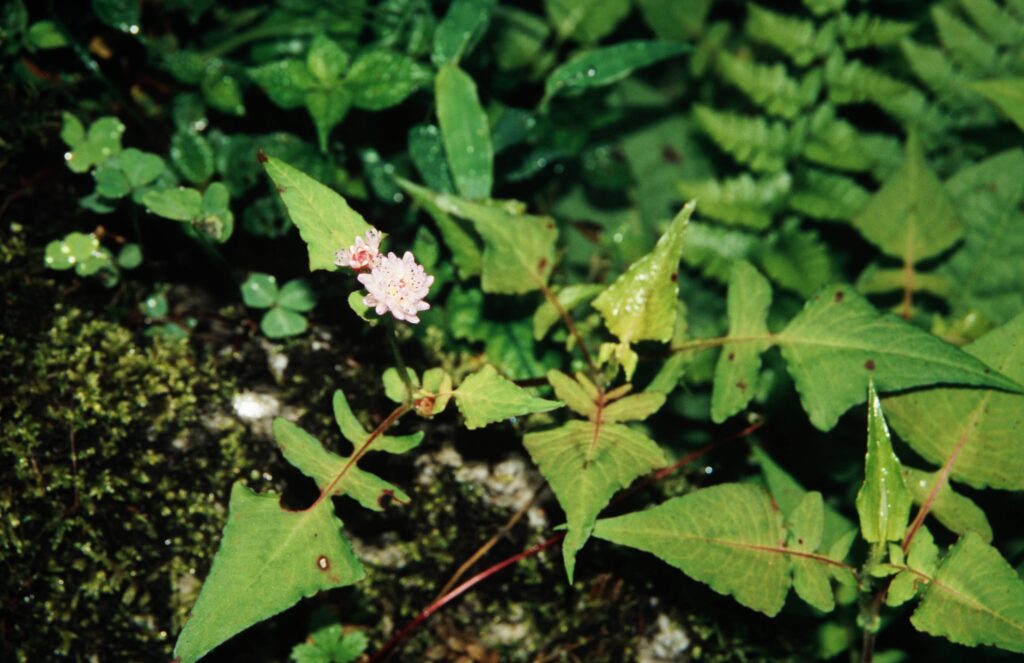
Buch.-Ham.

Sikkim 2006 458 ergebnis
India Sikkim, Ringi-Chu 2100m May

Description

Polygonum runcinatum is a widely distributed knotweed found across the Himalaya and extending through much of eastern and southeastern Asia to Malesia. Its range encompasses Nepal, Bhutan, India, Pakistan, Myanmar, China, Taiwan, Thailand, Vietnam, Malaysia, Indonesia, and Papua New Guinea, with scattered records elsewhere. GBIF documents over 1,660 occurrences, reflecting its abundance and broad ecological amplitude. The species colonises moist, open to semi-shaded habitats including forest margins, stream banks, roadsides, damp meadows, and disturbed ground at elevations from 500 to 3,500 m. The photograph from Ringi-Chu in Sikkim at 2,100 m, taken in May, shows the species at a mid-elevation site in the eastern Himalaya.
The plant is a prostrate to ascending perennial herb, 20–60 cm long, often forming extensive mats. Stems are slender, branched, rooting at lower nodes, reddish-brown, glabrous to sparsely pubescent. Leaves are distinctive: ovate to lanceolate, 3–8 cm long, with a hastate to runcinate base bearing prominent, backward-pointing basal lobes — the feature indicated by the epithet runcinatum. The upper leaf surface frequently bears a dark, V-shaped or chevron-like blotch, a useful field character. Ocreae are tubular, membranous, ciliate. Flowers are borne in dense, globose, terminal capitate heads, 8–12 mm in diameter, on slender peduncles. Individual flowers are small, with a five-lobed perianth, pink to deep rose, occasionally white. Stamens usually eight. The achene is trigonous, dark brown, enclosed within the persistent perianth.
Polygonum runcinatum has been transferred by some authors to Persicaria as P. runcinata (Buch.-Ham.) H.Gross, reflecting the broad restructuring of Polygonum sensu lato based on molecular phylogenetic evidence. The species is ecologically versatile and often weedy, colonising disturbed habitats rapidly. It plays a role in soil stabilisation on moist slopes and provides floral resources for small pollinators. It is not threatened and is considered common to locally abundant throughout its extensive range.

Author: Buch.-Ham. · Sources: POWO (Kew), GBIF, Li et al.: Polygonaceae in Flora of China Vol. 5, Grierson & Long: Flora of Bhutan Vol. 1