Tag:

Spring

(Buch.-Ham. ex D.Don) Benth. ex C.B.Clarke
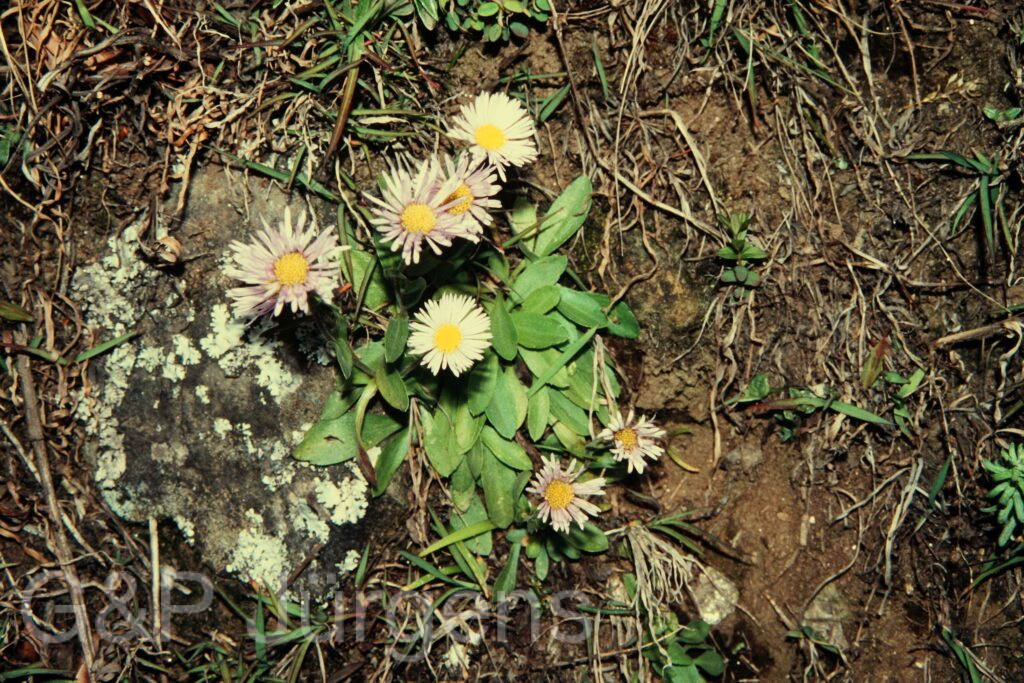
Nepal 97 284 G577
Nepal Chamtrug 2550m May
Nepal 97 284 G577
Nepal Chamtrug 2550m May

Description

Erigeron bellidioides is a small fleabane of the Western and Central Himalaya, with verified GBIF occurrences confined to Pakistan, Nepal and India. It is a plant of open grassy slopes, forest clearings, banks and stony pastures through the temperate zone, generally between about 1800 and 3000 m. The material photographed at Chamtrug in central Nepal at around 2550 m in May illustrates its flowering at the onset of the growing season in just such open montane grassland, where it forms low, daisy-like tufts among the sward.

The species is a low perennial or short-lived herb forming a basal rosette of obovate to spathulate, entire or slightly toothed leaves that, as the epithet bellidioides suggests, recall those of a daisy (Bellis). The stems are slender, sparingly leafy and finely hairy, each typically bearing a solitary terminal capitulum. The involucre is hemispherical with narrow, hairy phyllaria in a few rows; the head carries numerous slender, thread-like ray florets that are white, pink or pale lilac surrounding a disc of yellow tubular florets. The fruit is a small flattened achene crowned by a pappus of fine bristles that facilitates wind dispersal.

Within Erigeron, a large genus easily confused with related Aster, this species is distinguished by its rosette habit, narrow many-rayed heads and Himalayan distribution; it was transferred to the genus by C.B. Clarke from a Buchanan-Hamilton and Don basionym. Ecologically it behaves as a pioneer of open and disturbed ground and provides a nectar and pollen source for generalist insects. It is widespread and locally common in suitable grassland and is not regarded as being of conservation concern.

Author: (Buch.-Ham. ex D.Don) Benth. ex C.B.Clarke · Sources: POWO (Kew), GBIF, Flora of Pakistan, Annotated Checklist of the Flowering Plants of Nepal, Flora of British India
DC.

Sikkim2004 3 G4
Sikkim West-Bengal, Sambon 1750m April
Sikkim2004 4 P5
Sikkim West-Bengal, Sambon 1750m April

Description

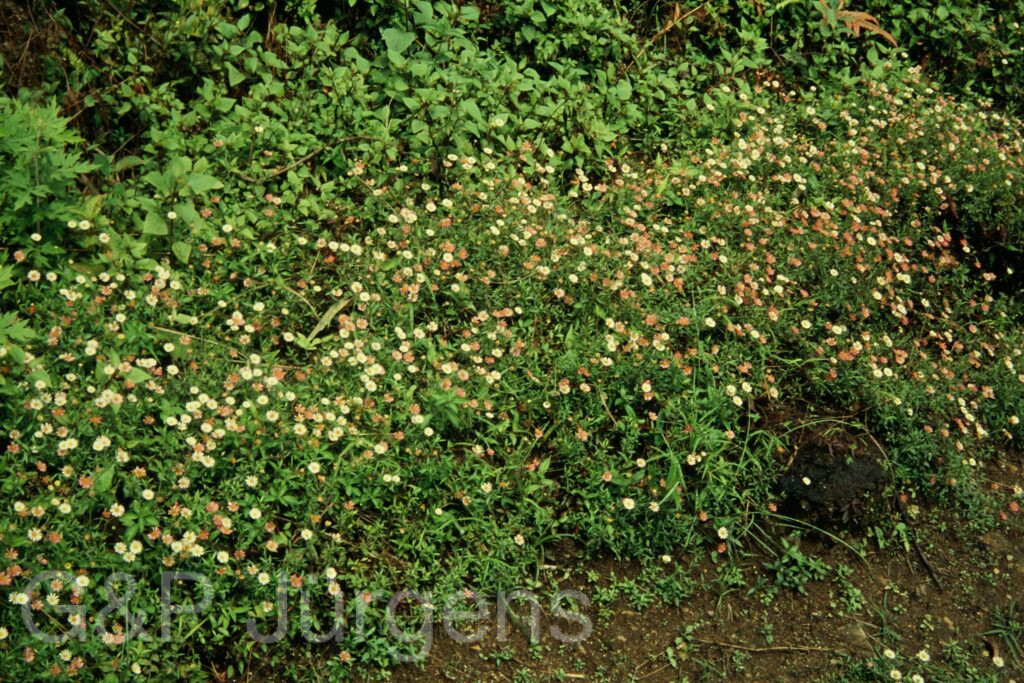
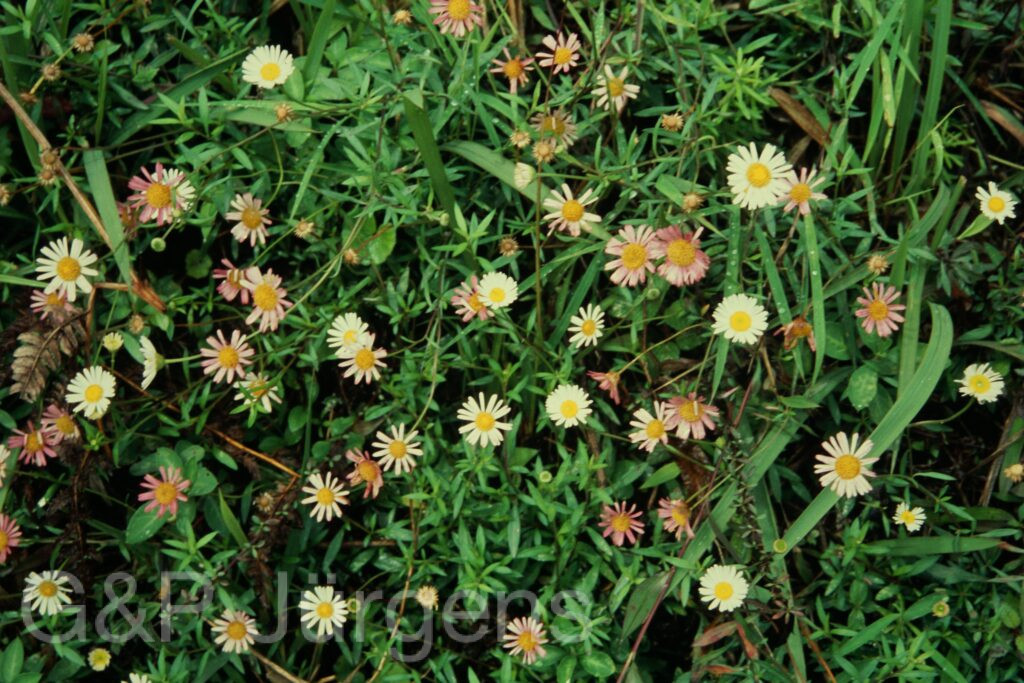
Erigeron karvinskianus, the Mexican fleabane, is a sprawling daisy native to Mexico and Central America but now naturalised across much of the temperate and subtropical world. GBIF documents it from Britain, France, the Netherlands, Spain, Italy, the United States, Mexico, New Zealand, Australia, South Africa, Japan and India, among many others, with over 67,000 occurrences reflecting its status as a cosmopolitan introduced species. It colonises walls, rocky banks, paths, terraces and disturbed slopes from sea level to about 2500 m. The plant illustrated was photographed near Sambon in the Sikkim/West Bengal hills at 1750 m in April, where it has become established as a garden escape along walls and roadsides.

It is a slender, much-branched, mat-forming perennial with wiry, decumbent to ascending stems. The lower leaves are oblanceolate and few-toothed or trilobed, the upper entire and reduced. The numerous small capitula are borne on slender peduncles; each head has a single series of narrow ray florets that open white and age through pink to purplish-red, so that a plant simultaneously bears flowers of several hues, surrounding a central disc of yellow tubular florets. The fruit is a small ribbed achene crowned by a pappus of fine bristles that facilitates wind dispersal.

A member of tribe Astereae, E. karvinskianus is valued horticulturally for its long, profuse flowering and self-seeding habit, the very trait underlying its weediness. In parts of Australia, New Zealand and South Africa it is regarded as an invasive environmental weed escaping gardens to colonise native rock and cliff habitats. In the Himalaya it is a naturalised alien rather than an indigenous element, of no conservation interest but of some invasion-ecology concern.

Author: DC. · Sources: POWO (Kew), GBIF, Flora of China, Flora of North America, Annotated Checklist of the Flowering Plants of Nepal, Erigeron (Asteraceae: Astereae) systematic monograph

Hook.f.

Bhutan2014 274
Bhutan Trithangebe 700m, May
Bhutan2014 276
Bhutan Trithangebe 700m, May

Description

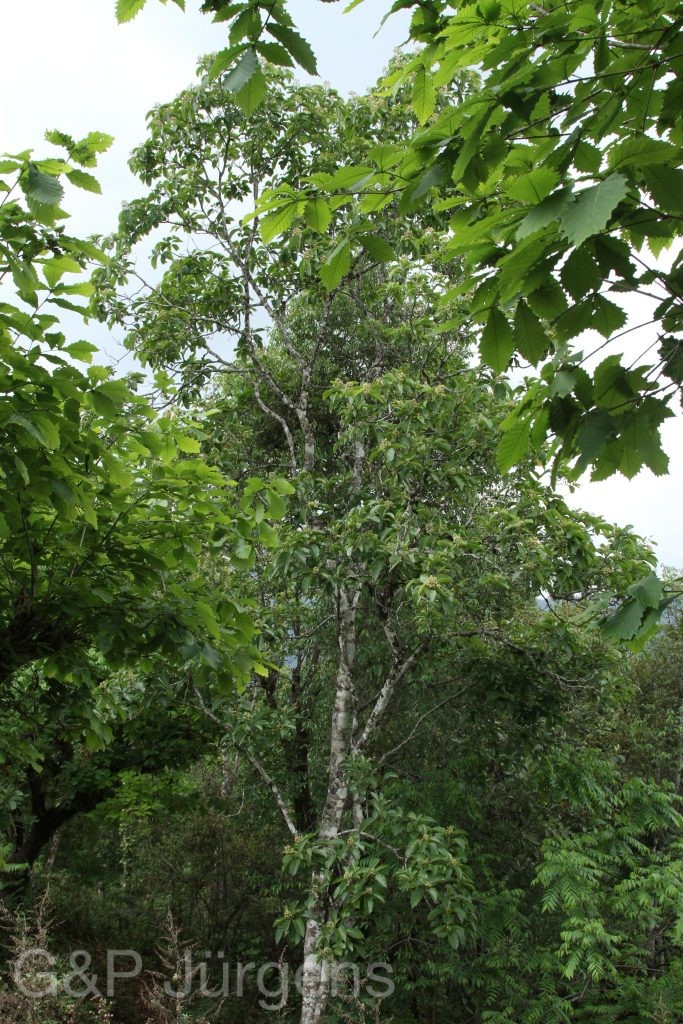
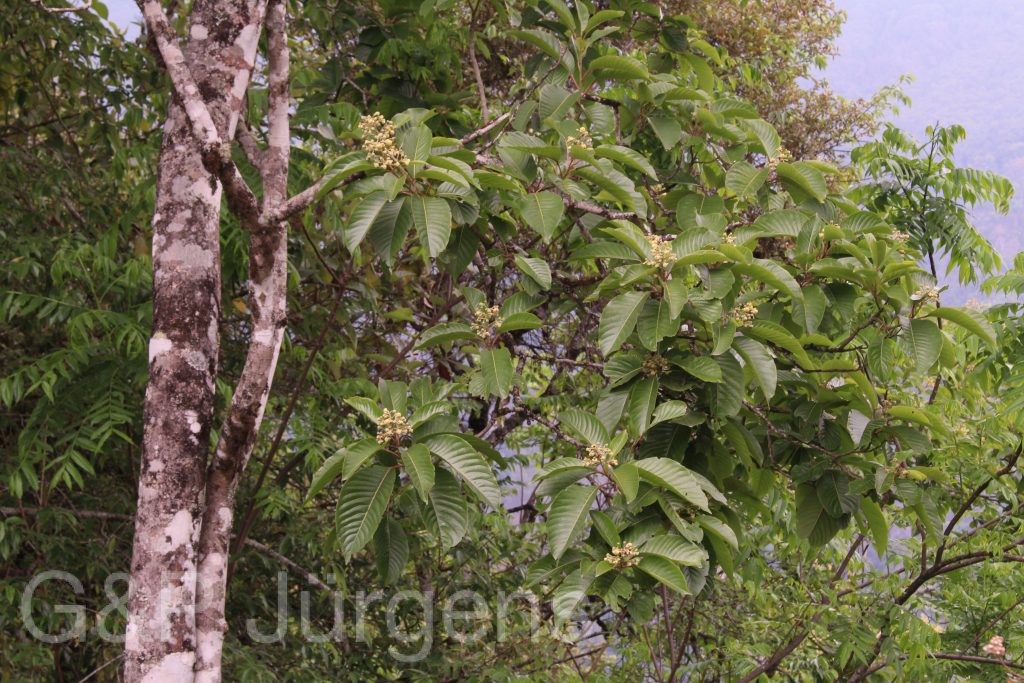
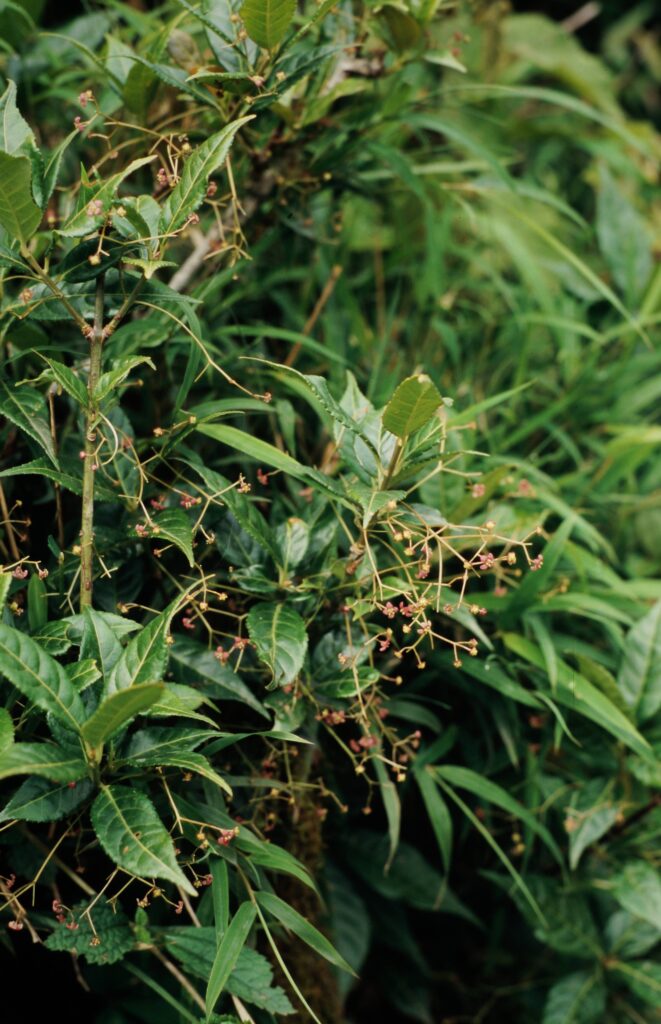
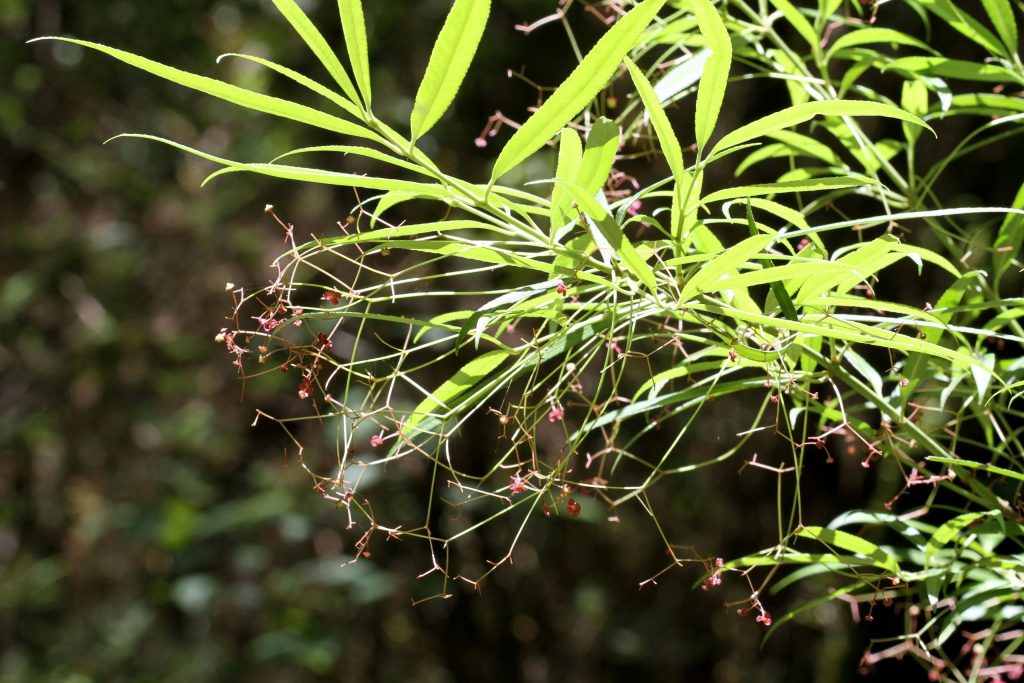
Eriobotrya petiolata is a small evergreen tree of the eastern Himalayan and Indo-Burmese subtropical forests, recorded from India, Bhutan, Myanmar, Bangladesh and China, with cultivated or vagrant records noted from Spain and the United States among the 62 GBIF occurrences. It inhabits warm broadleaved and subtropical hill forest at relatively low elevations. The photographed tree at Trithangebe in southern Bhutan at only 700 m, flowering in May, typifies its preference for humid, frost-free montane foothills well below the alpine plants that dominate the region's high passes.

The species is a tree with stout petiolate leaves, the feature underlying its epithet. The leaves are coriaceous, elliptic to oblong-lanceolate, with a prominent reticulate venation, an acuminate apex, and a margin that is entire to remotely serrate; young growth and the lower surface are typically clothed in rusty tomentum that weathers with age. The inflorescence is a terminal, much-branched, woolly panicle of small white flowers, each with five sepals, five petals, numerous stamens and an inferior ovary. The fruit is a small pome, fleshy at maturity and crowned by the persistent calyx, characteristic of the loquat genus.

GBIF treats the himalayaflora name as a synonym, with Eriobotrya petiolata (Hook.f.) the accepted entity in this dataset; the genus Eriobotrya is itself often submerged within Rhaphiolepis (and broadly within subfamily Maloideae of Rosaceae) in recent molecular treatments, so nomenclature remains in flux. Ecologically the fleshy pomes are dispersed by birds and mammals. As a forest tree of a comparatively restricted Himalayan-Burmese range, it is most threatened by lowland deforestation rather than by any intrinsic rarity.

Author: Hook.f. · Sources: POWO (Kew), GBIF, Flora of Bhutan, Flora of China (Rosaceae), Vidal Eriobotrya revision

Monnet

Nepal 2009 88 ergebnis
Nepal Helambu Bolgoau 2050, May

Description

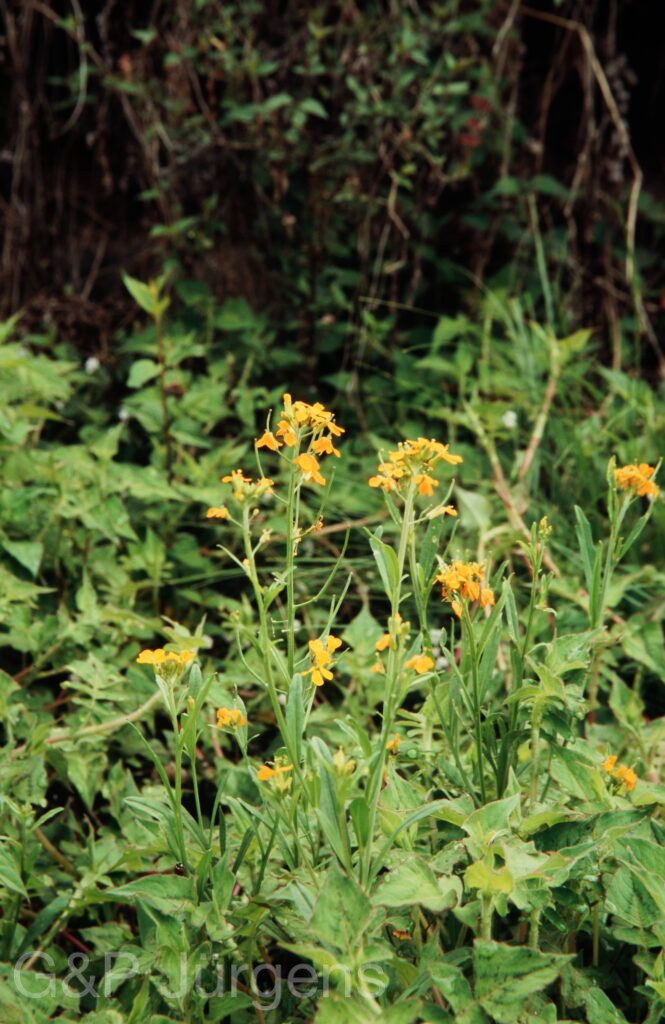
Erysimum benthamii is a Himalayan crucifer recorded from China, Nepal, Bhutan and India, with over 230 georeferenced occurrences spanning the central and eastern Himalaya. It favours open, sunny situations on dry banks, stony slopes, forest clearings and disturbed ground in the temperate and subalpine zones. The plant illustrated from Helambu at Bolgaon (about 2050 m) in Nepal in May reflects its typical mid-elevation habitat, where it flowers in spring on well-drained, often rocky or gravelly soils along trails and open hillsides.

It is an erect biennial or short-lived perennial herb covered, like most members of the genus, in appressed medifixed (malpighiaceous) two- to several-branched hairs that give the foliage a greyish cast. The stem is simple or branched above and bears narrowly lanceolate to linear, entire or remotely denticulate leaves. The flowers are arranged in elongating terminal racemes; the four sepals are erect, and the four clawed petals are bright yellow to orange-yellow in the cruciform arrangement typical of Brassicaceae. The fruit is a long, slender, four-angled silique held more or less erect on a short pedicel, splitting at maturity to release two rows of small seeds.

Erysimum is a large Holarctic genus whose Himalayan representatives are taxonomically intricate, distinguished by trichome branching, fruit shape and indumentum density; E. benthamii is set apart by these vegetative and silique characters. The presence of an indeterminate-country record (coded ZZ) reflects imprecise georeferencing rather than any disjunct range. Widespread and tolerant of disturbance, the species is of least conservation concern.

Author: Monnet · Sources: POWO (Kew), GBIF, Flora of Nepal, Flora of China, Flora of Bhutan, Polatschek's revisions of Erysimum

Hook.f. & Thomson

Nepal 2009 88 ergebnis
Nepal Samthang 2410m, May

Description

Erysimum pachycarpum is a Himalayan wallflower distributed across Nepal, Bhutan, northern India, and extending into southwestern China (Tibet, Yunnan). GBIF documents 39 occurrences from these countries. The species inhabits dry rocky slopes, open scrubland, disturbed ground along trails, and stony riverbanks in the warm to cool temperate zone, at elevations from approximately 1,800 to 3,500 m. The photograph from Samthang in Nepal at 2,410 m, taken in May, shows the species at a mid-elevation site during its spring flowering period.
The plant is a biennial or short-lived perennial herb, 20–60 cm tall, with erect, usually unbranched stems covered in appressed, medifixed (malpighian) trichomes characteristic of the genus. Basal leaves are oblanceolate, 3–8 cm long, with entire to sinuate-dentate margins, forming a rosette that may wither at flowering; cauline leaves are narrowly lanceolate, sessile, progressively smaller upward. The inflorescence is a dense, terminal raceme that elongates considerably in fruit. Flowers are tetramerous with yellow petals, 8–12 mm long, spatulate, clawed. Stamens six, tetradynamous. The silique is stout and thick-walled — hence the epithet pachycarpum (thick-fruited) — erect to slightly spreading, 3–6 cm long, quadrangular in cross-section, densely covered with appressed trichomes. Seeds are oblong, narrowly winged.
Erysimum pachycarpum is distinguished from other Himalayan Erysimum species primarily by its robust, thickened siliques and relatively large flowers. The genus Erysimum is taxonomically challenging due to frequent hybridisation and subtle morphological boundaries between species, and molecular studies are ongoing to resolve relationships within the Himalayan clade. The species is not currently assessed as threatened and appears locally common in suitable open, dry habitats across its range.

Author: Hook.f. & Thomson · Sources: POWO (Kew), GBIF, Flora of China Vol. 8, Grierson & Long: Flora of Bhutan Vol. 1

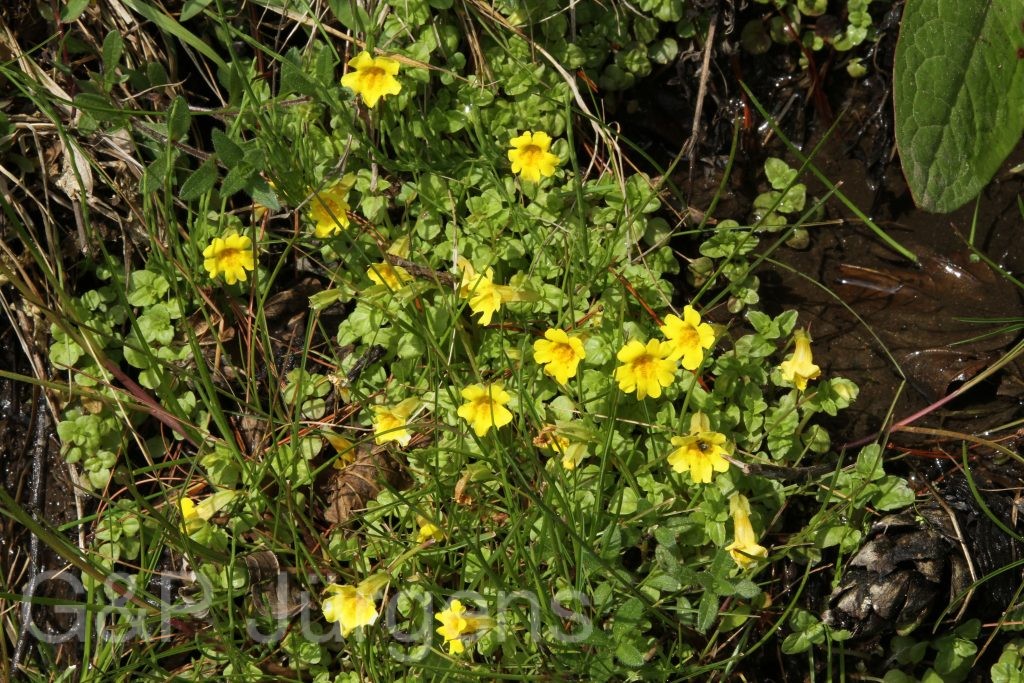
(Benth.) G.L.Nesom

Bhutan2014 855
Bhutan Thimphu 2600m, May

Description

Erythranthe nepalensis is a small wetland herb of temperate East and South Asia, recorded from Japan, China, Korea, Taiwan, Nepal, Bhutan, India, Myanmar, Pakistan and Bhutan, with around 2199 georeferenced occurrences in GBIF. It grows in damp, open ground: stream banks, ditch margins, wet meadows, seepages, rice-field bunds and moist rock crevices from the foothills into the temperate montane zone. The photographed plant from Thimphu in Bhutan at 2600 m in May is characteristic of such cool, moist Himalayan habitats, where it flowers in spring along watercourses and on dripping banks.

It is a slender annual or short-lived perennial herb with weak, decumbent to ascending, often rooting stems forming low mats. The leaves are opposite, small, ovate to broadly ovate, palmately veined, with a few shallow teeth and short petioles. The flowers are solitary in the leaf axils on slender pedicels; the calyx is tubular-campanulate and angled-ribbed, with short triangular lobes, and the corolla is bilabiate and yellow, the throat marked with reddish-brown to purplish spots and the lower lip prominent. There are four didynamous stamens, and the fruit is an oblong capsule enclosed by the persistent ribbed calyx, releasing numerous tiny seeds.

Formerly placed in Mimulus (as Mimulus tenellus var. nepalensis), the species was transferred to Erythranthe by G.L. Nesom following the molecular recircumscription that divided the old Mimulus among several genera and moved them from Scrophulariaceae to Phrymaceae. The spotted, bilabiate yellow flowers are adapted to bee pollination, and the plant's affinity for moist, disturbed ground allows ready local colonisation. Common and widespread across its range, it is of no particular conservation concern.

Author: (Benth.) G.L.Nesom · Sources: POWO (Kew), GBIF, Flora of China Vol. 18, Flora of Bhutan Vol. 2, Flora of Nepal, Taxonomy of Erythranthe (Phrymaceae) (Nesom)

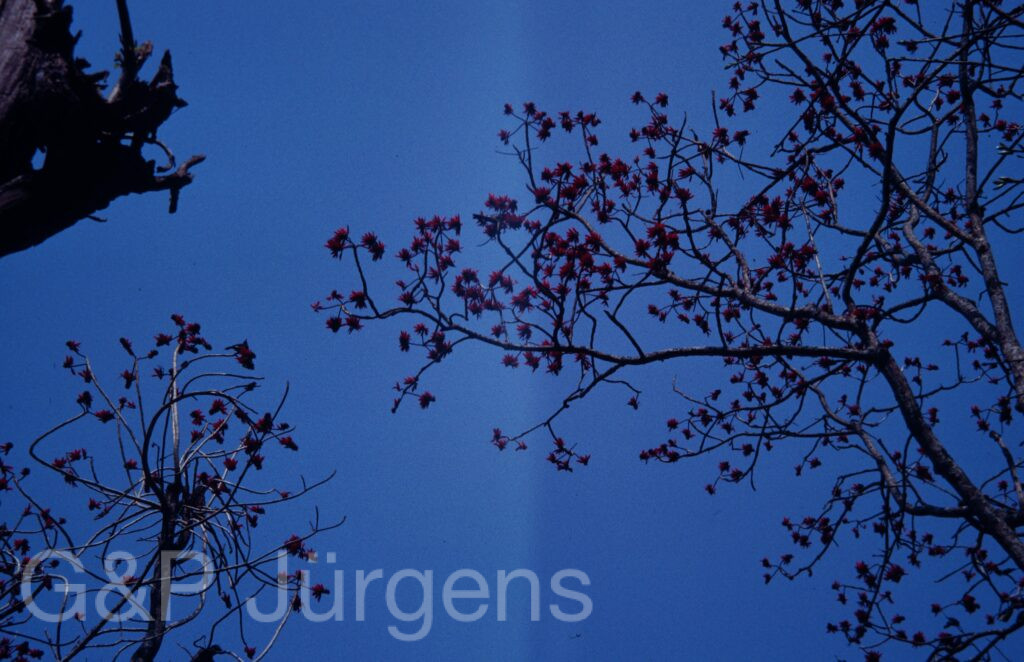
Erythrina stricta

by GP Jürgens

Roxb.

Nepal1992 23 P32 ergebnis
Nepal Kharang 1250m March 
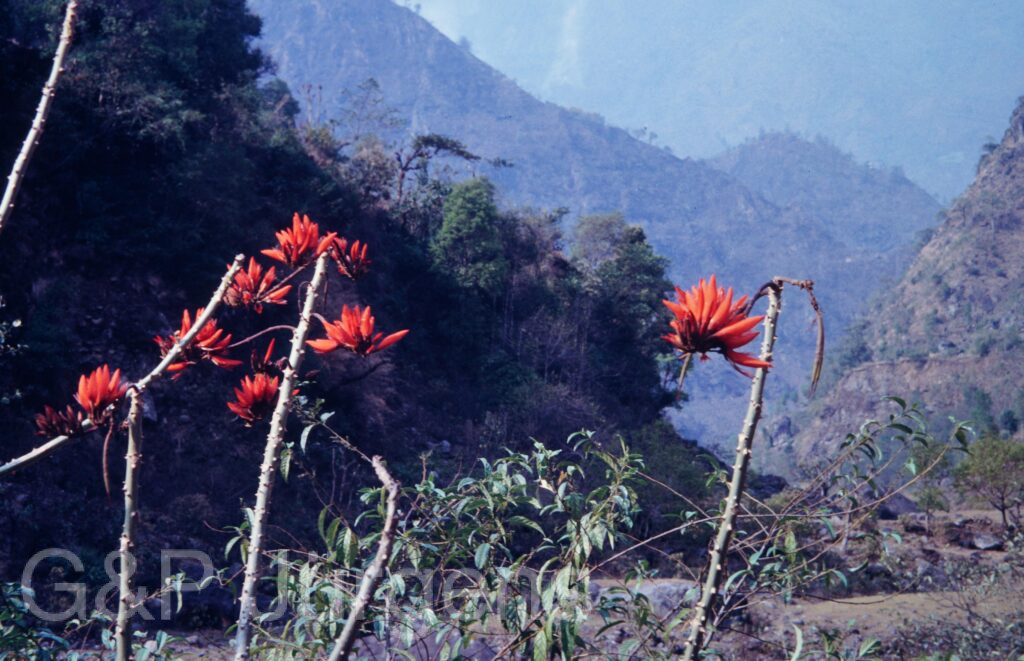
Nepal1992 84 P118 ergebnis
Nepal Kharang 1250m, March 

Description

Erythrina stricta Roxb. is a deciduous coral tree widely distributed across tropical and subtropical Asia, recorded from India, Nepal, Bhutan, China, Myanmar, Thailand, Laos, Vietnam, Sri Lanka, Malaysia, Indonesia and the Philippines; its GBIF dataset of 346 occurrences reflects both wild populations and frequent planting. It occurs in open subtropical forest, forest margins, scrub and along cultivated land in the foothills, broadly from the lowlands to about 1500 m. The photographed tree at Kharang in Nepal at about 1250 m, flowering in March, exemplifies its dry-season, leafless flowering in the warm subtropical hill zone of the outer Himalaya, conspicuous as a flush of scarlet bloom on bare branches.

The species is a small to medium-sized deciduous tree with a straight bole and armed branches bearing scattered conical prickles. The leaves are alternate and trifoliolate with broadly ovate to deltoid, entire leaflets, the terminal one rhombic-ovate and larger than the laterals; they are typically shed before flowering. The inflorescence is a dense, erect, terminal raceme of showy papilionaceous flowers; the large, bright scarlet to crimson standard is narrow and nearly straight, much exceeding the small keel and wings, and the nectar-rich flowers attract birds. The fruit is an elongate, torulose, constricted legume that splits to release several reddish, bean-like seeds.

Erythrina (Fabaceae, subfamily Faboideae, tribe Phaseoleae) is a pantropical genus of bird-pollinated coral trees; E. stricta belongs to the Asian assemblage with erect, narrow-standard flowers on leafless branches. It is widely planted as an ornamental, shade and support tree and as a living fence, and its bark and seeds contain Erythrina alkaloids of pharmacological interest. Broadly distributed, fast-growing and commonly cultivated, it is of no conservation concern and serves ecologically as an early dry-season nectar source for birds and insects.

Author: Roxb. · Sources: POWO (Kew), GBIF, Flora of China, Flora of British India, Annotated Checklist of the Flowering Plants of Nepal, Krukoff & Barneby — Conspectus of the genus Erythrina

Hochr.

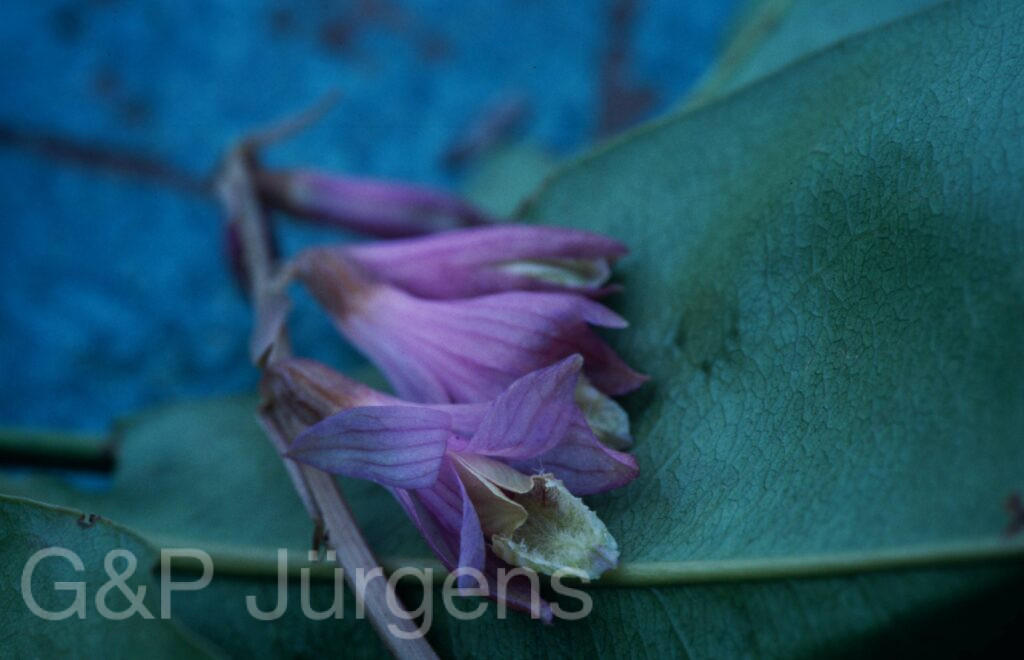
Nepal 2001 226 ergebnis ergebnis
Nepal Gorkha Tullikot 2000m, May

Description

Eulophia dabia is a terrestrial orchid distributed across the temperate and subtropical belts of Central and southern Asia, with verified records (some 166 GBIF occurrences) spanning China, India, Nepal, Bhutan, Pakistan, Afghanistan, Tajikistan, Turkmenistan and Uzbekistan, reflecting a broadly Irano-Turanian to Sino-Himalayan range. In the Himalaya it favours open grassy slopes, scrubland and disturbed pasture on well-drained soils, flowering with the onset of pre-monsoon warmth. The plant illustrated was photographed near Tullikot in the Gorkha district of central Nepal at about 2000 m in May, typical of the species' preference for sunlit, seasonally dry meadow habitats at middle elevations.

The species is a tuberous geophyte producing subterranean, somewhat cormous pseudobulbs from which arise erect, often leafless or scarcely leafy flowering scapes that emerge before or with the foliage. The leaves are linear-lanceolate, plicate and grass-like, sheathing at the base. Flowers are borne in a loose terminal raceme; the tepals are narrow and spreading, typically dull greenish to purplish-brown, while the trilobed labellum bears longitudinal lamellae or papillose crests and a short spur or saccate base. The fruit is a pendent, ellipsoid dehiscent capsule releasing dust-like seeds adapted for wind dispersal and obligate mycorrhizal germination.

Within Eulophia, a large pantropical genus, E. dabia belongs to the group of dry-ground terrestrials whose seasonal, drought-deciduous habit suits monsoonal climates. Like all orchids it is listed under CITES Appendix II, restricting international trade, though the species itself is not regarded as globally threatened owing to its wide range. Its dependence on mycorrhizal fungi and on grazed or open grassland makes it sensitive to land-use change and overgrazing at the local scale.

Author: Hochr. · Sources: POWO (Kew), GBIF, Flora of Nepal, Flora of China, The Orchids of the Himalaya (King & Pantling), CITES Appendix II

Wall.

Sikkim 2006 184 ergebnis
India West-Bengal, Samadan 2300m, May
BhutanPG2011 82 ergebnis scaled
Bhutan Menchuang 2850m, June

Description

Euonymus frigidus is a Himalayan spindle tree distributed from central Nepal through northeast India, Sikkim, Bhutan, and northern Myanmar to southwest China (Yunnan, Sichuan, Xizang). GBIF records over 1,570 occurrences, with the majority from China and the eastern Himalayas. The species inhabits cool-temperate and subalpine broadleaved and mixed forests, often growing along forest margins, stream gullies, and shaded slopes at elevations of 1,800–3,200 m. Collections from Samadan in West Bengal at 2,300 m and from Menchuang in Bhutan at 2,850 m illustrate its typical occurrence in the mid-elevation broadleaved forest zone of the eastern Himalayan slopes.
Euonymus frigidus is a large deciduous shrub or small tree, reaching 3–8 m in height, with smooth, greyish-green bark on younger branches. Leaves are opposite, elliptic to oblong-lanceolate, 6–14 cm long, acuminate at the apex, cuneate at the base, with finely crenate-serrate margins, glabrous on both surfaces, and turning reddish-purple in autumn. The inflorescence is an axillary, dichasial cyme bearing 7–15 flowers on slender peduncles. Flowers are tetramerous, small, 6–8 mm in diameter, with greenish-yellow to purplish petals and a conspicuous four-lobed disc. The fruit is a deeply four-lobed capsule, pink to crimson at maturity, splitting to reveal four seeds each enclosed in a bright orange aril — a striking ornamental feature.
The specific epithet 'frigidus' alludes to the cold-temperate habitats in which this species predominantly occurs. Euonymus frigidus is distinguished from the closely related E. hamiltonianus by its generally larger leaves, more deeply lobed capsules, and preference for higher elevations. The conspicuous arillate fruits are an important food source for frugivorous birds, including minivets and laughingthrushes, which serve as effective dispersal agents. The species is occasionally cultivated as an ornamental in European and North American gardens for its vivid autumn colour and decorative fruit.

Author: Wall. · Sources: POWO (Kew), GBIF, Flora of China Vol. 11, Flora of Bhutan Vol. 2, Grierson & Long: Flora of Bhutan (1991)

Hook.f.

Bhutan2014 976
Bhutan Chele-La 3400m, May
Bhutan2014 397
Bhutan Chele-La 3400m, May
Bh09 245 P408
Bhutan 2009

Description

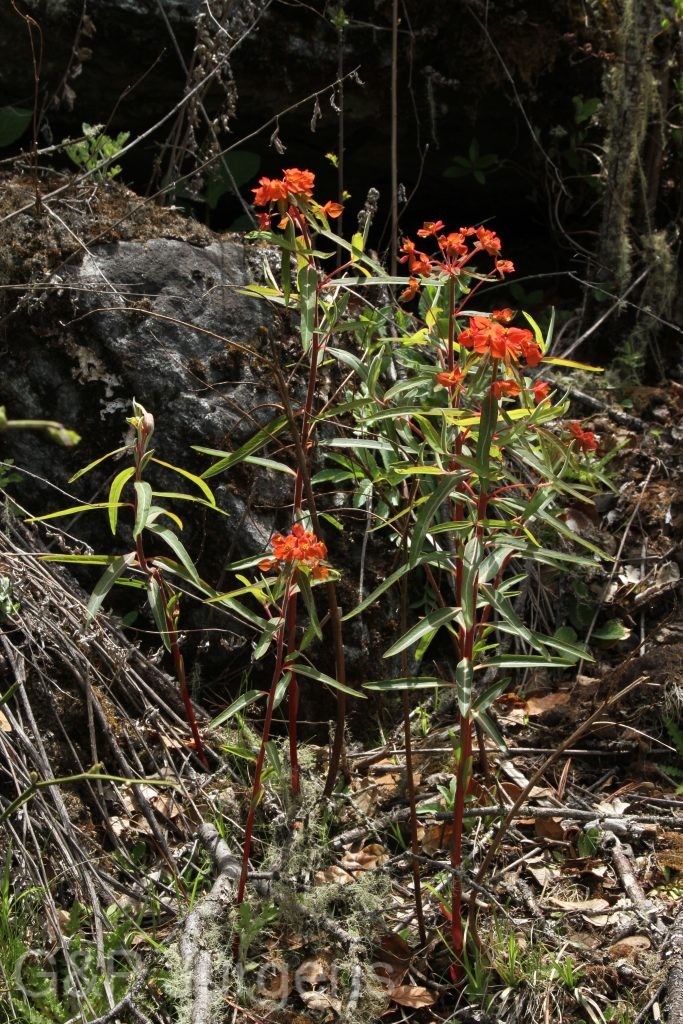
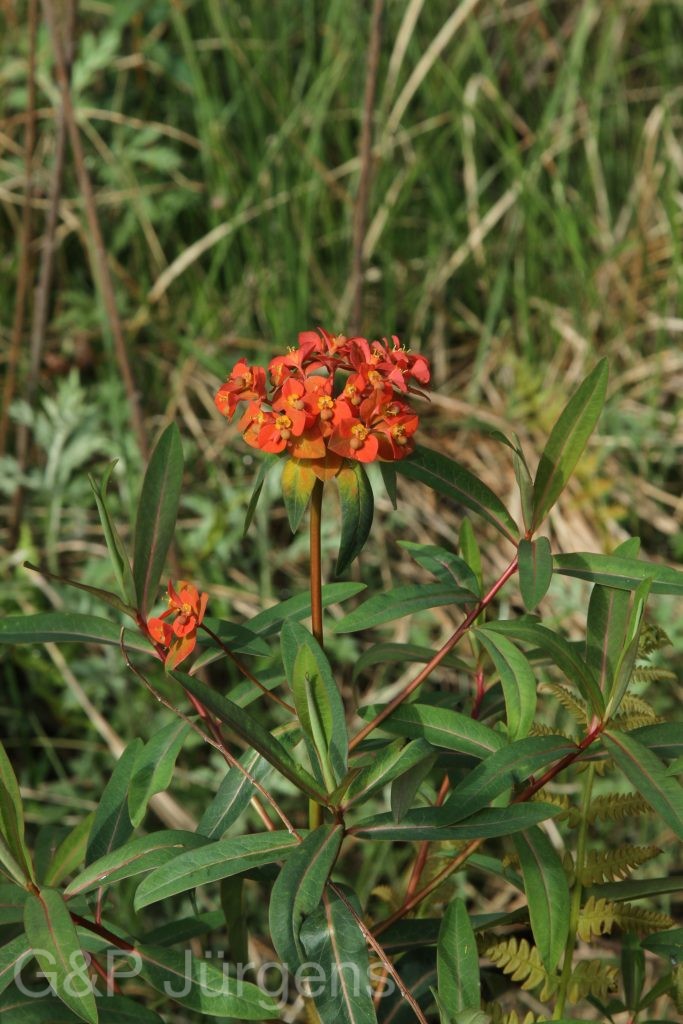
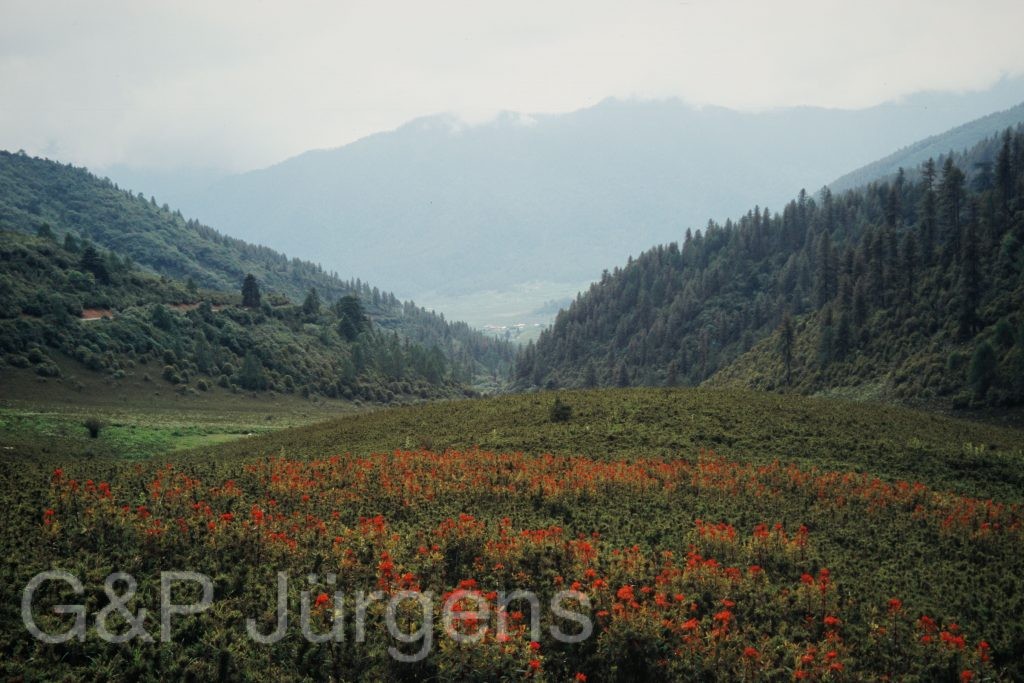
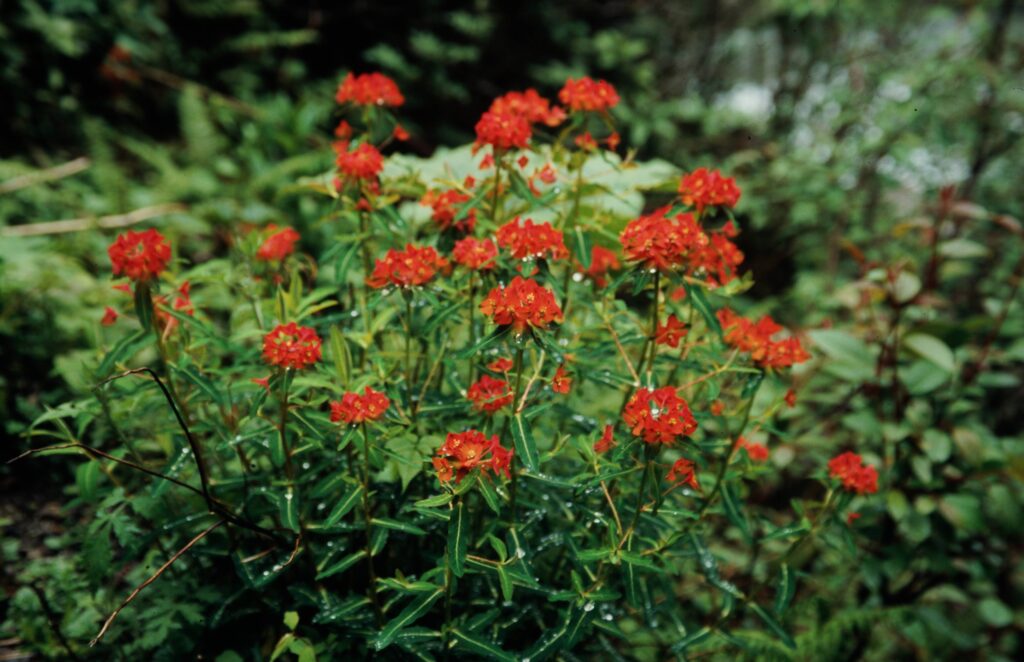
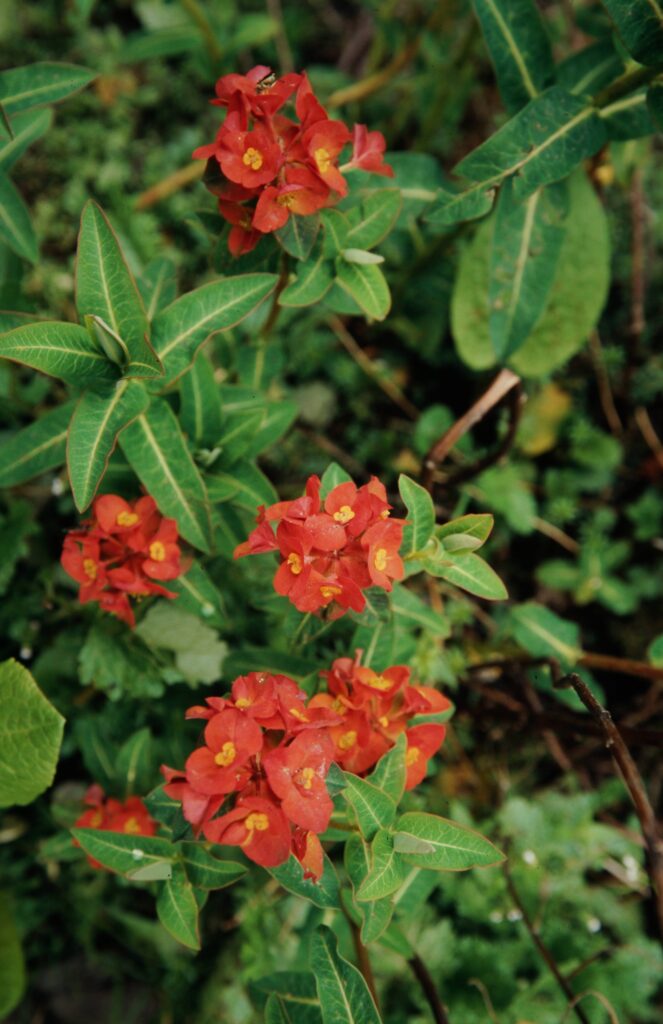
Euphorbia griffithii is a herbaceous perennial spurge of the eastern Himalayan mountains, with 538 GBIF occurrences spanning China, Bhutan, Myanmar, India and Nepal, alongside numerous cultivated records from Britain, Germany, France and North America, reflecting its popularity as a hardy garden perennial. It grows in open subalpine meadows, forest clearings, scrub and grassy slopes in the upper temperate to subalpine zone. It was recorded on the Chele-La in Bhutan at about 3400 m and at Tamrong in West Bengal, India, at about 2650 m, both in May, when the bracts colour vividly at the start of the growing season.

It is an erect, clump-forming herb arising from a creeping rhizome, the unbranched or sparingly branched stems exuding white latex when cut. The leaves are alternate, oblong to oblanceolate, entire, often flushed reddish and frequently with a pale midrib. The inflorescence is a terminal umbel-like cyme of cyathia, each cyathium a cup of fused bracts enclosing reduced flowers; the floral leaves and bracts beneath the cyathia turn fiery orange-red, providing the conspicuous display, while the involucral glands are typically yellowish. The fruit is a three-lobed capsule splitting into mericarps.

Euphorbia (Euphorbiaceae) is one of the largest plant genera, and E. griffithii belongs to its temperate, rhizomatous, herbaceous element rather than the succulent xerophytes. Long in cultivation, with selections such as the well-known coloured-bracted cultivars, it is widespread and secure across its native range. Its brilliant bract colouration and montane meadow habitat make it both a horticulturally important and biogeographically representative member of the eastern Himalayan herbaceous flora.

Author: Hook.f. · Sources: POWO (Kew), GBIF, Flora of China, Flora of Bhutan, Annotated Checklist of the Flowering Plants of Nepal, Radcliffe-Smith's treatment of Euphorbia (Euphorbiaceae)