Tag:

Spring

(D.Don) Anderb.

Nepal 2001 436 ergebnis ergebnis
Nepal (Gorkha) Gunda 1850m, May

Description

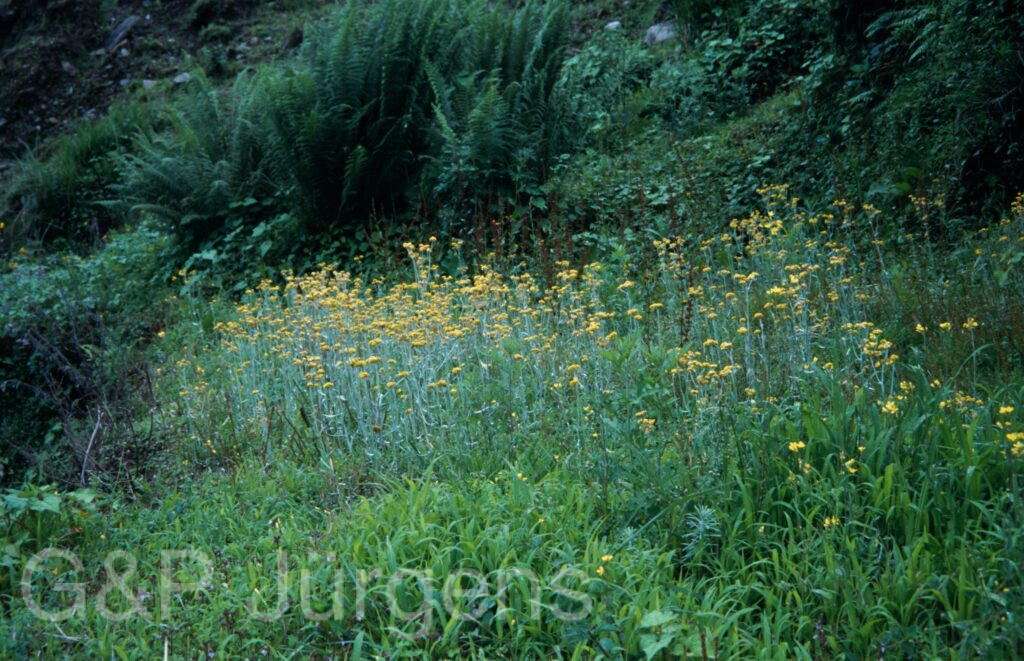
Pseudognaphalium affine is a widespread woolly cudweed of East Asia and the Indo-Himalaya, ranging across China, Japan, Korea, Taiwan, the Himalaya (Nepal, India, Bhutan, Pakistan, Afghanistan), Myanmar, Thailand, Sri Lanka and South-East Asia, and now naturalised more widely (with records as far afield as Argentina and Georgia); its very large dataset of over 7400 georeferenced occurrences confirms its abundance and weedy success. It grows on open grassy slopes, field margins, fallow ground, roadsides and other disturbed sites from the lowlands to the mid-montane belt, broadly from near sea level to about 2500 m. The plant recorded near Gunda in Gorkha, Nepal, at 1850 m in May is typical of such open, sunny, anthropogenic habitats.

It is an annual or biennial herb with erect, simple or branched stems clothed, like the foliage, in dense white-woolly (arachnoid) tomentum. The leaves are alternate, oblanceolate to spathulate, sessile and somewhat decurrent, grey-green and persistently woolly on both surfaces. The numerous small, discoid capitula are aggregated into dense terminal corymbs; each head is enclosed by several rows of pale yellow to straw-coloured, scarious involucral bracts, the florets all tubular, the outer female and filiform, the inner bisexual. The fruit is a tiny oblong cypsela bearing a pappus of slender, basally connate bristles aiding wind dispersal.

Formerly placed in Gnaphalium, this species was transferred to Pseudognaphalium on the basis of capitulum and pappus characters within tribe Gnaphalieae. It is used in East Asian cuisine and folk medicine and is a familiar ruderal weed; its broad ecological tolerance and prolific seed make it abundant and entirely unthreatened.

Author: (D.Don) Anderb. · Sources: POWO (Kew), GBIF, Flora of China, Flora of Nepal, Flora of Bhutan, Anderberg's monograph of the Gnaphalieae
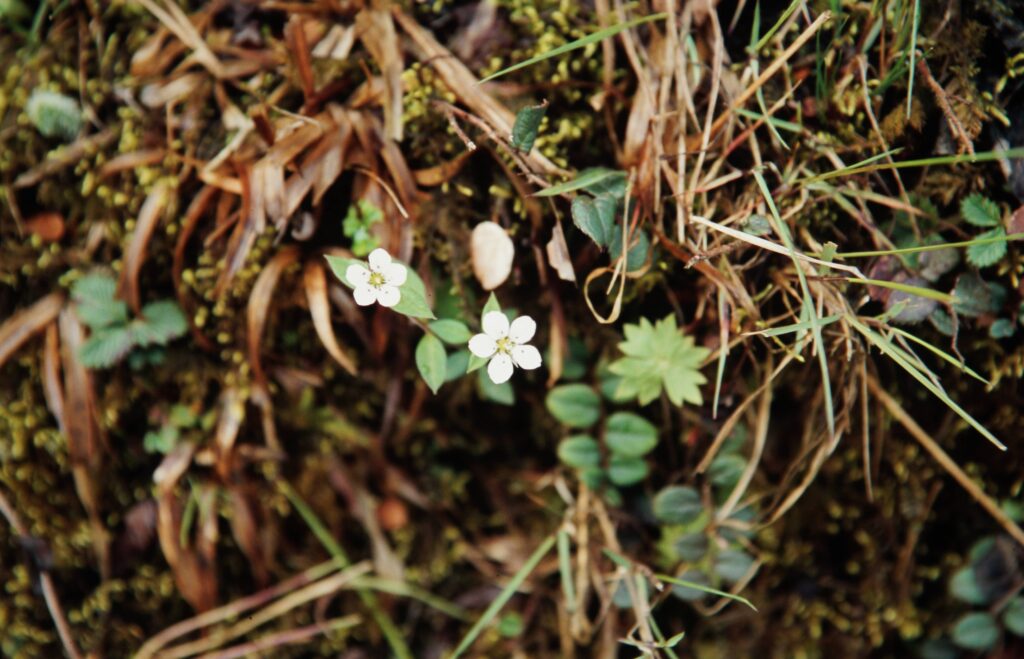
(Franch.) Pax

BhutanPG2011 117
Bhutan Chogham, 3450m June
Bh2008 38 G66
Bhutan Dochu-La, 3000m April
Sikkim 2006 79 ergebnis
India West-Bengal, Kalipokkri 3100m, May

Description

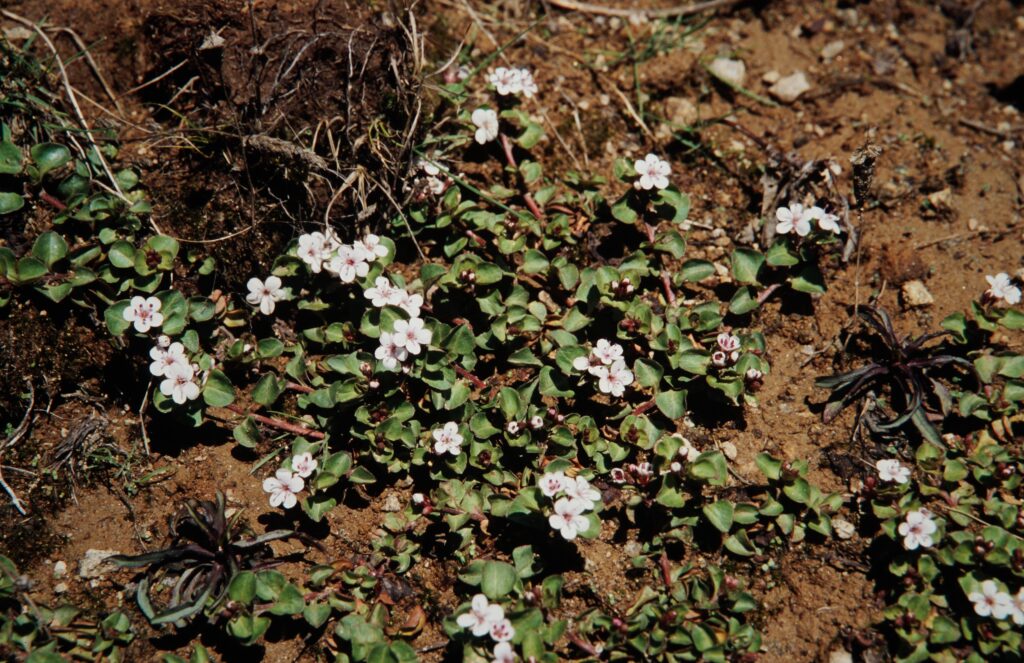
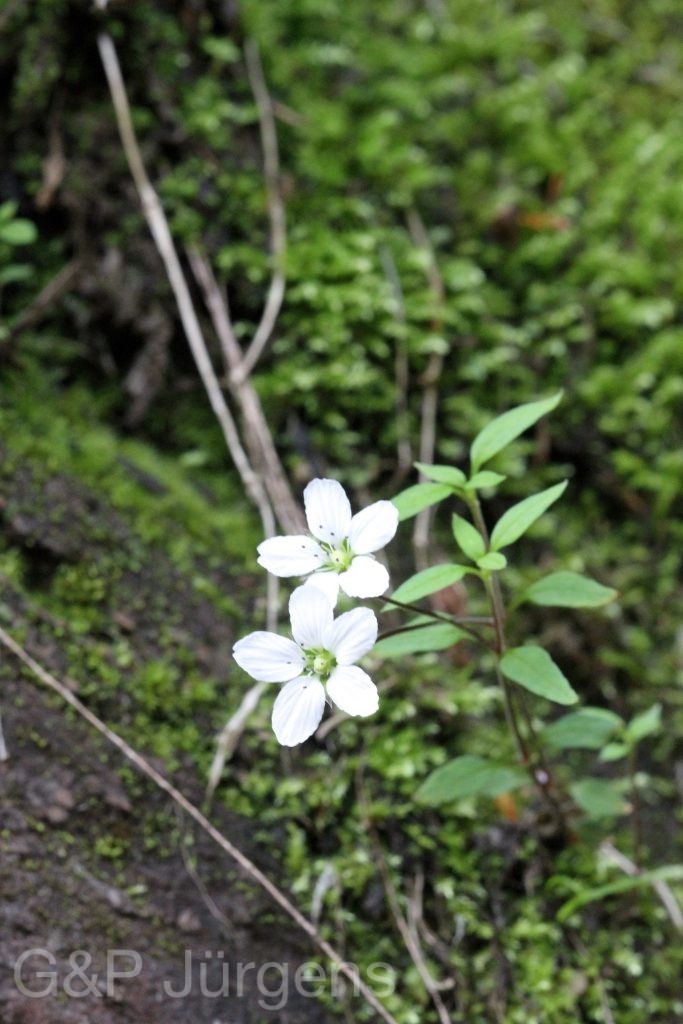
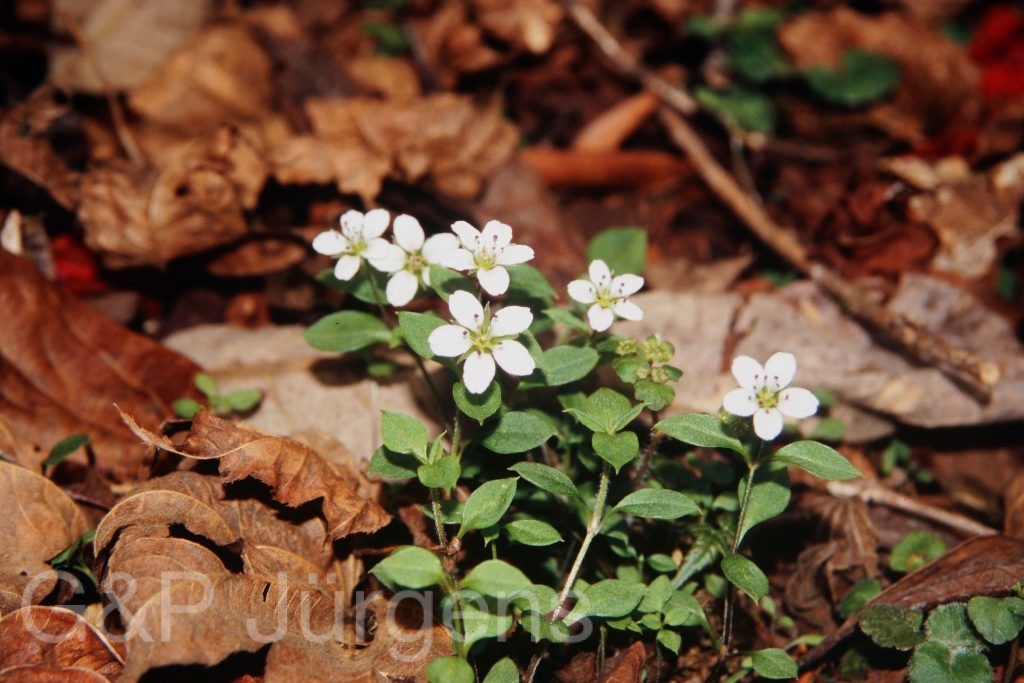
Pseudostellaria himalaica (Franch.) Pax is a small woodland perennial of the Himalaya and adjacent ranges, distributed through Bhutan, India, Nepal, Pakistan, Afghanistan and south-western China, with a comparatively modest GBIF record of about 118 occurrences reflecting its inconspicuous habit. It grows in cool, shaded, humus-rich conditions: the floor of temperate broadleaf and conifer forest, mossy banks, Rhododendron understorey and damp rocky slopes. The illustrated material spans three localities and seasons, from Chogham in Bhutan at 3450 m in June and Dochu-La at 3000 m in April to Kalipokkri in West Bengal, India, at 3100 m in May, indicating a flowering period extending through spring and early summer in the temperate to lower subalpine zone.

The plant is a delicate, glabrous to sparsely hairy perennial arising from slender, fusiform to tuberous-thickened roots. The stems are weak, slender and ascending, bearing opposite, sessile to shortly petiolate, ovate to lanceolate leaves with entire margins. The flowers are of two kinds in the manner typical of Pseudostellaria: showy, chasmogamous flowers borne in the upper axils or terminally, with five free white petals (often bifid or notched) somewhat exceeding the five lanceolate sepals, ten stamens and a three-styled ovary; and inconspicuous, often petal-less cleistogamous flowers produced lower on the plant that self-fertilise. The fruit is a small capsule dehiscing by valves to release few seeds.

This taxon has frequently been treated as Pseudostellaria heterantha var. himalaica, reflecting its close affinity with the variable P. heterantha aggregate, and authors differ on whether to recognise it at species or varietal rank, as the source page name indicates. The combination of showy outcrossing flowers with reliably self-pollinating cleistogamous ones is a reproductive strategy that buffers seed-set in the short, cool growing season of shaded montane forest. The species is widespread if seldom abundant, and no specific conservation threat is recorded, though it depends on intact forest understorey.

Author: (Franch.) Pax · Sources: POWO (Kew), GBIF, Flora of China, Flora of Bhutan, Caryophyllaceae of the Himalaya (Majumdar)

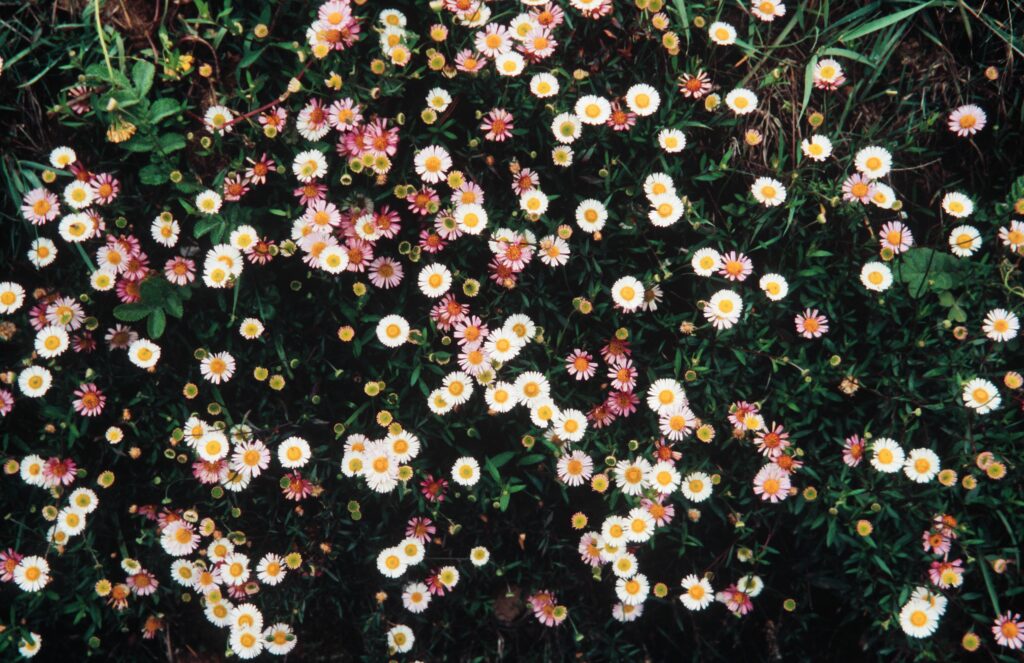
Krasch.

Sikkim 2006 178 ergebnis
India West-Bengal, Samadan 2400m, May

Description

Psychrogeton alexeenkoi is a high-mountain composite of the arid ranges of Central and South-West Asia, its georeferenced records concentrated in Afghanistan, Kazakhstan, Tajikistan, Iran, Pakistan and Turkey, GBIF accumulating some 58 occurrences that reflect a narrow, sparsely collected range. It grows on stony slopes, rock crevices, gravelly screes and dry alpine to subalpine meadows, typically on calcareous or schistose substrates. The population recorded in May at Samadan in West Bengal, India, near 2400 m marks an eastern, lower-elevation extension where it occupies open, well-drained sunny situations subject to strong diurnal temperature fluctuation.

The species is a perennial herb forming a woody caudex from which arise several ascending leafy stems clothed in spreading eglandular and gland-tipped hairs. The basal and lower cauline leaves are oblanceolate to spathulate, entire or obscurely toothed and narrowed to a winged petiole, the upper ones smaller and sessile. The solitary or few terminal capitula are radiate: numerous slender lilac to pale violet ray florets surround a disc of yellow tubular perfect florets, the involucral bracts linear-lanceolate, herbaceous and pubescent in subequal series. Achenes are flattened, oblong and pubescent, crowned by a pappus of fine barbellate bristles aiding anemochory.

Psychrogeton is a small Asiatic genus segregated from Erigeron, distinguished by habit and pappus and frequently treated as transitional to Aster within tribe Astereae. P. alexeenkoi, described by Krascheninnikov, is endemic to the mountains of Middle Asia and the Hindu Kush-Karakoram and is adapted to cold continental conditions, as its name ("cold-dweller") implies. No formal conservation assessment exists, but its restricted range and reliance on undisturbed montane habitat warrant monitoring of overgrazing and degradation.

Author: Krasch. · Sources: POWO (Kew), GBIF, Flora of Pakistan, Flora Iranica, Conspectus Florae Asiae Mediae, Nesom monograph of Astereae

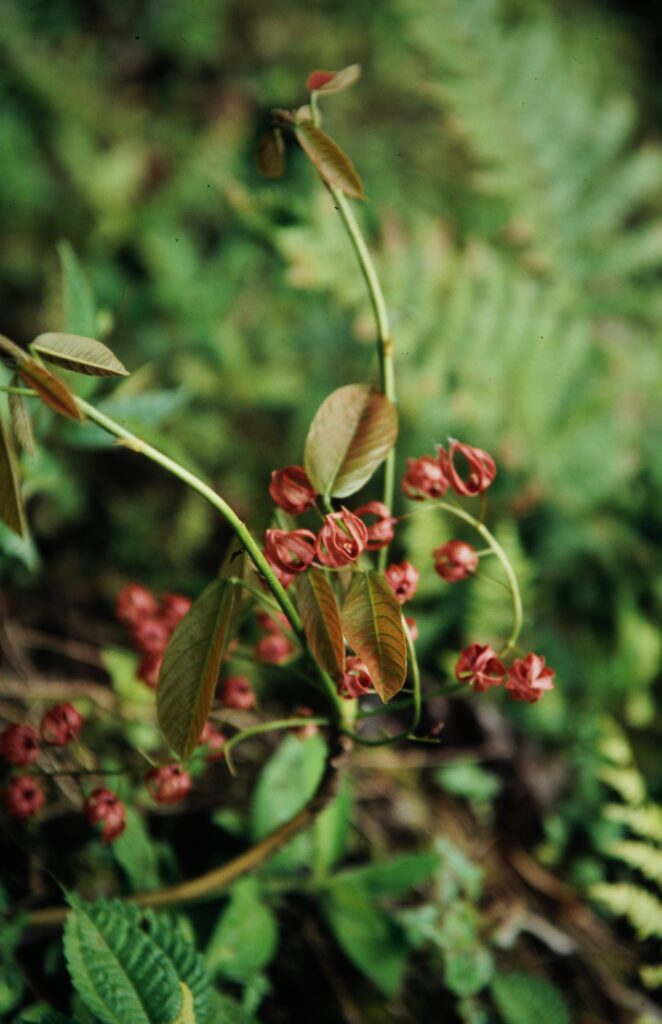
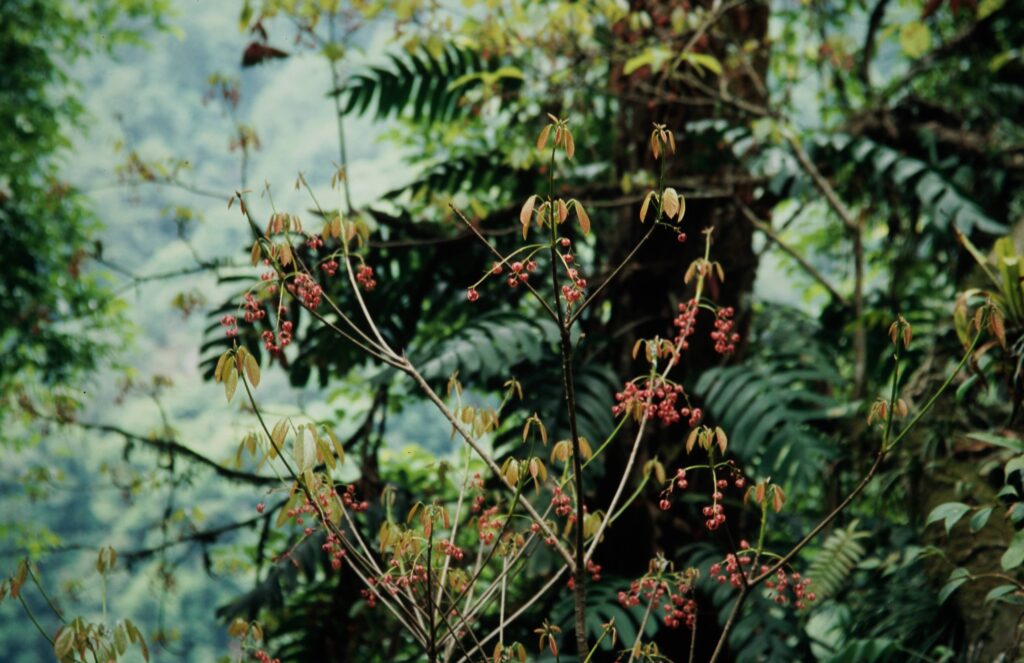
(Roxb.) R.Br.

Sikkim 2006 285 ergebnis
India West-Bengal, Chaana 1650m, May

Description

Pterygota alata is a large deciduous tree of tropical and subtropical Asia, distributed from India, Bangladesh, Sri Lanka and Nepal eastward through Myanmar, Thailand, the Malay Peninsula, Indonesia, the Philippines and southern China, with cultivated records elsewhere; GBIF lists some 350 occurrences, a number inflated by its frequent planting as an avenue and shade tree. It grows in lowland and lower-montane evergreen and semi-evergreen forest, often along valley bottoms on deep moist soils. The photographed individual was recorded in the West Bengal hills at Chaana around 1650 m in May, near the upper margin at which this tropical tree persists in the eastern Himalayan foothills.

It is a tall tree with a straight bole and spreading crown, the bark grey and rather smooth, often buttressed at the base. The leaves are alternate, large, broadly ovate to orbicular with a cordate base and abruptly acuminate apex, palmately veined and clustered toward the branch tips. The flowers are borne in axillary panicles, lacking a corolla, with a coloured, campanulate, lobed calyx. The most distinctive feature is the fruit, a cluster of large, woody, globose follicles that split to release numerous broadly winged seeds adapted for wind dispersal, the wing giving the genus its name.

Formerly placed in Sterculiaceae, Pterygota is now treated within an expanded Malvaceae (subfamily Sterculioideae), as reflected in the family given here. The winged seed and apetalous flowers ally it with Sterculia and Firmiana. Valued for its light timber and as an ornamental, P. alata is not considered globally threatened, although natural lowland-forest populations are locally reduced by logging.

Author: (Roxb.) R.Br. · Sources: POWO (Kew), GBIF, Flora of China Vol. 12, Flora of Bhutan Vol. 1, Flora of Nepal, Flora of Pakistan, Kostermans revision of Asian Sterculiaceae

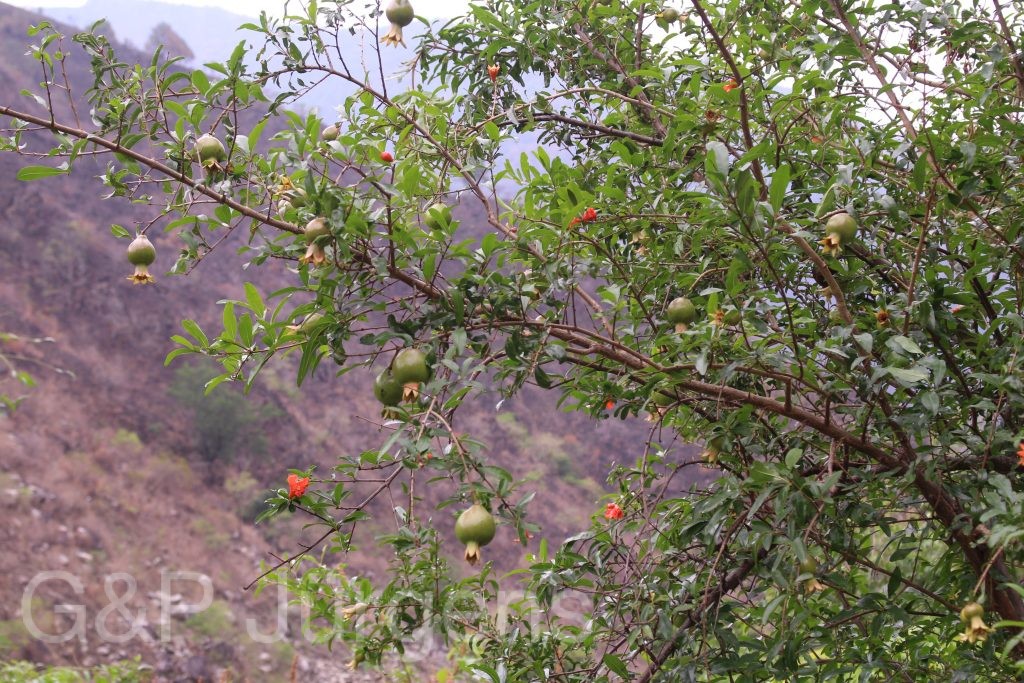
Punica granatum

by GP Jürgens

L.

Bhutan2014 69
Bhutan Kadi 1600m, May

Description

Punica granatum, the pomegranate, is a deciduous shrub or small tree native to the region from Iran and the Transcaucasus through Central Asia, now cultivated and naturalised worldwide; its 51453 GBIF occurrences span Mediterranean Europe, the Middle East, India, China, the Americas, Africa and Australia. It thrives in warm, semi-arid to subtropical climates on a wide range of soils, favouring sunny, well-drained sites, and tolerates drought and seasonal heat. The plant recorded at Kadi in Bhutan at 1600 m in May represents a cultivated or naturalised occurrence in the warm Himalayan valleys, flowering in late spring as temperatures rise.

The species is a much-branched shrub or small tree, often spinescent, with smooth grey bark and frequently angular young shoots. The leaves are opposite or subopposite, simple, entire, oblong to obovate, glossy and glabrous, often coppery when young. The showy flowers are solitary or clustered, with a thick, leathery, persistent campanulate hypanthium bearing 5-8 fleshy lobes and crumpled, bright scarlet to orange-red petals enclosing numerous stamens and an inferior ovary. The fruit is the distinctive balausta, a large, leathery-rinded berry crowned by the persistent calyx and partitioned internally into chambers packed with seeds enveloped in juicy, translucent, edible arils.

Long placed in its own family Punicaceae, Punica is now embedded within Lythraceae on molecular evidence, with the genus comprising only P. granatum and the Socotran P. protopunica. The pomegranate is among the most anciently cultivated fruit crops, valued for its edible arils, ornamental flowers and medicinal uses, and is widely grown across the warmer Himalayan foothills and adjacent plains.

Author: L. · Sources: POWO (Kew), GBIF, Flora of China Vol. 13, Flora of Bhutan Vol. 2, Flora of Nepal, Flora of Pakistan, Graham's revision of Lythraceae

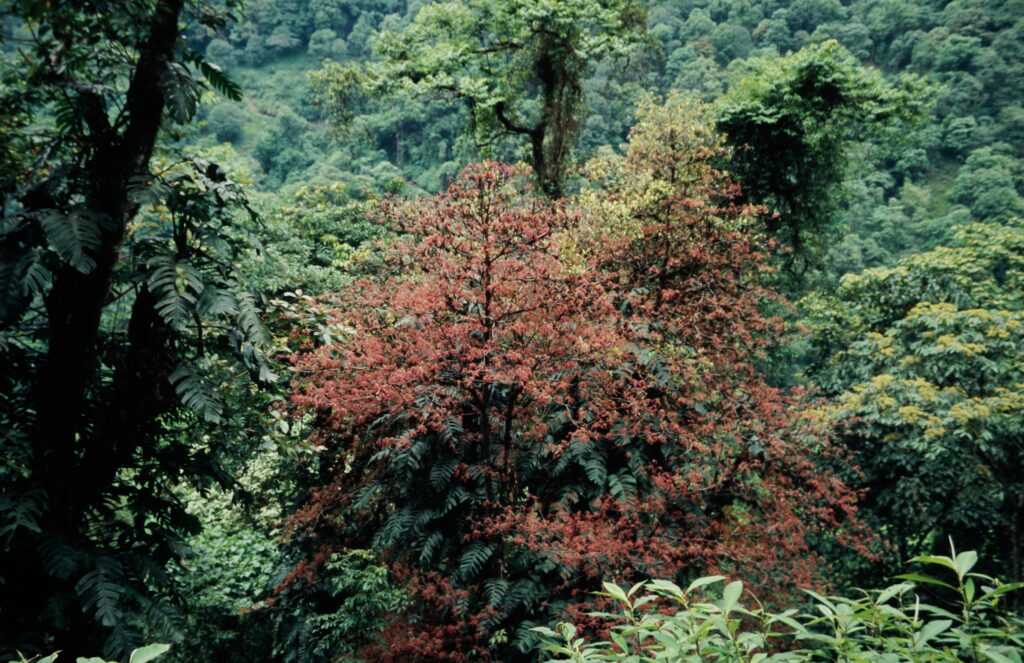
Quercus lanata

by GP Jürgens

Sm.

Nepal 97 83 P138
Nepal Tankhu 2100m April
Nepal 97 84 P141
Nepal Tankhu 2100m April

Description

Quercus lanata is an evergreen oak of the Himalaya and adjacent uplands, documented in 317 GBIF occurrences across Nepal, Bhutan, India, Pakistan, China, Myanmar, Thailand and Vietnam. It is a characteristic tree of subtropical to lower temperate broad-leaved forest, occurring on hill slopes and ridges, often in association with other evergreen oaks, rhododendrons and laurels, generally between about 1000 and 2400 m. The tree photographed at Tankhu in Nepal at 2100 m in April occupies the mid-montane oak belt, flowering in spring before or with the flush of new foliage on warm, well-drained slopes.

The species forms a small to medium-sized evergreen tree with a rounded crown and bark that is grey and fissured. The leaves are alternate, simple, coriaceous, ovate-lanceolate to elliptic, with serrate or crenate-dentate margins, the lower surface densely covered in a persistent greyish to tawny wool from which the epithet lanata derives. The flowers are unisexual and monoecious, the staminate borne in slender pendulous catkins and the pistillate few, in short spikes. The fruit is an acorn, ovoid, seated in a shallow, scaly cupule, maturing over one season.

Quercus lanata belongs to subgenus Cerris, section Cyclobalanopsis or the ring-cupped oak alliance recognised in older treatments, and has historically been confused with Q. leucotrichophora and other woolly-leaved Himalayan oaks. It is an important component of mid-elevation watershed forests, providing fuelwood, fodder and leaf litter, and is locally subject to pressure from lopping and forest clearance, though it remains widespread and not globally threatened.

Author: Sm. · Sources: POWO (Kew), GBIF, Flora of China Vol. 4, Flora of Bhutan Vol. 1, Flora of Nepal, Flora of Pakistan, Menitsky's Oaks of Asia

Sm.

Bhutan2014 857
Bhutan Chele-La 3000m, May
Bhutan2014 1039
Bhutan Chele-La 3000m, May
Nepal 99 374 ergebnis
West-Nepal Linji-Khola 3300m, June

Description

Quercus semecarpifolia, the kharsu oak, is an evergreen oak forming the highest-altitude oak forests of the Himalaya, native across China, Nepal, India, Bhutan, Pakistan and Afghanistan and extending into Myanmar and Thailand. It dominates upper montane and subalpine slopes, often at the treeline, generally between about 2400 and 3800 m, on cool, moist exposures. The trees photographed at Chele-La in Bhutan at 3000 m in May and along the Linji-Khola in West Nepal at 3300 m in June illustrate its role as the uppermost broad-leaved forest belt, frequently mixed with rhododendron, fir and birch near the limit of arborescent growth.

It is a large evergreen tree, gnarled and spreading at high elevations, with thick, fissured bark. The leaves are leathery and elliptic to oblong, dark glossy green above and golden- to rusty-tomentose beneath when young, the margin entire or with a few spiny teeth, especially on younger and coppice growth. It is monoecious, the male flowers in slender pendulous catkins and the female flowers solitary or few. The fruit is a large, hemispherical acorn seated in a shallow cup of appressed scales, maturing over a second season and providing important mast.

Quercus semecarpifolia belongs to subgenus Cerris (section Ilex, the ring-cupped oaks), the predominant oak lineage of the Sino-Himalayan mountains. As a treeline keystone it stabilises soils, supports rich epiphyte and understorey communities and yields hard timber, fuelwood and fodder, which makes it heavily exploited and in places poorly regenerating. Its acorns are dispersed by birds and rodents, and the species is regarded as ecologically critical yet locally threatened by overcutting and grazing across the Himalaya.

Author: Sm. · Sources: POWO (Kew), GBIF, Flora of China, Annotated Checklist of the Flowering Plants of Nepal, Flora of Bhutan, Menitsky's Oaks of Asia

Hand.-Mazz.

Nepal 2001 305 ergebnis ergebnis
Nepal (Gorkha) Kharka 3140m, May

Description

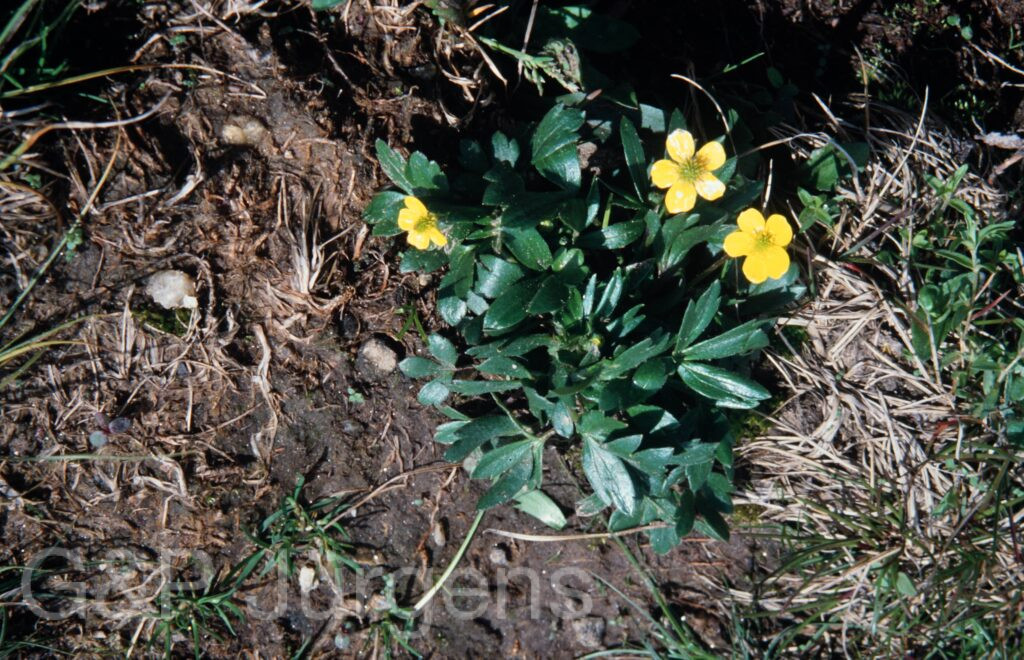
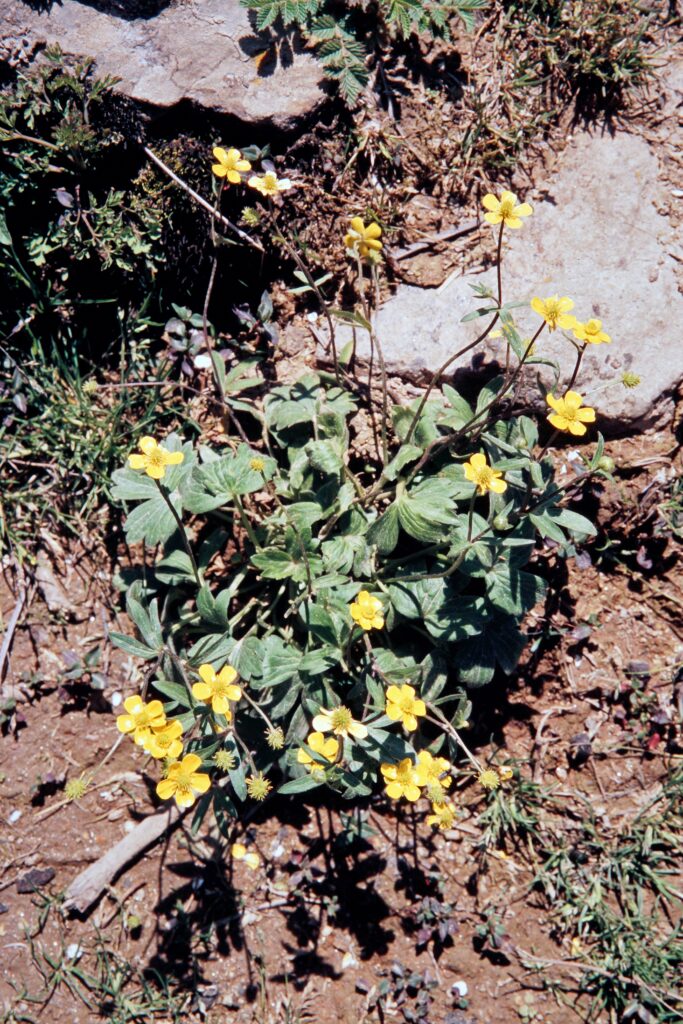
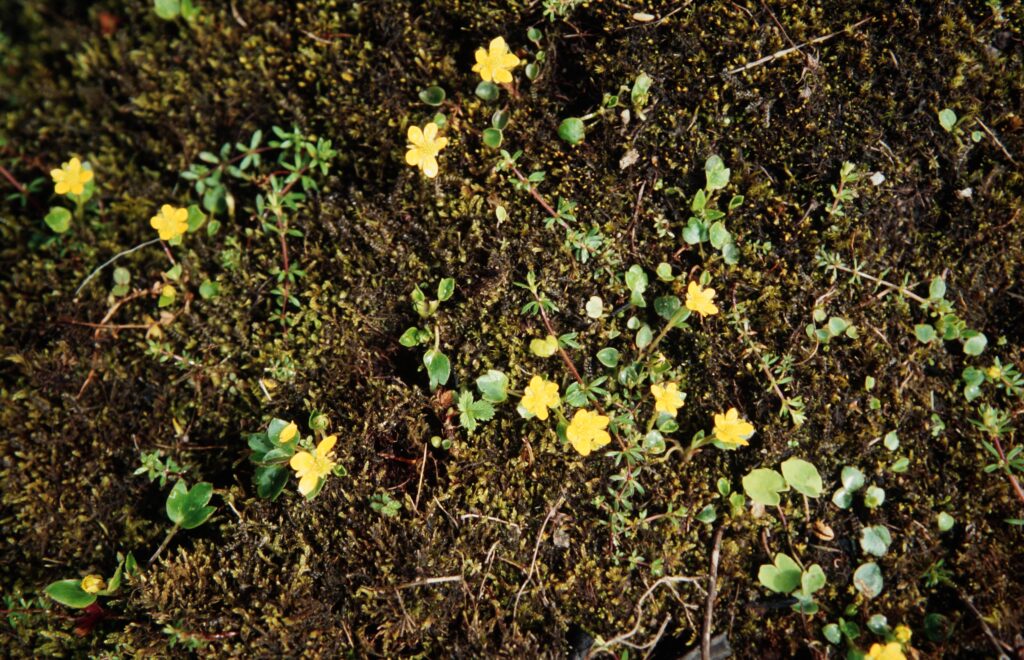
Ranunculus adoxifolius is a small buttercup of the Sino-Himalayan region, recorded from Nepal, India and Bhutan, with GBIF listing about 76 occurrences (the French record reflecting herbarium or cultivated provenance). It occupies moist subalpine to alpine habitats, including shaded forest margins, damp meadows, mossy banks and seepage slopes, generally between roughly 3000 and 4000 m. The photographed plant was found in the Gorkha district of Nepal at a kharka (high pasture) at 3140 m in May, flowering early in the season as snowmelt moistens the ground beneath open forest and on grassy slopes.

It is a delicate, low perennial herb with a short rhizome and fibrous roots. The basal leaves are long-petiolate with rounded, three-lobed to ternately divided blades whose segments are crenate-lobed, recalling the foliage of Adoxa, hence the epithet. The slender, few-leaved stems bear one to a few small flowers. Each flower has five (sometimes more) spreading, glossy yellow petals each with a basal nectary scale, numerous yellow stamens, and a domed receptacle of many free carpels. The fruiting head is a globose to ovoid cluster of small, glabrous, beaked achenes.

The species belongs to the cosmopolitan genus Ranunculus (Ranunculaceae), within the assemblage of small-flowered Asian alpine buttercups. Like its relatives it contains the acrid glycoside ranunculin, rendering the fresh plant unpalatable to grazing stock. With a restricted Himalayan range tied to undisturbed moist montane habitat, it is a useful indicator of intact subalpine vegetation; it has not been formally assessed, but its specialised habitat warrants attention where disturbance and grazing intensify.

Author: Hand.-Mazz. · Sources: POWO (Kew), GBIF, Flora of Nepal, Flora of China, Annotated Checklist of the Flowering Plants of Nepal, Ranunculus monographs (Tamura)

DC.

Nepal 97 611 P1182
Nepal Godawari 1350m May
Garh 07 47 ergebnis
India Garhwal Mandakini 2360m, June

Description

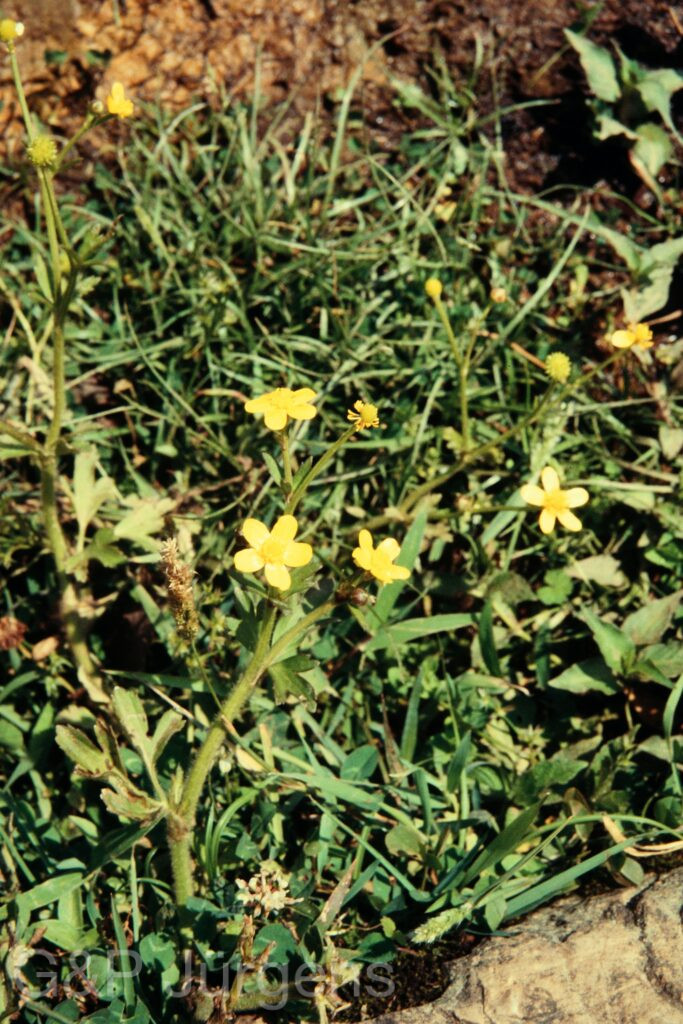
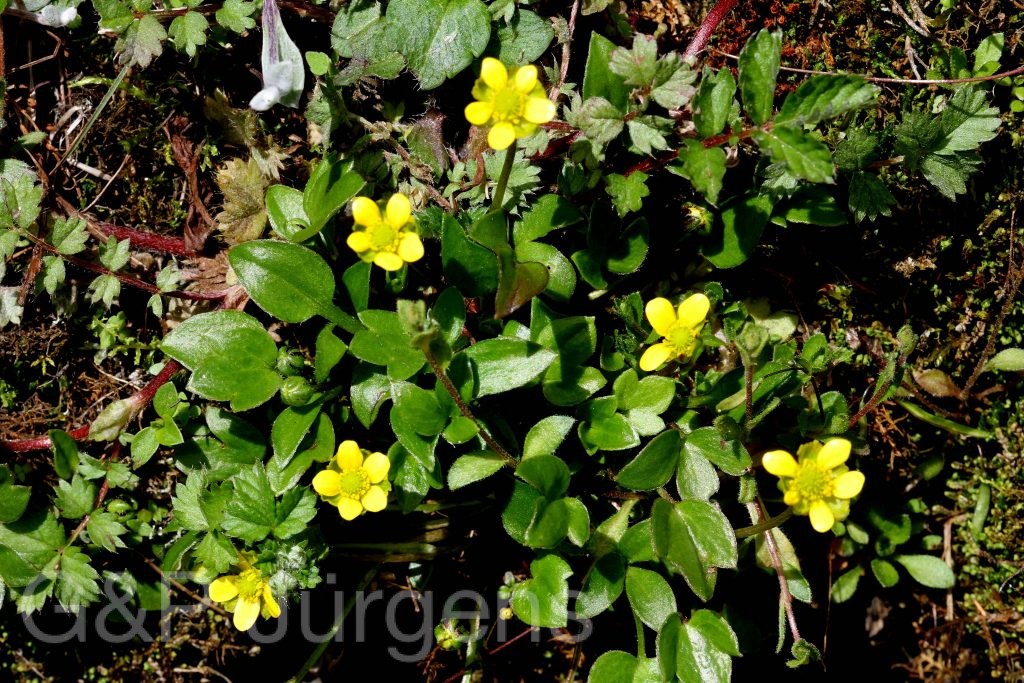
Ranunculus diffusus is a widely distributed buttercup of the Himalaya and montane Asia, recorded from India, Nepal, China, Pakistan, Bhutan, Myanmar, Vietnam, Malaysia, Indonesia, Sri Lanka and Taiwan, with some 618 occurrences in GBIF. It favours moist, shaded habitats such as forest floors, streamsides, damp banks and the margins of cultivation, ranging widely from the subtropical foothills into the temperate zone, roughly between 1000 and 3000 m. The photographs from Godawari in Nepal at about 1350 m in May and from the Mandakini valley in Garhwal at about 2360 m in June illustrate its broad ecological and altitudinal tolerance across the spring and early-monsoon flowering period.

The plant is a perennial herb with slender, diffusely spreading and often decumbent or rooting stems, the habit that gives the species its name. The basal and lower leaves are long-petioled and ternately divided into three lobed and toothed segments, more or less hairy. The flowers are small, solitary or few on slender pedicels, with usually five spreading, reflexed sepals and five glossy yellow petals each bearing a nectary scale at the base, surrounding numerous stamens and carpels. The fruiting head is a globose to ovoid cluster of small, compressed achenes tipped by a short curved or hooked beak.

Within the cosmopolitan genus Ranunculus, R. diffusus is a member of the diverse Asian assemblage of small-flowered, woodland and streamside buttercups and shows considerable variation in leaf division and pubescence across its wide range. Like most buttercups it contains the acrid glycoside ranunculin, rendering it unpalatable and somewhat toxic to livestock. Common and ecologically plastic, it is not of conservation concern and frequently behaves as a weed of moist disturbed ground.

Author: DC. · Sources: POWO (Kew), GBIF, Flora of China, Flora of Bhutan, Annotated Checklist of the Flowering Plants of Nepal, Tamura's treatment of Ranunculaceae

Hand.-Mazz.

Sikkim2011 233
Sikkim Yumthang 3700m, June
Nepal 2001 304 ergebnis ergebnis
Nepal (Gorkha) Lambra Kharka 3200m, May

Description

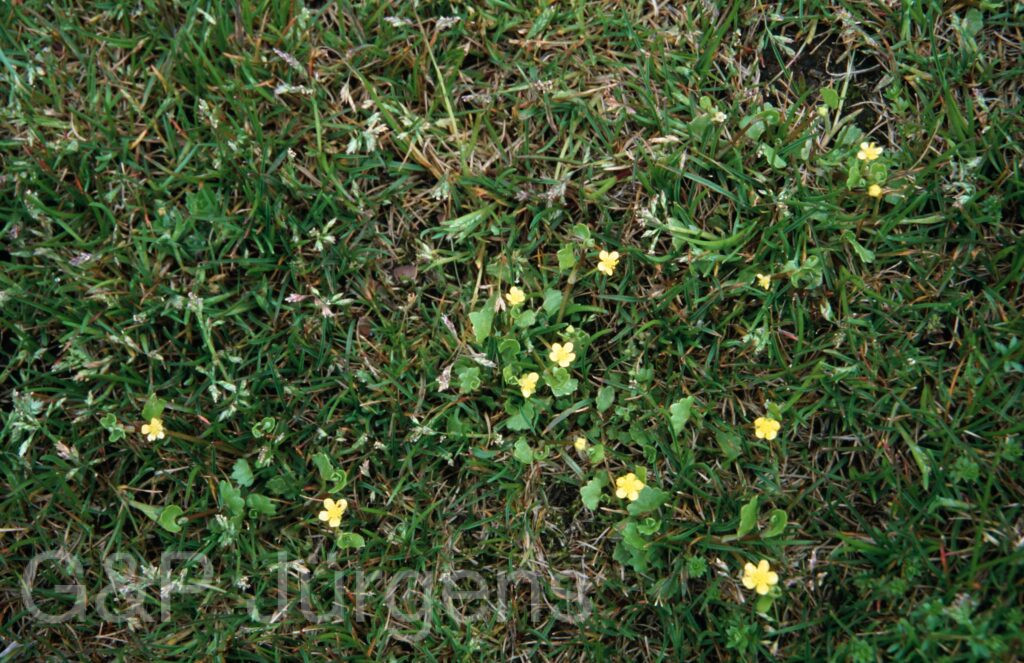
Ranunculus microphyllus is a Sino-Himalayan alpine buttercup whose core GBIF range (c. 399 occurrences) lies in China, Nepal, India and Bhutan, with scattered records elsewhere reflecting cultivated or misdetermined material. It grows in open alpine turf, moist meadows, snowmelt flushes, damp rock ledges and stream banks, typically between about 3000 and 4200 m. The cited localities—Yumthang in Sikkim at 3700 m in June, Lambra Kharka in the Nepalese Gorkha at 3200 m, and Sandakphu in West Bengal at 3200 m, both in May—illustrate its spring-to-early-summer flowering across moist, cool, high-elevation grasslands and seepage of the central and eastern Himalaya.

It is a small, tufted perennial herb, the stems low and ascending, often somewhat hairy, arising from a fibrous-rooted base. As the epithet implies the leaves are small; the basal leaves are petiolate and shallowly to deeply three-lobed or crenate, while the stem leaves are reduced and more dissected. The flowers are solitary or few, with the typical buttercup plan: five green sepals, five glossy bright-yellow petals each with a basal nectary, and numerous spirally arranged stamens and free carpels. The fruit is a globose head of small, slightly beaked achenes.

Described by Handel-Mazzetti, R. microphyllus belongs to the large, taxonomically intricate genus Ranunculus, in which the small-leaved Himalayan alpines form a closely related and often confused complex. It is locally common and not of conservation concern, though confined to moist high-altitude habitats sensitive to warming. Ecologically it is characteristic of snowmelt-fed alpine meadows, its open flowers offering accessible nectar and pollen to flies and other high-altitude insects.

Author: Hand.-Mazz. · Sources: POWO (Kew), GBIF, Flora of China, Annotated Checklist of the Flowering Plants of Nepal, Tamura monograph of Ranunculaceae