Tag:

Alpine (>3500 m)

(D. Don) Walp.

Description

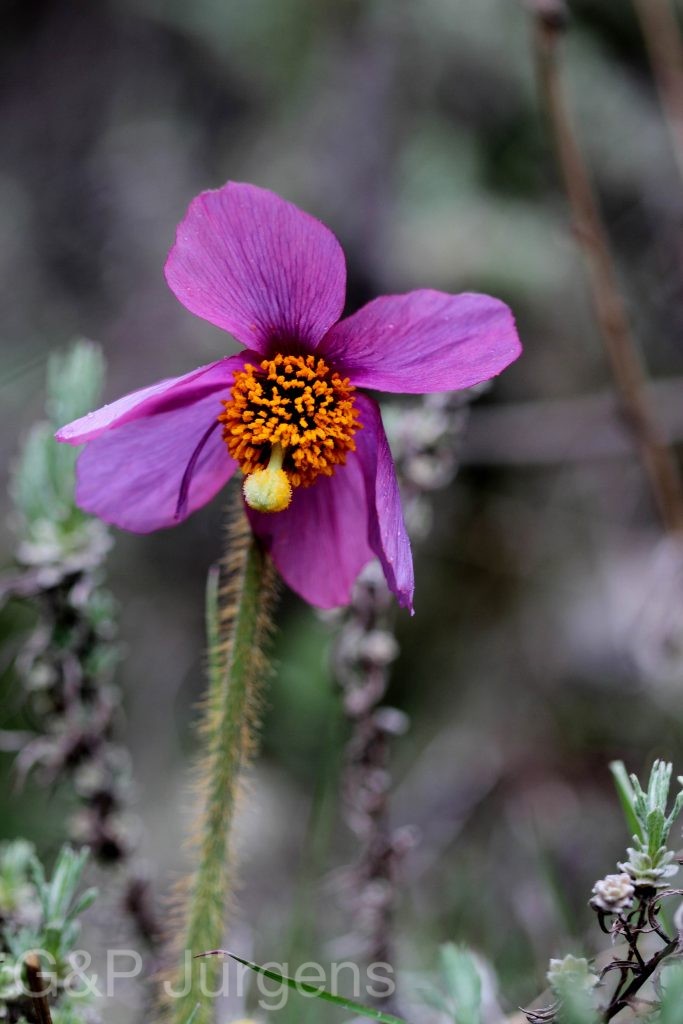
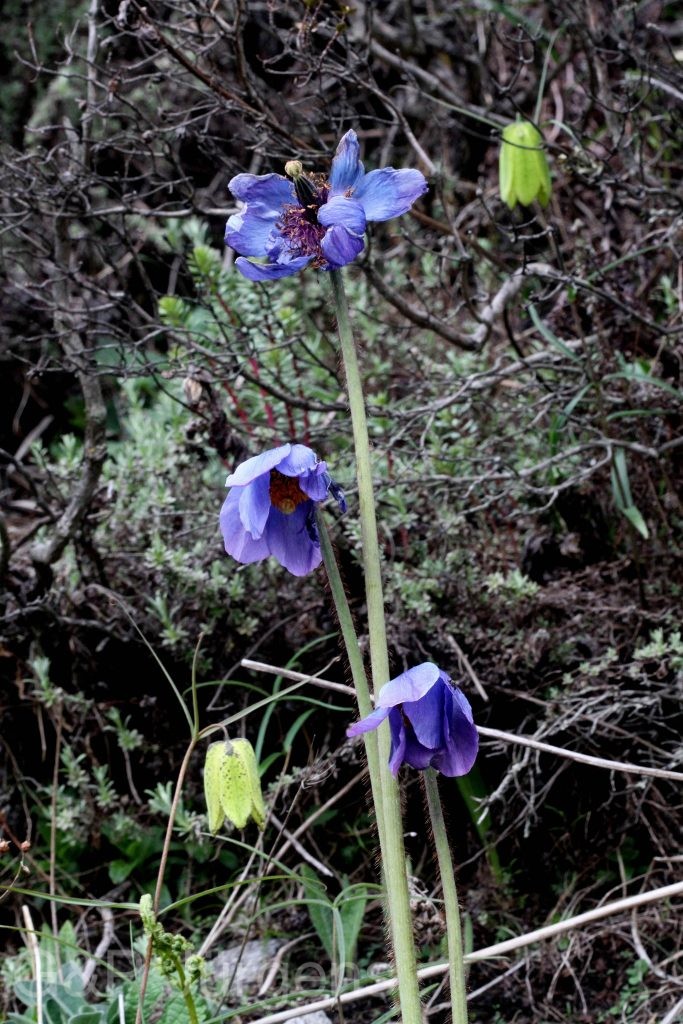
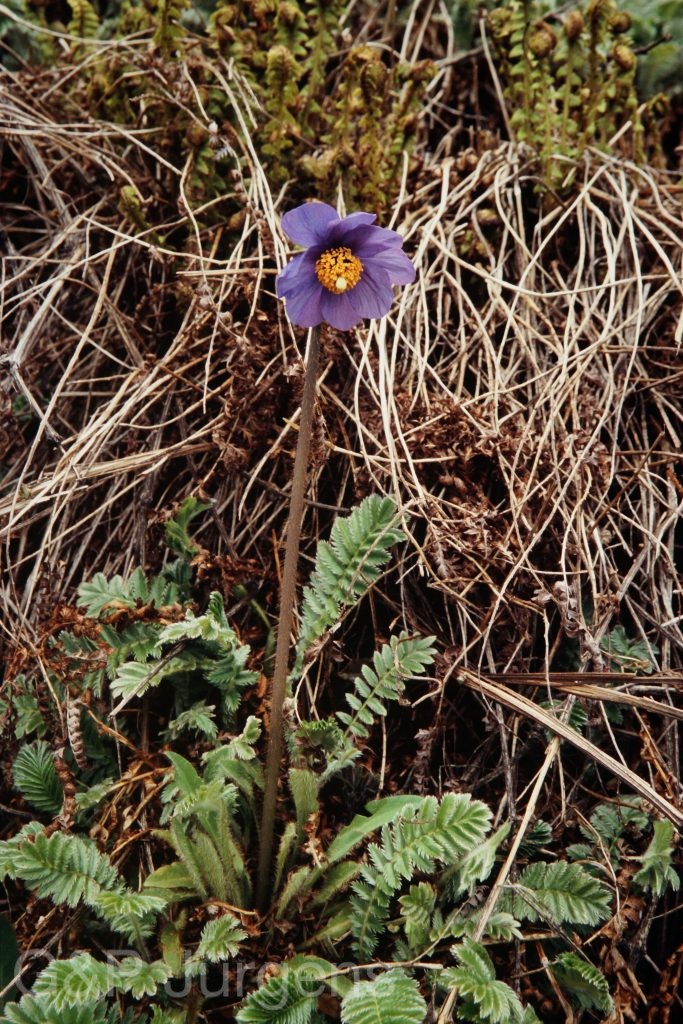
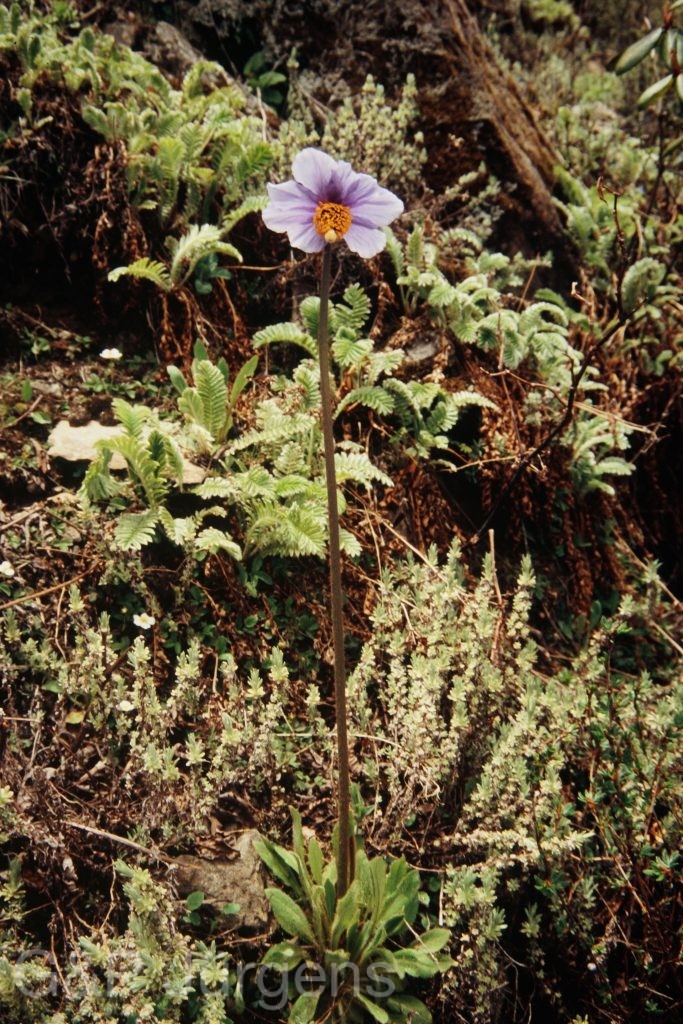
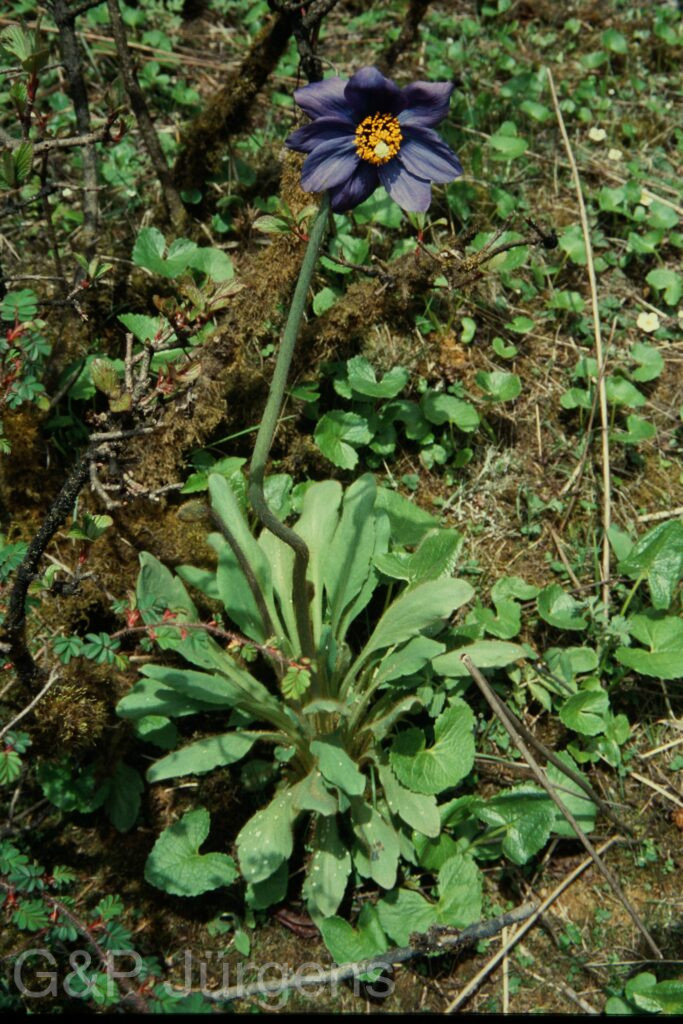
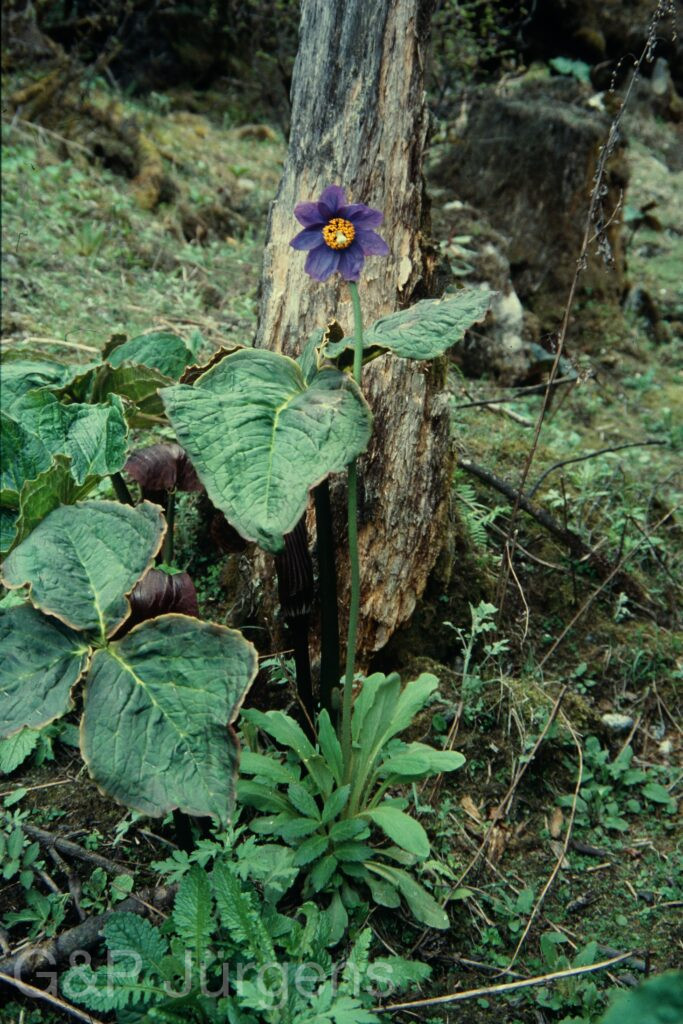
Meconopsis simplicifolia (D. Don) Walp. is a high-mountain perennial blue poppy of the central and eastern Himalaya, ranging through Nepal, Sikkim and northern India, Bhutan and southern Tibet (China), with cultivated records accounting for the United Kingdom entries in a GBIF dataset of roughly 267 occurrences. It inhabits alpine meadows, open turf, rocky slopes and the margins of Rhododendron scrub on moist, humus-rich, well-drained acidic soils, typically within the snowmelt-fed alpine zone. The illustrated collections cluster between about 3200 and 3900 m, from Tanghu in Sikkim at 3900 m and Chele-La in Bhutan at 3200 m in June to Yumthang on the Sikkim-India border at 3600 m in May, marking a late-spring to early-summer flowering as the snow retreats.

It forms a perennial herb with a basal rosette of simple, undivided leaves, oblanceolate to elliptic or narrowly lanceolate, entire to faintly toothed and clothed in soft, often fulvous to fawn-coloured bristly hairs, narrowing to a winged petiole; the simple, unlobed foliage gives the species its epithet. From the rosette arise one or several slender, bristly, leafless scapes, each bearing a solitary, nodding flower. The flowers have four (sometimes more) broad, silky, overlapping petals of clear sky-blue to violet or, in some forms, reddish-purple, surrounding a tuft of golden stamens and a stout ovary topped by a short, distinct style and capitate stigma. The fruit is an ellipsoid, bristly capsule opening by short apical valves.

Meconopsis simplicifolia is part of the perennial, scapose blue-poppy assemblage and is distinguished from allies such as M. grandis by its single-flowered scapes and entirely simple leaves; it is variable in flower colour and in whether it behaves as monocarpic or polycarpic. Pollinated chiefly by bumblebees, it is a celebrated ornamental long grown in cool temperate gardens. Across its range populations are localised and sensitive to grazing, trampling and the warming of alpine habitats, making it, like its relatives, a species of interest for Himalayan alpine conservation though not formally assessed as threatened.

Author: (D. Don) Walp. · Sources: POWO (Kew), GBIF, Flora of Bhutan, Flora of Nepal, Christopher Grey-Wilson – The Genus Meconopsis
Prain

BhutanPG2011 155
Bhutan Tsochenchen, 3500m June

Description

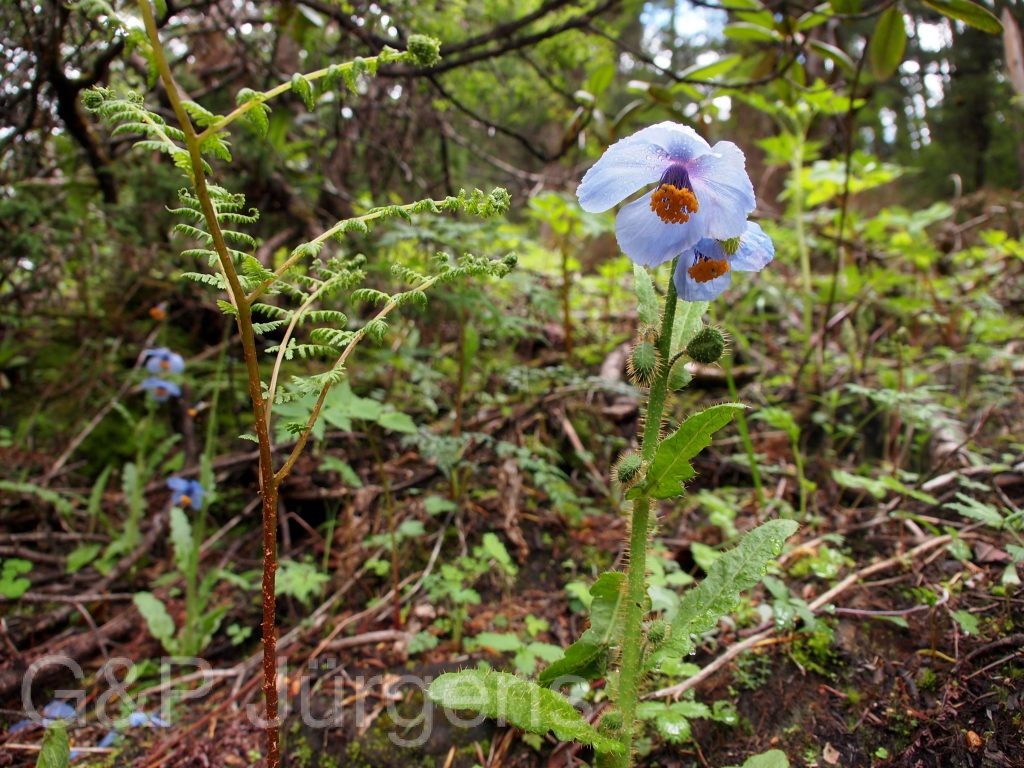
Meconopsis sinuata is a blue poppy of the eastern Himalaya. GBIF records it from India, Nepal, Bhutan and China, with around 60 occurrences distributed along the moist eastern Himalayan ranges. It grows in subalpine and alpine meadows, open shrubberies, forest clearings and rocky slopes, typically between 3000 and 4300 m, in the high-rainfall belt swept by the summer monsoon. The plant figured here was photographed at Tsochenchen in Bhutan at 3500 m in June, flowering early in the season among damp alpine herbage characteristic of this genus of cool, humid mountain habitats.

It is a slender perennial or biennial poppy bearing bristly hairs throughout. The basal leaves are oblanceolate with a distinctly sinuate to lobed margin, narrowing to a winged petiole, and the cauline leaves diminish upward. The nodding flowers are borne singly on bristly pedicels in the upper axils; the four (occasionally more) delicate, crinkled petals are sky-blue to purplish-blue, sometimes mauve, surrounding a boss of numerous yellow stamens. The superior ovary bears a short style, and the fruit is an elongate, bristly capsule dehiscing by apical valves to shed many small seeds.

Meconopsis, the celebrated Himalayan blue poppies, is a centre of endemism in the eastern Himalaya and Hengduan mountains, and the group has been extensively recircumscribed by molecular work separating Asian species from the European M. cambrica. The vivid blue pigmentation, attractive to bumblebee pollinators, has also made these poppies prized in cultivation. Restricted to specialised high-rainfall alpine habitats, M. sinuata is sensitive to grazing and habitat disturbance, and several congeners are of conservation concern.

Author: Prain · Sources: POWO (Kew), GBIF, Flora of China, Flora of Bhutan, Annotated Checklist of the Flowering Plants of Nepal, The Genus Meconopsis: Blue Poppies and their Relatives

Sikkim2003 156 G209
Sikkim Dzongri 3900m 08.2003
Sikkim2003 158 P211
Sikkim Dzongri 3900m, August

Description

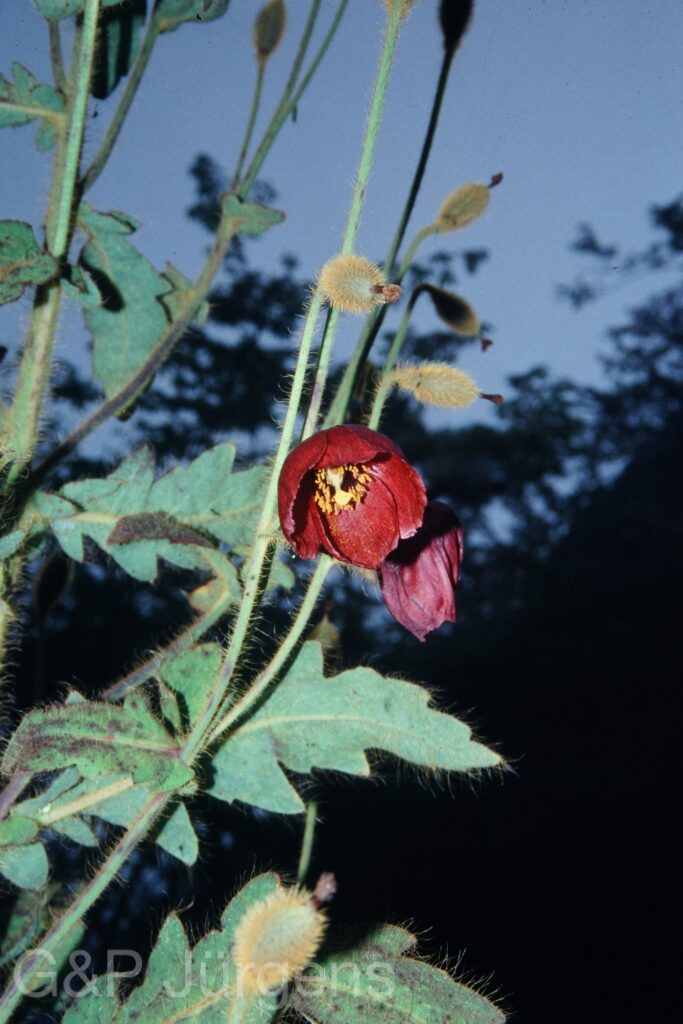
Meconopsis wallichii var. fusco-purpurea is a dark-flowered variant of the tall Himalayan blue poppy complex of the eastern Himalaya, ranging through Nepal, Sikkim and Bhutan. Although GBIF holds no occurrence records under this infraspecific name (the taxon being treated under the broader M. wallichii and the genus Meconopsis sensu lato), the species occupies open subalpine and lower alpine slopes, forest clearings and shrubberies, typically between 3000 and 4000 m. The photographs from Dzongri in Sikkim at about 3900 m in August document this purple-flowered form in its characteristic high-montane meadow habitat during the monsoon flowering season.

The plant is a tall, monocarpic herb that forms a basal rosette of deeply pinnatifid, bristly-hairy leaves over several years before producing a single robust, branched flowering stem up to a metre or more in height. The stems and foliage bear rusty to golden setose hairs. The large, nodding, saucer-shaped flowers are arranged in a leafy panicle; in this variety the petals are a deep dusky purple to wine-red rather than the sky-blue typical of the species, surrounding a boss of golden stamens. The ovary is bristly and develops into an elongate, several-valved capsule dehiscing at the apex to release numerous small seeds.

Taxonomically this purple form has been recognised at varietal rank within the variable M. wallichii, itself part of the difficult Sino-Himalayan genus Meconopsis where flower colour and indumentum vary clinally; many such names are now subsumed or transferred following modern revisions. The monocarpic life history, with a long vegetative phase and a single mass-flowering event, is characteristic of the group. As a striking ornamental, it is of horticultural interest, while wild populations depend on undisturbed subalpine slopes.

Sources: POWO (Kew), GBIF, Flora of Bhutan, Annotated Checklist of the Flowering Plants of Nepal, Grey-Wilson's monograph The Genus Meconopsis

Benth.

Nepal 99 293 ergebnis
West-Nepal Kalmura 4100m, June
Nepal 99 294 ergebnis
West-Nepal Kalmura 4100m, June

Description

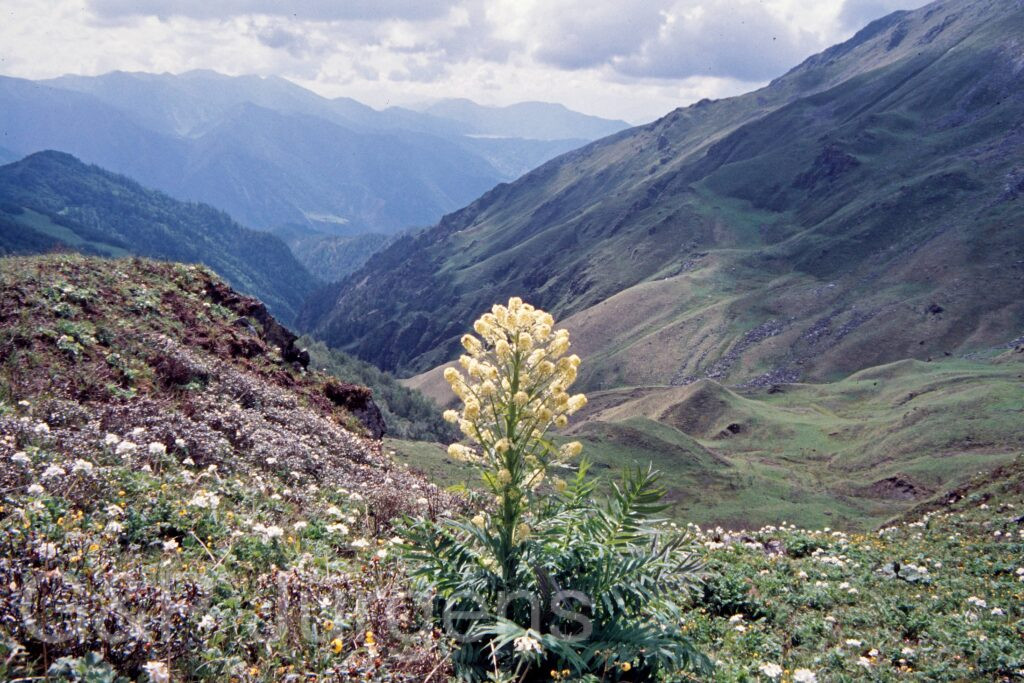
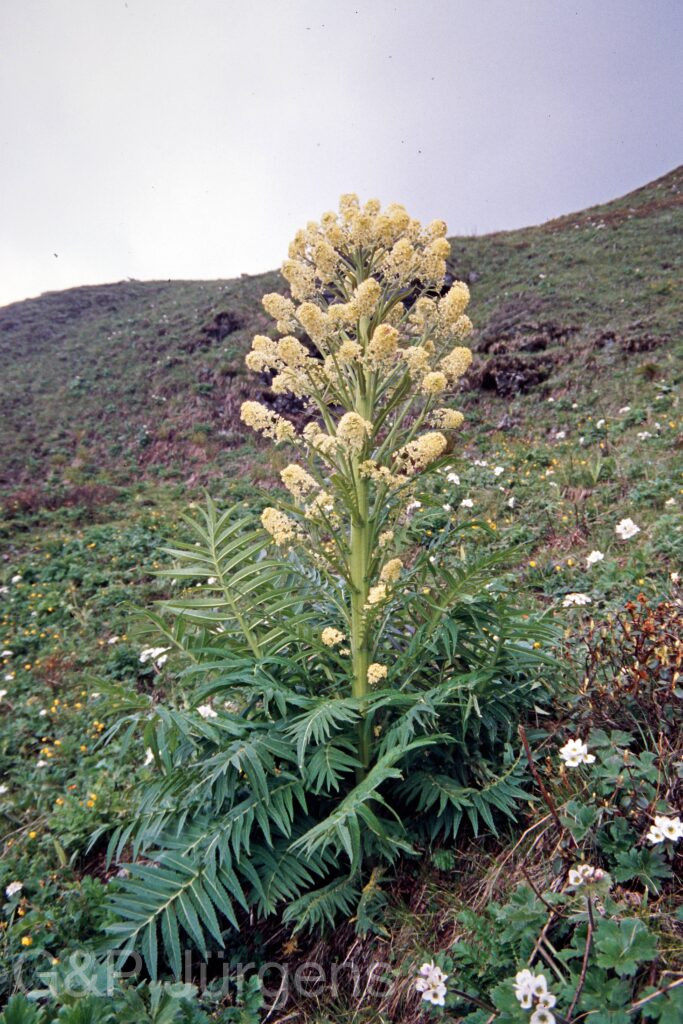
Megacarpaea polyandra Benth. is a robust alpine crucifer of the western and central Himalaya, known from about 99 records in India, Nepal and Pakistan, with scattered extralimital reports. It grows on open grassy and rocky alpine slopes, in subalpine scrub, forest clearings and along the margins of high pastures, generally between about 3000 and 4300 m. The plant photographed at Kalmura in West Nepal at 4100 m in June is typical of its preference for deep, moist, fertile soils on sunny slopes where it can attain a conspicuously large stature for an alpine herb.

The species is a stout perennial herb arising from a thick rootstock, with an erect, branching stem and large, deeply pinnatisect to lyrate leaves with several pairs of toothed lobes. The inflorescence is a broad panicle of many flowers; uniquely among most Brassicaceae the flowers bear numerous stamens (well in excess of the usual six), giving rise to the epithet "polyandra," and the petals are pale yellow to whitish. The fruit is the diagnostic feature: a large, flattened, didymous (two-lobed) silicle with broadly winged, papery valves, each loculus one-seeded, the whole readily wind-dispersed.

Megacarpaea is a small genus of central and high Asia notable for its polyandrous flowers and large winged fruits, features that set it apart within the mustard family and have made it of interest in studies of floral evolution in Brassicaceae. The young shoots and leaves are gathered locally as a potherb in parts of the Himalaya. Although widespread, its showy habit and use as a wild vegetable expose it to collection pressure, and as a narrow-belt alpine endemic it merits monitoring.

Author: Benth. · Sources: POWO (Kew), GBIF, Flora of Pakistan, Flora of Nepal, Hooker's Flora of British India, revision of Megacarpaea and tribe Megacarpaeeae

(C.B.Clarke) Harry Sm.

BhutanPG2011 807 01 01
Bhutan Chele-La, 3900m July

Description

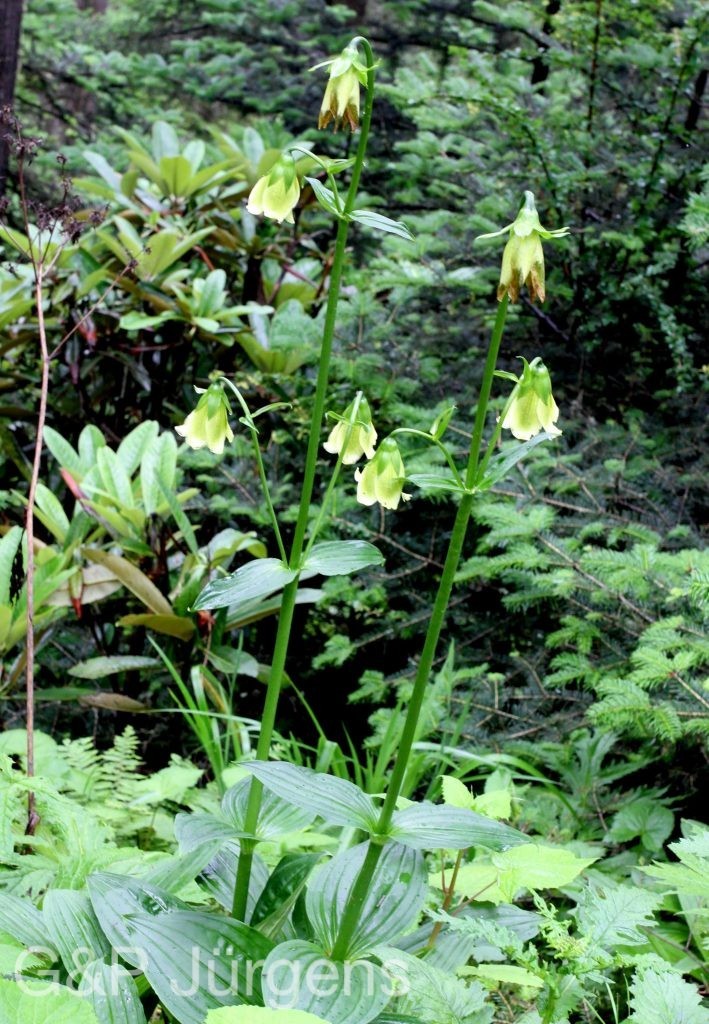
Megacodon stylophorus is a stately giant gentian of the eastern Himalaya and southwestern China. GBIF records it from China, India, Bhutan, Nepal and Myanmar, with roughly 450 occurrences, the genus being a small Sino-Himalayan endemic. It grows in moist subalpine meadows, forest clearings, scrub margins and along streamsides between about 3000 and 4300 m. The plant shown was photographed on the Chele-La pass in western Bhutan at 3900 m in July, when its tall flowering stems rise above the surrounding alpine herbage at the height of the monsoon growing season.

It is one of the largest herbaceous gentians, an erect perennial reaching 1-1.5 m from a stout rhizome. The stem bears opposite, sessile, broadly ovate leaves with conspicuous arcuate parallel venation. The large, pendulous, broadly campanulate flowers are borne in the upper leaf axils; the corolla is pale greenish-yellow, intricately net-veined with darker reticulation, and 4-5 cm long. Distinctively the style is long and persistent (the epithet stylophorus, style-bearing), exserted from the corolla, and the fruit is a large septicidal capsule releasing numerous winged seeds adapted to wind dispersal.

Megacodon is a segregate from the broadly defined Gentiana, distinguished by its great stature, reticulate corolla and elongate style, and molecular studies place it among the basal lineages of tribe Gentianeae. Its showy net-veined flowers are pollinated chiefly by bumblebees foraging at high elevation. Though striking and of horticultural interest, it is not regarded as globally threatened, but its dependence on undisturbed, moist subalpine habitats makes it sensitive to overgrazing and shifting monsoon regimes.

Author: (C.B.Clarke) Harry Sm. · Sources: POWO (Kew), GBIF, Flora of China, Flora of Bhutan, Annotated Checklist of the Flowering Plants of Nepal, Gentianaceae: systematics and natural history

(Royle) N.Kilian

Bhutan2012 260
Bhutan Chele-La 3500m, September
Nepal 99 928 ergebnis
West-Nepal Roha 2700m, July

Description

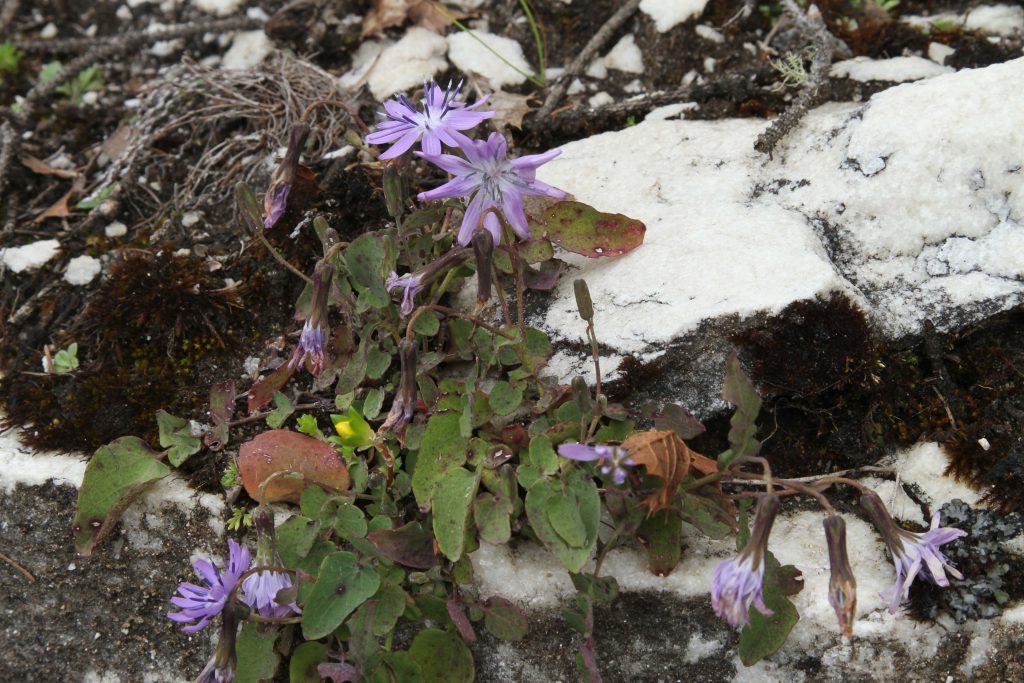
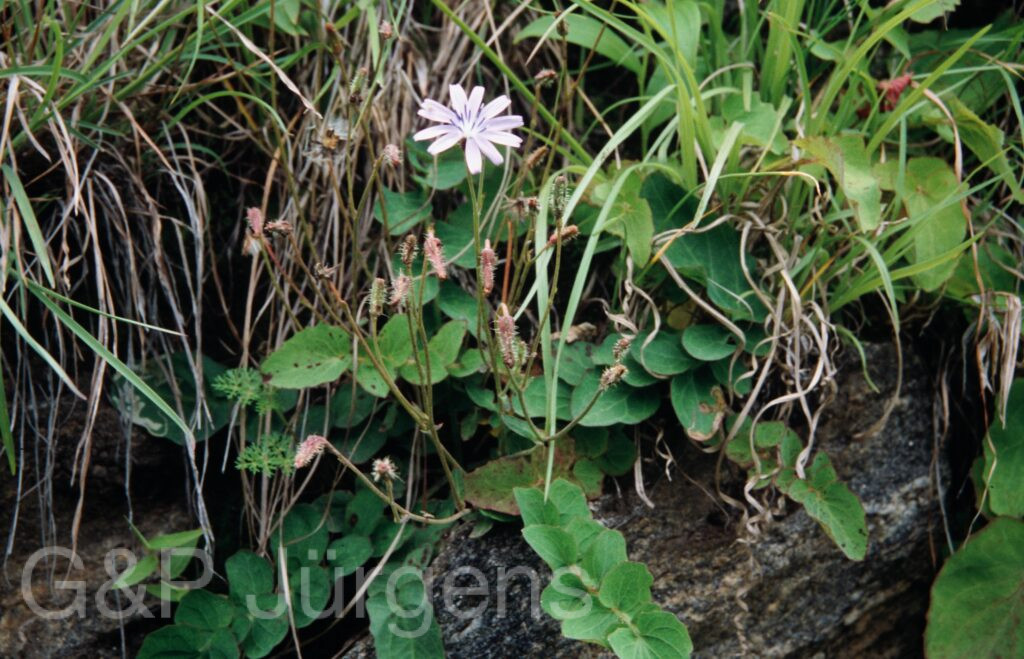
Melanoseris macrorhiza (Royle) N.Kilian is a Himalayan and Sino-Himalayan blue-flowered lettuce relative recorded from Nepal, India, Pakistan, Afghanistan, Bhutan, China and Myanmar, with around 468 georeferenced occurrences in GBIF. It grows on open alpine and subalpine slopes, in moist meadows, among rocks and along forest margins, typically between about 2700 and 4000 m. The collections from Chele-La at 3500 m in September and from Roha in West Nepal at 2700 m in July illustrate its broad Himalayan altitudinal range and its late-summer to autumn flowering.

It is a perennial herb arising, as the epithet macrorhiza indicates, from a stout, thickened taproot or rootstock, with milky latex characteristic of the tribe Cichorieae. The stems are erect and leafy below, becoming branched in the inflorescence. The leaves are lyrate-pinnatifid to runcinate, the basal ones petiolate and the cauline ones often clasping with auriculate bases. The capitula are wholly ligulate, with blue to violet-blue strap-shaped florets and a cylindric involucre of imbricate phyllaries. The fruit is a flattened, ribbed cypsela narrowed toward the apex and bearing a pappus of white, soft bristles.

The species has a complex nomenclatural history, having been placed at various times in Lactuca, Cicerbita and Cephalorrhynchus before transfer to Melanoseris, a predominantly Asian genus segregated within the lettuce alliance on the basis of cypsela and pappus characters supported by molecular data. It is a widespread montane element of no particular conservation concern.

Author: (Royle) N.Kilian · Sources: POWO (Kew), GBIF, Flora of China, Flora of Pakistan, Kilian revision of Cichorieae (Melanoseris)

Losinsk.

BhutanPG2011 567 1
Bhutan Jule-Tso, 4300m June

Description

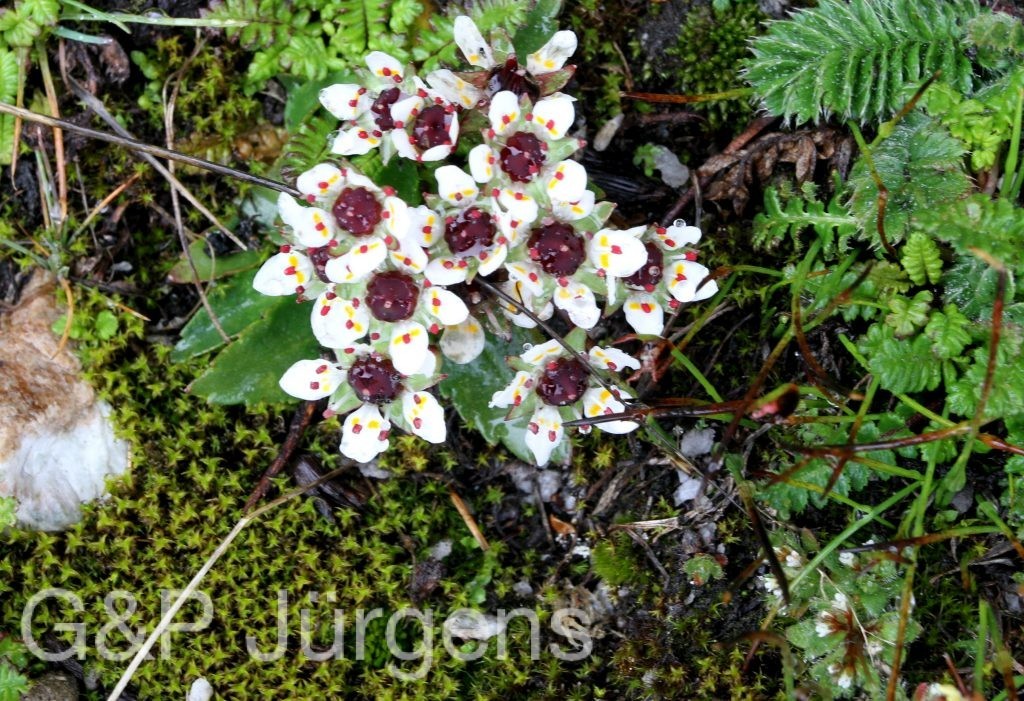
Micranthes melanocentra (long known as Saxifraga melanocentra) ranges through the high mountains of China, Nepal, India, Bhutan and Pakistan, with about 784 records tracing the Himalaya and the Hengduan and Tibetan ranges. It is a true alpine, the image documenting it at Jule-Tso in Bhutan at about 4300 m in June, at the onset of the brief alpine summer. It occupies open alpine meadow, stony slopes, moraine, streamsides and damp turf above the treeline on moist, well-drained gravelly and rocky substrates, where snowmelt provides early-season moisture and the growing season is compressed into a few weeks.

It is a small rosette-forming perennial herb arising from a short rootstock. The leaves are basal, obovate to spathulate, with crenate to dentate margins, narrowing to a broad petiole and often somewhat fleshy. From the rosette rises a leafless, glandular-hairy scape bearing a corymbose to subcapitate cyme of several flowers. The flowers have five white (sometimes pink-tinged) petals, and the species takes its epithet from the dark, almost blackish, contrasting centre formed by the deep-coloured ovary and the conspicuous reddish to purple-black anthers. The fruit is a two-beaked capsule releasing numerous small seeds.

The species was described by Losinskaja and is now placed in the segregate genus Micranthes, separated from Saxifraga sensu stricto on molecular and morphological grounds, comprising the rosette-leaved, scapose saxifrages. Its dark-centred white flowers are visually distinctive among Himalayan alpines and provide a contrasting nectar guide for insect pollinators. Adapted to cold, high-radiation alpine conditions, it is widespread and locally common across its montane range and is not considered threatened.

Author: Losinsk. · Sources: POWO (Kew), GBIF, Flora of China, Flora of Bhutan, Saxifragaceae monograph and Micranthes phylogenetic studies

Losinsk.

BhutanPG2011 366
Bhutan Tsochenchen, 3550m June

Description

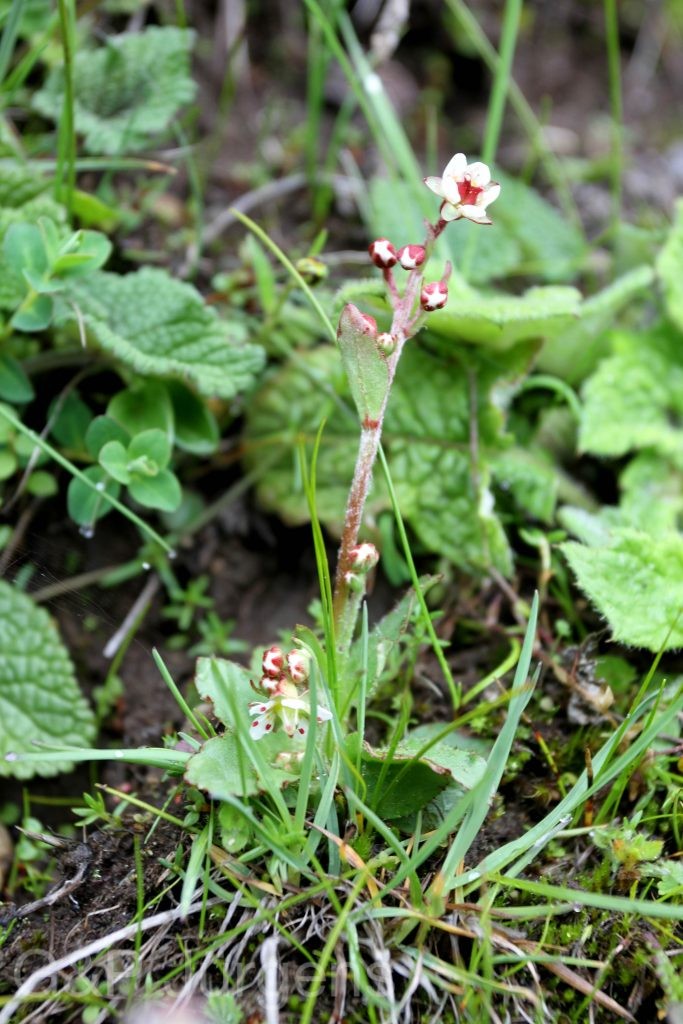
Micranthes pallida (formerly placed in Saxifraga, as reflected in the source link) is a Himalayan rosette herb distributed across the high mountains from Pakistan and northern India through Nepal and Bhutan into south-western China and northern Myanmar; with over 650 georeferenced occurrences (CN, NP, IN, BT, PK, MM) it is one of the more frequent members of its group. It inhabits damp alpine meadows, mossy rock ledges, stream margins and shaded slopes, typically between about 3000 and 4500 m. The plant recorded at Tsochenchen in Bhutan at 3550 m in June, flowering in the brief alpine summer, is characteristic of its cool, moist montane-to-alpine habitat.

It is a perennial herb forming a basal rosette of leaves on a short rhizome. The leaves are spathulate to obovate or broadly ovate, with a cuneate base tapering into a broad petiole, the margins coarsely toothed or crenate, and the blade thin-textured and often somewhat pale or glaucous. From the rosette rises a slender, glandular-pubescent flowering stem bearing a lax, often paniculate or corymbose cyme of small flowers. Each flower has five spreading whitish to pale greenish petals, ten stamens and a half-inferior, bicarpellate ovary that ripens into a many-seeded, two-beaked capsule.

Micranthes is now widely recognised as a genus distinct from Saxifraga sensu stricto, corresponding to the former Saxifraga sect. Micranthes, supported by molecular and morphological evidence; M. pallida belongs to this assemblage of broad-leaved, rosette-forming species. Adapted to the harsh alpine regime through its perennating rhizome and ground-hugging habit, it is widespread and not regarded as threatened across its extensive range.

Author: Losinsk. · Sources: POWO (Kew), GBIF, Flora of China, Flora of Bhutan, Flora of Pakistan, Gornall's revision of Saxifragaceae

Wall. ex DC.

Sikkim2003 372 G521
Sikkim Tista valley 3500m August
Nepal 99 84 ergebnis
West-Nepal Bhulbhule 3200m, June
Garw 2005 36 ergebnis ergebnis
India Garhwal Valley of flowers 3100m, September

Description

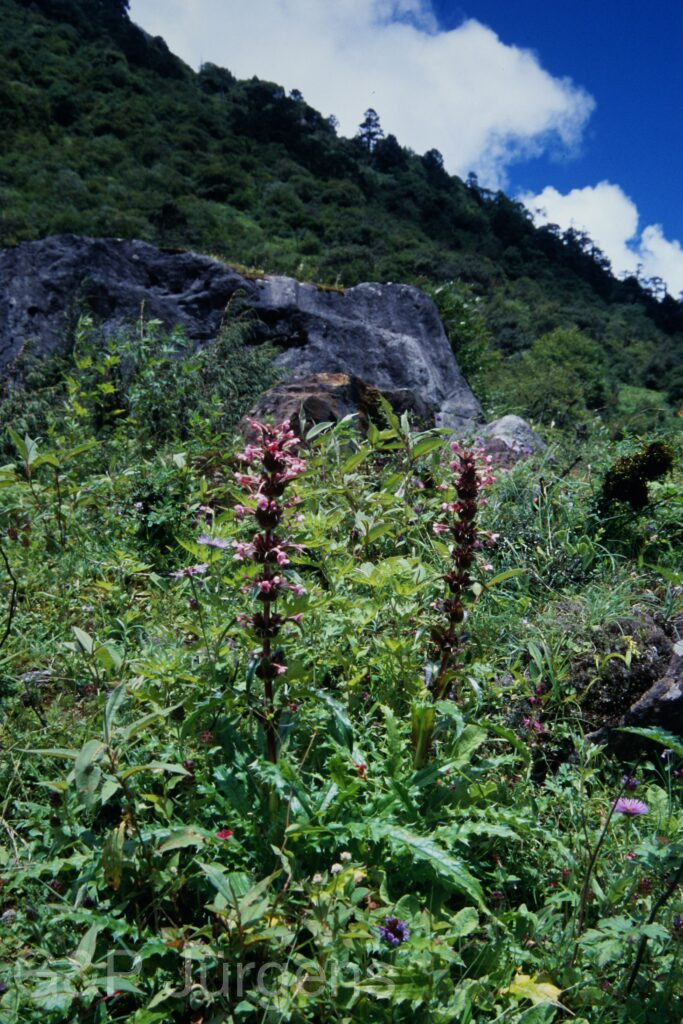
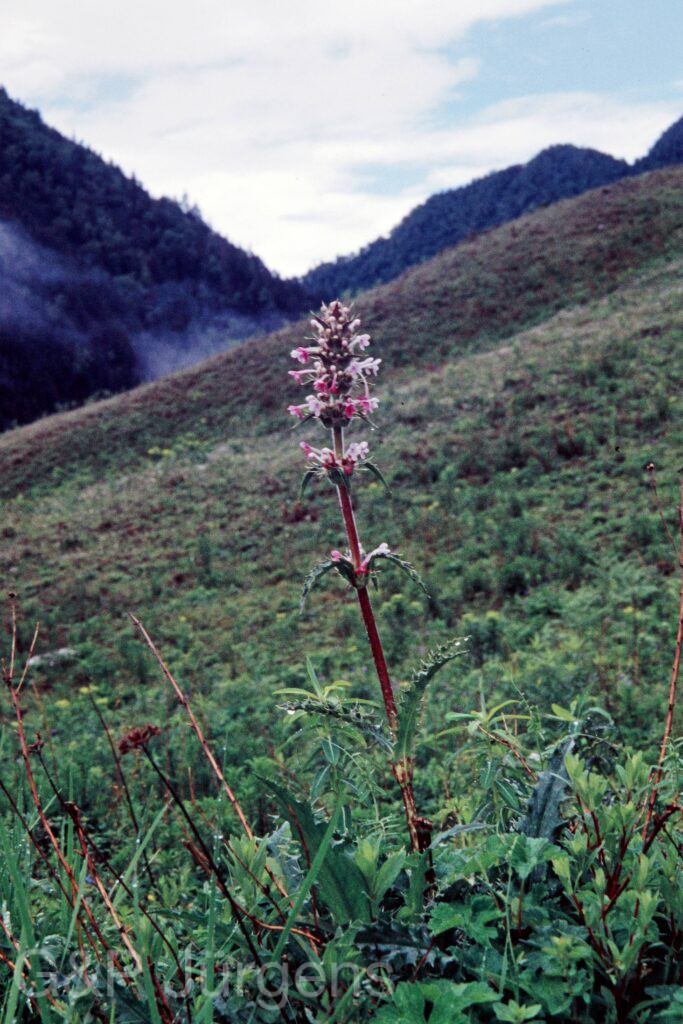
Morina longifolia, the Himalayan whorlflower, is native to the Himalaya across Pakistan, India, Nepal and Bhutan, with naturalised and cultivated records in Europe and North America (Norway, Germany, Denmark, Sweden, the United States) reflected among its roughly 125 GBIF occurrences. It grows on open alpine and subalpine slopes, in stony meadows, grassy clearings and among low scrub on well-drained soils above the forest. The cited localities, the Tista valley in Sikkim at 3500 m in August, Bhulbhule in western Nepal at 3200 m in June, and the Valley of Flowers in Garhwal at 3100 m in September, span its range of roughly 3000-4000 m, where it flowers through the summer monsoon.

It is a robust, erect perennial herb forming a basal rosette of long, narrow, linear-lanceolate leaves whose margins are conspicuously spiny-toothed, giving a thistle-like appearance, the whole plant aromatic when crushed. The flowering stem rises stoutly and bears the flowers in well-separated, spiny-bracted whorls (verticillasters) up the upper axis. Each flower has a tubular, curved, two-lipped corolla that opens white and ages through pink to deep crimson, so flowers of several colours appear together in one whorl. Two stamens are fertile, the slender style is exserted, and the inferior ovary develops into a small one-seeded achene enclosed within the persistent involucel.

The genus Morina, with its spiny leaves and whorled bicoloured flowers, has been placed variously in its own family Morinaceae or within Dipsacaceae, and is treated by current systems within an enlarged Caprifoliaceae; molecular work confirms its position near the teasels and valerians in the Dipsacales. The long-tubed flowers are pollinated by long-tongued insects, and the species is widely grown as an ornamental, accounting for its scattered occurrences far beyond its native range.

Author: Wall. ex DC. · Sources: POWO (Kew), GBIF, Flora of Pakistan, Flora of Bhutan, Cannon revision of Morina, Bell Dipsacales phylogeny

D. Don

Nepal 99 277 ergebnis
West-Nepal Kalomura 3900m, June
Nepal 99 276 ergebnis
West-Nepal Kalomura 3900m, June

Description

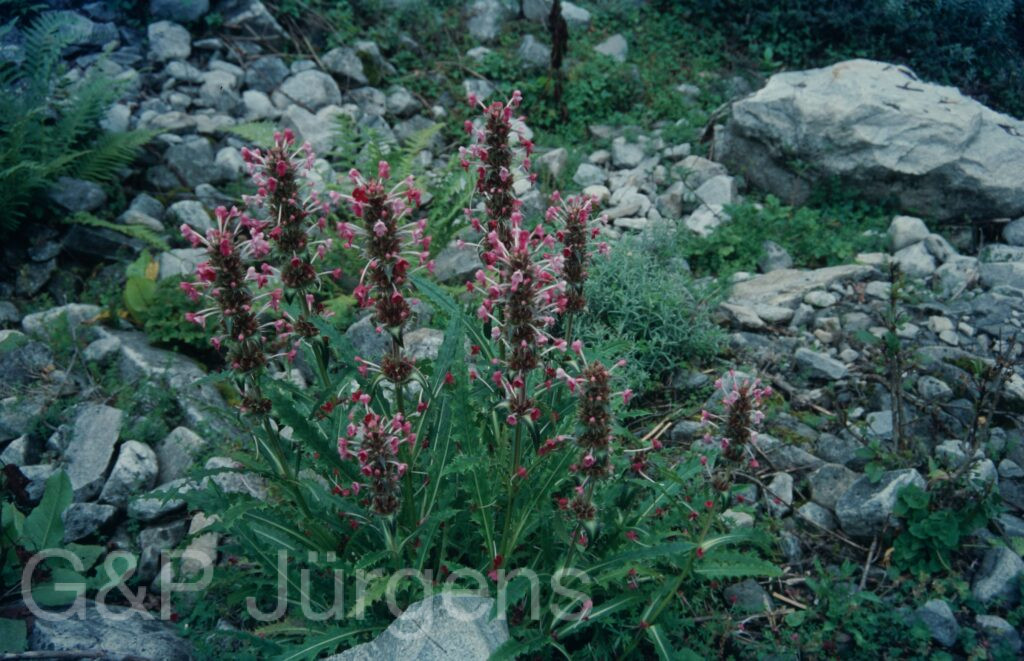
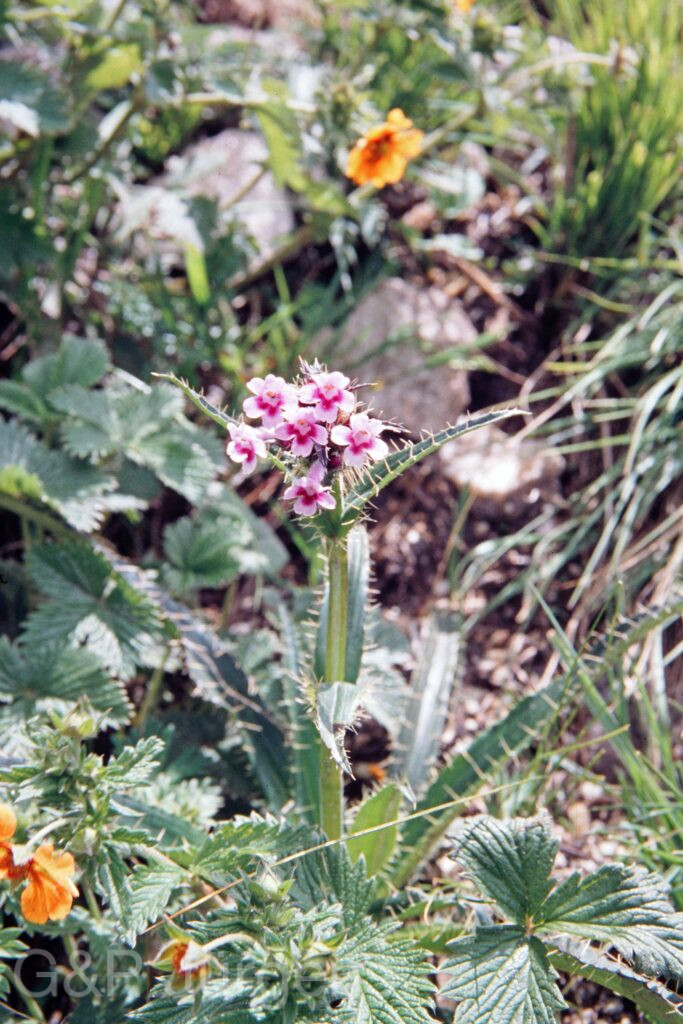
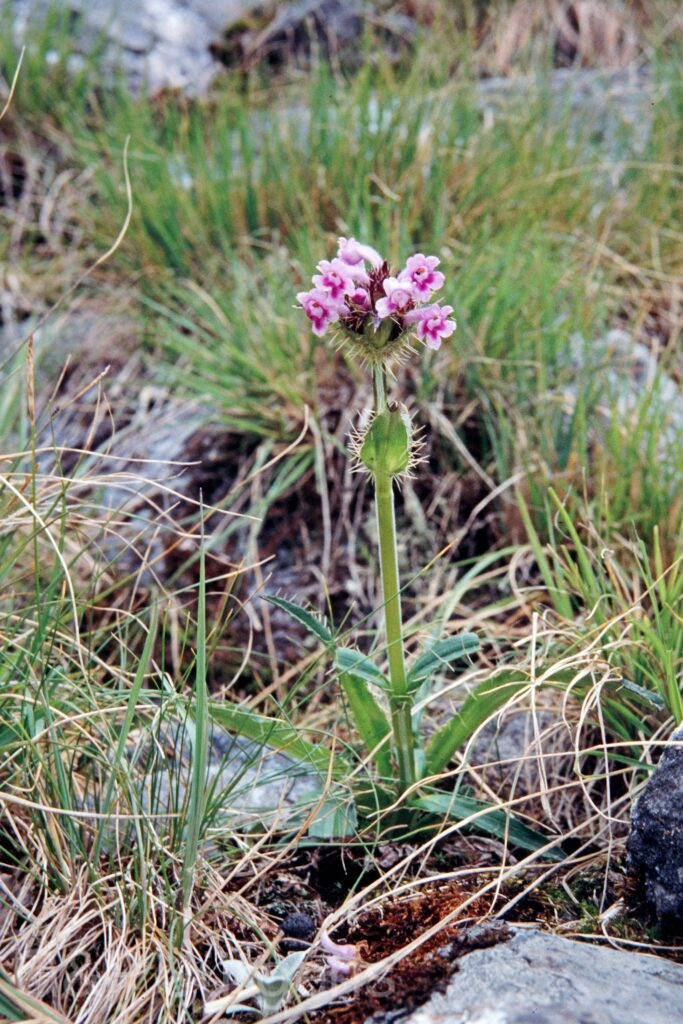
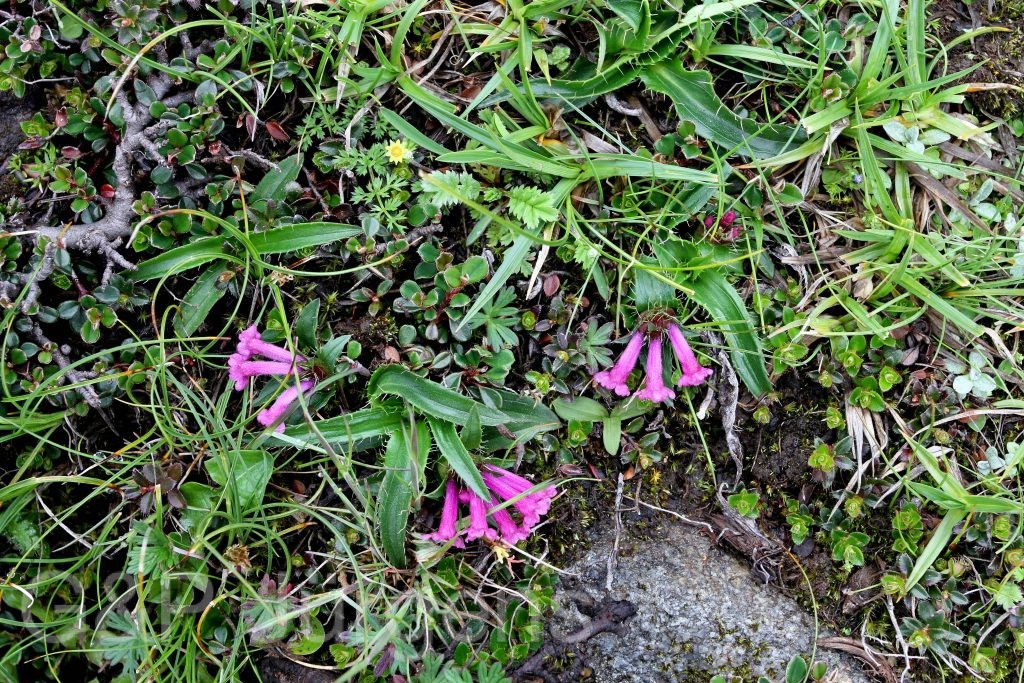
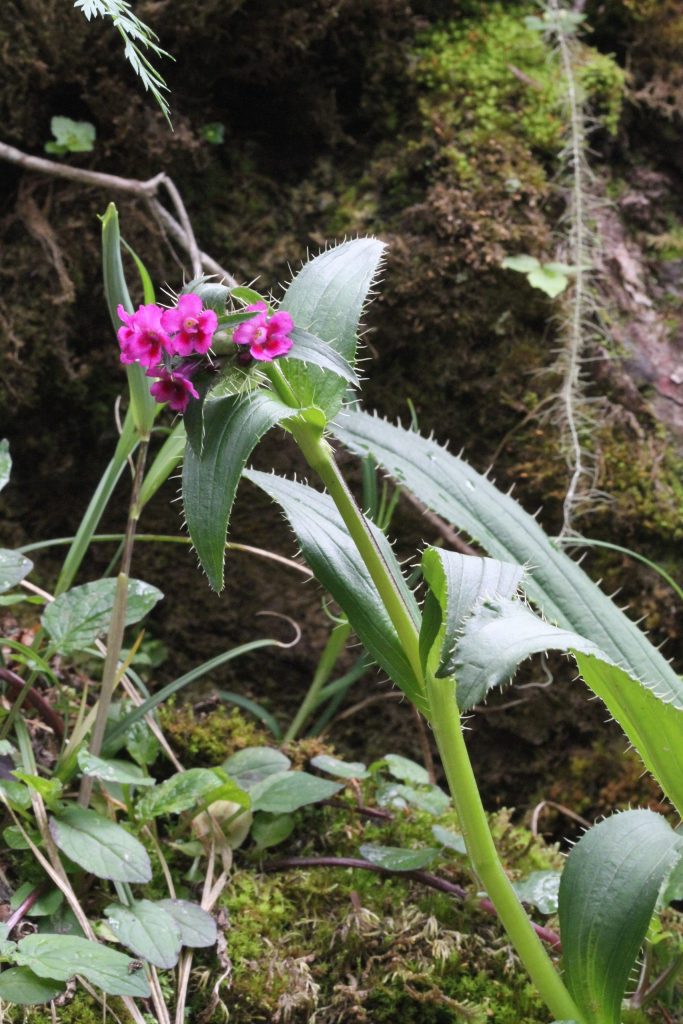
Morina nepalensis is a high-mountain perennial of the Sino-Himalayan region, ranging through China, Nepal, India, Bhutan and Pakistan, with GBIF recording 239 occurrences across this arc. It inhabits open alpine pastures, grassy slopes, rocky meadows and shrubby hollows above the treeline, typically between about 3000 and 4500 m. The illustrated plants were photographed in West Nepal at Kalomura at 3900 m and in Bhutan on the Ludlow-Sherriff Trail near Warrtlang-La at 4450 m, both in June, exemplifying the subalpine to alpine turf where the species is most frequent during the early summer flush.

The plant forms a stout rosette from a thick taproot, the basal leaves narrowly oblong to lanceolate, sessile or amplexicaul and conspicuously armed along the margins with stiff spinose teeth. The flowering stem is erect, terminating in interrupted whorls of flowers subtended by spiny pinnatifid bracts. Each flower sits within a tubular involucel and a two-lipped calyx; the corolla is gamopetalous, curved and white to pink, often deepening to rose with age, with a slender tube and five spreading lobes. There are two fertile stamens and a single inferior ovary maturing into an achene enclosed by the persistent involucel.

Long placed in the segregate family Morinaceae, the genus Morina is now subsumed within an expanded Caprifoliaceae, consistent with the input family. POWO and GBIF treat M. nepalensis as the accepted name. The colour change of the corolla after pollination is a notable floral signal, and the species contributes to the showy alpine herbfields grazed by Himalayan livestock.

Author: D. Don · Sources: POWO (Kew), GBIF, Flora of China, Flora of Bhutan, Annotated Checklist of the Flowering Plants of Nepal, Revision of Morinaceae (Dipsacales monograph)