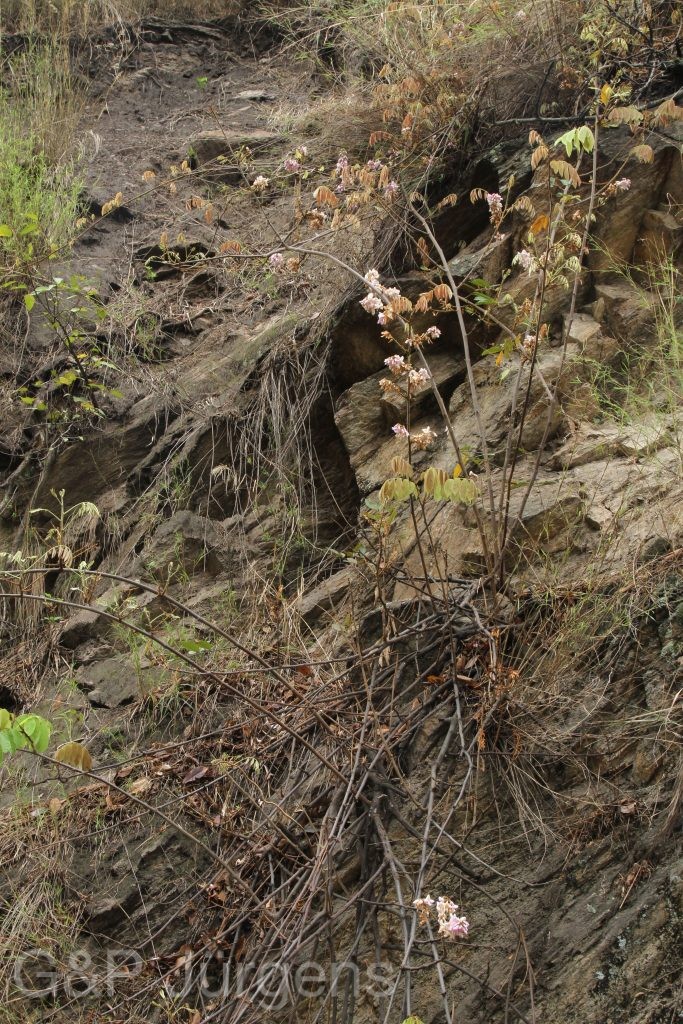
Tag:

Montane (1500-2500 m)

(Franch.) Prain

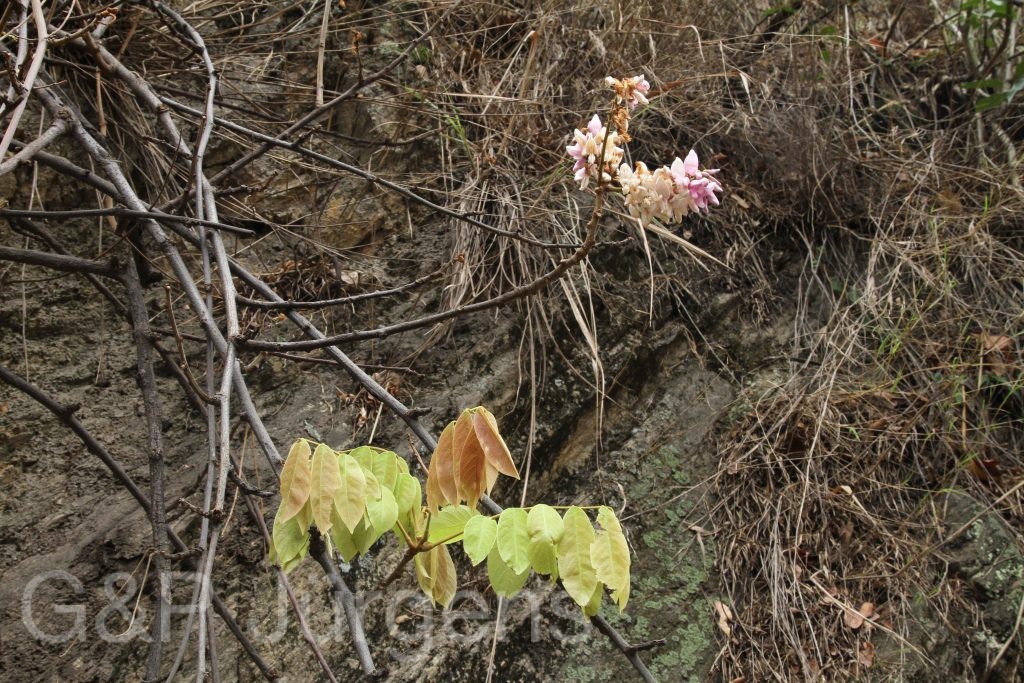
Bhutan2014 68
Bhutan Trashigang 1600m, May
Bhutan2014 67
Bhutan Trashigang 1600m, May

Description

Cladrastis delavayi (here spelled Cadrastis delavayi) is a deciduous tree of the eastern Sino-Himalaya, distributed from Bhutan and northeast India through northern Myanmar into south-central and southwestern China. It occurs in mixed broad-leaved and evergreen forest on warm-temperate to subtropical mountain slopes, generally between roughly 1000 and 2500 m. The photographed individual was recorded at Trashigang in eastern Bhutan at about 1600 m, flowering in May. The associated GBIF record is a spurious genus-level match (returning the kingdom-rank name and a global occurrence figure), so distribution here follows regional floristic accounts rather than the misapplied dataset.

The species is a medium-sized tree with smooth bark and odd-pinnate (imparipinnate) leaves bearing several alternate, ovate-elliptic, entire leaflets that are softly pubescent beneath. The flowers are borne in terminal, branched panicles and have the papilionaceous structure typical of Faboideae: a broad standard, two lateral wings and a keel of two partly fused petals, the colour white to creamy and often fragrant. The androecium comprises ten free or basally connate stamens, and the fruit is a flattened, several-seeded legume that is narrowly winged along the sutures and dehisces tardily.

Cladrastis is a small disjunct genus of the temperate Northern Hemisphere, with species in eastern Asia and a single North American representative (the yellowwood, C. kentukea), making it a classic example of the East Asian–North American floristic disjunction. C. delavayi, named for the French missionary-collector Père Delavay, is one of the Chinese species and yields a hard, attractively grained timber. It is locally distributed but not regarded as globally threatened.

Author: (Franch.) Prain · Sources: POWO (Kew), GBIF, Flora of Bhutan, Flora of China (Fabaceae), Duley & Vincent revision of Cladrastis (Leguminosae)
(L.) Graham ex Wall.

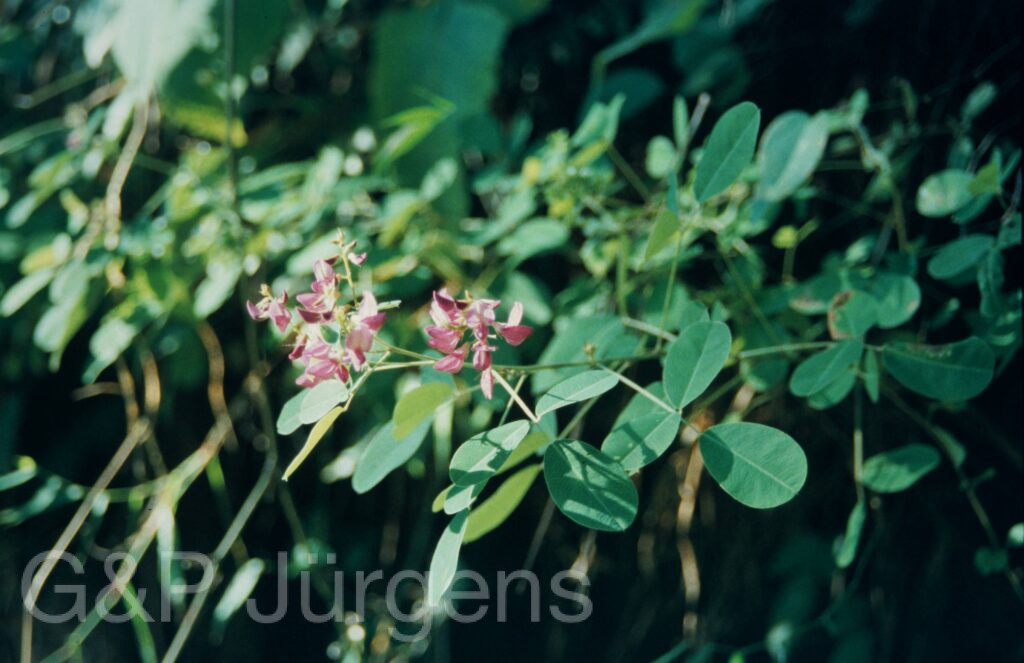
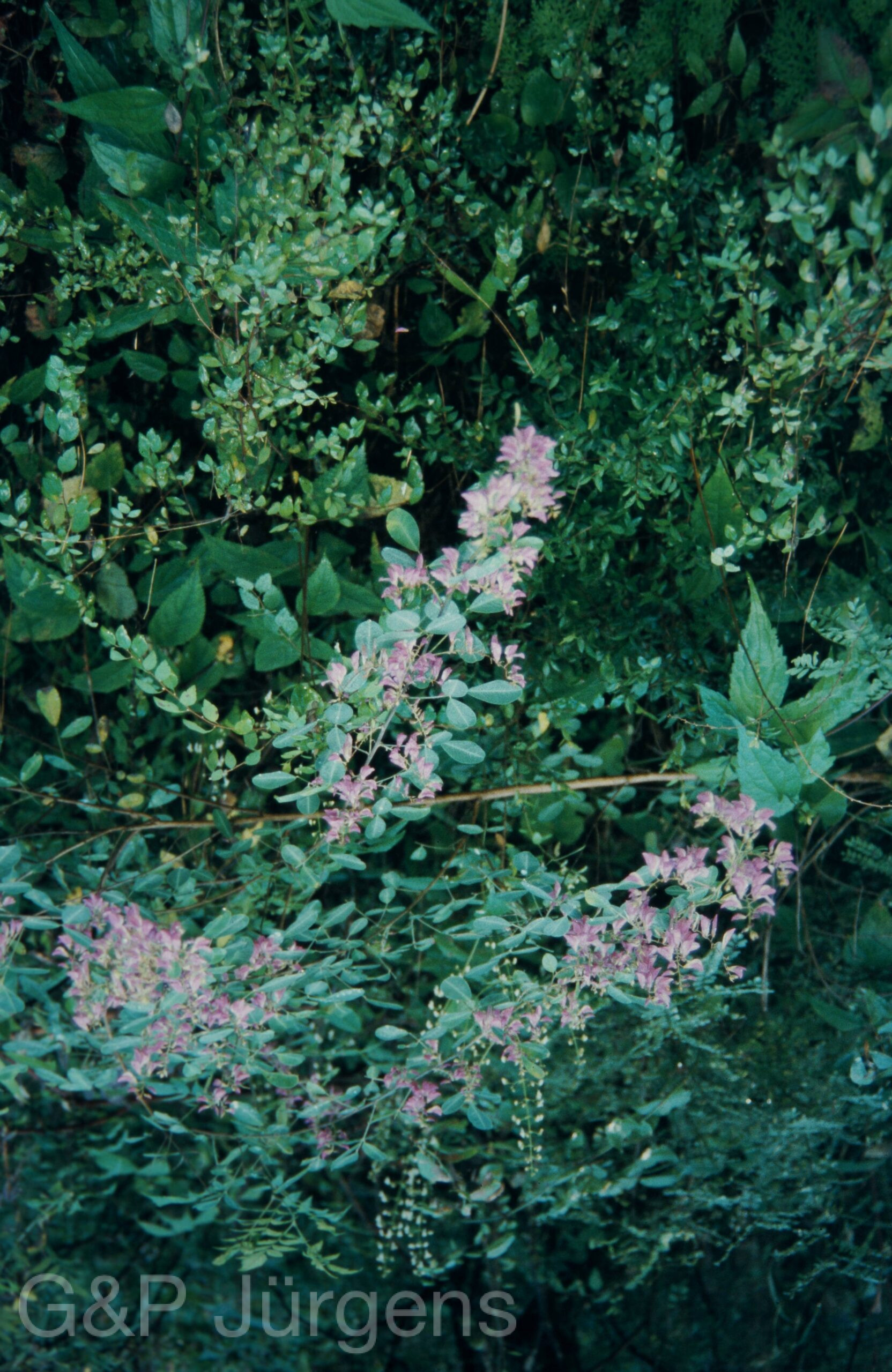
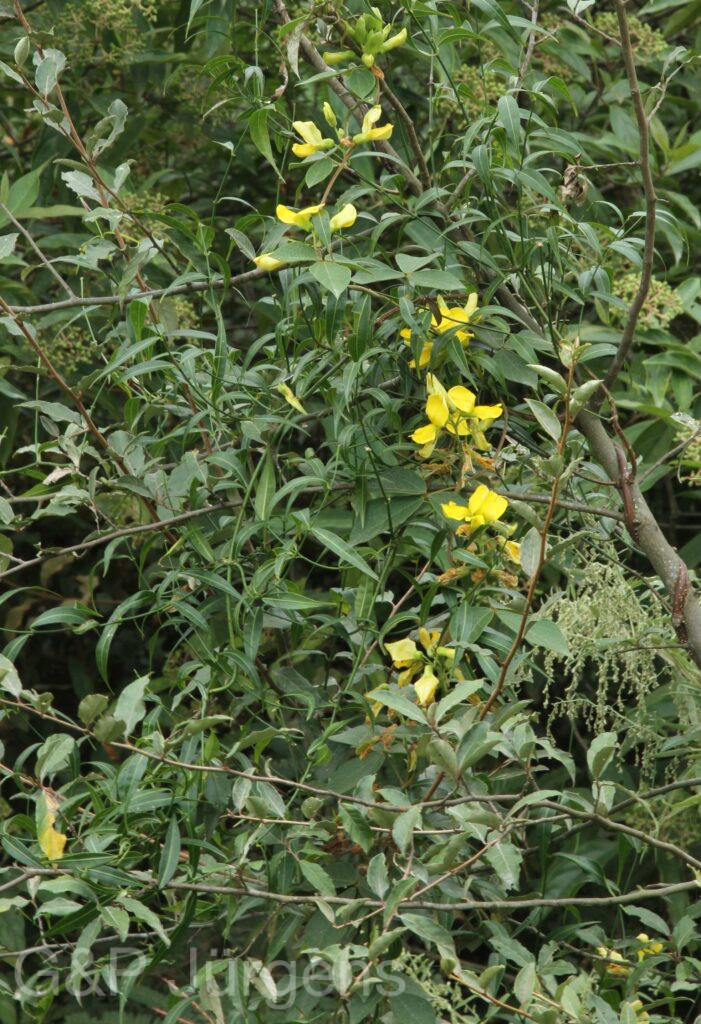
Bhutan2012 821
Bhutan Trongsa 2050m, October
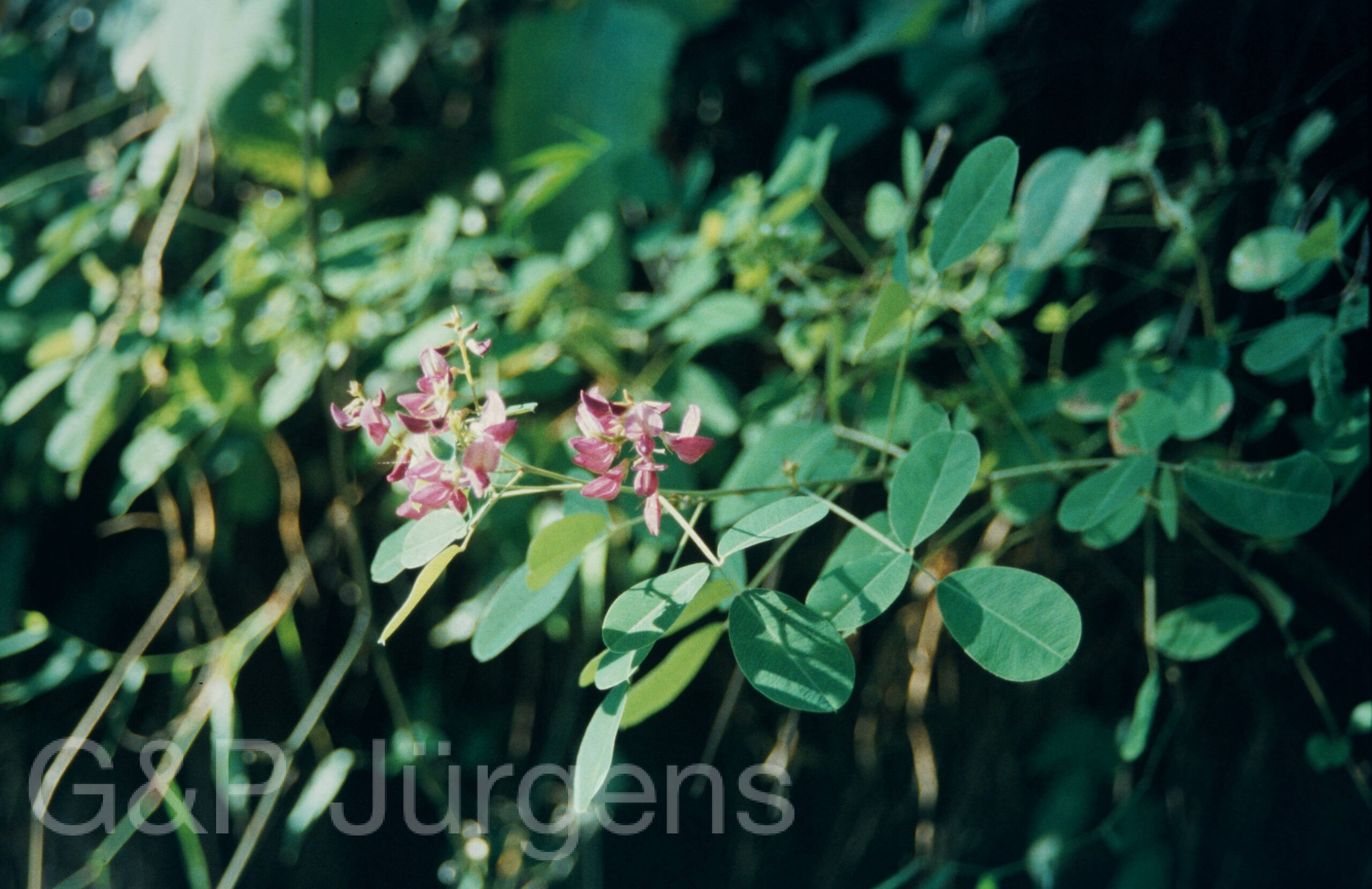
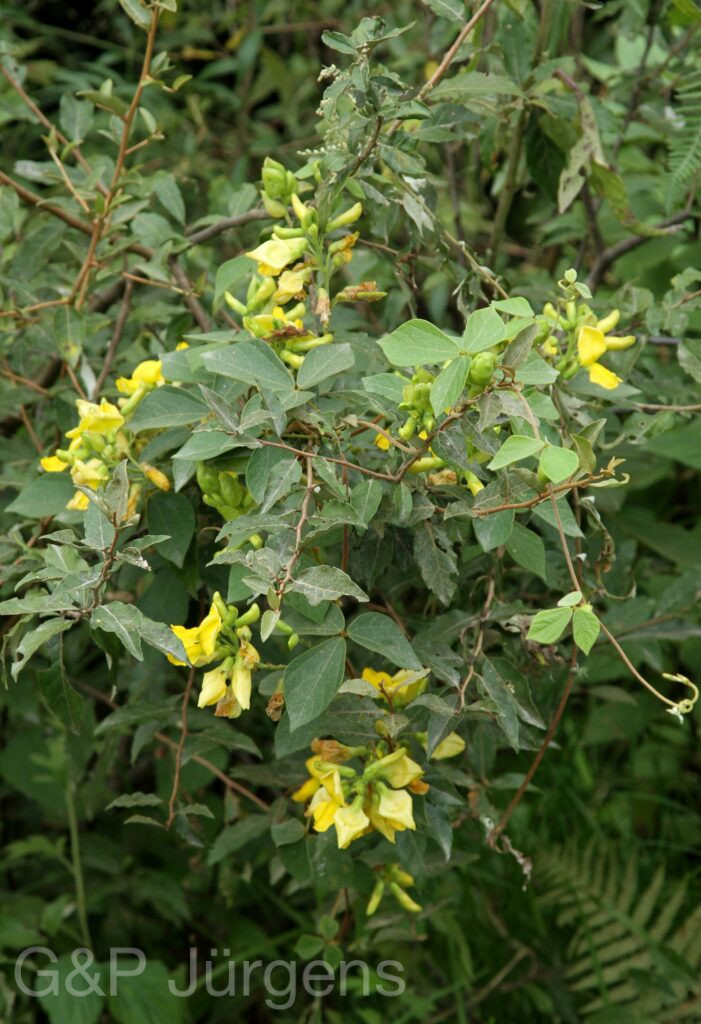
Bhutan2012 822
Bhutan Trongsa 2050m, October

Description

Cajanus scarabaeoides is a widely distributed twining legume of the Old World tropics and subtropics, recorded by GBIF from more than two dozen territories spanning the Indian subcontinent, China, Taiwan, mainland and insular Southeast Asia (Thailand, Vietnam, the Philippines, Indonesia, Papua New Guinea), Japan, Australia, the western Indian Ocean islands (Madagascar, Réunion, Mayotte) and parts of West Africa, with over 4,200 georeferenced occurrences attesting to its commonness as a weedy scrambler. In the Himalayan portion of its range it ascends well into the hills, as the photographed plant from Trongsa in central Bhutan at about 2,050 m elevation in October illustrates. It typically grows in open grasslands, scrub, forest margins, fallow fields, roadsides and other disturbed sunny situations, flowering and fruiting through the post-monsoon dry season; as a nitrogen-fixing pioneer it colonises poor soils readily and is often a component of degraded secondary vegetation.

The species is a slender, trailing or twining perennial herb to subshrub with prostrate to climbing stems clothed in spreading silky or brownish hairs. The leaves are pinnately trifoliolate, the leaflets oblong-elliptic to obovate, the terminal one largest, gland-dotted beneath and silky-pubescent on both surfaces, with small stipels and persistent stipules. The flowers are borne in short axillary racemes; the corolla is papilionaceous and yellow, the standard frequently marked with reddish or purplish veining on the back, and the calyx is campanulate with narrow lobes. The fruit is a flattened, oblong, brownish-pubescent pod constricted between the seeds and conspicuously transversely depressed, dehiscing to release several small dark seeds.

Cajanus scarabaeoides belongs to the tribe Phaseoleae (subtribe Cajaninae) and is taxonomically significant as one of the closest wild relatives of the cultivated pigeon pea, Cajanus cajan, sharing the characteristic resinous glandular dots that distinguish the genus. As a hardy, drought-tolerant wild crop relative it is valued in plant breeding as a source of genes for pest resistance and stress tolerance, and it serves locally as fodder and a green-manure cover crop. Its enormous natural range, ecological adaptability and frequency leave it of least conservation concern, though wild germplasm is increasingly recognised for its importance to food-security research.

Author: (L.) Graham ex Wall. · Sources: POWO (Kew), GBIF, Flora of China Vol. 10, Flora of Bhutan Vol. 1, Flora of Nepal, Flora of Pakistan, van der Maesen monograph on Cajanus and Atylosia (Wageningen Agricultural University Papers)

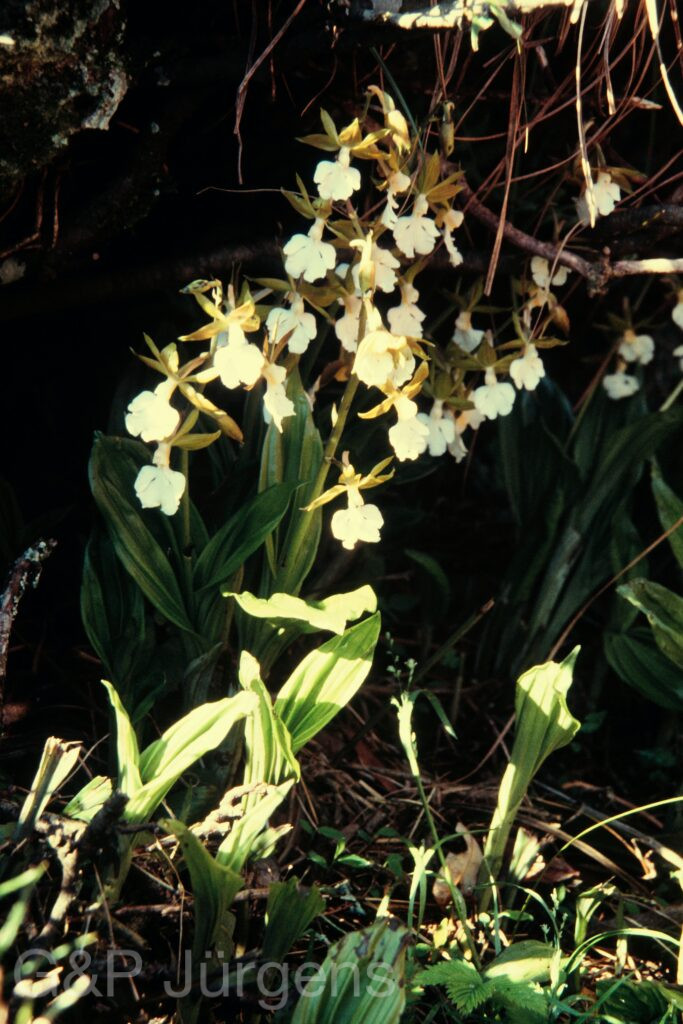
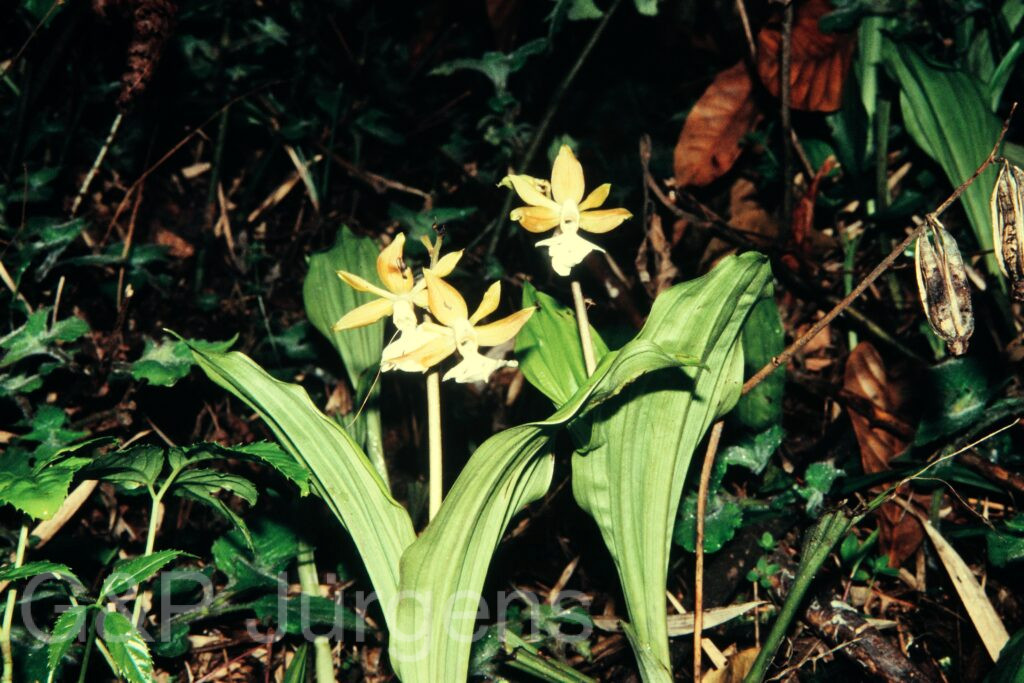
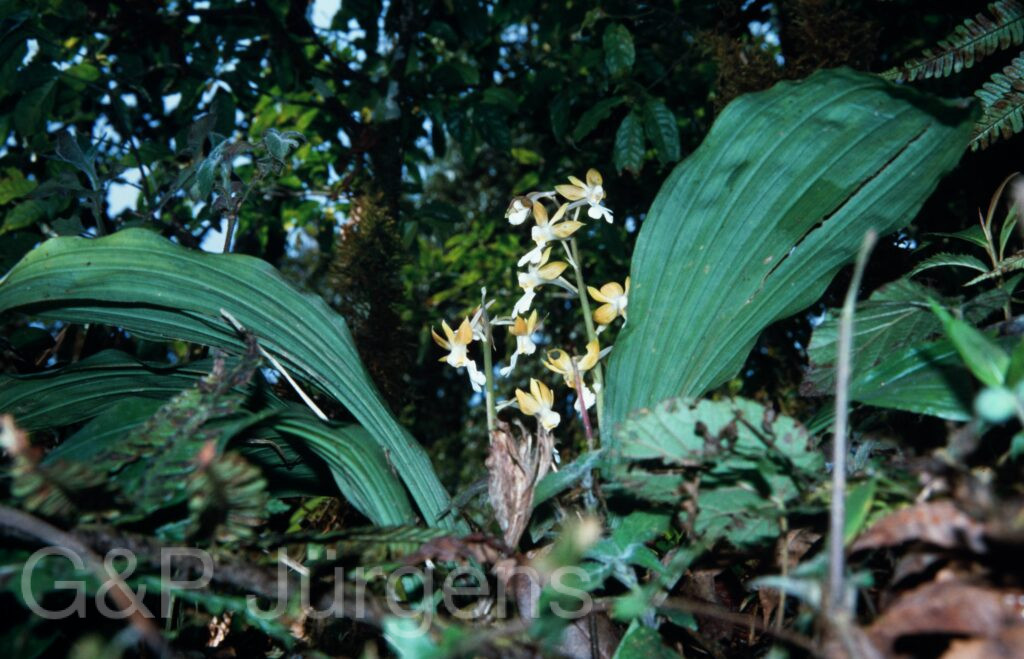
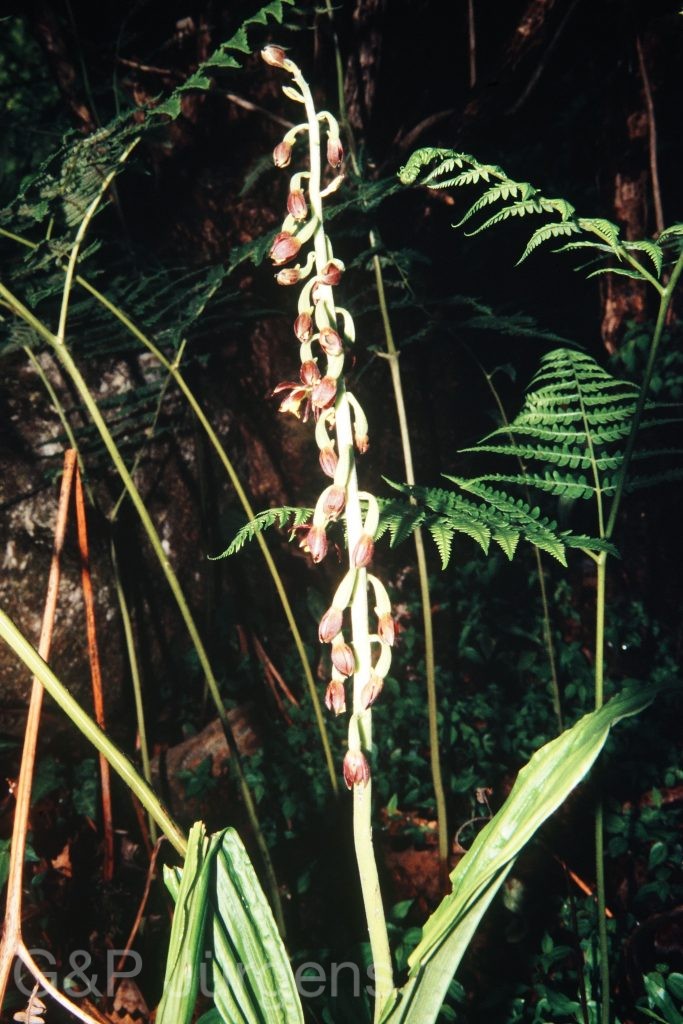
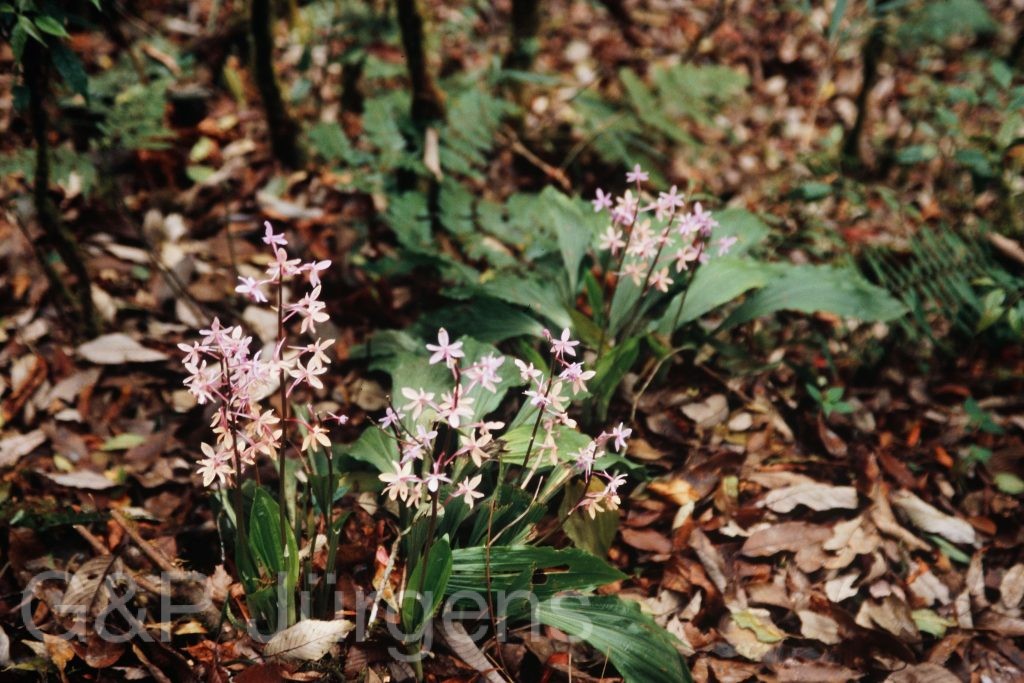
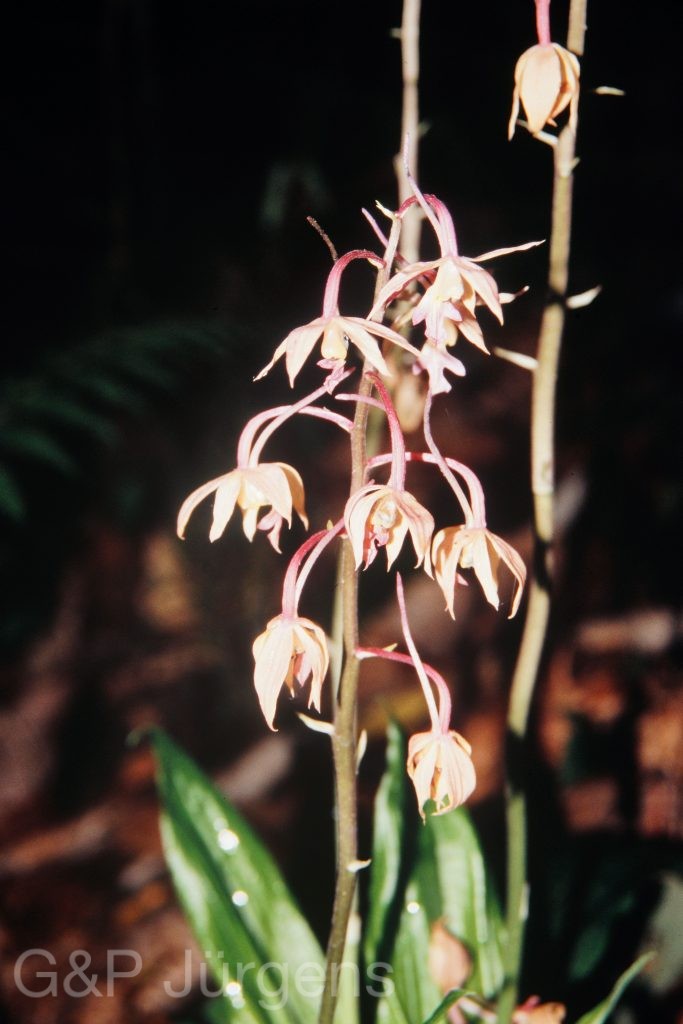
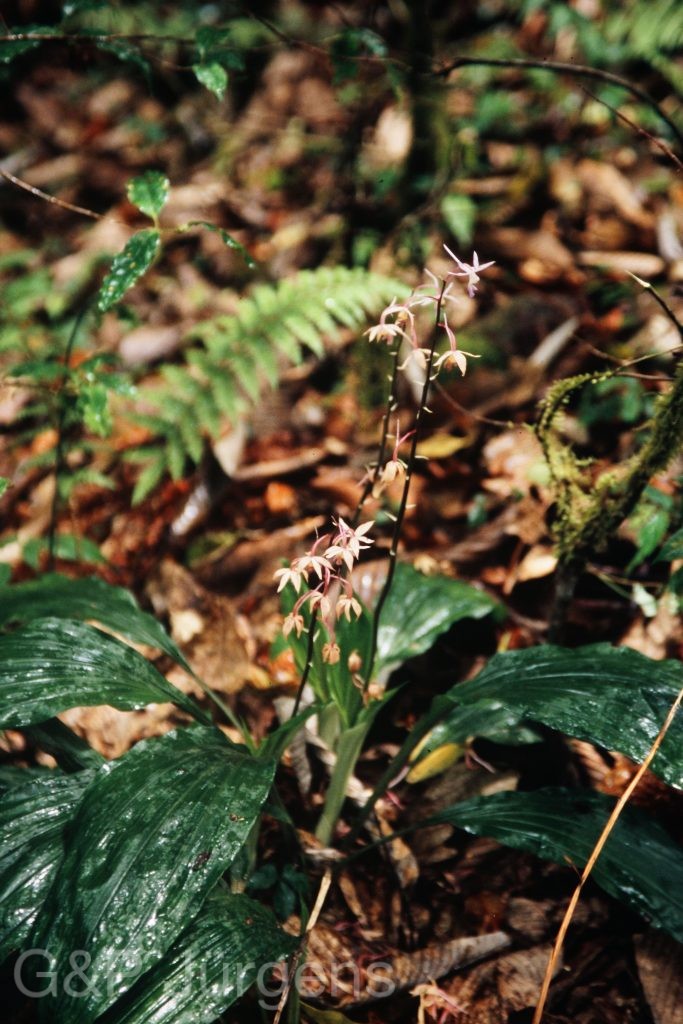
Lindl.

Nepal 97 299 P600
Nepal new Clepua 2370m May
Nepal 97 301 G602
Nepal new Clepua 2370m May
Nepal 2001 147 ergebnis ergebnis
East-Nepal Bhalukhop 2520m, April

Description

Calanthe chloroleuca is a terrestrial orchid of restricted distribution in the eastern Himalayas, known from Nepal, northeast India (Sikkim), Bhutan, and southwest China (Yunnan). With fewer than 20 documented occurrences in GBIF, it is one of the rarer Calanthe species in the region. The species grows in moist, shaded forest understory, on humus-rich soils among leaf litter, at elevations of 2,000–3,000 m.

The plant is an evergreen species with reduced pseudobulbs hidden by leaf bases. It produces 3–5 elliptic, plicate leaves 15–25 cm long. The inflorescence is an erect raceme 20–40 cm tall, carrying 8–15 flowers. The name 'chloroleuca' derives from Greek chloros (green) and leukos (white), accurately describing the flower coloration: sepals and petals are greenish-white, and the lip is white with a greenish or yellowish tinge, trilobed, with low, parallel keels on the disc. The spur is slender, 1–1.5 cm long, slightly curved. Flowering occurs from April to May.

Calanthe chloroleuca is easily confused with the similarly coloured C. brevicornu, from which it differs in its longer spur, narrower lip lobes, and more elongated floral bracts. Its rarity in herbarium collections may partly reflect the difficulty of distinguishing it from congeners in the field.

Author: Lindl. · Sources: POWO (Kew), Flora of Nepal Checklist, GBIF, Flora of Bhutan Vol. 3

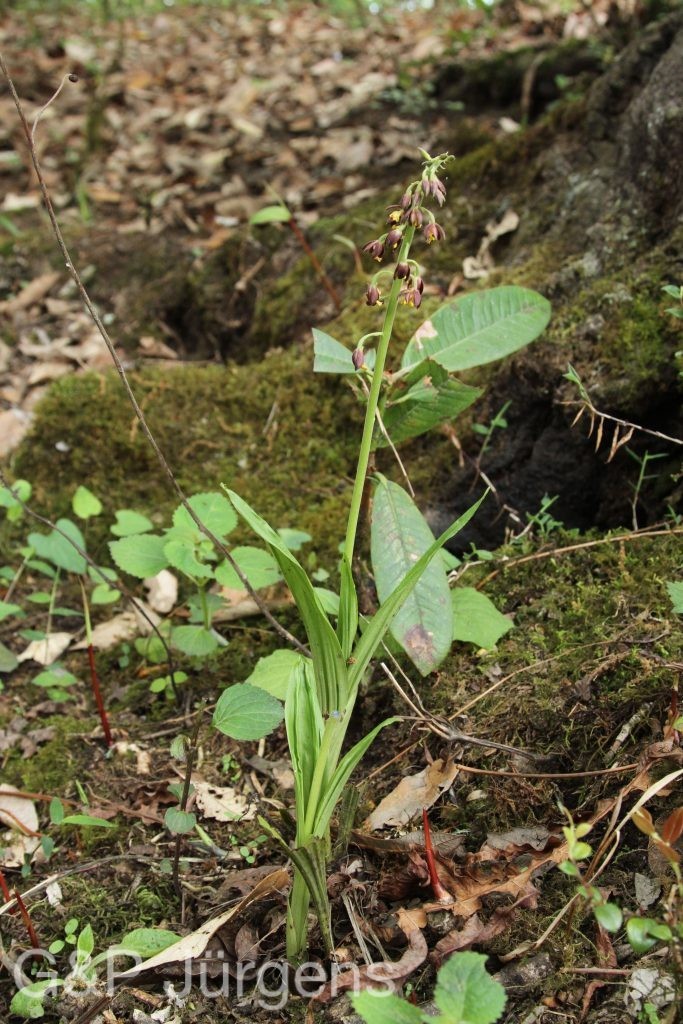
Hook.f.

Bhutan2014 804
Bhutan Mo-Chu 1600m, May
Bh2008 463 G724
Bhutan, Samtengang 1950m, May

Description

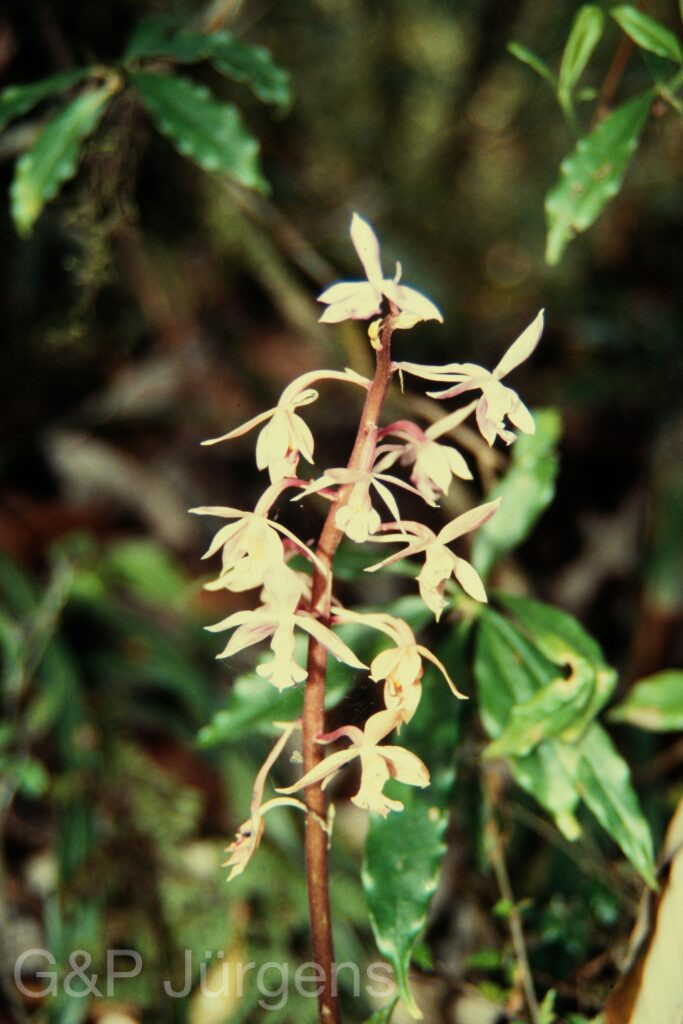
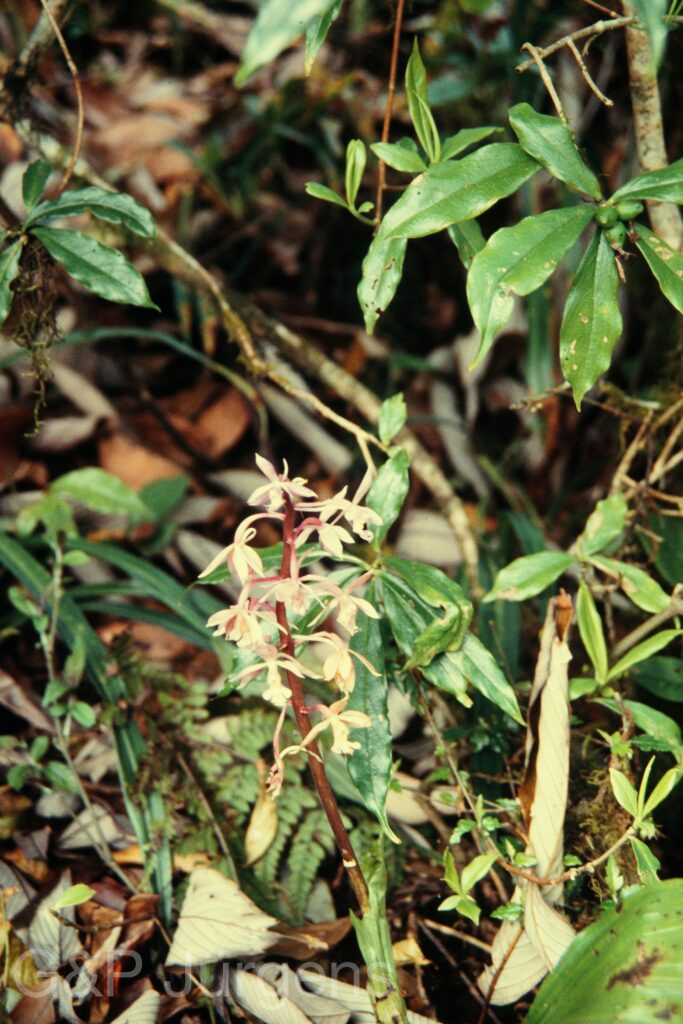
Calanthe mannii is a terrestrial orchid distributed across the eastern Himalayas and East Asia, from Nepal and northeast India through Bhutan, Myanmar, southern China (Yunnan, Guizhou, Guangxi), to Japan (Ryukyu Islands). GBIF records nearly 100 occurrences across this range. The species grows in warm to temperate broadleaved forests, often along streams and in ravines with rich humus soil, at elevations of 1,000–2,500 m.

The plant is an evergreen Calanthe producing narrow, conical pseudobulbs partially enclosed by leaf sheaths. Leaves are 3–5, elliptic-lanceolate, 20–40 cm long, plicate, with prominent veins. The inflorescence is an erect, densely many-flowered raceme 30–50 cm tall, bearing 15–30 flowers. Flowers are 2–2.5 cm across, with a distinctive colour combination: the sepals and petals are yellowish-brown to olive-green, while the lip is pale, trilobed, with the mid-lobe deeply bilobed and a prominent yellow callus. The spur is curved, 8–12 mm long. Flowering occurs from April to June.

Calanthe mannii is named after Gustav Mann (1836–1916), the German-born botanical collector who worked in northeast India. The species is distinguished from the similar C. puberula by its more densely flowered raceme and different lip morphology. Its presence in both subtropical (Mo-Chu valley, 1,600 m) and temperate zones in Bhutan indicates broad ecological tolerance.

Author: Hook.f. · Sources: POWO (Kew), Flora of Bhutan Vol. 3, GBIF, Flora of China Vol. 25, Pearce & Cribb: The Orchids of Bhutan (2002)

Lindl.

Bh2008 531 P809 1
Bhutan Chongsakha, 1900m April

Description

Calanthe plantaginea is one of the most widespread and conspicuous terrestrial orchids of the Himalayan montane forest zone. Its range extends from Pakistan through the entire Himalayan arc (Nepal, India, Bhutan) into Myanmar and southern China. GBIF documents over 110 occurrences. The species grows in the understory of broadleaved and mixed forests, in moist leaf litter and humus, at elevations of 1,000–3,000 m.

The plant produces reduced pseudobulbs hidden by persistent leaf sheaths. Leaves are 3–5, large, broadly elliptic, 15–40 cm long, prominently plicate, resembling plantain leaves — hence the epithet 'plantaginea'. The inflorescence is a stout, erect raceme 20–40 cm tall, bearing 10–20 showy flowers. Flowers are 3–4 cm across, the largest among Himalayan Calanthe, and range from pale pink to deep rose-pink, occasionally white. The lip is trilobed, the mid-lobe deeply bifid, with a prominent callus of 3–5 raised, yellow lamellae. The spur is slender, 1.5–2 cm long. Flowering occurs from March to May, typically before full canopy closure.

Calanthe plantaginea is arguably the most recognisable spring-flowering orchid in the Himalayan mid-altitude forests. Its large, brightly coloured flowers and broad leaves make it conspicuous even to non-specialists. It is often the first orchid to flower in the understory after winter.

Author: Lindl. · Sources: POWO (Kew), Flora of Bhutan Vol. 3, Flora of Nepal Checklist, GBIF, Pearce & Cribb: The Orchids of Bhutan (2002)

Lindl.

Bhutan2015 644
Bhutan Mo-Chu 1600m, October
Bhutan2015 642
Bhutan Mo-Chu 1600m, October

Description

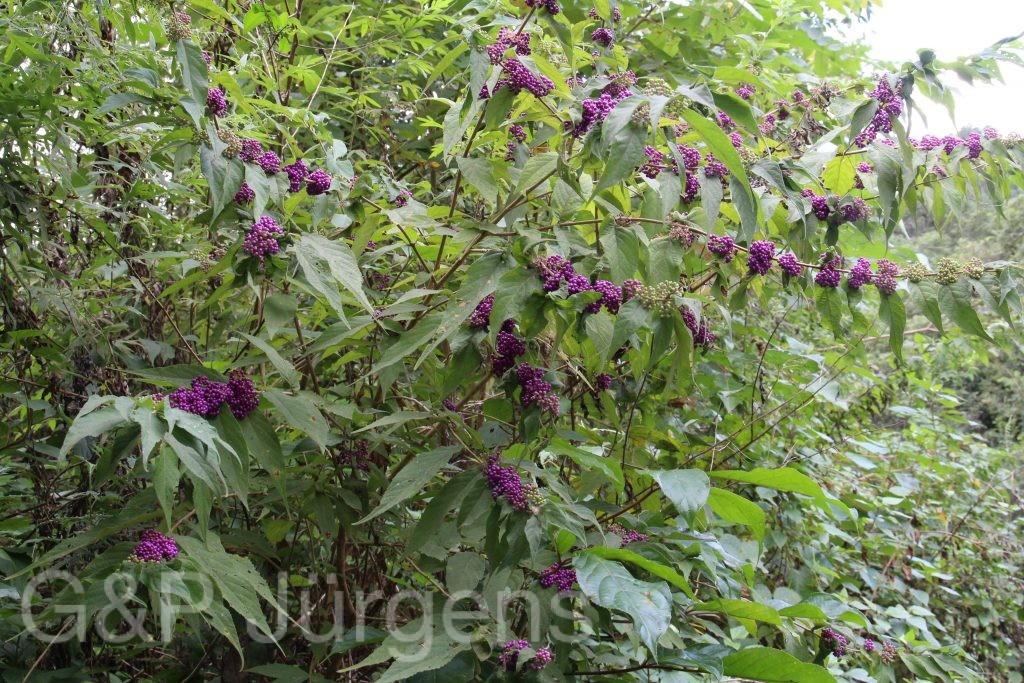
Callicarpa rubella is a widespread subtropical shrub ranging from the Himalaya and southern China across mainland and insular South-East Asia, with GBIF records from China, India, Bhutan, Myanmar, Thailand, Laos, Vietnam, Malaysia, Indonesia, Taiwan, Hong Kong, Bangladesh and Japan, alongside scattered introduced or cultivated occurrences elsewhere. Its 2863 georeferenced records reflect a common, much-collected species of warm-temperate to subtropical forest. The Bhutanese material from the Mo-Chu valley at 1600 m in October is typical, the species growing in forest margins, secondary scrub, clearings and along streams at roughly 200-2000 m, often as an early successional component of disturbed broadleaf woodland.

It is an erect shrub whose young branchlets, petioles and inflorescences are densely clothed in reddish-brown stellate, gland-dotted and sometimes glandular hairs. The opposite leaves are oblong to obovate-oblong, acuminate, serrate to serrulate, cordate or auriculate at the base, and stellate-pubescent beneath with conspicuous yellowish to reddish glands. The flowers are borne in dense axillary cymes; the small calyx is cupular and the rose-pink to reddish-purple corolla is shortly four-lobed, with four exserted stamens and a slender style. The fruit is a small globose drupe, purplish at maturity, containing four pyrenes.

The placement here under Lamiaceae follows current circumscription, in which Callicarpa and the former Verbenaceae beautyberries are referred to the mint family on molecular grounds. Within Callicarpa, C. rubella is distinguished by its reddish stellate-glandular indumentum and auriculate leaf bases. The colourful drupes are dispersed by birds, and the species is locally used in traditional medicine and occasionally grown as an ornamental. Given its vast range and tolerance of disturbance it is of least conservation concern.

Author: Lindl. · Sources: POWO (Kew), GBIF, Flora of China, Flora of Bhutan, Revision of Callicarpa (Verbenaceae/Lamiaceae) monograph

Wall.

Bh2008 504 P773
Bhutan Chongsakha 1800m, May

Description

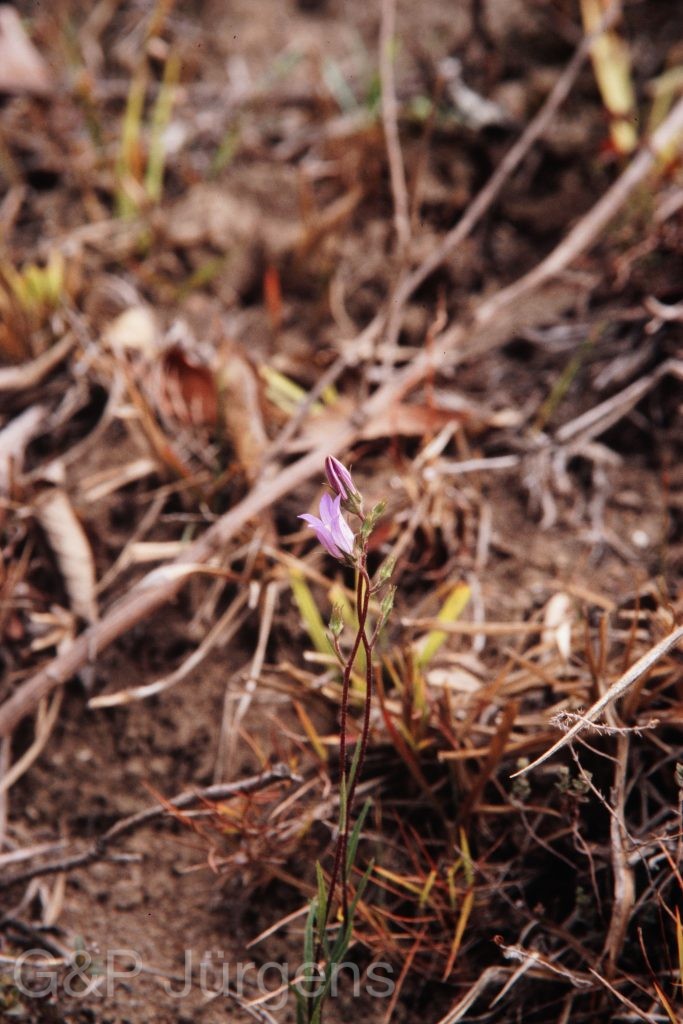
Campanula sylvatica Wall. is a Himalayan bellflower distributed along the temperate ranges from Pakistan and India through Nepal to Bhutan; the GBIF record of about 78 occurrences indicates a moderately frequent but regionally restricted endemic. As its epithet implies, it is a woodland and forest-margin herb of moist, shaded banks, clearings and grassy slopes in broad-leaved and mixed forest, broadly between 1500 and 3000 m. The photographed plant at Chongsakha in western Bhutan at about 1800 m, flowering in May, exemplifies its pre- to early-monsoon anthesis in the cool, humid mid-montane forest of the eastern Himalaya.

The species is an erect to ascending perennial or biennial herb with simple or sparingly branched, slender stems that are usually hispid or scabrid with stiff hairs. The leaves are alternate, ovate to lanceolate, toothed or crenate-serrate and shortly petiolate below, becoming sessile upward. The flowers are borne in a lax, leafy raceme or panicle, each nodding on a slender pedicel; the corolla is broadly campanulate, blue to violet-blue, divided to about a third into five spreading lobes, with a five-lobed calyx whose sinuses often bear reflexed appendages. The five stamens have dilated filament bases, and the inferior ovary ripens into a nodding capsule dehiscing by basal or lateral pores.

Campanula is a large, predominantly Holarctic genus, the Himalayan species forming a distinctive subtropical-to-temperate Asian element; C. sylvatica is recognised by its hispid stems and lax woodland inflorescence. It is taxonomically close to other Himalayan campanulas and has at times been confused in herbaria with allied forest taxa. As a fairly widespread endemic of relatively undisturbed forest, it is not formally assessed but may be locally affected by forest clearance; it has occasional value in rock and woodland gardens.

Author: Wall. · Sources: POWO (Kew), GBIF, Flora of Pakistan, Flora of Bhutan, Annotated Checklist of the Flowering Plants of Nepal, Lammers — World checklist and bibliography of Campanulaceae

(Royle ex Schindl.) Schindl.

Garw 2005 263 ergebnis
India Garwahl Kunol 2500m, September

Description

Campylotropis speciosa is a Sino-Himalayan shrub distributed across the warm-temperate and subtropical belts of the southern Himalaya and adjacent China, with verified records from India, Nepal, Pakistan, Bhutan, Bangladesh, Myanmar and China. The roughly 294 occurrences trace a continuous arc along the outer ranges. In the Garhwal Himalaya it occupies open hill slopes, forest margins and scrub at around 1900-2500 m, as documented by collections from Kunol (2500 m) and Sitel (1900 m) flowering in September. It favours sunny, well-drained rocky ground and is typically a component of secondary scrub and degraded oak forest.

It forms an erect, much-branched shrub to about 2 m, with ridged, finely pubescent young branchlets. The leaves are pinnately trifoliolate; leaflets are elliptic to obovate, the terminal one largest, rounded or emarginate at the apex and mucronate, glabrescent above and appressed-pubescent beneath, the stipules subulate and persistent. The showy flowers are borne in elongate, lax terminal and axillary racemes, each pedicel articulate and bearing a single papilionaceous corolla; the standard is broad and reddish-purple to violet, the keel incurved. The fruit is a small, flattened, indehiscent, one-seeded legume with a reticulate-veined surface.

The genus Campylotropis, allied to Lespedeza within tribe Desmodieae, is distinguished by its articulate pedicels and one-seeded pods. C. speciosa is among the more ornamental Himalayan species, valued for its long racemes. As a leguminous pioneer it aids nitrogen enrichment and slope stabilisation on disturbed ground; though not assessed as threatened, its dependence on open habitats makes it sensitive to forest succession and grazing.

Author: (Royle ex Schindl.) Schindl. · Sources: POWO (Kew), GBIF, Flora of China, Flora of Bhutan, Flora of Pakistan, Iokawa & Ohashi revision of Campylotropis

L.

Nepal 99 972 ergebnis
West-Nepal Dunai 2200m, July

Description

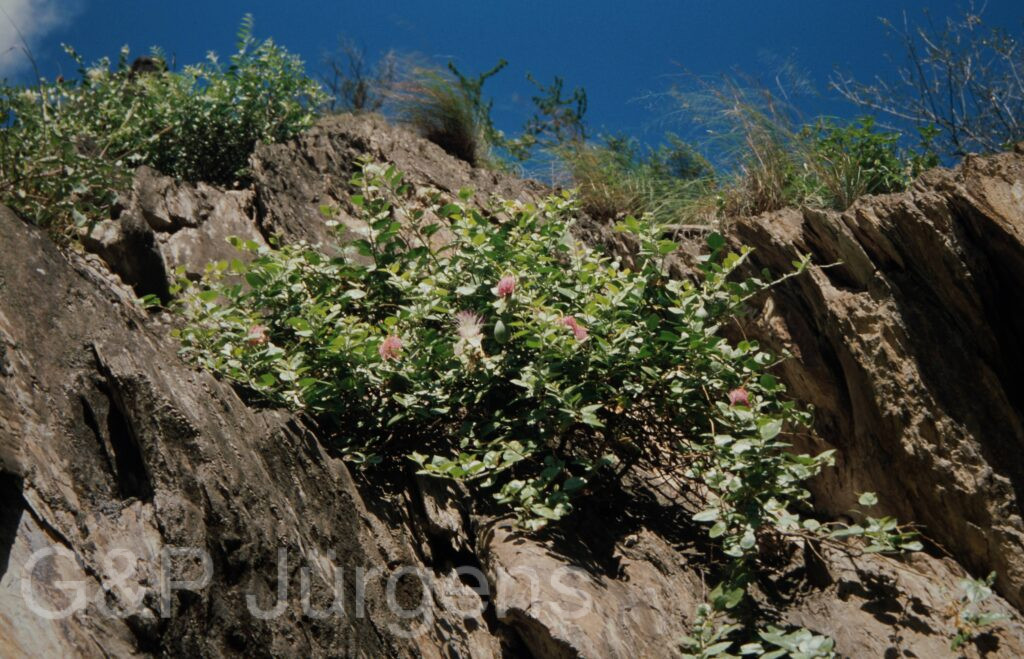
Capparis spinosa, the caper, is an exceptionally widespread sub-cosmopolitan plant of the warm-temperate, Mediterranean and arid subtropical zones, distributed from southern Europe, North Africa and the Middle East across Central Asia to the western Himalaya, Pakistan, India, China and Australia, with extensive naturalised and cultivated records worldwide; GBIF documents 22842 occurrences. It is a xerophyte of dry, sunny, stony habitats, colonising rocky outcrops, cliffs, walls, gravelly slopes and arid riverine flats. In the inner Himalaya it ascends the rain-shadowed valleys, as shown by the photographed plant from Dunai in West Nepal at 2200 m in July, growing in the dry trans-Himalayan terrain of the Dolpo region.

It is a spreading, often prostrate, deciduous shrub with trailing stems and a deep, woody perennial rootstock. The alternate leaves are simple, entire, fleshy, orbicular to obovate, and frequently subtended by a pair of recurved stipular spines, though spinescence is variable. The large, showy, short-lived flowers are solitary in the leaf axils, with four greenish sepals, four white to pinkish petals and a conspicuous brush of numerous long, purple-tinged stamens; the ovary is borne on a long gynophore. The fruit is an ellipsoid, fleshy, many-seeded berry that splits to reveal a pinkish pulp. The familiar capers of commerce are the pickled, unopened flower buds.

The species belongs to Capparis (Capparaceae), and is morphologically extremely variable across its vast range, having been split into numerous subspecies and varieties; here the family is given as in the source. Its flowers open at dusk and are pollinated by long-tongued bees and hawkmoths, while the fleshy berries are dispersed by birds and lizards. Drought-adapted, valued as a food and medicinal plant and cultivated commercially, it is abundant and of least conservation concern.

Author: L. · Sources: POWO (Kew), GBIF, Flora of China Vol. 7, Flora of Pakistan, Flora of Nepal, Capparis spinosa species complex revision (Inocencio, Rivera & al.)

(Wall.) Makino

Garh 07 234 ergebnis
India Garwahl Trijugi Narayan 2250m, June
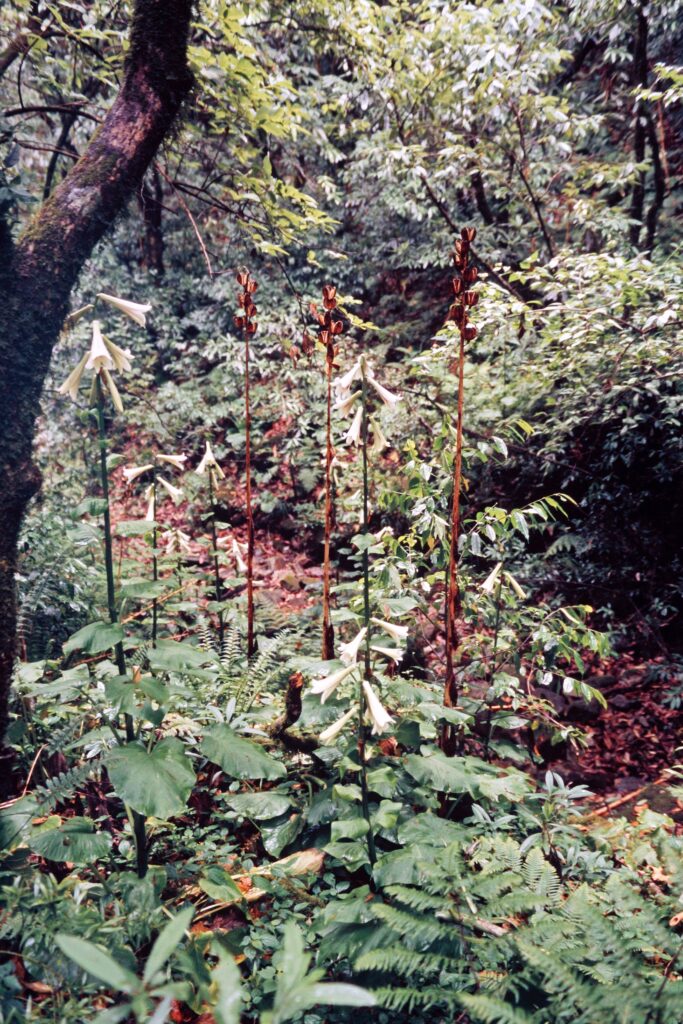
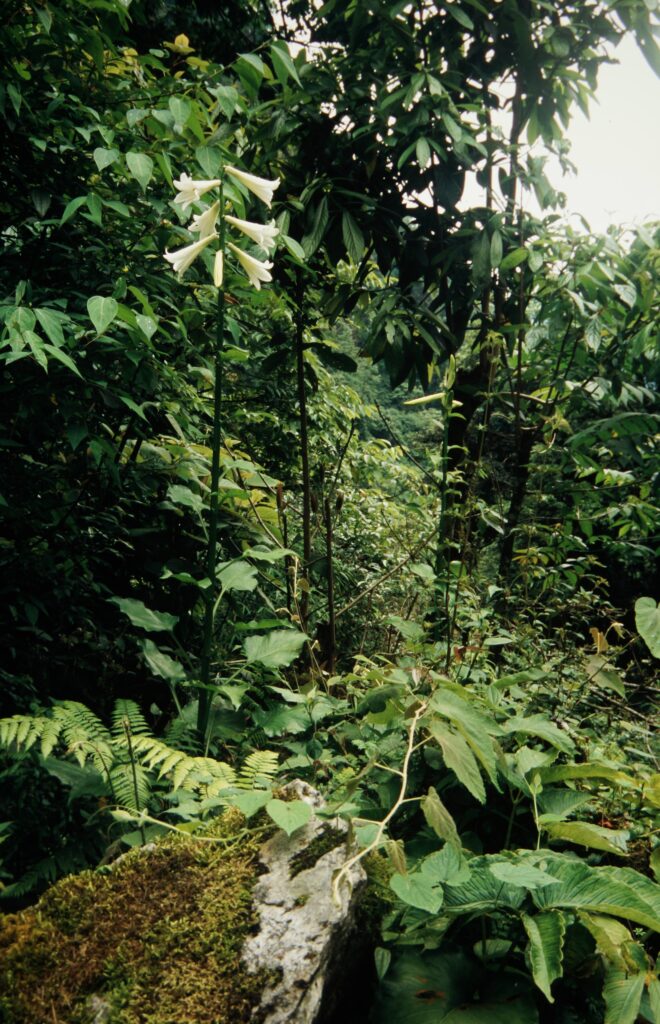
Sikkim 2006 469 ergebnis
Sikkim Ringi Chu 2200, May
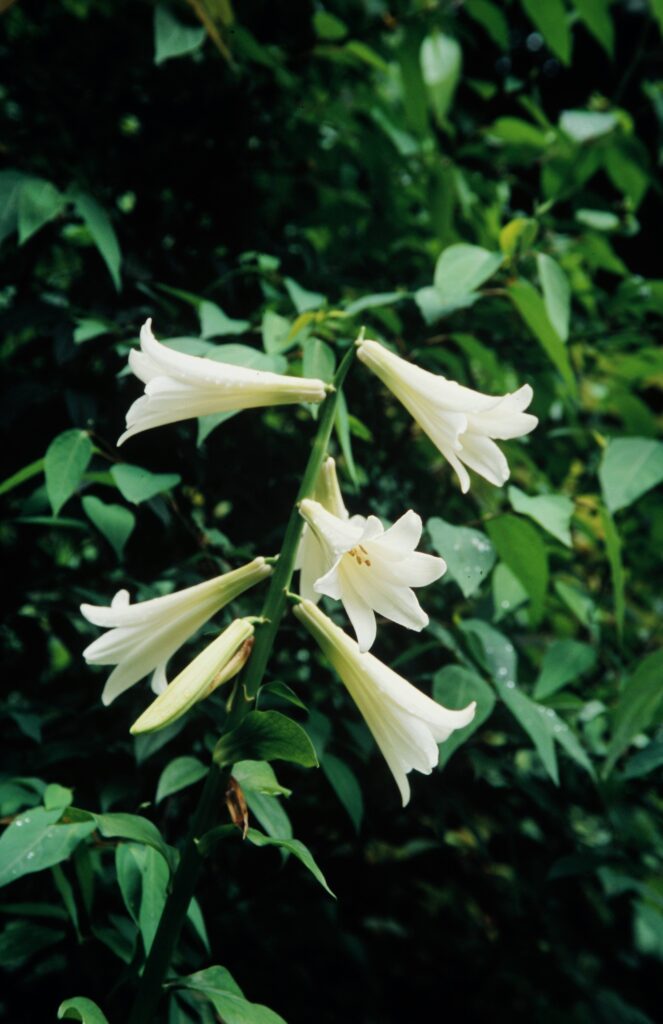
Sikkim 2006 471 ergebnis
Sikkim Ringi Chu 2200, May

Description

Cardiocrinum giganteum is the world's largest lily, distributed from central Nepal through Sikkim, Bhutan, and northeast India into upper Myanmar and southwestern China (Yunnan, Sichuan, Xizang). With over 1,370 occurrences recorded on GBIF, it is well-documented across its range. The species inhabits moist, shaded ravines and openings in temperate broadleaved and mixed forests at elevations of 1,500–2,800 m, favouring deep, humus-rich soils under canopies of Magnolia, Acer, and Rhododendron.
Cardiocrinum giganteum is a monocarpic perennial growing from a large, conical bulb up to 15 cm in diameter. In its final flowering year, the plant produces a stout, hollow stem reaching 1.5–3.5 m in height. Basal leaves are broadly cordate, glossy dark green, up to 45 cm long, with a conspicuous reticulate venation. The inflorescence is a terminal raceme of 10–20 large, trumpet-shaped, fragrant flowers, each 15–20 cm long, white with maroon-purple streaking inside the throat. The six tepals are slightly recurved at the tips. The fruit is an oblong, erect capsule, 4–6 cm long, containing numerous flat, winged seeds adapted for wind dispersal. After flowering and fruiting, the parent bulb dies, but several daughter bulblets persist at the base, requiring 5–7 years to reach flowering size.
The species was first described from material collected by Nathaniel Wallich in Nepal. The photographed specimens from Trijugi Narayan in Garhwal (2,250 m) and Ringi Chu in Sikkim (2,200 m) represent populations near the western and central portions of the range, respectively. Though widely cultivated in temperate gardens, wild populations face pressure from habitat fragmentation and collection. The var. yunnanense, sometimes recognized from southwestern China, differs in its bronze-flushed foliage, but its taxonomic distinctness remains debated.

Author: (Wall.) Makino · Sources: POWO (Kew), GBIF, Flora of China Vol. 24, Flora of Bhutan Vol. 3, Grierson & Long (1983)