Tag:

Spring

Kurz

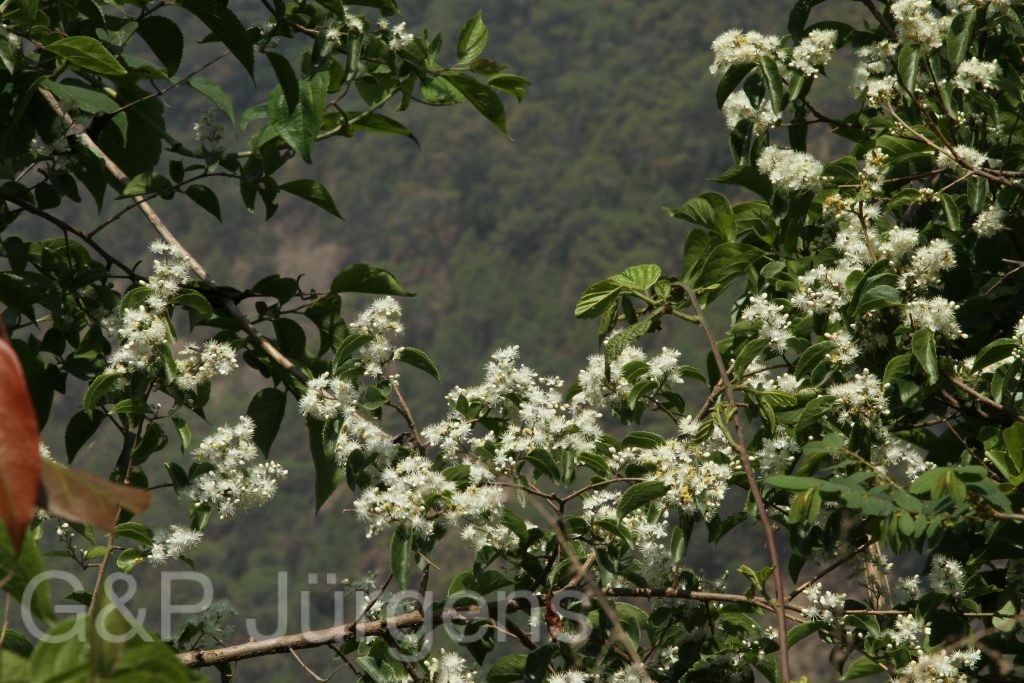
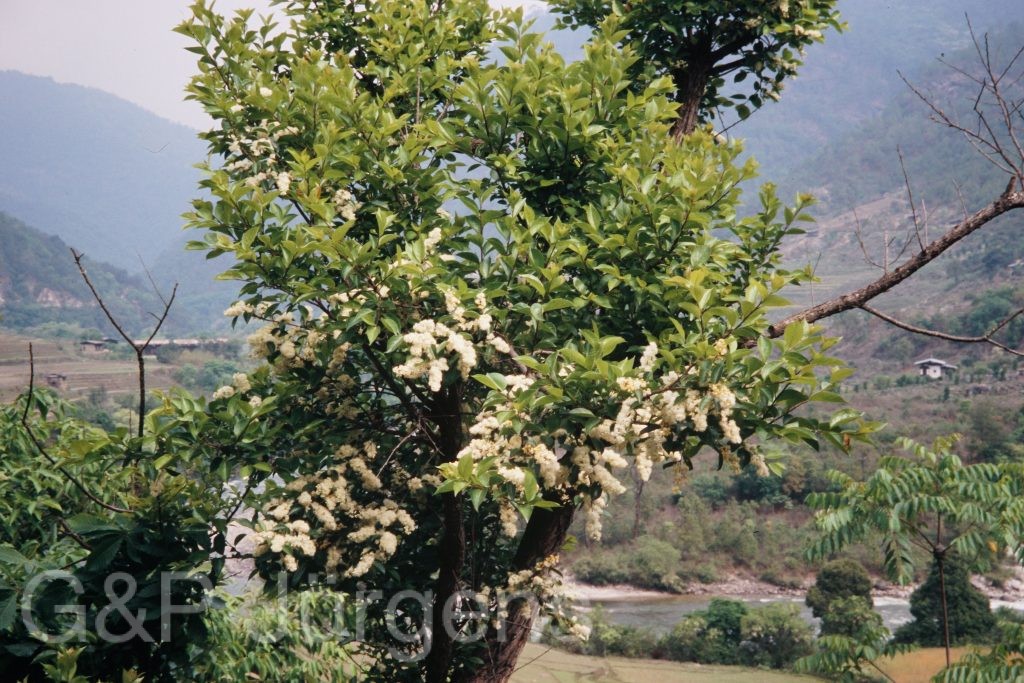
Bhutan2014 1072
Bhutan Paro 2400m, May

Description

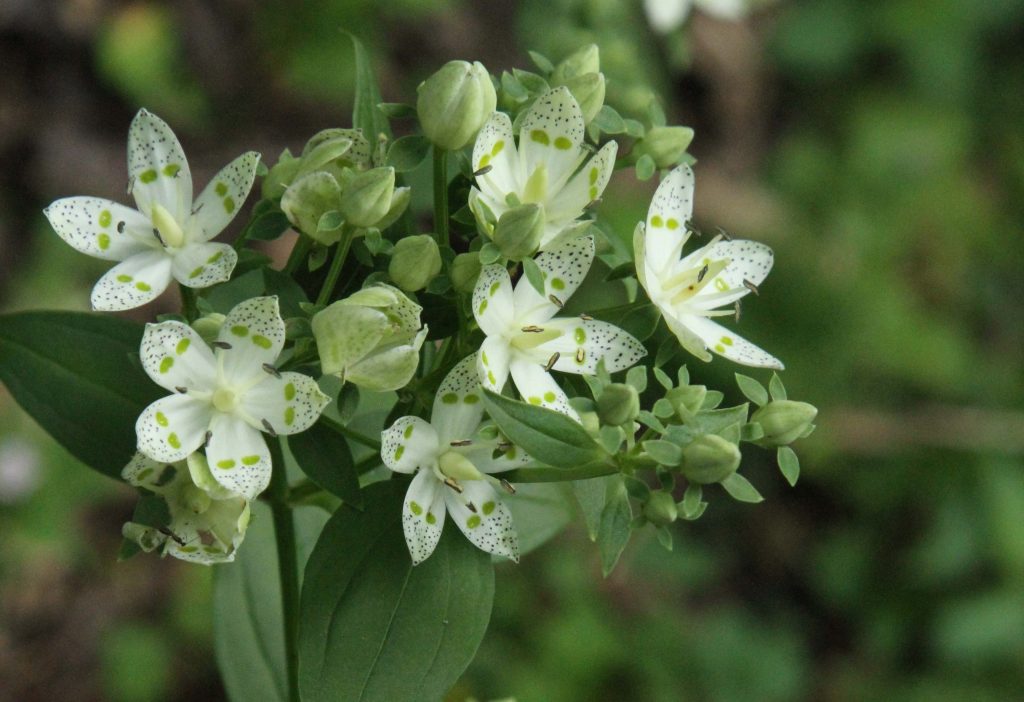
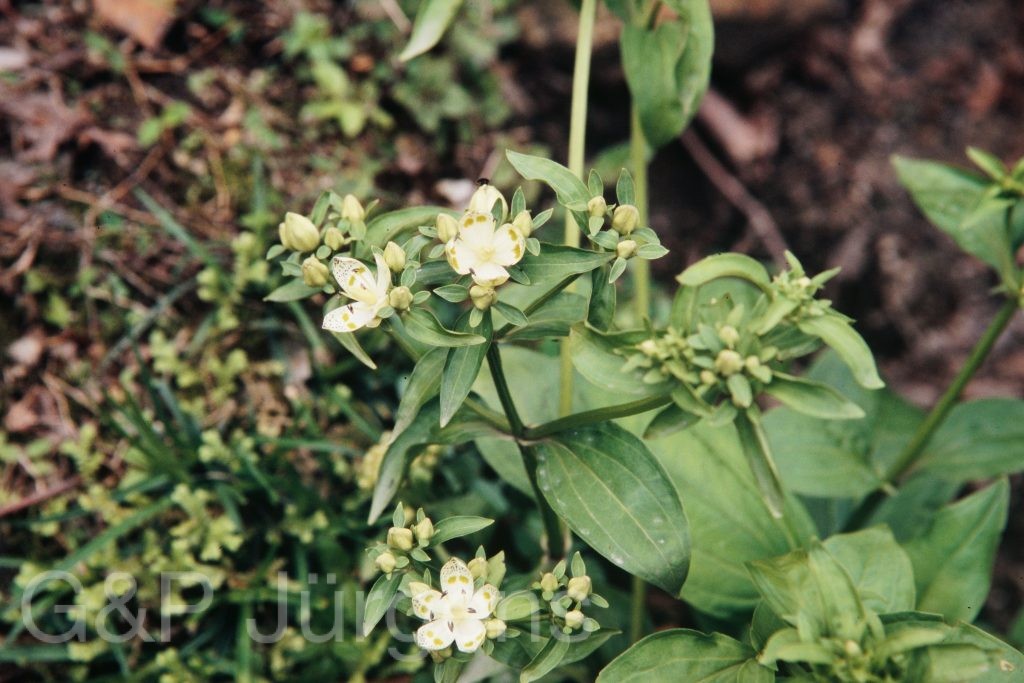
Stellaria vestita is a widespread chickweed of tropical and subtropical Asia, ranging from the Himalaya through southern China and Taiwan to Indochina, the Malesian archipelago, the Philippines and New Guinea, and eastward to Japan and Korea; GBIF records over 2,000 occurrences. It grows in open forest, scrub, grassy slopes, hedgerows and disturbed ground, generally from low elevations to about 2,800 m. The individual photographed near Paro in western Bhutan at 2,400 m in May reflects its presence in the temperate mid-montane belt of the eastern Himalaya, on moist, partially shaded banks and forest margins.

It is a perennial herb with weak, ascending to straggling stems 30-90 cm long, terete and densely clothed throughout with spreading white hairs, hence the epithet vestita ('clothed'). The leaves are opposite, sessile or shortly petiolate, ovate to ovate-lanceolate, 1-4 cm long, acuminate and pubescent on both surfaces. The inflorescence is a lax, dichasial cyme of several flowers on slender pedicels. Each flower has five lanceolate, pubescent sepals and five white petals deeply cleft nearly to the base into two lobes, the petals about equalling the calyx; there are typically ten stamens and three styles. The fruit is an ovoid capsule dehiscing by six valves and containing several reniform, tuberculate seeds.

Within the large and taxonomically complex genus Stellaria, S. vestita is recognised by its dense indumentum, deeply bifid petals and pantropical Asian distribution, features separating it from the S. media group and from glabrous montane species. The deeply two-lobed white petals are typical of the genus and aid pollination by small insects, while the many-seeded capsules favour effective local dispersal. As a common, weedy and ecologically tolerant species occupying a wide range of habitats and elevations, it is of least concern and faces no recognised conservation threat.

Author: Kurz · Sources: POWO (Kew), GBIF, Flora of China, Flora of Bhutan, Annotated Checklist of the Flowering Plants of Nepal, Caryophyllaceae monograph
L.

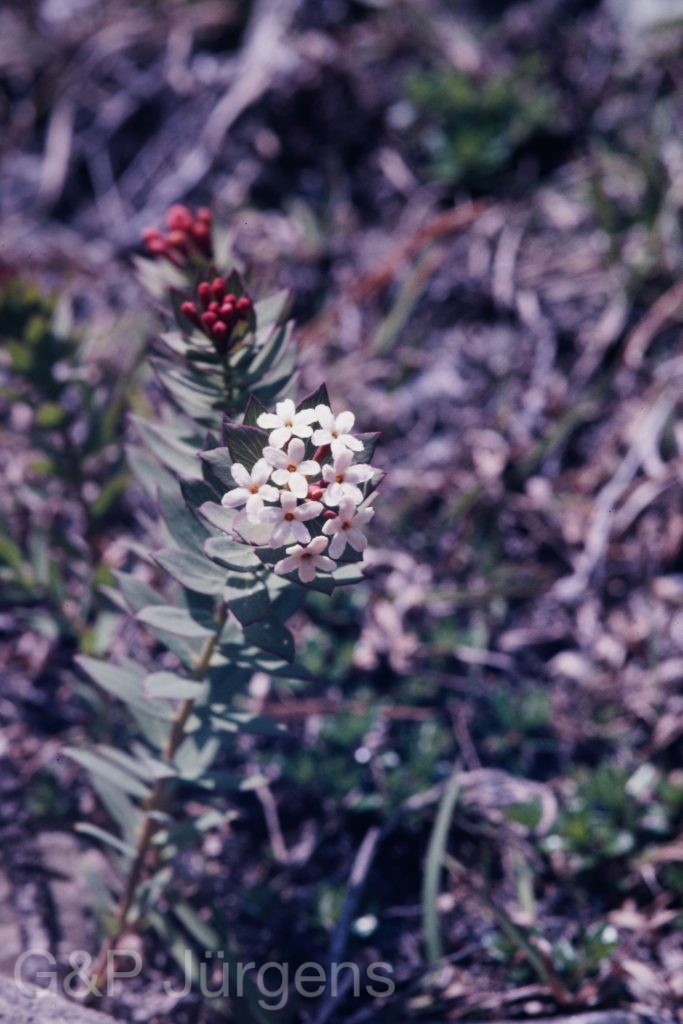
Nepal 1989 65
Nepal Bhatang 2915m, April
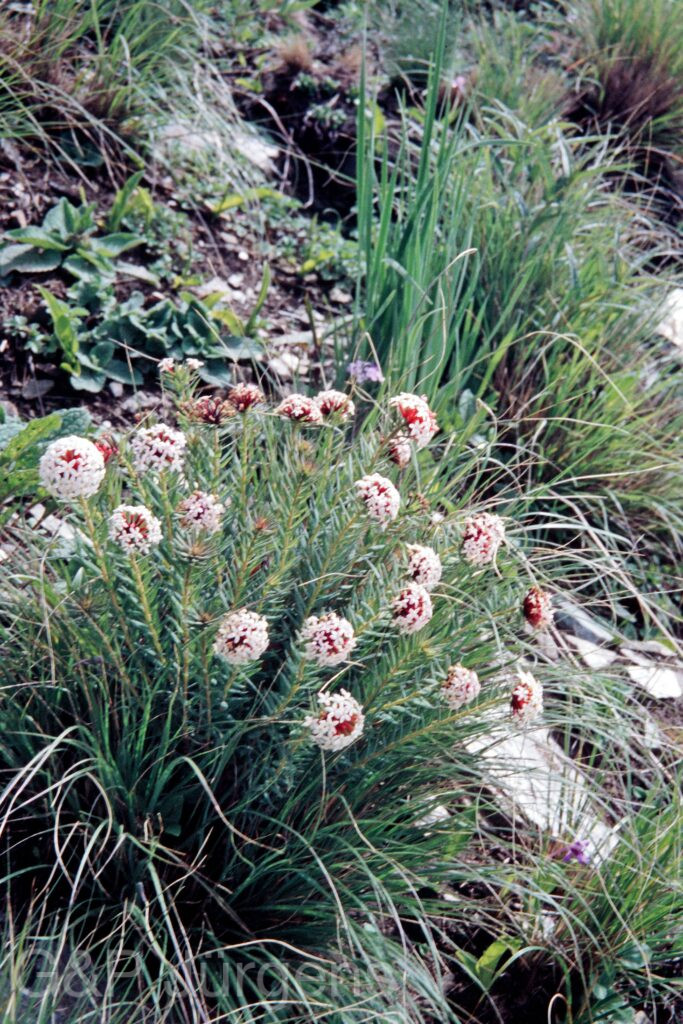
Nepal 99 362 ergebnis
West-Nepal Kalomura 3600m, June

Description

Stellera chamaejasme is a widespread perennial herb of the dry uplands of Central and East Asia, recorded by GBIF from China, Russia, Mongolia, Nepal, India, Bhutan, Kazakhstan, Korea, Iran and Turkey, among others, across some 3,400 georeferenced occurrences. It is characteristic of arid and semi-arid grasslands, alpine and subalpine meadows, sunny rocky slopes and overgrazed pastures on the Tibetan Plateau and throughout the trans-Himalaya, generally between about 2,600 and 4,500 m. The cited Nepalese records, from Bhatang at 2,915 m in April and from Kalomura in West Nepal at 3,600 m in June, span its lower temperate and upper subalpine occurrences and bracket its long spring-to-summer flowering season. It thrives on poor, dry soils where grazing has reduced competing vegetation.

The plant grows from a thick, woody, deep-seated taproot and rootstock, producing numerous erect, slender, unbranched leafy stems in a dense tuft. The leaves are numerous, alternate, crowded, narrowly lanceolate to elliptic, sessile and entire. The flowers are borne in a dense terminal capitate head; each flower lacks petals but has a showy, petaloid, tubular calyx whose five spreading lobes are commonly white above and flushed rose-red to purplish in bud on the outside, producing a striking bicoloured head. There are typically ten stamens in two whorls within the calyx tube, and the fruit is a small dry achene-like nutlet enclosed in the persistent base of the perianth.

Stellera chamaejasme is the best-known species of its genus within Thymelaeaceae and is notorious as a toxic, unpalatable indicator of rangeland degradation; its expansion is regarded across Tibet and Mongolia as a sign of overgrazing, since livestock avoid the poisonous foliage and roots. The plant is rich in bioactive diterpenoids and lignans and has a long history in Tibetan and Chinese traditional medicine, while its tough bast fibres have been used in papermaking. Though abundant and in no way threatened, it is ecologically significant as both a grassland weed and a chemically defended species of considerable pharmacological interest.

Author: L. · Sources: POWO (Kew), GBIF, Flora of China Vol. 13, Flora of Bhutan Vol. 2, Flora of Nepal, Flora of Pakistan, Tan & Wang: revision of Asian Thymelaeaceae and the Stellera complex

Roxb.

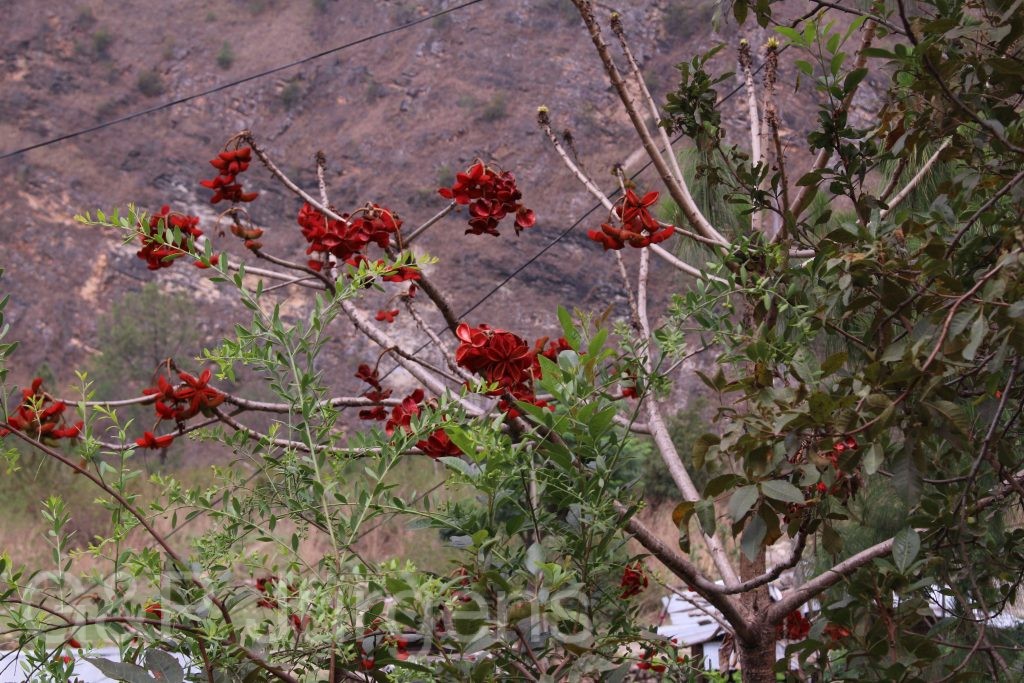
Bhutan2014 253
Bhutan Karu-Chu 1800m, May
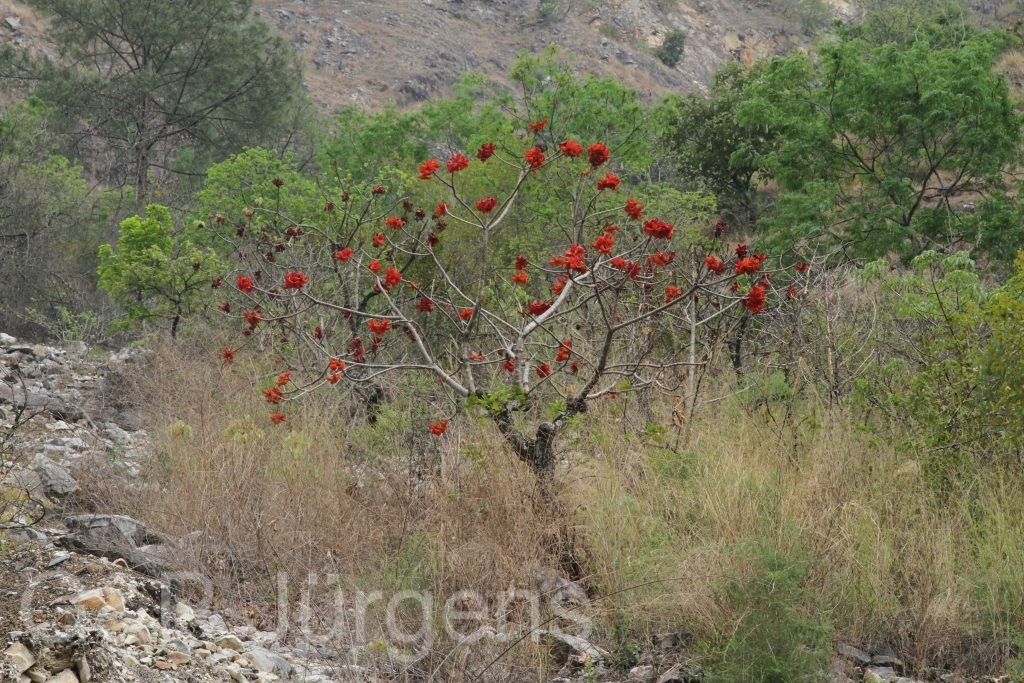
Bhutan2014 264
Bhutan Karu-Chu 1800m, May

Description

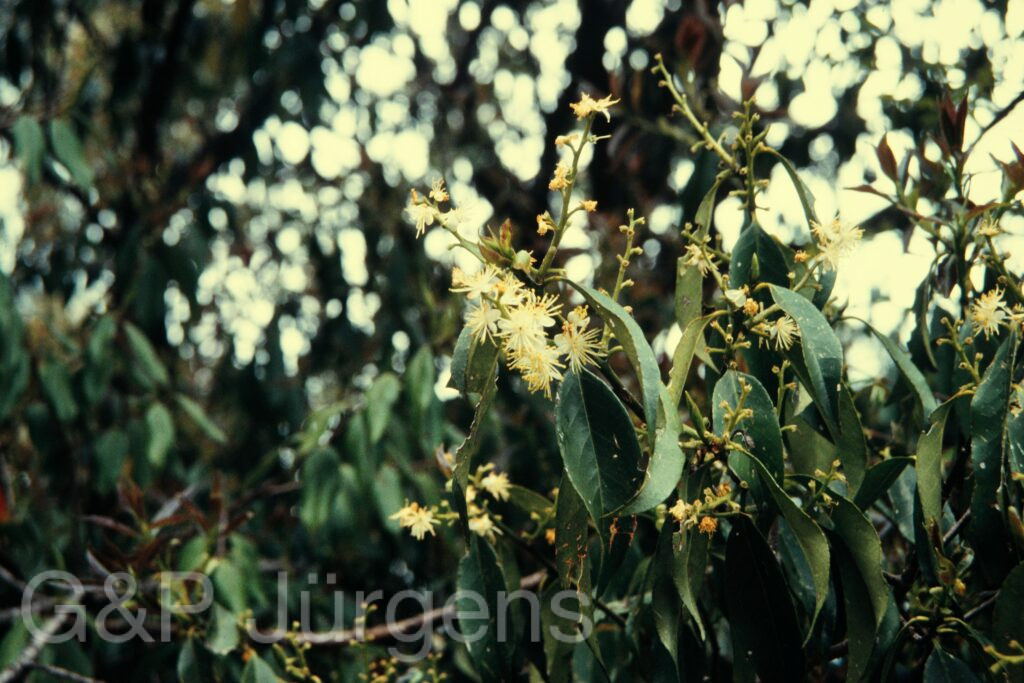
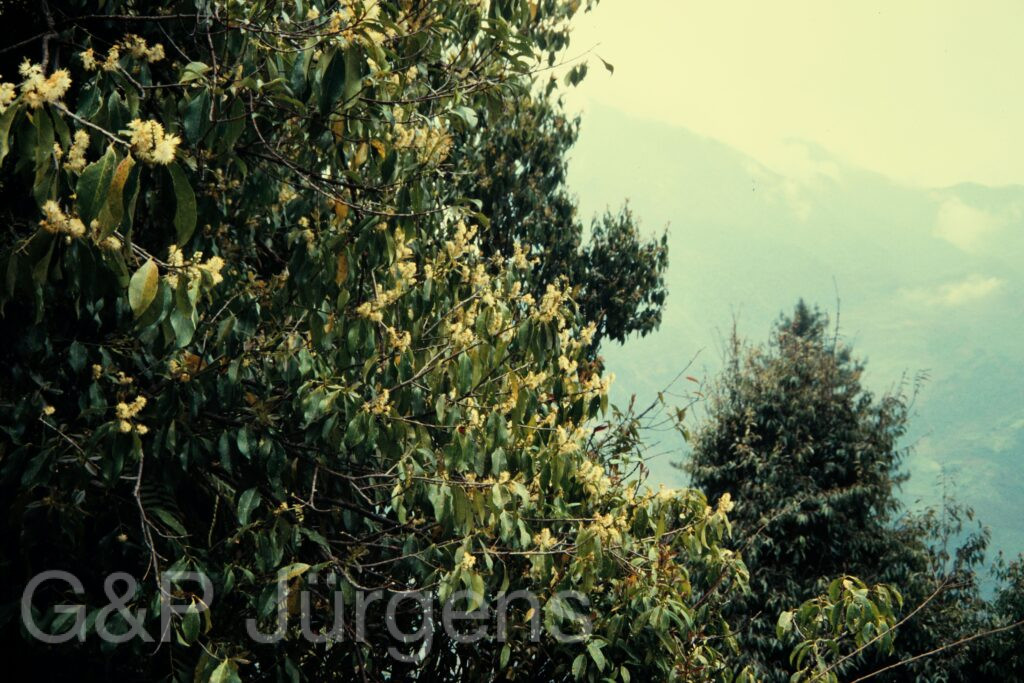
Sterculia villosa is a deciduous tree widely distributed across tropical and subtropical Asia, from India, Nepal, Bangladesh, Bhutan and Sri Lanka eastward through Myanmar, Thailand, Vietnam, southern China and into Malesia (Malaysia, Indonesia), with the 452 GBIF records reflecting both this native range and cultivated or naturalised occurrences elsewhere. It is a tree of monsoon and deciduous forest, riverine valleys and disturbed slopes at low to moderate elevations, generally below about 1500 m though reaching higher in warm valleys. The photographed individual from the Karu-Chu valley in Bhutan at around 1800 m, flowering in May before or with the new leaves, marks the upper, warm-temperate edge of its range.

The tree has a straight bole, grey bark and stout branches, the young parts densely clad in soft tawny villous hairs from which the epithet derives. The large, alternate leaves are palmately lobed with 5-7 broad lobes, cordate at the base and long-petioled, hairy beneath. The flowers, borne in much-branched velvety panicles, are apetalous, with a campanulate, lobed, reddish to greenish-yellow calyx; the species is andromonoecious with a central androgynophore. The fruit is the characteristic sterculiaceous group of large, woody, beaked, velvety follicles that dehisce to expose black seeds against a red interior.

Formerly placed in Sterculiaceae, the genus Sterculia is now treated within an enlarged Malvaceae (subfamily Sterculioideae), as adopted here. S. villosa is economically valued for its strong bast fibre, used for ropes and cordage, and yields a gum; its bark and seeds feature in local medicine. As a fast-growing, light-demanding species of disturbed and secondary forest it is widespread and not of conservation concern, though it is locally significant in agroforestry and as a host for lac and silk insects.

Author: Roxb. · Sources: POWO (Kew), GBIF, Flora of Bhutan, Flora of British India, Flora of China, Kostermans Sterculiaceae monograph

Siebold & Zucc.

Sikkim 2006 330 ergebnis
India West-Bengal, Tolung 2450m, May

Description

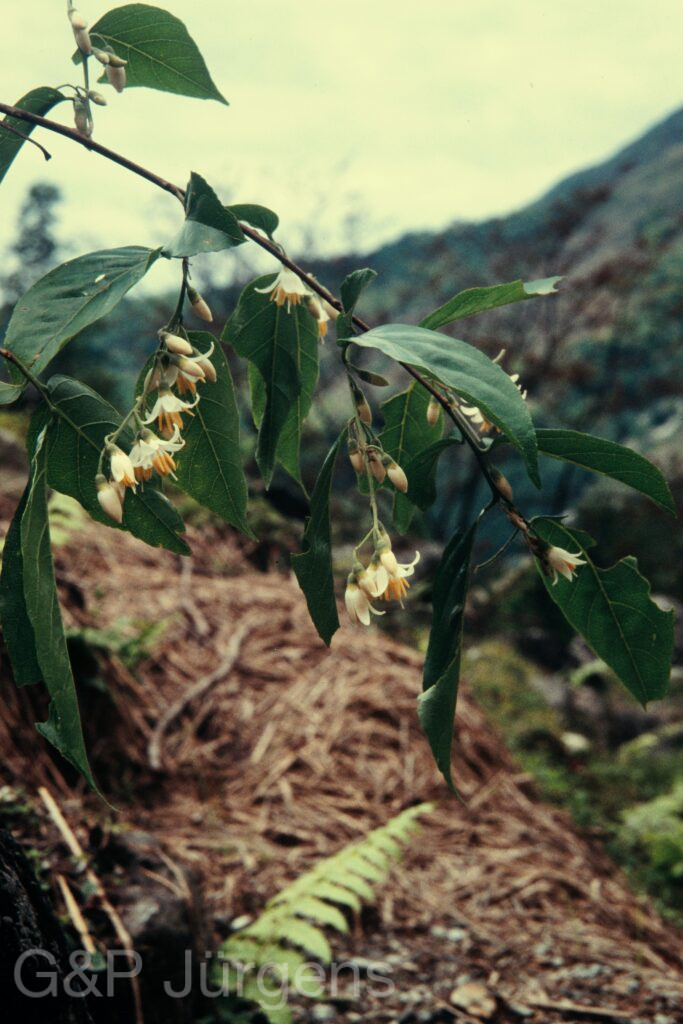
Styrax japonicus, the Japanese snowbell, is a deciduous shrub or small tree of the Styracaceae, distributed through temperate East Asia and extending into the eastern Himalaya. GBIF data (over 16,000 occurrences) reflect its native range across Japan, Korea, China, Taiwan, Myanmar and the eastern Himalaya, together with extensive cultivation in temperate gardens worldwide. In the wild it grows in deciduous and mixed broadleaved forest, on slopes, along streams and at forest margins, in the warm-temperate to lower montane belt. The collection from Tolung in West Bengal at 2,450 m in May illustrates its occurrence in the moist montane forests of the eastern Himalaya at flowering time.

The tree reaches up to about 10 m, with smooth grey bark and slender, often horizontally spreading branches. The leaves are alternate, simple, ovate to elliptic, with a finely serrate margin and an acuminate apex. The flowers are pendulous and borne singly or in few-flowered racemes from the leaf axils on slender pedicels; the white, bell-shaped corolla is deeply five-lobed and fragrant, subtended by a small cupular calyx, with about ten stamens forming a central column of yellow anthers. The fruit is an ovoid to subglobose, greyish, slightly tomentose drupaceous capsule containing usually a single hard seed.

The Styracaceae is a small family of woody plants notable as a source of aromatic balsamic resins (benzoin, storax) yielded by certain Styrax species. S. japonicus is among the most widely planted ornamentals of the family, valued for its profuse, snowbell-like spring flowers. Its disjunct occurrence in the eastern Himalaya is of biogeographic interest, reflecting the floristic links between the Sino-Japanese region and the eastern Himalaya; though broadly secure, its forest populations there depend on intact montane woodland.

Author: Siebold & Zucc. · Sources: POWO (Kew), Flora of China Vol. 15, Flora of Bhutan Vol. 2, GBIF, Hwang & Grimes: Styracaceae – Flora of China account

Roxb.

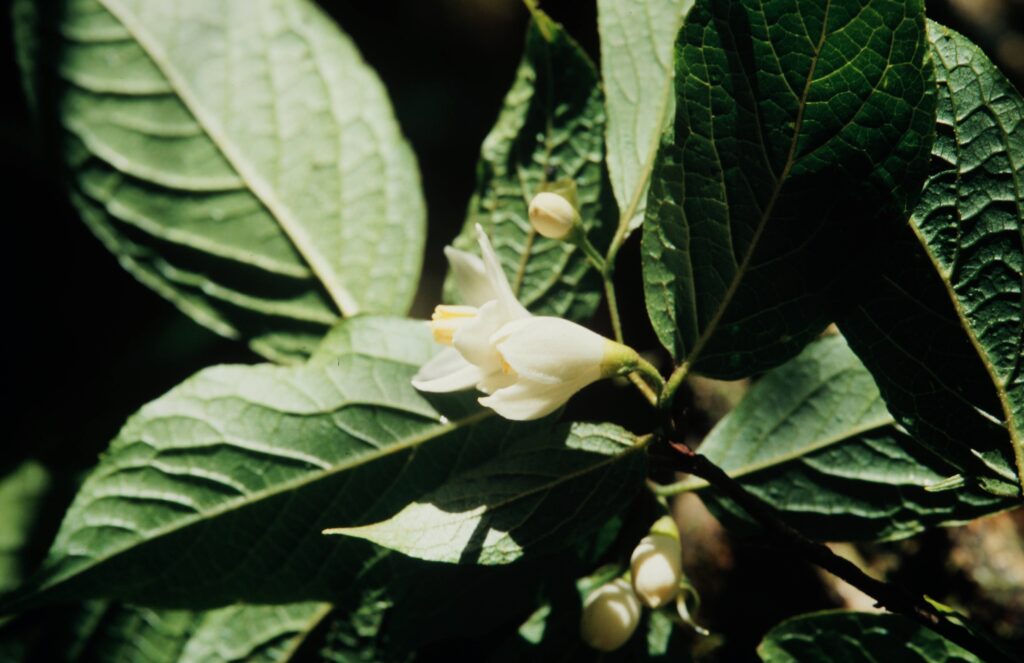
Nepal 97 399 P770
Nepal Arun-Valley 1750m April
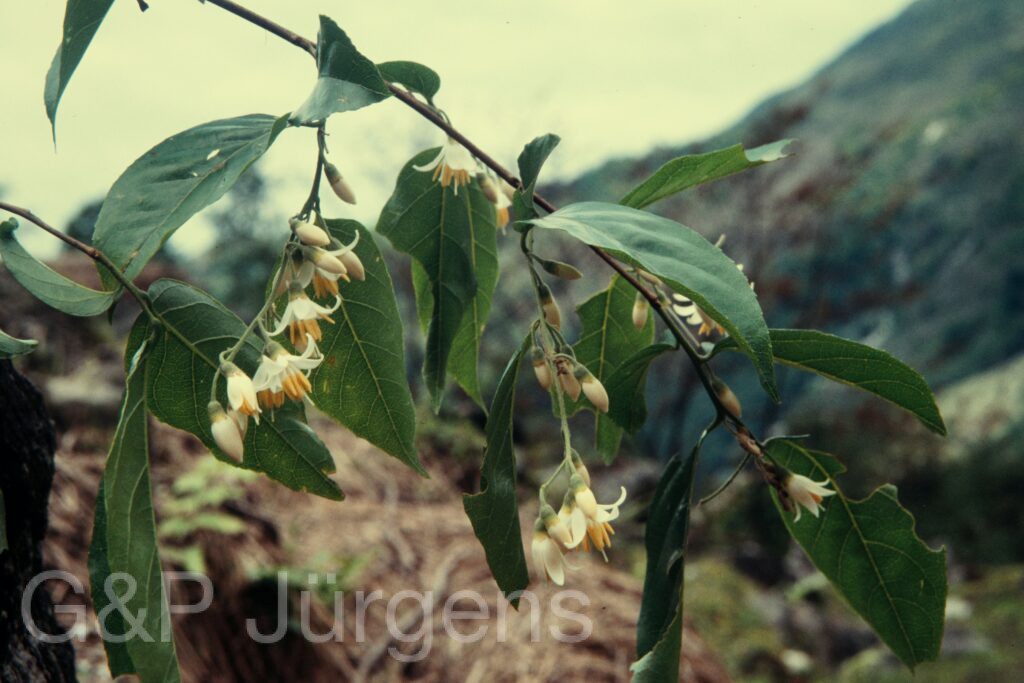
Nepal 97 400 P771
Nepal Arun-Valley 1750m April

Description

Styrax serrulatus is a small tree or shrub of the eastern Himalaya and mainland Southeast Asia, distributed from India and Nepal through Bhutan, Bangladesh, Myanmar, Thailand, Laos, Vietnam and southern China to Malaysia and Indonesia, with around 395 GBIF records (the few from Korea and the United States reflecting cultivation). It grows in subtropical to lower-temperate broad-leaved evergreen and mixed forest, forest margins and along streams, generally between about 1,000 and 2,400 m. The plant photographed in the Arun Valley of eastern Nepal at 1,750 m, flowering in April, exemplifies its spring anthesis in the warm, humid mid-elevation forests of the eastern Himalaya.

The plant is a deciduous to semi-evergreen shrub or small tree, the young branchlets, buds and lower leaf surfaces clothed in characteristic stellate hairs. The leaves are alternate, simple, elliptic to ovate-oblong with finely serrulate margins (as the epithet indicates), shortly petiolate and acuminate. The flowers are borne in short axillary or terminal racemes; each is white and fragrant, with a five-lobed campanulate calyx and a five-lobed, deeply divided corolla, the ten stamens united at the base into a short tube. The fruit is a subglobose, dry to leathery drupe-like capsule, often crowned by the persistent calyx, containing one or few seeds.

Styrax is the principal genus of the family Styracaceae, several species of which yield aromatic resins (benzoin). The genus has a notable disjunct distribution between eastern Asia and the Americas, and S. serrulatus belongs to its species-rich Asian assemblage. Widespread and occurring in both primary and secondary forest, it is not considered threatened.

Author: Roxb. · Sources: POWO (Kew), Flora of China Vol. 15, Flora of Bhutan Vol. 2, GBIF, Hwang & Grimes: Styracaceae monographic treatments

Sunhangia elegans

by GP Jürgens

(DC.) H.Ohashi & K.Ohashi.

Bhutan2014 125
Bhutan Trashigang 1570m, May
Bhutan2014 126
Bhutan Trashigang 1570m, May

Description

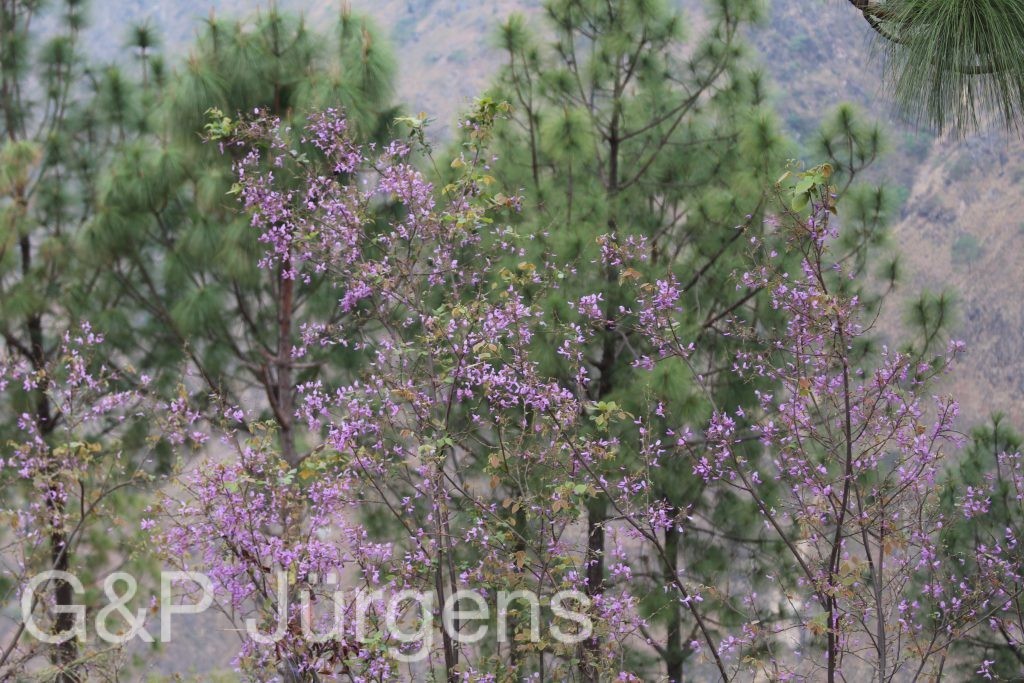
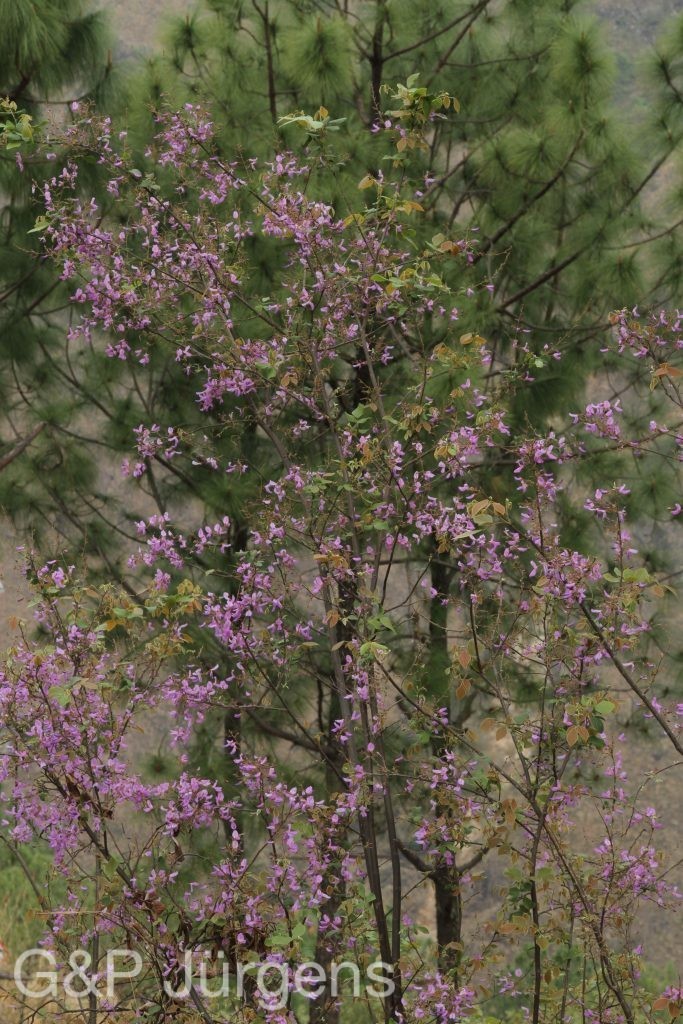
Sunhangia elegans—long familiar as Desmodium elegans—is a shrubby legume widely distributed through the Himalaya and adjoining mountains of China, Nepal, India, Pakistan and Bhutan, with around 1611 occurrence records; the scatter of points in distant countries largely reflects cultivation and naturalisation of this popular ornamental. It grows on open hillsides, forest margins, scrub, roadsides and disturbed slopes, mostly in the warm-temperate to subtropical montane belt. The illustrated plant from Trashigang in eastern Bhutan at 1570 m, flowering in May, sits within this characteristic mid-elevation habitat.

It is a deciduous shrub with arching, much-branched stems bearing trifoliolate leaves; the leaflets are rhombic-ovate to broadly elliptic, the terminal one largest, green above and paler and finely pubescent beneath. The inflorescences are terminal and axillary panicles of many papilionaceous flowers ranging from pale lilac and pink to purple, with the typical standard, wing and keel petals and diadelphous stamens. The fruit is a flattened, jointed loment constricted between the seeds and breaking into one-seeded articles whose hooked hairs cling to fur and clothing, effecting epizoochorous dispersal.

The genus Desmodium has recently been dismembered on molecular evidence, with several Asiatic species transferred by H. Ohashi and K. Ohashi to segregate genera, here placed in Sunhangia, with the accepted combination Sunhangia elegans. Like other members of the tribe Desmodieae it forms root nodules with nitrogen-fixing rhizobia, enriching poor montane soils, and is valued both as fodder and as a hardy garden shrub. It is widespread and faces no recognised conservation concern.

Author: (DC.) H.Ohashi & K.Ohashi. · Sources: POWO (Kew), GBIF, Flora of China (Fabaceae), Annotated Checklist of the Flowering Plants of Nepal, Grierson & Long Flora of Bhutan, Ohashi & Ohashi's revision of the Desmodium group (Leguminosae)

(Siebold & Zucc.) Hook. f. & Thomson ex C.B. Clarke

Bhutan2012 354
Bhutan Doch-La, 3000m September
Bhutan2012 355
Bhutan Doch-La, 3000m September
Bh2008 65 P106
Bhutan Punaka-Chu, 1600m April

Description

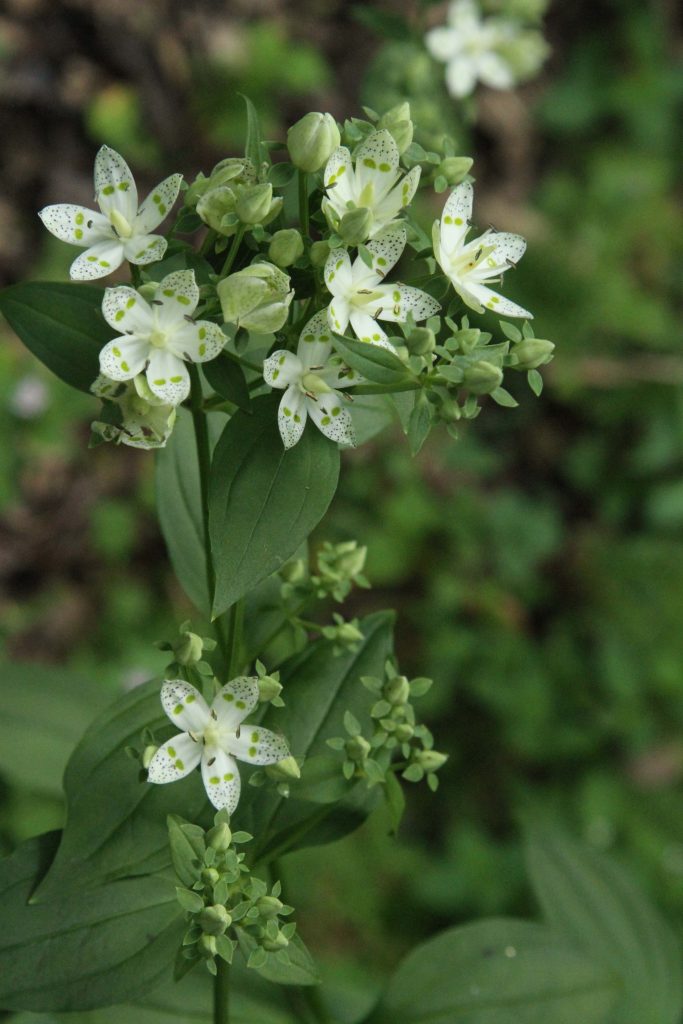
Swertia bimaculata is a widely distributed Asian gentian recorded by GBIF in nearly 3,942 occurrences spanning China, Japan, Korea, India, Bhutan, Nepal, Myanmar, Indonesia, Malaysia and Vietnam, making it one of the most far-ranging members of its genus. It occupies forest margins, grassy slopes, meadows and streamsides over a broad altitudinal span from lowland valleys to the subalpine zone. The Bhutanese collections illustrated, one from the Dochu La at 3000 m flowering in September and another from the Punakha Chu at 1600 m in April, demonstrate both its wide elevational tolerance and a flowering season extended by the diversity of habitats it occupies.

The species is a tall, erect annual or biennial herb with an angular, often branched stem arising from a slender taproot. The leaves are opposite, sessile to short-petiolate and broadly elliptic to lanceolate, with prominent arcuate veins. Flowers are numerous in a large, lax terminal panicle; the corolla is rotate and deeply four- to five-lobed, the lobes pale greenish-white to yellowish and finely dotted or streaked with purple. Each lobe bears two conspicuous dark glandular nectaries—the paired "two spots" of the epithet bimaculata—fringed with long fimbriae. The superior ovary develops into a narrowly ovoid septicidal capsule releasing many small seeds.

Swertia is a taxonomically complex, pharmacologically notable genus whose bitter secoiridoid-rich species are widely used in traditional Asian medicine, and S. bimaculata is among those harvested for such purposes. The fringed nectary glands and spotted corolla attract bees and flies that effect cross-pollination. Despite its medicinal exploitation the species remains common and ecologically plastic across its enormous range and is not regarded as threatened.

Author: (Siebold & Zucc.) Hook. f. & Thomson ex C.B. Clarke · Sources: POWO (Kew), GBIF, Flora of China, Flora of Bhutan, Flora of Japan, Revision of the Genus Swertia (Hara)

S.Moore

Nepal 97 95 P157
Nepal Dongen 2300m April
Nepal 97 94 P155
Nepal Dongen 2300m April

Description

Symplocos cochinchinensis is one of the most widely distributed members of the Symplocaceae, with an extraordinary pantropical range extending from West Africa across Madagascar and the Indian subcontinent through mainland and insular Southeast Asia, China, Japan, Taiwan, the Philippines, Papua New Guinea, Australia, and into the western Pacific islands. GBIF records nearly 5,840 occurrences from more than 20 countries. In the Himalayas, the species inhabits subtropical and warm-temperate evergreen broadleaved forests at 800–2,500 m elevation. At Dongen in eastern Nepal at 2,300 m, it occurs in the canopy and sub-canopy layer of Schima–Castanopsis forests, where it flowers in the pre-monsoon month of April.
Symplocos cochinchinensis is an evergreen tree or large shrub, typically 5–15 m tall, occasionally reaching 25 m. The bark is smooth, greyish-brown. Leaves are alternate, elliptic to oblong-elliptic, 7–15 cm long, with an acuminate apex, cuneate base, and serrate to crenate-serrate margins; the upper surface is glabrous and dark green, while the lower surface may be sparsely pubescent along the midrib. The inflorescence is an axillary raceme or panicle, 3–8 cm long, bearing numerous small, fragrant white flowers. Each flower has a five-lobed calyx, five petals fused at the base, and numerous stamens (20–60) in several series. The fruit is a cylindric to ovoid drupe, 5–8 mm long, dark blue to black at maturity, crowned by the persistent calyx lobes.
The vast geographical range of Symplocos cochinchinensis has led to considerable infraspecific taxonomic complexity, and numerous varieties and subspecies have been described. The treatment in POWO recognises several subspecies, with the Himalayan populations generally referred to subsp. laurina. The species is ecologically significant as a component of mid-elevation broadleaved forests across the Old World tropics and plays a role in forest regeneration on disturbed sites. In parts of South and Southeast Asia, the leaves and bark have traditional uses as a mordant in textile dyeing owing to their high aluminium content.

Author: S.Moore · Sources: POWO (Kew), GBIF, Flora of China Vol. 15, Flora of Nepal Checklist, Nooteboom: Symplocaceae in Flora Malesiana Ser. I, Vol. 8 (1977)

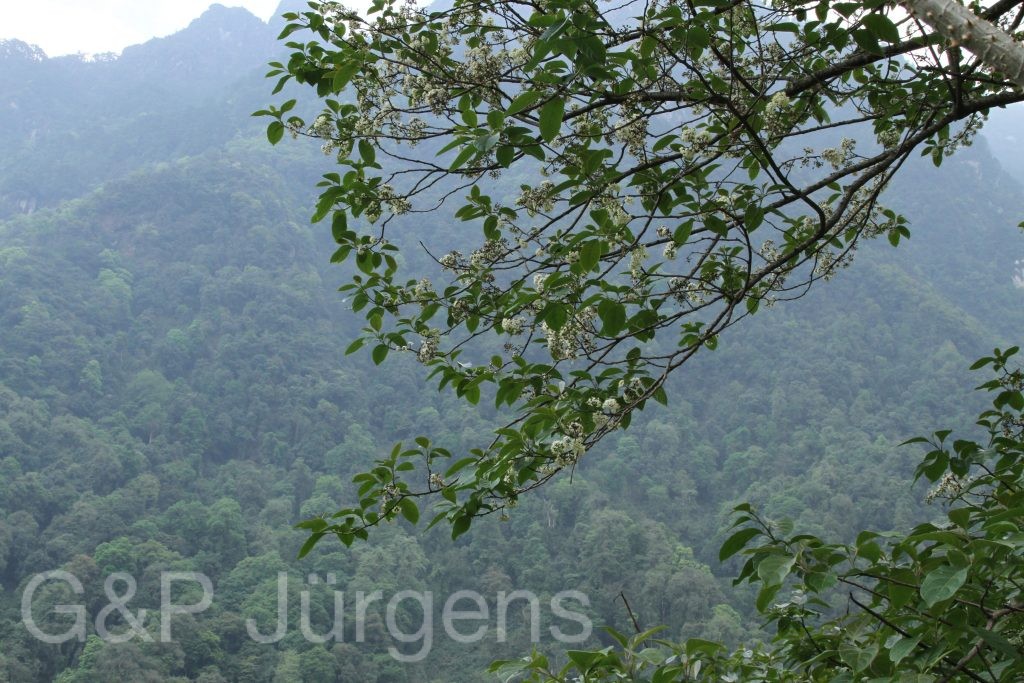
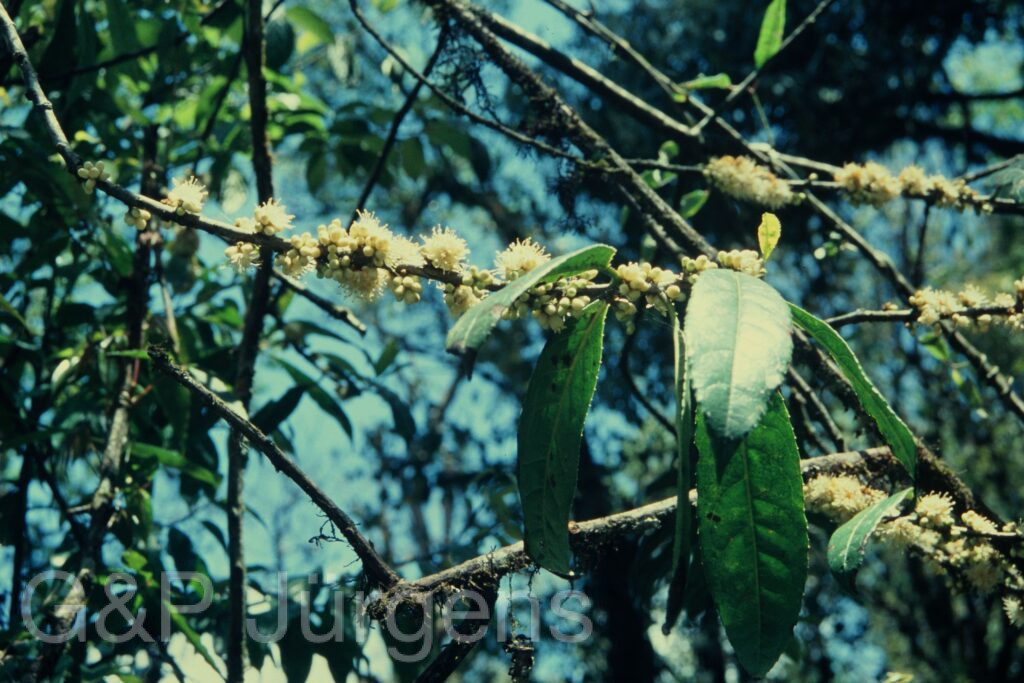
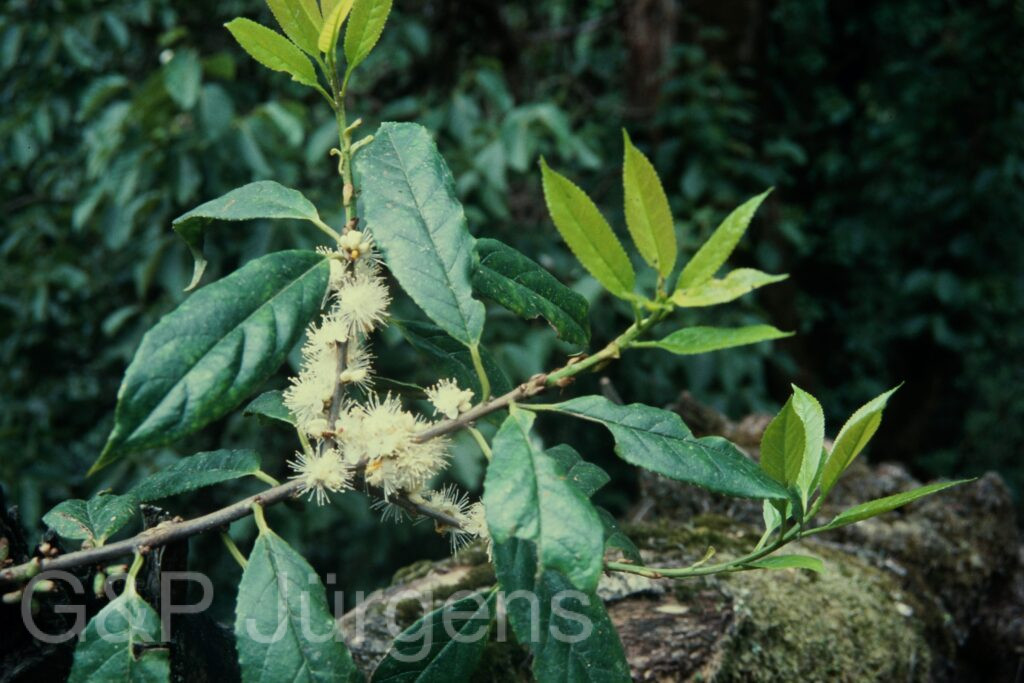
King ex C.B. Clarke

Bhutan2014 793
Bhutan
Sikkim2004 94 P164
Sikkim West-Bengal, Bersay 2700m April
Sikkim2004 329 P530
Sikkim West-Bengal, Bersay 2700m April

Description

Symplocos glomerata is an Asian tree distributed from the Himalaya and northern India through Bhutan, Nepal and Myanmar into southern China, Taiwan, Indochina and the Malesian region. Its 572 GBIF records span this broad range, indicating a widespread but locally distributed species of evergreen and mixed montane forest. It grows in broadleaved and laurel-dominated forests, on slopes and ridges, typically in the warm-temperate to lower-subtropical montane belt. The plant photographed at Bersay in the Sikkim-West Bengal border region at about 2700 m in April illustrates its occurrence in the moist mid-elevation forests of the Eastern Himalaya, flowering in early spring.

It is a small evergreen tree or shrub with leathery, alternate leaves that are elliptic to oblong, with serrate to crenate margins and a glabrous, glossy upper surface. The flowers are borne in dense, sessile, glomerate clusters in the leaf axils, as the epithet glomerata indicates; each is small, white and fragrant, with a five-lobed corolla and numerous stamens united at the base in fascicles, a characteristic of the genus. The fruit is a small, ovoid to cylindric drupe crowned by the persistent calyx lobes.

Symplocos is the sole genus of the Symplocaceae, distinguished by its polyandrous flowers and aluminium-accumulating tissues; several species, including this one, have been used to yield yellow dyes and mordants. S. glomerata varies considerably across its wide range and has accumulated numerous synonyms and infraspecific names. Widely distributed and ecologically tolerant, it is not regarded as threatened and is a common constituent of Asian montane forest.

Author: King ex C.B. Clarke · Sources: POWO (Kew), GBIF, Flora of Bhutan, Flora of China, Nooteboom Symplocaceae monograph

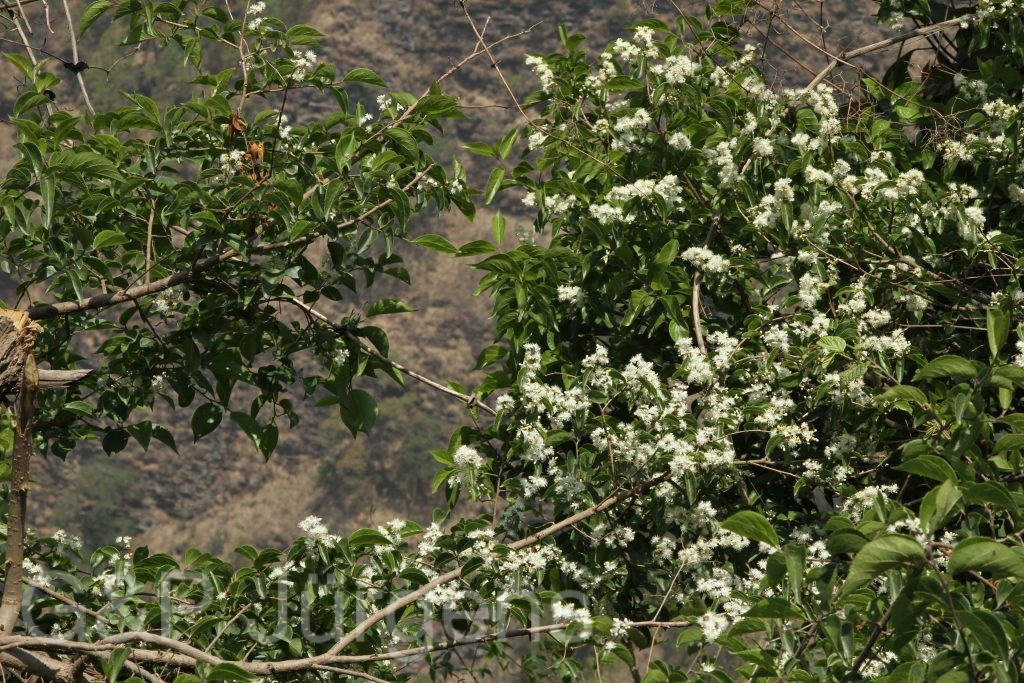
Miq.

Bhutan2014 663
Bhutan Phobjika 2250m, May
Bhutan2014 664
Bhutan Phobjika 2250m, May
Bh2008 58 P96
Bhutan Punakha 2400m, April

Description

Symplocos paniculata is a widely distributed eastern Asian shrub or small tree ranging from the Himalaya (Nepal, Bhutan, northeast India) across China, Taiwan, Korea and Japan, with extensive cultivated and naturalised records elsewhere; GBIF documents 9858 occurrences spanning these and many other countries. In the Himalaya it grows in temperate broad-leaved and mixed forests, forest margins, scrub and open hillsides, generally between about 1500 and 2800 m. The photographed plants from Phobjika in Bhutan at 2250 m in May and from Punakha at 2400 m in April show it flowering in spring, when the white, fragrant blossoms appear ahead of full leaf expansion in the temperate Bhutanese valleys.

It is a deciduous shrub or small tree with grey, often lenticellate bark and finely pubescent young twigs. The alternate leaves are elliptic to obovate, acuminate, with a serrulate to crenate-serrate margin and pinnate venation. The fragrant white flowers are borne in terminal and axillary panicles; each flower has a five-lobed calyx, a deeply five-parted corolla and numerous stamens that are basally connate into fascicles, giving the inflorescence a feathery appearance. The fruit is a small ovoid to ellipsoid drupe ripening blue-black to deep blue, crowned by the persistent calyx and containing a single hard stone.

The species belongs to Symplocos, the sole genus of the family Symplocaceae, a group of Old and New World woody plants noted for accumulating aluminium and historically valued as mordant ("sapphire-berry") plants whose bark and leaves were used in dyeing. The blue, lipid-rich drupes are dispersed by frugivorous birds. Common, ecologically tolerant and widely planted as an ornamental, S. paniculata is of least conservation concern across its extensive natural range.

Author: Miq. · Sources: POWO (Kew), GBIF, Flora of China Vol. 15, Flora of Bhutan Vol. 2, Flora of Nepal, Revision of the Asiatic Symplocaceae (Nooteboom)