
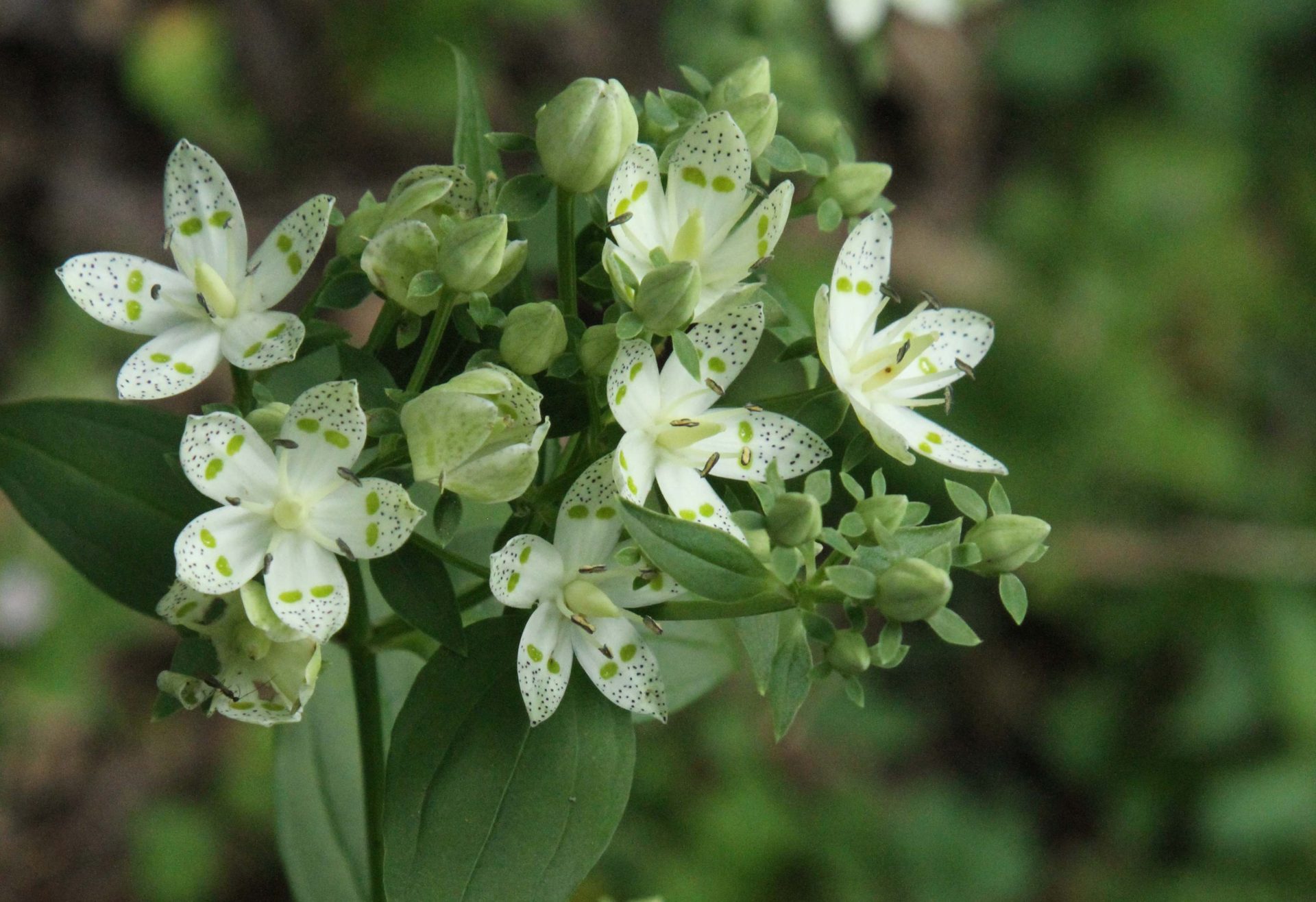
(Siebold & Zucc.) Hook. f. & Thomson ex C.B. Clarke
Description
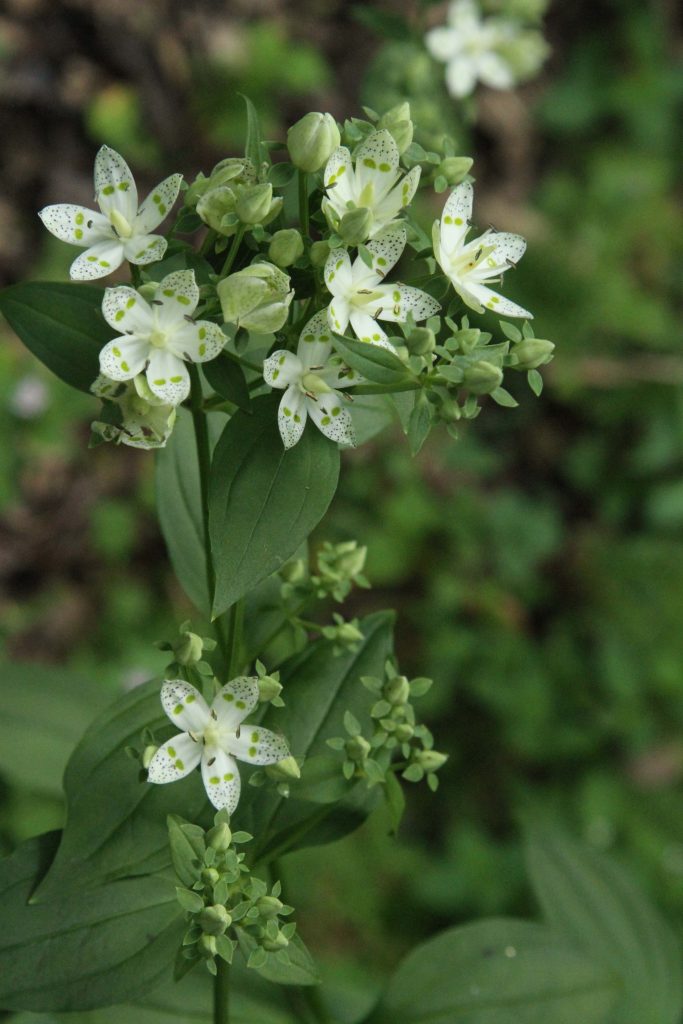
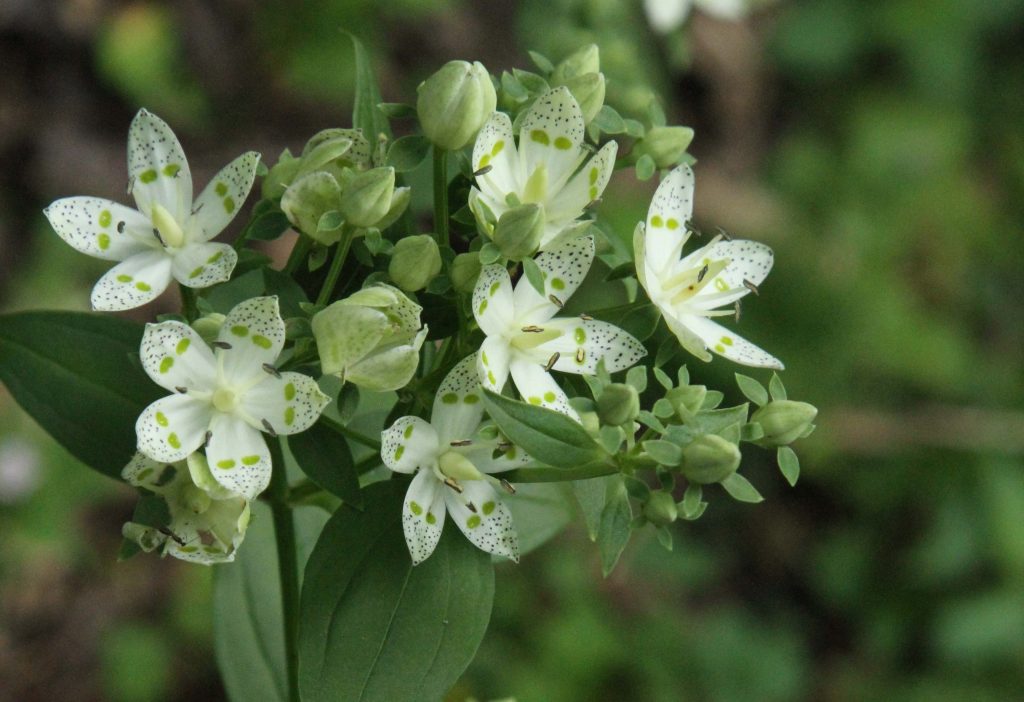
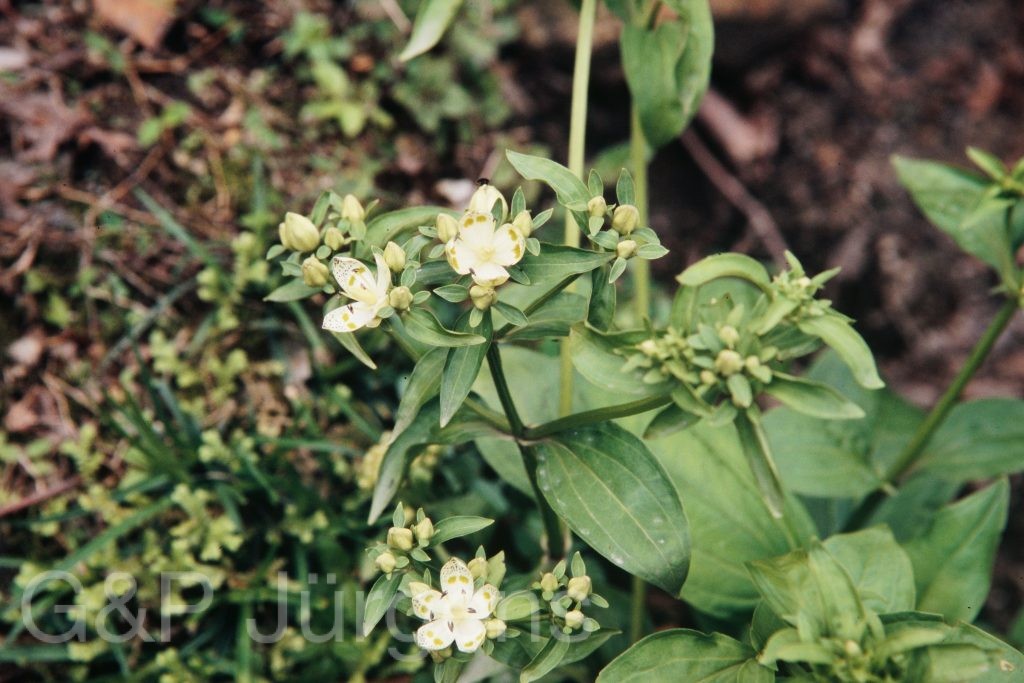
Swertia bimaculata is a widely distributed Asian gentian recorded by GBIF in nearly 3,942 occurrences spanning China, Japan, Korea, India, Bhutan, Nepal, Myanmar, Indonesia, Malaysia and Vietnam, making it one of the most far-ranging members of its genus. It occupies forest margins, grassy slopes, meadows and streamsides over a broad altitudinal span from lowland valleys to the subalpine zone. The Bhutanese collections illustrated, one from the Dochu La at 3000 m flowering in September and another from the Punakha Chu at 1600 m in April, demonstrate both its wide elevational tolerance and a flowering season extended by the diversity of habitats it occupies.
The species is a tall, erect annual or biennial herb with an angular, often branched stem arising from a slender taproot. The leaves are opposite, sessile to short-petiolate and broadly elliptic to lanceolate, with prominent arcuate veins. Flowers are numerous in a large, lax terminal panicle; the corolla is rotate and deeply four- to five-lobed, the lobes pale greenish-white to yellowish and finely dotted or streaked with purple. Each lobe bears two conspicuous dark glandular nectaries—the paired "two spots" of the epithet bimaculata—fringed with long fimbriae. The superior ovary develops into a narrowly ovoid septicidal capsule releasing many small seeds.
Swertia is a taxonomically complex, pharmacologically notable genus whose bitter secoiridoid-rich species are widely used in traditional Asian medicine, and S. bimaculata is among those harvested for such purposes. The fringed nectary glands and spotted corolla attract bees and flies that effect cross-pollination. Despite its medicinal exploitation the species remains common and ecologically plastic across its enormous range and is not regarded as threatened.
Author: (Siebold & Zucc.) Hook. f. & Thomson ex C.B. Clarke · Sources: POWO (Kew), GBIF, Flora of China, Flora of Bhutan, Flora of Japan, Revision of the Genus Swertia (Hara)