Tag:

Spring

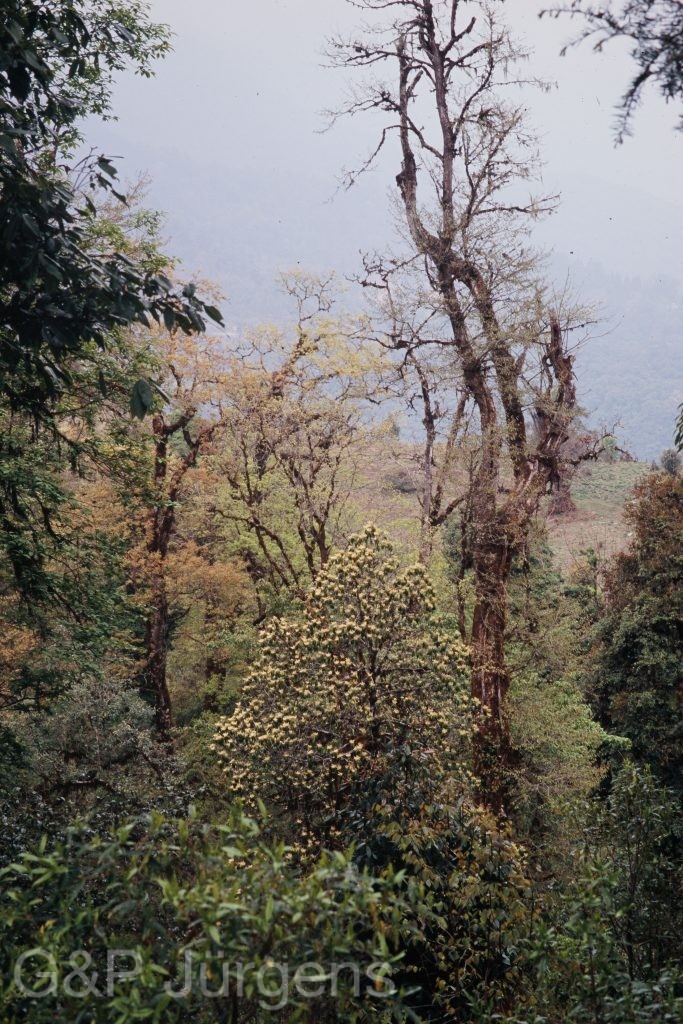
Buch.-Ham. ex D. Don
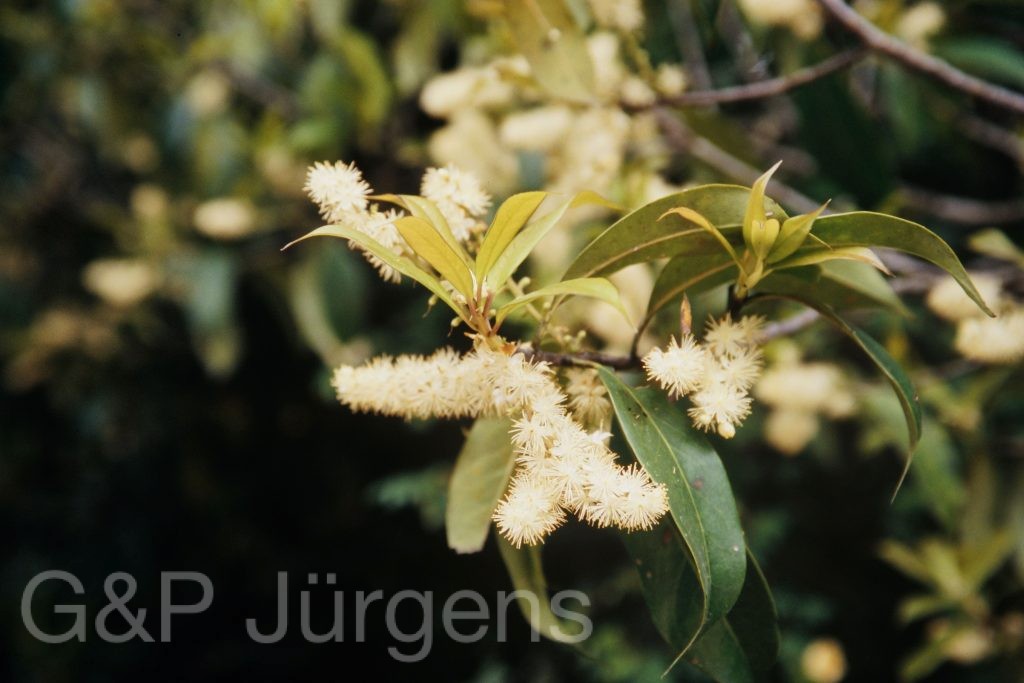
Bh2008 155 P254
Bhutan Phobjika 2650m, April

Description

Symplocos sumuntia is a broadly distributed East Asian and Himalayan tree, recorded from Nepal, north-east India, Bhutan and Bangladesh eastward through China, Taiwan, Japan and Korea to Indochina and Myanmar, with thousands of catalogued occurrences spanning this wide range. It is a constituent of broadleaved evergreen and mixed montane forests, occurring on slopes, ridges and forest margins from the warm subtropical lowlands to the cool temperate belt, broadly between about 800 and 2,800 m. The tree photographed at Phobjika in central Bhutan at 2,650 m in April was recorded in flower, the white blossom opening in spring before or with the new foliage.

It is an evergreen shrub or small to medium tree with smooth grey bark and slender, often glabrous twigs. The leaves are alternate, simple, coriaceous, narrowly elliptic to lanceolate, acuminate, with finely serrate to subentire margins and an entire to undulate texture. The flowers are small, white and fragrant, borne in short axillary racemes or panicles; the corolla is five-lobed, the numerous stamens united at the base into fascicles adnate to the corolla, a hallmark of the family. The fruit is an ovoid to ellipsoidal drupe crowned by the persistent calyx, ripening blue-black to purple.

Symplocos, the sole genus of Symplocaceae, is taxonomically complex, and S. sumuntia (Buch.-Ham. ex D. Don) has historically encompassed numerous regional variants and synonyms. The leaves and bark are valued locally as a source of mordant (aluminium-accumulating tissues used in dyeing) and in traditional medicine. As a widespread forest species it is not of conservation concern, though it depends on the integrity of subtropical montane forest.

Author: Buch.-Ham. ex D. Don · Sources: POWO (Kew), Flora of China Vol. 15, Flora of Bhutan Vol. 2, GBIF, Nooteboom: Revision of Symplocaceae (1975)
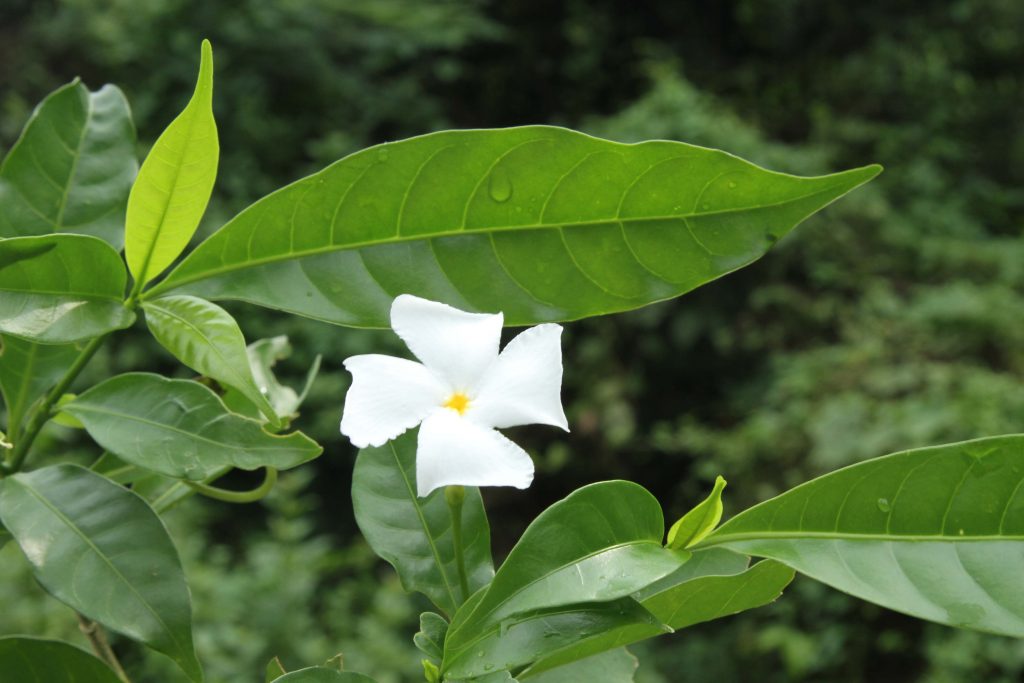
(L.) R.Br. ex Roem. & Schult.

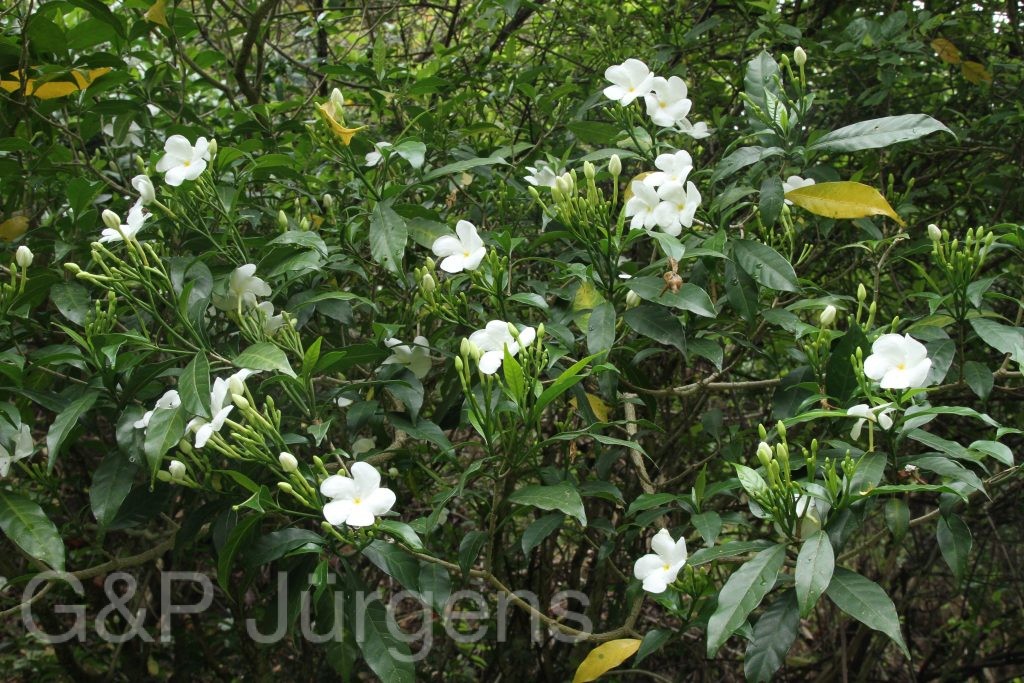
Bhutan2014 64
Bhutan Trashigang 1250m, May
Bhutan2012 732
Bhutan Galephu 550m, October
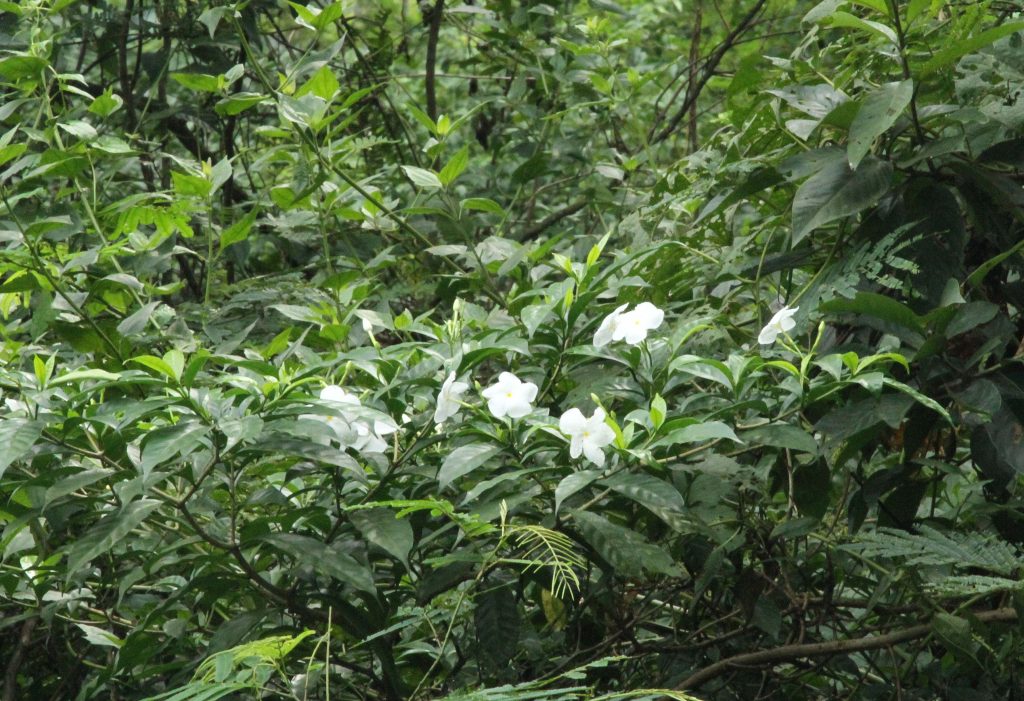
Bhutan2012 736
Bhutan Galephu 550m, October

Description

Tabernaemontana divaricata is a shrub of tropical and subtropical Asia, native to the Indian subcontinent and Southeast Asia and now pantropically cultivated and naturalised; GBIF records over 6500 occurrences across countries including India, China, Thailand, Sri Lanka, Bangladesh, Malaysia, Vietnam, the Philippines and many introduced ranges in the Americas and Pacific. In Bhutan it was photographed at Trashigang at 1250 m in May and at Galephu at 550 m in October, reflecting its occurrence in warm foothill forests, scrub and village surrounds, where it is also widely planted as the ornamental "crape jasmine."

It is a glabrous, evergreen shrub with dichotomously branched (divaricate) stems exuding copious white latex when cut. The leaves are opposite, simple, elliptic to oblanceolate, glossy dark green, with a tapering apex and prominent lateral venation. The flowers are borne in few-flowered terminal or axillary cymes; each is salverform with a slender tube and five contorted, white, often pinwheel-twisted lobes, fragrant especially at night, and cultivated double-flowered forms are common. The fruit is a paired (often divaricate) follicle, somewhat curved and ridged, splitting to expose seeds embedded in a bright orange-red fleshy aril.

The species belongs to the Apocynaceae (subfamily Rauvolfioideae) and, like its relatives, is rich in indole and monoterpene alkaloids that underpin its use in traditional medicine and account for its toxicity. Long cultivated, it has accumulated many synonyms and horticultural forms. It is not threatened, being abundant in cultivation and naturalising readily; its presence in lowland Bhutan marks the subtropical Himalayan margin of a broadly Indomalayan range.

Author: (L.) R.Br. ex Roem. & Schult. · Sources: POWO (Kew), GBIF, Flora of Bhutan, Flora of China, Flora of British India, revision of Tabernaemontana (Leeuwenberg)

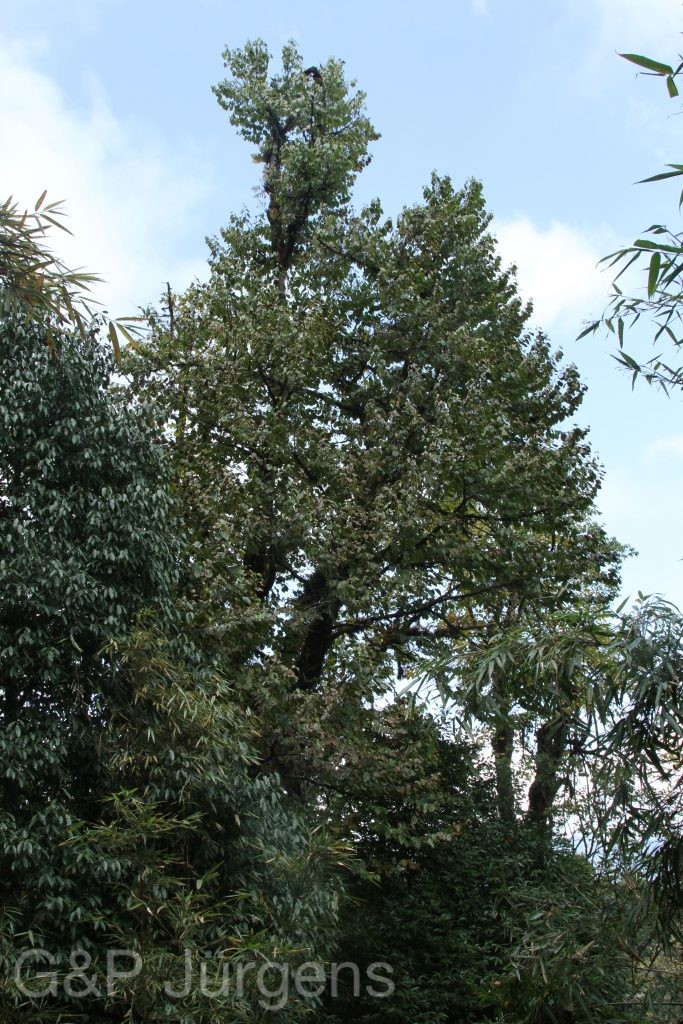
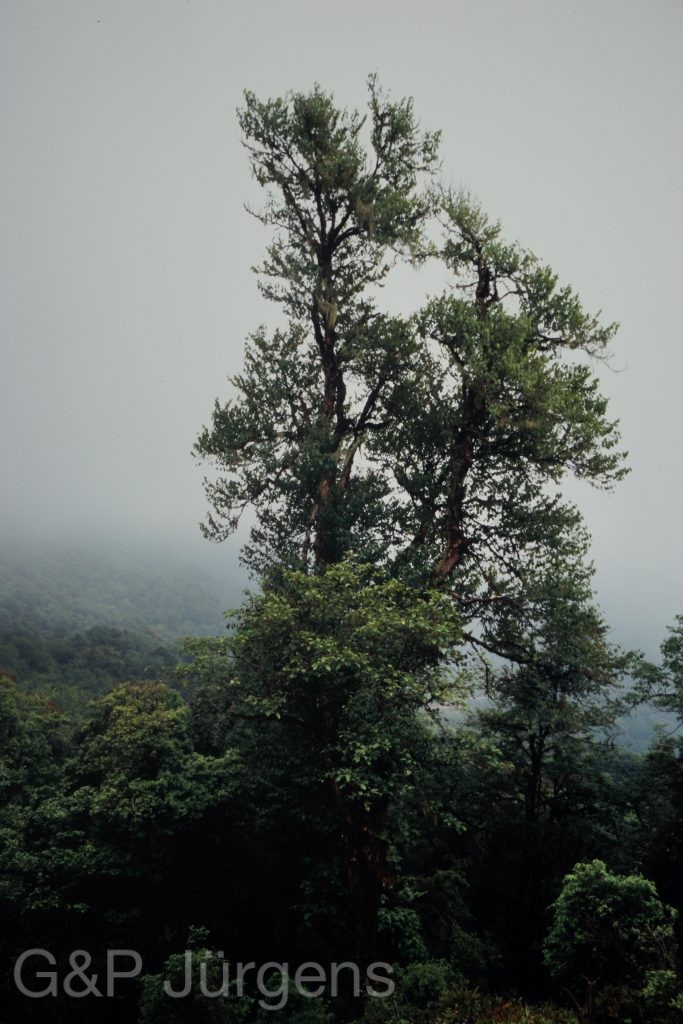
Oliv.

Bhutan2015 34
Bhutan Thimphu 2200m, October
Bh2008 43 G76
Bhutan Thimphu 2200m, April
Bh09 209 P350
Bhutan Thimphu 2200m, April

Description

Tetracentron sinense is a deciduous tree of the eastern Himalaya and the mountains of central and southwestern China, recorded by GBIF from China, Nepal, Bhutan, India, Myanmar and Vietnam (with cultivated records in Europe and North America) across about 940 georeferenced occurrences. It is a tree of cool, moist temperate broadleaf and mixed forest, growing in valleys, on shaded slopes and along streamsides, generally between about 1,700 and 3,500 m. The cited records from Thimphu in western Bhutan at around 2,200 m, photographed in both April and October, span the leafing-out and the autumnal phases of its annual cycle and place it well within the temperate forest belt of the inner Himalaya, where it occurs scattered among other broadleaved trees.

The tree has a straight trunk and bears its leaves in two kinds of position: simple, alternate, long-petioled leaves on long shoots and solitary leaves terminating short spur shoots. The leaves are ovate to broadly ovate, cordate at the base, acuminate, finely serrate, and conspicuously palmately veined from the base. The minute, perfect flowers are densely crowded on slender, pendulous, catkin-like spikes; each tetramerous flower has four tepals, four stamens and a four-carpellate ovary. The fruit is a small four-locular capsule that splits to release tiny winged seeds. Anatomically the wood is remarkable for being vesselless, the water-conducting tissue consisting only of tracheids.

Tetracentron sinense is one of only two genera in the small, isolated family Trochodendraceae (the other being Trochodendron), an ancient and phylogenetically basal lineage of eudicots whose vesselless wood is regarded as a primitive or secondarily reduced condition of great interest to plant systematists and to studies of angiosperm wood evolution. As a relict species with a disjunct, fragmented distribution, it is of significant conservation concern: it is legally protected in China and assessed as near-threatened, its populations reduced by logging and habitat loss, making it an emblematic "living-fossil" tree of the East Asian temperate flora.

Author: Oliv. · Sources: POWO (Kew), GBIF, Flora of China Vol. 6, Flora of Bhutan Vol. 1, Flora of Nepal, Flora of Pakistan, Endress: systematics and floral morphology of Trochodendraceae

(Wall. ex Kunth) Maxim.

Bh09 218 G366
Bhutan Wangdi 2250m, June
Nepal 99 897 ergebnis
West-Nepal Sepka 2760m, July
Sikkim 2006 453 ergebnis
India West-Bengal, Tolung 2200m, May

Description

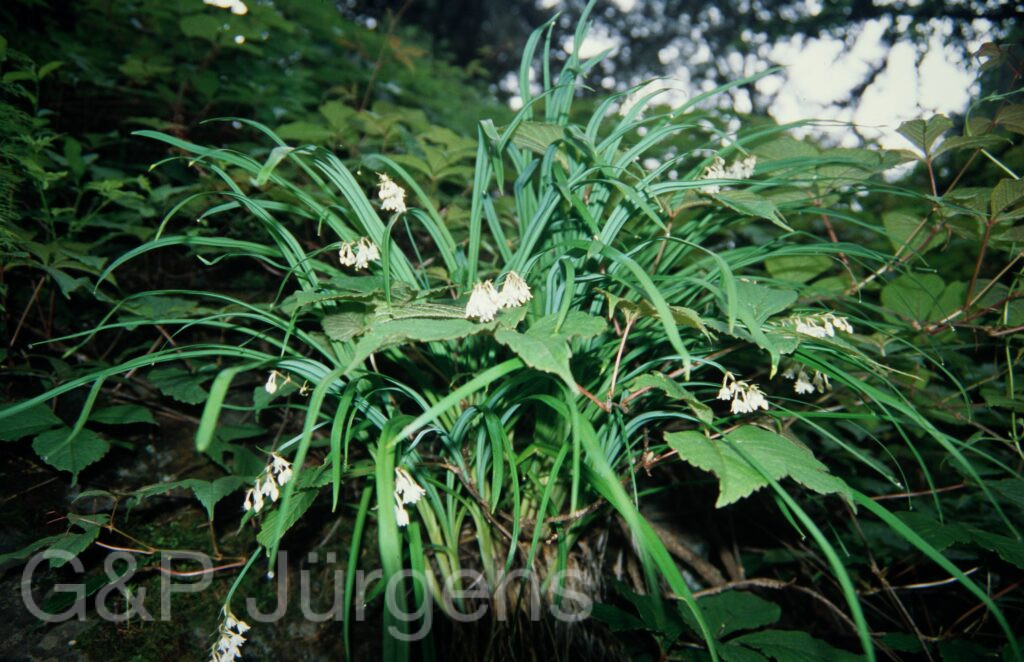
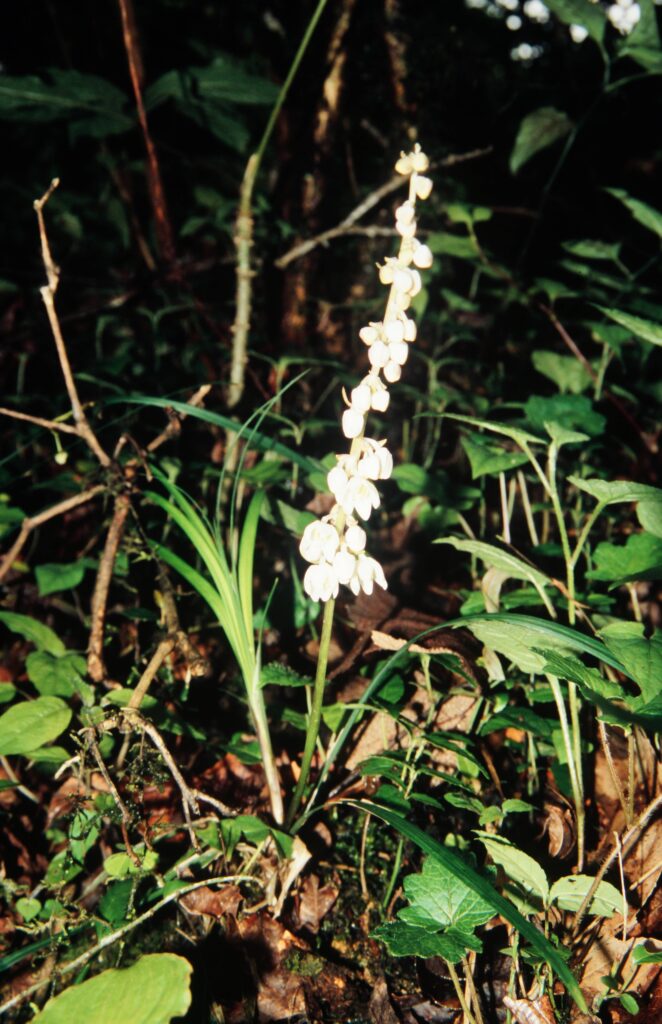
Theropogon pallidus is the sole species of its genus, a rhizomatous woodland herb distributed along the Himalaya from Nepal through northern India, Bhutan and south-western China into Myanmar and Thailand. GBIF lists some 264 occurrences concentrated in Nepal, China, India and Bhutan, with outliers in Myanmar and Thailand. It grows in shaded, humus-rich soils of temperate broad-leaved and mixed forest, on mossy banks, ravine sides and beneath shrubbery, broadly between about 1800 and 3000 m. The accompanying images span its range, from Bhutan at Wangdi (2250 m, June) and West Nepal at Sepka (2760 m, July) to West Bengal at Tolung (2200 m, May), illustrating its early-summer flowering across the mid-montane forest belt.

The plant arises from a short, creeping rhizome and forms tufts of narrowly linear, grass-like basal leaves that are channelled, arching and somewhat fleshy. The flowering scape is erect and leafless, bearing a lax, secund raceme of pendulous, bell-shaped flowers; each flower is subtended by a membranous bract and hangs on a slender, jointed pedicel. The perianth is white to pale pink, the six tepals fused below into a campanulate tube with recurved lobes, enclosing six stamens with short filaments. The ovary is superior and trilocular, maturing into a globose, fleshy berry that ripens red, containing few rounded seeds.

Theropogon is a monotypic genus of the Asparagaceae (formerly Convallariaceae or Liliaceae sensu lato), morphologically intermediate between Ophiopogon and Convallaria and allied to the lily-of-the-valley group by its nodding campanulate flowers and berry fruit. Its disjunct, narrowly montane distribution makes it of biogeographic interest as a relict of Sino-Himalayan forest flora. The species is locally frequent and faces no broad conservation concern, though it depends on intact shaded forest understorey.

Author: (Wall. ex Kunth) Maxim. · Sources: POWO (Kew), GBIF, Flora of China, Flora of Bhutan, An Annotated Checklist of the Flowering Plants of Nepal, Genera of Convallariaceae

Roxb.

Nepal 1994 16 ergebnis
Ost-Nepal Kandbari 490m April

Description

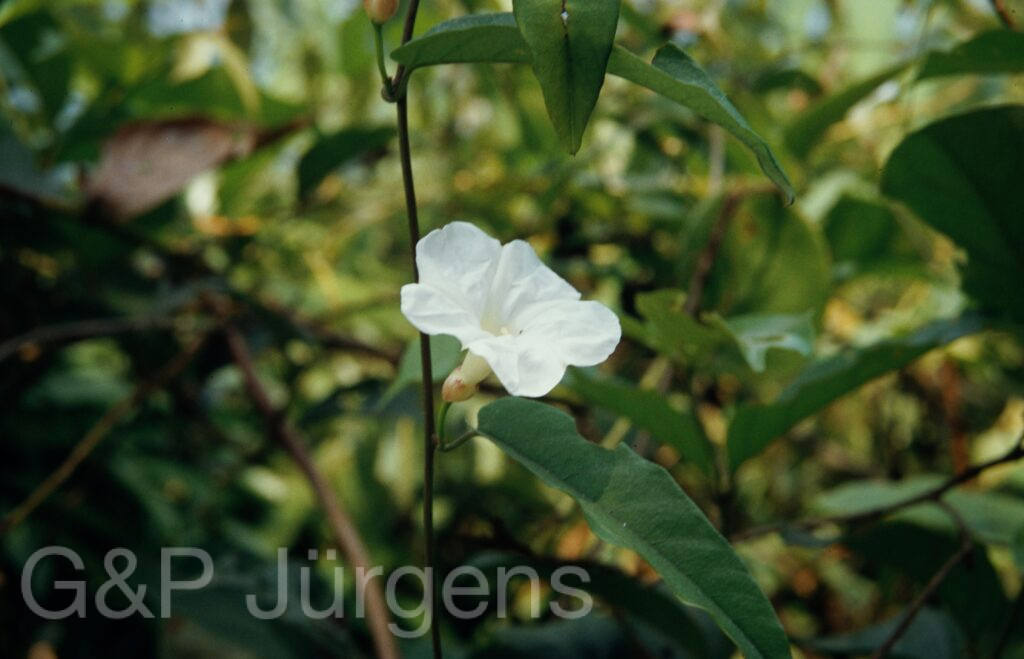
Thunbergia fragrans is a slender twining herbaceous climber native to tropical and subtropical Asia, from the Indian subcontinent and the Himalayan foothills eastward to China, Sri Lanka and Southeast Asia, and now naturalised across the Americas, the Pacific and Australia. It grows in thickets, hedgerows, forest edges, scrub and disturbed ground in the warm lowlands and lower hills, generally below about 1500 m. The photographed plant comes from Kandbari in East Nepal at around 490 m, flowering in April. With nearly 4900 georeferenced records, many from its introduced range, it is a conspicuous and frequently collected vine. Although filed here under Lamiaceae, the species belongs to the Acanthaceae.

The stems are twining, slender and angled, often finely hairy. The leaves are opposite, ovate to triangular-hastate, with a cordate to truncate base, entire to sinuately lobed or toothed margins, and a slender petiole. The flowers are solitary in the leaf axils on long peduncles, subtended by two large leafy bracteoles that enclose the much-reduced calyx. The corolla is salverform with a broad spreading limb of five rounded lobes and is pure white, the throat sometimes pale, the flowers faintly fragrant. Four didynamous stamens are inserted within the corolla tube. The fruit is a beaked, woody, explosively dehiscent capsule, the persistent style forming a long apical beak, scattering the few seeds.

Widely grown as an ornamental for its clean white flowers, T. fragrans has escaped cultivation in many warm regions and is regarded as an environmental weed in parts of Australia, the Pacific and the neotropics, where it smothers low vegetation. Within Thunbergia it is recognised by its white, fragrant corolla and hastate leaves. Abundant and expanding, it is of least conservation concern.

Author: Roxb. · Sources: POWO (Kew), GBIF, Flora of China, Flora of Nepal, Acanthaceae monographs (Thunbergia)

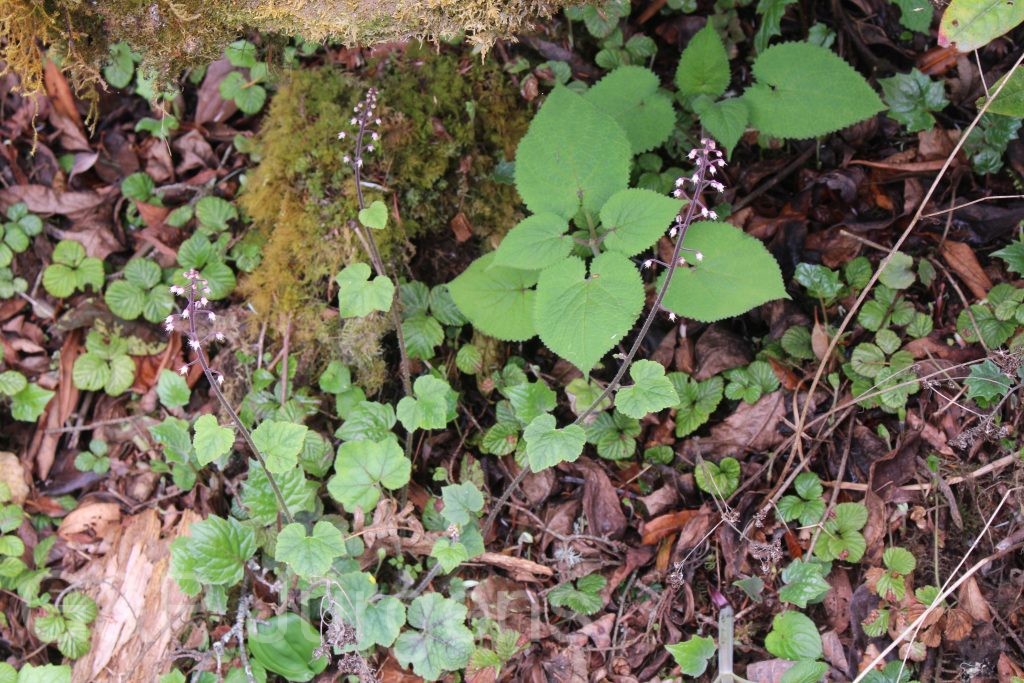
D. Don

Bhutan2014 588
Bhutan Phobjika 2810m, May
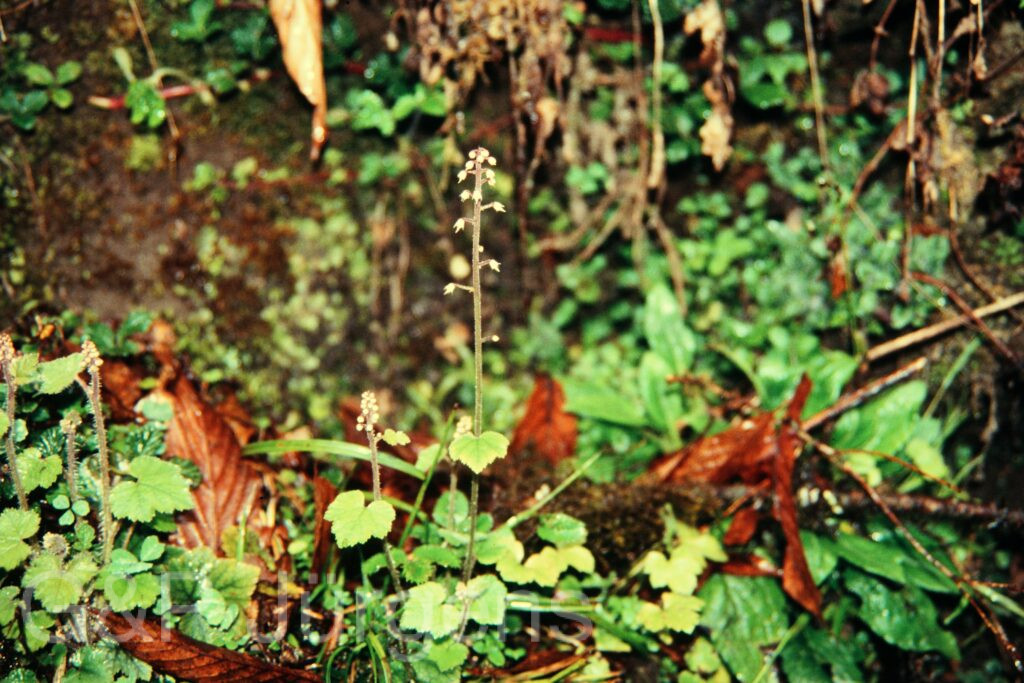
Nepal 97 128 G222
Nepal Mewa-Khole 2500m April
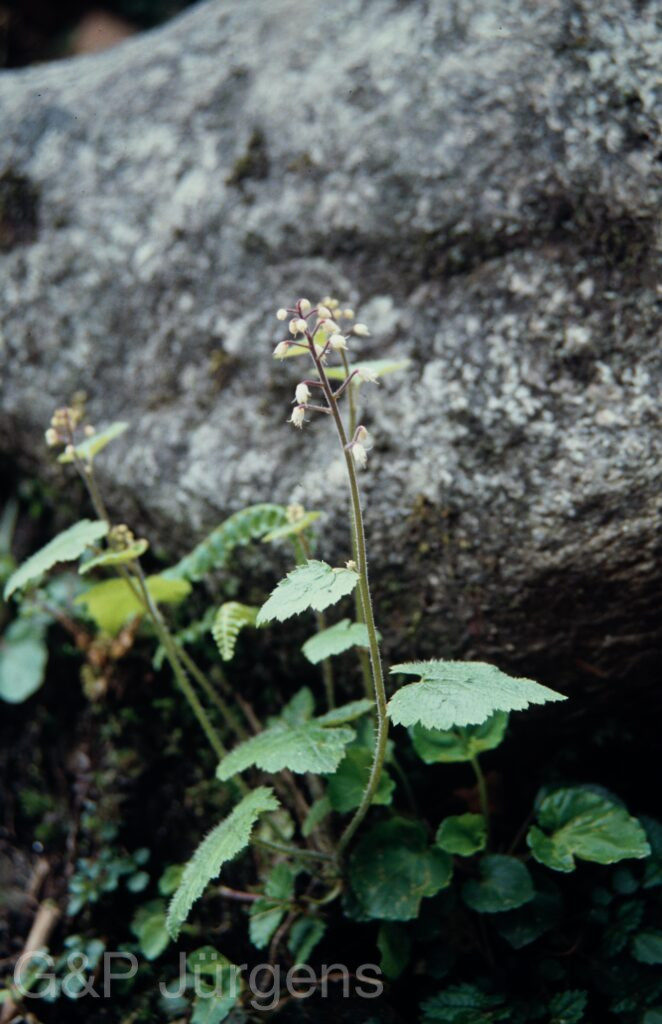
Nepal 1994 194 ergebnis
Ost-Nepal Mewa-Khola 2100m April
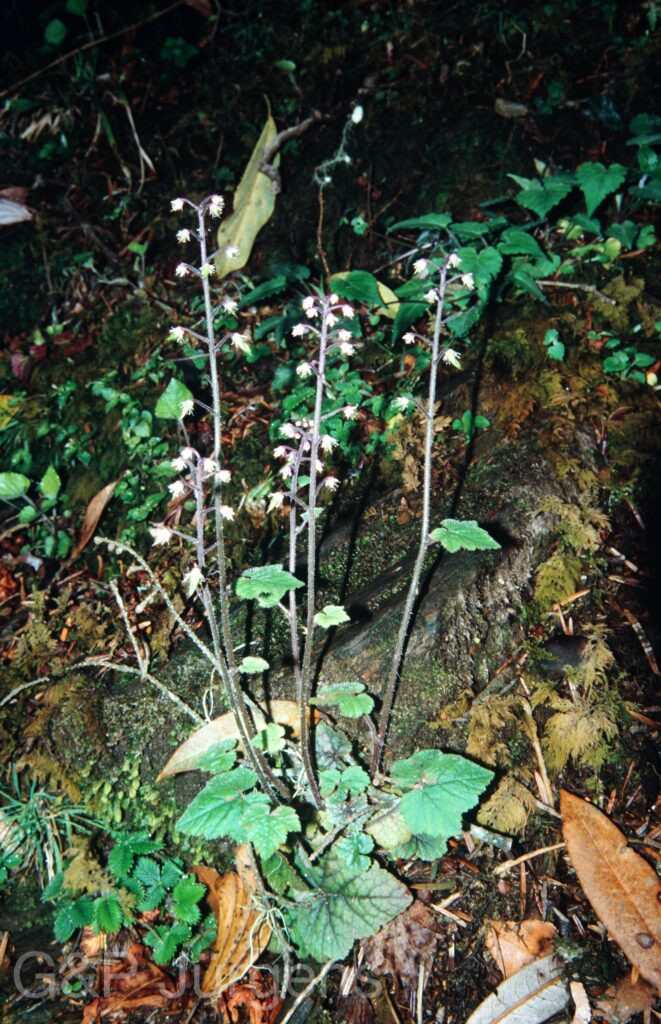
Nepal 2001 252 ergebnis ergebnis
Nepal (Gorkha) Niuli Kharka 2700m, May

Description

Tiarella polyphylla is a perennial herb with a wide East Asian and Himalayan distribution, recorded from China, Japan, Korea, Taiwan, Nepal, India, Bhutan and Myanmar, and reliably documented by over 4300 GBIF occurrences. It is a plant of cool, shaded, humid forests, growing in moist humus-rich soil along streamsides, on mossy banks and in the understorey of broadleaved and mixed forest, generally between about 1500 and 3500 m. The photographed populations span Bhutan (Phobjika, 2810 m, May) and eastern and central Nepal (Mewa Khola 2100-2500 m, and Gorkha at Niuli Kharka 2700 m), flowering through the spring months.

The plant grows from a short rhizome and produces a basal rosette of long-petioled leaves; the lamina is cordate-orbicular, shallowly three- to five-lobed, with toothed margins and scattered hairs. The slender, erect flowering stem bears a few reduced cauline leaves and terminates in a narrow, elongate raceme of small flowers. Each flower has five white to greenish, narrow petals and conspicuously exserted stamens, giving the inflorescence a delicate, foamy appearance. The fruit is a distinctive two-valved capsule with markedly unequal valves, splitting to release the small seeds.

Tiarella is a small genus of the Saxifragaceae, and T. polyphylla is the principal Asian representative, the remaining species being North American; this disjunction is a classic example of the eastern Asian-North American floristic link. The plant is shade-tolerant and clonal, often forming loose colonies on forest floors. Though not threatened across its broad range, it depends on intact moist forest and is locally sensitive to logging and disturbance of streamside habitats.

Author: D. Don · Sources: POWO (Kew), GBIF, Flora of China, Flora of Bhutan, Saxifragaceae monograph

DC.

Bhutan2014 272
Bhutan Trithangebe 700m, May
Bh2008 541 G819
Bhutan Limbukha 2200m April

Description

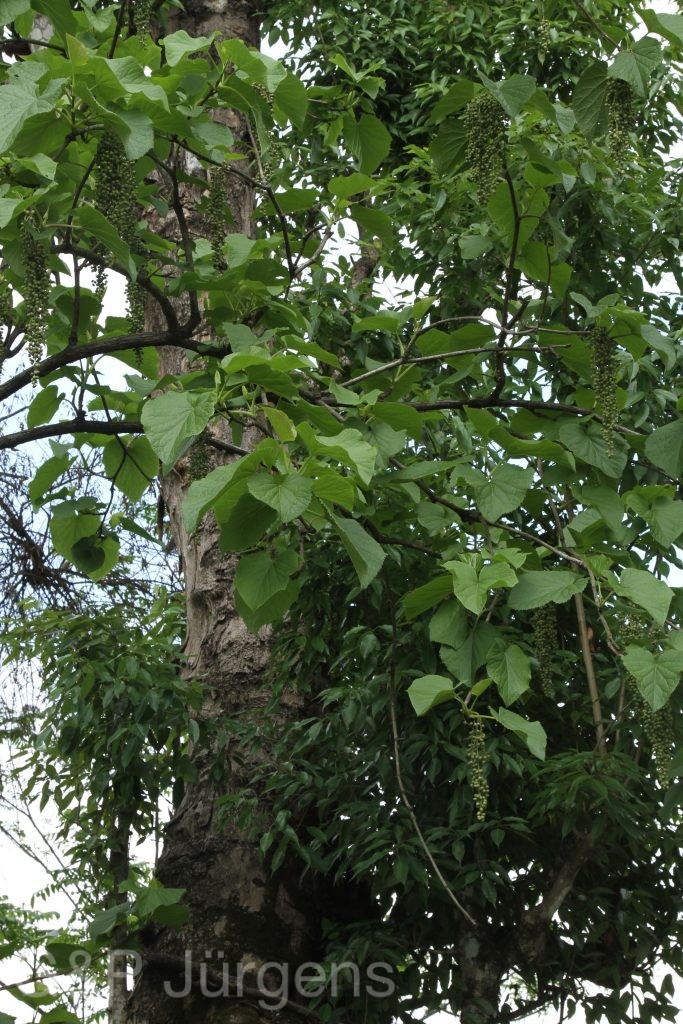
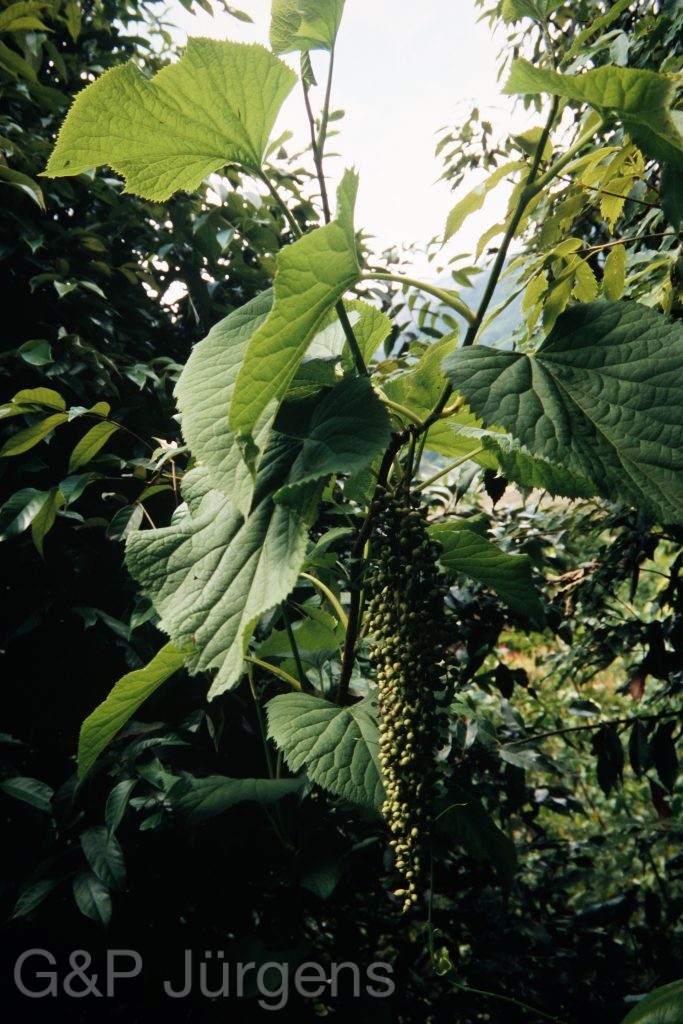
Toricellia tiliifolia DC. is a small deciduous tree or large shrub of the Cornaceae (or the segregate family Toricelliaceae), restricted to the Himalaya and southwestern China. GBIF records, totalling 23 occurrences, place it in China, Nepal, Bhutan and India. The species grows on moist, often disturbed slopes, ravine margins, forest edges and streamsides through the subtropical to lower temperate belt, broadly from 700 to 2,300 m. The cited Bhutanese collections from Trithangebe at 700 m in May and from Limbukha at 2,200 m in April illustrate this altitudinal span across the southern Bhutanese foothills.

The plant is a soft-wooded tree with stout, somewhat pithy branchlets and conspicuous leaf scars. The leaves are alternate, long-petiolate, broadly ovate to orbicular with a cordate base, palmately veined and shallowly lobed with a serrate margin, recalling those of a lime (Tilia), hence the epithet; the petiole base is dilated and sheathing. The plant is functionally dioecious, the small greenish flowers borne in long, slender, pendulous panicles; staminate flowers have minute petals and stamens, while the pistillate flowers have a reduced perianth and an inferior ovary. The fruit is a small ovoid drupe crowned by the persistent styles.

Toricellia is a relictual, taxonomically isolated genus whose placement has shifted between Cornaceae, Araliaceae and its own family Toricelliaceae within the Apiales, reflecting an ambiguous combination of cornoid and aralioid characters. Its disjunct, narrow Sino-Himalayan distribution makes it of considerable biogeographic interest as a Tertiary relict, and although not formally assessed as threatened, its limited range warrants attention where lower-montane forests are being cleared.

Author: DC. · Sources: POWO (Kew), GBIF, Flora of China Vol. 14, Flora of Bhutan Vol. 2, Flora of Nepal, Eyde: Comparative anatomy and phylogeny of the Cornaceae

(Roxb. ex Lindl.) Vis.

Bhutan2015 591
Bhutan Mo-Chu 1900m, October
Sikkim 2006 308 ergebnis
India West-Bengal, Chaana 1750m, May

Description

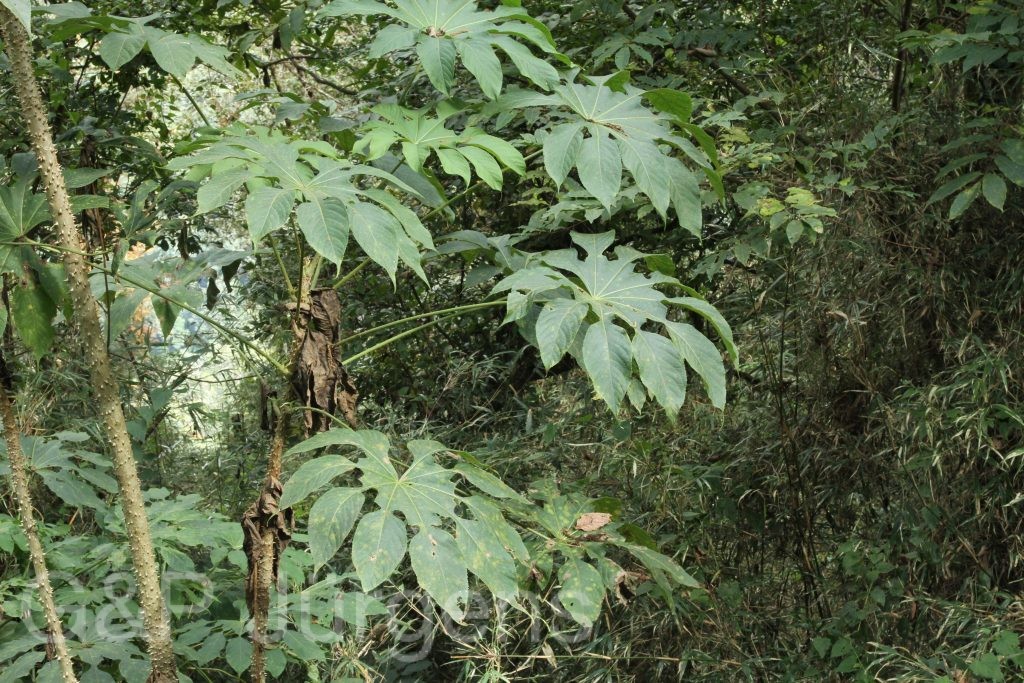
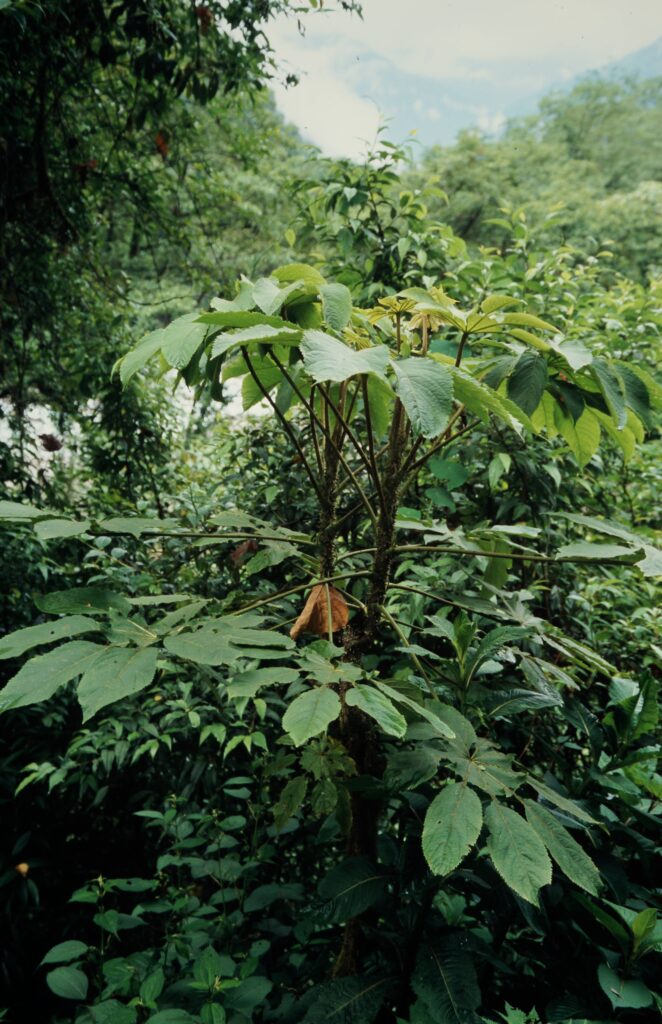
Trevesia palmata, the snowflake tree, is a tropical and subtropical Asian aralioid ranging from the Himalaya of Nepal, India and Bhutan through Bangladesh, Myanmar, Thailand, Laos, Cambodia, Vietnam, southern China and into Malaysia, with more than 700 GBIF occurrences including many from cultivation in botanic gardens worldwide. It grows in warm, humid broadleaved forest, in ravines, along streams, on shaded slopes and in clearings on moist, fertile soils. The localities illustrated, the Mo Chu valley in Bhutan at about 1900 m in October and Chaana in West Bengal at 1750 m in May, are typical of its lower-montane belt of roughly 500-2000 m in the eastern Himalaya.

It is a small, sparsely branched evergreen tree or treelet, often prickly on the trunk and petioles, with a stout pithy stem. The very large leaves are palmately lobed and again deeply incised, so that each is divided almost to the centre into spreading, toothed segments arranged like a snowflake, borne on long prickly petioles and clustered toward the stem apex. The numerous small flowers are creamy to greenish-white and grouped in dense globose umbels arranged along a large, branched terminal panicle. Each flower has a fleshy disc and an inferior ovary of several carpels, and the fruit is a small, somewhat ribbed, fleshy drupe containing several seeds.

Trevesia is a small genus of the ivy family centred on tropical Asia, and T. palmata is its most familiar and widespread species. The dramatically dissected juvenile foliage makes it a popular ornamental and conservatory plant, which explains the many cultivated records far outside its native range. In its forest habitat it is an understorey to mid-canopy element pollinated by insects, and its fruits are dispersed by birds and other animals.

Author: (Roxb. ex Lindl.) Vis. · Sources: POWO (Kew), GBIF, Flora of China, Flora of Bhutan, Frodin & Govaerts World Checklist of Araliaceae, Hooker Flora of British India

Wall. ex D.Don

Nepal 99 141 ergebnis
West-Nepal South of Rara-Lake 3800m, June
Nepal 2001 308 ergebnis ergebnis
Nepal (Gorkha) Kharka 3100m, May

Description

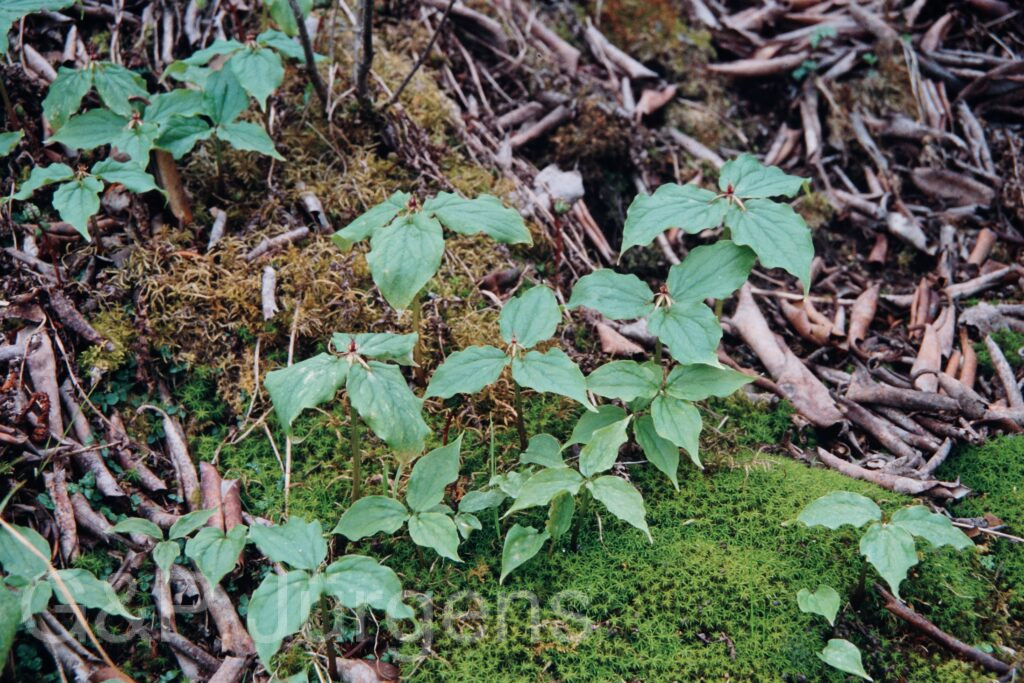
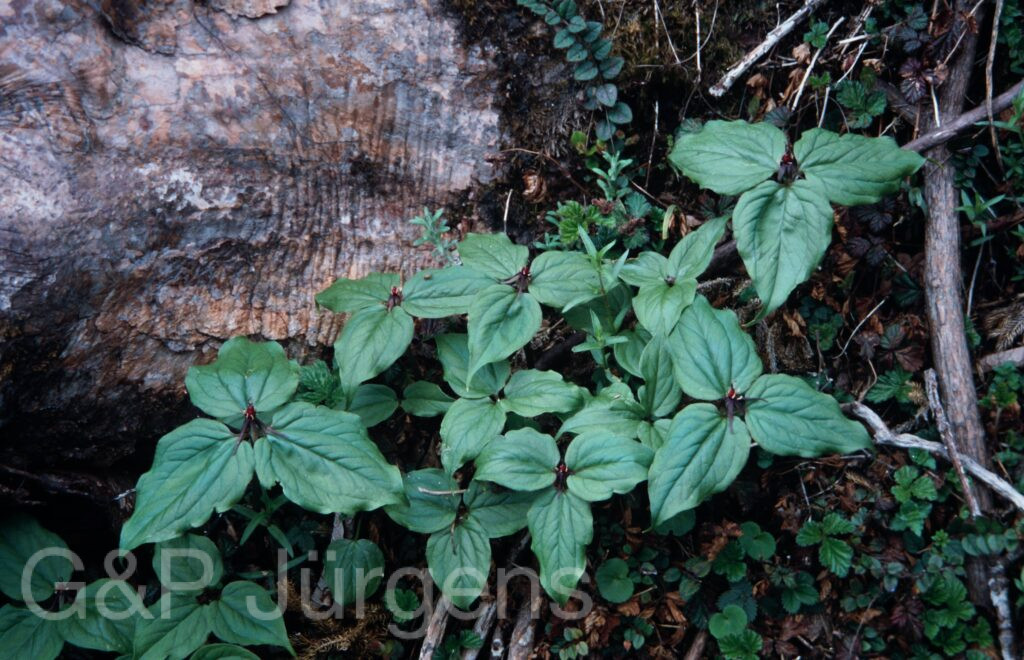
Trillium govanianum is a rhizomatous perennial herb of the family Melanthiaceae and the sole representative of the otherwise North American and East Asian genus Trillium in the Himalaya. GBIF data confirm a core distribution through Pakistan, India and Nepal, extending into Bhutan and the western fringe of China. It is a plant of moist, shaded temperate and subalpine forest, growing on humus-rich soils beneath Abies, Betula and rhododendron, and in damp alpine scrub and meadow margins, typically between about 2,800 and 4,000 m. The collections illustrated from south of Rara Lake in west Nepal at 3,800 m in June and from Kharka in Gorkha at 3,100 m in May are characteristic of this shaded, high-montane habitat.

The species arises from a short, thick, creeping rhizome and produces a single erect stem 10–30 cm tall bearing the diagnostic whorl of three broadly ovate, net-veined, sessile leaves at its summit. From the centre of this whorl a solitary, sessile or shortly stalked flower is borne; it is small and dark, with three narrow green sepals and three slender petals that are deep maroon to purplish-brown, accompanied by six stamens and a three-loculed ovary. The fruit is a fleshy, reddish berry-like capsule containing several seeds, in contrast to the dry capsules of many congeners.

The presence of a single Trillium in the Himalaya is of considerable biogeographic interest, representing a disjunct outlier of a genus otherwise centred on temperate North America and Japan. The species, locally known as nag chhatri, has become the focus of intense and unsustainable harvesting for its rhizome, which is traded for purported steroidal saponin content. This pressure, combined with slow growth and a narrow ecological niche, has raised serious conservation concern, and the plant is now regarded as threatened across much of its range.

Author: Wall. ex D.Don · Sources: POWO (Kew), GBIF, Flora of Nepal, Flora of Pakistan, Annotated Checklist of the Flowering Plants of Nepal, Farmer & Schilling: Phylogenetics of Trillium

Maxim.

Bh2008 35 P57
Bhutan Doch-La, 3000m April
Bh09 212 G355
Bhutan Paro, 2400m June

Description

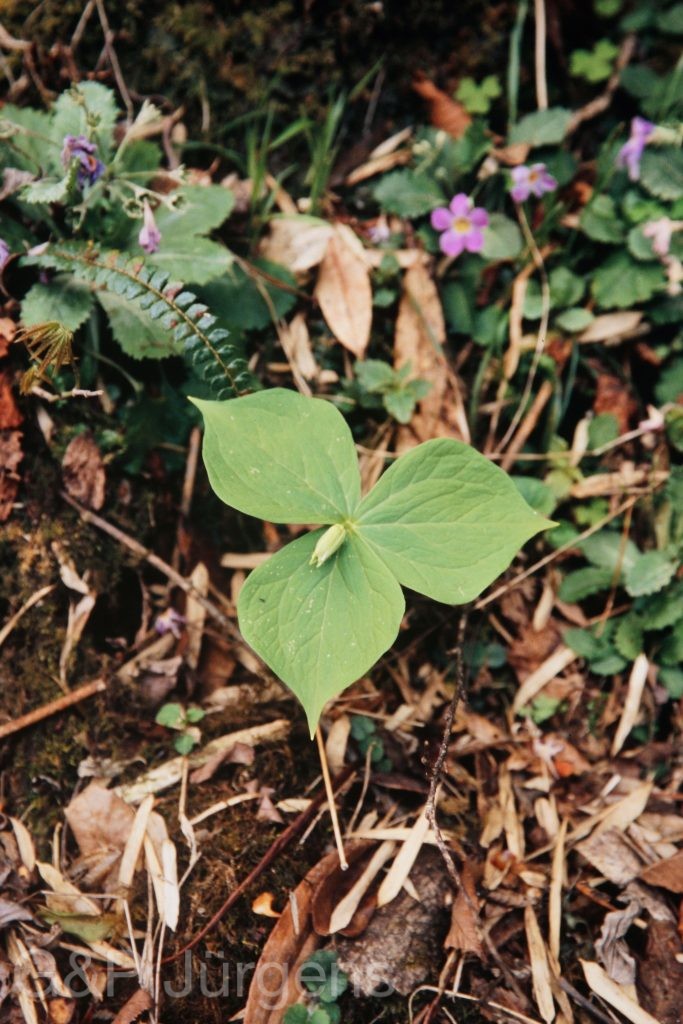
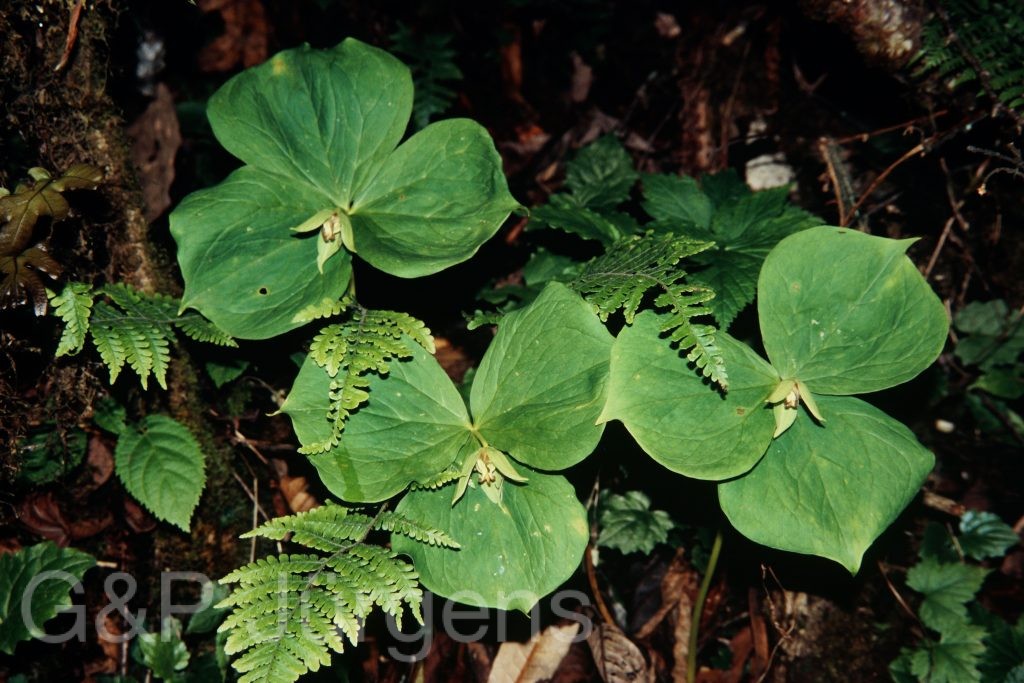
Trillium tschonoskii is a wide-ranging woodland herb of temperate East and South Asia, distributed from Japan, Korea and Taiwan through eastern and central China and into the Himalaya, reaching India, Bhutan and Nepal, with records also from the Russian Far East. With more than two thousand GBIF occurrences it is by far the most widespread Asian trillium, though it thins markedly toward its western Himalayan limit. It is a plant of cool, shaded, humus-rich broadleaved and conifer forest, favouring moist slopes and stream banks, generally between about 2300 and 3600 m in the Himalaya. The Bhutanese material illustrated, from Doch-La at 3000 m in April and from Paro at 2400 m in June, spans the species' flowering season as it tracks elevation, emerging soon after snowmelt in the deep shade of the forest floor.

The plant is a glabrous perennial arising from a short, thick, horizontal rhizome, producing a single erect stem that bears at its summit a single whorl of three broadly rhombic to ovate, net-veined, sessile or short-stalked leaves. Above this whorl a solitary flower is borne on a short erect pedicel. The flower is trimerous, with three green, lanceolate sepals and three white (sometimes ageing pinkish) ovate petals; six stamens with prominent anthers surround a superior, three-locular ovary topped by three recurved stigmas. The fruit is a fleshy, ovoid, reddish to dark berry-like capsule containing numerous seeds, each bearing an oily elaiosome that promotes dispersal by ants.

Trillium, now placed in the Melanthiaceae, is a classic component of the temperate deciduous forest flora of the Northern Hemisphere, and T. tschonoskii is the principal Asian representative reaching the Himalaya, exemplifying the floristic links between East Asian and Sino-Himalayan woodlands. Its slow growth, dependence on undisturbed forest humus and ant-mediated seed dispersal make it sensitive to habitat disturbance, and like many trilliums it has horticultural appeal and some traditional medicinal use of the rhizome, which can drive local collection. Although broadly distributed and not globally threatened, its peripheral Himalayan populations warrant monitoring as forest cover and microclimate change.

Author: Maxim. · Sources: POWO (Kew), GBIF, Flora of China Vol. 24, Flora of Bhutan Vol. 3 Part 1, Flora of Nepal, Trillium (Frederick W. Case and Roberta B. Case)