Tag:

Subalpine (2500-3500 m)

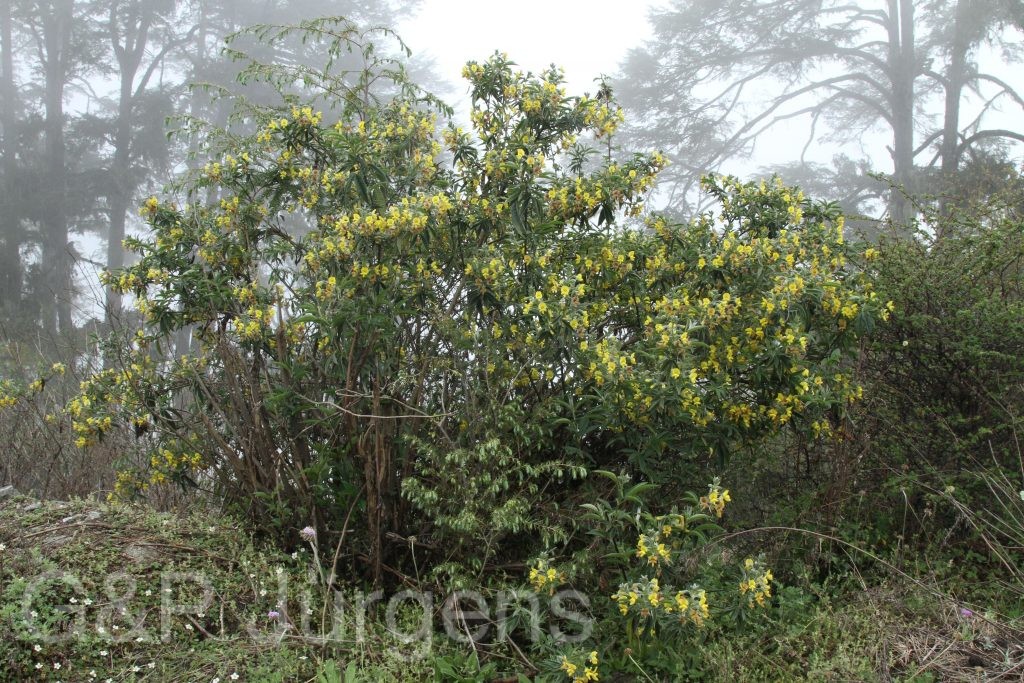
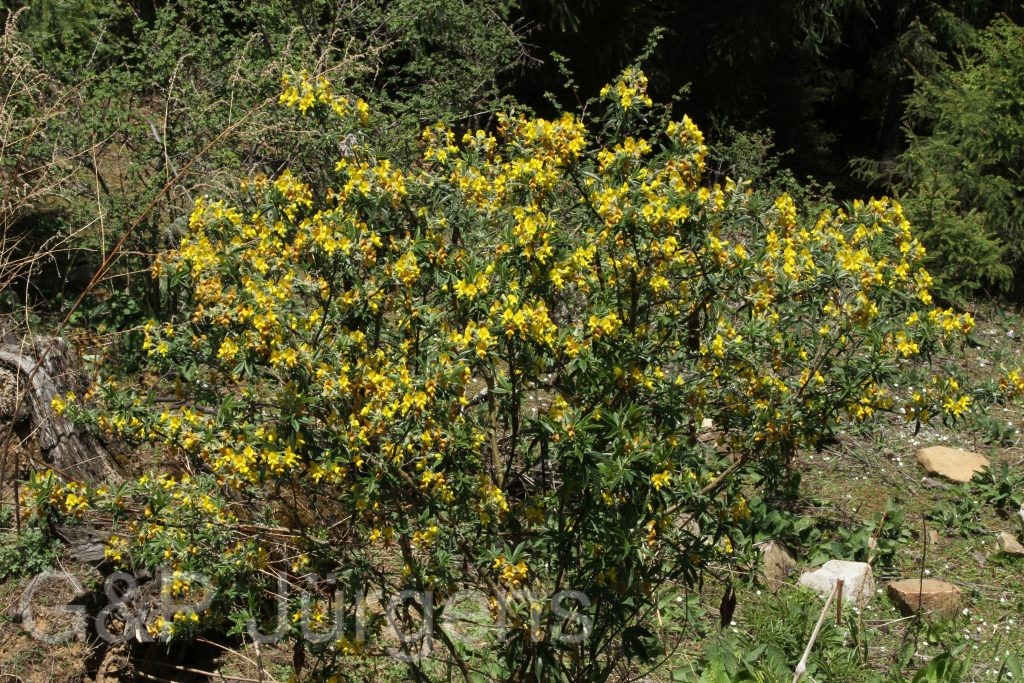
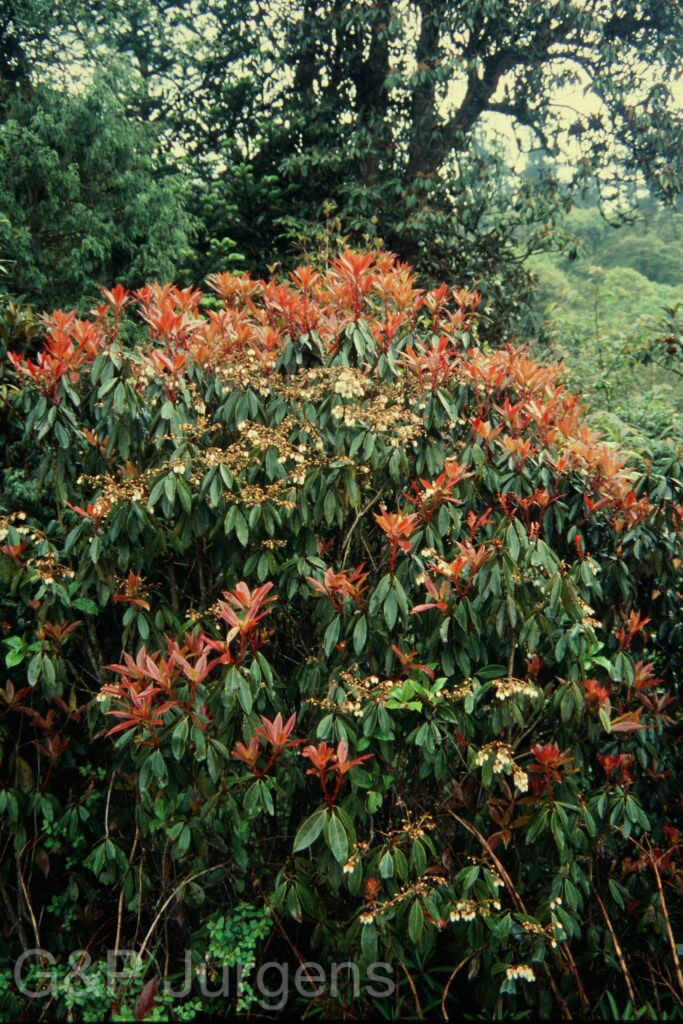
Pieris formosa

by G & P Jürgens

(Wall.) D. Don

Bhutan2014 861
Bhutan Chele-La 3000m, May
Bhutan2014 859
Bhutan Chele-La 3000m, May
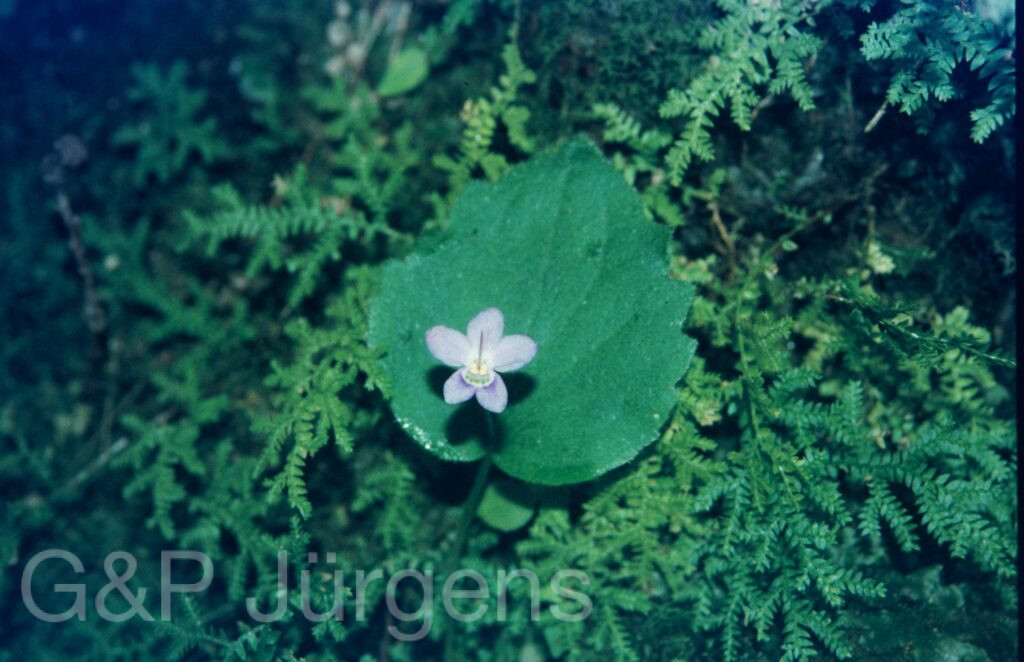
Sikkim2004 381 658
Sikkim/India Lachung 3000m May

Description

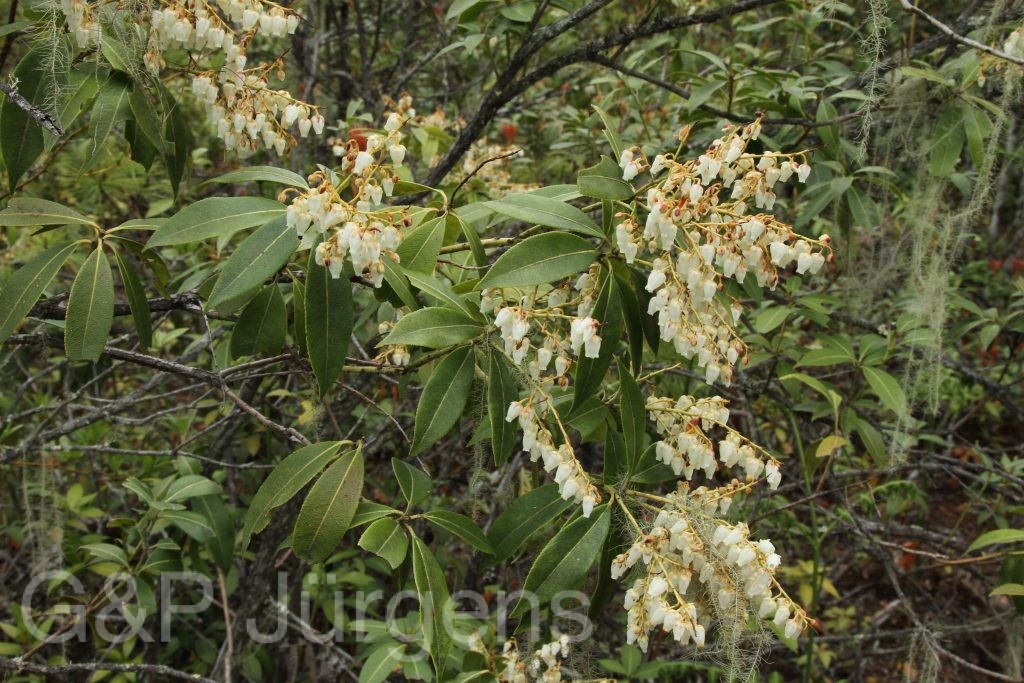
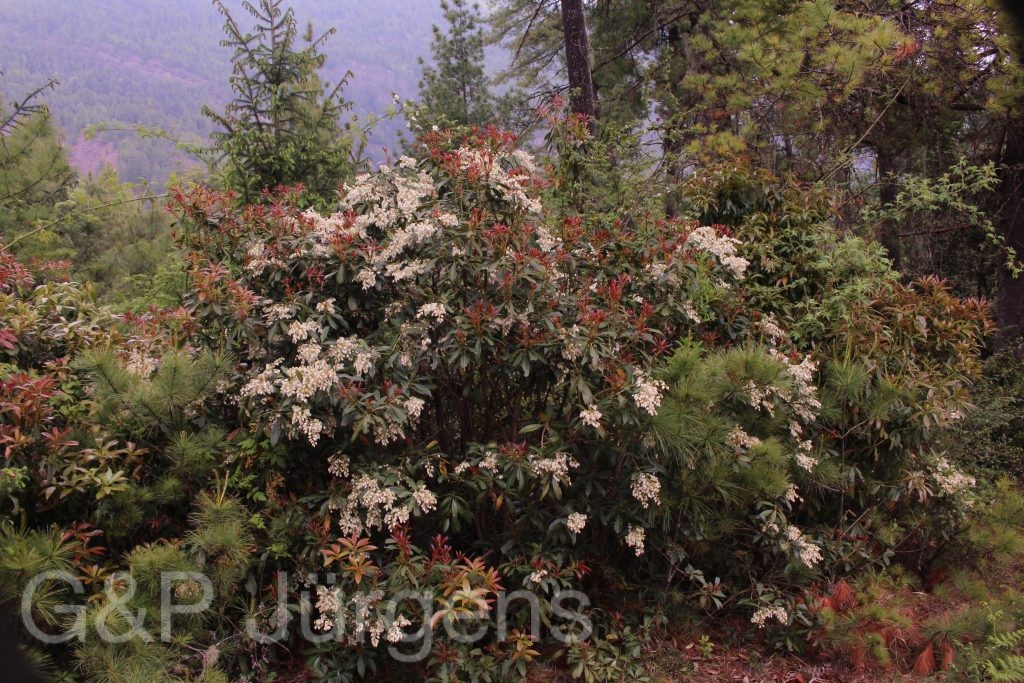
Pieris formosa is an evergreen ericaceous shrub native to the Himalaya and southwestern China, recorded from China, Nepal, India, Bhutan and Myanmar, with cultivated and naturalised records elsewhere accounting for the European, North American, Japanese and other points among its substantial 2971 GBIF occurrences. It occurs in temperate forest, forest margins, thickets and open rocky slopes, generally between 900 and 3300 m. The localities in the caption, Chele-La in Bhutan and Lachung in Sikkim, both around 3000 m in May, represent the cool, humid upper montane forest where the species flowers profusely in spring.

The plant is a much-branched evergreen shrub or small tree reaching several metres, with leathery, oblong-lanceolate to elliptic leaves that are finely serrate, glossy dark green above and frequently flushed bronze or coppery-red when young. The flowers are borne in large, terminal, much-branched panicles; each corolla is small, white, urceolate (urn-shaped) and five-toothed at the mouth, with the stamens enclosed and the ovary superior. Fruit is a small erect, woody, five-valved dehiscent capsule containing numerous minute seeds, the persistent panicles remaining conspicuous after flowering.

Pieris (tribe Lyonieae, subfamily Vaccinioideae) is a small genus of Asian and North American shrubs, and P. formosa is its most robust Himalayan representative, widely grown as an ornamental, notably the form 'Forrestii' selected for its vivid red young growth. Like many Ericaceae it favours acidic, humus-rich soils and harbours grayanotoxins, rendering its foliage poisonous to livestock. Its urn-shaped flowers are pollinated chiefly by bees, and the dust-like seeds are wind-dispersed. The species is common and not threatened across its native range.

Author: (Wall.) D. Don · Sources: POWO (Kew), GBIF, Flora of China, Flora of Bhutan, Bean Trees and Shrubs Hardy in the British Isles
Wedd. ex. Blume

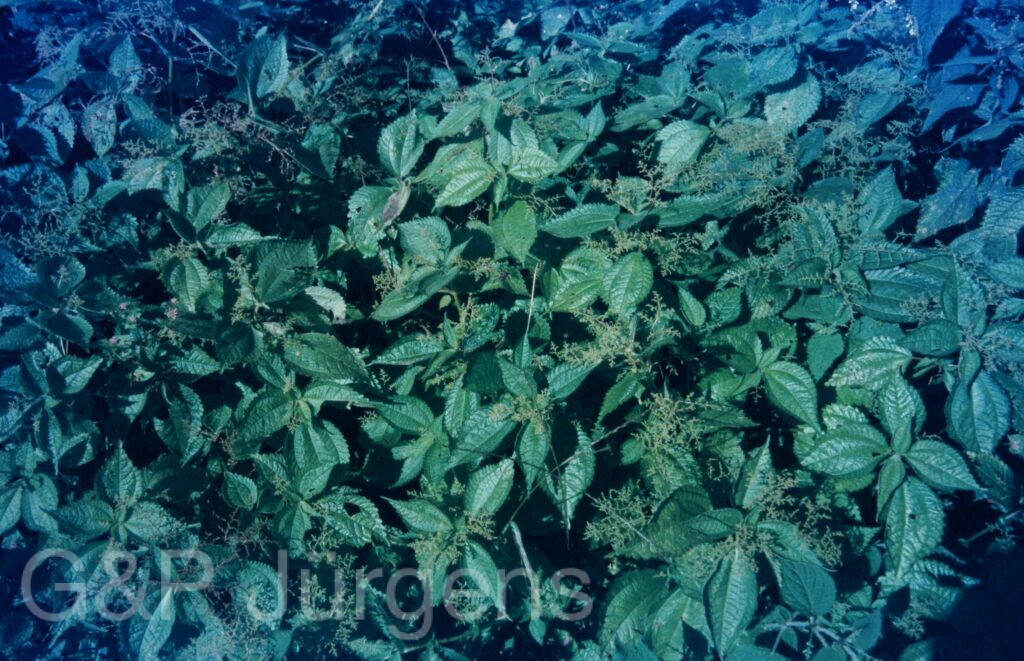
Garw 2005 220 ergebnis ergebnis
India Garhwal Simkarok 2700m, September

Description

Pilea umbrosa is a shade-loving herb of moist montane forests across the Himalaya and into south-east Asia, recorded from Nepal, India, China, Pakistan, Bhutan and Vietnam. The roughly 307 georeferenced collections trace the temperate forest belt from the western Himalaya eastward. As its epithet (umbrosa, "of shady places") implies, it occupies damp, humus-rich, deeply shaded sites: forest floors, rock crevices, mossy banks and the margins of streams beneath broadleaved and mixed canopy. The photographed material from Garhwal at Simkarok at 2700 m in September is characteristic of its upper-temperate habitat and its late-monsoon fruiting period.

It is a succulent, often fleshy perennial herb with semi-translucent, somewhat brittle stems that may root at the lower nodes. The opposite leaves are markedly anisophyllous, the two of a pair unequal in size, ovate to elliptic, with a toothed (serrate to crenate) margin and a characteristic triple primary venation; linear cystoliths are visible on the surface, a diagnostic feature of the genus. Stipules are present at the nodes. As in most Urticaceae the inflorescences are small, axillary cymes of inconspicuous, unisexual, greenish flowers, the male flowers with reflexed tepals and explosively dehiscent stamens that fling pollen at maturity. The fruit is a minute, compressed achene.

Pilea is one of the largest genera of Urticaceae, predominantly tropical and subtropical, and unusually for the family it lacks stinging hairs, making it harmless to handle. The explosive stamen mechanism enabling wind dispersal of pollen is a hallmark of the family. P. umbrosa is a widespread, locally abundant understorey element with no conservation concern, valued ecologically as ground cover that stabilises soil on shaded forest slopes.

Author: Wedd. ex. Blume · Sources: POWO (Kew), GBIF, Flora of China Vol. 5, Flora of Bhutan Vol. 1, Flora of Pakistan, Friis's Revision of Asian Urticaceae

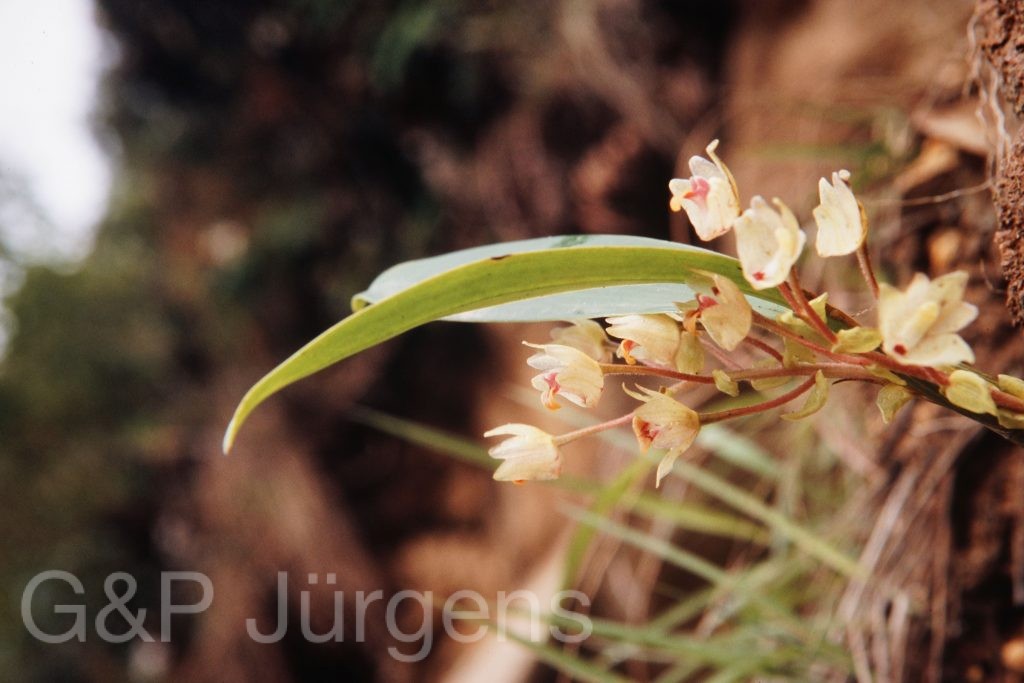
(Rchb.f.) Kuntze

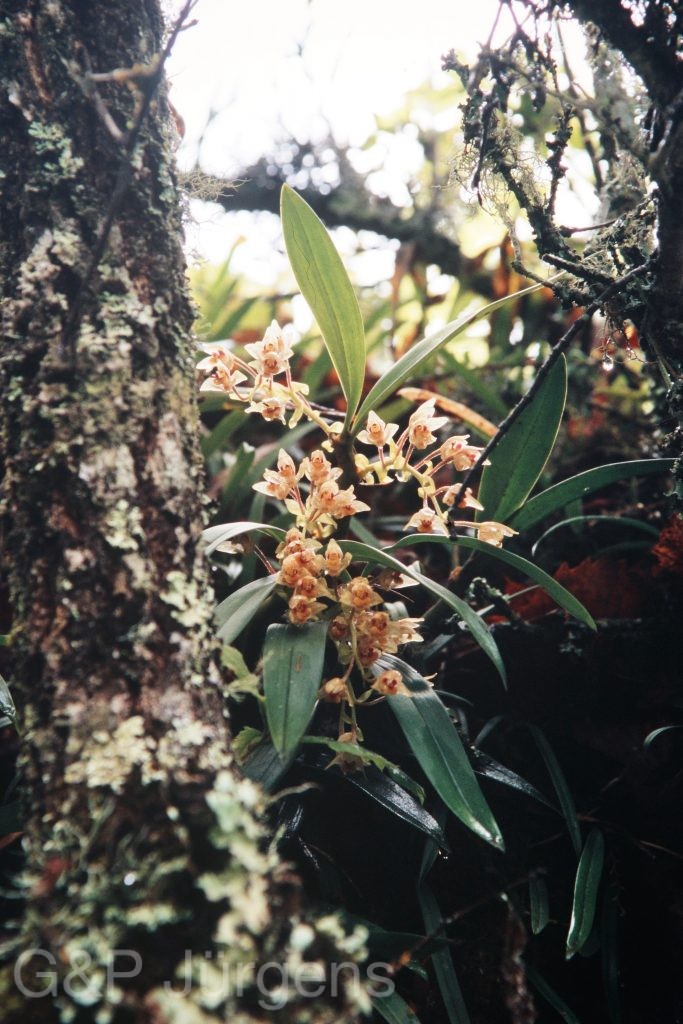
Bh2008 320 P495
Bhutan Jakar, 2950m April
Bh2008 321 G496
Bhutan Jakar, 2950m April

Description

Pinalia amica (Rchb.f.) Kuntze, long known under Eria amica, is an epiphytic orchid widely distributed through tropical and subtropical Asia. GBIF records (about 203 occurrences) extend from Nepal, northern India and Bhutan eastward through Myanmar, southern China, Taiwan, Thailand, Laos, Cambodia, Vietnam and Malaysia. It grows as an epiphyte, occasionally a lithophyte, on mossy trunks and branches in humid broad-leaved and mixed forest, from the foothills up to about 2000-3000 m. The plant photographed at Jakar in Bhutan at 2950 m in April, flowering in spring, occurs near the upper part of its altitudinal range in cool, moist montane forest where high humidity and shaded, well-aerated bark provide its rooting substrate.

It is a sympodial epiphyte with cylindric to fusiform pseudobulbs or stems clustered on a creeping rhizome, each bearing a few apical leaves. The leaves are oblong-lanceolate, leathery and several-nerved. The inflorescence is a lateral raceme of several to many flowers, the rachis and ovaries usually finely hairy. The flowers are small, cream to pale yellow, often marked with reddish-brown striations; the sepals form a short mentum at the base with the column foot, and the lip is three-lobed and bears longitudinal keels or calli. The pollinarium carries eight waxy pollinia, and the fruit is a ribbed dehiscent capsule releasing dust-like seeds.

The broadly circumscribed genus Eria has been dismembered on molecular evidence, and species of the Eria amica group are now placed in Pinalia within tribe Podochileae; Pinalia amica is the currently accepted name. Like most epiphytic orchids it depends on mycorrhizal fungi for seed germination and produces enormous numbers of minute wind-dispersed seeds. Widespread across Asia, it is not regarded as threatened overall, though, as with all orchids, it is listed on CITES Appendix II, and local populations are sensitive to deforestation and collection.

Author: (Rchb.f.) Kuntze · Sources: POWO (Kew), GBIF, Flora of China, The Orchids of Bhutan, Annotated Checklist of the Flowering Plants of Nepal, Ng et al. molecular phylogeny of Eria and allied genera

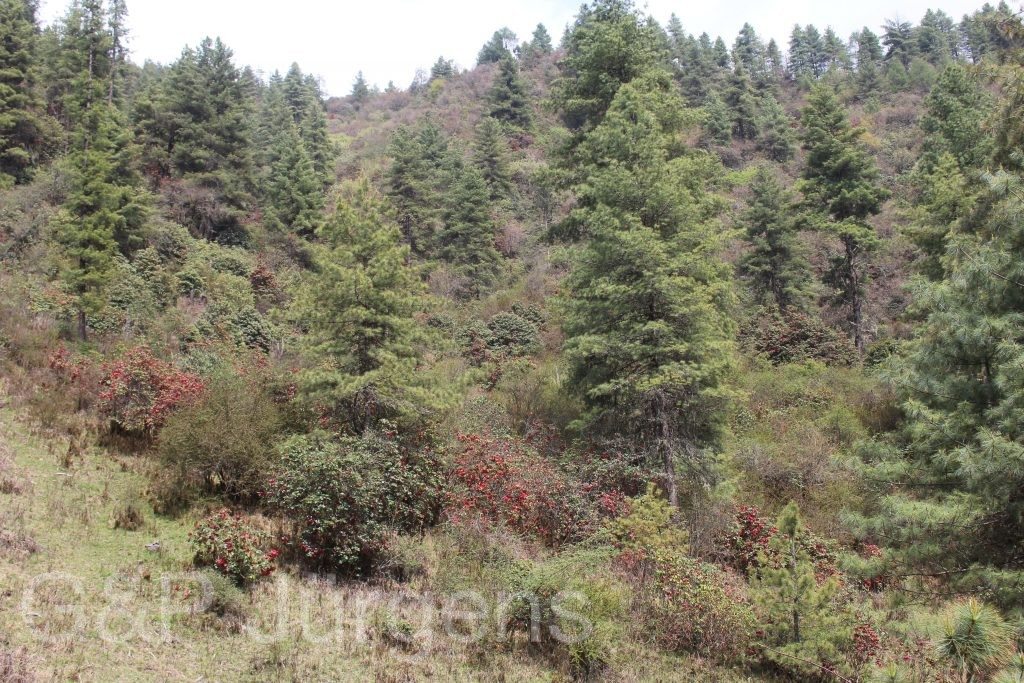
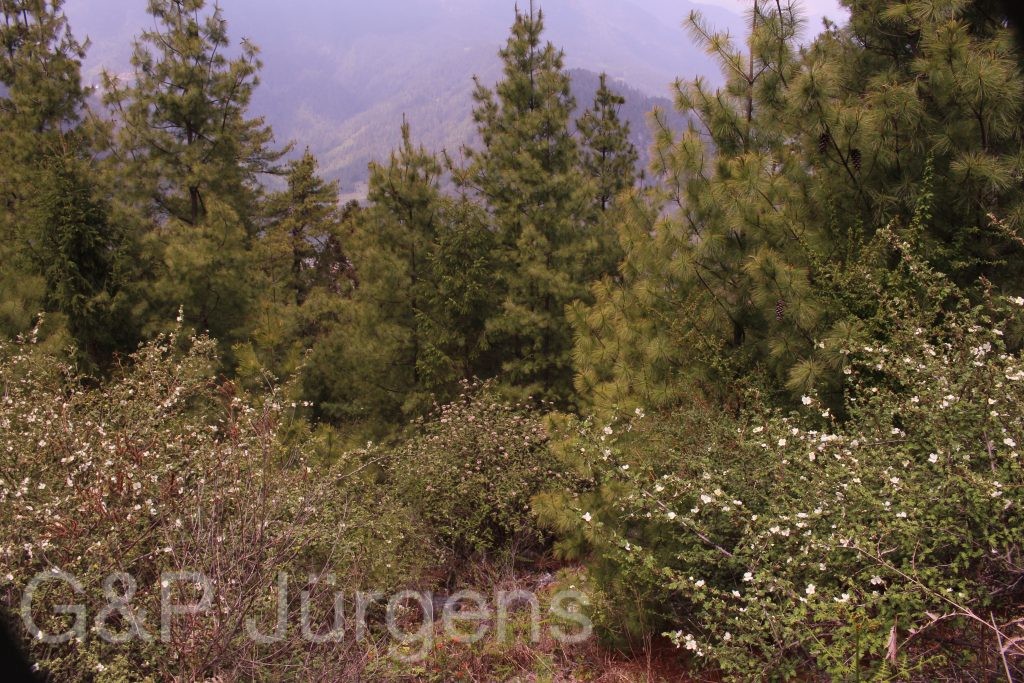
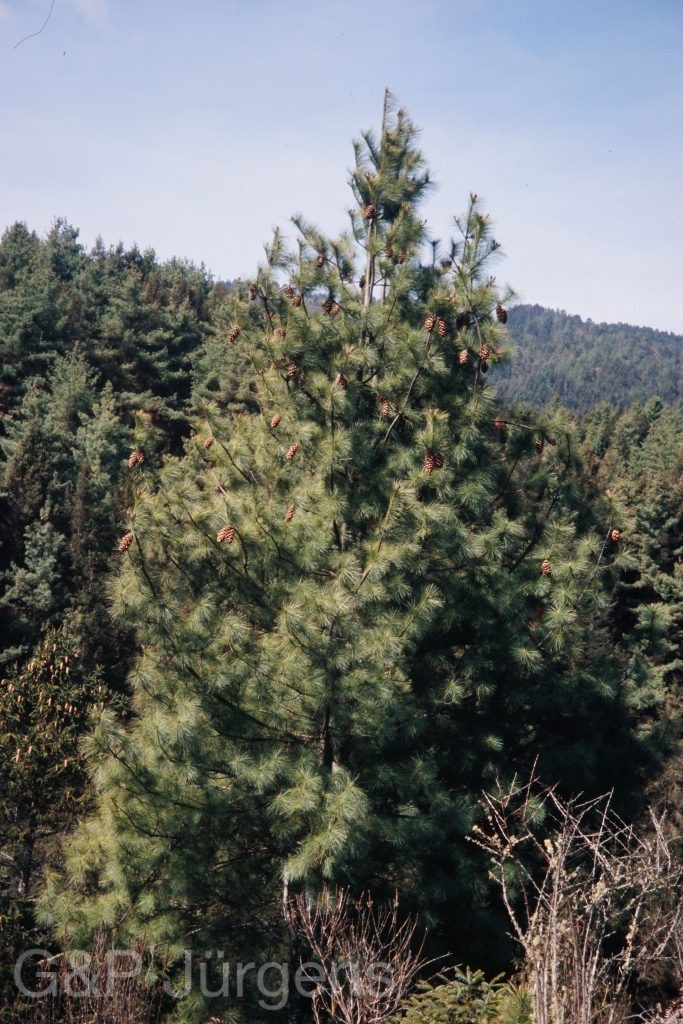
(Wall. ex. D.Don) A.B.Jacks.

Bhutan2014 544
Bhutan, Phobjika 3000m, May
Bhutan2014 961
Bhutan, Haa-valley, 2800m, May
Bh2008 295 P454
Bhutan, Ura 2900m, April

Description

Pinus wallichiana, the Bhutan or blue pine, is a major timber conifer of the Himalaya and Hindu Kush, ranging from Afghanistan and Pakistan through Kashmir, the Indian Himalaya, Nepal and Bhutan to south-eastern Tibet and China. It is among the best-recorded Himalayan trees, GBIF holding over 2400 occurrences, many from cultivation in Europe, North America and Australasia where it is a graceful ornamental. Natively it forms montane forests, often with Picea, Abies and Cedrus, on well-drained slopes between about 1800 and 4000 m. The Bhutanese stands at Phobjikha, the Haa valley and Ura between 2800 and 3000 m exemplify its dominance in the temperate conifer belt.

It is a large evergreen tree to 40 m or more, with a straight trunk, greyish fissured bark and whorled spreading branches forming a broad conical crown. The needle leaves are five per fascicle, slender, soft and drooping, 12 to 20 cm long, glaucous-bluish (whence blue pine) and finely serrulate. It is monoecious: small yellow pollen cones cluster at the base of new shoots, while the seed cones are long-pedunculate, cylindrical and resinous, 15 to 30 cm long and pendent, with broad woody scales spreading at maturity, each fertile scale bearing two winged, wind-dispersed seeds.

A member of Pinus subgenus Strobus (the soft or white pines, section Quinquefoliae), P. wallichiana is allied to P. griffithii and other five-needle pines of eastern Asia and North America, distinguished by its long pendulous cones and drooping foliage. It is important for construction timber, resin and fuel, and ecologically as a pioneer colonising landslides and abandoned terraces. Though widespread and not threatened, it is locally susceptible to blister rust and to over-exploitation near settlements.

Author: (Wall. ex. D.Don) A.B.Jacks. · Sources: POWO (Kew), GBIF, Flora of China Vol. 4, Flora of Bhutan Vol. 1, Flora of Pakistan, Farjon A Handbook of the World's Conifers

(Hook.) Sweet

Bhutan2014 342
Bhutan Tumching-La 3000m, May
Bhutan2014 886
Bhutan Chele-La 3300m, May

Description

Piptanthus nepalensis is a Sino-Himalayan shrub distributed along the southern flank of the great ranges from Nepal and northern India eastward through Bhutan into south-western China (Yunnan, Sichuan, Xizang), with outlying records in Myanmar; the species is widely cultivated and naturalised in temperate gardens, accounting for the European, North American and Antipodean records (GB, DE, BE, NL, US, CA, NZ) among its more than 1600 georeferenced occurrences. It favours open scrub, forest margins, rocky slopes and stream banks in the upper montane and subalpine belts, typically between about 2500 and 4000 m. The populations on the Bhutanese passes of Tumching-La (3000 m) and Chele-La (3300 m), flowering with the spring thaw in May, are characteristic of its habitat among Rhododendron and conifer scrub.

It is a deciduous to semi-evergreen shrub reaching 1-4 m, with stout greenish branchlets bearing silky-pubescent young growth. The leaves are trifoliolate, long-petiolate and stipulate, the leaflets elliptic to lanceolate, dark green and glabrescent above, glaucous and appressed-silky beneath. The showy golden-yellow papilionaceous flowers, 2.5-3 cm long, are borne in terminal erect racemes; the calyx is bilabiate and silky, and the standard, wings and keel are typical of the tribe Thermopsideae. The fruit is a flattened, elongate, dehiscent legume to 12 cm, glaucous-pubescent and containing several dark reniform seeds.

Piptanthus is a small genus of the broadly defined Thermopsideae allied to Thermopsis and Anagyris, distinguished by its woody habit and trifoliolate leaves. Long-cultivated for its early bloom, P. nepalensis hosts nitrogen-fixing rhizobia that aid colonisation of skeletal soils. It is not considered threatened, being abundant across a broad range, though its toxic quinolizidine alkaloids deter browsing.

Author: (Hook.) Sweet · Sources: POWO (Kew), GBIF, Flora of China, Flora of Bhutan, Flora of Nepal, Turner's revision of Piptanthus (Thermopsideae)

Wall.

Garw 2005 222 ergebnis ergebnis
India Garhwal Simkarok 2700m, September

Description

Platystemma violoides is a small Himalayan herb of the Gesneriaceae, restricted to the western and central Himalaya in Nepal, India, Bhutan and adjacent China, with around 179 recorded occurrences across this comparatively narrow range. It is a chasmophyte of moist, shaded rock faces, damp cliffs and mossy boulders, often in spray zones and on dripping banks within temperate forest, flowering toward the close of the monsoon. In the Indian Garhwal Himalaya it occupies the middle montane belt, as documented by the collection at Simkarok at about 2700 m in September, when the plants are in flower on rain-soaked rock.

The plant is a delicate annual or short-lived perennial that develops a single, large, suborbicular to broadly ovate leaf, cordate at the base, softly hairy and shallowly toothed, pressed against the rock surface in the manner of a monophyllous gesneriad. From the base of the leaf arises a slender scape bearing one or a few showy flowers; the corolla is broadly campanulate to rotate and violet to purplish-blue, recalling a violet and giving the epithet violoides, with a short tube, spreading lobes and two to four stamens. The fruit is a small capsule releasing numerous minute seeds.

The family in this record is given as Leptoboeinae, the subtribe of Old World Gesneriaceae to which the monotypic genus Platystemma belongs, alongside Loxostigma, Leptoboea and related rock-dwelling herbs; the species is properly placed in Gesneriaceae. Its single-leaved habit and adaptation to vertical rock microhabitats parallel those of other Himalayan gesneriads such as Corallodiscus and the African Streptocarpus. Confined to specialised cliff niches, P. violoides is naturally local though not currently regarded as threatened, its persistence depending on the integrity of shaded, perennially moist rock habitats.

Author: Wall. · Sources: POWO (Kew), GBIF, Flora of China Vol. 18, Flora of Bhutan Vol. 2, Flora of Nepal, Weber & Burtt classification of Gesneriaceae

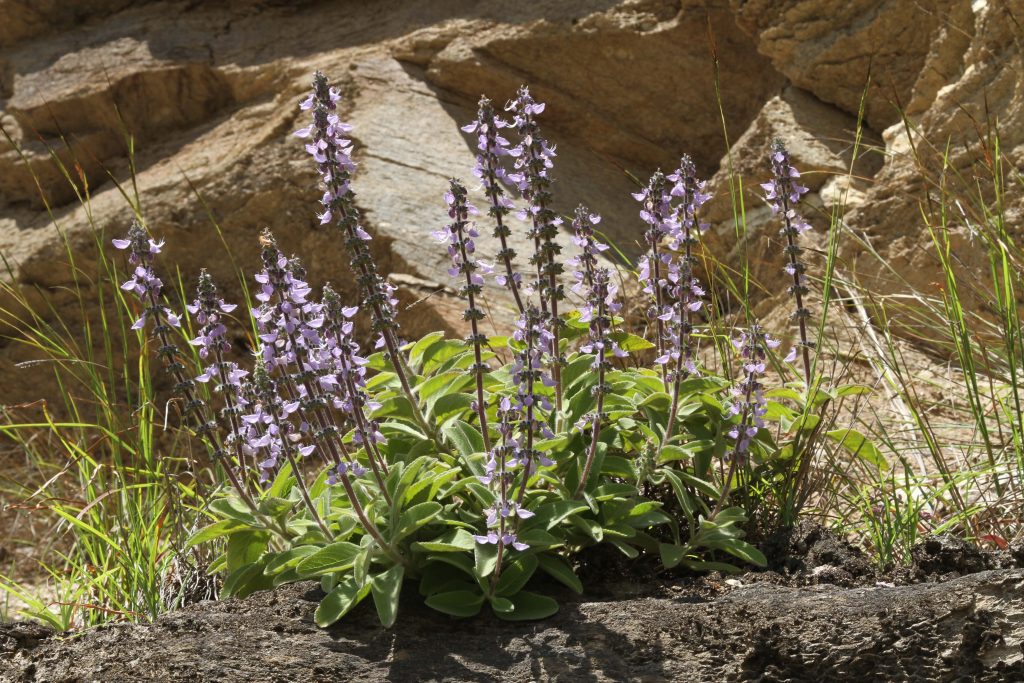
Andrews

Bhutan2012 398
Bhutan Wangdi 2600m, September

Description

Plectranthus barbatus Andrews is an aromatic perennial herb or subshrub with a broad palaeotropical distribution, recorded from tropical and southern Africa (Ethiopia, Kenya, Tanzania, South Africa) and the Arabian Peninsula through to the Indian subcontinent, Nepal, Bhutan and Sri Lanka, where it is both native and widely cultivated and naturalised. In the Himalaya it grows on warm, dry, rocky banks, terrace margins, scrub and open hill slopes, often near villages. The photographed plant from Wangdi (Wangdue Phodrang) in Bhutan at 2600 m, flowering in September at the close of the monsoon, illustrates its tolerance of sunny, well-drained sites in the lower-temperate zone. GBIF treats the listed name as a synonym, with Plectranthus barbatus the accepted name.

The plant forms an erect, branching, softly woody-based herb with quadrangular, finely pubescent stems. The opposite leaves are broadly ovate, crenate-margined, somewhat fleshy and strongly aromatic, narrowing to a winged petiole and densely glandular and hairy. The flowers are borne in whorls along elongate, terminal racemose inflorescences; the bilabiate corolla is blue to violet-blue, with a short upper lip and a deflexed, boat-shaped lower lip enclosing the four didynamous stamens. As in other Lamiaceae the fruit comprises four smooth nutlets seated in the persistent calyx.

Long cultivated for medicine and as a hedge plant, P. barbatus (often called Coleus forskohlii in pharmacological literature) is the principal source of the diterpenoid forskolin, which has driven extensive cultivation across India and Africa. Its taxonomy is complicated by this synonymy and by horticultural movement blurring native and introduced ranges. The species is not of conservation concern, being weedy, easily propagated and widely naturalised.

Author: Andrews · Sources: POWO (Kew), GBIF, Flora of Bhutan, Flora of Tropical East Africa (Lamiaceae), Plectranthus and Allied Genera (Lukhoba, Simmonds & Paton)

(Lindl.) Rollisson

Sikkim2011 381
Sikkim Lachen 2600m, June
Nepal 2001 262 ergebnis ergebnis
Nepal (Gorkha) Jaurey Kharka 2700m, May
Nepal 2001 263 ergebnis ergebnis
Nepal (Gorkha) Jaurey Kharka 2700m, May

Description

Pleione hookeriana is a small epiphytic and lithophytic orchid of the eastern Himalaya and Indochina, distributed across Nepal, India, Bhutan, China and Laos, with about 204 GBIF occurrences. It inhabits cool, humid montane forest, growing on mossy tree trunks, branches and shaded rocks in the temperate zone, favouring situations with abundant atmospheric moisture. The images document it in Sikkim near Lachen at about 2600 m in June and in the Gorkha district of Nepal at Jaurey Kharka around 2700 m in May, where it flowers on moss-clad substrates as the monsoon approaches.

It is a dwarf, deciduous orchid growing from a small annual pseudobulb that bears a single plicate leaf. The flower is solitary and produced with or just before the leaf on a short scape arising from the base of the pseudobulb. The sepals and petals are narrow, spreading and pale pink to rose-lilac; the labellum is comparatively large, obovate, fringed at the margin, and marked within by a yellow to brown-spotted, lamellate throat that contrasts with the paler perianth. The column is slender and winged. The fruit is a dry dehiscent capsule releasing dust-like seeds.

Pleione hookeriana is the smallest-flowered species of its genus and is distinguished by its diminutive habit and patterned lip. Like all Pleione it has an annual pseudobulb cycle and depends on mycorrhizal fungi for seed germination. The showy lip and contrasting throat markings attract bee pollinators in spring. As an attractive orchid it is subject to horticultural collection, and the entire genus is listed on CITES Appendix II, regulating international trade.

Author: (Lindl.) Rollisson · Sources: POWO (Kew), GBIF, Flora of China, Flora of Bhutan, The Genus Pleione (Cribb & Butterfield), CITES Appendices

Hand.-Mazz.

BhutanPG2011 57JPG
Bhutan Jakar 2600m June
Bh09 295 G486
Bhutan Pele-La, 3200m June
Bh09 296 G487
Bhutan Pele-La, 3200m June

Description

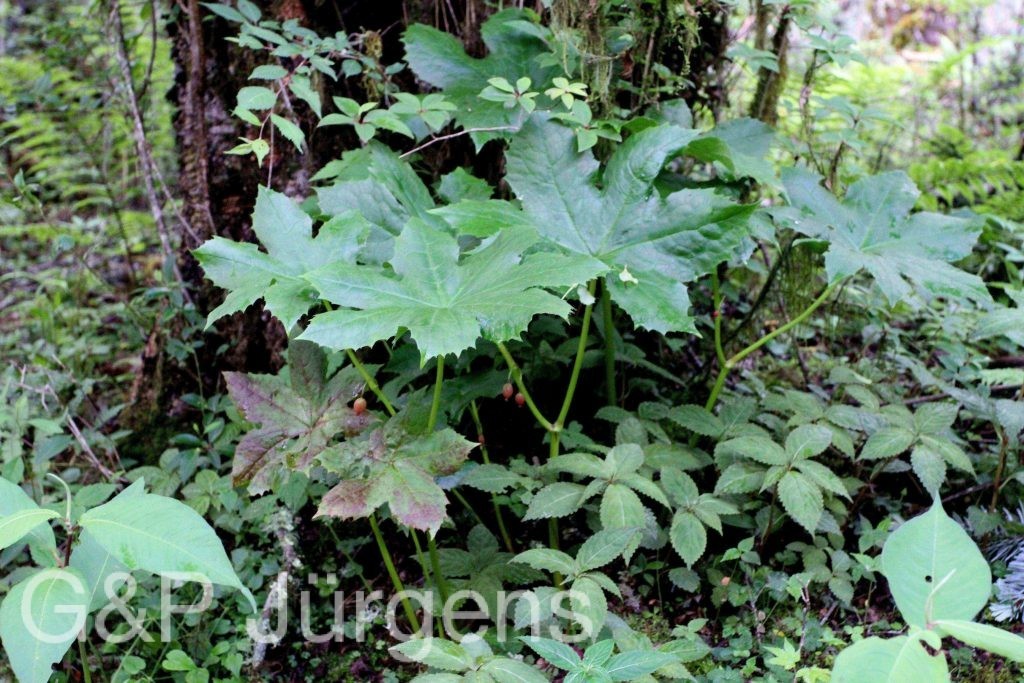
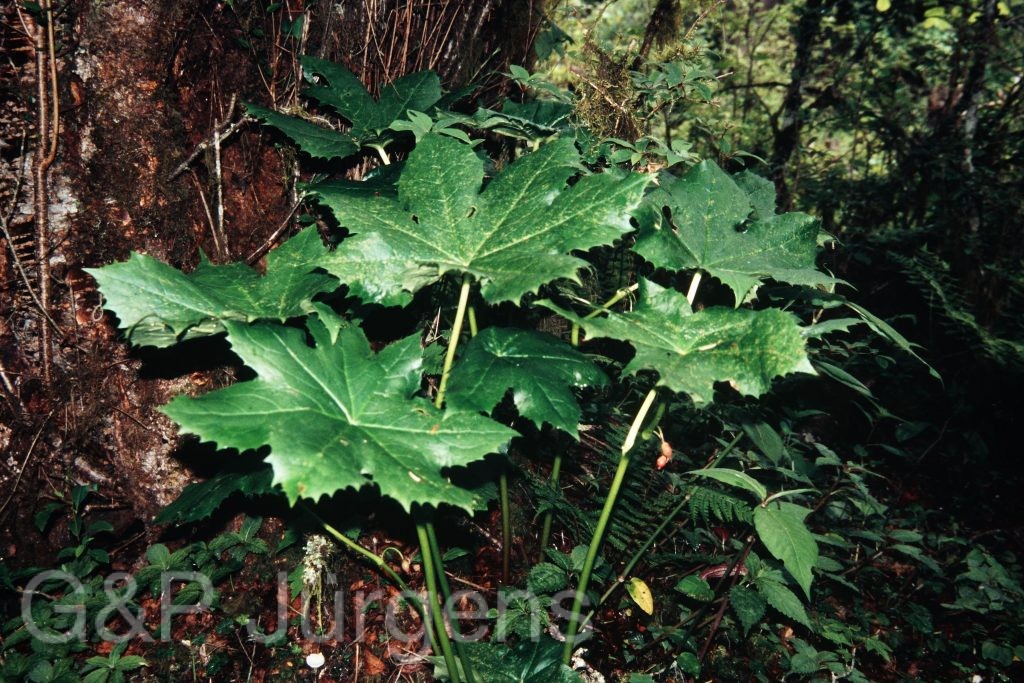
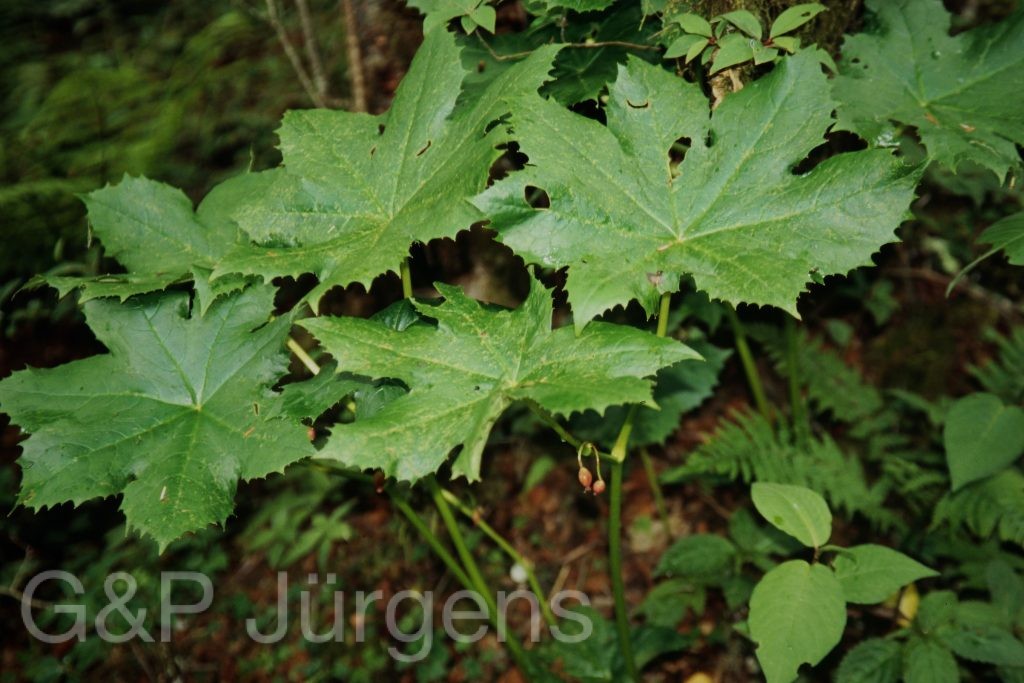
Podophyllum aurantiocaule is a Sino-Himalayan woodland herb recorded from China, Myanmar and India (with one extralimital cultivated record from the Netherlands), the c. 25 georeferenced occurrences reflecting a relatively narrow and uncommon distribution in the eastern Himalaya and adjacent mountains. It grows in the shade and humus of temperate broadleaved and conifer forest, on cool, moist, sheltered slopes and forest floor, generally between about 2400 and 3400 m. The illustrated plants were photographed at Jakar in Bhutan at 2600 m and at Pele-La at 3200 m, both in June, sites characteristic of the species, which emerges and flowers in early summer beneath the forest canopy. Under GBIF this name is treated as a synonym, with Podophyllum aurantiocaule itself recognised as the accepted name in that backbone.

It is a perennial herb arising from a stout creeping rhizome, sending up an erect, fleshy, often orange-tinted stem, the colouration reflected in the epithet aurantiocaule. The stem bears typically two large, long-petioled, peltate to deeply palmately lobed leaves whose margins are toothed. A single, rather large, nodding flower is borne at the fork between the leaves; it has free, somewhat fleshy petals in shades of dull red to purplish, numerous stamens and a single superior carpel. The fruit is a large fleshy berry containing many seeds embedded in pulp.

The Asian podophylloids, treated either in a broad Podophyllum or in the segregate genera Dysosma and Sinopodophyllum, are placed in Berberidaceae and are renowned for the lignan podophyllotoxin, precursor of the anticancer drugs etoposide and teniposide. As a slow-growing, rhizomatous, narrowly distributed forest herb subject to medicinal collection and habitat loss, P. aurantiocaule is intrinsically vulnerable, and members of this complex are widely flagged for conservation attention.

Author: Hand.-Mazz. · Sources: POWO (Kew), GBIF, Flora of China, Flora of Bhutan, Shaw monograph of the podophylloid Berberidaceae

Baker

Nepal 99 85 ergebnis
West-Nepal Bhulbhule 3200m, June

Description

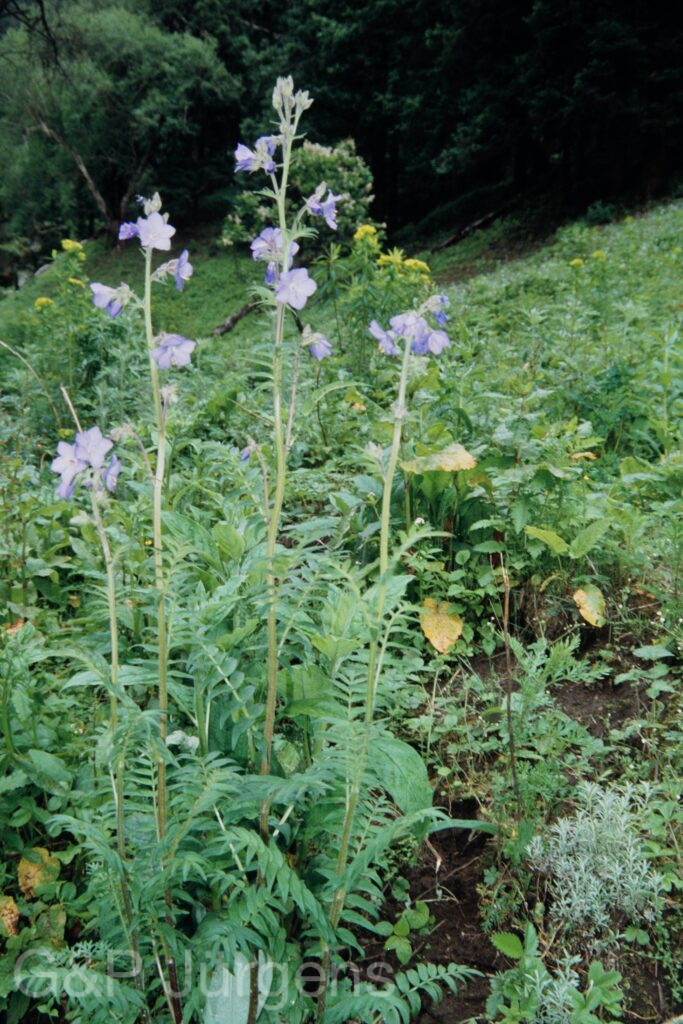
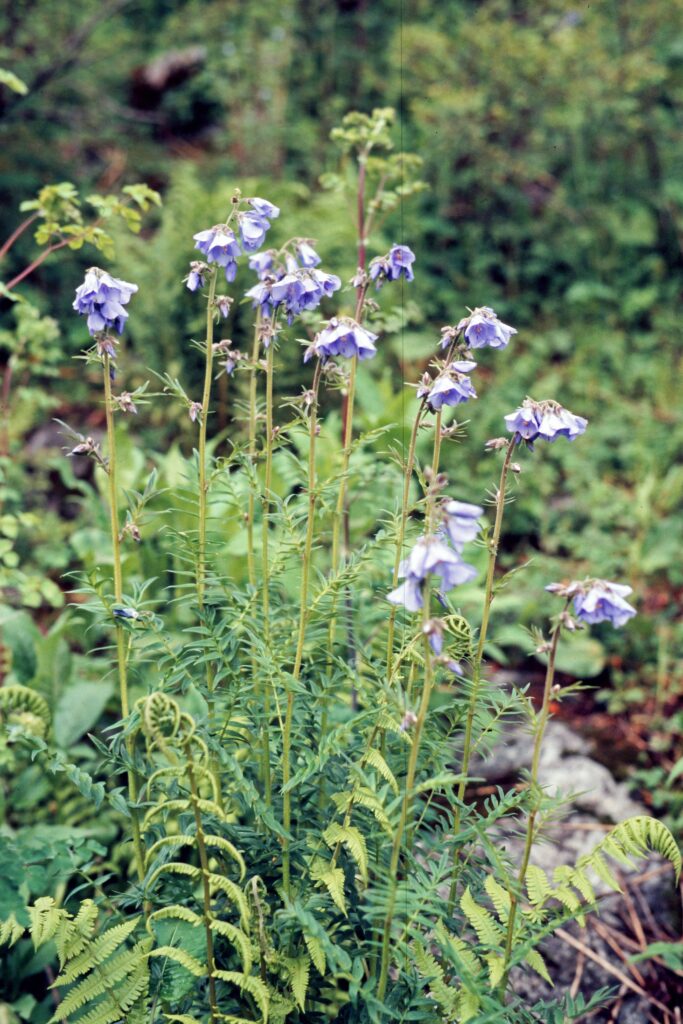
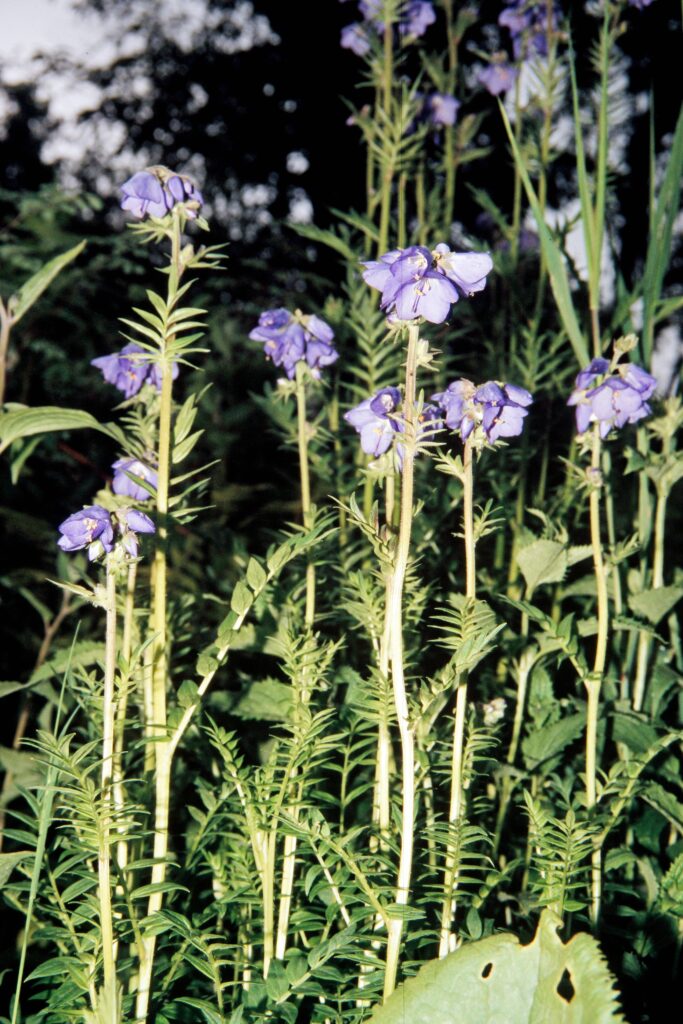
Polemonium caeruleum var. himalayanum is the Himalayan expression of the wide-ranging Jacob's ladder, here documented chiefly from Nepal, with only about 16 georeferenced GBIF occurrences reflecting its restricted recording rather than true rarity. It is a herb of moist alpine and upper-subalpine meadows, streambanks, open shrubberies and damp rocky slopes, typically between about 3000 and 4000 m. The populations noted at Bhulbhule in West Nepal at 3200 m and at Seema in Garhwal at 3400 m, both flowering in June at the start of the monsoon, are characteristic of its preference for cool, humus-rich, seasonally moist ground in the high western and central Himalaya.

It is an erect perennial herb arising from a short rhizome, the stems leafy and often glandular-pubescent above. The leaves are alternate and pinnately compound, the numerous lanceolate to ovate leaflets arranged ladder-like along the rachis, giving the plant its vernacular name. The flowers are borne in a terminal, somewhat congested panicle; each has a campanulate, glandular five-lobed calyx and a broadly campanulate to rotate blue corolla with five spreading lobes, the five stamens inserted in the throat with hairy filament bases, and a three-lobed style exserted. The fruit is an ovoid, three-valved loculicidal capsule containing several angular seeds.

GBIF treats the name as a synonym, with Polemonium caeruleum himalayanum recognised as the accepted infraspecific taxon within the circumboreal P. caeruleum complex. The protandrous, nectar-rich flowers are visited by bees and long-tongued insects, promoting outcrossing. As a high-altitude meadow plant it is sensitive to overgrazing, though not presently assessed as threatened.

Author: Baker · Sources: POWO (Kew), GBIF, Flora of Nepal, Flora of Bhutan Vol. 2, Flora of China Vol. 16, A Systematic Treatment of Polemonium (Polemoniaceae)