Tag:

Summer

(Haw.) Sternb.

Sikkim2011 28
Sikkim Lachen 2800m, June
Nepal 97 303 G604
Nepal Honggaon 2360m May
Nepal 2001 463 ergebnis ergebnis
Nepal (Gorkha) Gunda 1700m, May

Description

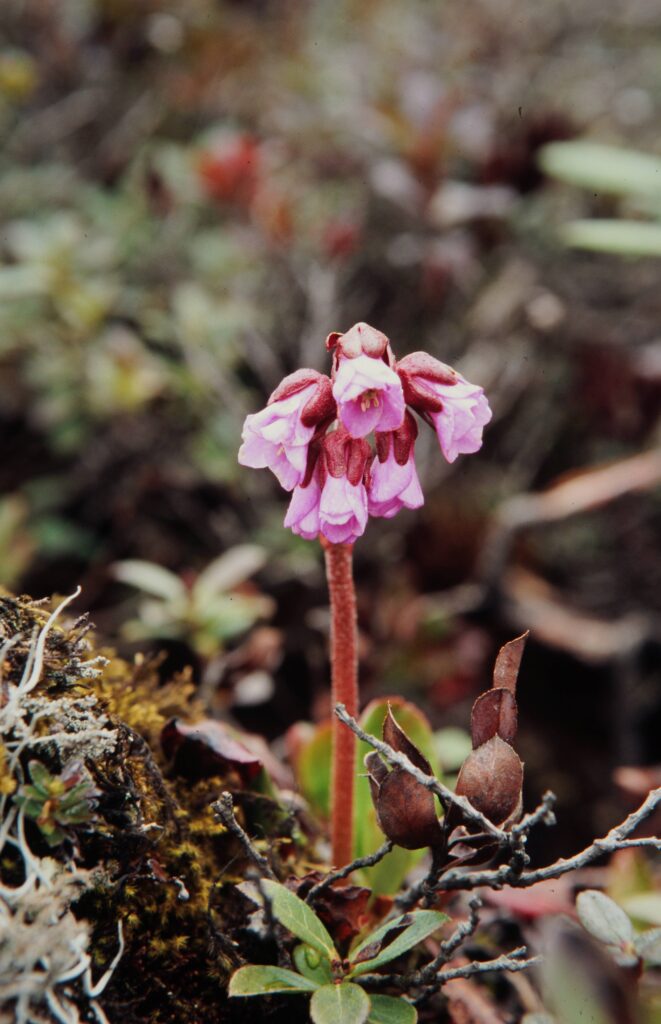
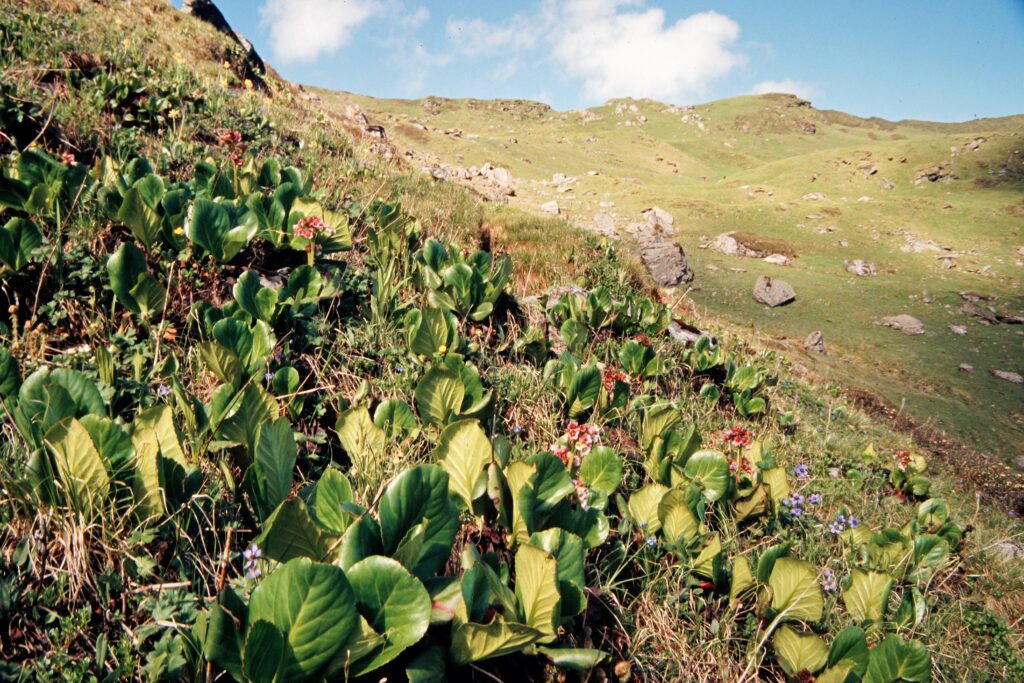
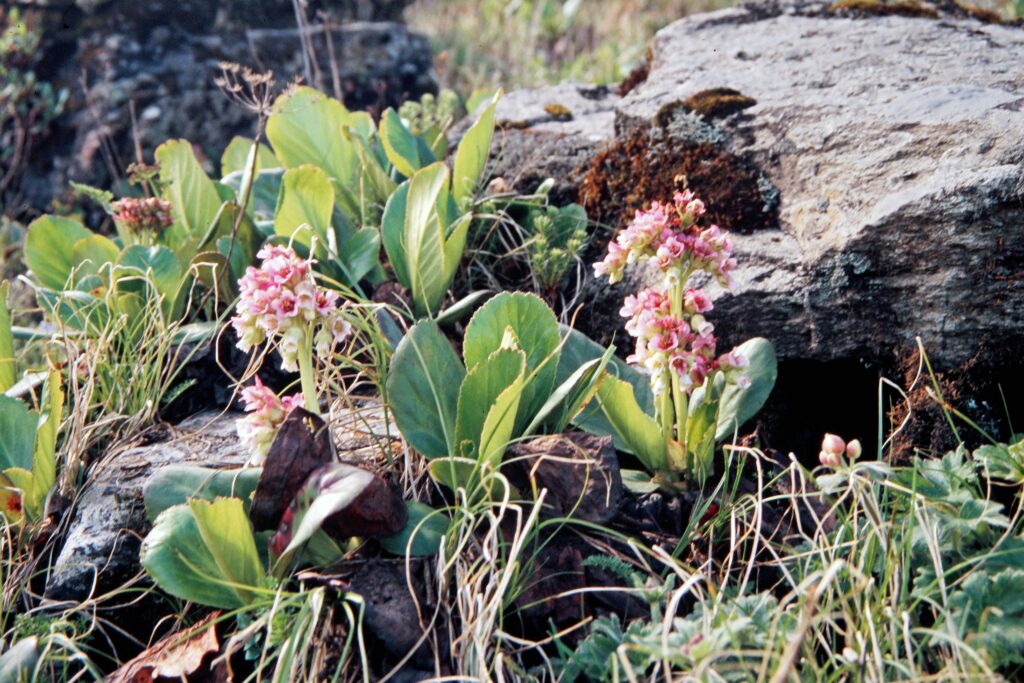
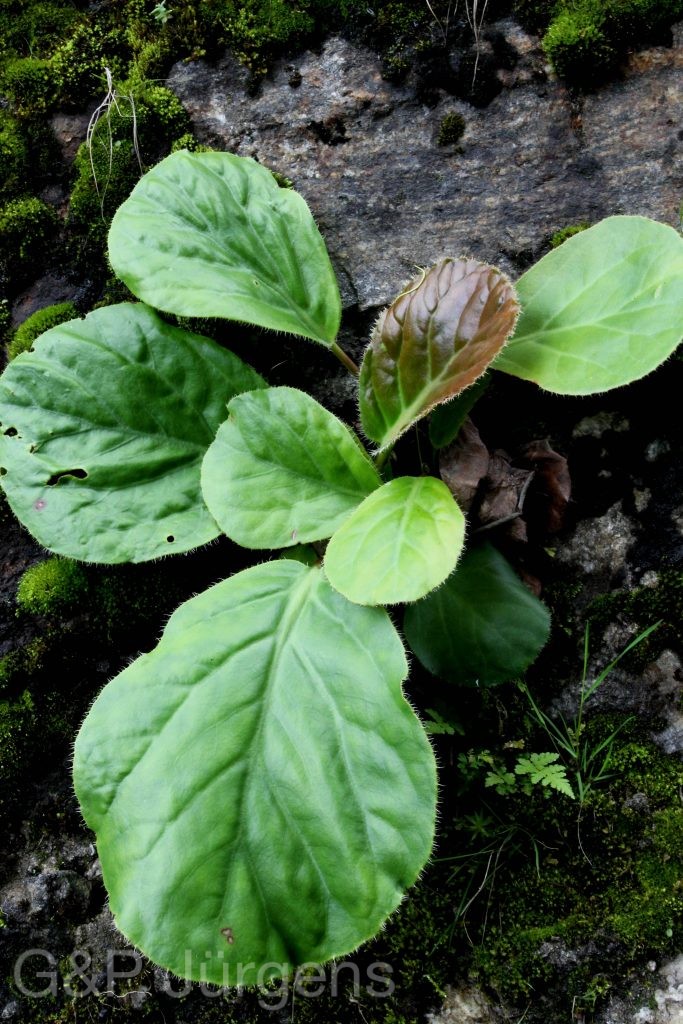
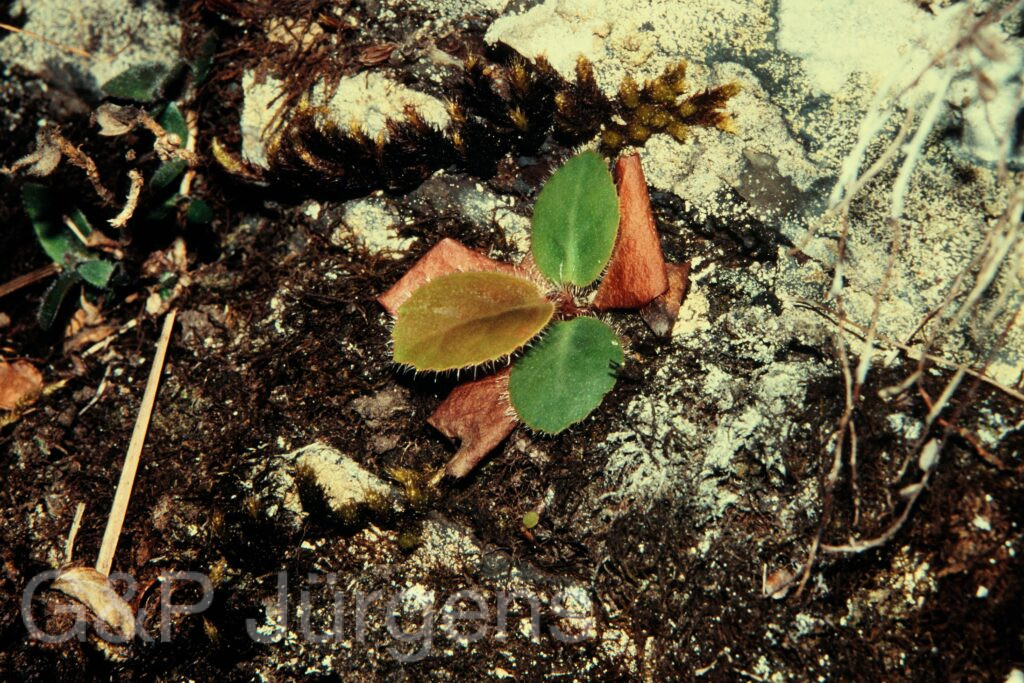
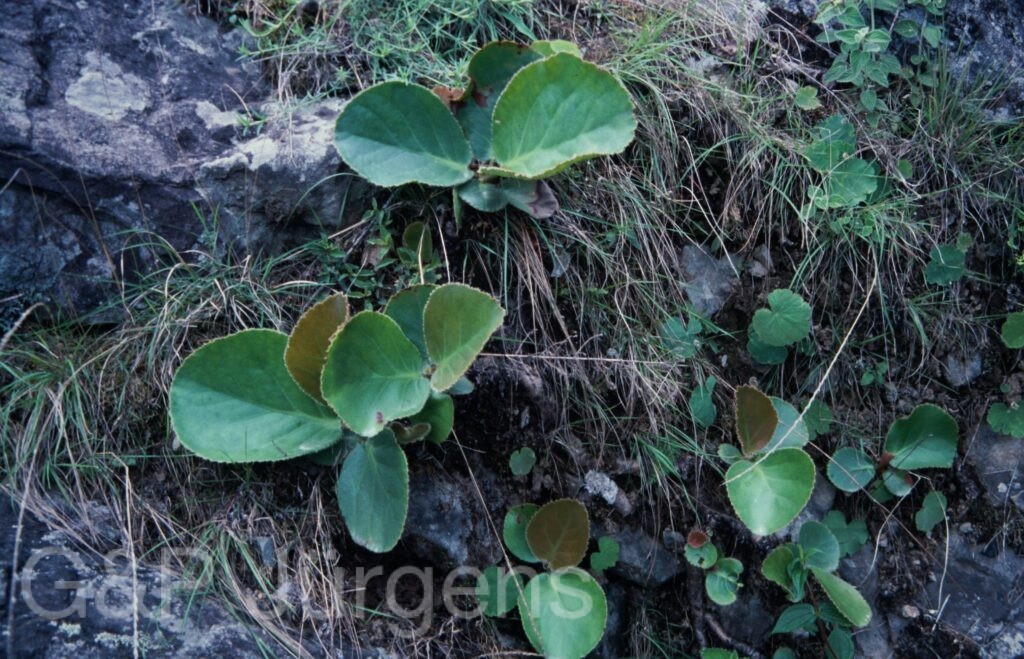
Bergenia ciliata (Haw.) Sternb. is a robust rosette-forming perennial widely distributed through the Himalaya from Pakistan and Afghanistan eastward across India, Nepal, Sikkim and Bhutan into south-west China. It is a characteristic plant of shaded, moist rock crevices, cliff ledges, stream banks and boulder-strewn slopes in the temperate forest belt, generally between about 1500 and 3000 m. The photographed gatherings span this range, from Gunda in the Gorkha region of Nepal at 1700 m and Honggaon at 2360 m up to Lachen in northern Sikkim at 2800 m, flowering in May and June. It favours cool, humid, semi-shaded microsites with seepage and good drainage, often forming extensive colonies on damp rock.

The plant arises from a stout, fleshy, creeping rhizome bearing the persistent remains of old leaf bases. The leaves are large, obovate to broadly elliptic, rounded and shortly toothed at the margin, and notably ciliate-hairy on both surfaces and margin (the basis of the epithet ciliata), distinguishing it from the glabrous-leaved B. purpurascens. The leafless scape carries a branched cymose panicle of showy flowers; the five petals are white to pale pink, broadly obovate, set off by a reddish calyx and conspicuous stamens, opening often before the new foliage is fully expanded. The fruit is a two-lobed capsule containing numerous small seeds.

Within Saxifragaceae the genus Bergenia is a small Asian group, and B. ciliata is one of its most widespread members, intergrading with relatives where ranges overlap. The thick rhizome ("pashanbhed") is important in Ayurvedic and folk medicine, valued for treating urinary calculi, which has led to heavy wild harvesting. Though not globally threatened, localised over-collection and habitat disturbance make sustainable management of this medicinally prized saxifrage a conservation concern.

Author: (Haw.) Sternb. · Sources: POWO (Kew), GBIF, Flora of China, Annotated Checklist of the Flowering Plants of Nepal, Flora of Bhutan, A Monograph of the Genus Bergenia (Yeo)
(Hook.f. & Thomson) Engl.

Sikkim2011 288
Sikkim Yumthang 3600m, June
BhutanPG2011 606 scaled
Bhutan Ludlow-Sherriff-Trail Warrtlang-La, 4500m June
Sikkim 2006 394 ergebnis
India West-Bengal, Kishong 3700m, May

Description

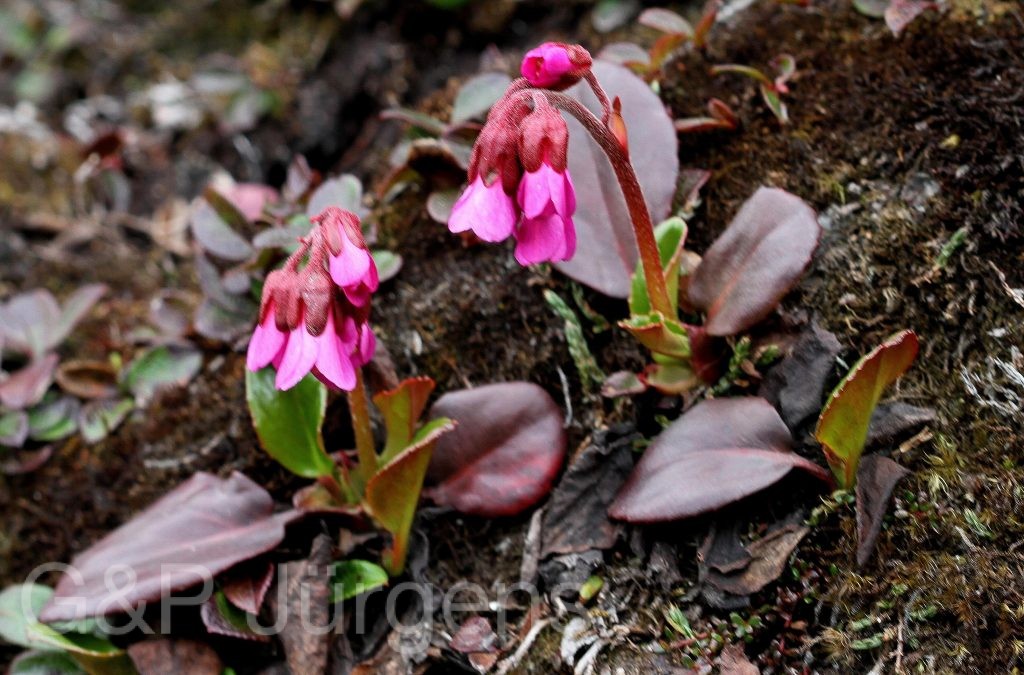
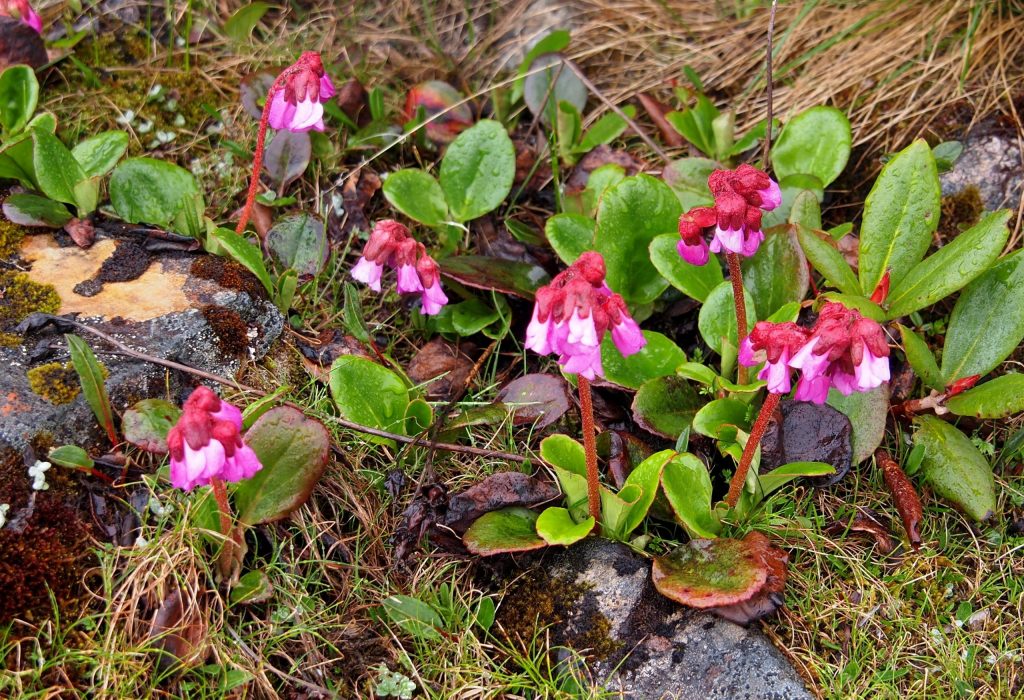
Bergenia purpurascens is a robust perennial of the high Himalaya and adjacent mountains, native to China, Nepal, India, Bhutan and Myanmar, and represented in cultivation across Europe and North America, where naturalised or garden-derived records inflate its GBIF tally to nearly a thousand occurrences. In the wild it is a plant of the alpine and upper subalpine belt, growing on rocky slopes, cliff ledges, moist meadows and the margins of rhododendron scrub. Field records illustrate this altitudinal range well: Sikkim at Yumthang around 3600 m in June, the Ludlow-Sherriff-Trail near Warrtlang-La in Bhutan at some 4500 m in June, and Kishong in West Bengal at about 3700 m in May.

The plant arises from a stout, woody, creeping rhizome bearing a basal rosette of large, leathery, obovate to elliptic leaves; these are glabrous, with entire to obscurely toothed margins and prominent reticulate venation, frequently flushing deep red or purple in autumn and cold exposure. The flowering scape is erect, reddish and glandular, terminating in a dense, nodding cyme. The flowers are showy, with five purple-red to magenta petals, a campanulate calyx of fleshy, often purplish sepals, ten stamens, and a bicarpellate ovary. The fruit is a capsule splitting to release numerous small seeds.

Described by Engler on the basis of Hooker and Thomson's material, B. purpurascens is the principal high-elevation representative of the genus in the eastern Himalaya. Its rhizomes are used in local traditional medicine, and the species is a parent of numerous ornamental Bergenia hybrids. It remains common within its broad range and is not considered threatened.

Author: (Hook.f. & Thomson) Engl. · Sources: POWO (Kew), GBIF, Flora of China, Flora of Bhutan, Pan's monograph of Bergenia

(Hook.f. & Thomson) Engl.

Description

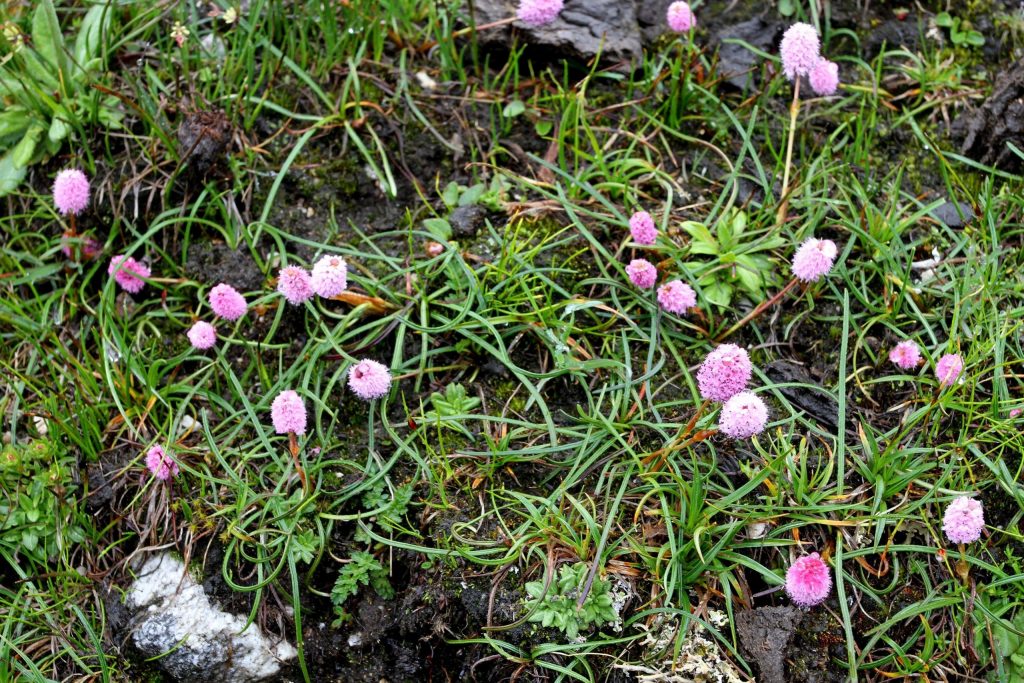
Bergenia stracheyi (Hook.f. & Thomson) Engl. is a perennial rock-dwelling herb of the higher Himalaya, native to Pakistan, north-west India, Afghanistan and adjacent China, with a GBIF record total (371 occurrences) inflated by its popularity in cultivation across Europe and North America. In its natural range it is a plant of moist alpine and subalpine ledges, screes, cliff crevices and stream banks, typically between about 3000 and 4500 m. The photographed individual, from Seema in Garhwal (Indian Himalaya) at 3700 m in June, exemplifies its habitat among shaded, humus-filled rock fissures where snowmelt provides reliable summer moisture.

The plant develops a stout, woody, creeping rhizome anchoring rosettes of thick, leathery, evergreen leaves. The leaf blades are obovate to broadly elliptic, glabrous, with crenate to entire ciliate margins and prominent reticulate venation, often flushing red in cold or exposed conditions. The inflorescence is a compact, nodding to erect cyme borne on a short fleshy scape, carrying campanulate flowers with five rose-pink to deep magenta petals, a persistent calyx, ten stamens and a bicarpellate, partly inferior ovary. The fruit is a capsule splitting to release numerous small seeds.

The genus Bergenia, often called elephant's-ears, comprises a small group of Asian saxifrages prized horticulturally for their bold foliage and early flowers; B. stracheyi is among the most cold-hardy and compact species and figures in the parentage of garden hybrids. In the wild its rhizomes have local medicinal use. Though not threatened owing to its broad montane distribution, populations are localised by their specialised cliff and scree microhabitats.

Author: (Hook.f. & Thomson) Engl. · Sources: POWO (Kew), GBIF, Flora of Pakistan, Flora Simlensis, Saxifragaceae of the Sino-Himalaya, Royal Horticultural Society monograph on Bergenia

Bistorta emodi

by GP Jürgens

(Meisn.) H.Hara

Bhutan2015 385
BH15
BhutanPG2011 569 01 scaled
Bhutan Ludlow-Sherriff-TrailMiluthang, 4350m July

Description

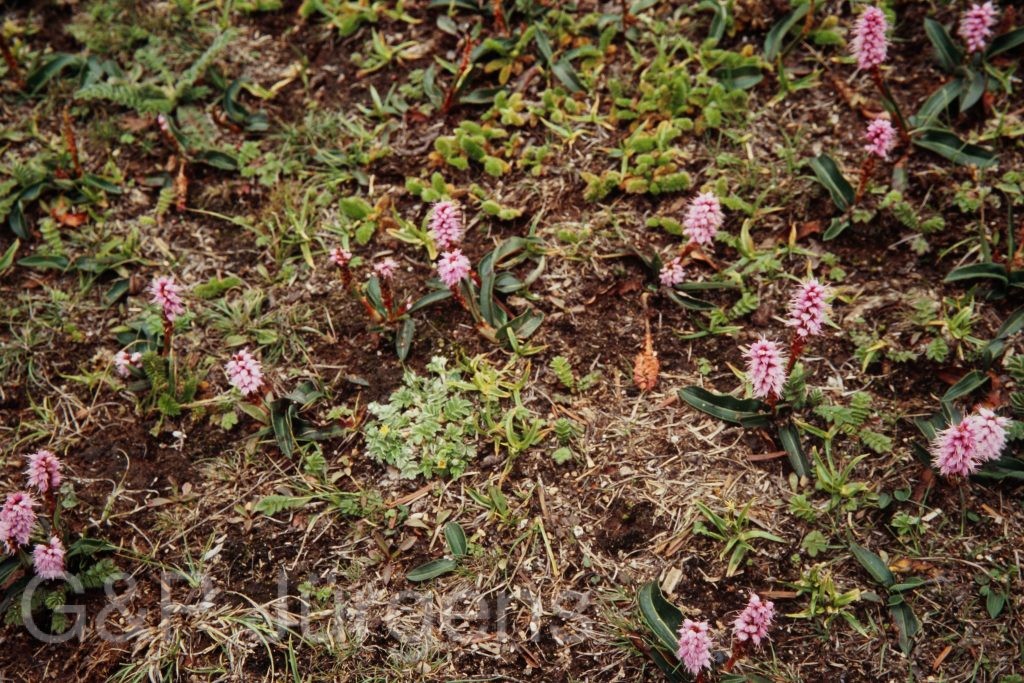
Bistorta emodi (Meisn.) H.Hara is an alpine knotweed of the Himalaya and adjacent China, recorded from about 363 collections in China, Nepal, India, Bhutan and Myanmar, with scattered extralimital reports. It grows in moist alpine meadows, dwarf-shrub heath, streamsides, seepages and damp rocky slopes in the alpine and upper subalpine zone, broadly between about 3500 and 4800 m. The plant photographed on the Ludlow-Sherriff trail at Miluthang in Bhutan at 4350 m in July occupies the cool, moisture-retentive high pastures that are characteristic of the species during the monsoon flowering period.

This is a perennial herb arising from a stout, often contorted, woody rhizome. The stems are erect and simple, sheathed at the nodes by tubular, membranous ochreae diagnostic of the family. Basal and lower leaves are long-petioled with ovate to lanceolate blades, often cordate or truncate at the base, the upper leaves smaller and sessile. The inflorescence is a dense, terminal, cylindrical to oblong spike of small flowers, the perianth pink to reddish or white, five-parted, with eight stamens; the lower part of the spike sometimes bears bulbils. The fruit is a small, trigonous, dark, shining achene enclosed in the persistent perianth.

The species belongs to Bistorta, segregated from Polygonum sensu lato (under which it appears as Polygonum emodi) and supported by molecular phylogenetics as a distinct lineage within Polygonaceae. Its rhizomes store carbohydrates that fuel rapid flowering in the short alpine summer, and the nectariferous spikes attract diverse insects. Widespread and often locally abundant in high Himalayan pasture, B. emodi is not of conservation concern, though it forms an important component of grazed alpine grassland.

Author: (Meisn.) H.Hara · Sources: POWO (Kew), GBIF, Flora of China, Flora of Bhutan, Flora of Nepal, revision of Bistorta / Polygonaceae

(Hook. f.) Grierson

BhutanPG2011 500
Bhutan Ludlow-Sherriff-Trail Mangde-Chu, 3950m July

Description

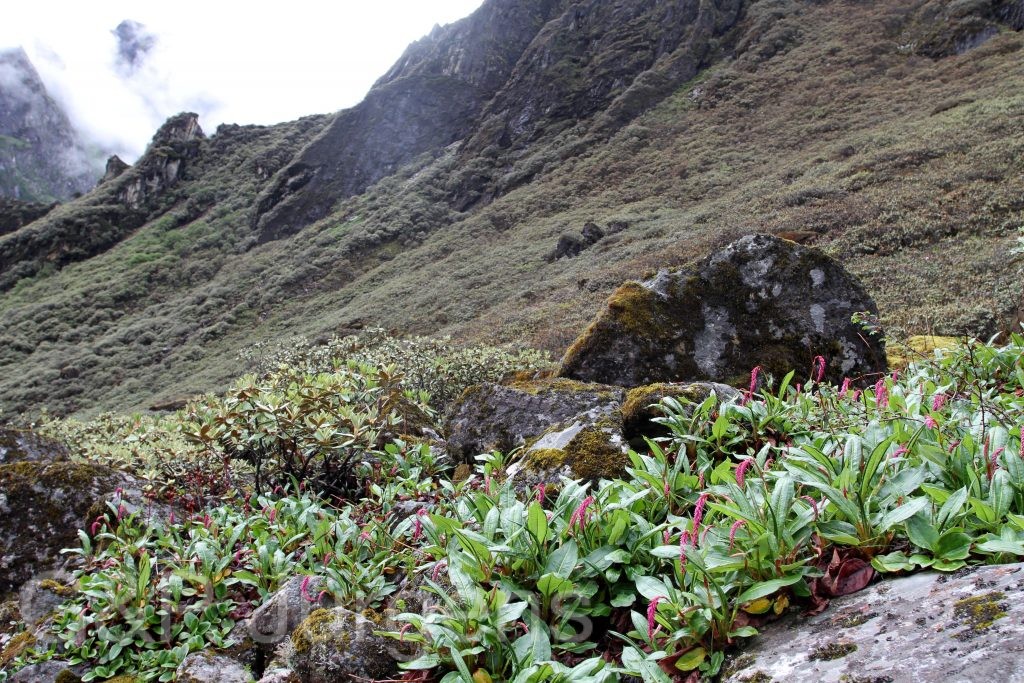
Bistorta griffithii (Hook. f.) Grierson is an alpine perennial herb of the eastern Himalaya, ranging through Bhutan, Sikkim and northern India into south-western China (Xizang, Yunnan) and northern Myanmar; the GBIF record of around 176 occurrences also includes herbarium-based citations from the United Kingdom and the United States. It is a plant of high alpine meadows, damp turf, rocky slopes and the upper margins of Rhododendron scrub, favouring cool, moisture-retentive soils kept wet by snowmelt and monsoon mist. The illustrated material was gathered along the Ludlow-Sherriff Trail at Mangde-Chu in central Bhutan at 3950 m in July, typical of the short midsummer flowering window in the upper alpine zone where this species reaches its display.

The plant arises from a short, thick, somewhat woody and contorted rhizome, producing erect, simple, unbranched stems. Basal leaves are long-petiolate with ovate to lanceolate or oblong blades, the margins entire and the lower surface often paler or thinly hairy; cauline leaves are few, smaller and shortly petiolate to sessile, subtended by membranous, tubular ochreae characteristic of the family. The inflorescence is a solitary, dense, terminal cylindrical to oblong spike of small flowers; perianth segments are five, white to pale pink, with eight stamens and a trifid style. As in many bistorts the lower flowers may be replaced by reddish bulbils. The fruit is a small, trigonous, dark brown shining achene enclosed by the persistent perianth.

Formerly placed in the broadly circumscribed genus Polygonum, this species is now treated in Bistorta on the basis of its perennial habit, unbranched flowering stems and dense terminal spikes. It is closely allied to other Himalayan bistorts such as B. macrophylla and B. vivipara, from which it is distinguished by leaf shape and inflorescence characters. Ecologically it contributes to the herbaceous turf grazed by livestock and wild ungulates, and the production of bulbils provides an effective means of vegetative propagation in the short, harsh alpine growing season. It has not been formally assessed for conservation but appears locally frequent within suitable habitat.

Author: (Hook. f.) Grierson · Sources: POWO (Kew), GBIF, Flora of Bhutan, Flora of China, Polygonaceae monograph (Hong & Steward)

(D.Don) Soják

Bh09 76 P130 2
Bhutan Jili-La 3600m, June

Description

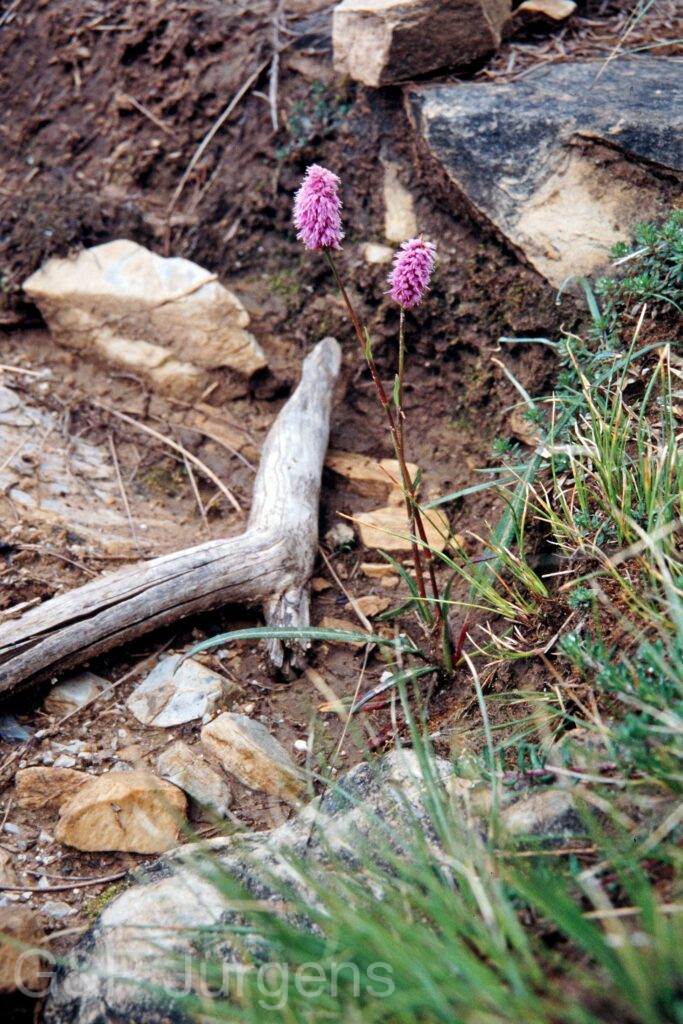
Bistorta macrophylla is a perennial herb widely distributed across the Himalaya and the Sino-Himalayan highlands, centred on China, Nepal, India and Bhutan and with scattered records reflecting its broad range and frequent cultivation (gbif_countries: CN, NP, IN, US, BT, ZZ, GB, MM, NZ, TH, JP, NO, RU); GBIF lists some 1887 occurrences, making it one of the better-documented Himalayan knotweeds. It thrives in alpine and subalpine meadows, open grassy slopes, damp turf and the margins of forest clearings, often forming conspicuous colonies. The illustrated record is from Jili-La in Bhutan at about 3600 m in June, typical of its early-summer flowering in moist high-mountain grassland.

The plant arises from a thick, contorted, blackish rhizome and produces erect, simple, unbranched flowering stems. The basal and lower leaves are large, long-petiolate, narrowly oblong to lanceolate, with the blade often decurrent on the petiole and a whitish, papery undersurface; the cauline leaves are smaller and increasingly sessile, sheathing the stem with the membranous ocreae characteristic of the family. The inflorescence is a dense, terminal, cylindrical spike of small flowers with a pink to rose-purple perianth of five tepals, sometimes with bulbils replacing lower flowers. The fruit is a small, trigonous, dark achene.

Formerly included in a broad Polygonum or Persicaria, the species is now placed in the segregate genus Bistorta, supported by molecular phylogenetics of Polygonaceae. Its stout, starchy rhizomes are gathered locally as food and in folk medicine, and it is a familiar component of Himalayan alpine pasture. Common and widespread, B. macrophylla is of no conservation concern.

Author: (D.Don) Soják · Sources: POWO (Kew), GBIF, Flora of Nepal, Flora of China, Annotated Checklist of the Flowering Plants of Nepal, Polygonaceae account in The Families and Genera of Vascular Plants

H.Lév.

Nepal 99 35 ergebnis
West-Nepal Nyor Gaad 2700m, June

Description

Bistorta milletii is a Sino-Himalayan knotweed distributed through China, Nepal, India and Bhutan, with GBIF recording 185 occurrences along this temperate to subalpine arc. It grows in open grassy slopes, moist meadows, forest margins and rocky banks, broadly between about 2500 and 4000 m. The illustrated plant was photographed in West Nepal at Nyor Gaad at 2700 m in June, a representative mid-montane meadow station where the species flowers through the early summer. It commonly forms patches in damp turf alongside other alpine and subalpine herbs.

The plant is a rhizomatous perennial herb arising from a stout, often contorted rhizome that anchors it in the sward. Basal leaves are long-petiolate with ovate-lanceolate to narrowly elliptic blades, the base cuneate to subcordate and the lower surface frequently pale; the membranous, tubular ochreae sheathing the stem are diagnostic of the family. The flowering stem is simple and erect, terminating in a dense, cylindrical, spike-like raceme. The small flowers have a five-parted, petaloid perianth, deep pink to red, with eight exserted stamens and a superior ovary bearing three styles. The fruit is a small, trigonous, dark brown achene enclosed in the persistent perianth.

The species belongs to genus Bistorta, segregated from Polygonum sensu lato and supported as a distinct lineage by molecular work; the input file's alternate web slug references the related B. affinis. POWO and GBIF accept the name B. milletii. As a meadow component with starch-rich rhizomes, members of the genus are locally grazed and occasionally used as famine food.

Author: H.Lév. · Sources: POWO (Kew), GBIF, Flora of China, Flora of Bhutan, Annotated Checklist of the Flowering Plants of Nepal, A Systematic Revision of Bistorta (Polygonaceae)

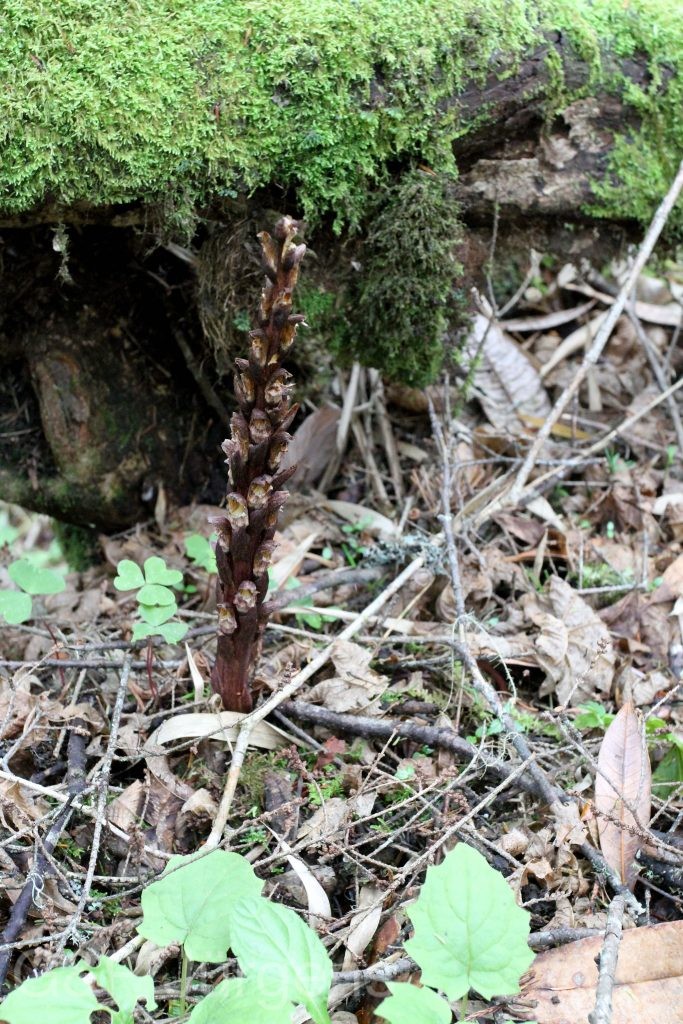
J. D. Hooker et Thomson

BhutanPG2011 101
Bhutan Chognam 3240m, June

Description

A non-photosynthetic, root-parasitic herb of the eastern Himalaya and East Asia, recorded from China, Taiwan, Nepal, India, Bhutan, Japan and Myanmar, with about 711 GBIF occurrences (a few outlying entries reflect data errors). It parasitises the roots of woody Ericaceae, particularly Rhododendron and Gaultheria, and is found in subalpine shrubberies, forest margins and moist thicket floors, generally between about 2700 and 4000 m. The illustrated plant was photographed in June at Chognam in Bhutan at around 3240 m, a typical rhododendron-dominated montane habitat.

Lacking chlorophyll, the plant draws all nutrition from its host. It arises from a swollen, tuberous, scale-covered basal organ attached to the host root, from which emerge fleshy, erect, unbranched stems coloured purplish-brown, yellowish or reddish and clothed only in small scale-leaves. The inflorescence is a dense, cylindrical, many-flowered terminal spike. Each flower is subtended by a bract and has a short cup-like calyx and a two-lipped, tubular corolla in dull purple to brownish-yellow, with a hooded upper lip and a shorter spreading lower lip; four didynamous stamens are inserted in the tube. The superior ovary ripens into a capsule packed with numerous minute, dust-like seeds adapted to wind dispersal.

Accepted by POWO and GBIF, B. himalaica is one of a small genus of broomrape relatives specialised on ericaceous hosts. Its life cycle is intimately governed by host availability and the germination of its tiny seeds in response to host-root chemical cues. Because it depends entirely on healthy Rhododendron-rich communities, it serves as an indicator of intact subalpine ericaceous vegetation. It is widespread but inconspicuous and locally sporadic; no significant conservation concern is recognised at present.

Author: J. D. Hooker et Thomson · Sources: POWO (Kew), GBIF, Flora of China, Flora of Bhutan, Beck monograph of Orobanchaceae

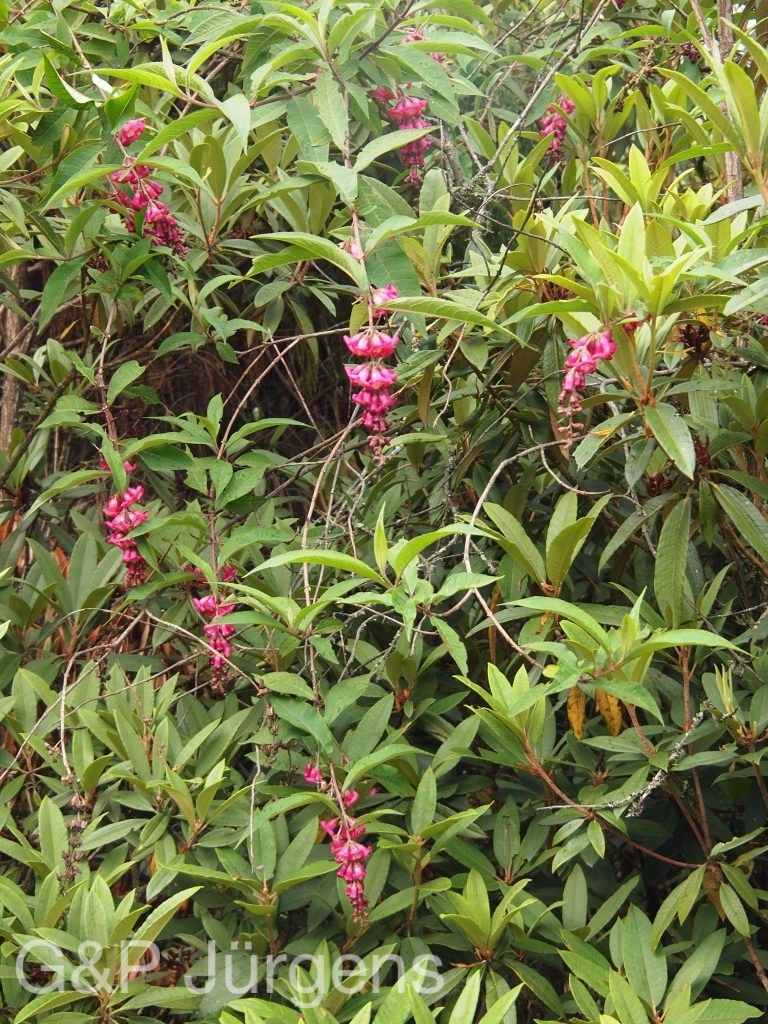
Hook.f.

BhutanPG2011 53
Bhutan Jakar, 2500m June
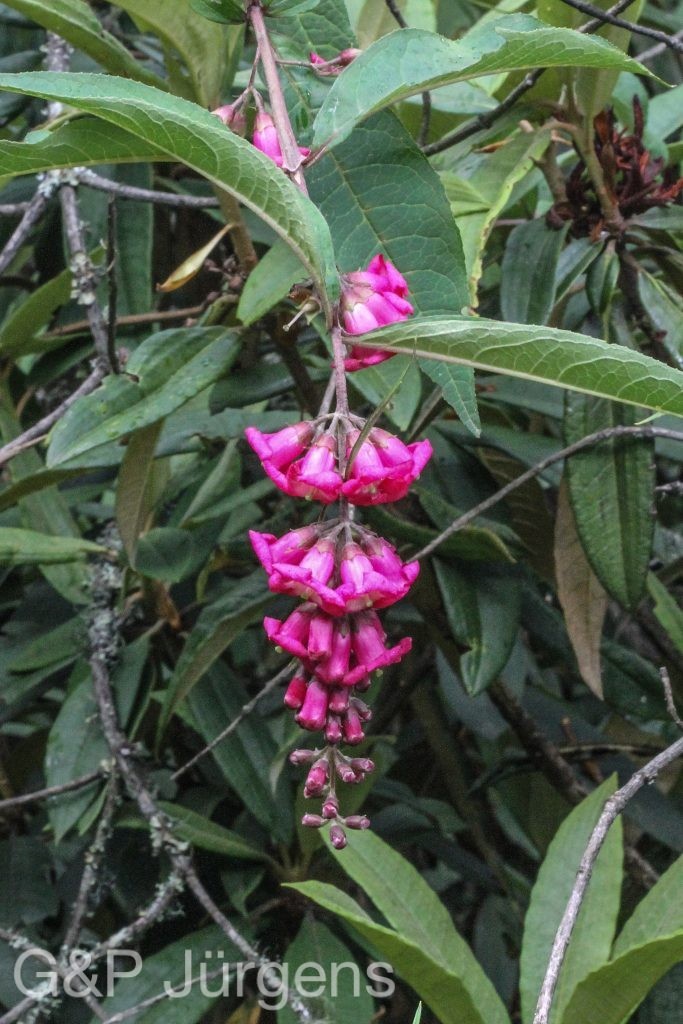
BhutanPG2011 552011 Bhutan Buddleia colvilei
Bhutan Jakar, 2500m June

Description

Buddleja colvilei is a large-flowered shrub or small tree of the eastern Himalaya, native to Bhutan, India, Nepal and China, and widely grown in temperate gardens, as its 166 occurrences from Britain, North America, New Zealand and Spain attest. In the wild it occupies open temperate forest margins, clearings, stream banks and shrubberies, typically between about 2400 and 4000 m. The plant recorded at Jakar in Bhutan at 2500 m in June represents its early-summer flowering within the moist temperate zone, where it forms a spreading, often arching woody framework.

The plant has stout branches with peeling bark and is clothed, especially when young, in a pale stellate or floccose indumentum. The leaves are opposite, lanceolate to elliptic, acuminate, with finely toothed margins, dark green above and paler and tomentose beneath. The inflorescence is a pendent terminal panicle of relatively few but exceptionally large flowers; the corolla is tubular with a flared, four-lobed limb, deep rose-red to crimson with a pale or whitish throat, and bears the largest flowers of any Buddleja. The fruit is a small two-valved septicidal capsule releasing numerous tiny seeds.

Buddleja is here placed in Scrophulariaceae following the family circumscription used in the source, though the genus is also treated in a segregate family Buddlejaceae and within an expanded Scrophulariaceae in current systems. B. colvilei is celebrated horticulturally for its outsized, vividly coloured flowers and has received garden awards. In its native range it remains locally frequent in disturbed and edge habitats and is not regarded as threatened.

Author: Hook.f. · Sources: POWO (Kew), GBIF, Flora of China, Flora of Bhutan, A Revision of the Genus Buddleja (Leeuwenberg), Flowers of the Himalaya (Polunin & Stainton)

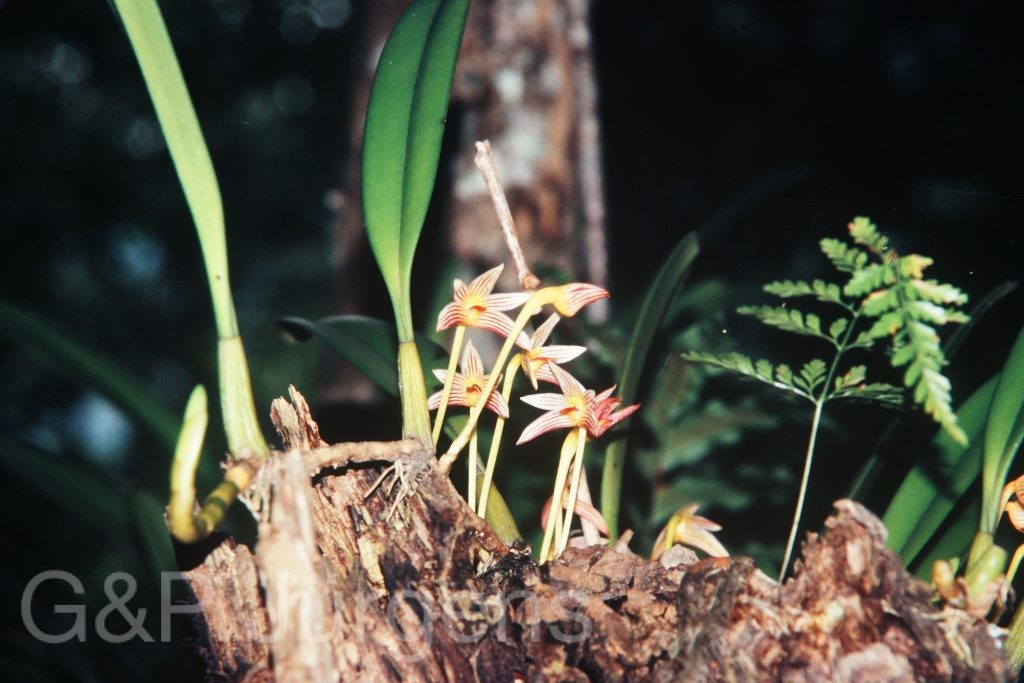
Lindl.

Bh09 392 G619
Bhutan Mo-Chu, 1500m June

Description

Bulbophyllum affine is an epiphytic orchid widely distributed across East and Southeast Asia, from Nepal and northeast India (Sikkim, Assam) through Bhutan, Myanmar, and southern China to Taiwan, Vietnam, and Thailand. It inhabits humid broadleaved and mixed forests at 500–2,500 m elevation, growing on mossy trunks and branches, occasionally on rocks (lithophytic).

The plant produces ovoid to conical pseudobulbs 2–4 cm tall, set 3–8 cm apart on a stout, creeping rhizome. Each pseudobulb bears a single, leathery, elliptic to oblong leaf 8–15 cm long. The inflorescence is a nodding, densely many-flowered raceme 5–15 cm long, emerging from the base of the pseudobulb. The flowers are small, 5–8 mm across, yellowish-green to pale brown, densely arranged in a cylindrical spike. Sepals are lanceolate and acuminate; the lip is small, fleshy, and recurved, mobile on a thin strap connecting it to the column foot — a characteristic feature of Bulbophyllum enabling pollination by small flies.

Bulbophyllum is the largest genus in the Orchidaceae, comprising over 2,200 described species. B. affine belongs to section Cirrhopetalum and is distinguished from similar congeners by its densely flowered, cylindrical raceme and the prominent column stelidia.

Author: Lindl. · Sources: POWO (Kew), Flora of Bhutan Vol. 3, GBIF, Seidenfaden: Orchid Genera in Thailand XIV: Bulbophyllum (1979)