(Elwes) Stearn
Description
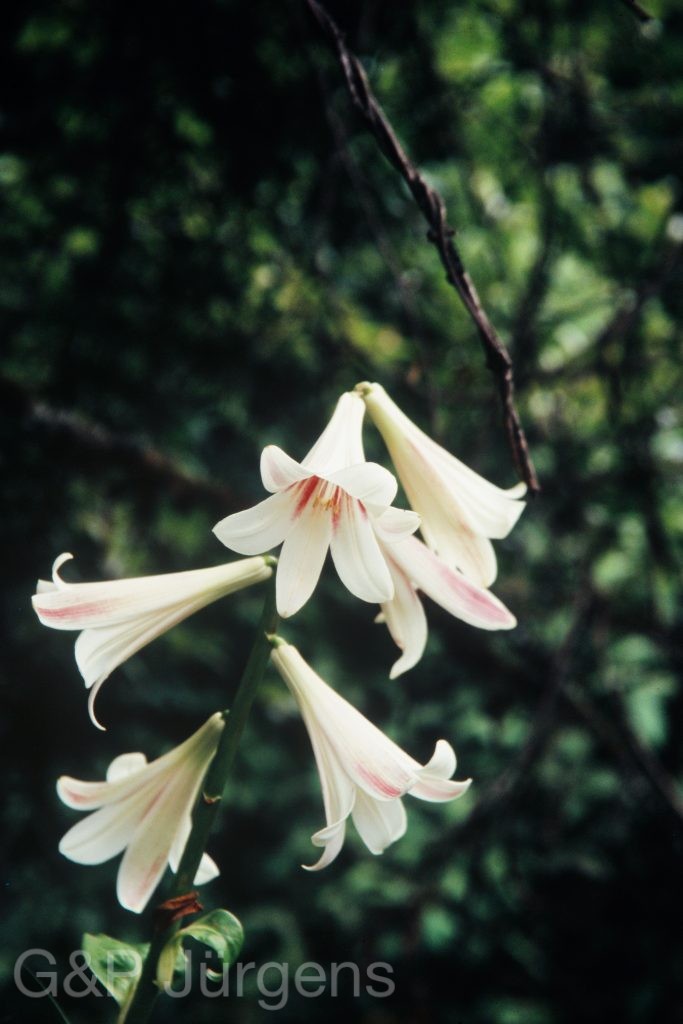
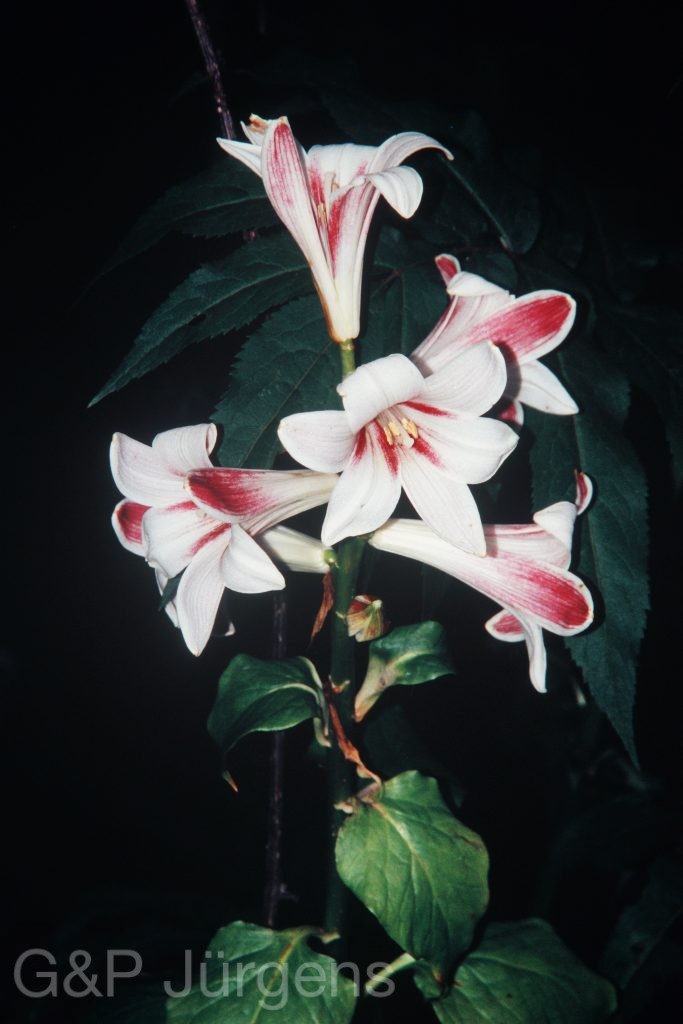
Cardiocrinum giganteum, the giant Himalayan lily, is a striking woodland geophyte of the eastern Himalaya and southwest China, with georeferenced records from China and naturalised or cultivated populations reported from Japan, Korea, Russia, Canada and Chile among its 173 occurrences. The variety yunnanense is the more eastern, often shorter-stemmed and darker-stemmed expression of the species. It thrives in cool, humid, deeply shaded broadleaved and conifer forest on humus-rich soils. The plant recorded at Jakar, Wangdi in Bhutan at 2500 m in June captures its early-summer flowering within the moist temperate forest belt it favours between about 1500 and 3000 m.
The plant grows from a large, scaled bulb that is monocarpic, flowering once after several years and then dying, leaving offset bulbils to continue the clone. The robust, hollow stem can reach two to three metres or more. The leaves are large, broadly ovate to cordate, glossy, net-veined and long-petiolate, arranged in a basal rosette and scattered up the stem. The inflorescence is a terminal raceme of up to twenty pendent, trumpet-shaped flowers; the perianth is white to creamy, streaked reddish-purple within the throat, and strongly fragrant. The fruit is a large erect, woody capsule splitting to release numerous flat, broadly winged seeds.
Cardiocrinum, segregated from Lilium chiefly by its cordate net-veined leaves and monocarpic habit, comprises a small genus of three species. The taxon is prized horticulturally, and its dependence on intact, humid forest understorey makes it sensitive to logging and habitat disturbance, though it remains locally frequent across its native range.
Author: (Elwes) Stearn · Sources: POWO (Kew), GBIF, Flora of China, Flora of Bhutan, The Genus Lilium and allies (Liliaceae) monograph, Flowers of the Himalaya (Polunin & Stainton)