
(Willd.) Haw.
Description
Opuntia monacantha is a prickly-pear cactus native to subtropical South America (Brazil, Argentina, Uruguay and Paraguay) that has become one of the most widely naturalised Opuntia species in the world. Its 4754 GBIF occurrences span Australia, South Africa, the Mediterranean, East Africa, India, China, Nepal, Bhutan and many other regions, almost all representing introduced and frequently invasive populations. In the Himalaya it persists as an escape from cultivation on dry, sunny, rocky slopes, banks, walls and disturbed ground in warm valleys. The record from the Pele-La area of Bhutan at about 2800 m in May is notable as a relatively high-elevation occurrence, the plant having been spread through cultivation as a hedge and ornamental into the inner dry valleys of the eastern Himalaya.
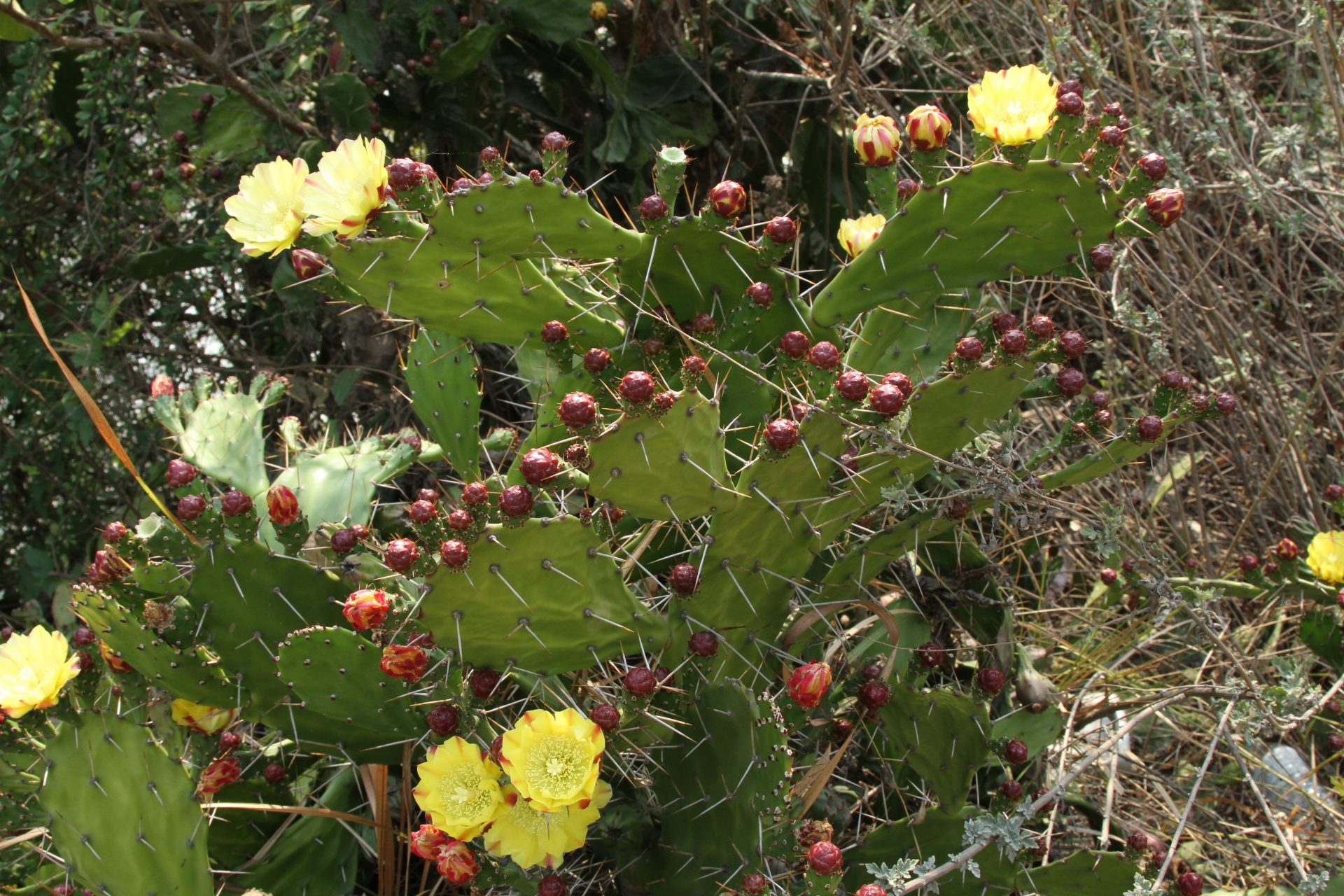
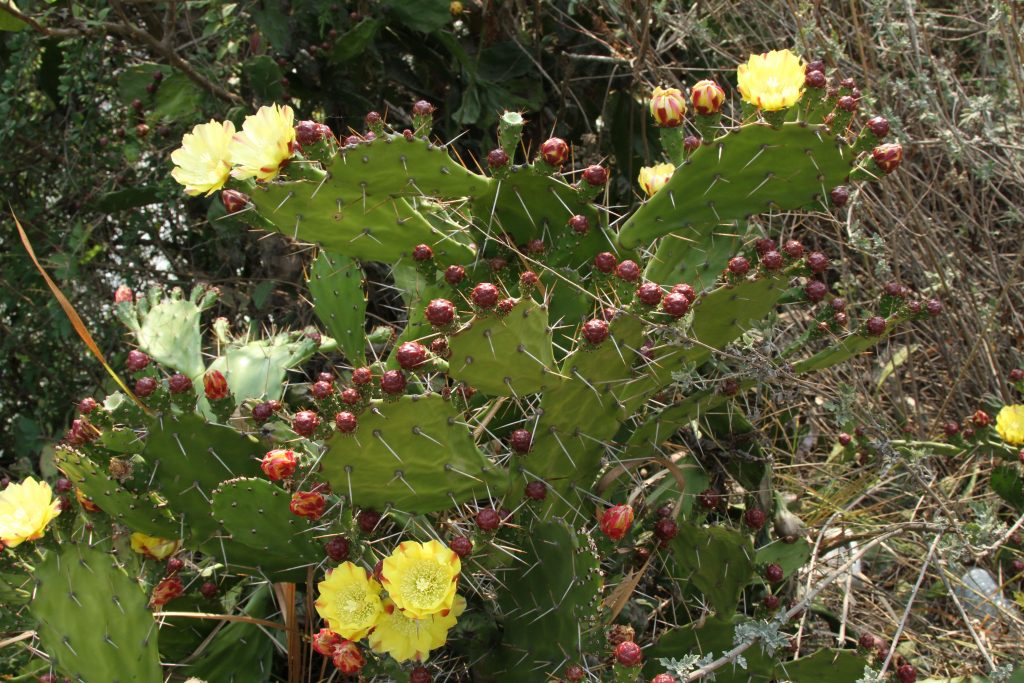
It is a succulent shrub to small tree, sometimes developing a distinct cylindrical woody trunk, with a branched crown of flattened green photosynthetic stem-segments (cladodes or pads). The pads are obovate to oblong, glossy green and somewhat flaccid, bearing areoles that produce tufts of minute barbed glochids and usually one or few (occasionally none) stout spines, the sparse armature giving rise to the epithet monacantha. The leaves are reduced to tiny caducous scales. The flowers are large, solitary, sessile on the pad margin, with a rotate perianth of bright yellow tepals often reddish at the base and numerous stamens. The fruit is a fleshy, obovoid, reddish-purple berry, frequently proliferous, the pulp edible and the seeds dispersed by frugivores.
The genus Opuntia is among the most successful of invasive plant lineages, the readily detached, root-forming cladodes enabling vigorous vegetative spread, while the bird- and mammal-dispersed fruits extend its reach. O. monacantha is regarded as a noxious weed in several countries and has been a target of biological control using cochineal insects. In the Himalayan context it is an introduced naturalised alien rather than a native element; its conservation status is irrelevant in the usual sense, the concern instead being its potential to colonise and degrade dry montane slopes.
Author: (Willd.) Haw. · Sources: POWO (Kew), GBIF, Flora of China Vol. 13, Flora of Pakistan, Flora of Nepal, Anderson The Cactus Family