
Sims
Description
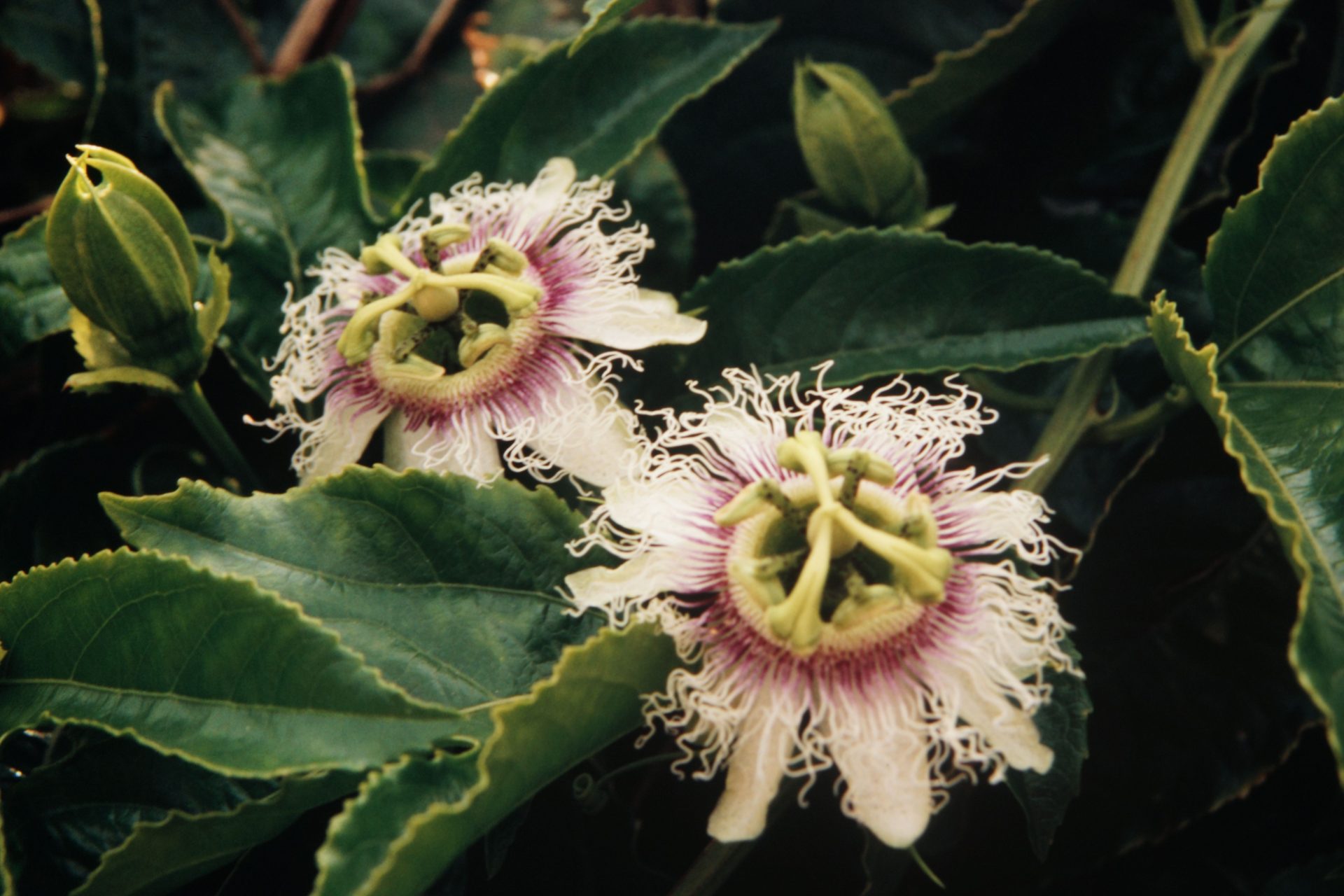
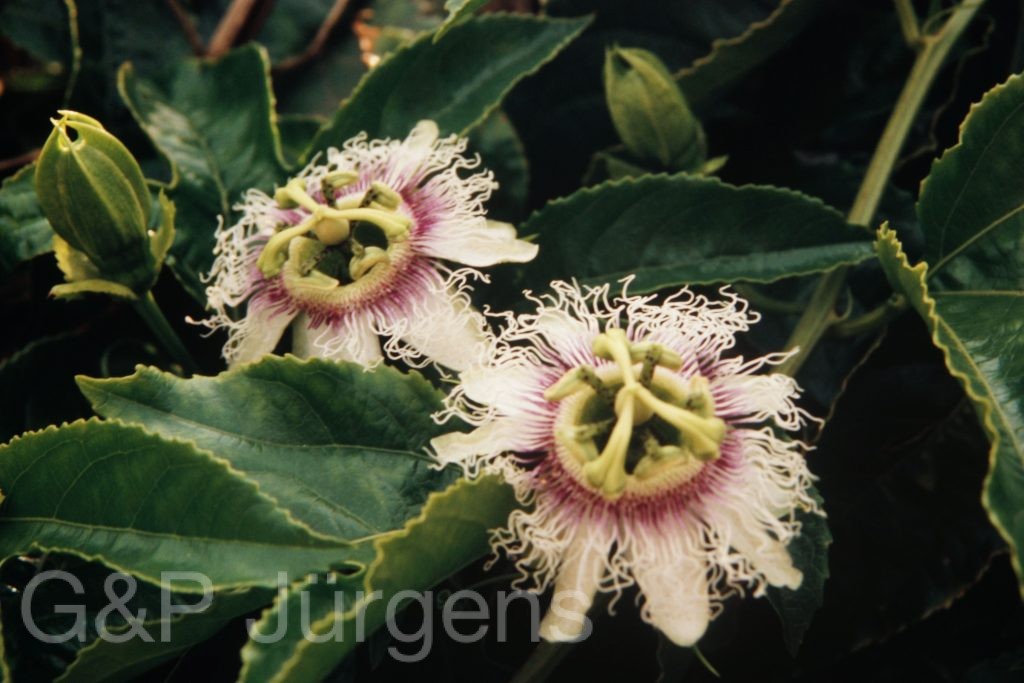
Passiflora edulis, the passion fruit, is a climbing vine native to subtropical South America (its core GBIF records cluster in Brazil, Argentina, Colombia, Ecuador and Peru) but now pantropically cultivated and naturalised, with records spanning Australia, the United States, South Africa, India and China. In the Himalaya it occurs as an introduced and cultivated plant, and the photographed individual from Samtengang in Bhutan at 2200 m, flowering in April, reflects this cultivated status in warm-temperate hill country rather than a native occurrence. It thrives in disturbed ground, hedges, plantation margins and gardens, scrambling over supports in frost-free to mildly temperate conditions.
It is a woody, evergreen, tendril-climbing perennial vine with deeply three-lobed, glossy, serrate leaves bearing axillary tendrils by which it ascends. The solitary, axillary flowers are large and intricate, with five sepals and five petals subtending a conspicuous corona of long, wavy filaments, white above and banded purple toward the base. The androgynophore raises five stamens and a tricarpellate ovary with three styles above the corona, the whole structure famously interpreted as emblematic of the Passion. The fruit is a globose to ovoid berry, purple or yellow at maturity, with a tough leathery rind enclosing numerous arillate seeds in fragrant, juicy, edible pulp.
Passiflora is a large, predominantly Neotropical genus celebrated for its elaborate, often bee-, bird- or bat-pollinated flowers and for hosting specialised heliconiine butterfly larvae on its cyanogenic foliage. P. edulis is one of the most economically important species, grown commercially for its fruit, and exists in distinct purple-fruited and yellow-fruited forms. Vigorous and readily naturalising, it is regarded as a weedy invader in some warm regions, though in the Himalayan context it remains a cultivated introduction.
Author: Sims · Sources: POWO (Kew), GBIF, Flora of China Vol. 13, Flora of Bhutan Vol. 2, Flora of Nepal, Killip's The American Species of Passifloraceae