
n.n.
Description
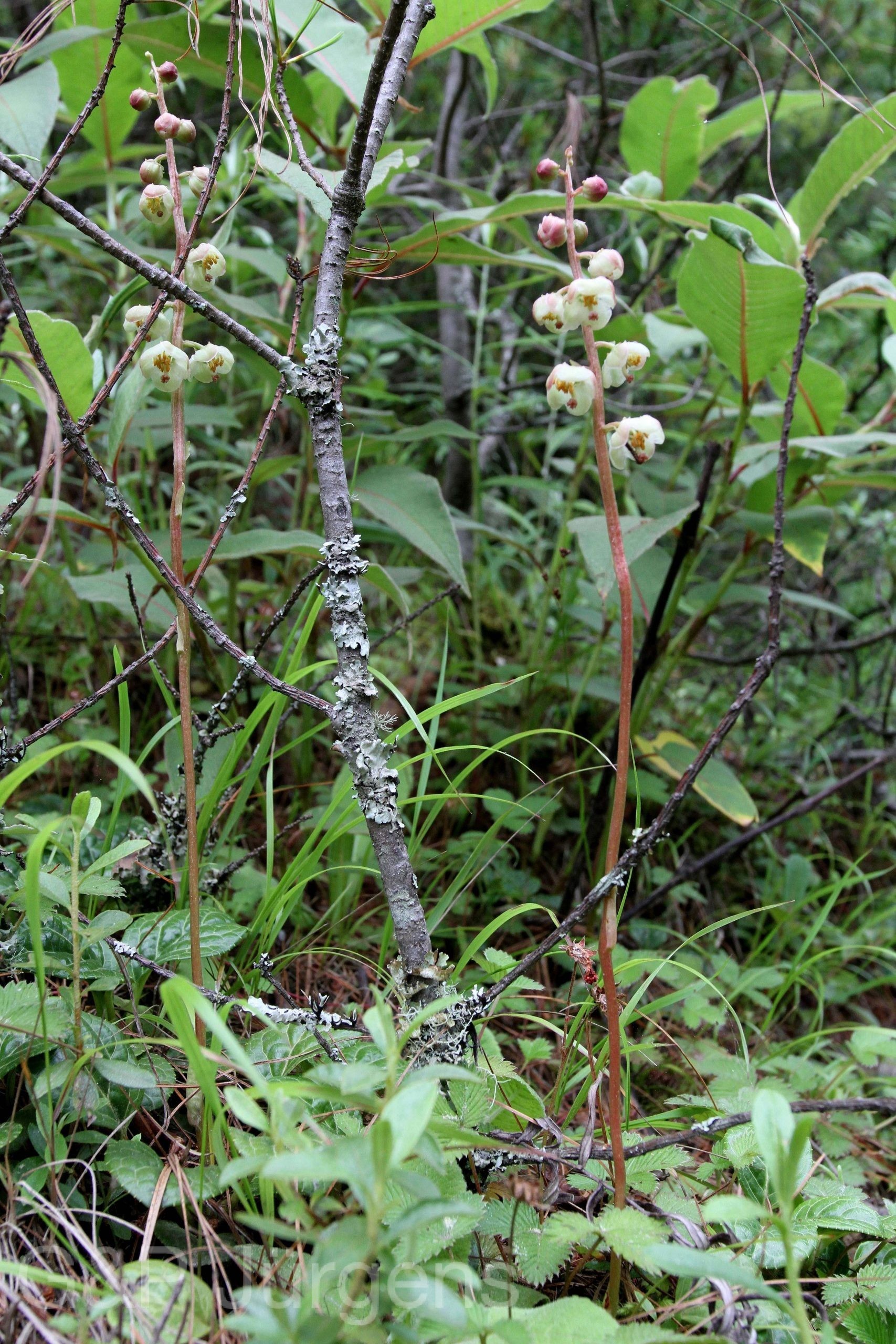
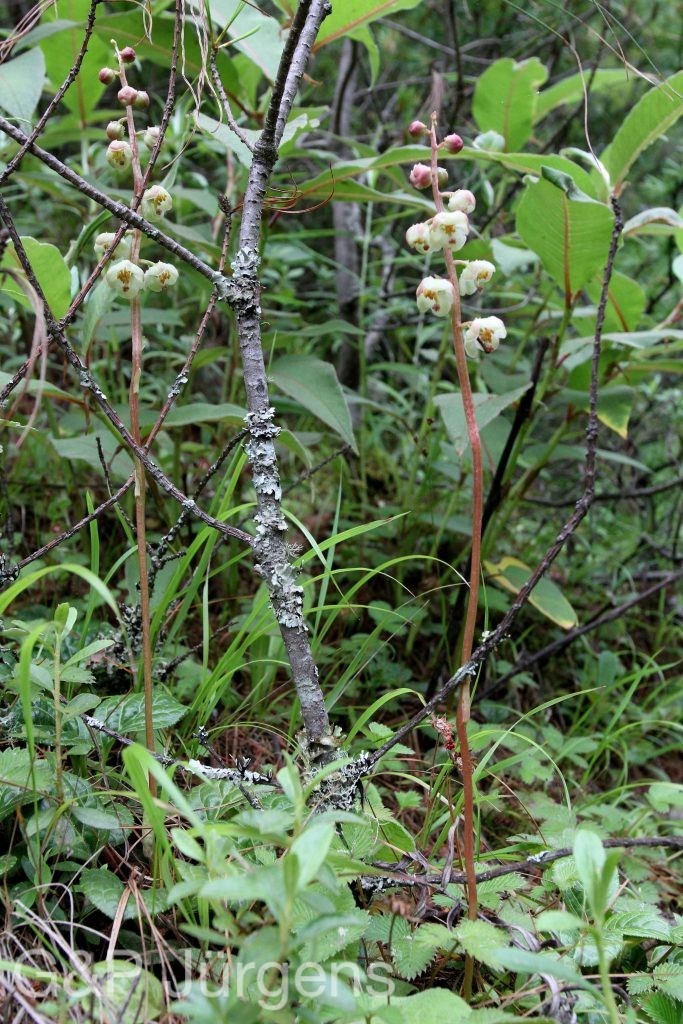
Pyrola asarifolia subsp. asarifolia is a small evergreen perennial herb traditionally placed in the family Pyrolaceae, now usually treated within Ericaceae (subfamily Monotropoideae). It is a circumboreal taxon, and its GBIF records span North America, eastern Asia and the Himalaya, including the United States, Canada, Japan, China, India and Bhutan, reflecting a broad cool-temperate to boreal range. It grows in moist, shaded coniferous and mixed forest, on humus-rich, often mossy soils, generally between about 2,500 and 3,500 m in its Himalayan stations. The plant illustrated from the Haa Valley in western Bhutan at 2,750 m in July typifies this shaded, damp montane forest-floor habitat.
The species is a low, rosette-forming herb arising from a slender, creeping rhizome. The leaves are basal, long-petiolate, with rounded to broadly ovate or reniform, somewhat leathery and glossy blades that persist through the winter, the shape recalling that of Asarum and giving the epithet asarifolia. The flowering scape is erect and leafless, bearing a many-flowered raceme of nodding, cup-shaped flowers; these are pink to rose-purple, with five spreading petals, ten anthers opening by pores, and a long, characteristically curved and exserted style, a key generic feature. The fruit is a dry, pendent capsule releasing extremely numerous dust-like seeds.
Like other members of the Pyroloideae the plant is partially mycoheterotrophic, supplementing photosynthesis through mycorrhizal fungi that link it to surrounding trees, an adaptation suited to deeply shaded forest floors. The dust seeds depend on appropriate fungal partners for germination. The transfer of the old Pyrolaceae into Ericaceae reflects molecular evidence of their nesting within that family. Widespread across the Northern Hemisphere, the species is not threatened, though its Himalayan populations occupy the southern margin of a primarily boreal distribution and are of phytogeographic interest.
Author: n.n. · Sources: POWO (Kew), GBIF, Flora of China Vol. 14, Flora of Bhutan Vol. 2, Flora of North America Vol. 8, Haber: Systematics of the Pyroloideae