
Mattf. ex Rehder & Kobuski
Description
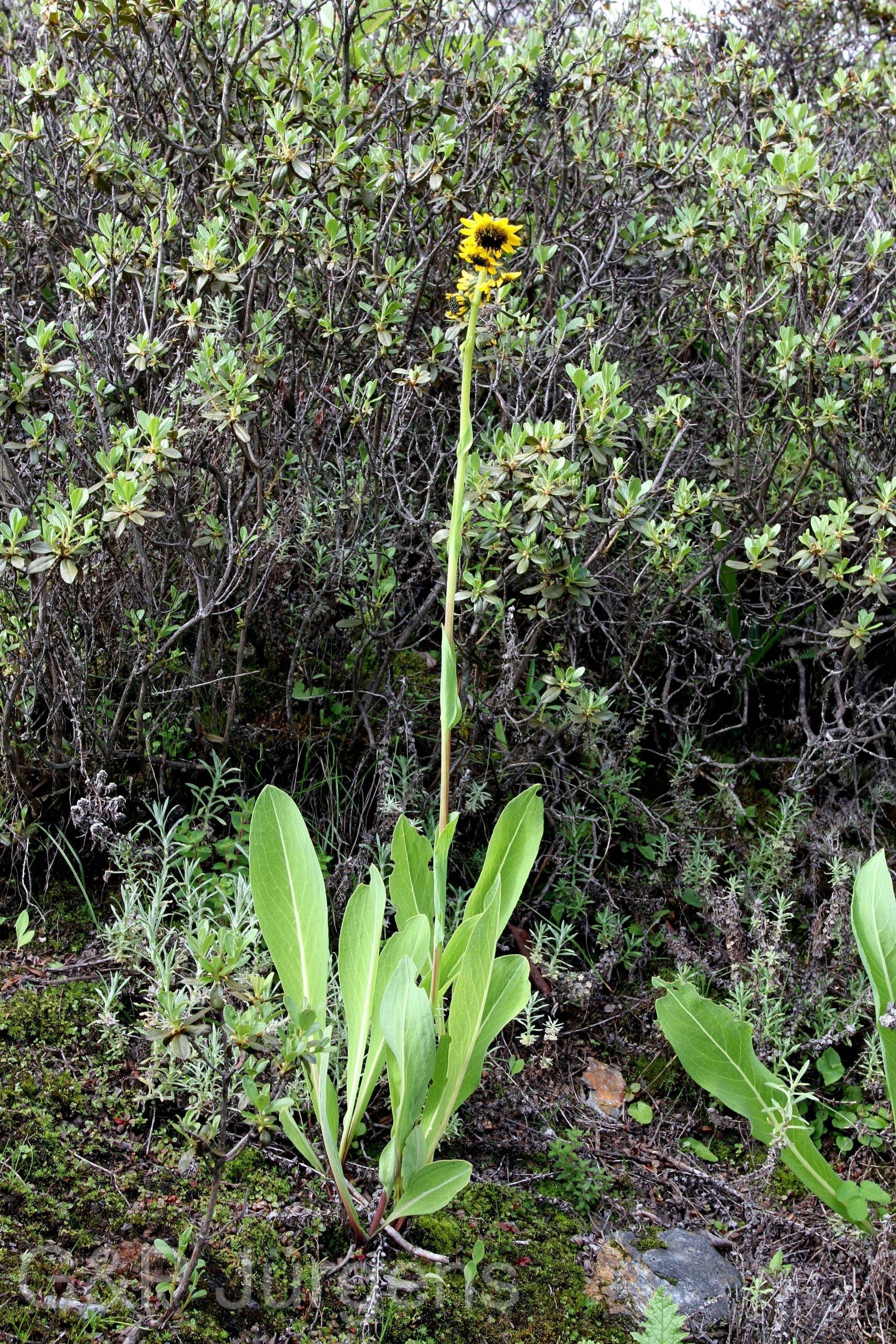
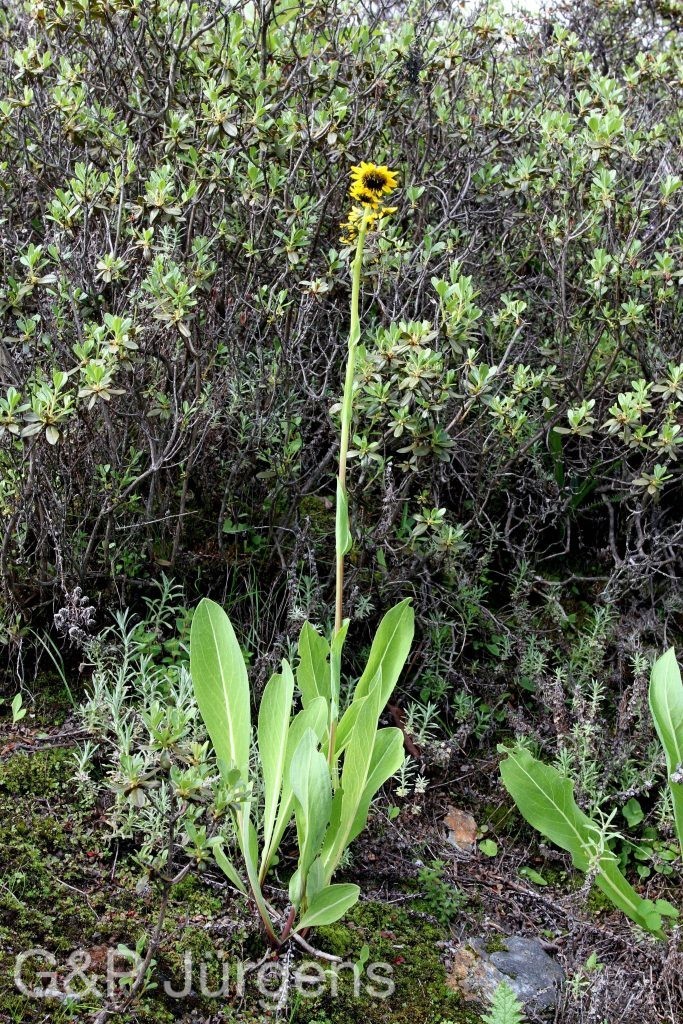
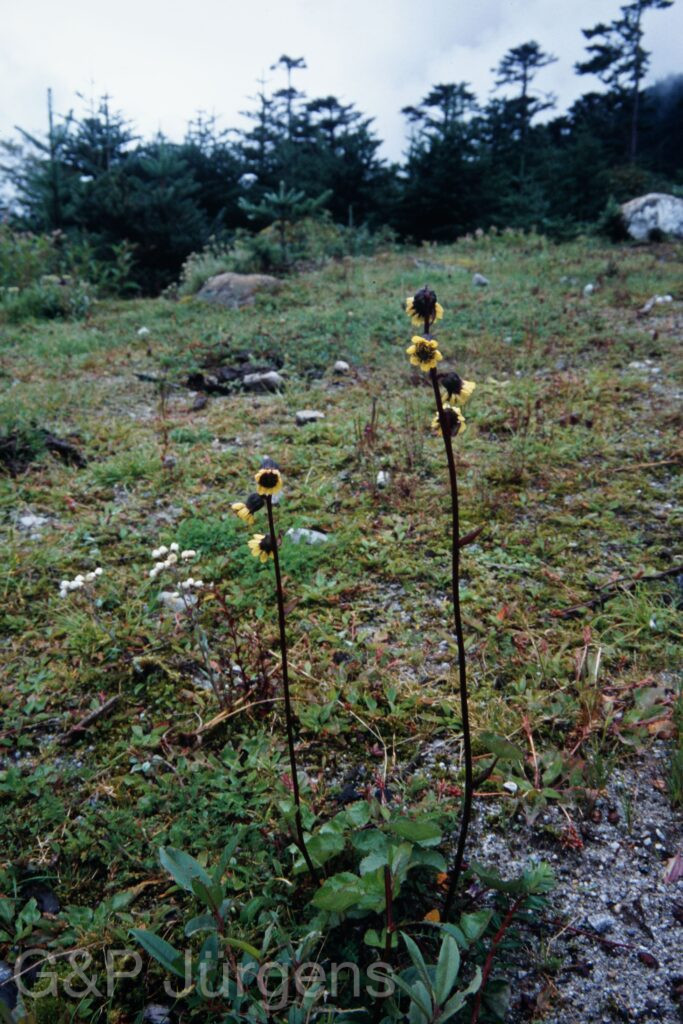
Ligularia virgaurea is a robust perennial of alpine meadows and grasslands centred on the Qinghai-Tibetan Plateau and extending into the Himalaya, with native records from China, Russia, Bhutan, Nepal and India; among the 777 occurrences, the European and other extra-regional points reflect garden cultivation rather than wild range. It forms extensive colonies on moist meadows, marshy pasture, riverbanks and open slopes, typically between about 2600 and 4700 m, and can dominate overgrazed grassland as an unpalatable increaser. The material documented from Bhutan in 2011 and Sikkim in August 2003 places it in the well-watered subalpine to alpine zone of the eastern Himalaya.
The species is a clump-forming herb with a stout rootstock and erect, glabrous to thinly hairy stems. The basal leaves are long-petiolate, with elliptic to ovate-oblong, entire or denticulate blades and sheathing petiole bases; the cauline leaves are reduced and clasping. The capitula are numerous, small and radiate, borne in a dense, narrow, racemose to spike-like synflorescence. Each head has a cylindric involucre of few phyllaries, a small number of yellow ray florets and yellow tubular disc florets. The cypselae are cylindric, glabrous and ribbed, crowned by a pappus of reddish-brown to whitish barbellate bristles.
Ligularia is a large Old World genus of the Senecioneae, richly developed on the Tibetan Plateau, distinguished from the closely allied Cremanthodium by its erect, non-nodding capitula. L. virgaurea is notably variable in leaf shape and inflorescence density, and several infraspecific forms have been recognised. Its tissues contain pyrrolizidine alkaloids and other deterrents, so livestock avoid it, allowing the species to expand under heavy grazing. It is widespread and abundant and is of no conservation concern.
Author: Mattf. ex Rehder & Kobuski · Sources: POWO (Kew), GBIF, Flora of China Vol. 20-21, Flora of Bhutan, Flora of Nepal, Liu Revision of Ligularia