
(L.) DeFilipps

Description
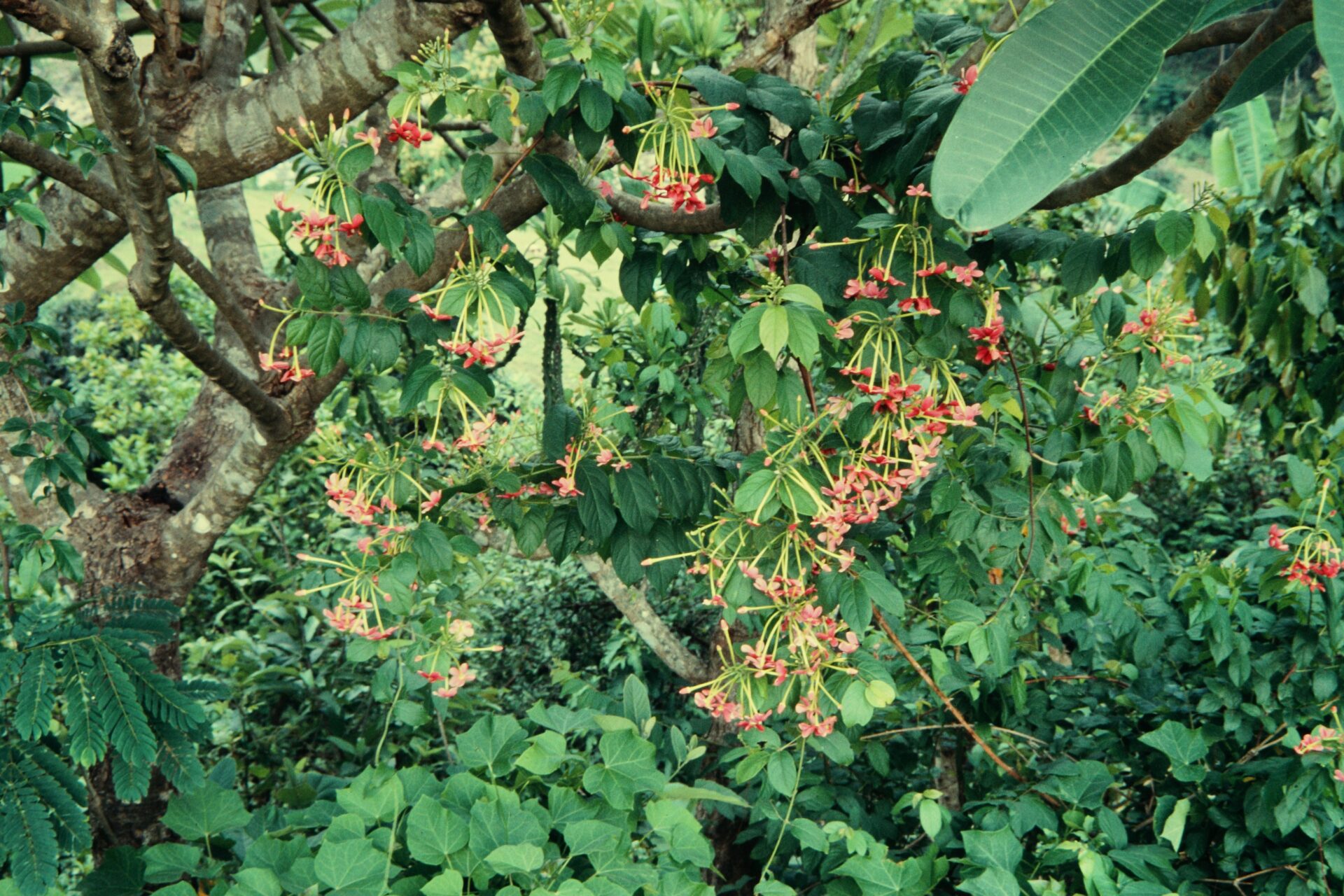
Combretum indicum (L.) DeFilipps, the Rangoon creeper, is a vigorous woody climber of the Combretaceae native to tropical Asia and now pantropically cultivated and naturalised. Its native and introduced records span India, Nepal, Myanmar, Thailand, Indochina, southern China, Malaysia, Indonesia and the Philippines, with widespread escapes in tropical Africa, the Americas, Australia and the Pacific. It is a plant of warm lowland and foothill environments: forest margins, riverbanks, thickets and hedgerows, often in secondary and disturbed vegetation. The plant photographed along the Sabha-Khola in Nepal at 1,000 m in May reflects its occurrence in the warm sub-Himalayan zone, where it flowers in the pre-monsoon season.
The plant is a large scandent shrub or liana, climbing by means of persistent woody petiole bases that function as hooks. The leaves are opposite, elliptic to oblong, entire and shortly petiolate, with the petiole base hardening and remaining as a spinescent peg. The flowers are borne in terminal and axillary spike-like racemes and are famously colour-changing: each long-tubed, five-petalled flower opens white and turns through pink to deep red over successive days, fragrant especially at night, indicating moth pollination. The fruit is an ellipsoid, five-winged or five-angled, leathery pseudo-drupe.
Formerly placed in the genus Quisqualis, the species is universally grown as an ornamental for its showy, sweetly scented, colour-shifting inflorescences, and its seeds and leaves have a long history of use in traditional medicine, notably as an anthelmintic. This horticultural ubiquity accounts for its extensive naturalisation, and in some warm regions it behaves as an invasive, smothering native vegetation, so that its spread beyond cultivation warrants management attention.
Author: (L.) DeFilipps · Sources: POWO (Kew), GBIF, Flora of China Vol. 13, Flora of Nepal, Exell: Combretaceae (Flora Malesiana)