
Gled.
Description
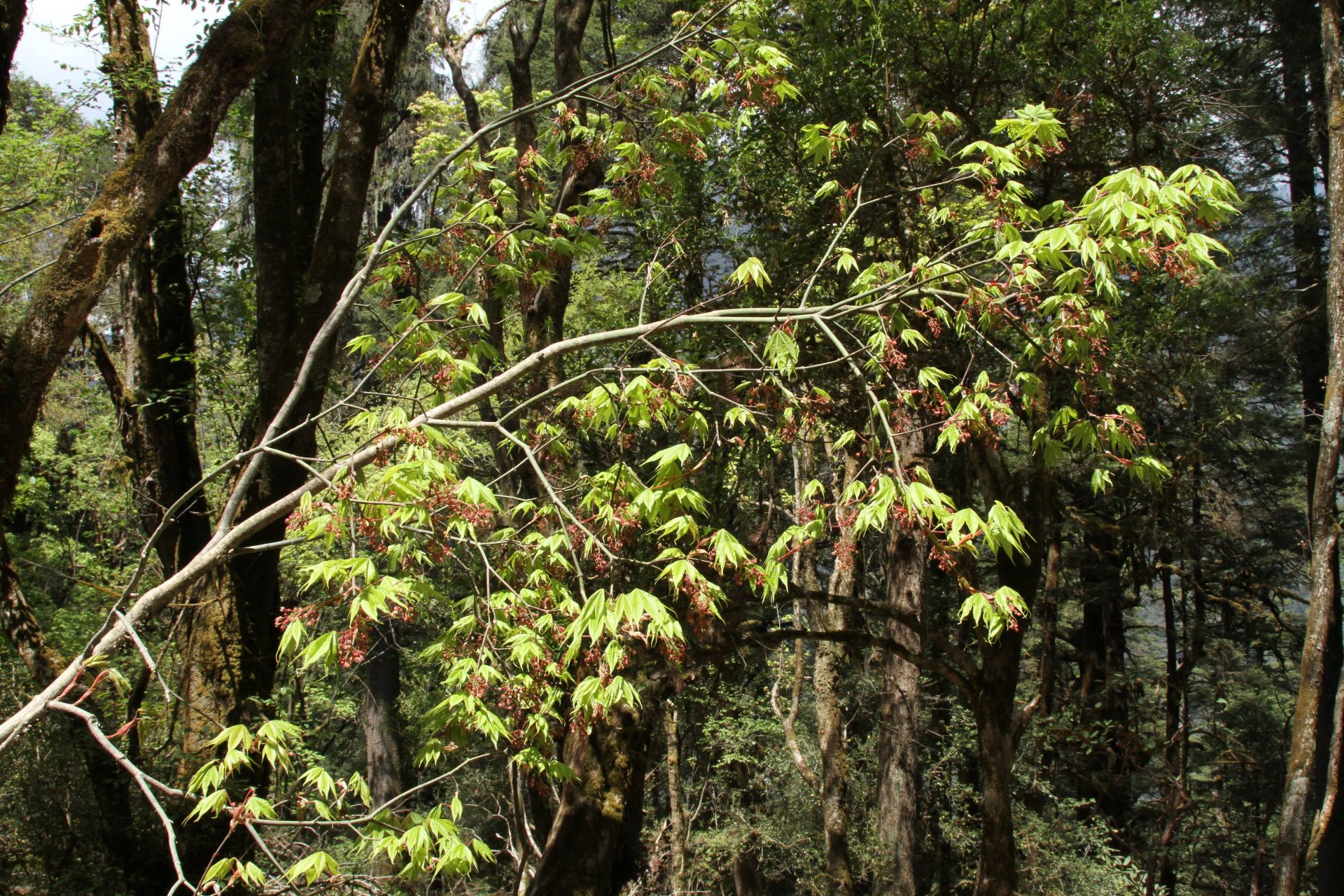
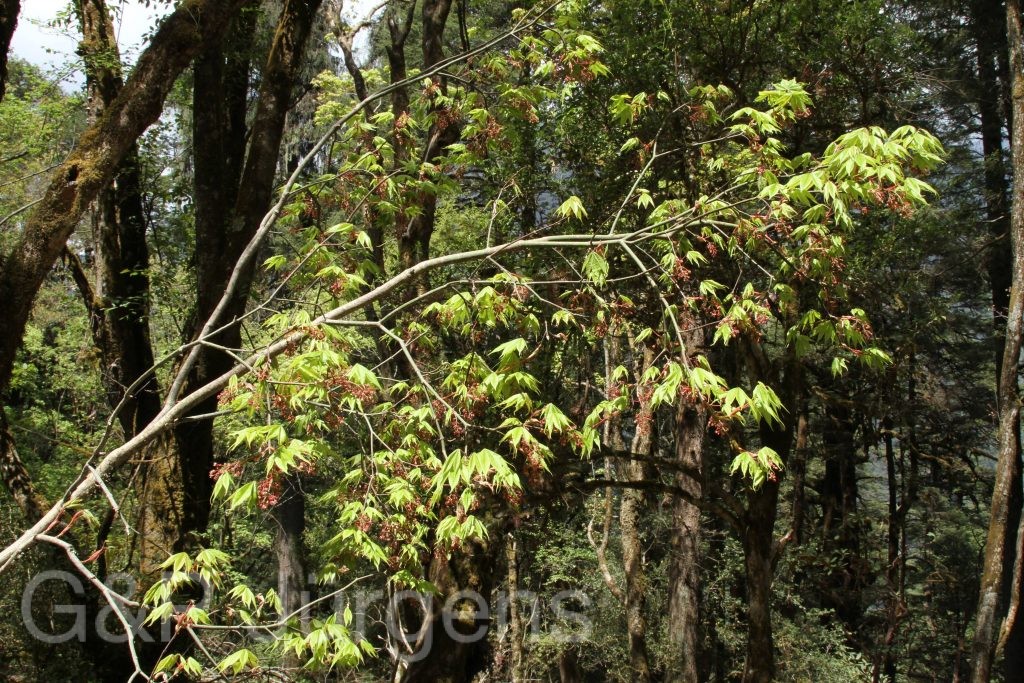
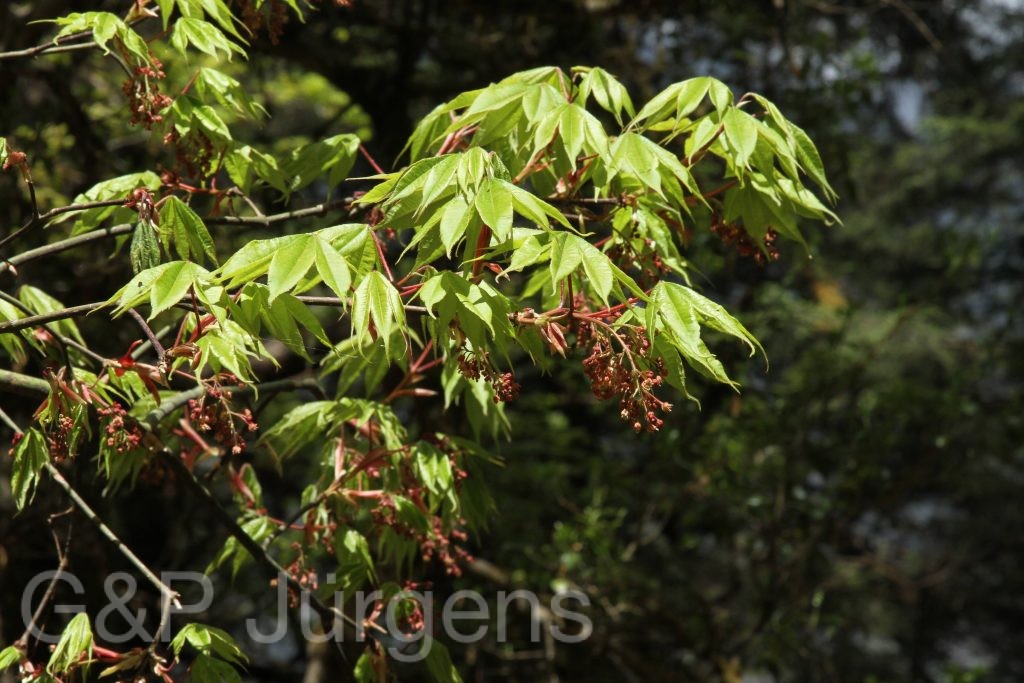
Acer cappadocicum is a deciduous maple with a remarkable disjunct distribution spanning the Caucasus, the western and central Asian mountains and the Himalaya to western China. GBIF (some 4,164 occurrences) records it from the Caucasus (Georgia, Azerbaijan, Turkey, Iran), China, India, Nepal, Pakistan and Russia, alongside extensive cultivated material across Europe and North America. It grows in moist temperate and montane mixed forest, often along streams and on north-facing slopes. The photographed tree is from the Mo-Chu valley in western Bhutan at about 1,600 m, in May, within its eastern Himalayan range of roughly 1,500–3,000 m.
It is a medium to large tree to 20–30 m with smooth greyish bark and reddish young shoots. The leaves are opposite, palmately 5–7-lobed, the lobes triangular-ovate, long-acuminate and entire-margined, glabrous and bright green, turning clear yellow in autumn. The inflorescence is a terminal erect corymb of small yellowish-green flowers. The fruit is the characteristic acerine double samara, the two nutlets bearing widely divergent, nearly horizontally spreading wings.
Acer cappadocicum is variable over its great range and several subspecies are recognised, the Himalayan and Chinese populations sometimes segregated as subsp. sinicum and others. Now placed in Sapindaceae (formerly Aceraceae), it is a widespread and non-threatened species, valued ornamentally for its autumn colour. Its trans-Asian range makes it a classic example of the temperate-forest floristic link between the Himalaya, Central Asia and the Caucasus. The input wp_link erroneously references A. campbellii.
Author: Gled. · Sources: POWO (Kew), Flora of China Vol. 11, Flora of Bhutan Vol. 2, GBIF, van Gelderen et al.: Maples of the World (1994)