
(L.) Benth. & Hook.f.
Description
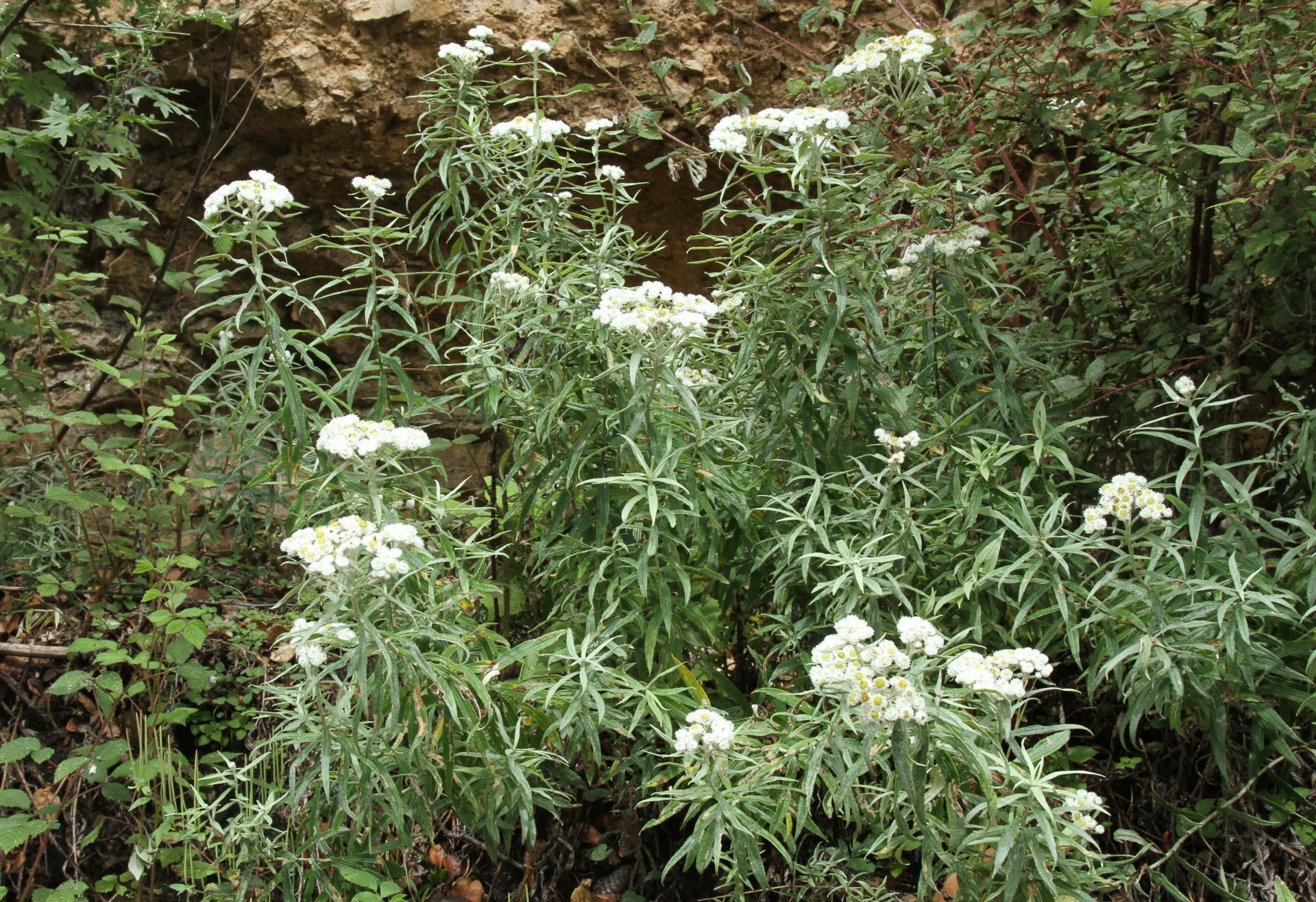
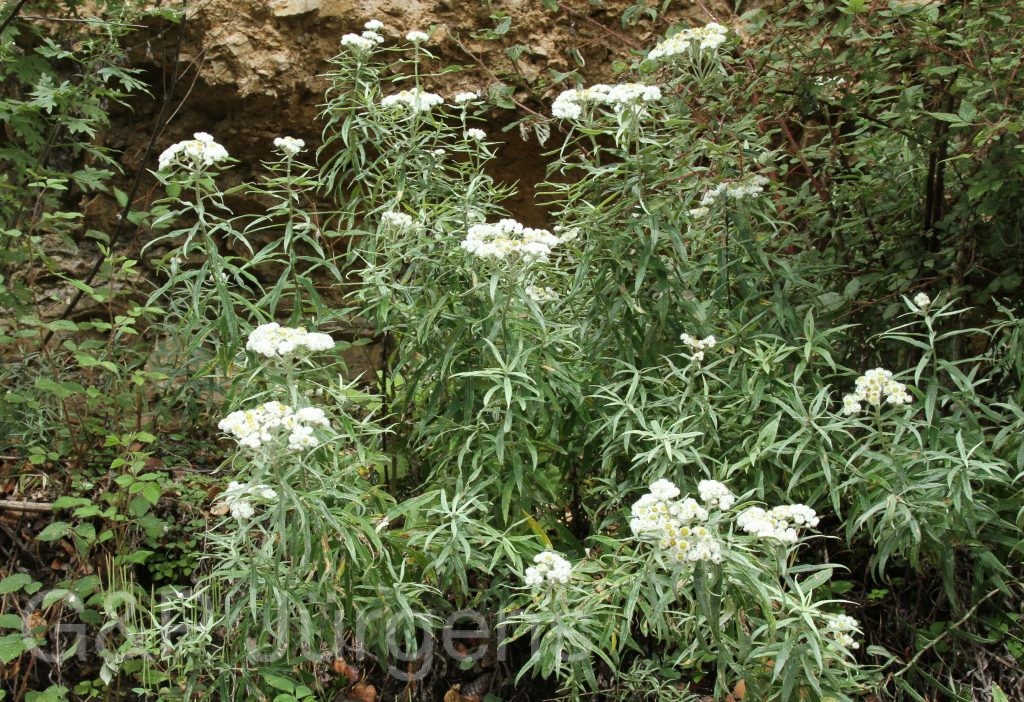
Among the most widely distributed of all Asteraceae, Anaphalis margaritacea spans a remarkable circumboreal and montane range, documented from North America (US, CA) and eastern Asia (CN, JP, TW) across the Himalaya (NP, IN) to a broad swathe of temperate Europe (GB, SE, DE, CZ, FR, AT, NL, CH, DK, NO, FI) and Russia, with more than 62,000 GBIF occurrences attesting to its abundance and partly naturalised status in the Old World. It favours open, well-drained sunny situations: grassy slopes, forest margins, roadsides, screes and subalpine meadows. In the eastern Himalaya it ascends well into the high mountains, as seen in the photographed population on the Shele-La in Bhutan at around 3600 m in September, where it flowers late in the season on stony alpine turf.
A perennial herb arising from a creeping rhizome, it forms erect, simple stems 20–60 cm tall, densely clothed throughout in white woolly-tomentose indumentum. The leaves are alternate, sessile, linear to linear-lanceolate, often somewhat decurrent, green and thinly arachnoid above and persistently white-tomentose beneath, with revolute margins. The inflorescence is a dense terminal corymb of numerous small capitula; each head is surrounded by several series of pearly-white, papery, radiating involucral bracts that give the plant its lasting ornamental quality. The florets are functionally unisexual, the species being largely dioecious, with tubular yellowish disc florets. The fruit is a small oblong cypsela bearing a pappus of slender barbellate bristles aiding wind dispersal.
The pearly everlasting is the type species of Anaphalis, a genus of the tribe Gnaphalieae centred on Asia, and its papery bracts retain form when dried, long valuing it in floristry. Ecologically it is a colonist of disturbed and pioneer ground, behaving as a weakly invasive naturalised plant in parts of Europe. Of least conservation concern given its vast range and ecological tolerance, it nonetheless provides a useful nectar source for late-season pollinators and larval food for certain lepidoptera.
Author: (L.) Benth. & Hook.f. · Sources: POWO (Kew), GBIF, Flora of China Vol. 20-21, Flora of Bhutan, Flora of Nepal, Anaphalis monograph (Hilliard & Burtt, Gnaphalieae)