
Grierson
Description
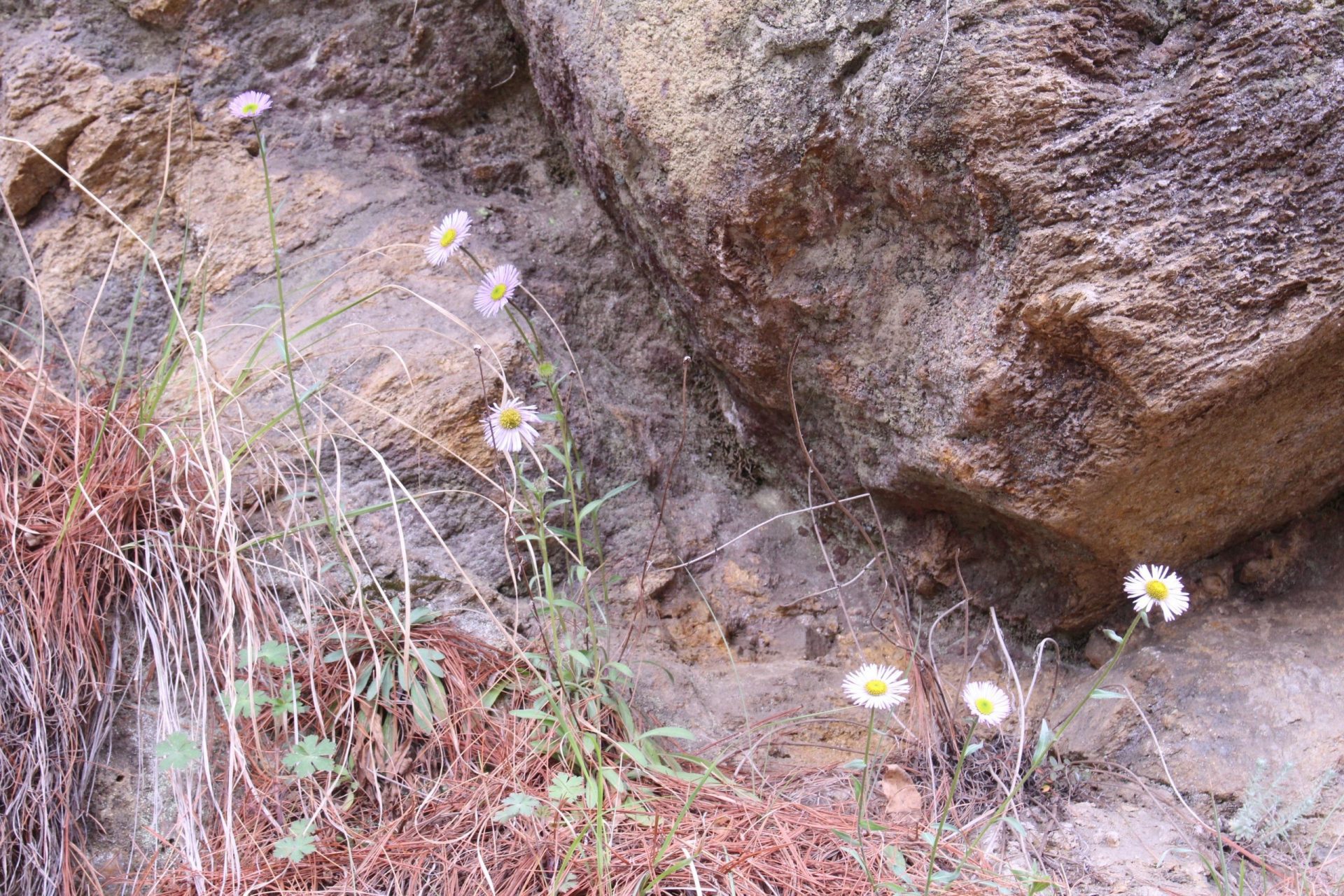
Aster neoelegans is an eastern Himalayan composite native to Bhutan, China (Tibet), India and Nepal, with 53 georeferenced occurrences indicating a fairly localised distribution along the main range. It grows on open grassy slopes, in scrub, forest clearings and on rocky banks in the temperate montane zone. It was photographed near Jakar in central Bhutan at 2400 m in May, flowering in spring on warm, well-drained slopes of the mid-montane belt, where it is a component of meadow and open-woodland communities.
It is an erect perennial herb arising from a short rhizome, with simple or sparingly branched, leafy, finely hairy stems. The alternate leaves are oblong to lanceolate or oblanceolate, entire to slightly toothed, narrowing to a sessile or clasping base and roughly pubescent. The flower heads are radiate and solitary or few in a loose corymb at the stem tips; each head has a hemispherical involucre of imbricate green phyllaries, an outer ring of spreading ligulate ray florets that are pale blue, lilac or mauve, and a central disc of yellow tubular florets. The fruit is a flattened, hairy cypsela bearing a pappus of barbellate bristles.
The genus Aster s.str. belongs to tribe Astereae and, following the segregation of numerous American and Asian species into other genera, comprises a predominantly Eurasian group well represented in the Sino-Himalaya. Aster neoelegans, described by Grierson, is one of several closely related Himalayan asters distinguished by subtle differences in leaf shape, indumentum and phyllary form. Ecologically it is an insect-pollinated meadow species. Owing to its restricted range it warrants monitoring, though it is not currently assessed as threatened.
Author: Grierson · Sources: POWO (Kew), GBIF, Flora of Bhutan, Flora of China, Asteraceae of the Himalaya (Grierson & Long studies)