
K.Rosenth.
Description
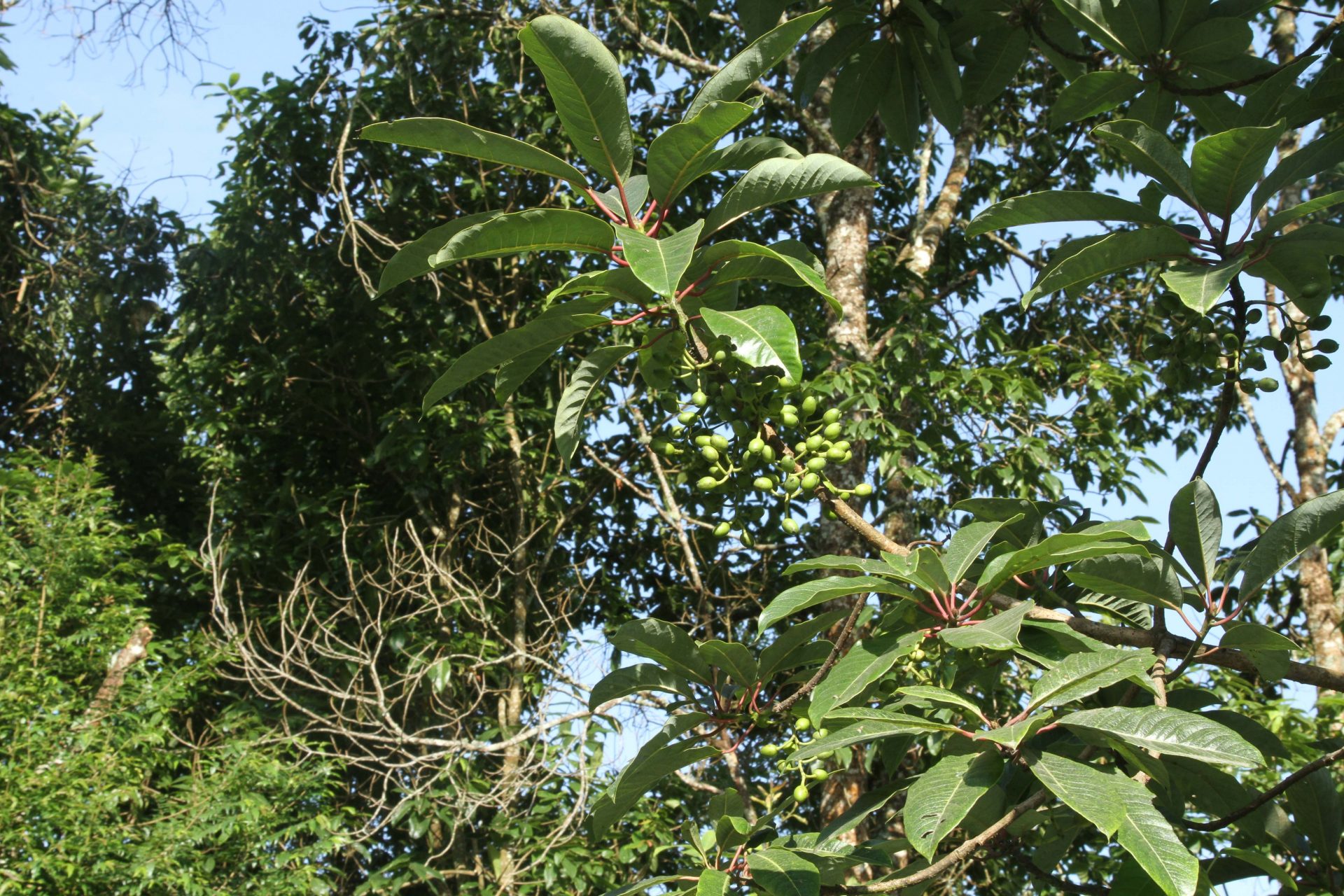
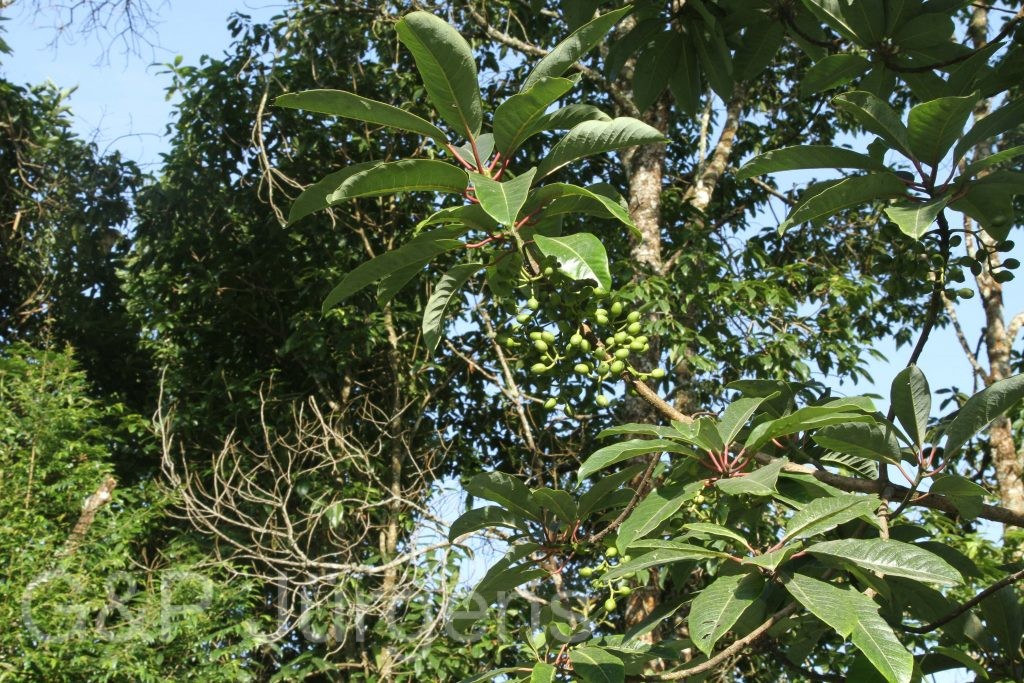
Daphniphyllum chartaceum is an evergreen tree or large shrub of the eastern Himalaya and Indo-Burmese uplands, recorded by GBIF, with around 140 occurrences, from China, Nepal, India, Bhutan, Vietnam and Myanmar. It is a component of moist, broad-leaved evergreen and warm-temperate forest, growing on humid slopes, in ravines and along forest margins, typically between about 1500 and 2500 m. The photographed plant from Tserang in Bhutan, at roughly 1660 m and recorded in June, is representative of its mid-elevation, subtropical-to-warm-temperate forest habitat, where it occupies the understorey to mid-canopy of dense, evergreen Himalayan woodland under a humid, monsoon-influenced climate.
The species is a dioecious tree with smooth bark and stout twigs bearing leaves crowded toward the branch tips. The leaves are simple, alternate but often appearing pseudo-whorled, elliptic to oblong-lanceolate, leathery to chartaceous (papery, as the epithet indicates), entire-margined, with the lower surface usually glaucous and conspicuously papillose, and frequently reddish petioles. Being dioecious, male and female flowers are borne on separate trees in axillary racemes; the flowers are small and apetalous, the males with numerous stamens and the females with a unilocular to bilocular ovary, lacking showy perianth. The fruit is a small, ellipsoid, one-seeded drupe, bluish-black and often glaucous at maturity, borne in short axillary clusters.
Daphniphyllum is the sole genus of Daphniphyllaceae, an isolated family of eastern and southern Asia of considerable phylogenetic interest, placed near Saxifragales and noted for its distinctive Daphniphyllum alkaloids. D. chartaceum is distinguished within the genus by its papery, glaucous-papillose leaves and has been associated with the variable D. himalense complex, with which it shares its montane Himalayan range. The fleshy drupes are dispersed by birds, and the dioecious breeding system enforces outcrossing. The species is reasonably widespread across the eastern Himalaya and Indo-Burma and is not regarded as threatened, though, like many evergreen forest trees of the region, local populations are sensitive to deforestation and land-use change.
Author: K.Rosenth. · Sources: POWO (Kew), GBIF, Flora of China Vol. 11, Flora of Bhutan Vol. 1, Flora of Nepal, Flora of Pakistan, Huang's monograph of Daphniphyllum