
Jacquem. ex Cambess.
Description
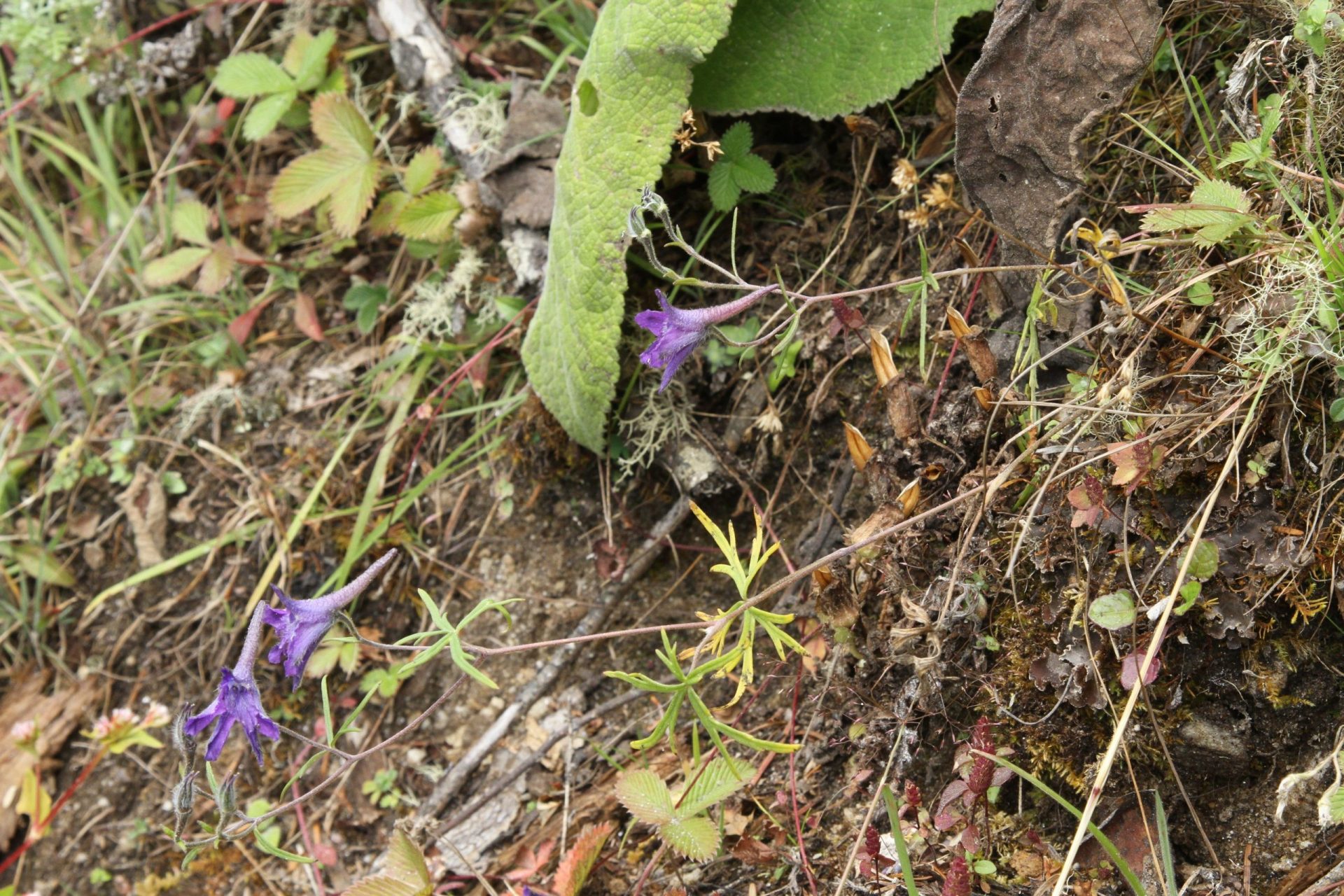
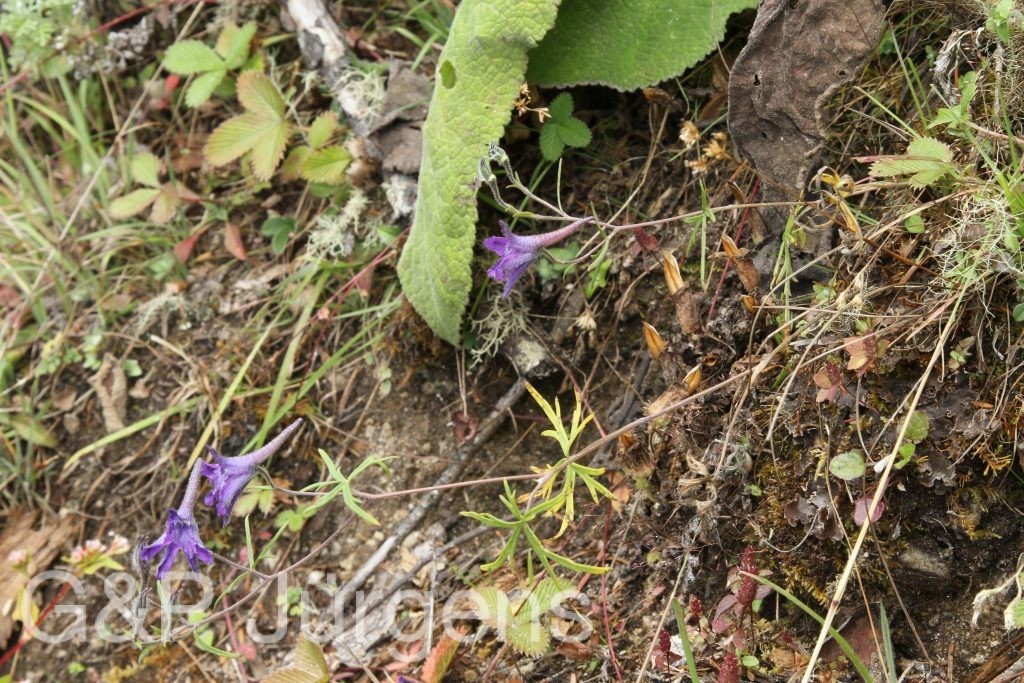
Delphinium caeruleum is an alpine larkspur of the high Himalaya and the Qinghai-Tibetan plateau, distributed across south-western China, northern India, Nepal and Bhutan, well represented in GBIF with 646 occurrences. It inhabits dry alpine meadows, open grassy slopes, sandy and gravelly turf and rocky pastures, typically between 3000 and 5000 m, often on relatively arid, well-drained ground. The photographed plant was found at Chele-La in Bhutan at 3960 m in October, a notably late flowering for this short, cushion-like high-elevation species at the close of the growing season on an exposed pass.
It is a low perennial herb, often only 5-30 cm tall, arising from a slender taproot, with erect or ascending stems and finely dissected leaves divided into narrow linear segments, the lower leaves long-petiolate. The flowers are few in a lax raceme or sometimes solitary, and are an intense deep blue to violet-blue. Each flower has five showy petaloid sepals, the upper one prolonged backward into a slender spur, enclosing the smaller true petals, of which the upper pair forms the nectariferous spur and the lower pair is often bearded. The fruit is a cluster of three erect, glabrous to pubescent follicles releasing winged or scaly seeds.
The spurred flower with its concealed nectar reservoir is adapted to pollination by long-tongued bumblebees, abundant in Himalayan alpine grassland. Within Delphinium it belongs to a group of dwarf, blue-flowered, plateau and high-alpine larkspurs. Like other members of the genus it contains diterpenoid alkaloids and is toxic to livestock, which contributes to its persistence in grazed pasture. Wide-ranging and locally common across the Tibetan and Himalayan highlands, it is of least concern, and several Sino-Himalayan Delphinium species, this among them, feature in traditional Tibetan medicine.
Author: Jacquem. ex Cambess. · Sources: POWO (Kew), GBIF, Flora of China, Flora of Bhutan, Munz: A Revision of Delphinium