
Wall.
Description
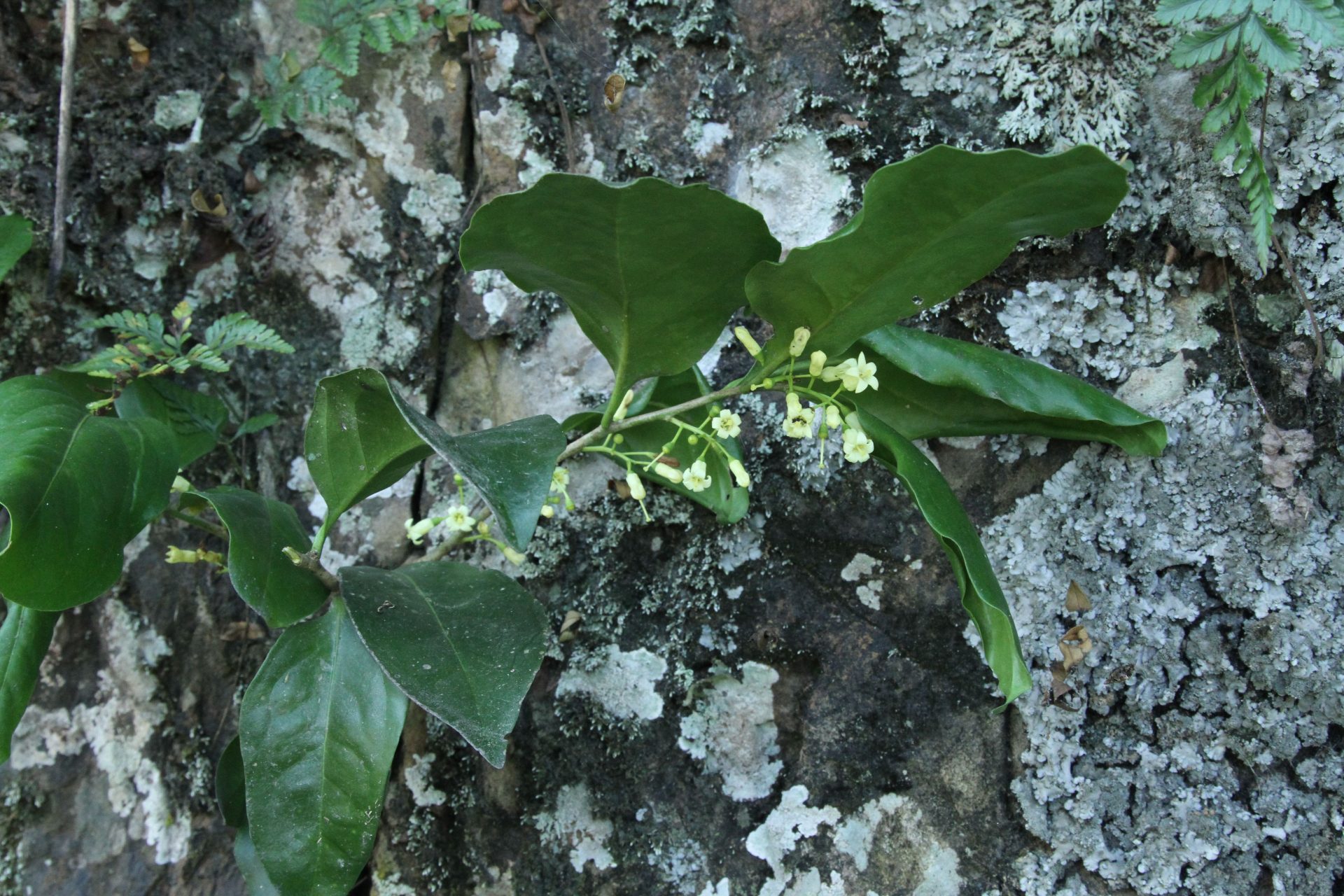
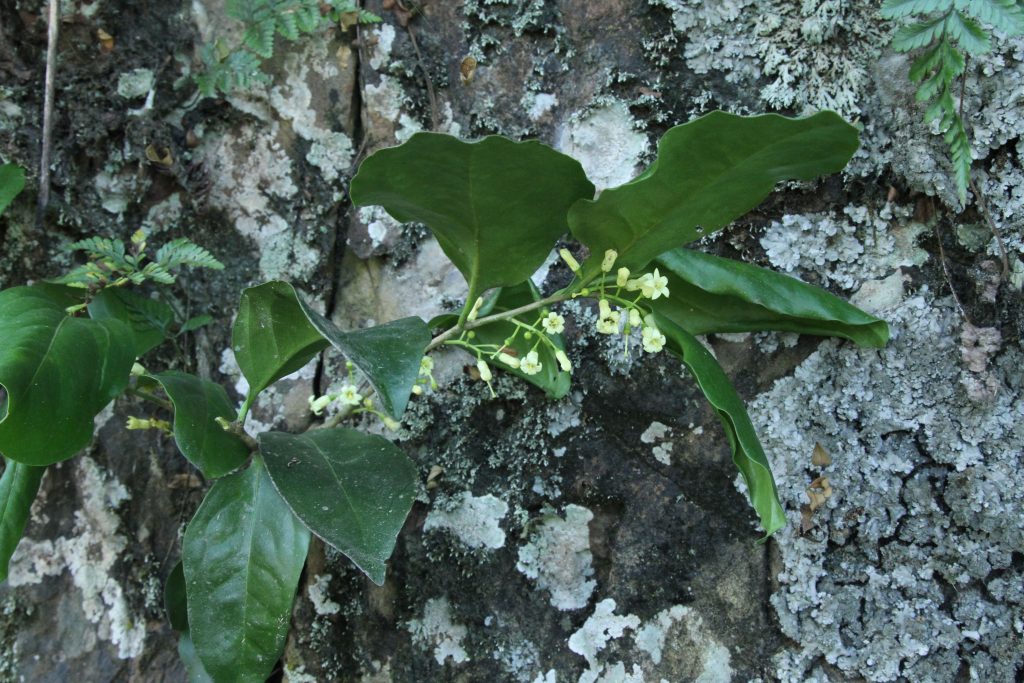
Schoepfia fragrans is a small tree or shrub of subtropical and tropical Asia, distributed across SW China, NE India, Nepal, Bhutan, Bangladesh and continental Southeast Asia (Myanmar, Thailand, Vietnam, Laos, Cambodia, Malaysia, Indonesia, Korea), with GBIF recording some 464 occurrences. It grows in evergreen and semi-evergreen broadleaved forest and forest margins at low to moderate elevations. The photographed plant from Zhemgang in south-central Bhutan at 910 m (October) typifies its occurrence in the warm subtropical hill forest of the southern Himalayan foothills.
It is an evergreen shrub or small tree with alternate, simple, entire, leathery ovate to lanceolate leaves that are acuminate and glabrous, with the lateral veins faint or obscure. The flowers are small, fragrant as the epithet records, and borne in short axillary spikes or racemes; the perianth is a tubular, funnel-shaped corolla with short recurved lobes, the stamens adnate to the corolla tube, and the ovary partly inferior, sunk in a fleshy disc. The fruit is a small ellipsoid drupe crowned by the persistent perianth remains and partly enclosed by the accrescent calyx.
Schoepfia was long placed in Olacaceae but is now segregated, with its relatives, into the family Schoepfiaceae (as given here) within the sandalwood order Santalales, a placement supported by molecular phylogenetics. Members of the order are characteristically hemiparasitic, and Schoepfia is understood to be a root hemiparasite drawing on neighbouring woody hosts while remaining photosynthetic. As a widespread forest species it is not of conservation concern, though it depends on the persistence of intact subtropical broadleaved forest.
Author: Wall. · Sources: POWO (Kew), Flora of Bhutan Vol. 1, GBIF, Flora of China Vol. 5, Nickrent: Santalales (Schoepfiaceae) phylogeny and classification