
(Azaola) Pennell
Description
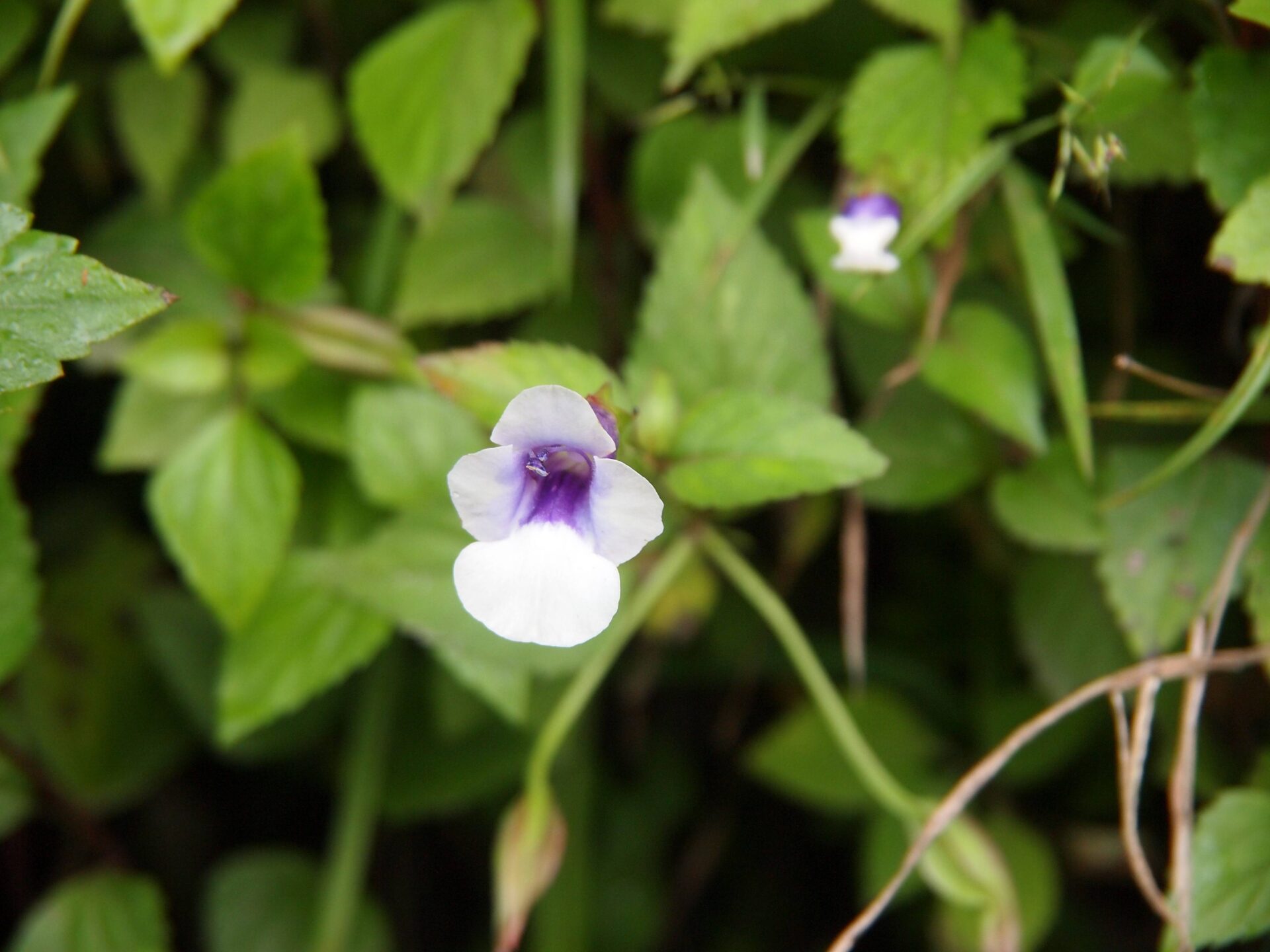
Torenia violacea is a small annual herb widely distributed across tropical and subtropical Asia, recorded by GBIF, with over a thousand occurrences, from India, Nepal, Bhutan and Bangladesh through China, Taiwan and Japan to Myanmar, Thailand, Laos, Cambodia, Vietnam, the Philippines, Malaysia, Singapore, Brunei, Indonesia and Papua New Guinea. It is a plant of warm, humid lowland and lower montane situations, growing on moist, shaded ground in rice-field margins, ditches, streamsides, damp roadside banks, forest paths and other disturbed wet places, mostly at low elevations. The photographed plant from Pemagatsel in southeastern Bhutan, at about 300 m and flowering in October, exemplifies this low-altitude, monsoon-influenced habitat, where the species flowers into the post-monsoon autumn in the warm foothill zone.
It is a slender, erect to ascending or somewhat decumbent annual with quadrangular, narrowly winged stems that branch from the base. The leaves are opposite, ovate to ovate-lanceolate, with a serrate margin, an acute apex and a rounded to broadly cuneate base, borne on short petioles. The flowers are axillary or in terminal racemes, each subtended by a tubular, five-winged (ridged) calyx. The corolla is two-lipped and violet to pale lilac, often with a yellow throat, the lower lip three-lobed and the tube curved; the four didynamous stamens are a diagnostic feature, the anterior filaments often bearing a slender appendage at the base. The fruit is a narrow, oblong, septicidal capsule enclosed by the persistent winged calyx and releasing numerous minute seeds.
Long placed in Scrophulariaceae and later in Veronicaceae or Plantaginaceae, Torenia is now assigned to the segregate family Linderniaceae, recognised on molecular grounds, alongside Lindernia and Vandellia, to which several species formerly called Torenia have been transferred. T. violacea, based on Azaola's name and recombined by Pennell, is distinguished within the genus by its five-winged calyx and violet corolla. The species is a self-compatible weedy annual of disturbed wet ground, abundant and adaptable across its very large range, and is of no conservation concern; ornamental relatives in the genus (the "wishbone flowers") are popular bedding plants.
Author: (Azaola) Pennell · Sources: POWO (Kew), GBIF, Flora of China Vol. 18, Flora of Bhutan Vol. 2, Flora of Nepal, Flora of Pakistan, Fischer's revision of Linderniaceae