
Lindl.
Description
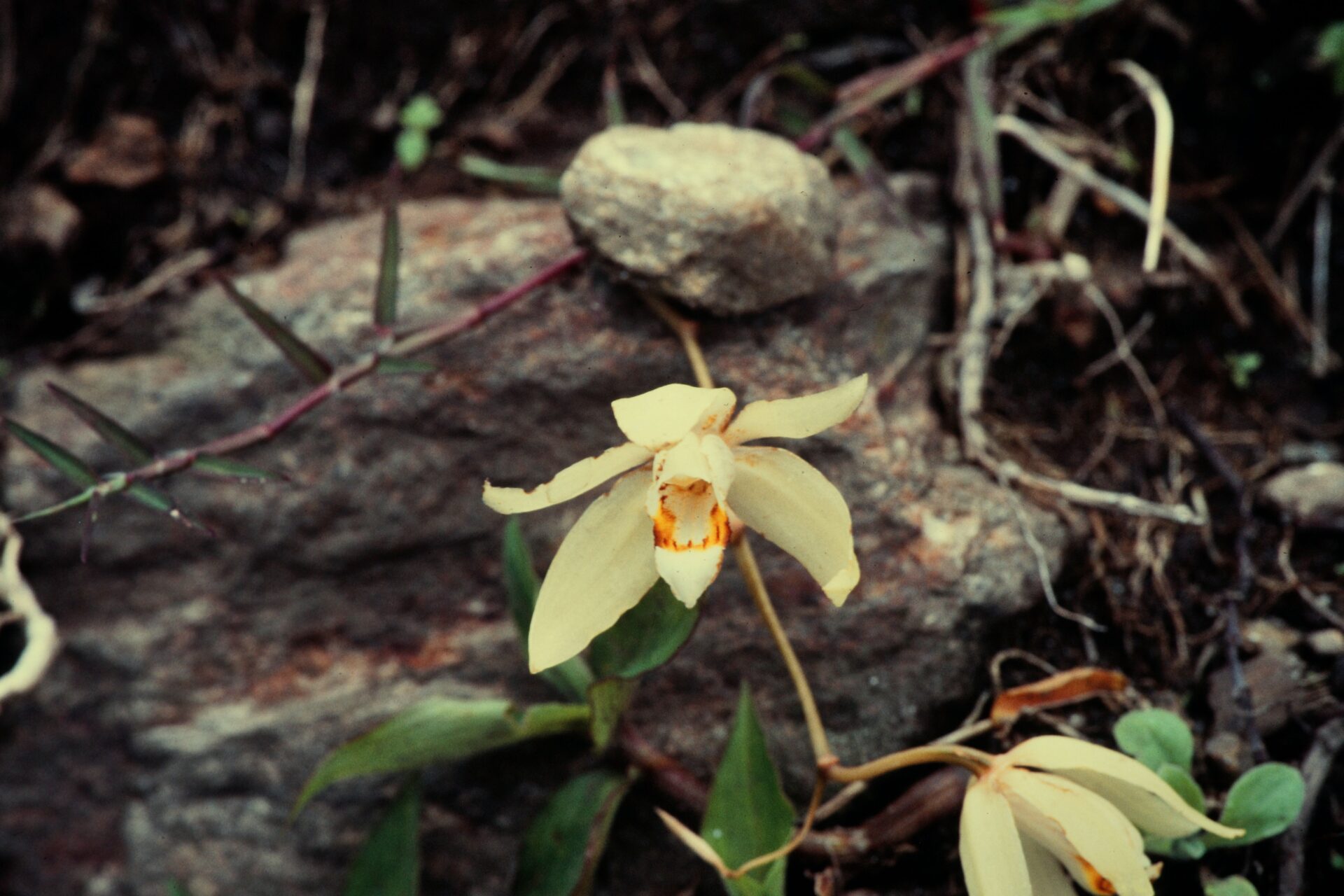
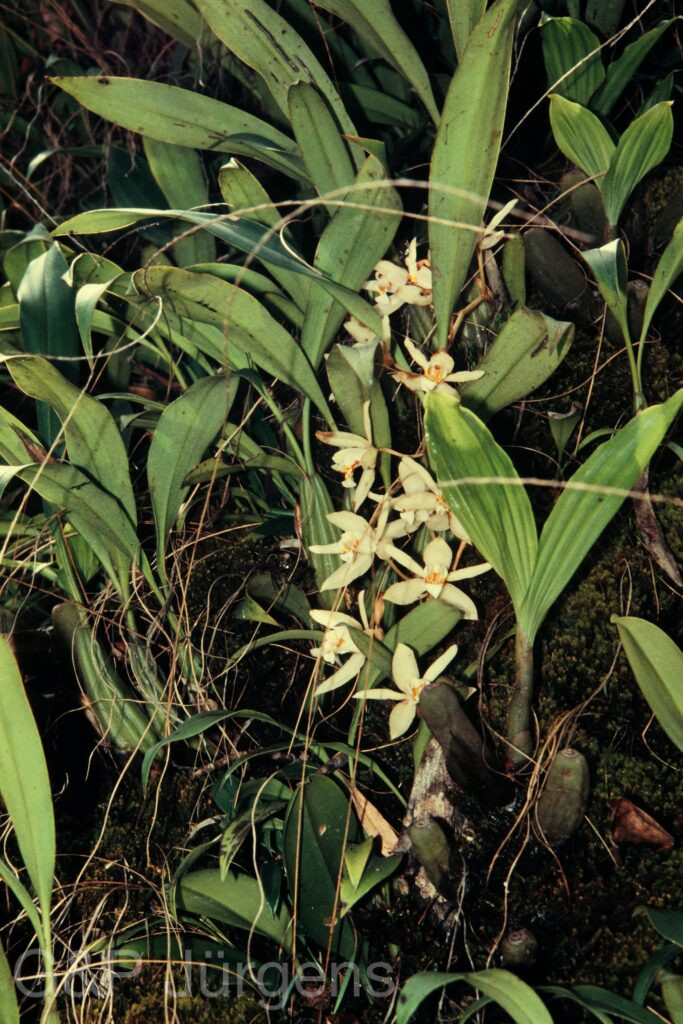
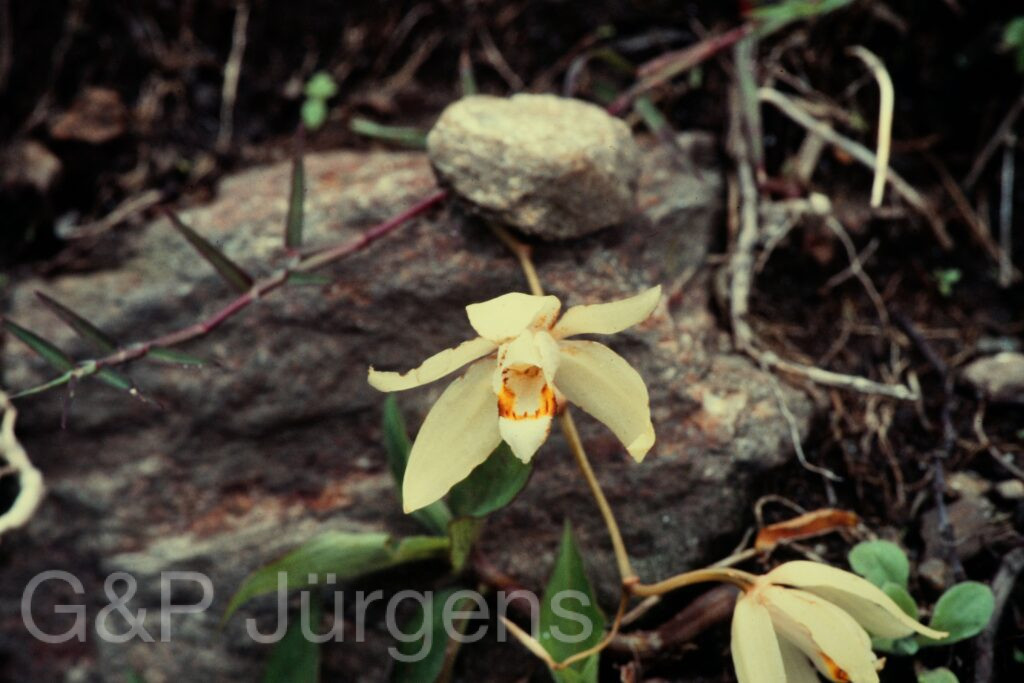
Coelogyne flaccida Lindl. is an epiphytic orchid of the Himalaya and Southeast Asia, recorded from China, India, Nepal, Bhutan, Thailand, Laos, Vietnam and Myanmar, with cultivated records widely scattered elsewhere; GBIF documents around 243 occurrences. It grows as an epiphyte, occasionally a lithophyte, on mossy tree trunks and shaded rocks in broadleaved evergreen and mixed forest, generally between about 900 and 2300 m, though montane records reach higher. The photographed plant was found at Tashigaon in Nepal at about 2900 m in May, at the upper, cooler edge of its range where this pseudobulbous orchid flowers in spring on humid, well-shaded substrates.
The plant is sympodial, with clustered, oblong to ovoid pseudobulbs borne on a creeping rhizome, each pseudobulb bearing one or two apical, plicate, lanceolate to elliptic leaves. The inflorescence is a pendent, laxly several-flowered raceme arising from the base of the pseudobulb. The flowers are fragrant, the sepals and petals creamy-white to pale buff and somewhat flaccid (the epithet flaccida), and the trilobed labellum is marked with conspicuous yellow to orange-brown keels and reddish-brown veining on the side lobes. The fruit is a ribbed dehiscent capsule releasing dust-like seeds.
Within the large Asiatic genus Coelogyne, this species belongs to the white-flowered, pendent-racemed group allied to C. cristata and C. corymbosa and is widely grown by orchid enthusiasts. Like other epiphytic orchids it depends on undisturbed humid forest and mycorrhizal partners for germination. Although fairly widespread, wild populations are vulnerable to habitat loss and collection, and all Coelogyne are listed on CITES Appendix II, regulating international trade.
Author: Lindl. · Sources: POWO (Kew), GBIF, Flora of China, Flora of Bhutan, Annotated Checklist of the Flowering Plants of Nepal, Clayton The Genus Coelogyne: A Synopsis