
DC.
Description
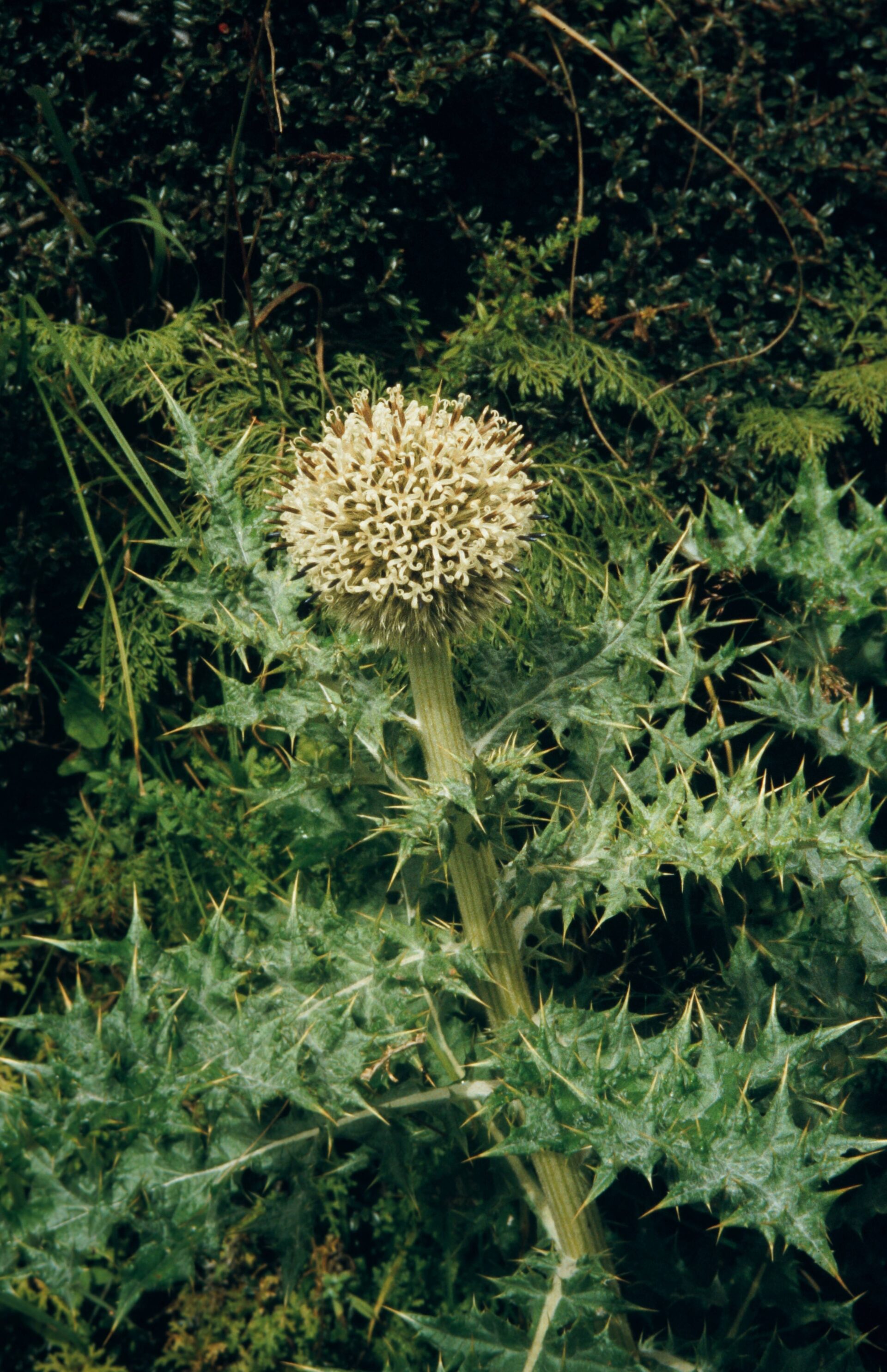
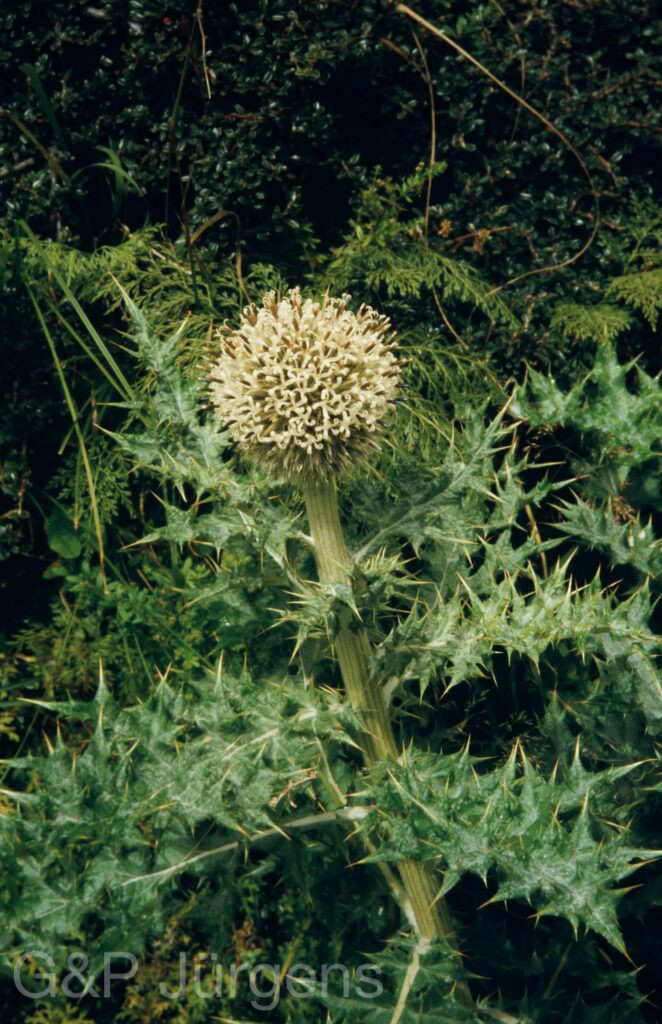
Echinops cornigerus is a Sino-Himalayan globe-thistle distributed across the western and central Himalaya and adjacent Tibetan plateau, with verified records from India, Pakistan, Nepal, Bhutan and China, alongside a scatter of cultivated or extra-regional occurrences (Iran, France, Belgium) among the roughly 294 georeferenced GBIF collections. It inhabits open, sunny slopes, dry stony pastures, forest margins and disturbed ground in the upper temperate to subalpine belt, typically between about 2000 and 3500 m. The plant photographed at Pana in the Garhwal Himalaya at 2800 m in September, fruiting at the close of the monsoon, exemplifies its preference for well-drained montane grassland exposed to strong insolation.
A stout perennial herb, it forms an erect, ridged and somewhat cottony-tomentose stem arising from a woody rootstock. The leaves are coriaceous, deeply pinnatifid to bipinnatifid, glabrescent and green above but white-tomentose beneath, the lobes terminating in conspicuous rigid yellowish spines. The inflorescence is the spherical compound capitulum characteristic of the genus: numerous one-flowered capitula aggregated into a globose synflorescence, each enclosed by stiff bristly involucral scales. The corollas are tubular, pale blue to whitish, and the achenes are cylindrical, densely hairy and crowned by a short pappus of fused scales.
The genus Echinops is taxonomically intricate, the spherical secondary head having evolved as a striking adaptation that pools many reduced florets into a single pollinator-attracting unit. The spiny architecture deters mammalian grazing, an advantage in heavily pastured Himalayan rangelands. Though not assessed as threatened, populations are locally affected by overgrazing and slope disturbance, and the species remains a useful indicator of dry montane grassland.
Author: DC. · Sources: POWO (Kew), GBIF, Flora of Pakistan, Flora of China (Asteraceae), Annotated Checklist of the Flowering Plants of Nepal, Kew monograph of Echinops