
Hook.f. & Thomson
Description
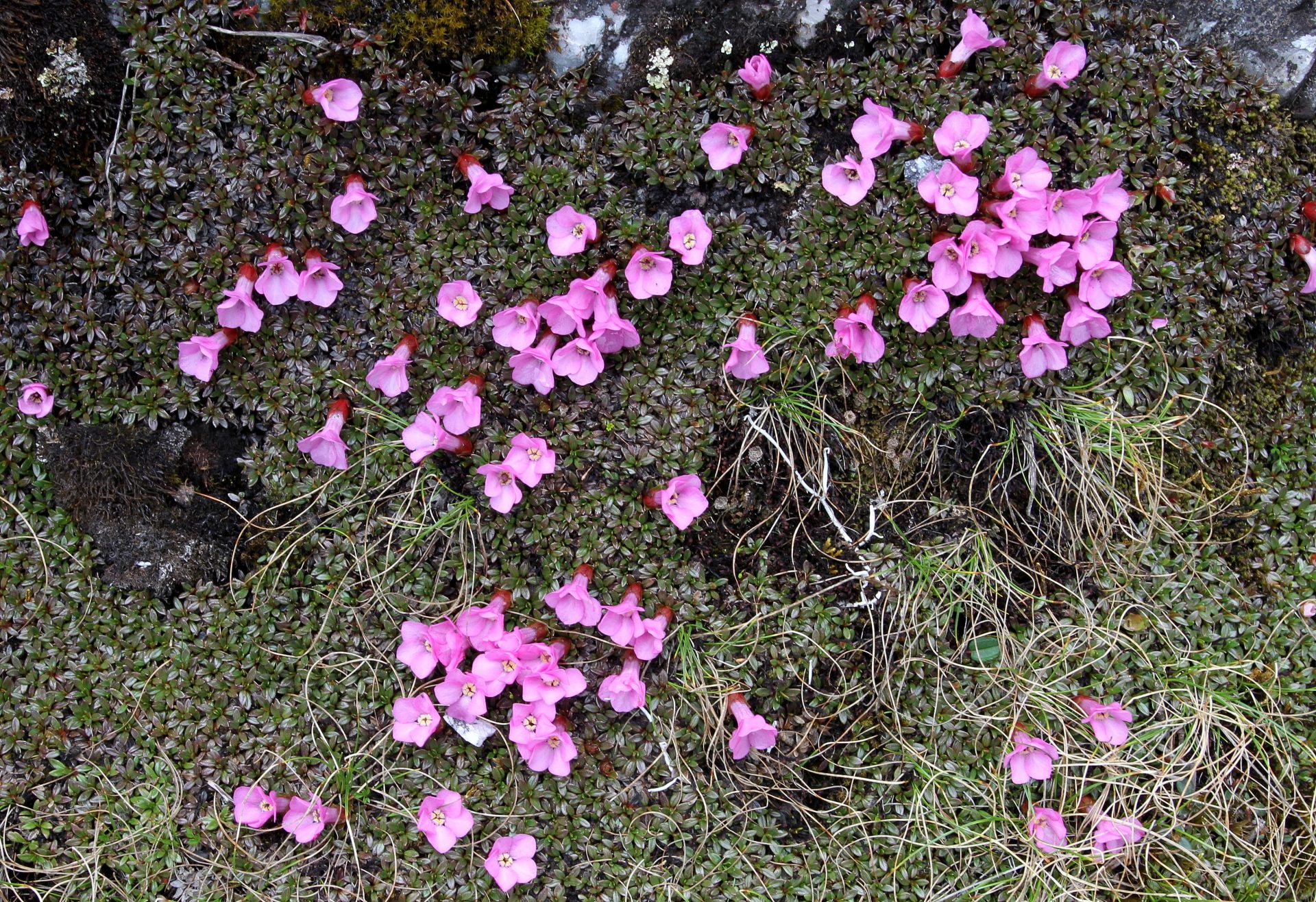
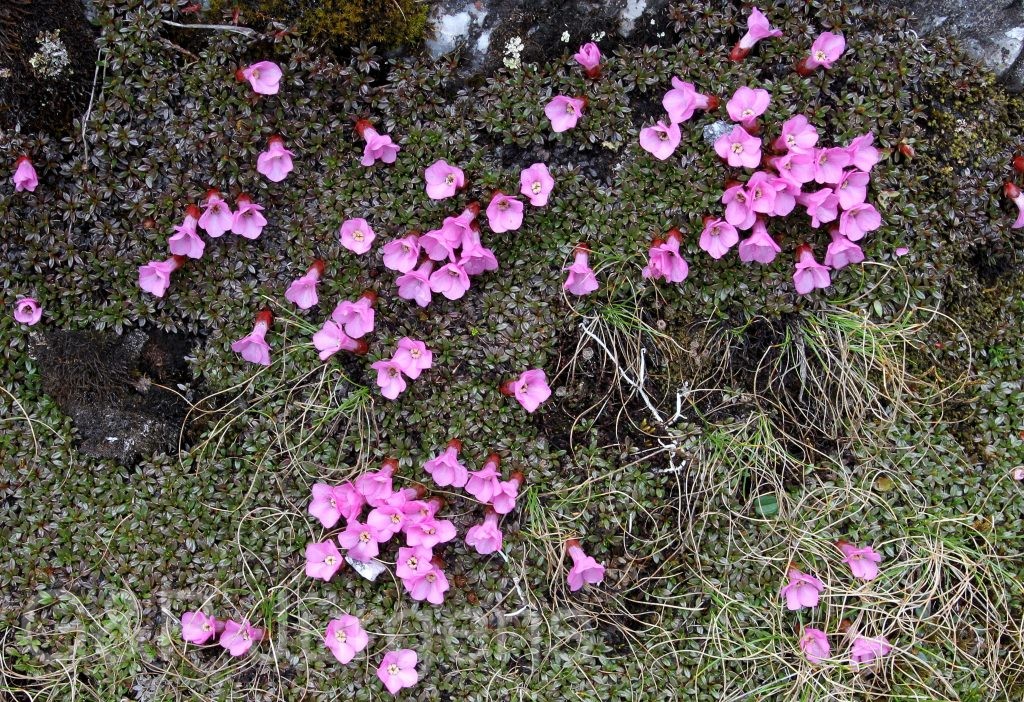
Diapensia himalaica Hook.f. & Thomson is a high-alpine cushion plant of the Sino-Himalayan mountains, recorded from China, India, Nepal, Bhutan and Myanmar (CN, IN, NP, BT, MM), with GBIF documenting some 304 occurrences. It is a plant of the upper alpine and subnival belt, on exposed rocky ridges, gravelly slopes, moraines and turf margins, generally above 4000 m where wind exposure and a short growing season prevail. The Bhutanese material from Jule-Tso at 4100 m in June illustrates its early-summer flowering after snow-melt, when the cushions are studded with relatively large solitary flowers.
It forms a compact, evergreen, woody cushion of densely crowded shoots clothed in small, leathery, imbricate leaves. These are narrowly spathulate to oblong, sessile, with a thickened entire margin and a coriaceous texture resisting desiccation. The flowers are solitary and terminal on short stalks scarcely exceeding the cushion, actinomorphic and five-merous, with a persistent calyx and a campanulate to rotate corolla of fused white to pale pink petals; the five stamens are adnate to the corolla tube. The fruit is a small loculicidal capsule with numerous minute wind-dispersed seeds.
Diapensia is the type genus of the small, isolated family Diapensiaceae, an arctic-alpine lineage of ericalean affinity, and D. himalaica is the Himalayan vicariant of the circumboreal D. lapponica complex. The compact cushion habit is a classic adaptation to cold, wind-swept, nutrient-poor high mountains. Its biogeographic importance lies in linking the Himalayan high-alpine flora to arctic and boreal cushion-plant communities, and as a slow-growing specialist it is sensitive to climate change.
Author: Hook.f. & Thomson · Sources: POWO (Kew), GBIF, Flora of Bhutan Vol. 2, Flora of China Vol. 14, Flora of Nepal, Scott & Day monograph of the Diapensiaceae