
(L.) Á.Löve & D.Löve
Description
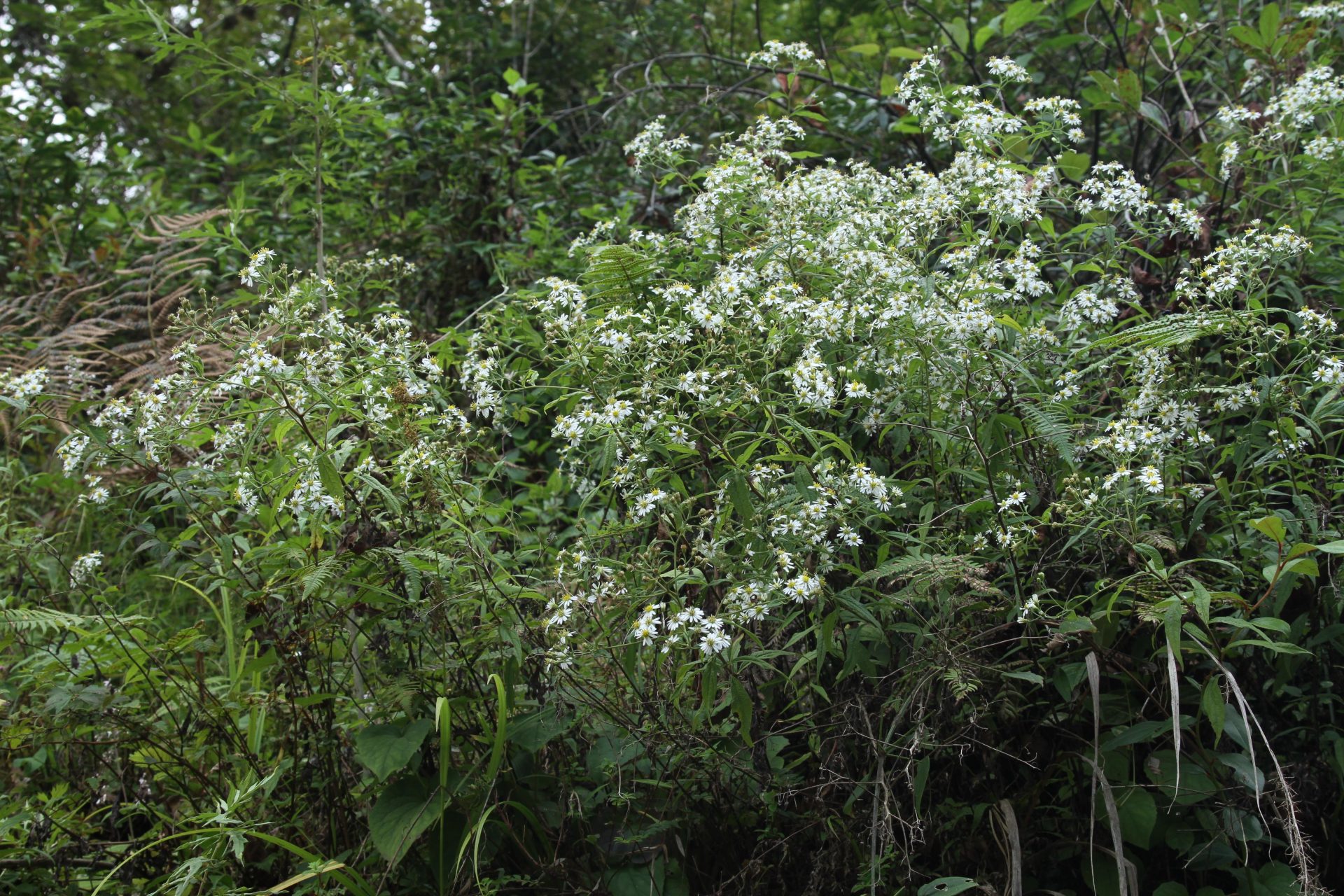
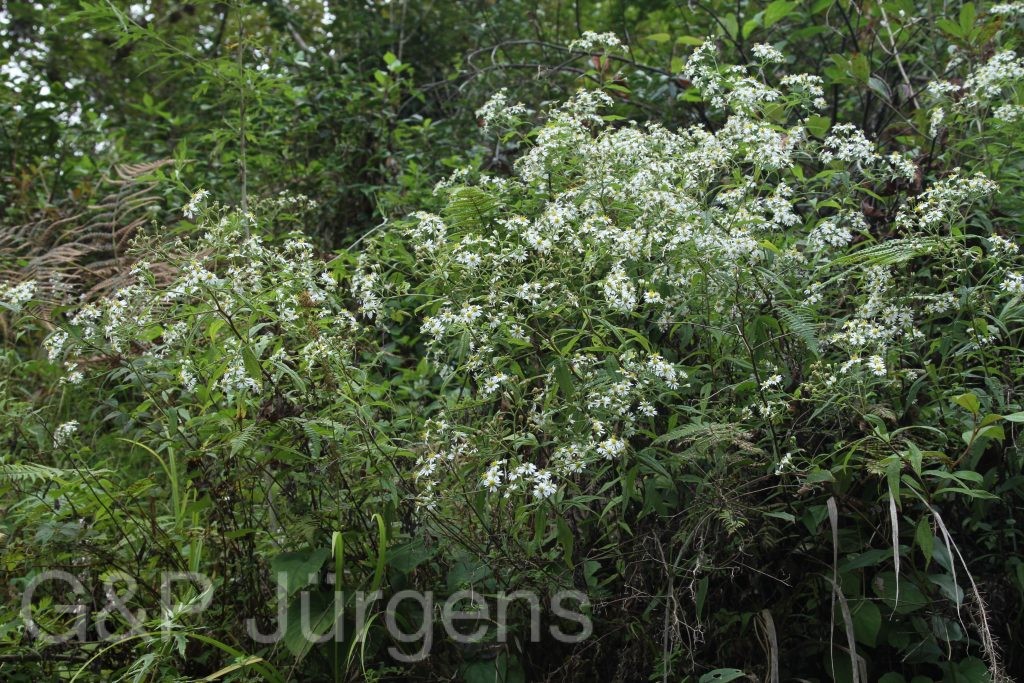
Symphyotrichum laeve, the smooth blue aster, is native to North America, where GBIF records its overwhelming abundance (15,822 occurrences) across the United States, Canada and Mexico. It is also widely naturalised in Europe (Germany, Netherlands, Sweden, France, Britain, Belgium and beyond) and is recorded as an introduced ornamental elsewhere. In its native range it occupies dry to mesic prairies, open woodland, glades and roadsides. The image was taken at Trashigang in eastern Bhutan at 1720 m in October, where the plant occurs as a cultivated or escaped garden ornamental rather than as a member of the indigenous Himalayan flora.
It is a glabrous, often glaucous perennial herb arising from a short rhizome or caudex, with erect stems to about 1 m. The leaves are alternate, firm and smooth, the lower oblanceolate and tapering to a winged petiole, the upper sessile and clasping with an auriculate base, the margins entire to remotely toothed. The inflorescence is an open paniculiform array of numerous capitula subtended by appressed, imbricate phyllaries with diamond-shaped green tips. Each head bears blue to violet ray florets surrounding yellow disc florets that age to purplish; the achenes are ribbed and crowned by a tawny pappus of capillary bristles.
Formerly placed in Aster, the species was transferred to Symphyotrichum by Á. Löve & D. Löve following molecular evidence dismantling the broad genus Aster, which is now restricted to Old World taxa. Smooth aster is a popular late-season ornamental and pollinator plant. It is secure throughout its native range and behaves as a benign garden escape in temperate regions worldwide.
Author: (L.) Á.Löve & D.Löve · Sources: POWO (Kew), GBIF, Flora of North America, Flora of Bhutan, Symphyotrichum revision (Nesom), Asteraceae of North America