
Van Heurck & Müll. Arg.


Description
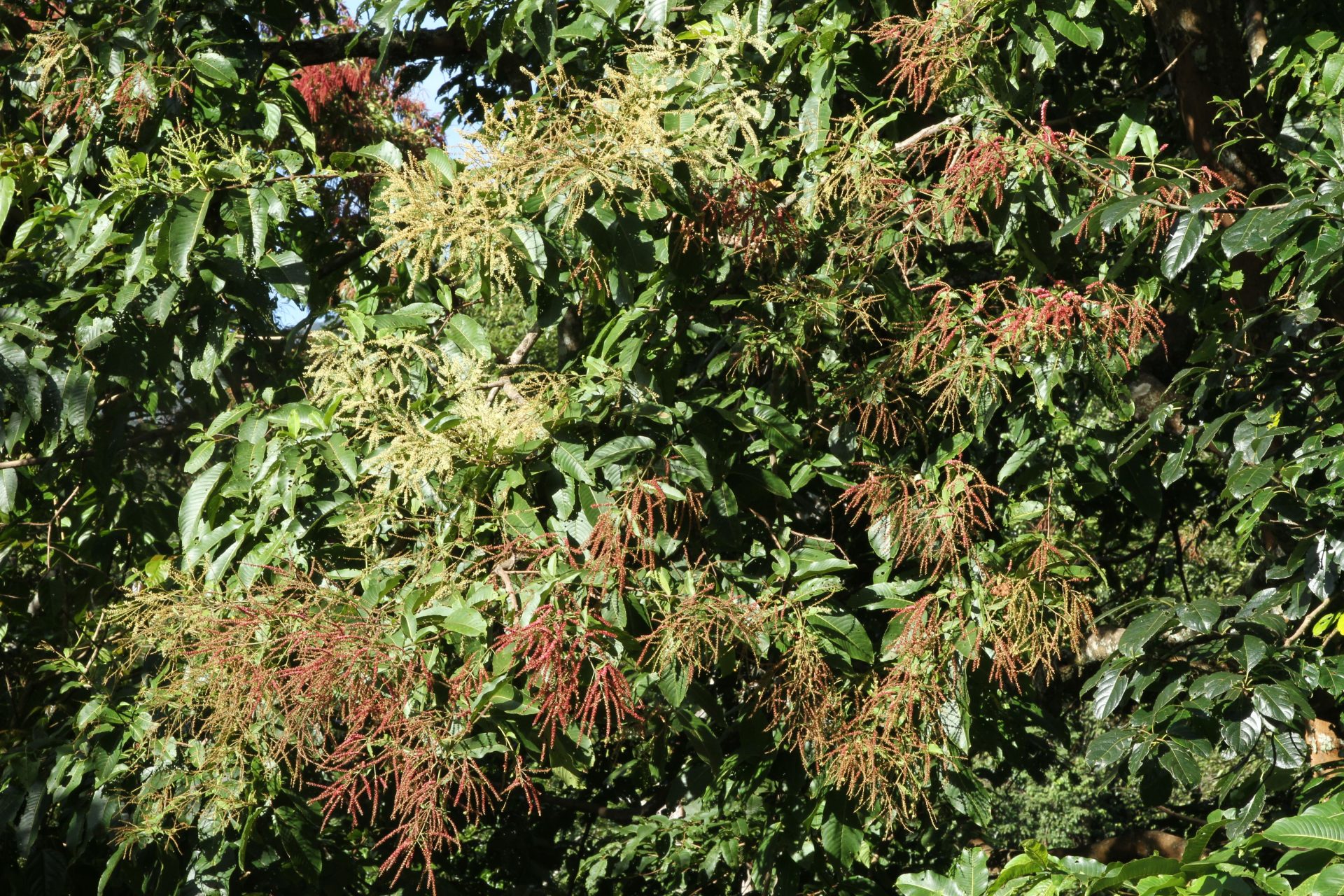
Terminalia myriocarpa Van Heurck & Mull.Arg. is a large evergreen tree of the Combretaceae, distributed across the eastern Himalaya and Indo-Burmese region, ranging from northeastern India, Nepal and Bhutan through Myanmar, Thailand, Laos and Vietnam to southwestern China (GBIF: c. 454 occurrences). It is a canopy tree of subtropical and tropical moist evergreen forests, favouring deep, moist soils along streams and in foothill valleys, generally below about 1,500 m though ascending higher locally. The photographed trees from Zhemgang in central Bhutan, recorded at about 950 m and 1,800 m in October, illustrate its presence in the warm, humid forests of the southern foothills.
The tree is tall, reaching 30 m or more, frequently developing prominent buttresses at the base. The leaves are opposite or subopposite, oblong-elliptic, with an acuminate apex and entire to crenulate margins, and often bear a pair of glands near the base of the petiole. The flowers are small, numerous and bisexual, borne in large, much-branched terminal and axillary panicles, giving rise to the species epithet "myriocarpa" ("many-fruited"). The fruit is a small, two-winged, samaroid nutlet that turns pink to crimson in dense masses, a striking feature that aids wind dispersal.
Terminalia belongs to the pantropical Combretaceae and includes many ecologically and economically important timber trees. Terminalia myriocarpa yields a useful general-purpose hardwood and is a significant component of lowland evergreen forest. Although locally common over a wide range and not globally threatened, its lowland forest habitat is under pressure from logging and land conversion across parts of its distribution.
Author: Van Heurck & Müll. Arg. · Sources: POWO (Kew), Flora of China Vol. 13, Flora of Bhutan Vol. 2, Flora of Nepal, GBIF, Exell: Combretaceae revisions