
Franch.
Description
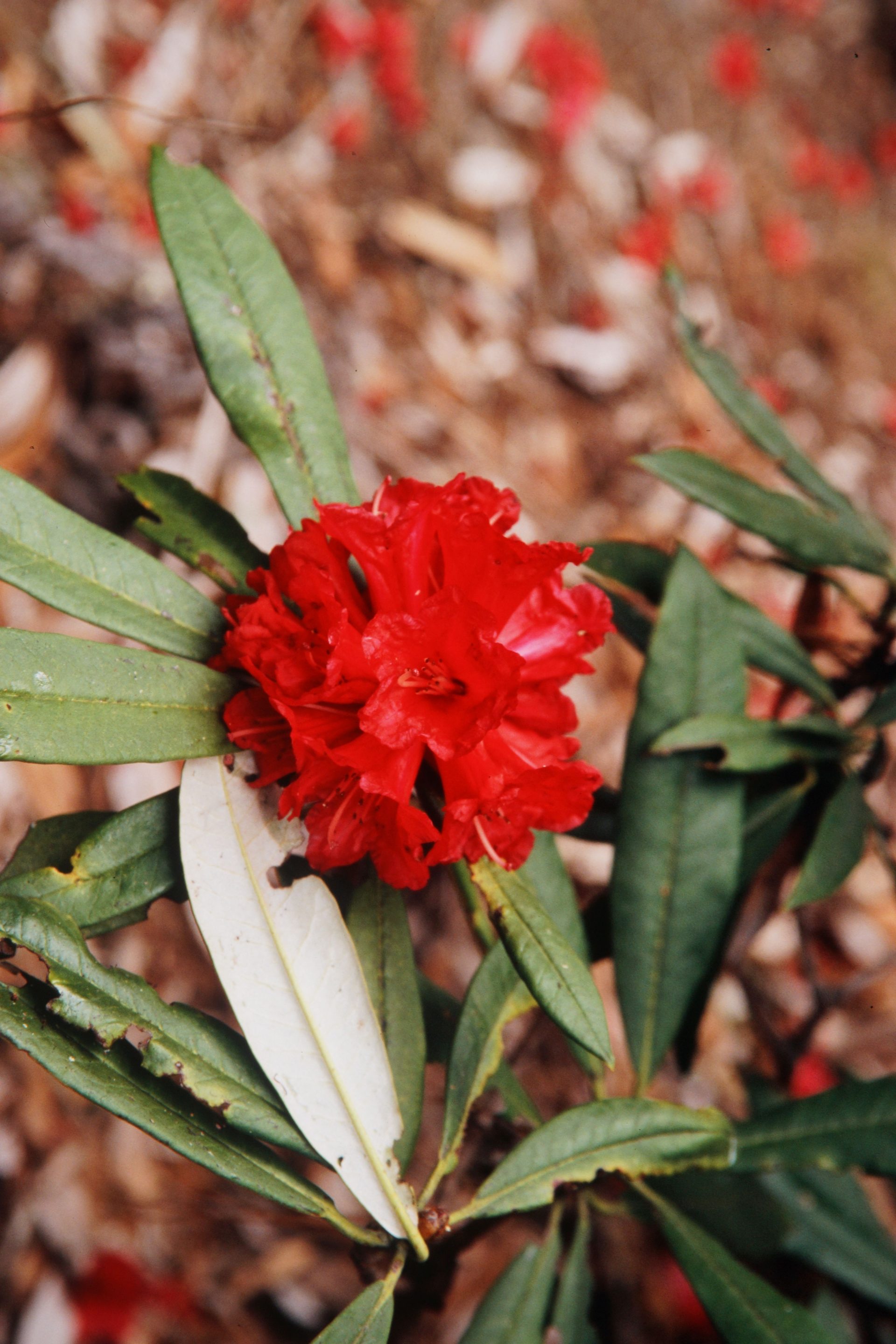
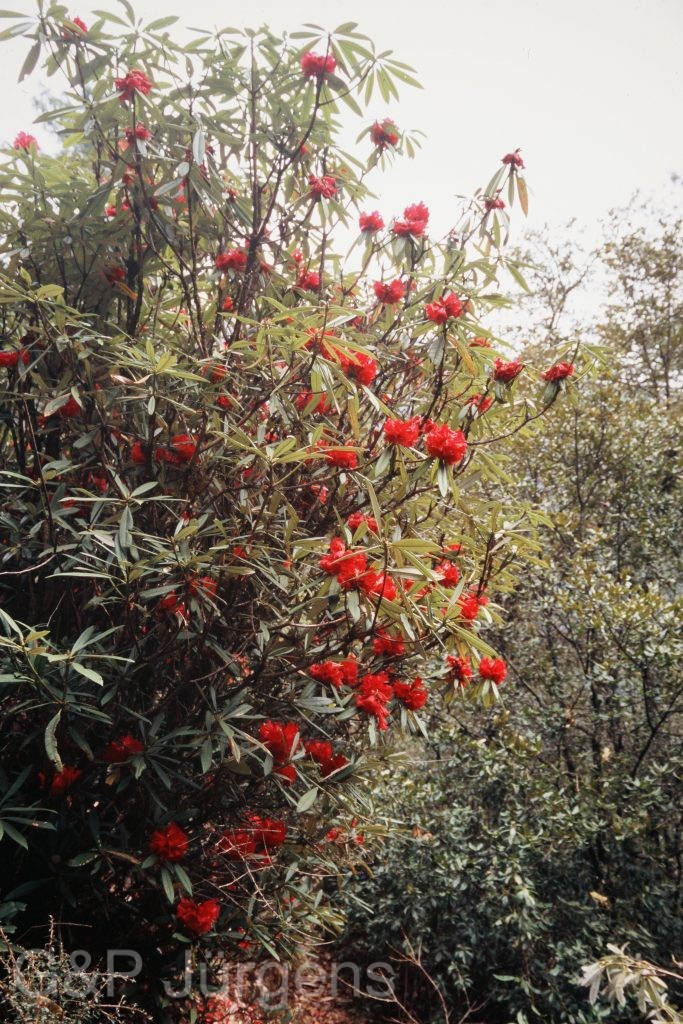
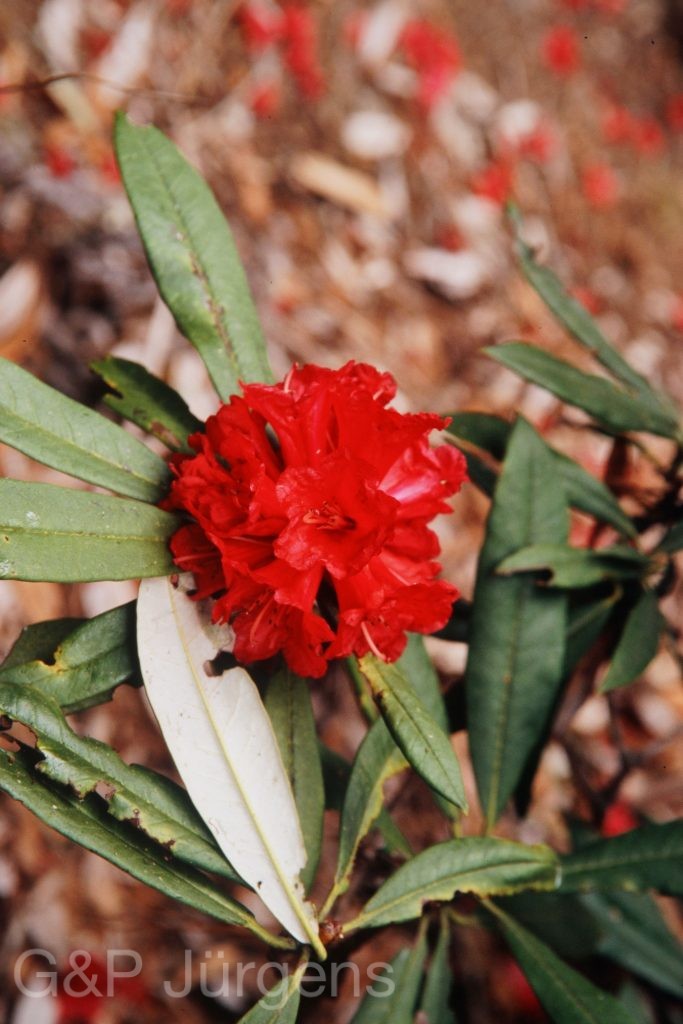
Rhododendron delavayi Franch. is a shrub or small tree of the Sino-Himalayan region, distributed through south-western China (Yunnan, Guizhou, Sichuan, Xizang), Myanmar, Thailand, Vietnam, north-eastern India, Bhutan and Nepal, with horticultural records from the United Kingdom, United States, Canada and Belgium contributing to a GBIF total of around 1,290 occurrences. It grows in evergreen broadleaf forest, pine forest, open thickets and on rocky montane slopes, typically on acidic soils in the warm-temperate to lower montane belt. The illustrated plant comes from the Thimphu-Chu valley in Bhutan at about 2800 m, an elevation characteristic of the species where it forms a conspicuous element of the forest canopy and understorey and flowers in spring.
It is an evergreen shrub to small tree with stout branches and a thick, often flaking bark. The leaves are leathery, oblong-lanceolate to oblanceolate, dark green and glabrous above, the lower surface densely covered with a felted, persistent, fawn to greyish or whitish tomentum (indumentum) that is diagnostic of the species. The flowers are borne in dense, rounded, terminal trusses; each is broadly campanulate with a deep crimson to scarlet corolla of about five lobes, marked at the base with darker nectar pouches, and contains about ten stamens and a glabrous or hairy ovary with a long style. The fruit is a woody, cylindrical, ribbed capsule dehiscing by valves to release numerous minute seeds.
Rhododendron delavayi is the type species of subsection Arborea and is closely related to the Himalayan R. arboreum, with which it intergrades and shares the tree habit and red flowers; it is distinguished by its compact indumentum and floral details. Ecologically it is bird- and insect-pollinated and is a dominant component of warm broadleaf forest, while in cultivation it is valued as a parent of many hybrids. Although widespread, it is locally affected by deforestation and habitat conversion in parts of its range, but overall it remains common and is not regarded as globally threatened.
Author: Franch. · Sources: POWO (Kew), GBIF, Flora of China, Flora of Bhutan, The Genus Rhododendron (Edinburgh, Chamberlain et al.)