
(C.B.Clarke) S.W.Liu
Description
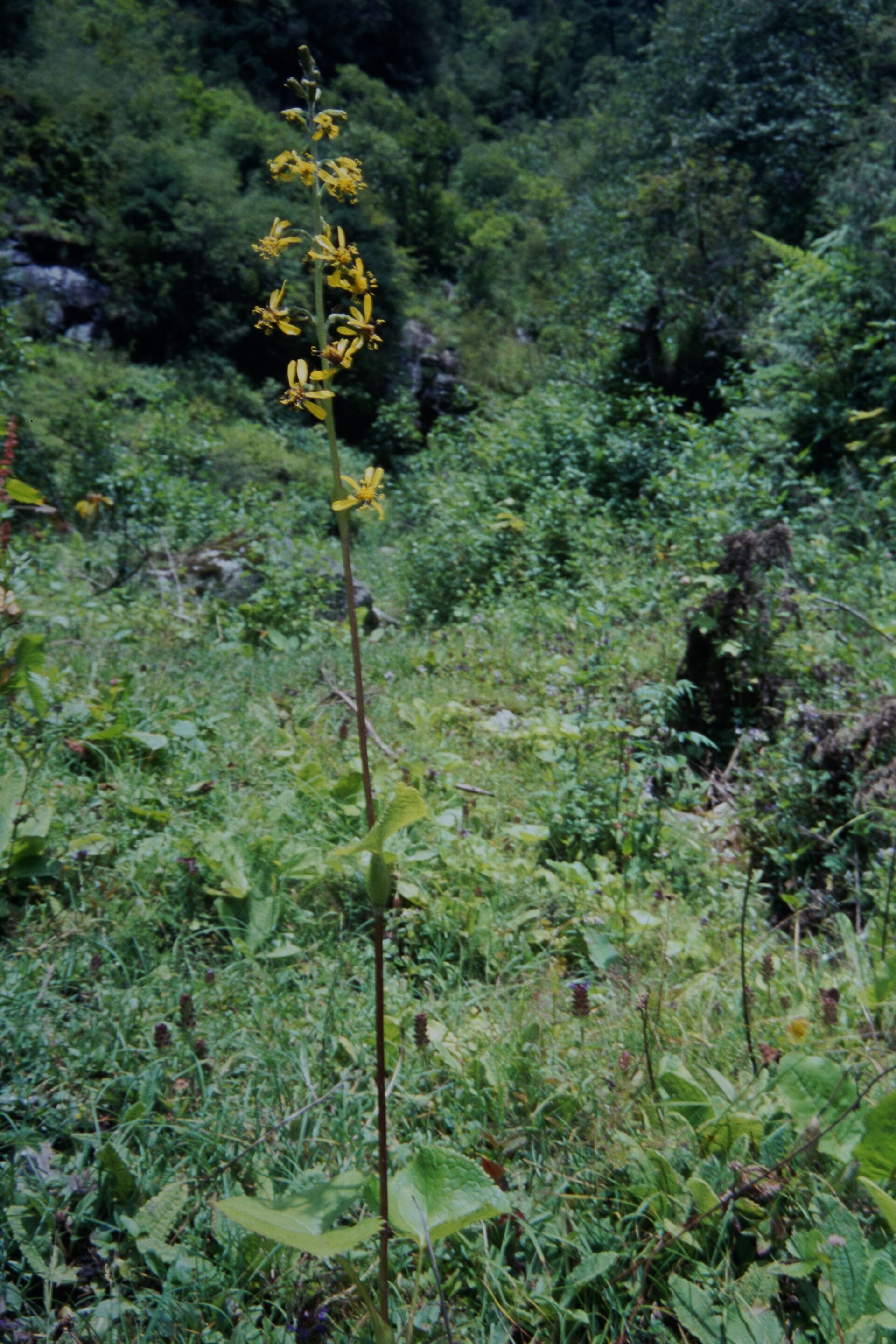
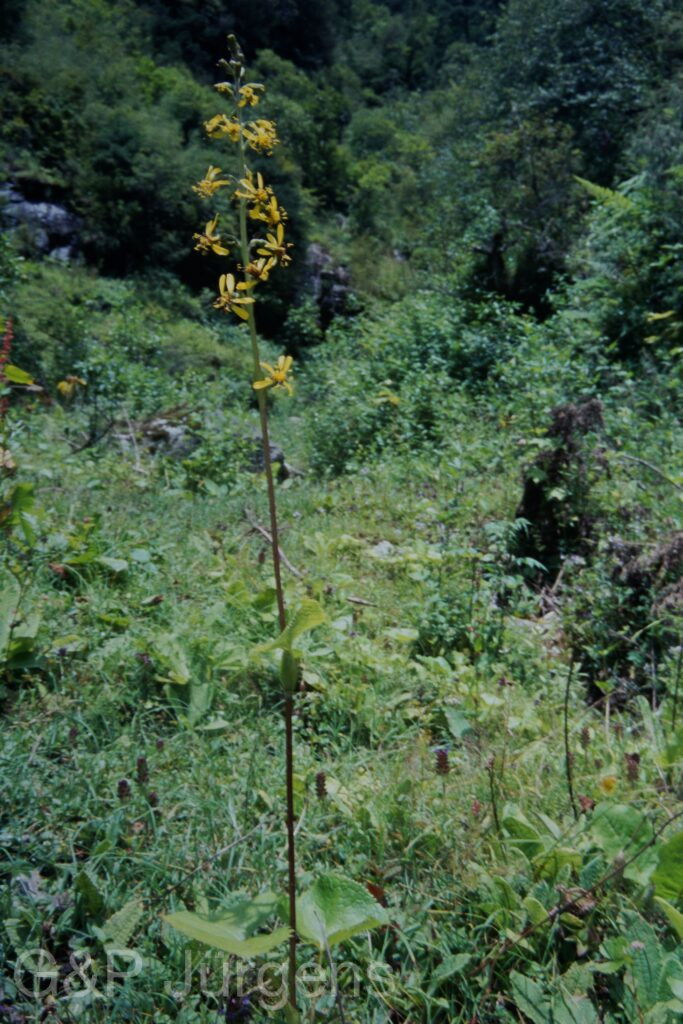
Ligularia atkinsonii is a tall herbaceous perennial of the Himalaya and adjacent China, with verified occurrences in Nepal, China, Bhutan, India and Myanmar. It favours moist, cool situations such as forest margins, streamsides, damp meadows and shrubby slopes through the temperate and subalpine zones, broadly between about 2500 and 4000 m. The plant photographed at Lachen in northern Sikkim at around 2740 m in August represents its late-summer flowering, when these golden composites are conspicuous in the monsoon-fed grasslands and clearings of the inner valleys.
The species arises from a stout rootstock bearing large, long-petioled basal leaves; these are broadly cordate to reniform, with toothed margins and a soft texture, the bases of the petioles often sheathing the stem. The flowering stem is erect, leafy below and bears a narrow elongate inflorescence (a raceme or narrow panicle) of numerous radiate capitula. Each head has an involucre of few narrow phyllaries and carries several spreading yellow ray florets around a disc of tubular florets. The fruit is a glabrous cylindrical achene topped by a pappus of fine brownish bristles aiding wind dispersal.
Ligularia, of tribe Senecioneae, is a large and taxonomically demanding genus centred on the Sino-Himalayan region, and L. atkinsonii, transferred to the genus by S.W. Liu from a C.B. Clarke basionym, is distinguished by its leaf shape and narrow inflorescence. Ecologically these robust herbs are important late-season nectar sources in subalpine meadows. The species is reasonably widespread along the Himalaya and is not currently considered to be of conservation concern, though it depends on the persistence of moist montane grassland.
Author: (C.B.Clarke) S.W.Liu · Sources: POWO (Kew), GBIF, Flora of China, Flora of Bhutan, Annotated Checklist of the Flowering Plants of Nepal