
L.

Description
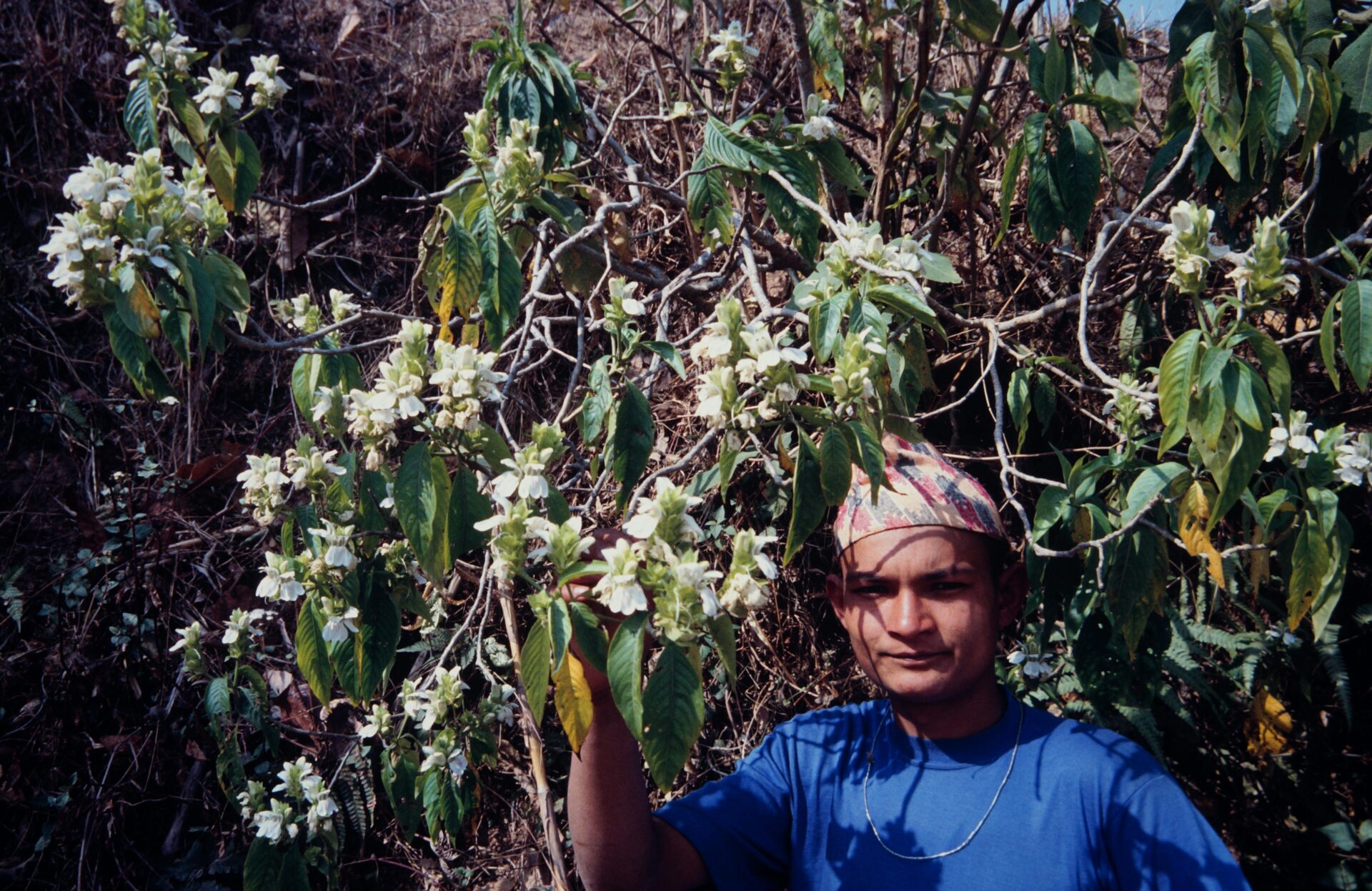
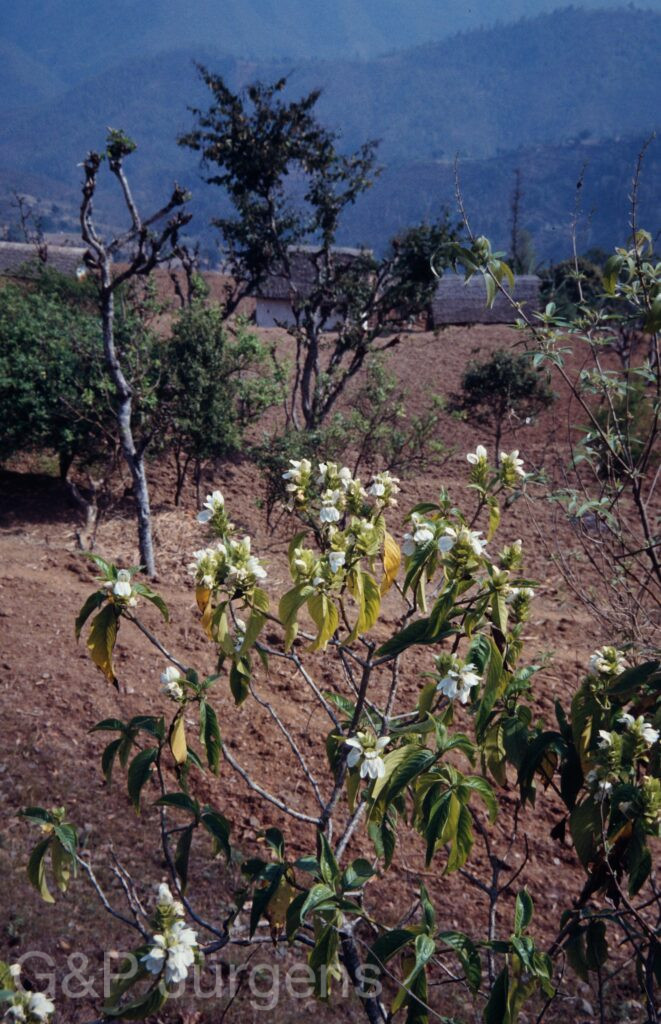
Justicia adhatoda, the Malabar nut or vasaka, is a widely distributed shrub native to the Indian subcontinent and now naturalised or cultivated across much of the tropics and subtropics; GBIF records (over 1500) span India, Nepal, Pakistan, Sri Lanka, China, Southeast Asia and many introduced regions in the Americas, Europe and beyond. In its Himalayan range it grows in the subtropical foothills and warm valleys, along streamsides, forest margins, fallow land and roadside scrub, generally below about 1300 m. The photographed plant from Tumlingtar in eastern Nepal (1200 m, flowering in March) sits squarely within this lower-elevation, dry-season-flowering habitat.
The plant is a robust, evergreen, much-branched shrub reaching 1–3 m, with opposite, lanceolate to elliptic-oblong, entire leaves that are pinnately veined and emit a strong odour when crushed. The flowers are borne in dense, axillary or terminal, bracteate spikes, the large ovate bracts conspicuous. Each flower is strongly two-lipped (bilabiate): the corolla is white to pale, the lower lip marked with purple to pinkish veining and a yellow throat. There are two stamens with bithecous anthers whose cells are unequally inserted. The fruit is a clavate, four-seeded capsule that dehisces explosively, the seeds projected from retinacula in the manner characteristic of Acanthaceae.
The species is of considerable economic and ethnobotanical importance, long used in Ayurvedic and Unani medicine for respiratory complaints; its leaves contain the quinazoline alkaloid vasicine (peganine) and related compounds with bronchodilatory and expectorant activity. Taxonomically it was formerly segregated in the monotypic genus Adhatoda but is now embedded within a broadly circumscribed Justicia. Being weedy and widely cultivated, it is of no conservation concern.
Author: L. · Sources: POWO (Kew), GBIF, Flora of Nepal, Flora of British India, Flora of China (Acanthaceae), A Revision of the genus Justicia (Acanthaceae)