
(Hook.f. & Thomson) H.Ohba
Description
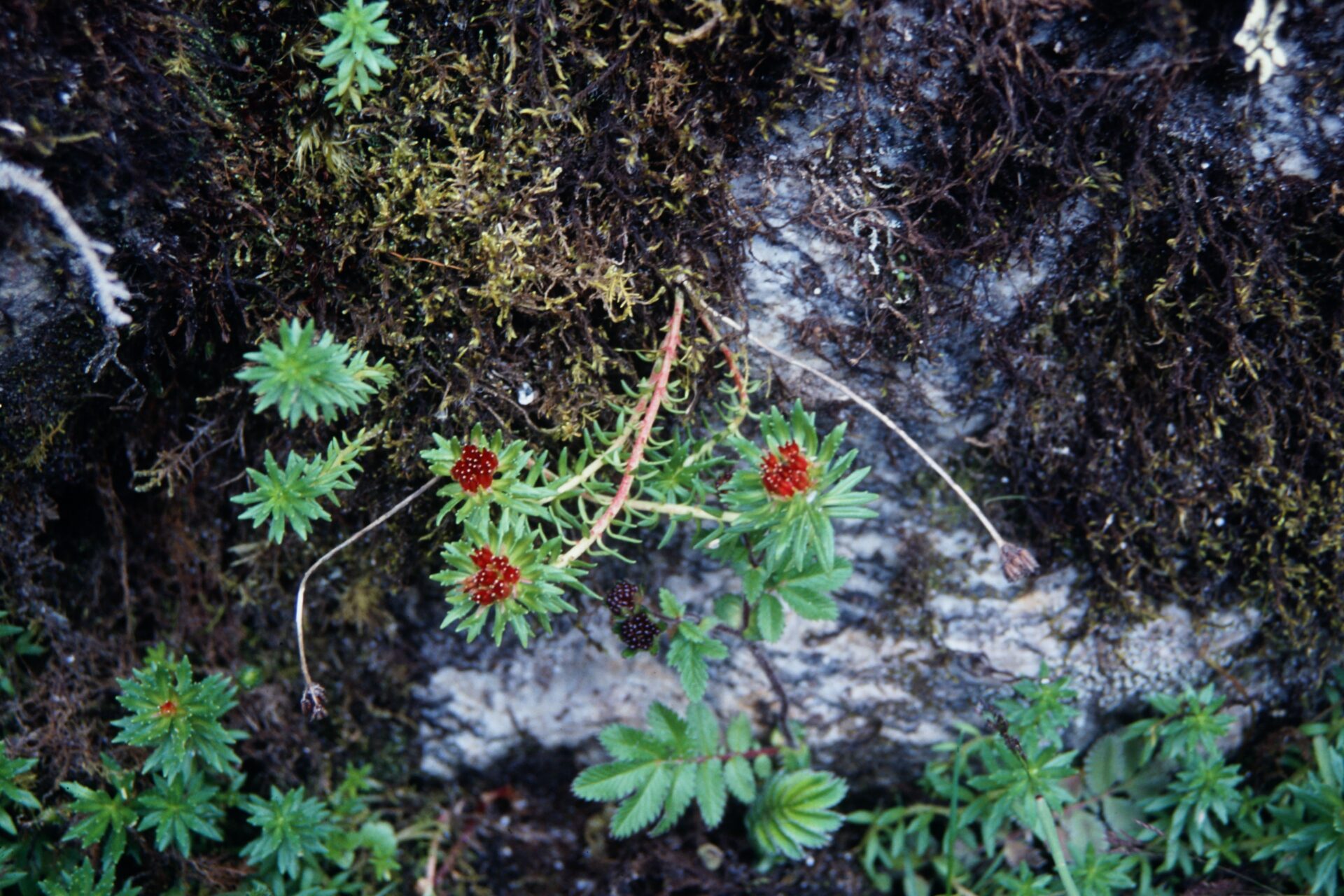
Rhodiola crenulata (Hook.f. & Thomson) H.Ohba is a succulent perennial of the high Himalaya and Tibetan plateau, distributed across China, Nepal, India, Bhutan and Pakistan. It is recorded from Bhutan at Tem-Tso and along the Ludlow-Sherriff trail near Dem-Tso between 4640 and 4650 m, flowering in June, exemplifying its strict confinement to the upper alpine zone. The species colonises rocky alpine meadows, scree, cliff ledges, moraine and well-drained gravelly slopes, generally between 4000 and 5600 m, where it withstands extreme cold, desiccating winds and high ultraviolet flux. Its roughly 484 GBIF records confirm a genuine but specialised high-elevation presence.
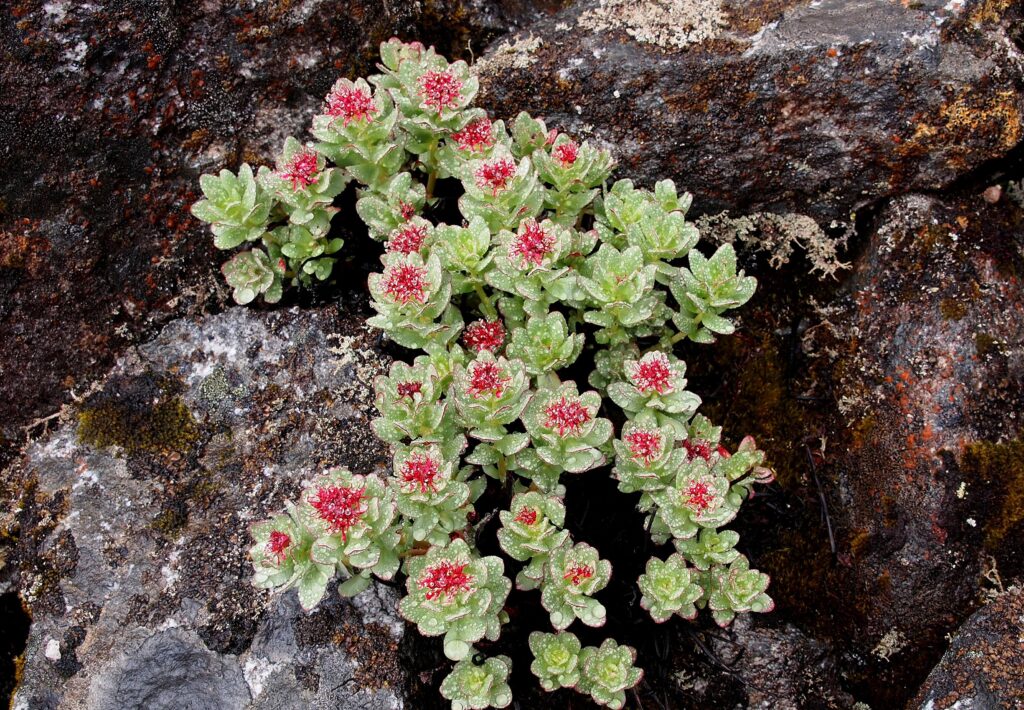
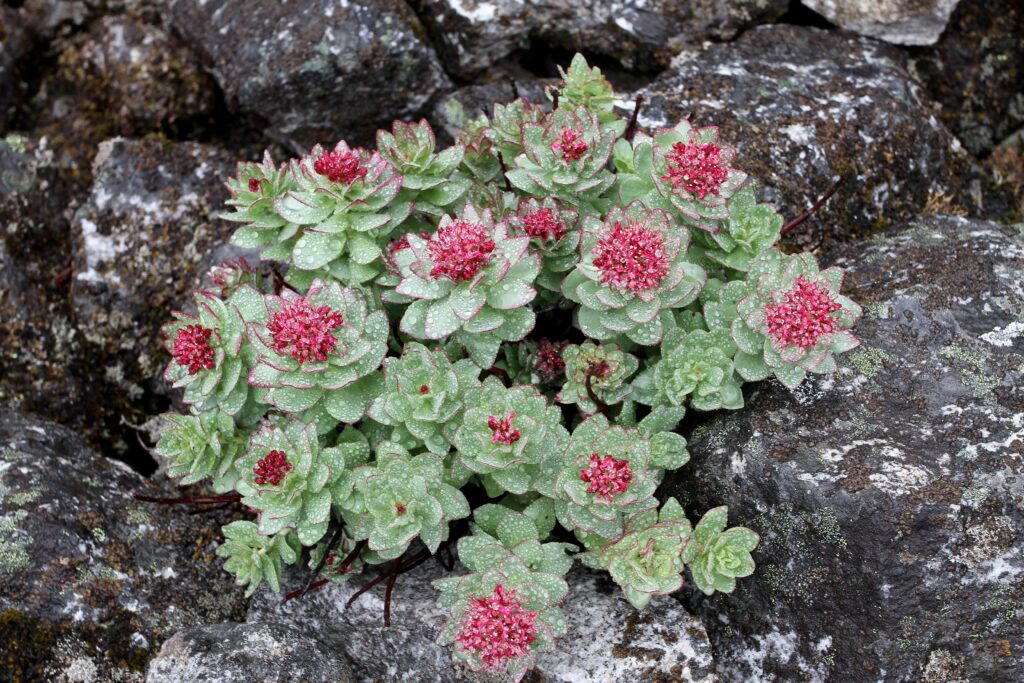
The plant arises from a stout, branched, woody caudex and thick fleshy rootstock that is reddish or yellowish within and aromatic. Numerous short, erect flowering stems bear crowded, sessile, glaucous leaves that are oblong to obovate and crenulate to dentate at the apex, giving the epithet. The species is usually dioecious, the flowers grouped in dense terminal corymbose cymes; they are small and typically four- to five-merous, with petals ranging from deep red and pink to greenish-white, the staminate flowers showing exserted stamens. The fruit is a cluster of erect, several-seeded follicles that turn red at maturity.
Rhodiola crenulata belongs to the genus Rhodiola, segregated from Sedum and centred on the cold deserts and alpine zones of Asia. The thick rhizome, rich in salidroside, rosavin and related compounds, makes it the principal source of "hong jing tian" in Tibetan and Chinese medicine, and intensive wild harvesting for the adaptogen trade has driven serious population decline across parts of its range. Slow growth at extreme altitude renders it especially vulnerable, prompting growing interest in cultivation and sustainable management.
Author: (Hook.f. & Thomson) H.Ohba · Sources: POWO (Kew), GBIF, Flora of China, Flora of Bhutan, Sedum and Rhodiola of the Himalaya (Ohba), Crassulaceae monograph (Ohba)