
(Hook.f.) Danser
Description
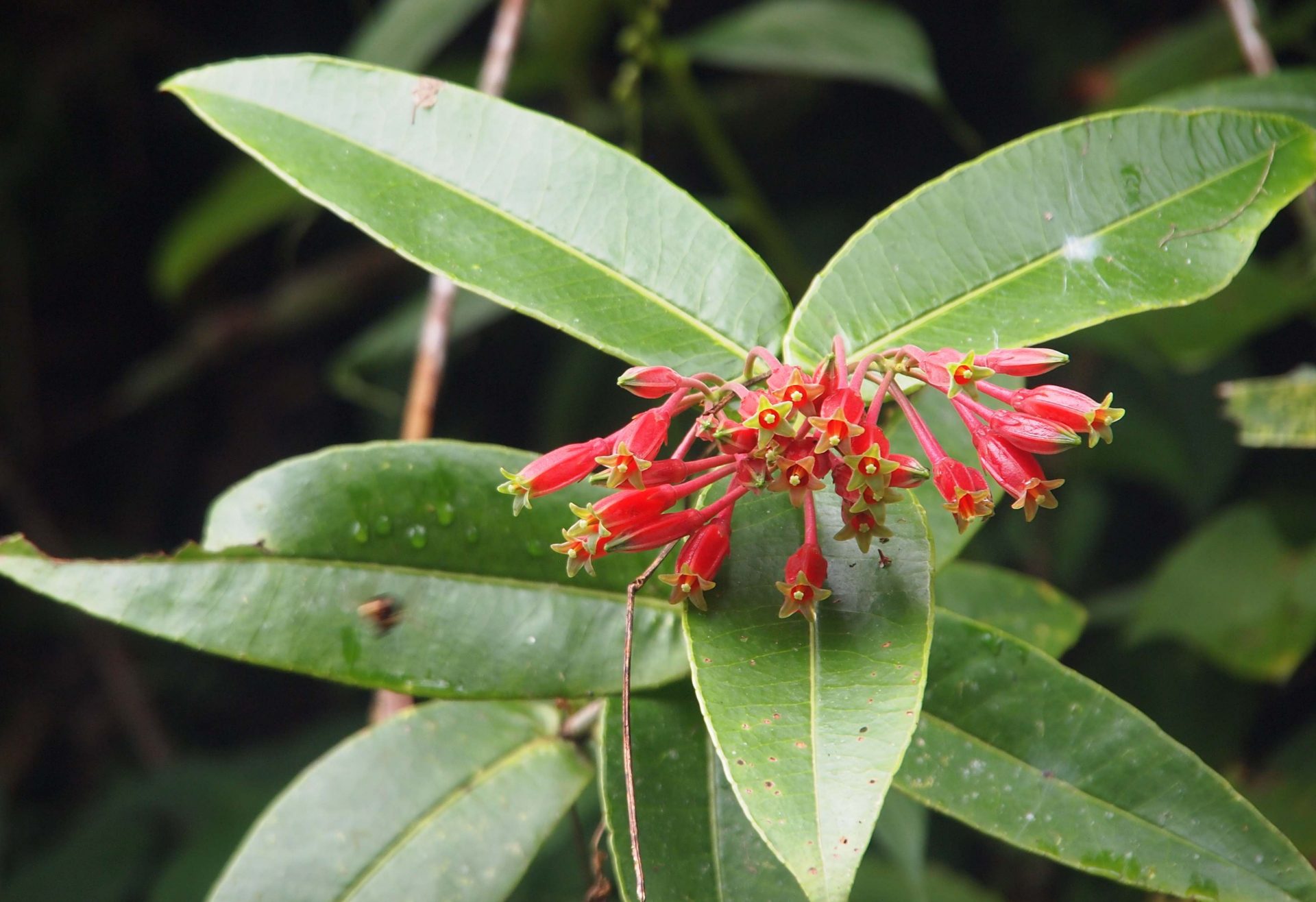
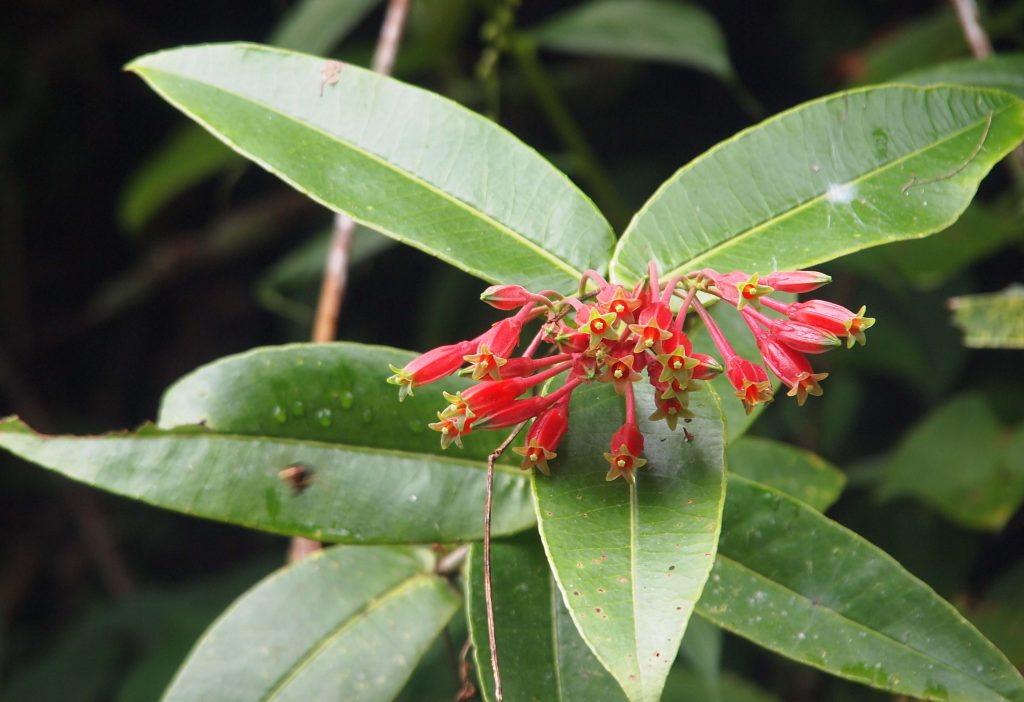
Macrosolen psilanthus is an eastern Himalayan hemiparasitic mistletoe distributed across India, Bhutan, Nepal and Bangladesh, with about 35 occurrences concentrated in the warm subtropical foothills and duars at the base of the Himalaya. It grows as a stem parasite on the branches of a range of broad-leaved trees and shrubs in subtropical broad-leaved forest, secondary woodland and along forest edges, predominantly at low elevations below about 1200 m. The photographed plant from Galephu in southern Bhutan at 850 m, flowering in September, is typical of its occurrence in the humid, low-altitude foothill forests of the eastern Himalayan front, where suitable host trees are abundant.
It is a glabrous, woody aerial hemiparasite attached to its host by a haustorial connection. The branches are terete to somewhat angled, and the leaves are opposite, coriaceous, ovate to elliptic-lanceolate, entire, with pinnate venation and a short petiole. The inflorescences are axillary spikes or racemes bearing opposite, decussate flowers, each subtended by a single bract. The flowers are bisexual with a calyculus crowning the inferior ovary and a tubular, six-merous corolla that is reddish, orange or greenish-yellow, the lobes reflexing at anthesis; the epithet psilanthus ("smooth-flowered") refers to the glabrous perianth. The six stamens are epipetalous. The fruit is a one-seeded berry whose seed is enveloped in viscin.
Macrosolen belongs to the Loranthaceae, the showy-flowered mistletoes, and like its relatives is an obligate hemiparasite drawing water and minerals from its host while photosynthesising in its own green leaves. The flowers are bird-pollinated (ornithophilous), and the viscin-coated seeds are dispersed by frugivorous birds such as flowerpeckers that deposit them on host branches. The species is locally frequent within its foothill range and is not considered threatened.
Author: (Hook.f.) Danser · Sources: POWO (Kew), GBIF, Flora of Bhutan Vol. 1, Flora of Nepal, Barlow Loranthaceae revisions for the Malesian and Asian region (monograph), Flora of British India