
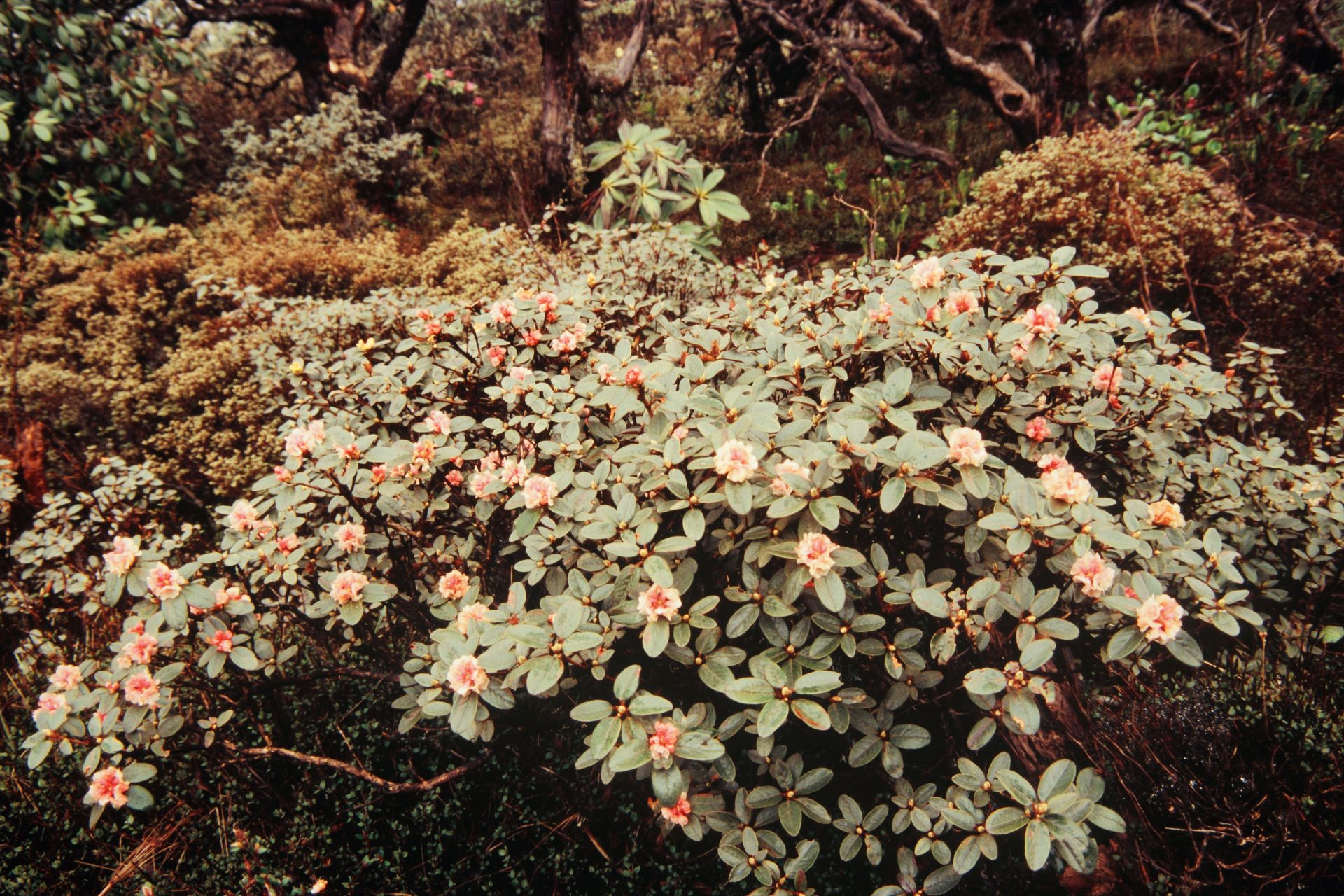
(Balf. f.) Cullen
Description
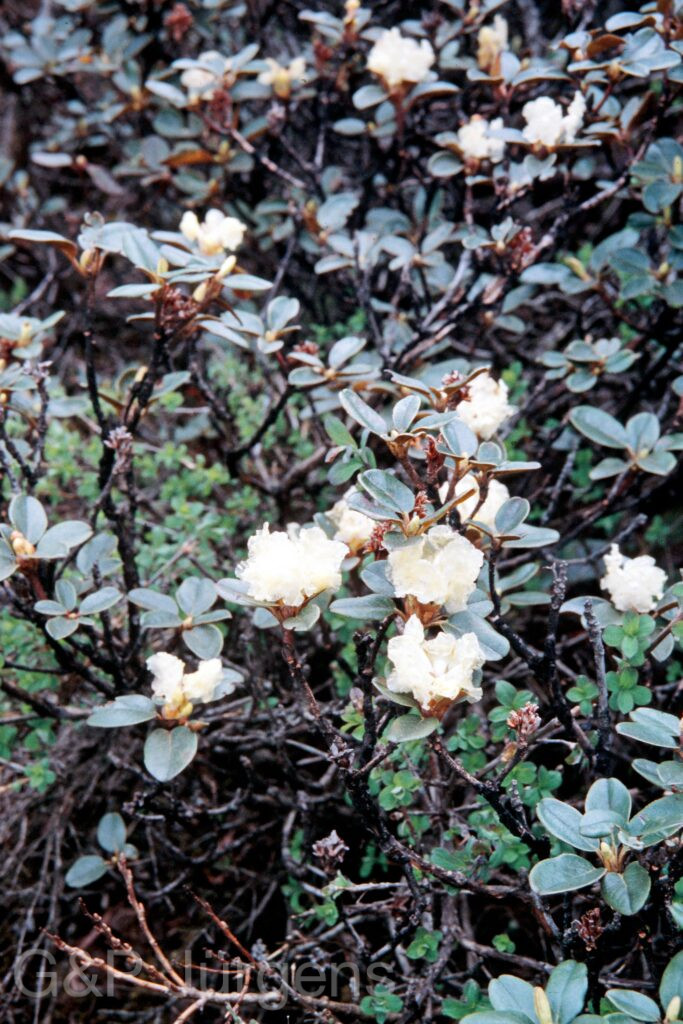
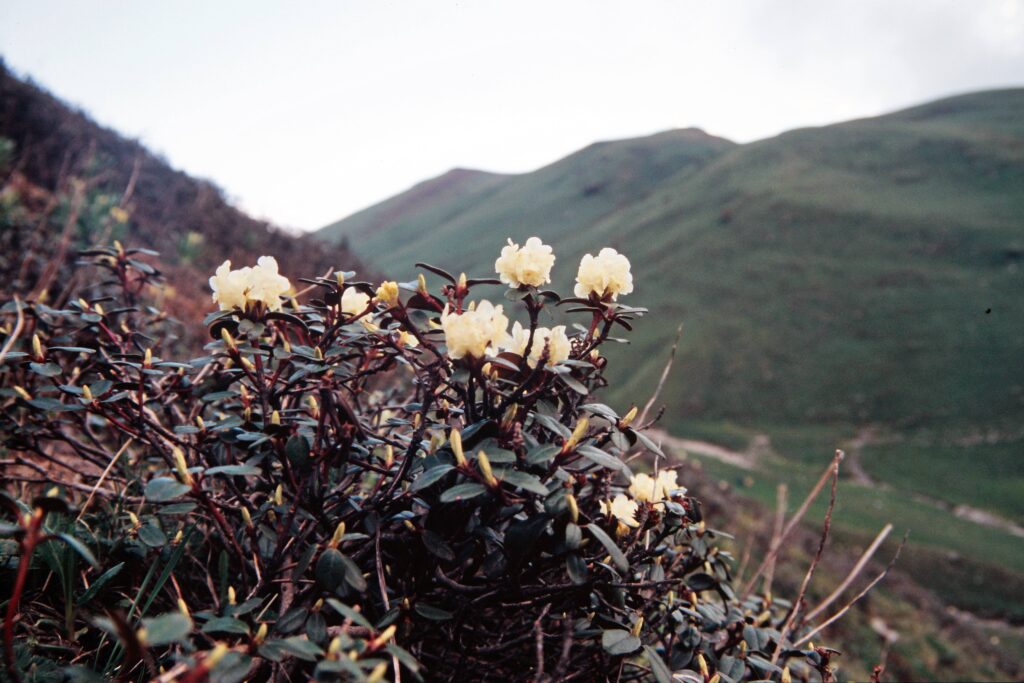
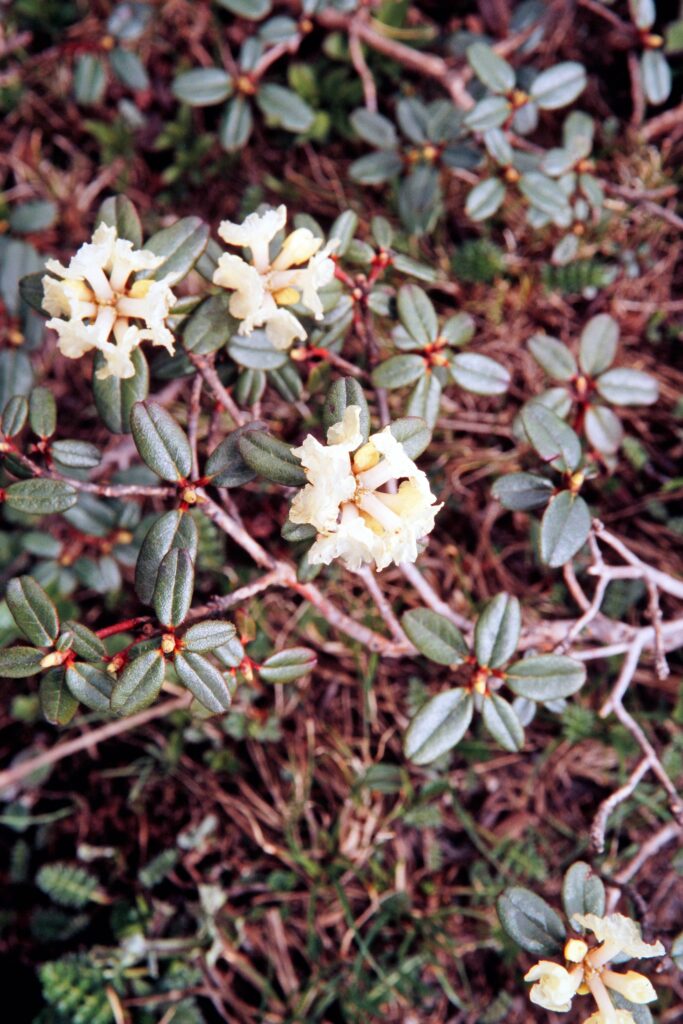
Rhododendron anthopogon subsp. hypenanthum is a dwarf alpine shrub of the high Himalaya and adjacent Tibetan ranges, recorded from China, India, Pakistan, Nepal and Bhutan. It is a characteristic component of the dwarf-rhododendron heath that clothes open slopes, rocky moorland and the margins of alpine meadows above the treeline, frequently forming dense aromatic mats over granite and schist. The taxon ascends from roughly 3300 to over 4500 m; the photographed populations occur south of Rara Lake in West Nepal at about 3700 m and at Khiar Kutti in Indian Garhwal near 4000 m, both flowering in June as the snow retreats. With around 169 records it is a well-documented element of the subnival zone.
It forms a low, much-branched, intricate evergreen shrublet, the twigs densely scaly and the bark flaking. The small leaves are aromatic, elliptic to oblong, leathery, dark green and glabrous above, the lower surface densely covered by overlapping rusty-brown peltate scales, the margins often recurved. The flowers are borne in compact terminal capitate heads; the corolla is narrowly tubular with a short spreading limb of five lobes and is here a clear pale yellow, distinguishing this subspecies from the usually pink to cream typical race. Stamens are included within the tube. The fruit is a small scaly capsule splitting septicidally to release minute seeds.
Within section Pogonanthum, subsp. hypenanthum is separated from the more eastern subsp. anthopogon chiefly by its yellow corolla and western Himalayan distribution. The fragrant foliage is harvested locally for incense and traditional medicine. As a widespread, abundant alpine taxon it is of least conservation concern, though high-altitude grazing and a warming climate may shift the lower limits of its heathland communities.
Author: (Balf. f.) Cullen · Sources: POWO (Kew), GBIF, Flora of China, Flora of Bhutan, The Plant-Book (Cullen, Revision of Rhododendron section Pogonanthum)