
Balf. f. & R.E. Cooper
Description
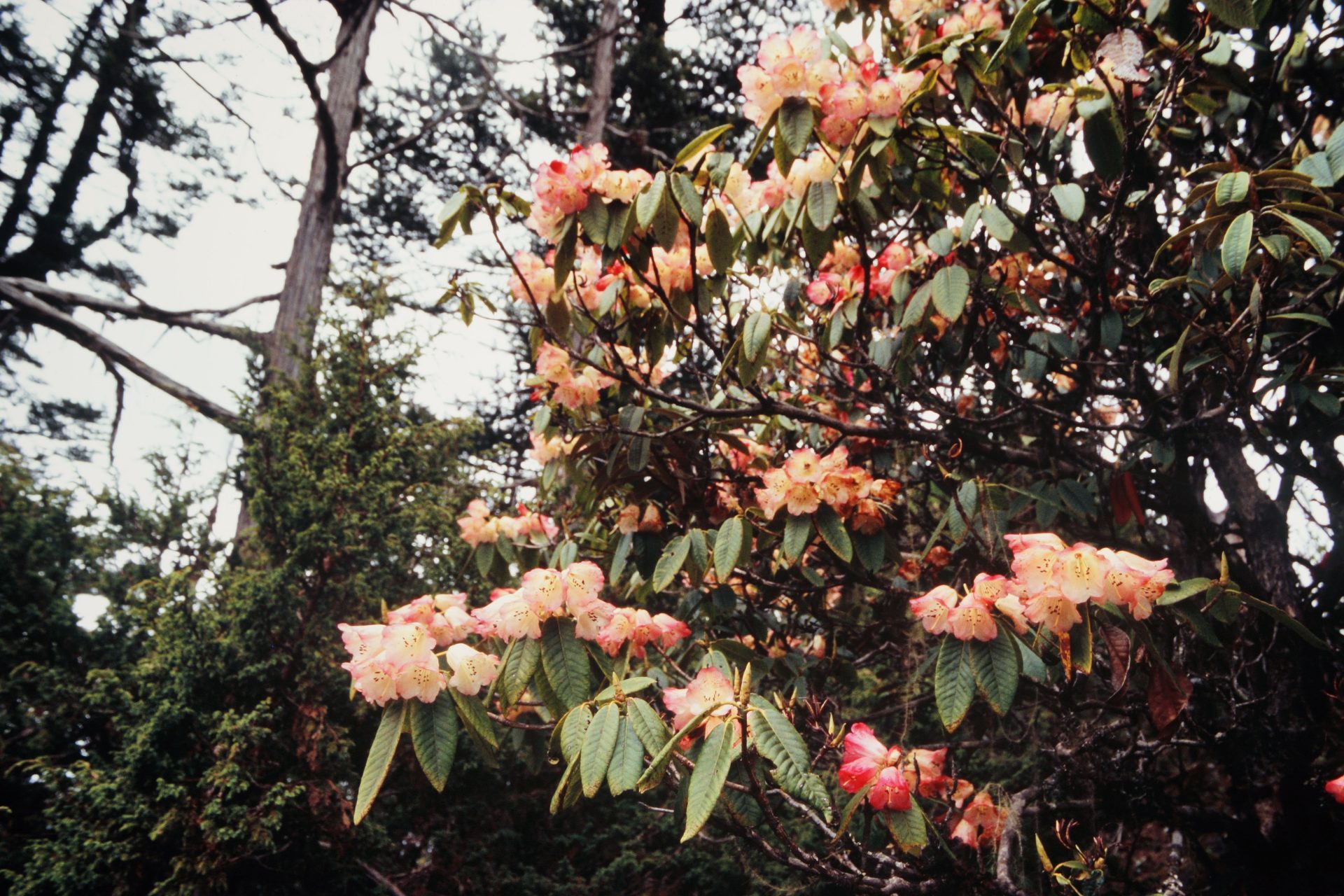
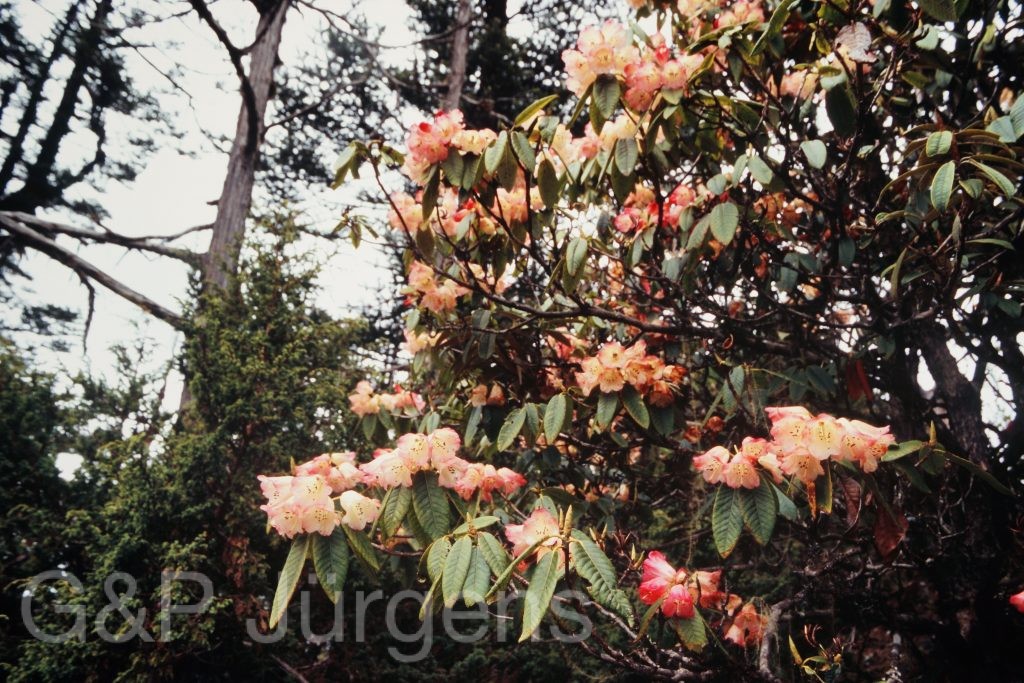
Rhododendron papillatum is a narrowly distributed eastern Himalayan shrub recorded from Bhutan, China, India and Nepal, and is among the rarer species treated here with only about 19 GBIF occurrences. It grows in the upper temperate to subalpine zone, inhabiting open conifer and mixed forest, rhododendron thickets and shrubby slopes generally between roughly 3000 and 4000 m. The photograph from Jangchulakha in Bhutan at 3700 m in June captures it at its early-summer flowering season, when these high ridges carry a dense understorey of evergreen rhododendrons emerging from winter snow.
It is an evergreen shrub or small tree with stout branchlets. The leaves are leathery and elliptic to obovate, dark green and glabrous above, and distinctively papillate beneath, the lower surface bearing a thin papillose covering (the feature giving the epithet) rather than the dense indumentum seen in many relatives. The flowers are borne in a terminal truss; the corolla is broadly campanulate, white flushed pink to pale rose and usually marked with darker spots within, with numerous stamens and a glandular ovary. The fruit is a woody septicidal capsule that splits to release abundant minute seeds.
Within Rhododendron, this species is placed in subgenus Hymenanthes (the elepidote rhododendrons), a group strongly radiated across the Sino-Himalayan ranges where allopatry and elevation partitioning have produced many local endemics. Its restricted range and modest occurrence count make it a species of biogeographic interest and potential conservation concern, dependent on intact high-altitude forest. Pollination is chiefly by bees and other insects attracted to the conspicuous corollas.
Author: Balf. f. & R.E. Cooper · Sources: POWO (Kew), GBIF, Flora of Bhutan, Flora of China, The Genus Rhododendron (Edinburgh / Cullen & Chamberlain)