
Wall. ex Lindl.
Description
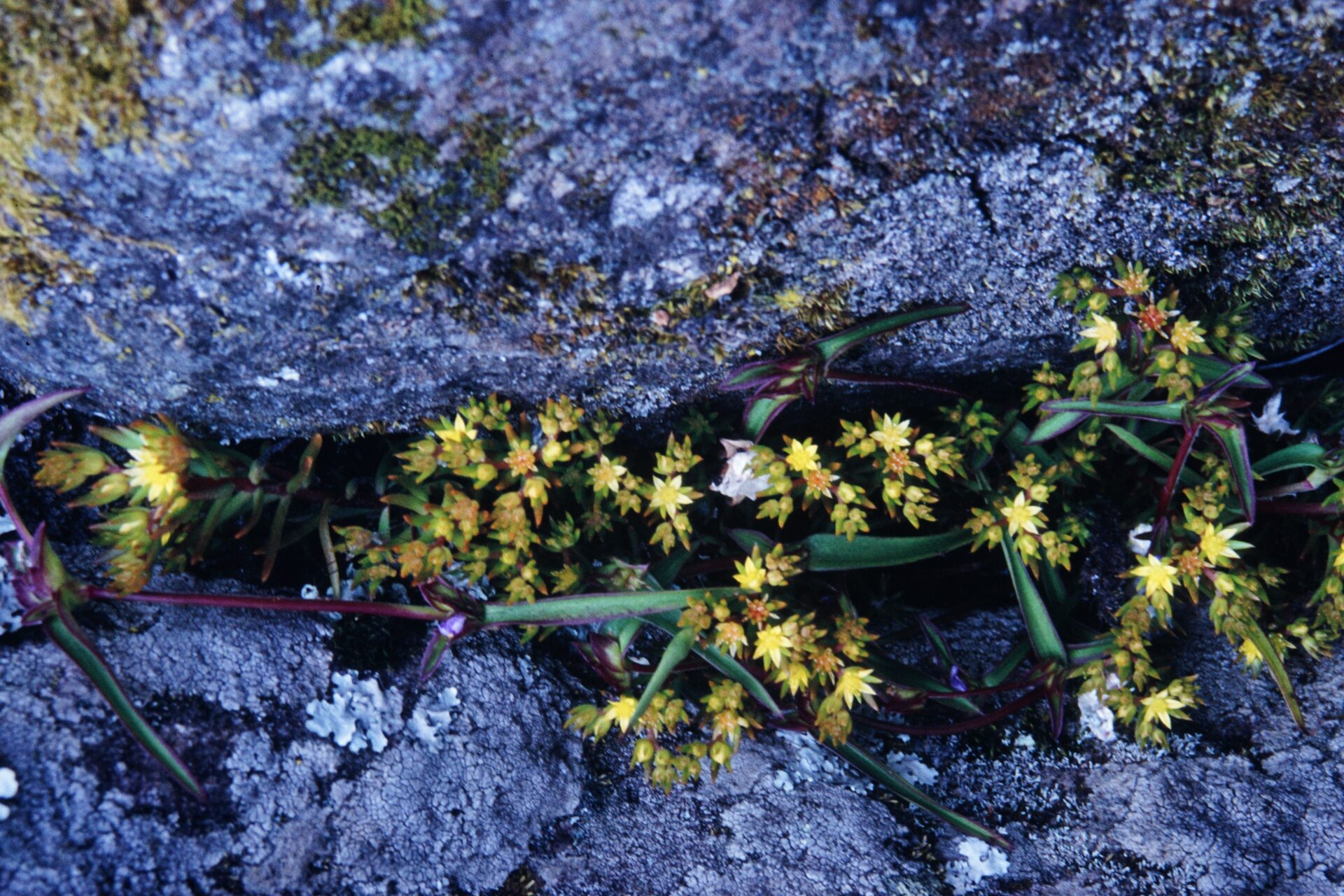
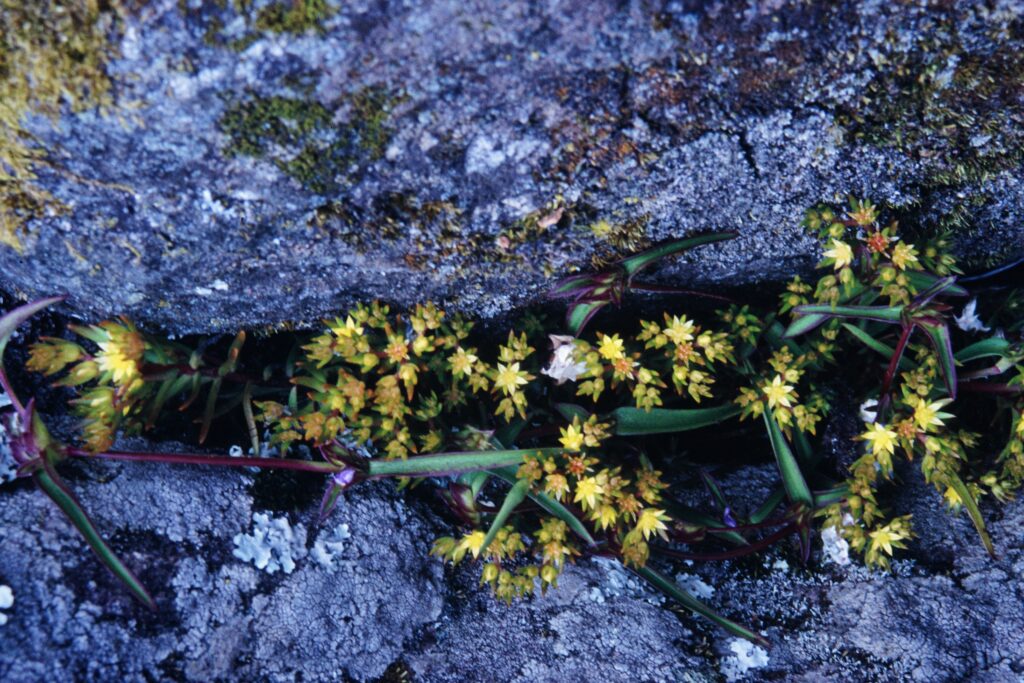
Sedum multicaule is a widespread Himalayan stonecrop ranging from Pakistan eastwards through India, Nepal, Bhutan and into China and Myanmar, and is well collected with around 618 GBIF records. A succulent of rocky habitats, it colonises moist cliffs, boulders, mossy banks, walls and stony slopes, often growing as a lithophyte in the spray of streams across the temperate to subalpine belt, broadly between about 2000 and 4000 m. The documented gathering from Talim in the Zemu valley of Sikkim at 3280 m in August reflects its preference for damp rock faces during the summer growing season.
It is a perennial, somewhat tufted herb with numerous slender, often reddish stems, as the epithet "multicaule" implies, that are decumbent at the base then ascending. The fleshy leaves are alternate, linear to oblong and terete or semi-terete, frequently spurred at the base and crowded along the stems. The inflorescence is a terminal cyme of several branches bearing many small, sessile, star-shaped flowers; these are typically five-merous with narrow, acute yellow petals, ten stamens and free or shortly united carpels. The fruit comprises spreading, many-seeded follicles.
Sedum in the broad sense belongs to the Crassulaceae and exhibits the CAM photosynthesis and water-storing succulence that suit it to seasonally dry, exposed rock surfaces. The Himalayan members form a taxonomically complex assemblage, several segregated by modern authors into related genera. Of no conservation concern given its abundance and broad altitudinal and geographic range, S. multicaule is a characteristic and resilient element of montane rock-crevice vegetation.
Author: Wall. ex Lindl. · Sources: POWO (Kew), GBIF, Flora of China, Flora of Pakistan, Crassulaceae monograph (Ohba / 't Hart)