
(D.Don) Hochr.

Description
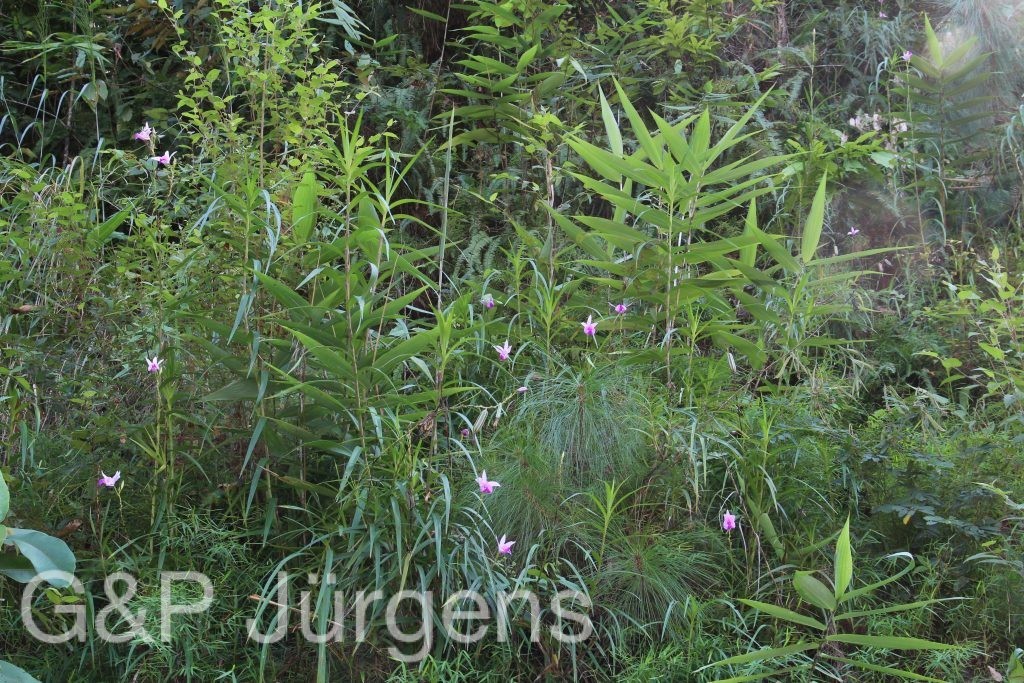
Arundina graminifolia, commonly known as the bamboo orchid, is a robust terrestrial species with a remarkably wide distribution from the Himalayas (Nepal, India, Bhutan) through Southeast Asia to southern China, the Malay Archipelago, and the Pacific Islands. It has become naturalised in parts of tropical America, Hawaii, and the Caribbean. In the Himalayas, it grows on exposed banks, road cuttings, landslide scars, and open grasslands at 200–2,800 m elevation, favoring well-drained, acidic soils with good light exposure.
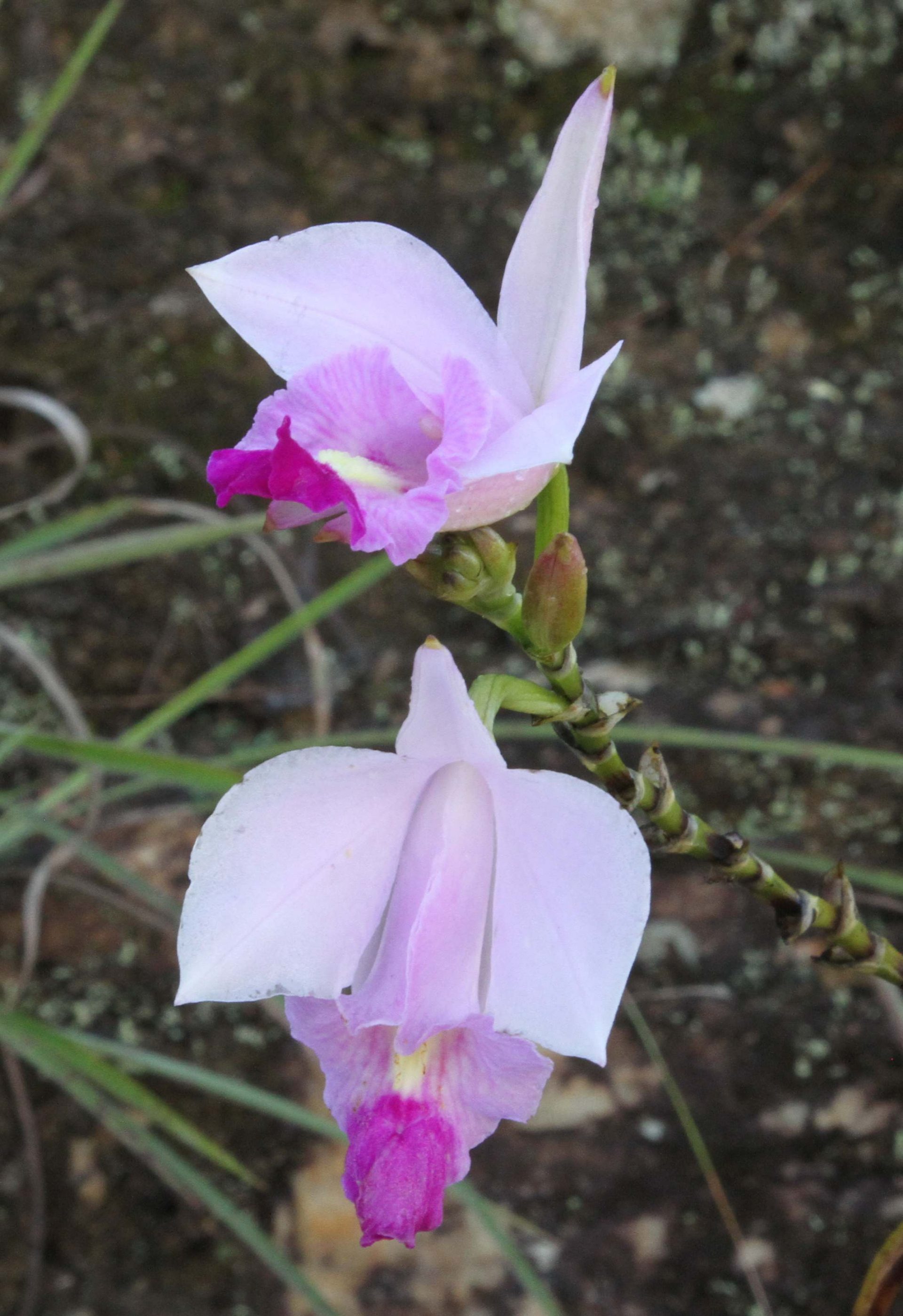
The plant forms dense clumps of erect, reed-like stems 60–150 cm tall, bearing linear-lanceolate, grass-like leaves 10–20 cm long that are arranged distichously. Flowers are produced terminally, 5–8 cm across, resembling small Cattleya blooms: the sepals and petals are white to pale pink, while the lip is deep rose-purple with a tubular base and a broad, ruffled apical lobe. Flowers open successively over an extended period, with individual blooms lasting only 2–3 days. In the eastern Himalayas, flowering peaks from August to November.
Arundina graminifolia is one of very few orchids that thrives as a pioneer species on disturbed ground. Its wide ecological amplitude and capacity for rapid colonisation are facilitated by its production of numerous wind-dispersed seeds. The species exhibits considerable morphological variation across its vast range, and several subspecific taxa have been proposed.
Author: (D.Don) Hochr. · Sources: POWO (Kew), Flora of Bhutan Vol. 3, GBIF, Seidenfaden: The Orchids of Indochina (1992)