
(Christm.) Roscoe
Description
Curcuma zedoaria, white turmeric or zedoary, is a tropical and subtropical species of probable northeast Indian and Southeast Asian origin that is now pantropically cultivated and naturalised. Its 694 GBIF occurrences span an extensive range including India (IN), China (CN), Thailand (TH), the Philippines (PH), Taiwan (TW), Indonesia (ID), Bangladesh (BD), Vietnam (VN), Malaysia (MY), Myanmar (MM), Sri Lanka (LK) and Japan (JP), alongside introductions to the Neotropics in Costa Rica (CR), Brazil (BR), Colombia (CO), French Guiana (GF), Panama (PA) and Ecuador (EC), and the United States (US). It thrives in warm, humid lowland and lower-montane situations, in moist forest understorey, clearings and as a cultivated medicinal and ornamental rhizomatous herb.
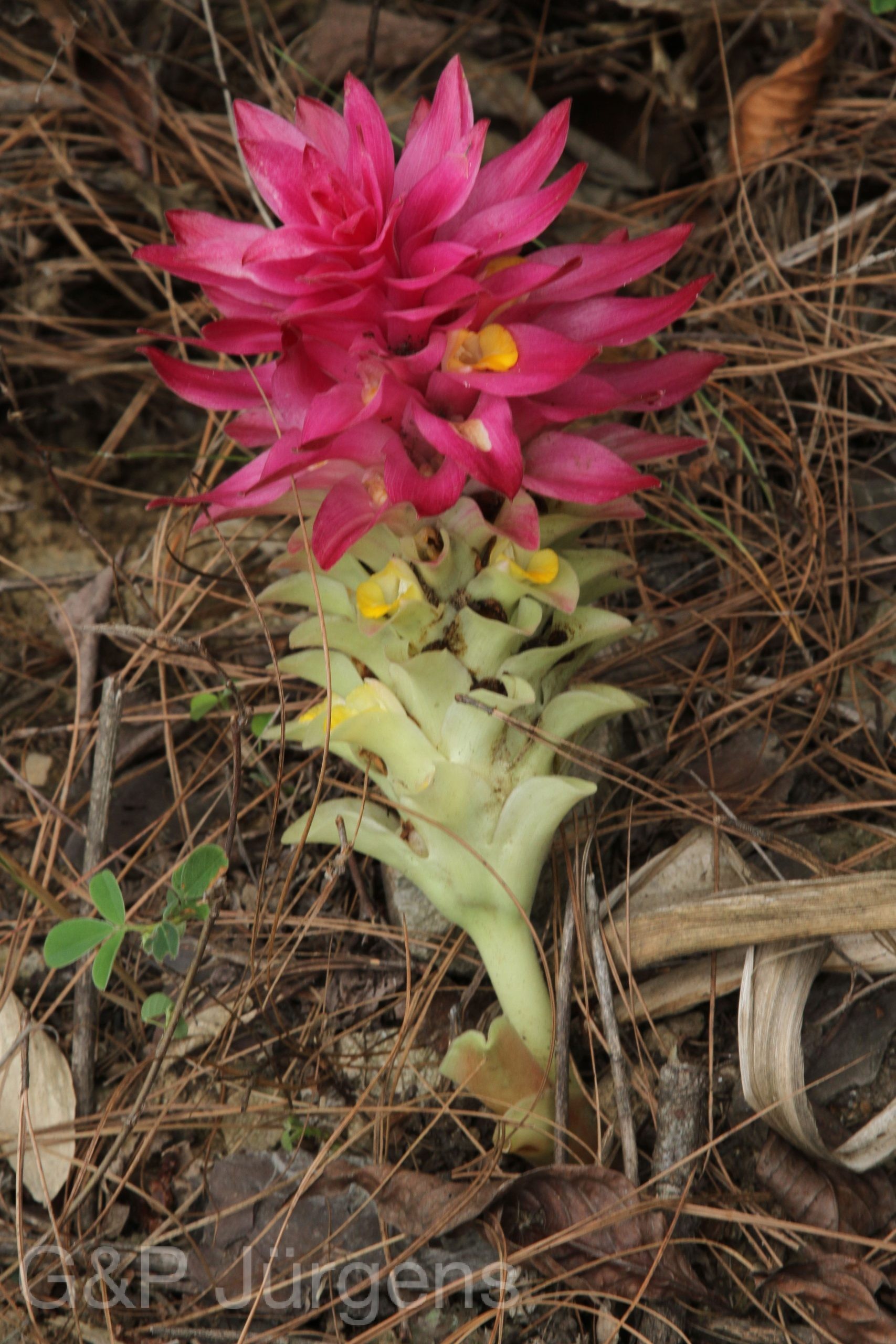
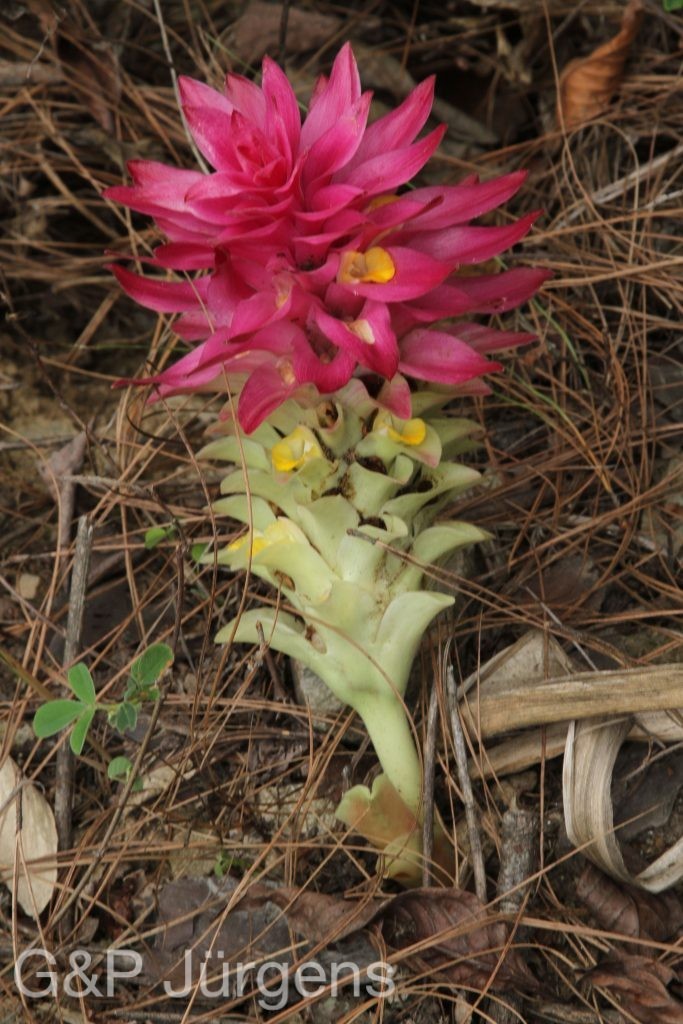
It is a robust herbaceous perennial arising from a large, fleshy, aromatic, yellowish-internally rhizome with cylindrical tuberous roots. The pseudostem is formed by the sheathing leaf bases, bearing oblong-lanceolate leaves that often display a characteristic reddish-purple midrib stripe. The inflorescence emerges separately from the rhizome, a spike of imbricate green and pink coma bracts subtending small pale-yellow flowers; each flower has a tubular calyx, a corolla with a hooded dorsal lobe, and a showy three-lobed labellum derived from staminodes. The fruit is a trilocular capsule, though propagation is chiefly vegetative.
Long used in traditional Asian medicine for its bitter, camphoraceous rhizome, zedoary is valued as a digestive and source of essential oils. Its taxonomy within the variable genus Curcuma has been complicated by sterile triploid cultivated clones and by confusion with allies such as C. aromatica and C. caesia. The family is given verbatim as Zingiberacaea (Zingiberaceae).
Author: (Christm.) Roscoe · Sources: POWO (Kew), GBIF, Flora of China, Flora of Bhutan, Flora of Thailand, Revision of the genus Curcuma (Skornickova et al.)