

(L.) Sw.

Description
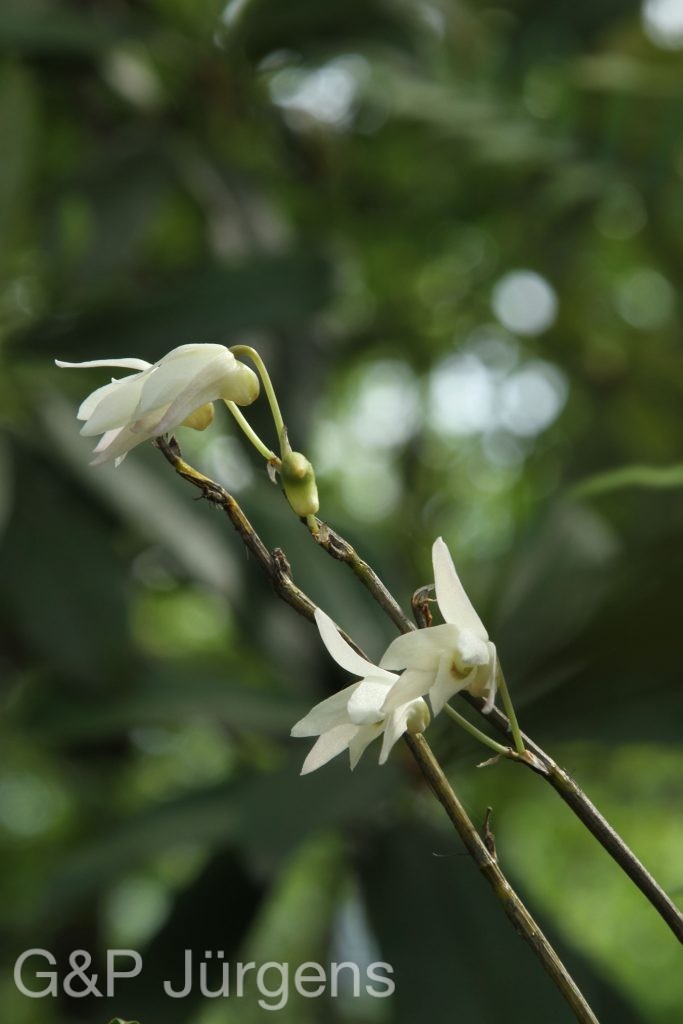
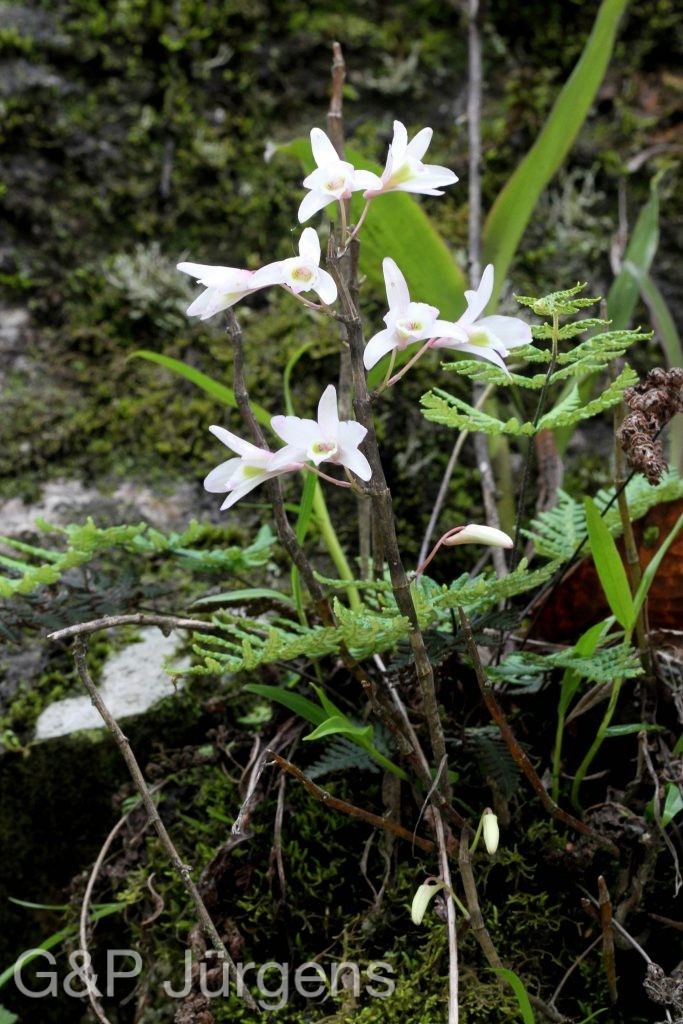
Dendrobium moniliforme is one of the most widely distributed temperate dendrobiums, ranging from Japan, Korea, Taiwan and China westward through the Himalaya to Nepal, with GBIF documenting over a thousand occurrences across this broad East Asian and Himalayan span. It grows as an epiphyte on the trunks and branches of trees, and occasionally as a lithophyte on mossy rock, in cool, humid evergreen and mixed montane forest. The species experiences a pronounced cool, dry winter rest; the photographed material from the Mo-Chu valley in Bhutan at about 1880 m and from Lachung in Sikkim at 2660 m, both in June, illustrates its occupation of mid-elevation temperate forest and its early-summer flowering.
The plant produces tufted, slender, erect or arching cane-like stems that are conspicuously jointed and somewhat swollen at the nodes, giving the necklace-like appearance evoked by the epithet. The stems are leafy above, the leaves narrowly lanceolate, thin-textured and deciduous, leaving the older canes bare. The flowers are borne singly or in pairs from the nodes of leafless stems, fragrant, and variable in colour from white to pale pink, cream or yellowish. The sepals and petals are spreading; the trilobed labellum is often marked with reddish or greenish spots and bears a hairy or warty disc, while the short column has a foot forming a mentum. The fruit is a small ellipsoid capsule.
Highly polymorphic across its enormous range, D. moniliforme is placed in Dendrobium section Dendrobium and has accumulated extensive synonymy, with numerous regional forms and horticultural selections; the alternative name appearing on the source link reflects this nomenclatural complexity. Long cultivated in East Asia and esteemed for its fragrance and cold-hardiness, it remains widespread, but localised populations are reduced by collection and habitat loss.
Author: (L.) Sw. · Sources: POWO (Kew), GBIF, Flora of China, The Orchids of Bhutan (Pearce & Cribb), Dendrobium and its Allies (Lavarack et al.)