
Griff.
Description
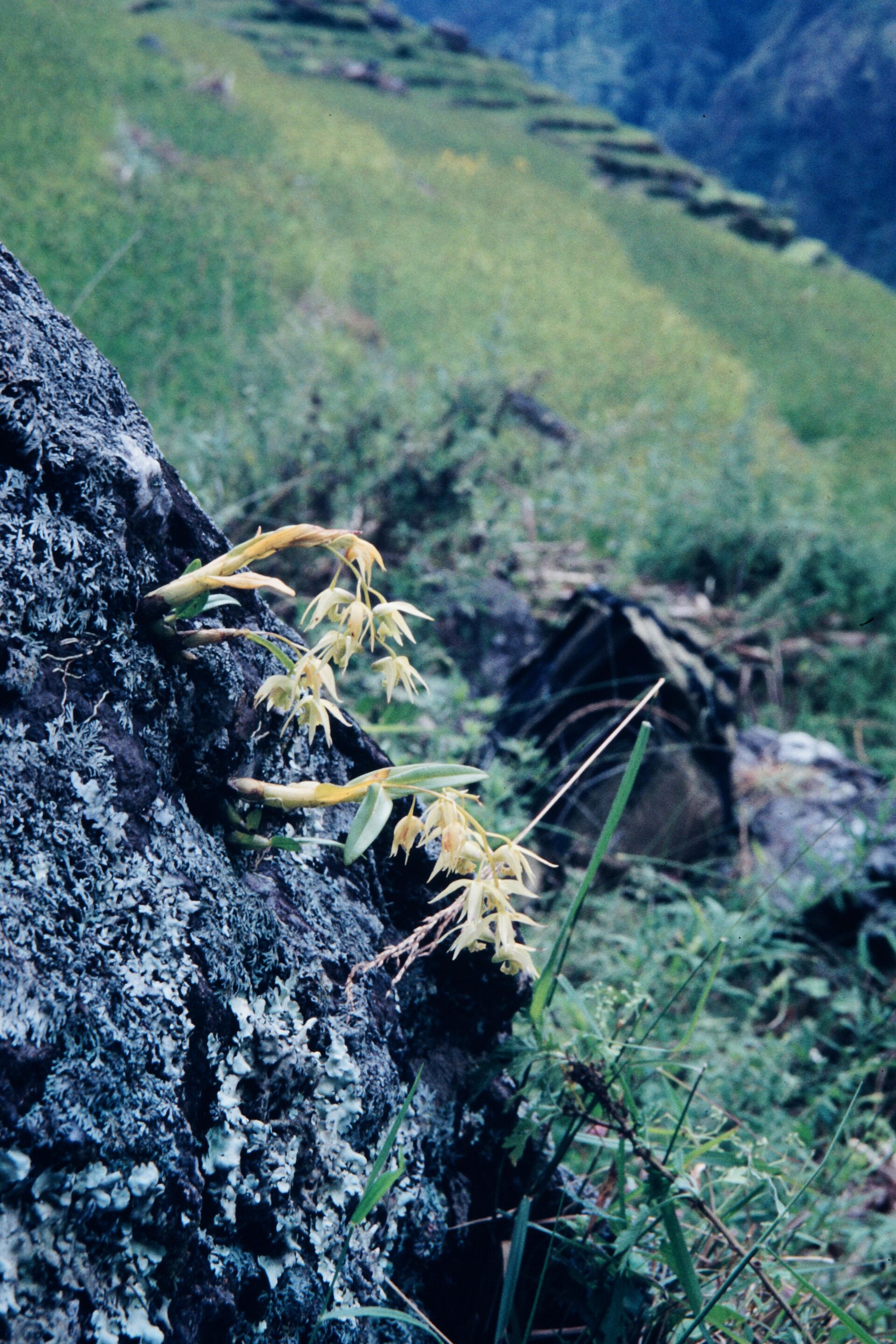
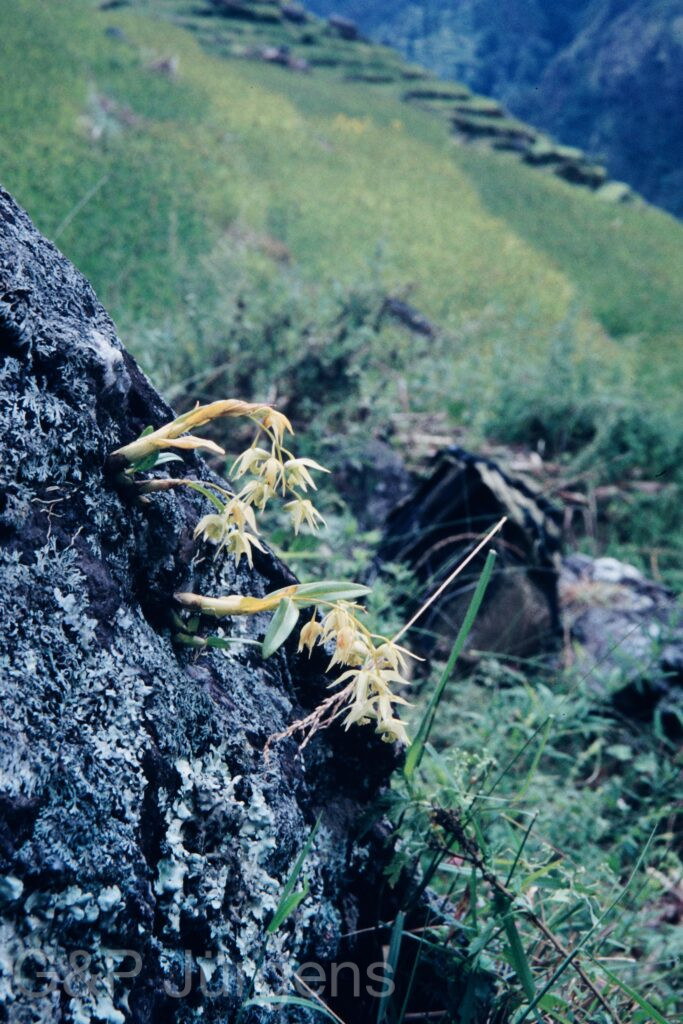
Dendrobium eriiflorum is an epiphytic orchid of the eastern Himalaya and Indo-Burmese region, distributed through Nepal, northern India, Bhutan, Bangladesh and Myanmar into Thailand, peninsular Malaysia and Indonesia; GBIF records about 112 occurrences across this range. It is a plant of the subtropical to lower temperate broadleaved forest, growing as an epiphyte on tree trunks and mossy branches in humid, shaded montane woodland, as documented at Bharang in Nepal at 1850 m. In this elevational band it benefits from high atmospheric moisture and a pronounced monsoon, and is recorded in flower in October toward the close of the wet season.
It is a small, tufted epiphyte with clustered, slender, erect to pendent stems (pseudobulb-like canes) sheathed by the membranous bases of the leaves. The leaves are thin, narrowly lanceolate, distichous and deciduous, leaving the older canes leafless. The inflorescences are short, few-flowered racemes arising laterally near the stem apex; the flowers are small, pale greenish-white to cream and densely covered externally with fine hairs, the hairy perianth recalling the genus Eria and giving rise to the epithet "eriiflorum". The lip is three-lobed with a recurved apex, and the column bears a short foot forming a mentum, with the pollinia waxy in the manner typical of Dendrobium.
The species was described by William Griffith, an early explorer of the Himalayan and Burmese flora. Within the large, taxonomically complex genus Dendrobium it falls among the small-flowered Himalayan species; the distinctive pubescent flowers are an unusual diagnostic feature among its relatives. Pollination in such Dendrobium is generally by small bees attracted to the lip. As an epiphyte dependent on intact, humid forest canopy, it is sensitive to deforestation and to the horticultural collection that affects many Himalayan orchids; like all Dendrobium it is listed on CITES Appendix II, regulating international trade.
Author: Griff. · Sources: POWO (Kew), GBIF, Flora of Bhutan, Orchids of Nepal, Seidenfaden's monographic studies of Dendrobium